







Abstract

Dear Editor,
Ice fishing is a traditional Nordic hobby during winter time. Heavy physical work is required to make the necessary holes in the thick ice with a manually operated ice drill. Usually, up to 50 to 100 holes must be drilled during the day to catch fish efficiently. Recently, powered ice drills have gained popularity. This has led to an increase in non-dominant left thumb injuries, caused by a common injury mechanism.
A manual ice drill is composed of a long drill bit and a manually operated handle. Lately, adaptors that connect a long ice drill bit to a cordless high-torque power drill are being marketed to amateur fishermen. Typically, these adaptors have a round-shaped disc that prevents the drill from falling into the water after the hole is drilled (Figure 1(a)). The components of these motorized ice drills are sometimes sold separately and, thus, the responsibility of safety is intentionally left to the user. This makes regulation very difficult.
(a) Powered ice drill. High-torque cordless hand drill mounted to a traditional ice drill bit with an adaptor. The round disc prevents the drill from dropping into the water after drilling the hole, (b) Lifting and moving the ice drill predisposes to thumb injuries of the non-dominant left hand and (c) Distal phalanx of the left thumb avulsed by a motorized ice drill.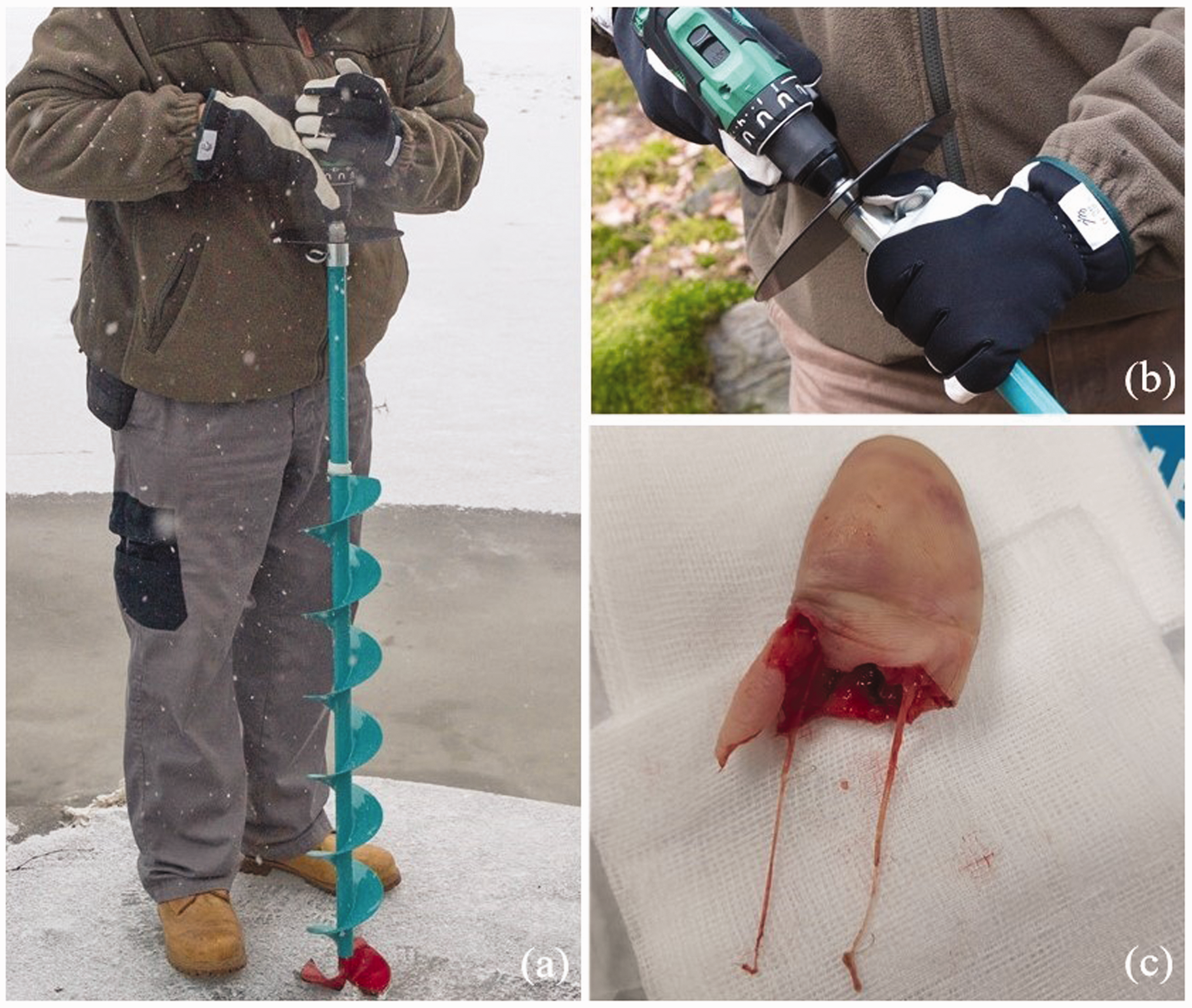
The powered drills appear safe when drilling but, after the hole has been made, the drill needs to be lifted out of the water and moved to the next drilling point. The drill is usually lifted with the non-dominant left hand gripping the drill bit while the dominant right hand holds the handle of the power drill. During this manoeuvre, it is easy to accidentally turn on the drill with the right hand, leading to the glove of the left hand being caught by the rotating adaptor or drill bit. Due to the clockwise rotation of the drill bit, the left thumb is forced to rotate around the drill bit clockwise, which causes the typical injury pattern (Figure 1(b)). Most likely, the injury would not occur in a similar way to the right thumb if the ice drill is operated by a left-handed person, because the drill bit always rotates clockwise. This conclusion remains speculative.
Tampere University Hospital, Tampere, Finland, is a level four hand trauma centre responsible for patients needing microsurgical treatment. During last winter, four powered ice drill accident patients were referred to us over a 2-month period. Characteristically, all patients had an identical injury mechanism of the non-dominant left thumb.
A 67-year-old male had an incomplete avulsion of the distal phalanx of the non-dominant left thumb with both arteries ruptured. He had a successful revascularization combined with an interphalangeal joint arthrodesis.
A 65-year-old male had a complete avulsion of the non-dominant left thumb distal phalanx with soft tissues avulsed a few centimetres proximal to the interphalangeal joint. Digital nerves had been avulsed even more proximally. This kind of avulsion injury is typically very difficult to replant due to the damage to the arteries. As this patient had a typical ‘red-line sign’ (Van Beek et al., 1978) distally, indicating distal artery damage, the thumb was not replanted (Figure 1(c)). We covered the remaining proximal phalanx of the thumb with an adipo-fascial flap from the radial side of the ring finger, including the digital neurovascular bundle to gain sensation to the thumb. We have modified the original technique of Littler in 1953 by harvesting the adipose tissue encircling the phalanx, which enlarges the flap up to 3 × 6 cm. The adipose tissue part of the flap needs to be covered with a skin graft.
A 66-year-old male and a 51-year-old female sustained a non-dominant left thumb metacarpophalangeal joint, ulnar collateral ligament injuries and were treated with reattachment of the ligament with a bone anchor. These ligament injuries were caused by the same mechanism but, perhaps due to a lower level of injury energy, the outcome was less severe.
A distinct type of injury has emerged following the introduction of power tools that are customized to users’ needs. These powered ice drill injuries have resulted in thumb rotation injuries, ranging from ulnar collateral ligament avulsions to avulsion amputations of the thumb. Patients injure specifically their non-dominant left thumb because of the way the powered ice drill is operated. These injuries could probably be prevented by covering the base of the rotating drill bit and the adaptor with a protective sleeve, which would prevent the non-dominant left thumb from being caught in the drill mechanism.
Footnotes
Declaration of conflict interests
The authors declared no potential conflicts of interest with respect to the research, authorship, and/or publication of this article.
Funding
The authors received no financial support for the research, authorship, and/or publication of this article.
Consent
Written informed consent was provided by the patient for the images to be published.