







Abstract

Dear Editor,
Nonunion is one of the major complications of distraction lengthening. Although curettage and bone grafting with stable internal fixation is a useful option in reconstructing the nonunion, the harvest of bone tissue could be associated with donor-site morbidity and major complications (Younger and Chapman, 1989). Matsushita and Watanabe (2007) demonstrated a new technique for the reconstruction of nonunion without bone grafting by chipping both ends of the bone at the nonunion site into small pieces. They suggested that the pulverizing procedure introduces progenitor cells and several cytokines, such as bone morphogenic protein or basic fibroblast growth factor, from the bone into the nonunion site. We speculated that the effect of progenitor cell and cytokine induction could be further activated in children compared with that in adults. We performed pulverization of newly formed callus and all nonunion tissue, including the fibrous and granulation tissue at both ends of the lengthening site, without any curettage procedure. Open internal fixation was successively performed at the pulverized nonunion site without bone grafting to maintain the distracted length. We applied this modification of the surgical technique for the treatment of nonunion at the site of distraction lengthening of the ulna in four children with radial longitudinal deficiency.
A 7-year-old girl who had radial longitudinal deficiency treated with shortening of forearm and distraction lengthening of the ulna performed at 6 years of age, presented with nonunion of the ulna. During this distraction process, a 33 mm lengthening was gained with callus formation (Figure 1(a) and (b)). However, a nonunion gap between each end of the newly formed callus remained despite external fixation for 134 days after discontinuation of lengthening. We performed chipping without curettage or bone grafting for the nonunion, followed by internal fixation to preserve the length gained by distraction (Figure 1(c) and (d)). At 50 days after the surgery, bone union was confirmed on radiographs (Figure 1(e)).
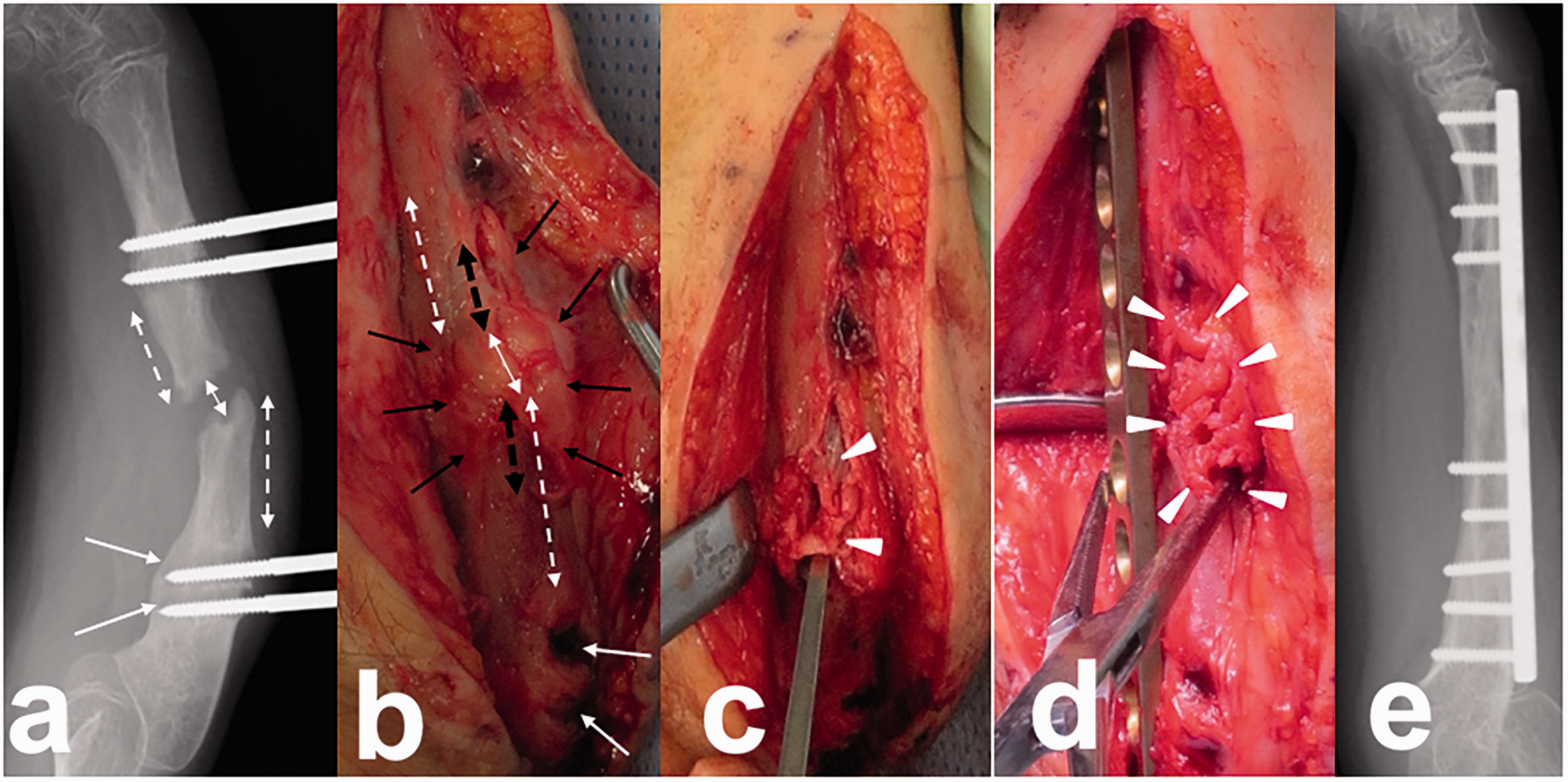
Chipping and internal fixation without bone grafting for the nonunion at distraction lengthening site. (a) Newly formed callus formation (dotted bidirectional white arrows) obtained by distraction lengthening with a nonunion gap (bidirectional white arrow) with loosening of the proximal fixation pins (white arrows). (b) Nonunion tissue including 1 cm of callus at both ends (dotted bidirectional black arrows) and the fibrous and granulation tissue (black arrow). (c) Nonunion tissue chipped into small pieces (white arrow head) using a hammer and osteotome without any debridement procedure. (d) Internal fixation using a plate performed at the pulverized nonunion site without bone grafting to maintain the length gained by distraction and (e) Radiographs confirming bone union at nonunion site.
The age of the patients (two males and two females) ranged from 5 to 9 years at the time of nonunion surgery. According to the classification of Bayne and Klug (1987), a Type 2 anomaly was observed in one patient, Type 3 in two patients and Type 4 in one patient. Prior to the distraction lengthening, three of the four patients had undergone surgical treatments with wrist centralization and index finger pollicization. One patient had vertebral defects, anal atresia, cardiac defects, tracheoesophageal fistula, renal anomalies and limb abnormalities (VACTERL) association as a comorbidity. The study was approved by the Institutional Review Board of our university hospital and informed consent was obtained from patients and their parents before enrolment to the study. The study was performed in compliance with the Declaration of Helsinki. In all patients, favourable bone union at the nonunion site was obtained, and the length gained by distraction was preserved (Table S1). Functional improvement was rated as much better in all cases (Taghinia et al., 2013). Our modified chipping technique for the treatment of nonunion at the distraction lengthening site, which included a relatively wide surgical field to expose the nonunion site, followed by pulverization of newly formed callus and all the soft tissues at the nonunion site and internal fixation of the bone with no curettage or bone grafting, achieved favourable bone union. We believe that this surgical technique will afford an option for the treatment of nonunion at the distraction lengthening site in children with congenital anomaly of the forearm.
Footnotes
Acknowledgements
We thank Drs Makoto Emori, Hikaru Hayakawa and Kenichi Takashima (Department of Orthopaedic Surgery, Sapporo Medical University School of Medicine, Sapporo, Japan) for their advice concerning the evaluation of the patients in this study.
Declaration of conflicting interests
The authors declared the following potential conflicts of interest with respect to the research, authorship, and/or publication of this article: Kousuke Iba has an endowed chair at Department of Musculoskeletal Anti-aging Medicine, Sapporo Medical University. The other authors declared no potential conflicts of interest with respect to the research, authorship, and/or publication of this article.
Funding
The authors received no financial support for the research, authorship, and/or publication of this article.
Informed consent
Obtained from patients’ parents before enrolment in this study and the study was approved by the institutional review board of the University.
Supplemental material
Supplemental material for this article is available online.
