







Abstract
The aim of this study was to explore the pattern of eye dominance in individuals with congenital transverse absences between humeral and metacarpal levels. Eighty-one patients were included with a median age of 25 years (interquartile range 15 to 35; range 6–71). The left–right laterality of limb absence was 27:54. Eighty-one per cent of left-hand-dominant (absent right hand) patients were left-eye dominant (compared with 57% of normal left-handers); 83% of right-hand-dominant (absent left hand) patients were right-eye dominant (compared with 66% normal right-handers). Patients were more likely to be right-eye dominant than left-eye dominant (odds ratio 22.4; 95% confidence interval: 7.0 to 85.8; p < 0.001). This study suggests a possible link between eye dominance and unilateral congenital upper limb transverse deficiency which may have implications for future rehabilitation techniques and prothesis design.
Keywords
Introduction
Laterality, which encompasses hand and eye dominance, has been a subject of scientific inquiry for decades. Beyond its theoretical interest, laterality plays a key role in visuomotor integration, rehabilitation and prosthetic design. For example, variations in eye dominance can influence how individuals perceive and interact with their environment, particularly in those with motor limitations (Cheng et al., 2023; Johansson et al., 2015). Although most individuals have right-hand dominance for skilled and unskilled activities, eye dominance also plays a major role in tasks such as aiming at an object with one eye. A large meta-analysis reported that around 9.3% of the general population are left-hand dominant and 33% are left-eye dominant. When examining the relationship between handedness and eye-dominance, 34% of right-handers and 57% of left-handers are left-eyed dominant (Bourassa, 1996). At least 20% of the population have contralateral hand–eye dominance with the sides of the dominant hand and eye being different (Bourassa, 1996; McManus, 1999). Some researchers have proposed that eye dominance may be more significant than hand dominance in determining an individual’s underlying laterality (Delacato, 1959; 1963; 1966; O’Connor, 1965). However, eye dominance is not always fixed. Studies in binocular viewing conditions have shown that it can shift based on environmental input or tasks demands (Johansson et al., 2015), challenging assumptions about its rigidity.
In unilateral congenital upper limb transverse deficiencies (UCULTDs), a child is born with a partial or complete absence of the upper limb owing to failure of formation during fetal development. Such deficits occur in around 1 in 20,000 live births (Farr et al., 2018). The hand that is present will of necessity be the dominant hand in those with a congenitally absent hand.
Despite extensive research on hand and eye dominance in the general population, there has been little research about the effect of congenital upper limb abnormalities on handedness. A recent small series found that congenital hand differences did affect handedness (Jones et al., 2023), but to our knowledge, no previous studies have investigated eye dominance in the context of UCULTDs. This study aimed to explore the pattern of eye dominance in individuals with congenital transverse absences between the humeral and metacarpal levels.
Methods
This prospective cohort study was conducted in clinics for those with congenital upper limb differences and upper limb amputations in a single orthopaedic hospital. Patients with congenital unilateral upper limb deficiencies were routinely tested for eye dominance using the Porta (pointing) test and the findings confirmed by the consultant in charge (GH). The Porta test was done by pointing the index finger of the hand that was present at a distant object with both eyes open, before covering one eye in turn. The eye that lines up with the finger pointing at the object is the dominant eye. The inclusion criteria were: unilateral congenital upper limb transverse deficiency; no history of ocular surgery or visual impairment; and ability to perform the Porta test. The exclusion criteria included bilateral limb absence, brain injury or inability to perform the Porta test reliably. As the Porta test was done as part of the routine clinical examination, no ethical approval was required. About 75% of the patients had been or were current users of prostheses or orthoses, varying from myoelectric to cord-operated and cosmetic prostheses, and palmar gripping plates, but this aspect was not further investigated as the numbers in each of these sub-groups was too small for further analysis and the focus of the study was on the relationship of hand and eye dominance.
The age, sex, type and side of limb deficiency and eye dominance of patients were recorded. The deficiency was recorded by anatomical location into upper arm (above elbow, through elbow), forearm (lower forearm, upper forearm) and at or distal to the wrist (total carpal, transwrist, transcarpal). No patients had any functional digits.
Statistical analysis
Continuous data were summarized as means (standard deviation) or medians (interquartile range) based on visual (quantile–quantile plots) and statistical assessment (Shapiro–Wilks test) of normality. Categorical data were cross-tabulated, and differences tested using the chi-squared or Fisher’s exact tests. Statistical significance was set at p < 0.05. Data were analysed using R 3.6.3 (R Foundation for Statistical Computing, Vienna, Austria; https://www.r-project.org/foundation/), with packages including Tidyverse (Wickham et al., 2019) and Finalfit (Harrison et al., 2023). A multivariable mixed-effects logistic regression model was used to explore eye dominance and the laterality of upper limb deficiency, and when considering age, sex and the anatomical location of the upper limb deficiency. It was also used to determine whether hand dominance predicts eye dominance or vice versa.
Results
A total of 81 patients met the inclusion with comparable age, sex and limb deficiency groupings. The laterality of limb deficiency was significantly associated with eye dominance in both univariable and multivariable analysis (Table 1). The anatomical level of limb deficiency had no statistically significant effect on eye dominance (Figure 1). Right-eye dominance was more prevalent. The performance of the multivariable model was evaluated using the Akaike information criterion (AIC) and the C-statistic. The AIC was 84.5, indicating a good balance between model fit and complexity. The C-statistic was 0.828, suggesting a strong discriminatory ability.
Eye dominance logistic regression model.
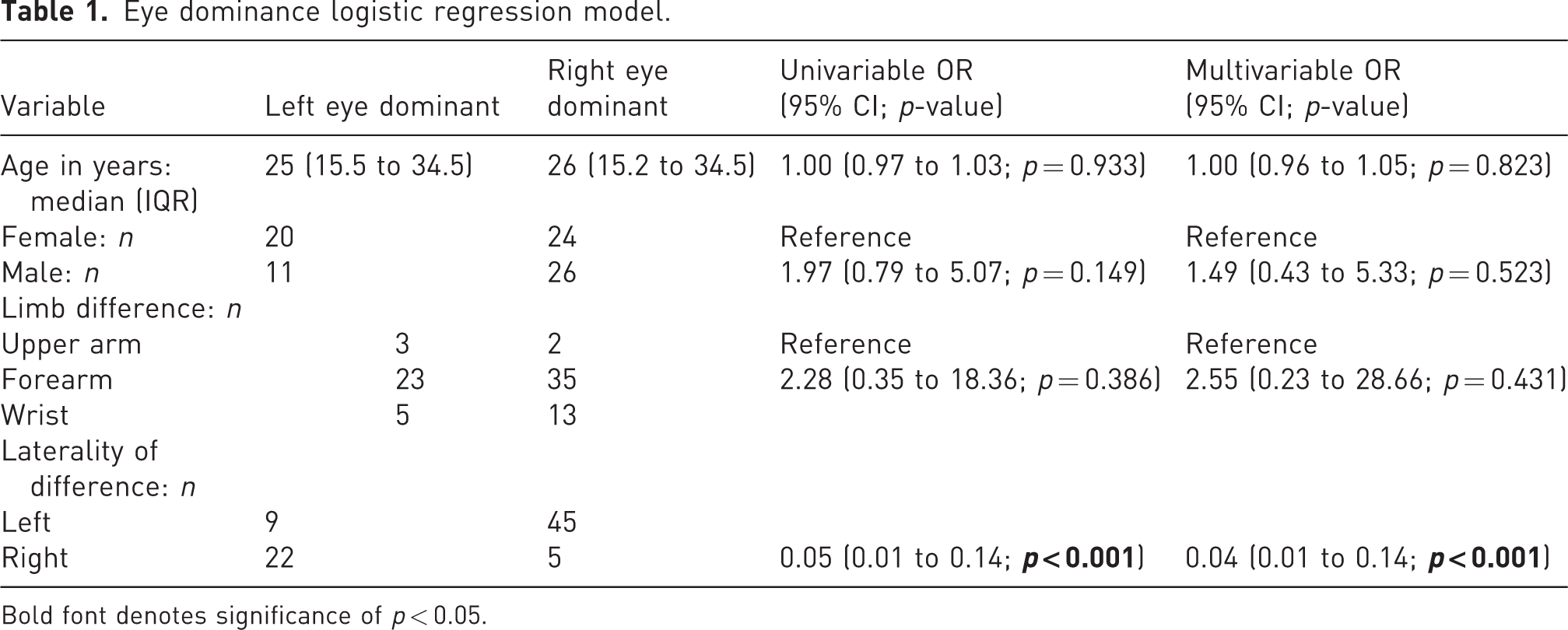
Bold font denotes significance of p < 0.05.
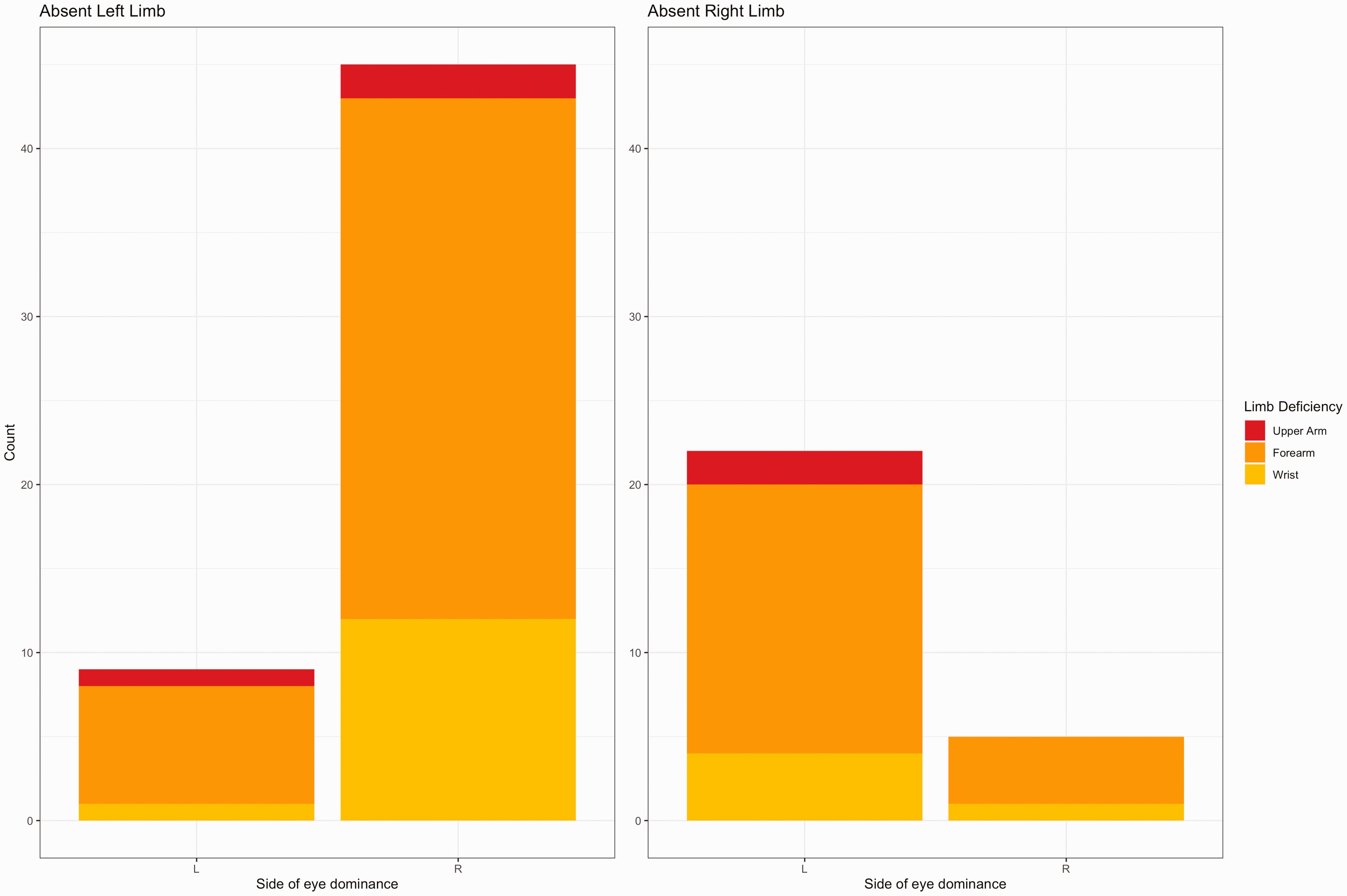
A compound graph demonstrating the proportion of eye dominance in individuals stratified by the laterality of limb absence and grouped by anatomical location of the limb deficiency.
When patients were grouped according to whether their eye dominance was ipsilateral or contralateral to the side of limb deficiency, most demonstrated a contralateral pattern, regardless of the side affected.
A binomial test was used to compare the proportions of laterality of eye dominance with those in the general population (Bourassa, 1996). In the general population, 66% of right-handers are right-eyed compared with 83% of those with a left upper limb absence (95% CI: 71 to 92%; p < 0.05). In contrast, 57% of left-handers in the general population are left-eyed compared with 81% of those with a congenitally absent right limb (95% CI: 62 to 94%; p < 0.05).
Discussion
Our study aimed to explore the eye dominance in individuals with UCULTDs and to compare the findings with those in the general population. This study has shown that individuals with a UCULTD are more likely to have contralateral rather than ipsilateral eye dominance and that these patients are more likely to have contralateral eye dominance than the general population.
We have identified that eye dominance is strongly associated with the laterality of limb absence. When explored further, we found that individuals with a left-sided limb deficiency were more likely to be left-eye dominant than right-eye dominant. This finding offers a new perspective on the mechanisms behind eye dominance and its potential association with hand dominance.
Eye dominance is a complex phenomenon influenced by neurological, genetic and environmental factors (Porac and Coren, 1981). Traditional theories of eye dominance propose a neural basis in which hemispheric specialization contributes patterns of lateral dominance (Bourassa, 1996). For instance, some theories suggest that dominance of one eye over the other could be a compensatory mechanism when usual lateralization patterns (right-hand, right-eye dominant) are disrupted, as is seen in individuals with congenital limb absence (Guiard, 1987; Knecht et al., 2000). However, there is no widely accepted theory for the development of eye dominance. This study adds to our understanding by exploring individuals with a congenital upper limb absence, which acts as a determinant for hand dominance.
Previous studies generally support a link between eye dominance and hand dominance. Bourassa (1996) found a strong correlation between handedness and eye dominance, with right-eye dominance more prevalent between handedness among right-hand dominant individuals. However, for populations with congenital upper limb deficiencies, the lack of one upper limb may alter typical lateralized behaviours, prompting a shift in eye dominance as an adaptive response. For example, Zuniga et al. (2021) explored the effect of prosthetic hand use on hemispheric dominance in children with upper limb deficiencies and found compensatory adaptations in neurological processing among individuals with limited hand function.
Developmental theories propose that dominance patterns emerge through adaptive mechanisms during early brain development, shaped by environmental interaction and sensory-motor experiences (Annett, 2001; Corballis, 1991). In cases of congenital upper limb absence, early constraints on hand use may lead to alternative dominance adaptations. Research has shown that neuroplasticity enables the brain to adjust to altered sensory-motor demand, which might contribute to atypical dominance patterns; this is seen in string instrument players (Elbert et al., 1995), and similar effects may be possible in patients with UCULTDS. In individuals with limb loss, functional imaging has shown preserved structure and activity in cortical regions corresponding to the absent limb, further supporting theories of adaptive reorganisation (Makin et al., 2013). Similarly, Stoeckel et al. (2009) demonstrated altered somatotopic representations in the motor cortex of individuals with congenital upper limb deficiencies.
Eye dominance itself has implications for motor planning and spatial coordination, as individuals often use their dominant eye for precision in spatial tasks (Carey and Liddle, 2013; Miles, 1930). In the context of congenital upper limb deficiency, an alignment between the limb that is present and the dominant eye could theoretically provide functional advantages in tasks requiring spatial coordination, supporting daily interactions and overall functionality. An association between upper limb deficiency and eye dominance may reflect an adaptive mechanism to optimise performance . This has practical implications for prosthetic design and rehabilitation, particularly in understanding user satisfaction and visual motor alignment (Biddiss and Chau, 2007).
Several studies have explored the laterality of eye dominance within families. These studies found moderately strong associations linking parental hand–eye dominance with their offspring’s hand–eye dominance, with parents who were both right-eyed having approximately 30% left-eye offspring and around 50% of children with two left-eyed parents being left-eyed (Brackenridge, 1982; Coren and Porac, 1980; Merrell, 1957; Zoccolotti, 1978). We do not have information about parental eye dominance to explore this effect within our own dataset, but this could be a subject for future studies in patients with a UCULTD. The concept of inherited dominance has been further explored through the use of twin studies. Reiss et al. (1999) identified that there was no statistically significant difference in the laterality of limb use in monozygotic or dizygotic twins when compared with singletons.
A limitation of our study is the small sample size compared with other studies involving participants with both upper limbs. An additional limitation is our assumption of hand dominance. We have assumed that the unilateral absence of a hand would result in the contralateral limb being dominant as it is the only hand present; given the current lack of understanding of how hand and eye dominance are associated, we must acknowledge the possibility that hand dominance may be genetically determined rather than being determined by body morphology.
Footnotes
Acknowledgements
We thank Helen Scott, Dr Salman Hameed and Dr Hazem Al-Khawashki, who helped with data collection.
Data availability statement
The authors confirm that the data supporting the findings of this study are available within the article. Raw data that support the findings of this study are available from the corresponding author, upon reasonable request.
Declaration of conflicting interests
The authors declare that we have no financial, personal, or professional conflicts of interest that could influence the objectivity, integrity or impartiality of the research presented herein.
Ethical considerations
The study was conducted in accordance with the Declaration of Helsinki and Good Clinical Practice guidelines. As the Porta test was done as part of the routine clinical examination, no ethical approval was required. All data were kept confidential as part of the clinical notes.
Funding
This research received no specific grant from any funding agency in the public, commercial, or not-for-profit sectors.
