







Abstract
Introduction:
Social media (SoMe) is increasingly used for research promotion and dissemination. Classic bibliometrics measure long-term measures of research impact, such as citation counts. Altmetrics are newer real-time measures of activity on multiple SoMe platforms (e.g. X, Facebook) capturing the consumption, reach and impact of scientific outputs. Promotion via SoMe has short-term positive impacts on citations but the long-term impact remains unknown.
Methods:
Altmetrics and citation rates were collected from Altmetric Explorer 6 years post-publication for 624 articles published in 2017 across six hand surgery journals (Journal of Hand Surgery, Journal of Hand Surgery: European Volume, Journal of Hand Surgery: Asian-Pacific Volume, Journal of Plastic Surgery and Hand Surgery, Techniques in Hand and Upper Extremity Surgery and HAND). Negative binomial regression was used to estimate the relationships between citation counts and predictor variables. Incident rate ratios were reported as 95% confidence intervals (CI).
Results:
SoMe mentions had a long-term positive impact on citations, whereby mentions in 2017 were independently associated with a 2% higher citation rate 6 years later (CI 1-3%). Evidence synthesis studies had at least eight more citations than other types of articles (p < 0.001), and articles published in the Journal of Hand Surgery had more citations than those in other hand surgery journals (p < 0.001).
Conclusion:
Using SoMe to advertise hand surgery literature is associated with long-term gains in citations. Continued research into the impact of SoMe on bibliometrics will help to ensure the academic ecosphere is responsive to evolving digital trends.
Level of evidence:
IV (Cross-sectional study)
Introduction
Social media (SoMe) is a ubiquitous feature of modern life. The diversity of platforms and their uses have increased significantly over the past 15 years. They have been co-opted in academia to disseminate research, recruit for multicentre trials, host online journal clubs and more (Nason et al., 2015). For both authors and journals, they represent a powerful means of disseminating research findings quickly and directly to relevant audiences. Indeed, they bypass the traditional vehicles of research publication and promotion such as distribution of journal issues to paid subscribers and the indexing of articles on online databases (e.g. Medline). For consumers, SoMe platforms offer the choice of which users/groups to follow, filters such as hashtags and diversity of content from text to videos.
X (formerly known as Twitter) has historically been the most popular microblogging forum for academics to disseminate new research (Nason et al., 2015). Informal scientific discussion can occur contemporaneously, generating questions and conversations around the content, previously limited to the letters and correspondence sections of subsequent journal issues. Social media activity surrounding individual papers has been shown to yield a significant uplift in citations in the medical literature, including hand surgery, which ultimately influences traditional author and journal level metrics (Boyd et al., 2020; Grant et al., 2021; Richardson et al., 2021; Yoshimura et al., 2021).
While traditional, citation-based metrics (Impact factor and SCImage journal rank and h-index) remain powerful indicators of journal and author impact, SoMe attention may offer an alternative lens by which to judge the reach of research (Grant et al., 2021; Richardson et al., 2021). There are now multiple tools to capture and quantify these so-called alternative metrics (‘altmetrics’). One example is Altmetric, a data science company that provides an aggregate score for the attention a research article generates across platforms including X, Facebook, Instagram, YouTube, Wikipedia and others. Although the literature shows correlation between altmetrics and short-term citation rates (within 2 years of publication), there are fewer long-term studies of the effect of social media attention on citations (Boyd et al., 2020; Richardson et al., 2021; Yoshimura et al., 2021).
The aim of this study was to investigate whether SoMe attention in the first year after publication is associated with more citations in the long term.
Methods
This study was a continuation of our previous work, which demonstrated that social media mentions of hand surgery articles independently increased citations by 4% within 3 years post-publication (Yoshimura et al., 2021). We included the same articles published in the Journal of Hand Surgery (JHS; ISSN: 0363-5023), the Journal of Hand Surgery: European Volume (JHS Eur); ISSN: 1753-1934), the Journal of Hand Surgery: Asian-Pacific Volume (JHS Asian-Pacific); ISSN: 24248363), the Journal of Plastic Surgery and Hand Surgery (J Plast Surg Hand Surg; ISSN 2000-656X), Techniques in Hand and Upper Extremity Surgery (Tech Hand Up Extrem Surg; ISSN: 1089-3393) and HAND (ISSN: 1558-9447), all published during 2017.
In July 2023, the digital object identifier (DOI) of each article was uploaded to Altmetric Explorer (www.altmetric.com) to extract altmetrics and citation counts. If there were no citations we extracted citation counts from PubMed instead. Articles were grouped into correspondence (e.g. letters to the editor, opinion, critique), case reports, primary research, or evidence synthesis articles (e.g. literature review, systematic reviews). Articles were also grouped by topic. Altmetric Explorer scrapes the internet for current tweets, Facebook mentions and similar mentions of articles in real time and as such, their counts are not a cumulative total of all historical (active and deleted) social media mentions.
Data were analysed using Stata v18/MP (StataCorp LLC, Texas). The Wilcoxon signed rank test was used to compare citations per article between 2020 and 2023. Owing to overdispersion of citation counts, negative binomial regression was used to estimate relationships between citation counts and SoMe mentions (continuous variable), with adjustment for the journal, type of article and open access status (as categorical variables). The effect of SoMe attention on citations is presented as incident rate ratios (IRR) alongside Huber-White sandwich-adjusted 95% confidence intervals (CI). Plots were customized using grstyl (Jann, 2018a, 2018b). A higher IRR indicates relatively more citations. The raw data are available at https://osf.io/uywjv/.
Results
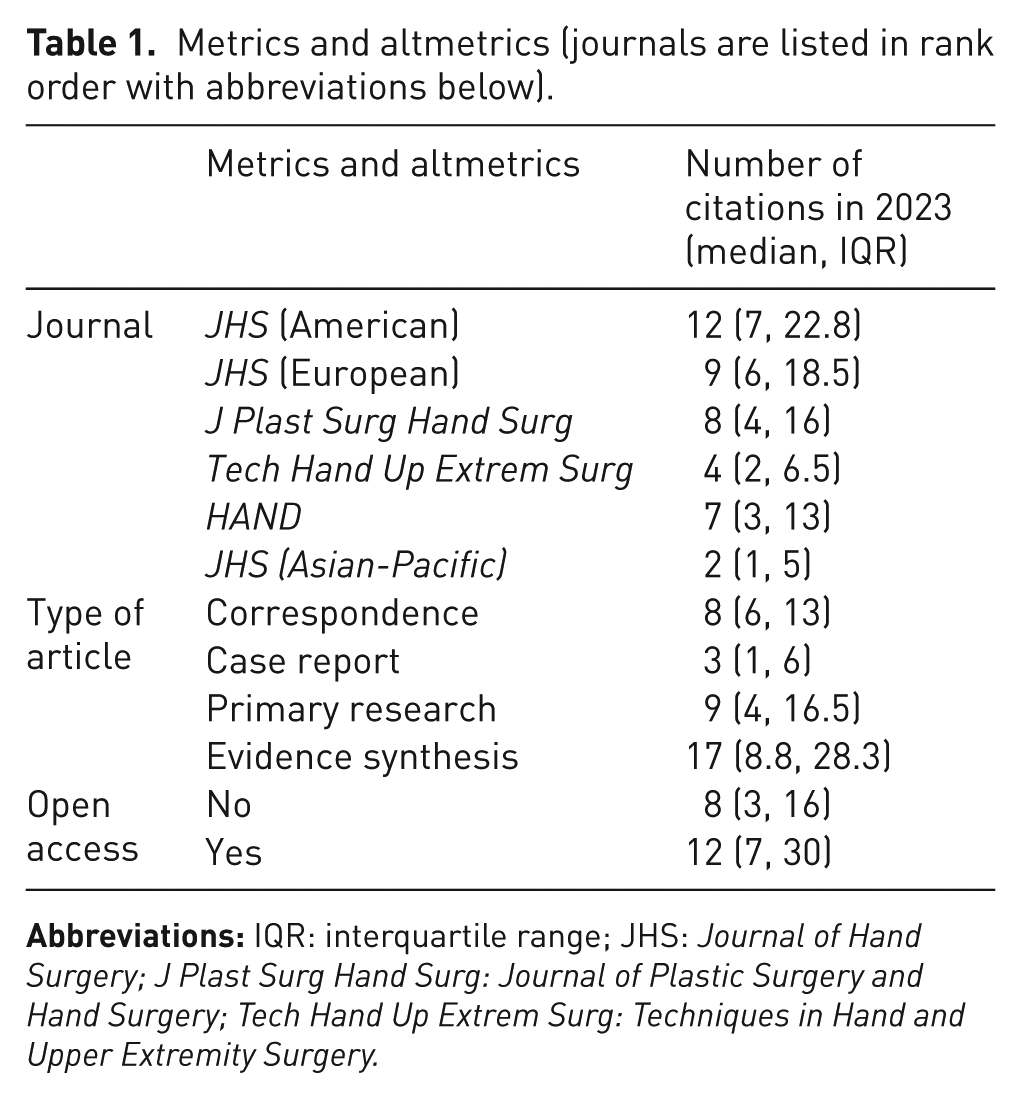
A total of 624 hand surgery-related articles published in 2017 were included in this study. Six years later, the median number of citations was eight per article (IQR 3 to 16). Table 1 presents the median citation rates for each journal. Overall, the included articles were cited 8199 times. By journal, there were 3901 citations for JHS, 1483 citations for JHS Eur, 1350 citations for HAND, 926 citations for J Plast Surg Hand Surg, 387 citations for JHS (Asian-Pacific) and 152 citations for Tech Hand Up Extrem Surg. The majority of citations came from articles written by authors based in the USA. There were more citations for articles published between January and June (4324), compared with articles published between July and December (3875).
Metrics and altmetrics (journals are listed in rank order with abbreviations below).
Univariable analysis showed that more SoMe activity around the time of publication (i.e. mentions) was associated with increased citations long term. Multivariable analysis showed that after accounting for potential confounders (the publishing journal, article type and open access status), more mentions on SoMe independently increased the number of citations an article received by 2% (95% CI 1 to 3, Table 2). It appeared that JHS articles were more likely to be cited than articles published in other journals (Figure 1) and evidence synthesis articles (systematic reviews) received the highest number of citations.
The relationship between citations, article characteristics, and social media mentions.
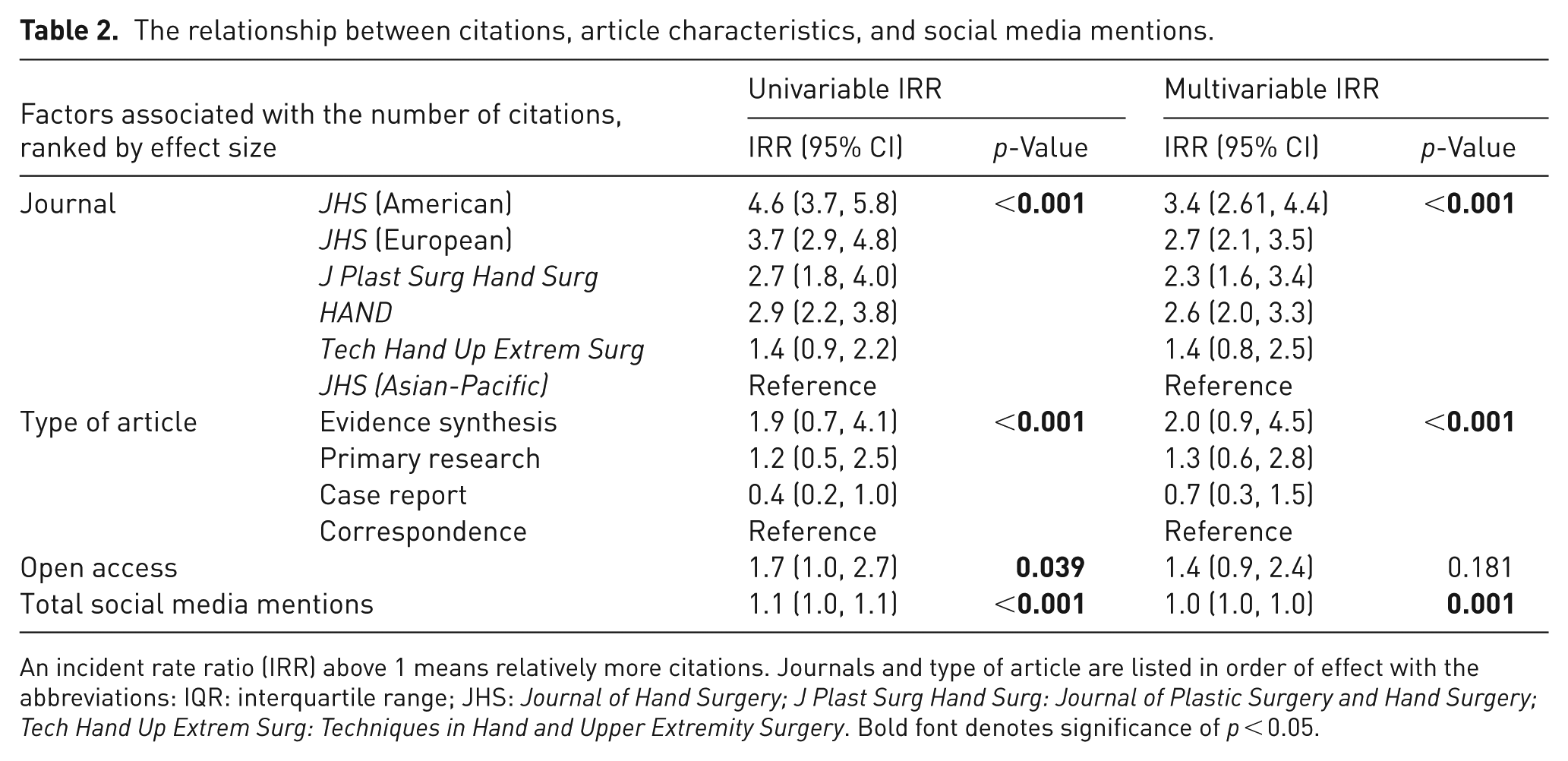
An incident rate ratio (IRR) above 1 means relatively more citations. Journals and type of article are listed in order of effect with the abbreviations: IQR: interquartile range; JHS: Journal of Hand Surgery; J Plast Surg Hand Surg: Journal of Plastic Surgery and Hand Surgery; Tech Hand Up Extrem Surg: Techniques in Hand and Upper Extremity Surgery. Bold font denotes significance of p < 0.05.
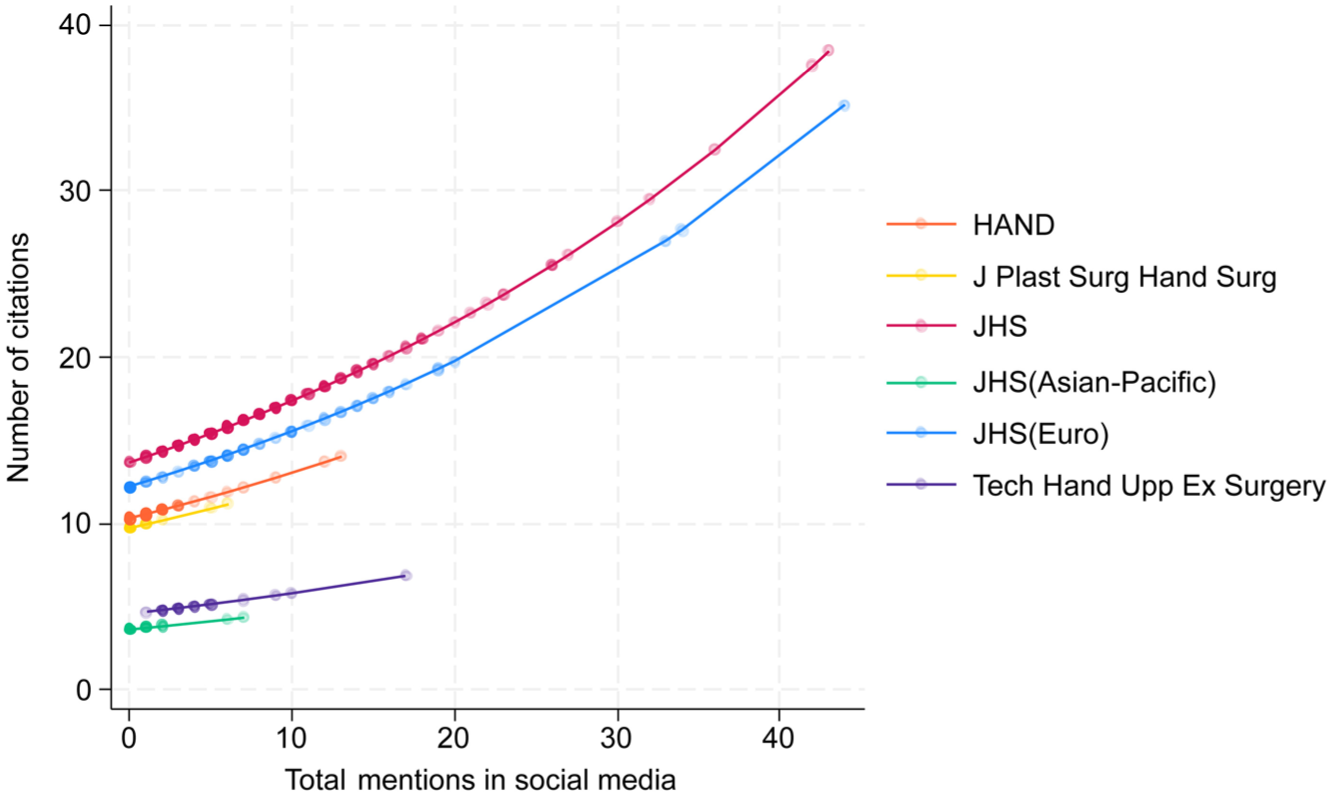
The relationship between number of mentions on social media and the citation rates in different hand surgery journals.
Discussion
This study has shown that publicising hand surgery articles on social media is independently associated with more citations in the long-term. Therefore, we encourage researchers and journal staff to engage actively with SoMe platforms to promote work to the wider community, as this may generate greater and longer-lasting impact.
By analysing SoMe activity, researchers can optimize engagement with their intended audience. Altmetrics are unique metrics that capture SoMe engagement from both academic and non-academic circles (Cabrera et al., 2018). Researchers can therefore assess their reach to non-academic stakeholders and the societal impact of their work, potentially bridging the gap between researchers and policymakers, and promote patient education (Cabrera et al., 2018; Sánchez-Santos and Cano-Valderrama, 2024). Another advantage is that altmetrics capture online activity across different SoMe platforms since users of a single platform do not represent the whole online community. Equally, altmetrics may be incomplete (Mayol, 2023) and we found that some articles had lower attention metrics years later, which may reflect deletion of accounts or individual posts. Another risk with using altmetrics is that each SoMe mention is assumed to carry the same weight for article dissemination, which clearly is not the case. For example, a mention by a prolific academic with a large following may reach many more users and thus have greater impact than a user with no following (Jensen, 2017). This means that not all SoMe mentions are created equal and future work could consider the reach of mentions by analysing the users following and mention engagement. Equally, the half-life of social media posts differs per platform (Tweets average 43 minutes, Facebook posts average 76 minutes) so our observed effects may not be universally translatable (Graffius, 2024). Overall, our earlier work demonstrated that SoMe improved short-term citations and here again, we show that SoMe activity has positive effects on long-term citation rates (Yoshimura et al., 2021).
Our 6 year follow-up study again suggest that evidence synthesis articles are cited approximately twice as often as primary research, and roughly six times more often than case reports. This differential has been noted across the literature for plastic surgery and other specialties (Brandt et al., 2019; Ormseth et al., 2023; Patsopoulos et al., 2005; Willis et al., 2011). This might be explained by the move towards evidence-based medicine, which prioritizes evidence synthesis articles. On this basis, there may be a greater scholarly incentive to publish evidence synthesis articles. Indeed, in a review of the top 50 most cited papers in hand and wrist surgery, level IV evidence was the most common study design – followed by levels I and III (To et al., 2013). Thus, the scope of a paper to generate citations, as well as to start discussion, is influenced by factors not purely explained by the ‘level of evidence’. This may explain the relative parity between the total SoMe mentions received by correspondence and evidence synthesis. These findings should encourage academics to support the genesis of high-quality research.
Other factors appear to influence citation rates, including the journal of publication. With the exception of HAND, which has the second highest impact factor but only the fourth highest number of citations, our data show that impact factor is directly related to citation rates. According to SCImago (2023), the impact factors and medical journal rankings were: impact factor 1.63, rank 3600 (JHS), impact factor 1.52, rank 3799 (HAND), impact factor 1.15, rank 4446 (JHS Eur), impact factor 1.07, rank 4590 (J Plast Surg Hand Surg), impact factor 0.57, rank 5673 (Tech Hand Up Extrem Surg) and impact factor 0.54, rank 5724 (JHS (Asia-Pacific)). A possible explanation for the apparent discrepancy in HAND is that our data covers a 6 year period from 2017-2023, whereas impact factor is based on citations over a 2 year period. HAND has experienced a significant increase in citations per article, which is not fully captured in our data.
The association of increased impact factor and citation rate is logical, given that impact factor is based on number of citations per article over a 2 year period. This finding is corroborated by Callaham et al. (2002), who showed that impact factor is the most important predictor of article citations. Another hypothesis for these findings, is the composition of articles published in each journal. All six journals favoured primary research, however the two most cited journals, JHS and JHS Eur, were the least likely to publish case reports, which generally receive fewer citations per article. Other hypothetical explanation is the geographical bias towards research to high-income countries, with North American research capturing 42% of the world’s citations (Skopec et al., 2020). Greater economic prosperity will allow more funding for higher quality research, enabling authors in these countries to produce a volume of work that is greater in quality and quantity (Skopec et al., 2020). Heuristic factors may also predispose readers to favour research affiliated to certain academic institutions or countries, originating in higher income countries, such as the US (Akre et al., 2011; Skopec et al., 2020). Open access status is also positively associated with citations, most probably owing to the enhanced readership attracted by removing paywalls (Gargouri et al., 2010).
The age of authors may play a role as younger academics use SoMe more to promote their research (Reddy et al., 2021). The digital landscape is also constantly evolving, which will inevitably vary the influence of SoMe on research consumption. One notable trend is the increasing popularity of Bluesky, originally a Twitter/X initiative which severed ties with the latter following Elon Musk’s acquisition (Patel, 2024). Bluesky experienced a significant surge in activity days after the 2024 US Presidential election in both the US (519%) and UK (352%) compared with the first 10 months of that year (Carr, 2024). Altmetric Explorer incorporated Bluesky into its coverage in December 2024. Such shifts in trends may change the relationship between SoMe platforms and articles over time, and newer articles may experience different effects compared with earlier publications. Therefore, we encourage future research into how SoMe affects academia over time to ensure researchers remain up-to-date with trends and tools.
The main limitation of this study is the use of a single altmetric provider. Altmetric Explorer lacks coverage of Mendeley and Wikipedia compared with PlumX and CED (Crossref Event Data), but has a greater coverage of Tweets, blogs and news feeds (Ortega, 2019; Zahedi and Costas, 2018). It also does not cover platforms such as Threads, Weibo and WeChat. Future research may benefit from merging datasets from multiple altmetric tools for a more comprehensive measurement of social media activity. We did not include other forums for promotion (e.g. personal websites, conferences, WhatsApp groups, etc.) which may be used to promote academic work and influence long-term citation rates. As a consequence of presumed deleted SoMe posts, some articles had a lower altmetrics in 2023 compared with 2020, which makes long-term inferences complex.
Overall, we provide compelling evidence that promotion of hand surgery literature on SoMe platforms improves long-term citation rates. Future work should seek to elucidate the mechanisms underlying this association.
Footnotes
Contributorship detail
All authors have made substantial contributions to the conception and design of the work. All authors were involved with the drafting of the manuscript, have approved the final version of the work, and agree to be accountable for all aspects of the work in ensuring that questions related to the accuracy or integrity of any part of the work are appropriately investigated and resolved.
Declaration of conflicting interests
The authors declared no potential conflicts of interest with respect to the research, authorship, and/or publication of this article.
Funding
The authors disclosed receipt of the following financial support for the research, authorship, and/or publication of this article: Ryckie Wade is an Academic Clinical Lecturer funded by the NIHR (CL-2021-02-002). The views expressed are those of the author(s) and not necessarily those of the United Kingdom’s National Health Service, NIHR or Department of Health.
Ethical approval
Not required
Informed consent declaration
Not applicable.
