







Abstract
The communicative theory of emotions postulates that emotions are communications both within the brain and between individuals. Basic emotions owe their evolutionary origins to social mammals, and they enable human beings to use repertoires of mental resources appropriate to recurring and distinctive kinds of events. These emotions also enable them to cooperate with other individuals, to compete with them, and to disengage from them. The human system of emotions has also grafted onto basic emotions propositional contents about the cause of the emotion, the self, and other matters. Complex emotions always contain such contents, whereas basic emotions can be experienced without them. This article explains the role of basic emotions in social relationships, their effects on reasoning, and their pathology in psychological illness, such as depression and obsessive-compulsive disorder.
The communicative theory of emotions of Oatley and Johnson-Laird (1987) is cognitive, functional, and based on evolutionary considerations. It postulates that emotions are communications to ourselves and to others. It was formulated because the semantic basis of emotional words was then unclear, and because human planning could hardly be based on a search across the space of all possible sequences of action. The initial argument for the theory was that emotions are heuristics that organize action in a world that is always imperfectly known. The theory was updated and modified by Oatley and Johnson-Laird (1996) in response to new evidence. It is not our intention in the present article to compare the communicative theory with other accounts of emotion. Moors (2009) makes such comparisons in a comprehensive description of functional causes of emotion. The communicative theory, however, does appear to make predictions over a wider range than other theories. It provides accounts of the semantics of emotion terms, emotional experience in everyday life, planning, emotions in literature and music, and the development of emotions in children. It also applies to topics that have not usually been considered in cognitive accounts of emotions—their roles in relationships, in reasoning, and in psychological illnesses.
This article begins with a synopsis of the theory and of some of its supporting evidence. It then considers the role of emotions in social relationships. Next, it describes how emotions function in reasoning, in particular in the reasoning of individuals who are suffering from psychological illnesses. The data presented here led to the description of a new, emotionally based, theory of psychological illnesses. The article concludes with some general reflections on the nature of human emotions.
The Communicative Theory: A Synopsis
The communicative theory derives from Aristotle’s (330
We developed Simon’s idea a stage further (in Oatley & Johnson-Laird, 1987). We argued that distinct basic emotions evolved in social mammals, and that they configure the cognitive system to make it ready for each of a relatively small number of generic events. People are not aware of any mental process as an emotion occurs, but only of the sequence of its results. Hence, even though they may be aware of the cause of an emotion, they cannot be aware of the process that makes the transition to the emotion itself. You hear a piece of music, for instance, and you may immediately experience a particular emotion even though you’ve never heard the piece before. What aspects of the music trigger the emotion? Introspection tells you nothing: the transition is unconscious in Helmholtz’s (1866/1962) sense that it occurs outside awareness but can underlie the construction of the contents of consciousness. The theory also postulates that only those processes that yield results of which individuals are aware have access to working memory, which functions to hold information while it is thought about (see, e.g., Baddeley, 2001; Miyake & Shah, 1999; Newell, 1990). Individuals are conscious of its contents, although not necessarily all of them. Working memory is also the heart of computational power because it holds the intermediate results of computations (Hopcroft & Ullman, 1979). For instance, people cannot handle recursive processes, such as reasoning with propositional contents, without working memory, or a surrogate such as an external representation. Hence, processes that do not act on conscious results are computationally crude, whereas processes dealing with propositional content are more powerful. This contrast underlies the idea of two systems of inference, so-called “dual process” theories (see, e.g., Evans, 2003; Johnson-Laird, 1983, chap. 6; Kahneman & Frederick, 2005; Stanovich, 2004). System 1 is fast and computationally simple. It is equivalent to a finite-state automaton, coping only with heuristics and the construction of single mental models. And it includes the unconscious transitions to basic emotions, which also function as heuristics. System 2 depends on working memory. It can carry out slower sequential operations such as recursion.
An example of the heuristic mode is as follows. If an external danger appears we enter the mode of fear. This mode has an experiential quality that differs from that of other basic emotions such as happiness or anger. We experience basic modes of this kind as nonpropositional because they do not embody any propositional information. Indeed, some basic emotions—happiness, sadness, anger, and fear—can be experienced with neither any propositional content nor an object. Other basic emotions do have known objects. They include the emotion of children’s love for their caregivers, the reciprocal emotion of parental care, sexual love, disgust, and hatred; the emotional signal that propagates in the brain links these emotions to a representation of their object. We distinguish propositional content that can be linked to an emotion, which allows one to think and talk about it, from the emotion’s object or target. One cannot experience love without an object of the emotion. In contrast, one can, for instance, feel fear or in a prolongation of its mode, anxiety, in a free-floating, objectless way, and without it having any propositional content. One can say, for example: “I feel anxious but I don’t know why,” and at the same time be unable to say much about the feeling. Music refers to nothing whatsoever, but can create a feeling of fear or of joy even if one has never heard the particular piece before (Johnson-Laird & Oatley, 2008).
Emotions function to configure the cognitive system heuristically to make ready repertoires of actions distinctive to the mode. For fear, these kinds of readiness can include the following: stop the current plan, reevaluate results of all recent actions, freeze, prepare to avoid, escape, flee, or attack, and attend vigilantly to the environment for even the slightest sign of danger. If the danger passes, the previous plan can be resumed, otherwise the resources of the cognitive system have been reconfigured, and the next actions tend to be chosen from the repertoire of actions made ready by fear. Without the broad general category of basic emotions there can be neither experiences such as fear or anxiety, nor the mode of cognitive configuration appropriate to danger.
Feldman-Barrett et al. (2007) have argued that the very idea of basic emotions implies a theory of emotions as natural kinds, which cannot explain the variability of emotions. Our theory is derived from principles of cognitive psychology rather than of facial expression or neural embodiment, against which Feldman-Barrett et al. were arguing. We have not discussed natural kinds because they seem to us to distract from the real cognitive questions, which are about how, during evolution, creatures such as mammals, when faced with novel events that impinged on their goals, have been able to reduce the search space rather than having to consider indefinitely many possibilities about what has happened and what to do about it. We propose that the answer has been to enter modes that are repertoires of readiness, which we call basic emotions. They are not reflexes or fixed action patterns. Variability occurs within the repertoires; modes constrain the range of options so that behavior is not infinitely variable.
The criteria for basic emotions in the theory are fourfold:
First, they have psychological causes (as opposed to purely bodily or physiological causes) fundamental to the ontology of social mammals, that is, they evolved in social mammals and relate to the significant entities for which mammals formulate generic plans: maintaining life, sexual relations, and social relations; caring for offspring; and avoiding danger and noxious substances.
Second, they can have objects, but they have no integral propositional content.
Third, they make ready characteristic suites of behavior, facial expressions, and bodily deportments.
Fourth, they are primitives that cannot be decomposed into lower level states or processes that are not themselves emotions.
The theory accordingly recognizes nine basic emotions referred to in English as happiness, sadness, anger, fear, disgust, hate, sexual love, and parental love and its reciprocal emotion of love for caregivers. Some borderline cases are surprise, sexual jealousy, shame, and guilt. In fact, a surprise, which we distinguish from an orienting reflex, elicits different basic emotions depending on its nature. Some surprises make us happy, others make us sad, frightened, angry, and so on. Sexual jealousy is part hatred for a rival and part possessive sexual love. Shame and guilt, however, are borderline cases that are more difficult to resolve. Shame is characteristically associated with blushing, but so too is shyness. And, as Darwin (1872/1965, chap. 13) remarks, it would require an overwhelming amount of evidence to make us believe that any animal could blush from shame. In the past, we have therefore treated it as a species of self-disgust. Guilt is likewise difficult to assess in other species, and does not appear to elicit a characteristic facial expression or bodily deportment. It is akin to shame, but normally arises from one’s assessment of a moral shortcoming, that is, the emotion has a concomitant propositional content. A person may feel shame, not guilt, because they are incompetent. Both, however, fail the theory’s criteria for basic emotions. Complex emotions are built on basic emotions but they are elicited by evaluations with conscious results, and so they contain propositional content concerning a relation to the object of the emotion, its cause, its sequelae, and possible implications for action.
Evidence for the Communicative Theory
Since the theory proposes that emotions mediate between goals and the world, an important source of evidence is the emotion diary. Only the person concerned can record the interaction between events that are often external and goals that are always internal. The keeper of an emotion diary records emotions and their outward and inward contexts. The first person we know to have kept an emotion diary was Dante (1292–1295/1995). He recorded the results in his small book Vita Nuova (The New Life). He described his emotions at meeting Beatrice, falling in love with her, and thinking intensely about her. He also recorded his thoughts in a series of poems (see Oatley, 2007). More recent developers of the diary method have been Averill (1982), Field (1934/1952), and Gates (1926).
We have used diaries to test the communicative theory. Our first method derived from that of Averill (1982), and results were reported by Oatley and Duncan (1992, 1994). We asked participants to look out for, and record, emotions, or moods (which we take to be extended emotions), that occurred in their daily lives. The diary had pages structured as questionnaires, one page for each emotion or mood to be recorded. Participants were asked to name each one, to say whether it was an example of happiness/joy, sadness/grief, anger/irritation, fear/anxiety, or disgust/hatred which, in these studies we took to be basic. Then the diary keeper had to say how intense the emotion or mood was and how long it lasted, how it was caused, who was there, what the effects were, and so on. Most episodes could be classified into the five basic emotions about which we asked, and most concerned another person. Participants usually knew what caused their emotions or moods, but on 6% of occasions they did not. We take this to indicate that nonpropositional signals of basic emotions can occur separately from propositional information about the emotion. We predicted 69% of the emotions that people recorded from the goal-relevant events that participants experienced: happiness/joy was typically caused by achievements, sadness/grief by losses, anger/irritation by frustration, and fear/anxiety by threat. We were not so good at predictions for disgust/hatred. In agreement with the theory, we found that positive emotions tended to help plans whereas negative emotions tended to hinder them. But, contrary to our original theory that basic emotions occurred individually, we found that mixtures of emotions occurred in 31% of episodes. This result led to an updated theory (Oatley & Johnson-Laird, 1996). The diary evidence corroborated the theory’s prediction that a cognitive evaluation yielding a basic emotion can be conscious or unconscious (see Morris, Öhman, & Dolan, 1998).
If complex emotions are built on basic emotions by the addition of propositional content, the meaning of any emotional term in any natural language should refer to at least one basic emotion, and an analysis of 590 emotional words in English corroborated this point (see Johnson-Laird & Oatley, 1989; but cf. Reisenzein, 1995).
The theory predicted that emotions can be experienced without propositional content, and made a distinction between basic and complex emotions. Subsequent work in neuroscience has corroborated both predictions. The amygdala—an almond-shaped organ in the medial temporal lobe—is crucial for basic emotions. It activates release of hormones, suppression of pain, and various responses in the autonomic nervous system that prepare the body for emergencies. Damage to the amygdala impairs basic emotions in rats, monkeys, and humans (LeDoux, 1996). It also impairs the human ability to recognize facial expressions of emotions (Calder et al., 1996). The amygdala is part of a system in which stress hormones, such as epinephrine and gluco-corticoids, enhance memory of emotional events (for a review, see Buchanan & Adolphs, 2002). The amygdala receives information from all the senses, and is part of two perceptual pathways underlying fear (LeDoux, 1996, 2000). One pathway is rapid, going directly from the sensory thalamus (a way station for perceptual information) to the amygdala. This pathway bypasses the cortex, and so it relies only on a crude evaluation of perceptual information. The other route is longer and slower, going from the sensory thalamus to the cortex and then to the amygdala. It makes possible an evaluation of perceptual information that produces propositional content for emotions. The intensity of fear, however, correlates with the activation of the amygdala (LaBar, Gatenby, Gore, LeDoux, & Phelps, 1998), and damage to it makes it impossible to acquire fear from conditioning (Phelps, 2005).
Basic emotions underlie complex emotions, which involve mental models of the self and/or others. Hence, individuals cannot experience complex emotions without being aware of the evaluations that produce them. They include such emotions as remorse, envy, and pride. People feel remorse when they have violated the morality embodied in their idealized models of their selves, and so they feel sad. Descriptions of certain actions tend to elicit an emotional reaction before a moral evaluation, whether positive or negative, whereas descriptions of other actions tend to elicit moral evaluations first (Bucciarelli, Khemlani, & Johnson-Laird, 2008). This phenomenon implies that the emotions and moral evaluations depend on interacting systems that work in parallel rather than on moral evaluations that are always based on emotions in the first place (Haidt, 2001; pace Hume, 1739/1978) or on emotions that are always triggered by moral evaluations (pace Hauser, 2006; Mikhail, 2007).
The difference between basic and complex emotions has been borne out by Panksepp (2005). Likewise, Damasio (1994), who refers to these emotions as “primary” and “secondary,” has observed that basic emotions survive damage to the ventromedial region of the prefrontal lobes, but complex emotions do not:
The prefrontal, acquired dispositional representations needed for secondary emotions are a separate lot from the innate dispositional representations needed for primary emotions. But[. . .] the former need the latter in order to express themselves. (p. 137)
Some features of the communicative theory are not very different from those of other cognitive theories of emotions, for example, those concerned with appraisal. Two features taken together, however, are distinctive to the theory: its hypothesis of a small set of basic emotions that constrain the search space when the unanticipated occurs, and the idea that the experience of an emotion can contain two parts: one part nonpropositional that includes the tone of the emotion and readiness for a particular repertoire of actions, the other part propositional that includes information such as the object of the emotion, its cause, and what to do about it. Some leading cognitive theorists of emotions who are skeptical about the existence of basic emotions, such as Frijda (2009), Reisenzein (2009), and Russell (2003), include the idea of a nonpropositional, or nonconceptual, part of emotions in their theories. Some commentators criticize basic emotions because they seem rigid, and in the course of such criticisms one often comes across the metaphor “hard-wired.” As Lewis and Liu (2011) have shown in this special section, however, basic modes of emotions can occur without emotions being hardwired. If, as with the communicative theory of emotions, one takes a functional view, the central question is what a process enables psychologically. Basic emotions offer an understanding of a process in which the brain is configured with distinctive repertoires of readiness that occur with distinctive events in relation to goals such as signs of progress, loss, frustration, and danger.
Emotions and Social Relationships
The brief account of the communicative theory in the previous section covers traditional concerns of cognitive theories of emotion: causes and properties of emotions in individuals. In this section, we extend our analysis to a less traditional topic: how emotions affect relationships. Just as emotions configure the individual cognitive system, they structure social relationships. Thus, being happy is likely to elicit cooperation with others; being sad is likely to lead to mental detachment from another person, for example, in response to the loss of that person; being angry is likely to lead to conflict with another. And when one is fearful, the danger is often interpersonal, either from threat or from the danger of separation, though it can also be physical. In any case, one frequently joins others to try to avoid the danger.
The social implications of the basic emotions are present in all primates. But we humans are the most social of primates. We do not just have the general mammalian bond with immature offspring in a system of parental care and attachment. We do not just take part in a social life like that of the chimpanzees (de Waal, 1982), we are critically dependent on cooperation in order to do things that we cannot do alone: not only do we tend to form day-to-day living arrangements with each other, we need friendly cooperation to form societies, cultures, and technologies. Thus, early in human development, infants around the age of 1 and a half are able to recognize others as agents akin to themselves (Herrmann, Call, Hernandez-Lloreda, Hare, & Tomasello, 2007). By the age of 4 children are able to infer what is going on in the minds of other individuals. These abilities are absent from our closest evolutionary relatives, chimpanzees.
The communicative theory postulates that emotions occur in relation to goals. It follows that social emotions relate to social goals. Biologically, as Jenkins and Oatley have argued (see Oatley, Keltner, & Jenkins, 2006), three social goals are foremost: assertion, attachment, and affiliation. The evolutionarily oldest is assertion: the goal of achieving and maintaining status. When individuals achieve status, they are proud. When they strive for status, they may be in conflict with others, and experience its typical emotion: anger. When they lose status, they feel shame. With mammals, a new social goal evolved: parental caregiving and attachment. (An analogous goal occurs with birds.) When a child’s goal of attachment is satisfied, the child experiences a mood of comfort in closeness, and when attachment is threatened, the child is anxious. Humans also have a goal of affiliation—of cooperating with peers. It is fostered by positive mood and trustfulness. Its failure results in the sadness of loss. Our social successes as a species depend on a system of affiliative cooperation (Oatley, 2004). And our propensity for affiliative cooperation makes our peculiarly social human adaptation possible. But, affiliation comes with a cost. We also have antisocial goals of exclusion and even destruction of members of out-groups, and with these we can experience emotions such as contempt and hatred.
When we do something cooperatively, and when we compete within a cooperative framework, we promote some shared goals to the top of the goal hierarchy. Then the cognitive systems of the people involved have to be coordinated. This typically involves agreeing plans, assigning roles, and accomplishing actions in the service of the overall shared goal or goals. Much of this is accomplished by exchanging verbal messages in the way that Grice (1975) has shown. But emotions are critical. Think of it like this. On the stage, an actor learns a script, a set of words that the actor will say. The actor’s job is to use the words and to portray the emotions that support the relationships with the other actors. Ordinary life requires an inverse: emotions provide scripts not of words but of ways of relating—in happy cooperation, in angry conflict, in sad disengagement, in fear, and so on—and people supply words appropriate to these modes. The modes supplied by basic emotions are useful in setting frames for interaction.
Perhaps the most important social emotion is happiness, which instigates and maintains social cooperation. In the diaries in which we asked people to watch out for emotions (Oatley & Duncan, 1992, 1994), it occurred frequently. In a study of positive emotions recorded in this way, Duncan and Grazzani-Gavazzi (2004) found that 40% of them occurred in social interactions with friends or in intimacy with a partner. Only 23% of positive emotions occurred when the participants were alone. When we used a different method—experience sampling in which people were asked to record what emotion or mood they were feeling whenever they were signaled at random times—happiness was reported twice as frequently as in Oatley and Duncan’s studies because this method picked up emotions of lower intensity (Oatley, 1998). Happy emotions of low or moderate intensity, emotions of social cooperation, are so usual that they seem unremarkable, and often are not memorable enough for diary methods in which the signal to record an emotion is the emotion itself.
A different diary method that we have used has been to ask people to look out for events that were explicitly interpersonal and liable to cause emotions: errors in joint plans with others (Grazzani-Gavazzi & Oatley, 1999; Larocque & Oatley, 2006; Oatley & Larocque, 1995). Joint plans ranged from meeting someone for coffee to complex arrangements at home or workplace. We found that errors occurred in about one of 20 joint plans. Thus, on most occasions, joint plans are arranged and completed in a mood of happy and trustful cooperation but, when errors were made in these plans, negative emotions occurred. For instance, in our largest sample (n = 157, with each person recording one such error) anger was recorded in 66% of the error diaries. Participants were typically angry that the other person involved in the joint plan had caused the error by failing to play their part properly. Anger is a typical interpersonal emotion. It monopolizes attention, makes ready a repertoire of interpersonal actions, and urges us towards an adjustment of the relationship with the other person that usually involves a shift of status between the people involved.
Originally we predicted that if participants failed to do their part in a cooperative plan they would feel guilty. Larocque and Oatley (2006) found that this prediction was wrong. When diaries were collected from both participants after an error occurred in a joint plan, both people tended to see the other as at fault. Guilt did occur: principally when participants recorded that they had other goals that competed with the joint plan but that had not been discussed with the other person.
At an ordinary level people feel empathy with others: see a smile and smile back, see a frown and start to prepare for possible conflict because a goal other than the shared goal has come into view. Goldman (in press) argues that this kind of empathy involves low-level mindreading, attributing emotions to others based mainly on their facial expression. He cites the studies of the inability of patients with damage to the amygdala to recognize facial expressions of fear and, to a lesser extent, anger and surprise (see our earlier account). Extending the implications of mirror neurons, in which the visual recognition of an intended action is accomplished by the same neurons that accomplish that action in the observer, Wicker et al. (2003) have undertaken an fMRI study in which the same area of the brain that is involved in recognizing the emotion of disgust is involved in the production of disgust. But what if the situation becomes more complex? Here a second kind of empathy occurs, which Goldman says calls for high-level mindreading, in which empathy is cognitively constructed and the person feels with regard to another on the basis of a wide variety of possible information.
The configuration of relationships by emotions parallels the configuration of individual cognitive systems, and once again the idea of basic emotions is useful. Basic modes of emotion set up distinctive interpersonal frames such as cooperation, disengagement, conflict, and shared avoidance. Proposing emotions as fundamental to configuring our relationships, moreover, enables an understanding of the important ebb and flow of emotional life, not just of emotions as responses to particular events.
Basic Emotions and Reasoning in Psychological Illnesses
Evidence suggests that basic emotions are a crucial component of psychological illnesses (Johnson-Laird, Mancini, & Gangemi, 2006). A psychological illness, we assume, is a disorder in thinking, feeling, or ability to relate to others, which has a psychological cause, though neurophysiological factors may predispose individuals to such illnesses. These illnesses include phobias, general anxiety disorder, obsessive–compulsive disorder, posttraumatic stress disorder, reactive depression, hypochondria, and borderline states of abandonment with chronic feelings of emptiness or anger (see Axes I and II of DSM-IV-TR). An influential treatment for these illnesses is cognitive behavioral therapy as formulated by Beck (e.g., 1976). He was skeptical about the role of repression in illness (cf. Freud, 1933), and argued that individuals are aware of the thoughts that cause their illnesses. He thought the cause was faulty reasoning: “The patient’s appraisal of reality may not be distorted, but his system of making inferences or drawing conclusions from his observation is at fault …” (Beck, 1976, p. 219). The evidence for this assertion, however, is slim.
The Italian psychiatrist Francesco Mancini observed that a patient suffering from obsessive–compulsive disorder reasoned that she might have contracted the HIV virus because she had touched a newspaper photograph of the late Rock Hudson, who had died from AIDS. She argued as follows:
The photographer must have been close to Hudson, because the photograph was a close-up. So, the photographer himself might have been contaminated. So, when he developed the negative, he could have contaminated it. The negative was in contact with the print of the photograph and so could have contaminated it. The man in charge of printing the newspaper used the photograph, and so he could have passed its contamination on to the newspaper’s printer. The printing press could have passed the contamination on to the picture in every newspaper. So, when I touched the newspaper, I too might have been contaminated. (Mancini, personal communication)
This chain of interconnected inferences suggested that the patient could envisage more than just obvious possibilities. Observations of this sort led to an investigation of the reasoning of individuals suffering from psychological illnesses (Johnson-Laird et al., 2006).
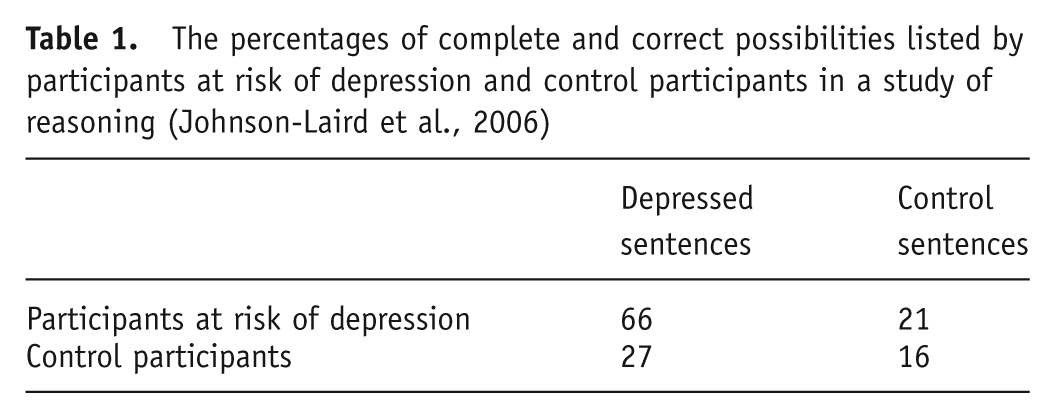
An initial study used an Italian version of the Beck Depression Inventory to pick out the top 5% at risk of suffering from depression, and the bottom 5% at no such risk, from 370 students at Palermo University in Sicily. These two groups were then given perhaps the simplest of all reasoning tasks: to list what was possible (and impossible) given a sentence at the end of a brief story. For example, they had to carry out the task for a sentence such as, “The burglar alarm rings and I feel depressed,” or for a control sentence that concerned guilt, for example, “The burglar alarm rings and I feel guilty,” or for a sentence with a neutral content. Each participant carried out the task four times. Two of the stories had a test assertion based on and, and two of the stories had a test assertion based on or. Table 1 presents the percentages of listings of complete and correct possibilities that the participants made in the four separate groups. As the table shows, individuals at risk of depression who encountered a story likely to engage a feeling of depression listed a greater percentage of correct and fully explicit possibilities than the participants who were not at risk. But, with the control materials, no reliable difference occurred between the performance of the two groups. The most frequent error was a failure to list the complete set of possibilities.
The percentages of complete and correct possibilities listed by participants at risk of depression and control participants in a study of reasoning (Johnson-Laird et al., 2006)
An analogous study involved students at the University of Palermo at risk, and not at risk, of obsessive–compulsive disorder. They were selected from a new sample of 290 students at Palermo University. The pattern of results was identical to the previous study. Those at risk reasoned better than those not at risk, but only with materials pertinent to obsessive–compulsive disorder. Likewise, a recent study of reasoning examined patients under treatment for depression, though not on therapeutic drugs (Gangemi, Mancini, & Johnson-Laird, 2010). Their task was to draw their own conclusions from pairs of syllogistic premises, such as:
In some cases when I go out, I am not in company. Every time I am very happy I am in company. What follows?
A valid conclusion is:
In some cases when I go out, I am not very happy.
Individuals make predictable mistakes with syllogisms, which occur in most cases from a failure to think of all the possibilities consistent with the premises (Bucciarelli & Johnson-Laird, 1999). The patients, however, reasoned more accurately than mentally healthy control participants. They were more likely to draw conclusions concerning the sources of their illness, and less likely to draw conclusions about other matters. In contrast, healthy participants tended to show the well-known bias of reaching believable conclusions but not unbelievable ones, especially from premises that did not yield validly to them. The same pattern of results occurred in a separate study that compared individuals at risk of clinical depression with mentally healthy control participants.
The role of emotions as the mediator in these results was borne out in a study of nonclinical participants (Johnson-Laird et al., 2006). One group was made to feel guilty by having to write down the description of an episode from their lives about which they still felt guilty, whereas a control group wrote no such account. A postexperimental rating task showed that the guilt-inducing task succeeded in evoking the emotion. The reasoning task was to list possibilities, as before, and the key sentences either provoked feelings of guilt or not. Those who felt guilty outperformed the control group with sentences concerning guilt, whereas no reliable difference occurred with neutral sentences. Perhaps the most dramatic results of this sort are due to Blanchette, Richards, Melnyk, and Lavda (2007). Their participants had to reason syllogistically about terrorism shortly after the terrorist bombings on buses in London, UK, in July 2005. Those who were closest to the terrorist bombings reasoned more accurately than those who were remote from these events. And distance had an effect, because those living in Manchester, UK, reasoned more accurately than those living in London, Ontario. The difference between the people from Manchester and Ontario disappeared 6 months later, but the English Londoners still reasoned more accurately on terrorist-related material than the other two groups. In contrast, emotions unrelated to the content of reasoning appear merely to impair the process regardless of the particular emotion (Blanchette & Richards, 2004; Oaksford, Morris, Grainger, & Williams, 1996).
The import of these results is twofold. First, emotions that are pertinent to a topic being reasoned about improve performance—assuming the emotions are not of overwhelming intensity. According to the theory of mental models, reasoning calls for people to use the meanings of assertions and their knowledge to construct mental models of possibilities (see, e.g., Johnson-Laird, 2006). When individuals reason about the cause of an emotion, the emotion seems to prompt them to think of more possibilities than they would otherwise. Hence, emotions, whether induced experimentally, or by an emotion-producing event, or resulting from a psychological disorder, lead individuals to be more likely to construct models of possibilities pertinent to their source than to do so for other contents. It follows that they will be more likely to infer conclusions about the source of an emotion than about other matters. This effect coupled with normal inferential ability yields the pattern of inferences in our experiments.
Second, the effect of emotions accounts for the superior reasoning of patients suffering from psychological illnesses, or individuals who are at risk of such illnesses, because this superiority occurs only with contents that are pertinent to their illness. The presence of such emotions was corroborated by postexperimental measures. In addition, however, when individuals from a clinical population reason about neutral matters their performance is not reliably worse than that of control participants. Hence, no robust evidence exists to support the claim that individuals suffering from psychological illnesses do so because of faulty reasoning. So, what is the cause of these illnesses?
The Hyper-Emotion Theory of Psychological Illnesses
The theory that we will consider is that psychological illnesses are disorders in the system mediating basic emotions (Johnson-Laird et al., 2006). The theory attributes the onset of such an illness to an overemotional reaction. That is, individuals acquire an unconscious transition from a cognitive evaluation to a basic emotion appropriate to the situation but aberrant in its intensity. Such transitions mark the onset of a psychological illness, but they continue to occur throughout the illness. The theory allows, however, that unconscious transitions to emotions of aberrant intensity can occur as a result of arbitrary fluctuations in any individual. Constitutional factors may then determine whether this hyper-emotional reaction is merely a temporary aberration or becomes a deep-seated pathology.
One immediate corollary of this account is that psychological illnesses should relate to the same ontology of social mammals from which basic emotions emerge. They appear to do so as the following list (from Johnson-Laird et al., 2006) shows:
Disorders concerning health (e.g., hypochondria).
The avoidance of noxious substances (e.g., obsessive–compulsive disorder).
The maintenance of life and meeting its goals (e.g., hypomania).
The avoidance of dangerous situations (e.g., phobia).
Maintenance relations between caregivers and children (e.g., depression).
Sexual relations (e.g., psychological impotence).
Relations with peers (e.g., social anxiety).
Anxiety is a common feature of many psychological illnesses. It is a prospective emotion. It focuses on possible threats, such as illness in the case of hypochondria, or contamination in the case of obsessive–compulsive disorder. Sadness is a ruminative emotion. It focuses on negative aspects such as personal losses. Because transitions to emotions are unconscious, people have little voluntary control over their emotions. People can choose situations conducive to certain emotions, and they can choose to go along or not with implications or plans of an emotion (Oatley, 2010), but they cannot start to feel an emotion like fear merely by intending to do so. Likewise, once an emotion has started to build within them, an intention not to feel it is without effect. Although some psychologists have implied that people can diminish their emotions, such control is usually best accomplished by focusing on something else or someone else (see Gross, 2002).
The present theory predicts that the sign of a psychological illness is a basic emotion of an intense degree, that is, a hyper-emotion. Evidence corroborates this prediction. Patients tell doctors that their problems started in this way, and a small epidemiological study corroborated this claim (Johnson-Laird et al., 2006). We asked 24 psychiatrists in Rome and Verona to consult their records of recent patients whom they had diagnosed as obsessive, agoraphobic, hypochondriac, or depressed. They used these records to complete a questionnaire containing 15 items about their diagnosis, the sex and other details of the patient, and whether the patient had any other morbid symptoms. The critical questions for the investigation were whether the patient remembered the onset of the illness and, if so, the psychiatrist had to indicate which emotion had occurred from the following list: anxiety, pride, guilt, fear, disgust, anger, joy, sadness, embarrassment, shame, envy, or some other emotion. The psychiatrists did not know the purpose of the study, but they all complied with the request. Of the 11 emotion words in the list, five referred to basic emotions: anxiety, disgust, fear, anger, and sadness. Joy can also refer to the basic emotion of happiness, but was a filler item, and the patients never reported it as occurring at the onset of their illnesses.
The psychiatrists provided data about 106 patients ranging in age from 16 to 70 with onsets of their illnesses ranging from 15 to 60 years old. All but five of the patients recalled the onset of their illnesses. The emotions they tended to experience were basic (83% of patients) as opposed to complex (17% of patients). The two main complex emotions were guilt, which was often reported by patients suffering from obsessive– compulsive disorder and sometimes by those suffering from depression, and shame, which occurred once or twice with all illnesses except hypochondria. These data reflected the psychiatrists’ notes of their patients’ reports. They were statistically significant both in analysis of the psychiatrists and in an analysis of the illnesses, and they corroborated the theory that emotional illnesses concern basic emotions. By far the most prevalent emotion was anxiety. On our account guilt is a complex emotion, because it depends on a conscious evaluation of behavior and does not have an innate facial expression (Ekman, 1993). However, patients sometimes report feeling guilty without knowing why, and some theorists do treat the emotion as a basic emotion (for a review, see Ortony & Turner, 1990). It is a borderline case. Overall, the results bore out the theory’s prediction that the onset of emotional illness tends to occur with a basic emotion rather than a complex one.
Earlier, we reviewed evidence that the amygdala mediates basic emotions, especially negative ones (Schneider et al., 1997). Hence, the hyper-emotion theory predicts that the amygdala should be active in patients whenever events pertinent to their emotions occur. This prediction is supported in studies using functional magnetic resonance imaging (fMRI) with individuals suffering from obsessive–compulsive disorder (Breiter et al., 1996), social phobia (Birbaumer et al., 1998), hypochondria (van den Heuvel et al., 2005), and posttraumatic stress disorder (Rauch et al., 2000). Similarly, activity in the amygdala correlates with the occurrence of depression (Davidson, Pizzagalli, Nitschke, & Putman, 2002; Yurgelun-Todd et al., 2000) and with its severity (Drevets et al., 1992), and it predicts feelings of depression in such patients (Abercrombie et al., 1998).
The evidence leads to the following conclusion. From what we know about psychological illnesses, their cause could be a disorder in the system of basic emotions. The hyper-emotion theory postulates that vulnerable individuals acquire the tendency to overreact emotionally to events that in healthy individuals may yield the same emotion but of manageable intensity. Because transitions to basic emotions are unconscious, the theoretical gap has been filled in the past by theories of cognitive mechanisms such as repression or faulty inference making. But, perhaps what has gone wrong is the intensity of emotions. Relief of psychological illnesses, as offered by cognitive-behavioral therapy, may work because the emotional system is enabled to recalibrate itself.
Conclusions
What does the communicative theory say about the nature of human emotions? We argue that emotions have evolutionary roots in social mammals. This system of basic emotions was useful to our mammalian ancestors, and continues to be useful to us, because it enables us to respond rapidly to events that are important to us and it fosters social behavior in relation to others. The human system of emotions, however, has grafted onto the system of basic emotions the propensity to combine them with propositional content, so that cognitive evaluations of which we are aware can elicit an emotion and a knowledge of the object as well as propositional content of causes and implications of the emotion. This component of the system is susceptible to all the influences of culture and society. In our culture, we can experience an emotion at events that would leave members of other cultures quite unmoved, and vice versa. Thus, it is hard for modern Westerners to come to terms with the pederasty of classical Athens (Dover, 1989) and some Moslems are appalled at the public sexuality of the Western world. The emotional system can also exact a cost for individuals. Each of us has little or no control over the unconscious transitions that produce emotions. If, for whatever reason, the system becomes uncalibrated so that we experience emotions of excessive intensity, we may come to suffer a psychological illness.
When the communicative theory was formulated, it was speculative, and skeptics may suppose that it is impossible to falsify. In fact, any of the following sorts of observation would show it to be false:
The existence of a culture lacking a particular basic emotion.
The occurrence of a basic emotion without unique neural components.
The existence of individuals who can at will experience immediately a basic emotion.
The systematic occurrence of complex emotions (according to our criteria) in mentally healthy individuals that can be experienced in the absence of propositional content; for example, a person feels embarrassed but for no (known) reason.
The universal occurrence of a basic emotion (according to our criteria) that is always accompanied by propositional content beyond the knowledge of its object.
Some of our original theory’s predictions turned out to be prescient. In this article, we have considered the implications of the theory for social relationships and psychopathology for which the theory has so far been successful. In some other cases, the theory’s predictions turned out to be false; we do not suppose that all its errors have now been expunged.