






Abstract
This article provides an analysis of moral emotions from an attributional point of view, guided by the metaphors of man as a naïve scientist (Heider, 1958) and as a moral judge (Weiner, 2006). The theoretical analysis focuses on three concepts: (a) The distinction between the actor and the observer, (b) the functional quality of moral emotions, and (c) the perceived controllability of the causes of events. Moral emotions are identified (admiration, anger, awe, contempt, disgust, elevation, embarrassment, envy, gratitude, guilt, indignation, jealousy, pity, pride, rage, regret, remorse, resentment, respect, schadenfreude, scorn, shame, and sympathy). A classification of these moral emotions is suggested and the empirical evidence briefly summarized. In discussing our results, we identify unresolved issues awaiting further analyses and research.
What other reason can we ever assign for these affections, but the original fabric and formation of the human mind, which is naturally adapted to receive them?
This article provides an analysis of moral emotions from an attributional point of view. First, we will briefly summarize the core elements of attributional theories. Second, we will present a classification of moral emotions, thereby considering their relation to attributional concepts. Third, we will summarize the available evidence on the link between attributional concepts and moral emotions.
As Weiner (2014) points out, attributional theory is not one integrated theory, but rather a set of related ideas, concepts, and theories. At the heart of this conceptual system lies the assumption that causal thinking is of high functional significance. Fritz Heider (1958), the founding father of attribution theories, introduced the metaphor of persons as (naïve) scientists, aiming to understand, predict, and control themselves and their environment. Causal ascriptions, according to this point of view, are assumed to have a strong impact on the way we think, feel, and act. Consider, for example, a student attributing his failure at an exam to being misjudged by a biased teacher—this student will feel and act very differently as compared to a student attributing the same failure to his own insufficient effort. As a consequence, attributional theories are scientific concepts aiming to understand and predict the naïve theories of persons. Causal attributions form the center of these naïve theories.
In addition to the assumption that causal thinking is of high functional significance, two other characteristics are shared by attributional approaches. First, attributional analyses assume (a) that causal attributions determine feelings, and (b) feelings guide and energize actions. Accordingly, attributional theories of emotion and motivation might adequately be labeled sequence theories, incorporating a wide set of specific emotions mediating between causal thought and action (Weiner, 2006). Second, attributional concepts have been applied to intrapersonal as well as interpersonal phenomena (Weiner, 2000). The intrapersonal domain includes thinking and feeling related to one’s self. For example, achievement-related processes include the choice of tasks or calculation of effort expenditure, and active involvement of other persons is not necessary. In contrast, the interpersonal domain involves the way we think, feel, and behave in relation to others. This also includes phenomena such as impression formation, going towards or against others (i.e., helping and aggression), social justice, reward and punishment, and social stigmas. These social interactions can take place in all kinds of social settings, such as the family, the workplace, kindergartens, schools, sport teams, as well as in different cultures. The landscape of moral emotions embraces both the intra- and interpersonal domain, with complex interconnections between them (see Weiner, 2000).
As outlined, perceived causes of events or outcomes are the core of attribution(al) theories (see also Kelley & Michela, 1980). As there are many potential causes for a myriad of events, it is necessary to identify the basic properties of causes and to introduce a system for the classification of causes (Weiner, 1995, 2006). Three such properties—causal dimensions—have been proven to be part of the phenomenal causality of the naïve perceiver: (a) Locus: Causes are located either inside a person (such as effort or ability), or outside the person and in the environment (as for example task difficulty or a biased teacher); (b) Stability: Causes can be more or less stable over time. For example, high math aptitude or high intelligence are considered as stable causes, while effort or weather conditions may change quickly; (c) Controllability: Some causes can be altered volitionally, whereas others are uncontrollable. For example, effort is regarded as a controllable cause, while musical aptitude is uncontrollable. Controllability is an essential prerequisite for ascriptions of responsibility (for a detailed discussion of the relation between controllability and responsibility, see Weiner, 1995). As will be seen, the controllability dimension plays a crucial role within the moral emotional landscape.
Moral Emotions
What are moral emotions? One possible first step in characterizing emotions as moral in nature is to analyze their antecedent conditions. Weiner (2006, p. 87) suggested that these include “a consideration concerning good and bad, right and wrong, and ought and should.” This point of view corresponds with philosophical investigations by Hume (1740) and Smith (1759/2005), early sociological and ethnological concepts proposed by Westermarck (1932), early emotion theories (Meinong, 1894), as well as psychological reasoning pertinent to attribution theories (Heider, 1958).
In addition, in line with a functionalist perspective, the social function of moral emotions has been emphasized: Moral emotions are associated with a society’s norms and values and the interests or welfare of persons or groups, beyond the concerns of the actor (e.g., Cushman, 2011; Haidt, 2003). That is, moral emotions function as signals of normative behavior (see Hareli, Moran-Amir, David, & Hess, 2013). In a similar vein, Heider (1958) already introduced the concept of “ought” as an impersonal concept that refers to stable standards of what should be done or experienced from a normative point of view, independent of the individual’s wishes and personal concerns. The characterization of ought as an impersonal, normative concept implies that it has interpersonal validity: “Not only should ought disregard personal desires, not only does ought appear in principle unchanged in spite of incidental situational factors, but it is also universal and should look alike to everybody” (Heider, 1958, p. 222). Similar considerations have guided recent analyses of moral emotions as well (e.g., Fiske, 2002; Haidt, 2003).
To identify those emotions that have been labeled as moral emotions by scientists, Rudolph, Schulz, and Tscharaktschiew (2013) conducted a comprehensive literature search (including PsycInfo and Philosopher’s Index Online). It turned out that during the past 100 years, about two dozen emotion terms have been labeled moral emotions. These are, in alphabetical order: admiration, anger, awe, contempt, disgust, elevation, embarrassment, empathy, envy, gratitude, guilt, indignation, jealousy, pity, pride, rage, regret, remorse, resentment, respect (including self-respect), schadenfreude (joy in the misfortune of others), scorn, shame, and sympathy (compassion). Note that this list represents an entirely descriptive collection. That is, these emotions have been labeled as “moral” by at least one philosopher or life scientist. Rather than discussing the legitimacy of membership of any of these emotions in this list, we suggest not to narrow the range of emotions too early. Therefore, we will elaborate on the mentioned collection of moral emotions by (a) considering some additional observations referring to prototypes, close relatives, and “special cases,” (b) distinguishing between moral actor and moral observer emotions, and (c) introducing the concept of functional quality of moral emotions.
Observations on Prototypes, Close Relatives, and “Special Cases”
(a) Prototypical moral emotions are those that figure prominently in the vast majority of publications on moral emotions. Sympathy and anger are good examples in this vein, as these played a central role in discussing the “moral sentiments” in the groundbreaking philosophical works of Hume (1740) and Smith (1759/2005), and ever since. (b) Some words for moral emotions denote close relatives with quantitative rather than qualitative differences, as for example anger and rage. Others, such as awe, elevation, and admiration, are qualitatively similar as well, but designed for specific contexts (e.g., Algoe & Haidt, 2009; Keltner & Haidt, 2003). (c) Special cases: One such special case is disgust. Originally, disgust has been considered an emotional response to poisoned food or other contaminated objects (Darwin, 1872). However, disgust may also occur in an interpersonal context (Rozin, Lowery, Imada, & Haidt, 1999), and has been investigated with respect to extreme violations of social norms, such as murder or incest. Although the analysis of disgust as a moral emotion elicited critical discussion as well (e.g., Pizarro, Inbar, & Helion, 2011; Royzman & Kurzban, 2011), we suggest that disgust can be regarded as a moral emotion, but only when used in an interpersonal context and given personal causation (Heider, 1958).
We do not regard empathy as a moral emotion, but rather as a broader concept relevant in the context of moral emotions. Titchener (1908) introduced this term into psychology (as a translation of the German word Einfühlungsvermögen; see also Engelen & Röttger-Rössler, 2012). Empathy involves a person’s concern for another person’s situation (e.g., Betancourt, 1990; see also Eisenberg & Fabes, 1990). Such processes include cognitive and emotional capabilities (e.g., perspective taking, empathic concern, personal distress; see Davis, 1983; Engelen & Röttger-Rössler, 2012; Preston & Hofelich, 2012) rather than an actual emotional state. Empathy is often regarded as a prerequisite for moral judgments as well as for ethical and moral behavior (e.g., Harris, 2007; Hollan, 2012; Roskies, 2011) and has been related to prosocial actions (e.g., helping behavior; see Betancourt, 1990; Preston & de Waal, 2002). For example, highly empathic persons experience stronger feelings of guilt, regret, and sympathy (e.g., Imhoff, Bilewicz, & Erb, 2012; Leith & Baumeister, 1998; Schmitt & Clark, 2006), as well as lower degrees of anger and schadenfreude (e.g., Jensen, 2012; Strayer & Roberts, 2004). Consequently, close relationships between empathy and moral emotions have been proposed. As pointed out by Roskies (2011), however, empathy-related phenomena in the moral domain clearly need further analyses.
In sum, our moral emotional life consists of a multitude of feelings, many of which are experienced frequently and are common in everyday life. Our emotional lexicon is obviously finely nuanced to differentiate even quite similar feelings (e.g., anger, indignation). Moreover, there are terms designated to the experience of very similar emotions at different occasions (e.g., respect, awe), and to different intensities (e.g., anger, rage). These findings correspond with observations in the general emotional landscape and beyond moral emotions: Emotion researchers have, in a highly similar way, identified various commonalities and nuances of the affective lexicon (e.g., Ortony, Clore, & Collins, 1988). Interestingly, commonplace character and multitude are striking characteristics of both moral emotions and causal attributions (see Weiner, 1985). Therefore, further systematization, proven useful within an attributional analysis of perceived causes and their underlying dimensions, seems a promising tool to advance our analyses.
Moral Actor Versus Moral Observer Emotions
Upon closer inspection, it turns out that the emotions in our list vary with respect to their target: Some emotions are primarily self-directed, as is the case for shame, guilt, regret, and pride. These emotions arise vis-à-vis one’s own actions or characteristics of the self. Other moral emotions, like admiration, anger, envy, gratitude, indignation, or sympathy, are typically elicited by and directed at actions and characteristics of others. For example, Tangney, Stuewig, and Mashek (2007) and Weiner (2006) have labeled the first group as “self-conscious” or “self-directed,” while the latter group has been classified as “other-focused” or “other-directed.” In what follows, we will refer to these as actor and observer emotions. That is, actor emotions refer to emotions a moral actor feels vis-à-vis his/her own behaviors or characteristics. In contrast, moral observer emotions refer to emotions elicited by the behavior and characteristics of observed others.
Functional Quality
The most basic and obvious distinction for classifying emotions seems to be their hedonic quality (Weiner, 2006): It feels good to experience joy, relief, gratitude, or pride, and it feels bad to experience sadness, anger, sympathy, or indignation. However, from an attributional point of view, we may as well maintain a functional perspective. From this perspective emotions, and moral emotions as well, can be classified according to their functional value in regulating behavior. On closer inspection of our list it turns out that all moral emotions represent (negative or positive) signals to a person. As a critical test to specify the functional quality of a moral emotion, we may ask: Which kind of signal—positive or negative—is sent, either to myself as an actor, or from an observer’s point of view to another person? To illustrate, imagine these signals as a green (go) versus red (stop) light. In most cases, hedonic and functional qualities go hand in hand—for example, it feels bad to be angry, and being angry sends a negative signal (red light, stop e.g., “better not do that again”) to the interaction partner. Experiencing gratitude feels good, and conveys a positive signal to the other (green light, go e.g., “do it again”). The same is true for moral actor emotions: It feels good to experience pride, and gives oneself a positive signal (green light, go e.g., “I can go on like that”). On the negative side, guilt feels bad, and sends oneself a negative signal (red light, stop e.g., “I should have done otherwise,” “I should not do that again”).
Why, then, should we distinguish between hedonic quality and signal quality? First, we should keep in mind, both from an evolutionary and an attributional perspective, that emotions are of high functional value, and this is the more true of the moral emotions regulating social interactions (Cushman, 2011). Thus, moral emotions provide go and stop signals, some to the moral actor, and some others to the observed person. These signals convey information about the rightness or wrongness of actions or characteristics of the person or action under consideration. That is, in case of the moral actor (e.g., when experiencing regret or guilt), the emotion is a negative signal directed to oneself, thus increasing the likelihood of behavioral change. In contrast, pride as a self-directed moral emotion represents a positive signal to oneself, thus increasing the likelihood that the actor continues this kind of action. Analogously, observer emotions such as anger or scorn may represent negative signals to others, thus increasing the likelihood that the observer “goes against” the observed person and that the observed persons stops his/her current behavior. In contrast, observer emotions such as admiration or gratitude provide positive signals to others, increasing the likelihood of “going toward” and support, thus encouraging the observed person to go on and continue his/her behavior.
Second, as Heider (1958) pointed out, there are discordant moral emotions as well. For these, hedonic and functional qualities differ sharply: It feels bad to experience sympathy, but sympathy nevertheless sends a positive signal (e.g., “you deserve help”). The opposite discordance applies to schadenfreude (joy in the misfortune of others): Schadenfreude feels good (“joyful”), but sends a negative signal to the observed person (e.g., “you do not deserve help”). An even more complex case is envy: It clearly feels bad to be envious. On the one hand, envy is a negative feeling the envied person evokes, and it is likely quite inconvenient to be the target of envy (actually, sometimes a person may regard envy as the price one pays for a positive outcome). On the other hand, envy might be taken as a sign of accomplishment—at the very least, there is something to be envied about.
Table 1 summarizes our considerations thus far by providing a preliminary list of moral emotions classified according to (a) the actor versus observer distinction and (b) their functional quality (go vs. stop signals). When treating entries as equal that differ only with respect to intensity (such as anger and rage) or setting (such as admiration and awe), 15 qualitatively different moral emotions remain. A first conclusion upon inspection of Table 1 is that our moral emotional life is multifold and highly differentiated. Second, considerations by Weiner (2006) are corroborated by this literature search: Within the affective moral landscape, negative emotional signals (n = 11) outnumber the positive ones (n = 4). Hence, signals representing stop signs (intended to change morally negative behaviors) are more frequent or more differentiated as compared to the green lights (intended to encourage morally positive behaviors) available in the moral emotional landscape. Moreover, moral emotional signals directed at other persons (n = 10) outnumber those directed at oneself (n = 5). Given the social function of moral emotions, this is not surprising: We may pay more attention to the righteous conduct of others than to our own, and stop signs (i.e., setting limits or motivating change) may be more often needed than green lights (i.e., encouraging what has happened or is going on). This observation gives rise to some thoughts about the underlying metaphors guiding attributional research.
Moral emotions classified according to target (actor, observer) and functional quality (negative vs. positive signal).
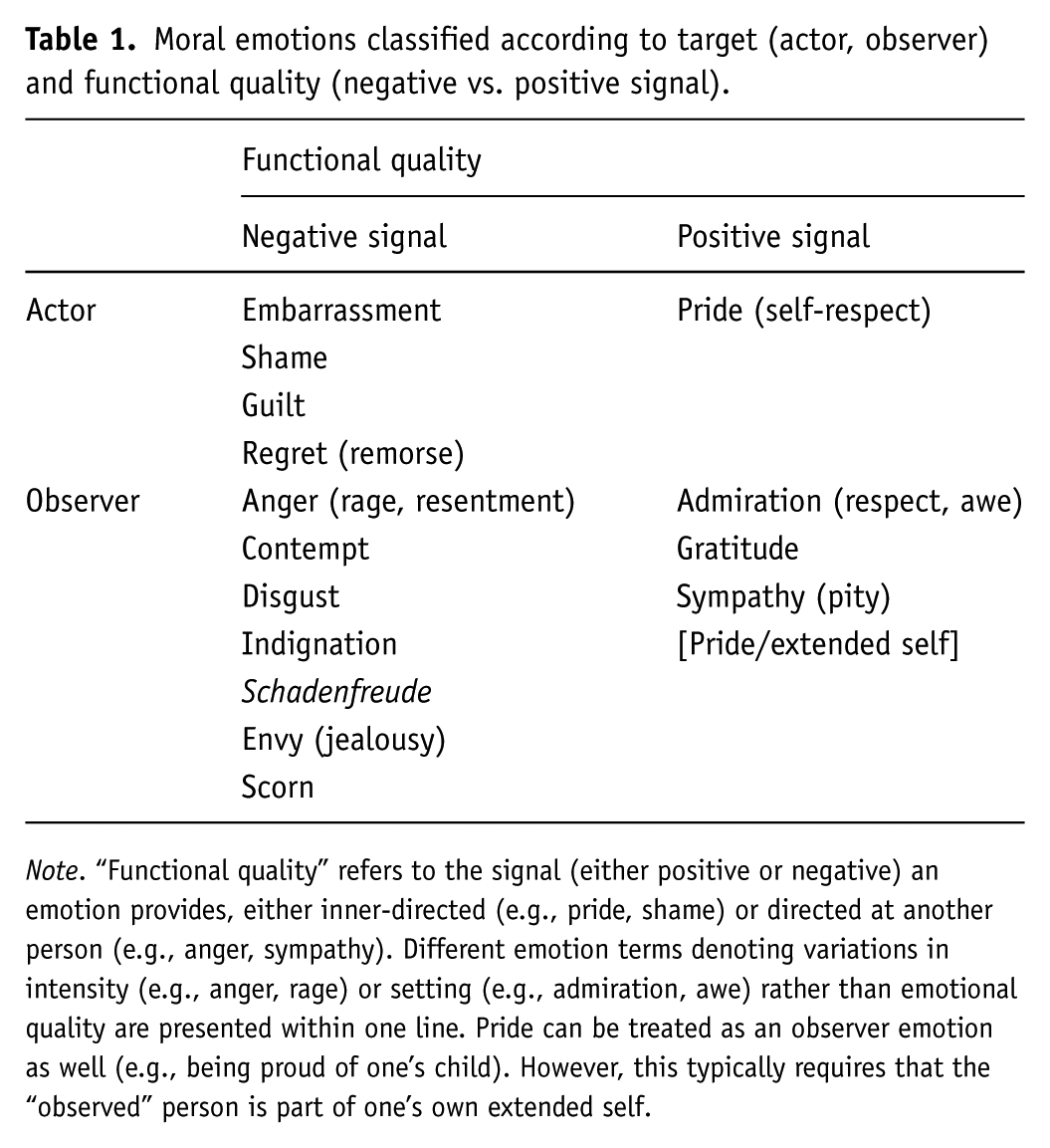
Note. “Functional quality” refers to the signal (either positive or negative) an emotion provides, either inner-directed (e.g., pride, shame) or directed at another person (e.g., anger, sympathy). Different emotion terms denoting variations in intensity (e.g., anger, rage) or setting (e.g., admiration, awe) rather than emotional quality are presented within one line. Pride can be treated as an observer emotion as well (e.g., being proud of one’s child). However, this typically requires that the “observed” person is part of one’s own extended self.
On Metaphors: From Scientists to Judges
As outlined, the metaphor of the naïve scientist, aiming to understand, predict, and control himself and his environment, guided attribution theory from its beginning. This metaphor has been supplemented by another conception or metaphor of the human mind (as a juxtaposition rather than a replacement). Weiner (e.g., 2006) referred to this new metaphor as the person as a judge, and life as a courtroom. One obvious facet of this metaphor is that decisions concerning right and wrong must be made.
Several factors contributed to the transition from the man as a scientist to the courtroom metaphor. One factor is theoretical progress: When Atkinson (1964) introduced pride and shame as the central motivational forces of achievement-related behavior, this provided a first step to open the door to a more differentiated analysis of our emotional life (see Weiner, 2014). A second factor contributing to this metaphor shift is the “Zeitgeist”: A transition took place from the purely information-processing analogies of the human mind to the discovery of heuristics and emotionally mediated characteristics of human inference and decision-making. As an analogy, the ideal casting for the “man as scientist” is Star Trek’s highly analytical Commander Spock, and the “man as judge” is, with her profound emotional and social competencies, Counselor Troi.
Finally, the metaphor of life as a courtroom is genuinely inherent to the domain of moral sentiments and moral behavior: As Hume (1740, 1777) already outlined, moral emotions require considerations of right and wrong, good and bad—evaluations directly pertinent to persons as judges and life as a courtroom. Note that Hume (1740) advocated the view that “moral sentiments” (i.e., moral emotions) provide the decisive bridge in moving from thought to action. Thus, emotional capacities, related to both the expression and the perception of emotions in self and others, are an essential element of the man as judge and life as courtroom metaphor as well.
The metaphor of man as a “judge in the courtroom of life” has several connotations, some of which serve our analysis well, while others might be misleading. An undesired connotation of the metaphor is the extraordinariness of the courtroom situation. Instead, we frequently have to make moral judgments: A teacher needs to decide whether she provides negative or positive feedback in the classroom. The same is true for partners in close relationships, colleagues at the workplace, members of a sports team, or in interactions between parents and children. Moral decisions sometimes inevitably come to us, for example when a homeless person approaches us asking for money and we ask ourselves whether his plight is due to lack of ability or effort. Or imagine we ask someone to give us directions and receive no answer: Is this person unwilling, or is he unable because of an autistic disorder? These examples illustrate that being a “judge” is quite a commonplace thing in everyday life.
Second, being a judge is not intended to imply that we are omniscient information processors. Thus, Mr. Spock is not the typical ruler of the everyday courtroom. What is true in case of Heider’s (1958) metaphor of the naïve scientist (scientists try to get it right, but may often fail as well), applies to judges as well: Our judgments are not always well-informed, correct, and just. At times, we are reminded or remind ourselves that judgments, though inevitable, need to be made with great caution (as the Bible says: “He who is without sin among you, let him be the first to throw a stone”). On the other hand, judgments under uncertainty and quick intuitive decisions are often needed. Thus, our daily lives involve a myriad of judgments about right and wrong, both with respect to the intrapersonal domain (“Am I right or wrong?”) and the interpersonal domain (“Is s/he right or wrong?”). We might therefore say that we are judges of and in everyday life.
Moral Emotions From an Attributional Point of View
Weiner (2006) provided the most comprehensive attributional theory of moral emotions. This approach enables us to integrate a multitude of findings that would otherwise remain unconnected. The basic argument is that moral emotions vary according to the controllability of the perceived causes of the event under consideration. For example, a student might fail an exam in school due to low effort or due to low aptitude. Attributional theories conceptualize low effort as a controllable cause; thus, anger is the typical emotional reaction. In contrast, low aptitude is uncontrollable; therefore, sympathy is likely. As can be seen, entirely different moral emotions arise, depending upon the controllability of the perceived cause. Is this true for other emotions in the moral landscape as well? We will answer this question by summarizing the available evidence. To do so, we consider moral actor emotions that provide (a) positive or (b) negative signals, as well as moral observer emotions that provide (c) positive or (d) negative signals. For each of these four cells, we distinguish between emotions related to controllable versus uncontrollable causes. An overview is given in Table 2.
Moral emotions classified according to target, functional quality, and controllability of perceived cause.
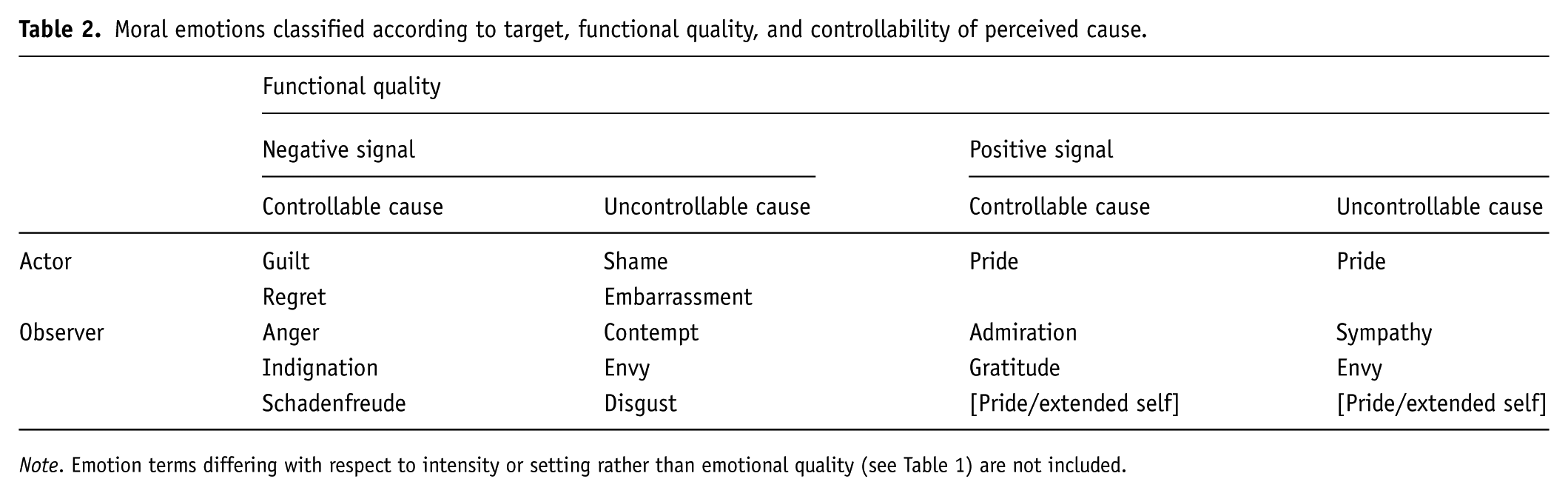
Note. Emotion terms differing with respect to intensity or setting rather than emotional quality (see Table 1) are not included.
The Moral Actor Receiving Negative Signals
It is assumed that guilt and regret are present given controllable causes of negative events or actions, while shame and embarrassment prevail when uncontrollable causes are present. Both guilt and regret are based on perceptions of controllability and responsibility (e.g., Basil, Ridgway, & Basil, 2006; Graham, 1984; van Dijk, van der Pligt, & Zeelenberg, 1999; Zeelenberg, van Dijk, & Manstead, 1998, 2000) and are linked to making up for one’s fault or wrongdoing (e.g., Tangney & Fisher, 1995; van Dijk & Zeelenberg, 2002). As Berndsen, van der Pligt, Doosje, and Manstead (2004) argued, regret is more closely related to intrapersonal faults, while guilt follows after interpersonal harm.
Both guilt and shame may occur after a person’s transgression of moral standards, as is the case for lying, stealing, cheating, or not helping others (e.g., Baumeister, Stillwell, & Heatherton, 1994; Keltner & Buswell, 1996; Tangney, 2002). In addition, shame is elicited given two conditions: (a) A person perceives herself as being uncontrollably defective or flawed, and (b) this state of affairs is perceived by others (e.g., Lewis, 1971). Shame has predominantly been connected to uncontrollable and stable outcomes or “faults” (e.g., an enduring stigma like obesity or low intelligence), while embarrassment is experienced when the uncontrollable negative event is unstable in nature (see Keltner & Buswell, 1996; Miller, 1992). In contrast to regret and guilt, shame and embarrassment are often characterized by withdrawal and a tendency to hide (Lewis, 1971; Lindsay-Hartz, 1984; Sheikh & Janoff-Bulman, 2010; Tangney & Dearing, 2002; Tangney & Fisher, 1995; Tangney et al., 2007), which also is apparent in the mimic and gestural expression of shame and embarrassment (Darwin, 1872). However, under specific circumstances shame can also be followed by approach motivation and prosocial behaviors (de Hooge, Zeelenberg, & Breugelmans, 2010, 2011).
The Moral Actor Receiving Positive Signals
Pride is the only positive signal related to the moral actor. Pride can arise given either controllable or uncontrollable causes, as it tells “a tale of two facets” (Tracy & Robins, 2007). Thus, a person can be proud of uncontrollable causes like beauty or inherited wealth (Chipperfield, Perry, Weiner, & Newall, 2009), or proud of controllable causes, as for example achieving a goal by means of high effort (Hareli & Weiner, 2002). In this regard, Tangney and coworkers (Tangney, 1990, 2002; Tangney et al., 2007) distinguish between alpha- versus beta-pride: Alpha-pride refers to pride in a person’s self (e.g., with regard to one’s abilities), whereas beta-pride refers to pride in a person’s behavior (e.g., expended effort to attain one’s goals). Experiencing pride is likely a rewarding inner-directed signal following positive behavior, as confirmed by the motivational role of pride in the expectancy-value theory by Atkinson (1964). However, it is a two-edged sword, with obvious downsides when exhibited to others (see Feather, 1989, 1991; Hareli & Weiner, 2000). Pride can as well be experienced from an observer’s point of view (see next).
The Moral Observer Sending Negative Signals
Quite surprisingly, at first sight, there are negative emotional signals to those who succeed due to uncontrollable causes (i.e., envy), as well as to those failing due to uncontrollable causes (i.e., contempt, scorn, disgust). Envy, as Weiner (2006) argued, is less likely to emerge vis-à-vis positive outcomes caused by controllable causes such as effort, as all can exert effort. Thus, envy is more likely to be directed at others’ uncontrollable characteristics such as aptitude, intelligence, beauty, or wealth.
Contempt is in one respect the counterpart of envy (following uncontrollable positive outcomes), as it represents a negative signal following uncontrollable negative outcomes (Hareli & Weiner, 2002; Hutcherson & Gross, 2011; Weiner, 2006). Contempt is related to the perception of the observer that s/he is in some way better than the observed person (Izard, 1977), as for example due to a stable characteristic such as intelligence, wealth, or beauty (uncontrollable causes). As Weiner (2006, p. 90) states: “Others might be held in contempt because of their actions, but these behaviors likely are ascribed to their character, which I suggest drives this emotional reaction.” Similar arguments also apply to disgust (in its limited sense, as outlined before), and contempt as well as disgust are also experienced given an individual’s failure to comply with norms of the society (Rozin et. al., 1999).
Finally, we consider negative signals to others due to controllable causes. Anger and indignation can be conceptualized as being similar in several respects. However, while anger is more typically evoked when the observer is part of the interaction, indignation does not require personal involvement (for example, when observing a person betraying another person). There is an impressive database indicating that anger is connected to perceptions of controllability (for a meta-analysis, see Rudolph, Roesch, Greitemeyer, & Weiner, 2004). In addition, anger increases the likelihood that help is withheld or a reactive aggression occurs (for a summary, see Weiner, 2006).
Schadenfreude has already been characterized as a discordant moral emotion: The moral observer takes joy in the misfortune of another, and the joy of the observer represents a negative signal to the observed person. Interestingly, children at the age of 4 already tend to hide their feelings of schadenfreude, as they are aware of the fact that their joy is hurtful (Schulz, Rudolph, Tscharaktschiew, & Rudolph, 2013). Schadenfreude often involves complex sequences of events and attributions, and some of them do not necessarily require perceptions of controllability and responsibility (see Weiner, 2014). In many cases, however, schadenfreude is elicited when the cause of the misfortune is regarded as controllable (“could have done otherwise”). Schadenfreude can be seen as a counterpart of sympathy—both emotions (either feeling bad or sorry vs. experiencing joy) are reactions to misfortunes of others. While the misfortune is necessarily linked to uncontrollable causes in case of sympathy, which elicits prosocial actions, schadenfreude has behavioral implications opposite to sympathy. For example, children experiencing schadenfreude tend to withhold help, while children experiencing sympathy are willing to help (Schulz et al., 2013).
The Moral Observer Sending Positive Signals
Admiration and gratitude are related to appreciating or praising others (e.g., Algoe & Haidt, 2009; Ortony et al., 1988). Furthermore, admiration occurs after successes attributed to high effort (Hareli & Weiner, 2002; Rudolph et al., 2013; Weiner, 2006). For example, Nelson Mandela has been among the most admired people on earth for decades (as consistently confirmed by Gallup Polls). This is unequivocally ascribed to the fact that Nelson Mandela worked extremely hard and persistently for achieving a highly valued goal. Gratitude can be regarded as a special case of admiration, because for gratitude the welcomed behavior must have been directed at the moral observer who benefitted from such action. Thus, from an external perspective, admiration for Mandela is the dominant reaction, while many of the fellow countrymen of Nelson Mandela likely feel gratitude as well. Both admiration and gratitude are intricate emotions, for different reasons: Admiration can as well be experienced given uncontrollable causes (such as beauty or intelligence), and gratitude can have negative implications for the self (see Weiner, 2006, for a summary). However, Rudolph et al. (2013) found that admiration is more likely and felt stronger when the observed person has invested much effort (a controllable cause), rather than when effort was not invested. We therefore suggest that controllable causes increase the likelihood and intensity of admiration.
We now turn to emotions representing positive signals directed at the observed person due to uncontrollable causes. Pride (as an observer emotion) is experienced after successes ascribed to both controllable and uncontrollable causes of other’s success (e.g., Chipperfield et al., 2009; Hareli & Weiner, 2002). Thus, Tangney’s concept of alpha- versus beta-pride (see previous lines) may as well be related to pride as an observer emotion. However, Rudolph et al. (2013) reported that pride (like admiration) predominantly emerges when the attainment of positive goals is attributed to high effort (as a controllable cause). Sympathy is a positive signal to a person who suffers from an undesirable outcome or plight, given that uncontrollable causes are present, such as lack of ability or aptitude. For sympathy (like anger), there is impressive evidence that attributions to uncontrollable causes are required (for a meta-analysis, see Rudolph et al., 2004). Moreover, it is unequivocally confirmed that sympathy is a strong determinant of help-giving (for a summary, see Rudolph et al., 2004; Weiner, 2006).
Conclusions
An attributional account of the moral emotions has been presented. In which way and how well does this attributional account serve us in our aim to understand the moral emotions? Clearly, the moral emotional landscape is well explored for some of these moral emotions, especially anger, guilt, regret, shame, and sympathy. For the remaining moral emotions (see Table 1), researchers have just begun to analyze these from an attributional point of view.
First, the person as a judge emerges as an everyday moral judge, both intrapersonally (as an actor) and interpersonally (as an observer). This fundamental dichotomy of the actor and the observer has been a guiding theme of attributional research from the beginning, and is one of the main divides of the landscape of moral emotions as well. Second, the functional quality of moral emotions allows for a classification of moral emotions according to the signals they send to either the moral actor or the observed person. It is this functional quality of moral emotions that helps us navigate the social world. Third, when taking the perceived causes of outcomes into account, the perceived controllability of causes divides the moral landscape into “effort-linked” and “ability-linked” emotions (Weiner, 2006). For negative outcomes, controllability is crucial for a distinction between “sin” (could have done otherwise) versus “sickness” (cannot do better; see Weiner, 1993). For positive outcomes, controllability marks the difference between deserved (by effort) and undeserved (inherited or accidentally present) positive characteristics.
Although the resulting classification of moral emotions (see Table 2) embraces the richness of emotions that have been characterized as being moral in nature, there is clearly much room for discussion and future research: (a) Lists of emotions and classification systems should not be regarded as definite, but are helpful due to their heuristic value. (b) The analyses presented here are not to be taken as proposing that all the determinants of moral emotions have been identified (see also Weiner, 2006). (c) Empirical evidence is extremely rich and assuring for some parts of the moral emotional landscape. A good example in this vein is the analysis of the cognitive determinants and behavioral consequences of sympathy and anger. As indicated, other parts of that landscape are far less well explored.
Finally, let us turn to open questions or “blind spots,” hopefully the subject of future analyses. In accordance with the guiding metaphors of attribution research (man as everyday scientists and judges), attributional research emphasizes the everyday character of moral emotions. Therefore, one of the strengths of the present attributional approach to moral emotions is the diversity of emotions and settings under investigation. However, this research is thus far largely unrelated to the analyses of moral judgments and decisions involving extraordinary situations, such as murder (Chapman & Anderson, 2011), incest between siblings (e.g., Haidt, 2001), or life-and-death situations involving decisions such as killing one person to rescue a group of other persons (e.g., Greene, Sommerville, Nystrom, Darley, & Cohen, 2001). It is far from clear thus far whether principles valid in the one domain are readily applicable to the other.
Another “blind spot” needing clarification is the distinction between events and causes as opposed to actions and reasons (see also Malle, 2004). That is, in explaining an event, we typically refer to the event as being caused by something in the past. Examples are “I was late at work because my car broke down,” or “I got an excellent grade at this exam because I tried so hard.” That is, explaining an event typically requires that a cause (in the past) is mentioned. In contrast, when explaining our actions, we often do so by giving justifications or reasons (anticipated or desired consequences of actions which made us chose these actions). For example, we say: “I study medicine because I want to become a physician,” or “I bought my friend this great book because I wanted to please him.” Thus, when explaining a (volitionally chosen) action, we often refer to some anticipated or desired end state we wish to achieve by this action. As Weiner (2006) noted “There is a valid distinction between reasons and causes, even though it is murky and sometimes fraught with philosophical intricacies and quagmires” (p. 20). For some good reasons, therefore, an attributional analysis has thus far predominantly been dedicated to the analysis of causes. However, to fully explore moral emotions and moral actions, we will have to take actions and their reasons into account as well: Persons are not only judged according to outcomes caused by their past actions, but also according to the actions they chose to attain future outcomes.
This leads to a related issue that has been explicated even from the very beginning of attribution theory: As Heider (1958) outlined in his naïve action analysis, actions are characterized by can, want, must, and ought. The concept of ought is especially relevant in the moral domain: We ought to aspire to goodness and virtue, while we ought to avoid vice and sin. Thus, moral emotions are not only determined by the results or effects persons obtain and how these results are caused. Rather, moral emotions are also determined by the goals persons chose (the good or the bad), and which actions are taken to obtain these. In the moral domain, this requires an integration of Heider’s concepts of ought, in addition to perceived controllability of causes. A first attempt to empirically test these considerations is presented in Rudolph et al. (2013). These studies investigated the pursuit of goals as either conforming or being opposed to ought standards, the attainment (or nonattainment) of such goals, and the controllability of the underlying cause. Results indicate that each of these three factors exerts a substantial impact (each characterized by large effect sizes) on all the moral emotions outlined here. It is further seen that actors judging themselves, place comparatively strong emphasis on whether they actually attain a desired goal. In contrast, observers (in judging others) are more inclined to take the underlying intentions (pursuing positive vs. negative goals) and actions (e.g., investing effort) of the observed person into account. This is another confirmation of the eminent influence of the actor/observer distinction in the moral landscape.
In concluding, let us return to one of the most fundamental characteristics of both the conceptual analysis and the empirical findings outlined here. This is the sequential character of an attributional theory of (moral) emotion and motivation, with thinking giving rise to moral emotions, and moral emotions guiding and energizing action. Though there is still much work to be done, psychology has substantiated the basic idea that guided David Hume’s (1740) philosophical analysis of moral emotions:
Since morals, therefore, have an influence on the actions and affections, it follows, that they cannot be derived from reason; and that because reason alone, as we have already proved, can never have any such influence. Morals excite passions, and [these passions] produce or prevent actions. (p. 977)