







Abstract
The widespread assumption that anger is a response to wrongdoing and motivates people to sanction it, as well as the lack of distinction between resentment and indignation, obscure notable differences among these three emotions in terms of their specific beliefs, goals, and action tendencies, their nonmoral or moral character, and the kinds of moral claim implied. We provide a cognitive-motivational analysis of anger, resentment, and indignation, showing that, while sharing a common core, they are distinguishable from one another because they comprise nonoverlapping belief–goal compounds. We also emphasize the usefulness of applying a belief–goal analysis to kin emotions because, by comparison, one can sharpen the analysis and identify the distinctive features of each of them.
What may be called the “family” of hostile emotions—namely, emotions involving ill will against somebody—is quite large: anger, resentment, indignation, contempt, and disgust, to name just the most obvious ones, belong to this family.
Although “anger” is often used to refer to most of those emotions, especially resentment and indignation, and the latter terms are used interchangeably, we suggest that each of these emotions is qualified by specific belief and goal components. Belief–desire theories of emotions have already been proposed (e.g., Reisenzein, 2009), and cognitive-motivational “anatomies” already exist for many emotions (e.g., Lazarus, 1991; Ortony, Clore, & Collins, 1988). However, we believe that much work is still needed to identify the distinctive features of each emotion.
We aim to show that a belief–goal analysis is a useful means for identifying both the common core of kin emotions and notable differences among them. To identify a family of emotions, we focus on a particular domain of emotional experience (in this case, hostility concerned with others’ behavior and attitudes), single out the basic beliefs and goals that are pertinent to this domain, and define the “cognitive space” of the emotions resulting from these mental constituents. To identify the specific cognitive space of each possible member of the family, we try to ascertain whether there may exist a compound of beliefs and goals that does not completely overlap with another compound in the same family.
We will restrict our treatment to anger, resentment, and indignation, which are particularly difficult to disentangle from one another. We will only consider their necessary and sufficient belief–goal compounds, neglecting other cognitive-motivational components which in natural contexts may enrich the constitutive compounds.
Before analyzing each emotion, we need to define two basic concepts, those of harm and wrong, which are crucial for understanding the differences between anger and its “cousins.”
Harm Versus Wrong
A harm is here defined as a material or immaterial damage caused by something or someone to something or someone. The efficient causes can be human agents as well as nonhuman animals or physical forces and environmental conditions. The harmed entities or victims can be human agents, nonhuman animals, or physical objects. The efficient causes may coincide with the victims. When victims are endowed with goals, the harm implies a frustration, that is, the thwarting of some of their goals. For inducing an emotional reaction in a victim, the frustration should be perceived by him or her. In systems endowed with cognitive regulatory mechanisms (goals, beliefs, and discrepant assumptions), a perceived frustration implies a perceived discrepancy between their beliefs and goals (e.g., Miceli & Castelfranchi, 1997).
A wrong is a special kind of harm: it is a harm which is responsibly inflicted by an agent to a victim. The victim is typically a human being or society at large, although nonhuman animals and the environment itself can also be viewed as victims of a wrong. A wrongdoer is an agent who (a) has caused harm to somebody (causal responsibility); and (b) had either the goal to cause it (goal responsibility) or at least the power to foresee and prevent it (avoidance responsibility) while omitting to do so (Miceli, 1992; Weiner, 1995). Notice that condition (a), as it is expressed, is not strictly necessary: for an agent to be a wrongdoer, it is sufficient that (s)he has either pursued—successfully or not—the goal to cause harm to somebody or that, although not having that goal, (s)he caused harm while having the power to foresee and prevent it.
However, the previous definition is still incomplete, because a “responsibly inflicted harm” does not coincide with a wrong if it is perceived as justified—which occurs in the following cases: (a) when it is done in order to favor the victim’s interests (for instance, A hurts B in order to prevent B from killing themself); (b) when it is a punishment proper, that is, a commensurate response to a previous wrong committed by the victim (Miceli & Castelfranchi, 2011). Therefore, for a “responsibly inflicted harm” to be a “wrong,” it should be perceived as unjustified.
The notion of wrong implies that of harm. However a wrong is something more: it is, generally speaking, a twofold harm. Suppose John has been robbed of some good. His goal p of using (or possessing) it has been thwarted: this is the first harm. But another goal p1 of John’s has also been thwarted: the goal that his rights—including the right not to be a target of unjustified harm—be respected. This is the second harm, which, because of its immaterial nature, we may call an offense or insult.
Any wrong is a harm, even when the wrongdoer’s behavior is ineffective. In fact, although the wrongdoer (from now on, W) does not succeed in thwarting the victim’s goal p, W’s intentional attempt to inflict an unjustified harm implies a second-order harm: the thwarting of p1.
Any wrong is a harm, even when no suffering victim is identifiable. As long as an action is conceptualized as a wrong in a given society, this action is a responsibly inflicted and unjustified harm to the values or norms of that society. The victim is society itself—because W has attempted to thwart its values and norms, which are supposed to establish what is good or bad, and to promote and defend the collective interest and welfare.
Evaluations of wrongfulness—that is, of responsible and unjustified harmfulness—pertain to the moral domain. Moral evaluations in fact concern someone’s behavior, goals, beliefs, or attitudes for which (s)he is regarded as responsible. The evaluation will be positive or negative depending on the “beneficial” or “harmful” quality ascribed to such behavior, goals, and so on.
As shown by Gray, Schein, and Ward (2014), moral evaluations of wrongfulness activate perceptions of harm, even in what they call “objectively harmless” scenarios (e.g., consensual incest without procreation). According to these authors, “harmless wrongs” can be objective facts, but are a myth in psychological terms, because wrongs are perceived to imply harmed victims even when the latter are objectively absent. However, in our view harmless wrongs are a myth not only psychologically, but conceptually speaking, because the concept itself of wrong implies that of harm.
Whereas any wrong is a harm, a harm is not necessarily a wrong, as long as either the efficient cause is not held responsible for the harm or the latter is perceived as justified. Harm can be caused by natural forces such as fire, flood, wind, and so on. Or it can be caused by (human or nonhuman) agents who are cognitively unable to anticipate the consequences of their behavior. Or it can be caused by a human agent who, although being generally able to anticipate the effects of his or her behavior, performed a harmful act without having the goal to harm, and could not foresee and prevent the harmful consequences of that action.
Anger
According to a widespread view, anger is a strong feeling of annoyance and hostility elicited by a perceived wrong, and motivating action against W. Since Aristotle (1945), many definitions of anger share this view—thereby obscuring the possible differences among anger, resentment, and indignation. For instance, according to Dictionary.com, anger is “a strong feeling of displeasure and belligerence aroused by a wrong; wrath; ire,” and wrath is “strong, stern, or fierce anger; deeply resentful indignation.” Likewise, according to many students of emotion (e.g., Averill, 1982; Clore & Centerbar, 2004; Frijda, Kuipers, & ter Shure, 1989; Ortony et al., 1988; Petersen, 2010; Roseman, 1991; Weiner, 1985) anger is aroused by perceived frustrations ascribed to intentional and controllable factors—which comes close to the implication that the eliciting event is perceived as a wrong by the frustrated person.
Anger Implies a Perceived Harm, Not Necessarily a Perceived Wrong
In our view, the perceived intentionality and controllability of the harm are not necessary antecedents of anger. However, we do not suggest that anger is provoked by any frustration (e.g., Berkowitz, 1989). Goal frustration can provoke various emotional reactions (e.g., Lazarus, 1991), including anxiety, sadness, shame, or helplessness.
The necessary and sufficient antecedents of anger are, in our view, as follows:
First, one perceives a frustration or harm, that is, a discrepancy between one’s beliefs and goals, especially if important and unexpected. One’s goals include the goals of those people one identifies with and cares about—from one’s family members or friends to larger social groups, provided that one perceives oneself as belonging to those groups and derives one’s social identity from the qualifying features of these social categories. In fact, once individuals have internalized their group membership, and the latter has become part of their self-image, they share the group’s goals and values (e.g., Tajfel & Turner, 1986).
Second, the harmed individual attributes the harm to an efficient cause, and focuses their attention on this cause, which becomes the target of the emotion.
The perceived efficient cause can be, as already mentioned, not only a human agent (including oneself), but also a nonhuman animal, or an accidental negative event, or a physical object or force.
Admittedly, the typical targets of human anger are other human agents (e.g., Averill, 1983)—and these instances of anger are also the most relevant to our present concern to distinguish anger from resentment and indignation. However, as anger can be felt against a nonhuman harming cause, there is in principle no reason to view the perceived intentionality and controllability of the harm as necessary antecedents of the emotion, even when the cause is a human agent. Analogously, C. A. Smith and Lazarus (1993) propose three conditions for the elicitation of anger against somebody: the motivational relevance of the outcome, its inconsistency with the person’s goals, and the “other-accountability” of the outcome. This accountability does not necessarily coincide with responsibility proper. In line with a Heiderian view, which admits several levels of other-accountability, the more primitive levels include “impersonal causality,” according to which “anything that is caused by p is ascribed to him” (Heider, 1958, p. 113), whereas the more advanced ones imply controllability and intentionality factors (responsibility proper).
No doubt, intentionality and controllability contribute to the experience and intensity of hostile feelings (e.g., C. A. Smith, Haynes, Lazarus, & Pope, 1993). Hostility is more likely to be expressed, and to prompt aggression, when it is associated with the perception of a wrong (e.g., Bettencourt & Miller, 1996; Cohen, Nisbett, Bowdle, & Schwarz, 1996). But this does not prove that a perceived wrong is a necessary eliciting condition of anger. Humans are taught to control anger and its expression. A perceived wrong renders anger “legitimate,” that is, it makes anger coincide with resentment proper (see further on), which makes one feel allowed to express one’s hostility. As observed by Stein, Liwag, and Wade (1996, p. 108), “adults may not report angry feelings precipitated by inanimate objects or physical occurrences, because in their culture such expressions are not considered appropriate.”
Illegitimate Anger and the Perception of Injustice
Human anger can still be felt when it is “illegitimate,” that is, not only when it is not preceded by any attribution of the harm to human agency (e.g., Anderson, Deuser, & DeNeve, 1995; Berkowitz, 1989; Frijda, 1993), but also when a human harmdoer (from now on, H) is identified, but the latter is not perceived as a wrongdoer. For instance, as admitted by a stressed mother taking part in an Internet forum (mentalhelp.net),
I always seem to get mad for really nothing at my three kids, I always shout and scream at them . . . I like things done in a certain way, and it has to be that way or I get really stressed.
She feels anger at her children because they thwart her goal of “having things done in a certain way,” while believing that her kids are not guilty of any wrongdoing.
Anger is experienced by human infants (e.g., Lewis, Alessandri, & Sullivan, 1990), who are hardly capable of distinguishing “harmdoing” from “wrongdoing.” According to Stein and Levine’s (1989) studies, both children’s and adults’ experiences of anger were independent of the kind of harming agent, and independent of the intentions attributed to this agent. In Averill’s (1983) studies, 12% of the respondents described their anger as a reaction to another’s harmful act even though they viewed it as justified.
On the grounds of the previous arguments, we suggest that in order to feel anger at somebody it is necessary and sufficient that one believes that (s)he has thwarted one’s own interests or those of people one cares about, irrespective of any perceived injustice (Batson et al., 2007; Dubreuil, 2015).
Once such basic anger arises, it typically undergoes further cognitive elaborations (e.g., Frijda, 1993) including controllability and intentionality considerations. Consequently, one may either recognize one’s anger as illegitimate and try to suppress it, or (unconsciously) “translate” H’s causal responsibility into responsibility proper so as to legitimate one’s anger, and feel allowed to blame him or her. Blame in fact implies an evaluation of wrongfulness (e.g., Malle, Guglielmo, & Monroe, 2014).
In other words, the perception of injustice may be a rationalization of one’s anger (e.g., Miller, 2001). This is apparent in cases of incidental anger (triggered by sources unrelated to the event at hand). For instance, in a study by Goldberg, Lerner, and Tetlock (1999), participants experiencing incidental anger, compared to participants in a neutral state, were more likely to show a blaming tendency towards supposed “defendants.”
Anger and blame influence each other. As shown by Quigley and Tedeschi (1996), “although blame is a cognitive mediator of anger feelings, anger can also affect blame such that the more angry one becomes, the more blame one attributes” (p. 1282). As pointed out by Alicke (2000), people engage in blame-validation processing, by attributing intentionality and foresight to H’s actions (and downplaying mitigating circumstances and environmental causes) so as to validate their blame.
Because perceived injustice elicits hostile feelings, people tend to assume that hostile feelings—including anger—imply perceived injustice. However, “if p then q” (“If one has suffered a wrong, then one feels angry”) does not allow to infer p from q (“If one feels angry, then one has suffered a wrong”). Suppose that Paul knows that if “Mary asks John to marry her” (p), then “John is happy” (q). If Paul finds John in a happy mood and draws the inference that Mary has asked John to marry her, Paul can be mistaken, because John’s happiness can be the consequence of many different premises. Paul’s inference is a typical example of abduction (e.g., Levesque, 1989), a form of diagnostic reasoning where a premise is inferred from its consequence. However frequent and often efficient in dealing with everyday problems (Oaksford & Chater, 1991), abduction leads to questionable assumptions, in that a single piece of evidence is normally insufficient for reaching a univocal diagnosis.
As we are going to suggest, perceived injustice elicits a special kind of “anger,” or more correctly, hostile feeling—namely, resentment or indignation—whereas mere anger is not elicited by perceived injustice, although it often leads to perceived injustice to legitimize it.
Action Tendencies
Anger is characterized by a tendency to attack H, so as to change the negative, harmful situation (Frijda et al., 1989; Harmon-Jones & Allen, 1998). The physiological reactions and neurological correlates of anger, such as autonomic arousal (e.g., Levenson, Ekman, & Friesen, 1990) and left frontal hemispheric activation, which is typical of approach motivation (Harmon-Jones, 2003), support the assumption that anger prompts aggressive tendencies towards H. The urge to move against H is sustained by a sense of control and optimistic expectations about one’s own capability to influence the situation (e.g., Lerner & Tiedens, 2006).
The basic motivation of an attack prompted by anger is that of causing harm to H by thwarting some goal of his/hers. This is not to say that anger necessarily causes aggression—an assumption questioned by various researchers (e.g., Bandura, 1973; Törestad, 1990). In our view, emotions are linked to goals and action tendencies, rather than actual behavior. Goals are not necessarily pursued, and action tendencies can be inhibited.
The harm inflicted on H may in turn be viewed as a means to prevent, block, or neutralize H’s behavior, so as to avoid or reduce the harm H is going to cause to oneself. Angry people, perceiving H as an obstacle to the attainment of their own goals, move against this obstacle so as to neutralize it.
However, anger can also promote “attack” when the harm has already been done and no remedy is available. In these cases, the attack is no longer functional to coping with the threat of goal frustration. Still, it is functional to weaken or intimidate H, thereby deterring future harm, as well as to restore the “power balance” between oneself and H by inflicting some injury on him or her.
Depending on contextual as well as personality factors, an attack can be more or less direct. By direct attack we mean not only a physical attack but also a verbal one such as an insult. By indirect attack we mean any form of relational aggression, that is, any aggression to H’s social status or relationships (e.g., Crick & Grotpeter, 1995), such as spreading rumors, lies, or secrets about H, and excluding H from one’s social network.
A different, special case of “indirect” attack is the displaced one (e.g., Marcus-Newall, Pedersen, Carlson, & Miller, 2000), when the target is different from H because either the latter is unavailable or the goal to attack H is inhibited for fear of negative consequences. In such instances, attack does not serve the aforementioned functions. The only function of a displaced attack is that of “giving vent” to one’s anger. This can imply some relief, by mitigating the tension caused by the inhibited expression of anger. However, the intensity of anger is not necessarily reduced by its expression, and in fact it can even increase (e.g., Bushman, Baumeister, & Stack, 1999).
Apart from displaced attack, the typical adaptive functions of an angry attack are, as already pointed out, either (a) avoiding goal frustration by preventing, blocking, or neutralizing H’s behavior, or (b) deterring future harm by weakening or intimidating H, or (c) restoring the power balance between oneself and H.
However, these adaptive functions of an attack response are not necessarily internal goals of the angry person, that is, goals represented in the “angry mind.” What is necessary and sufficient to motivate attack is only the goal that H suffer harm. In an evolutionary perspective, emotions trigger goals and action tendencies that “serve” (or served) to answer recurrent ecological demands (e.g., Tooby & Cosmides, 1990). However, the instrumental relationship between such goals and their adaptive functions is not necessarily represented in people’s minds. For instance, another hostile emotion, envy, implies ill will and the consequent goal or wish that the envied suffers harm, 1 which has been traced back to the functions of attaining equality with the envied, and, in turn, self-protection (e.g., Silver & Sabini, 1978). But equality and self-protection are not necessarily goals of the envier. The latter wants the envied person’s harm nonstrategically, as an end in itself (Miceli & Castelfranchi, 2007), just “out of ill will.”
The functions attributed to an angry attack testify to possible constructive outcomes yielded by anger and its expression: anger favors the attainment of one’s own goals through action tendencies and behaviors that often protect or restore one’s own resources. As remarked by Lerner and Tiedens (2006), the sense of control and optimistic expectations about one’s own capability to get what one wants, which are typically associated with anger, are both pleasant and rewarding, considering the positive impact of self-efficacy beliefs on effort, persistence, and achievement (e.g., Bandura & Cervone, 2000; Peterson & Seligman, 2004). Moreover, the optimistic expectations favored by anger are likely to have carryover effects on a wide range of new situations (e.g., Lerner, Gonzales, Small, & Fischhoff, 2003).
Even when anger does not involve an attack against H, its (verbal or nonverbal) expression may induce H’s attempts at compensation and repair, either because H can envisage a threat to his or her relationship with the angry person, or because, more simply, H realizes that the angry person’s goals have not been met. Anger is indeed a powerful signal that one feels hurt. Displays of anger capture others’ attention (Hansen & Hansen, 1988), and may favor their inquiry into the cause, reciprocal explanations, and attempts to rectify the situation (e.g., Burgoon, Stern, & Dillman, 1995; Gottman & Krokoff, 1989).
These positive consequences of anger are counterbalanced by some obvious negative consequences (e.g., Lerner & Tiedens, 2006). The urge to move against the harming source can induce reckless attacks, implying overconfidence, excessive risk-taking, and consequent damages to oneself, as well as disregard of others’ welfare and social norms, and unjust blame against nonculpable harmdoers.
Resentment
We define resentment as a hostile emotion qualified by the perception of having suffered a wrong. Therefore, resentment is legitimate anger. However, this anger is “legitimate” in the resenter’s (R’s) perception, in that the perception of unfairness can be inaccurate (e.g., MacLachlan, 2010).
Resentment as a Moral Emotion
Resentment can be said to be a moral emotion in that it invokes a moral concept such as an acknowledged right or wrong (e.g., Rawls, 1971) as an explanation of the feeling itself. (On the polysemy of “moral emotions,” see Cova, Deonna, and Sander [2015].)
The resenter’s suffering is twofold—for both the first-order harm and the second-order harm or offense received (Miceli & Castelfranchi, 2011). Because a wrong typically implies a first-order harm, R’s thwarted goals—goal p which has been frustrated by the first-order harm, and goal p1 of not being a target of unjustified harm—are generally “fused” with each other. However, they are distinct goals, which is apparent when only p1 is thwarted. Going back to a previous example, suppose that a thief’s attempt to rob John of a certain good fails: although John’s goal p of benefitting from that good is not thwarted, p1 is thwarted, because the thief’s intention to deprive R of his or her possessions is already an offense for R. And a perceived offense is sufficient for resentment to be felt, and for an aggressive action tendency to be triggered. In an interesting study on retaliation (Batson, Bowers, Leonard, & Smith, 2000) where the effects of “harm done” were separated from those of “harm intended,” it was harm intended, regardless of its consequences, that led the victims to retaliate. Although “harm done” may have elicited mere anger, it was less likely than (resentment for) “harm intended” to trigger an aggressive response.
As with the angry individual, R’s goals include the goals of those people or groups (s)he identifies with and cares about. Consequently, the victim of the wrong can be another individual as well as a group, and still one can perceive the wrong as affecting oneself, and experience resentment.
True Resentment Versus Disguised Anger
We do not share the view that for resentment proper to be experienced, the hostile feeling should be objectively (or intersubjectively) justified (e.g., Parrott, 1991). As long as R genuinely believes to have suffered a wrong, R’s hostile feeling against the supposed W is resentment, even though R’s belief is mistaken. The accuracy of people’s beliefs has no relevance for the kind of their emotions. The latter depend on the subjective appraisals of the experiencing individual. If Jimmy is sad because he mistakenly (but sincerely) believes that his mom is dead, Jimmy’s feeling is still sadness. Likewise, if John is resentful because he mistakenly believes to have been treated unfairly, he feels true resentment.
By contrast, if one shows to be resentful without genuinely believing to have suffered a wrong, one’s feeling is not resentment, but mere anger, disguised as resentment. This is, for instance, a typical manoeuvre of envious people, who try to masquerade their anger against the envied as resentment (e.g., Foster, 1972) by pretending to have suffered unfairness. That is, while “deeply” believing that the envied deserves their advantage, the envier may try to persuade themself (and others) that the advantage was obtained dishonestly, thereby raising illegitimate anger to the dignity of a moral emotion.
Envious anger can be elicited by an unfavorable comparison with the advantaged other, and by the consequent frustration, sense of inferiority, and loss of self-esteem, independent of a sense of injustice. The envier “feels hostility because the envied person serves as a threat, a marker of the envious person’s real or perceived deficit” (Exline & Zell, 2008, p. 325). However, envious people often find very hard to acknowledge this unjustified and blameworthy hostility, and “look for” some possible wrong committed by the envied. In other words, their so-called “subjective injustice beliefs” (e.g., R. H. Smith, Parrott, Ozer, & Moniz, 1994) can be post hoc manoeuvres for justifying their hostile feelings. As shown by Feather and Sherman (2002), envy can occur without a sense of injustice, whereas resentment is elicited by a judgment of undeservingness of the advantaged.
This is not to say that true resentment is alien to envy. Envy can in fact imply two kinds of hostile feeling: the first one is the ill will towards the advantaged party, which is mere anger (although possibly disguised as resentment). The second kind of hostile feeling involves some perceived injustice—the “injustice” of God, nature, or luck, for endowing some people with more gifts (skills, beauty, health, wealth) than others. (See Parrott’s [1991] notion of “global resentment.”) Actually, even when others are viewed as deserving their advantage, one’s own comparative disadvantage can be still (sincerely) considered unfair (Miceli & Castelfranchi, 2007), and elicit resentment against the supposed “bestowers of advantages.”
Action Tendencies
The typical action tendency triggered by resentment is retaliation. Retaliation does not necessarily differ from an angry attack as for the specific actions instigated by either emotion. However, the respective underlying goals are different.
An angry attack is motivated by the goal that H suffer harm, which in turn serves the functions (not necessarily internal goals) of either avoiding one’s own present goal frustration, or deterring future harm, or restoring the power balance between oneself and H.
By contrast, retaliation is motivated by R’s internal goal that W be punished, that is, by the goal of making W suffer a harm as a commensurate response to the wrongdoing; R wants to punish the infringement of his or her own right not to be a target of illegitimate harm (although the extent of the desired punishment can be also related to the seriousness of the first-order harm).
Punishment is in turn instrumental to R’s internal goal of “getting even” or “settling accounts” with W. The resented person feels in credit with W because of the suffered wrong, and the punishment is viewed as a form of payment of W’s “debt” to R. According to the natural principles of retributive justice, the victim of an undeserved and responsibly inflicted harm is indeed entitled to seek compensation by inflicting a corresponding harm on W.
As attack, retaliation can be either direct or indirect. Moreover, the goal that W be punished does not have to be necessarily pursued by R themself. Sometimes this can be unfeasible or ill-advised, and R can see his or her goal as fulfilled through other agents’ (intended or even unintended) harming actions against W, or through some accidental harm that befalls W, independent of human agency—provided that R conceives the harm suffered by W as a punishment (inflicted by God, luck or the karmic law) for the wrong (s)he has committed.
As shown by Feather and Sherman (2002), Schadenfreude, or joy at another’s misfortune, is closely associated with resentment. However, Schadenfreude is a multidetermined emotion (van Dijk, Ouwerkerk, Goslinga, Nieweg, & Gallucci, 2006): it can be elicited by resentment (van Dijk, Ouwerkerk, Goslinga, & Nieweg, 2005), envy (Brigham, Kelso, Jackson, & Smith, 1997; R. H. Smith et al., 1996), or mere dislike (Hareli & Weiner, 2002). Basic anger, implying the goal that H be harmed, can also be associated with Schadenfreude, because the satisfaction of this goal through H’s misfortune is likely to induce some pleasure in the angry person. Still, we suggest that the overt expression of Schadenfreude might be most typical of resentment, because R feels authentically justified by a sense of injustice: pleasure at W’s misfortune, although being an unpraiseworthy feeling, is viewed as a pardonable emotional response to the fact that “justice is done.”
According to equity principles (e.g., Walster, Berscheid, & Walster, 1976) retaliation is indeed a basic way to “get even” with W. Getting even implies restoring a power balance with W, and it is also functional to deter further wrongs (e.g., Rogers, 1980). However, these are possible functions of retaliation, which do not need to be internal goals of R. In R’s perception, “getting even” can simply mean making W pay his or her debt. In performing retaliation, R is not necessarily motivated by the goal of “equalizing” power between himself or herself and W—that is, having equal resources or social status. As a matter of fact, punishment can be costly for R, and cause R’s overall power reduction rather than increase. In the same vein, R may not consider the advantageous effects of retaliation in preventing further wrongdoings by W (Carlsmith, Darley, & Robinson, 2002).
Despite the costs of punishment, R will tend to retaliate, even without any prospect of future benefits. Studies in behavioral economics (e.g., Camerer, Loewenstein, & Rabin, 2004; Diamond & Vartiainer, 2007) have substantially modified the models of neoclassical economics by showing that ordinary people’s decision making cannot be explained solely in terms of a rational maximization of expected utility, because other determinants, with special reference to emotions, exert a significant impact on their decisions.
A paradigmatic example is offered by the ultimatum game, where a “proposer” should offer part of his or her own endowment to a “responder,” and the latter should decide whether to accept or reject it. If the offer is rejected, both parties receive nothing. Therefore, according to the “rational” prediction of classical economic theory, proposers would offer the minimal amount possible, and responders would accept it. However, this prediction is typically violated: proposers are more generous than expected in that they tend to offer about 40% of their own endowment, and responders tend to reject offers below 30–40% (e.g., Camerer, 2003; Camerer & Thaler, 1995).
Leaving aside the reasons for the proposers’ “generosity,” that might be motivated by strategic rather than fairness considerations (e.g., Croson & Konow, 2009), what is more significant to our present concerns is the responders’ behavior—namely, the fact that they tend to sacrifice their own payoff (even without any prospect of future benefits) in order to punish the proposers who make “offensive” offers. 2
Moreover, the responders’ punishing behavior has been found to be mediated by “anger,” or more precisely (in our terms) resentment, against the unfair proposers. As shown by Sanfey, Rilling, Aronson, Nystrom, and Cohen (2003), responders confronted with unfair offers exhibited increased activation of the anterior insula, which is typically associated with hostile emotional reactions. 3 In turn, the intensity of the emotional reactions was associated with the rejection rate of the offensive offer.
Positive and Negative Implications of Resentment
Even when objectively justified, resentment has detrimental effects when it elicits disproportionate punitive reactions, which foster an escalation of retaliations. Despite R’s goal of inflicting a punishment proportionate to the wrong, retaliation implies the risk of inequitableness because victims and perpetrators typically disagree on the seriousness, intentionality, or excusability of a wrong (e.g., Stillwell & Baumeister, 1997).
Moreover, resentment, especially when unresolved, chronic, and associated with rumination, is detrimental for the person’s health and well-being (VanOyen Witvliet, Ludwig, & Vander Laan, 2001; Worthington & Scherer, 2004). Unresolved resentment monopolizes R’s psychological resources. It leaves R fixated on the wrong, waiting for W’s punishment; consequently, R tends to neglect the pursuit of other goals, and to feel depressed because of the nonresolution of the “matter.”
These negative implications are not exclusive features of unresolved resentment. Unresolved anger can also be depleting. However, the twofold suffering of resentment is likely to make matters worse. Anger can be more easily “resolved”—it may suffice that the harm is neutralized. If the damage is avoided or remedied, anger is more likely to be appeased. Consequently, the goal to cause harm to H can be abandoned. By contrast, even when the first-order harm implied by a wrong is neutralized, resentment is likely to persist until the offense is punished.
However, the moral claim implied by resentment testifies to a sense of justice which is functional under many respects. Resentment motivates retaliation, which, as already pointed out, is functional to restore a power balance with W and to deter further wrongs. Moreover, because offenses are likely to threaten the victim’s sense of control and self-worth, resentment and retaliation are functional to defend the victim’s self-worth against ego threats (e.g., Baumeister, Smart, & Boden, 1996). Experiencing resentment implies that the wrong is a wrong, that is, an unjustified harm which is responsibly inflicted, and, as such, it is “unacceptable” (e.g., Tedeschi & Nesler, 1993). In feeling resentment we are demonstrating our self-respect (Murphy, 2003). Conversely, lack of resentment may imply acknowledging either that R deserved the harm or that R is so coward or worthless to accept being the victim of any abuse (Lind, 2001). This is not to say that one feels resentment or performs retaliation in order to defend one’s self-worth or demonstrate one’s self-respect. These are functional advantages conveyed by resentment, not necessarily R’s goals.
Indignation
As resentment, indignation is a hostile feeling elicited by a perceived wrong. Resentment and indignation are often used interchangeably both in everyday language and in current dictionary definitions. For instance, Merriam–Webster defines resentment as “a feeling of indignant displeasure or persistent ill will at something regarded as a wrong, insult or injury,” and indignation as “anger caused by something that is unfair or wrong.”
However, one distinguishing feature has been suggested in the relevant literature. According to both Rawls (1971) and Strawson (1962/2008), whereas in resentment the perceived wrong is suffered by R, indignation is a moral response to the wrongs suffered by other people. Strawson (1962/2008) also remarks that “it is this impersonal or vicarious character of the attitude . . . which entitles it to the qualification ‘moral’” (p. 15)—which, incidentally, we do not agree with because we endorse a broader notion of “moral”: for an emotion to be moral, it is sufficient that it invokes a moral concept, such as a right or wrong, as an explanation of the feeling itself.
In any case, indignation is viewed as more “detached” than resentment. Whereas resentment belongs to the category of “nondetached” reactive attitudes, meaning “reactions of people directly involved in transactions with each other” (Strawson, 1962/2008, p. 5), indignation is a prototypical example of the “detached” category.
Indignation Is More Detached Than Resentment
We also view indignation as more detached than resentment. Although both emotions imply a sense of injustice, resentment (as well as anger) is felt when the victim is either the self or somebody R cares about and identifies with, whereas in indignation the victim can be anybody. Resentment is “tainted” by R’s need to make W suffer, whereas indignation is better qualified by a need to condemn and sanction the wrongdoing, so as to restore justice. We suggest that whereas resentment calls for subjective justice or revenge, indignation calls for objective justice.
Indignation seems to focus more on the wrongdoing than on the wrongdoer, whereas resentment is typically directed against W. Even when indignation is directed against W, the latter is viewed as a perpetrator of an injustice which should be rectified through punishment. By contrast, R views W as a “betrayer” who is responsible for having made R (or somebody R cares about) suffer without justification, and who should be punished through equivalent suffering, because the victim needs to get even.
What we have said so far, however, doesn’t necessarily imply that the victim of a wrong cannot feel indignation proper. Even a victim can feel indignation, provided that (s)he is motivated by the goal that the norms of social justice be applied, rather than by a desire for personal revenge. Here lies, in our view, the “impersonal” character attributed by Strawson (1962/2008) to indignation. The crucial aspect is not the fact that the indignant person feels resentment on behalf of someone else—this does not necessarily change resentment into indignation. Rather, the indignant person should be motivated by the impersonal norm of justice. As pointed out by Ci (2006, p. 18), “when we are resentful, not merely indignant, the object of our moral reaction is not so much the violation of norms as the violation of our interests protected by the norms.” By contrast, the object of the moral reaction implied in indignation is the mere violation of a norm.
In this regard, consider the interesting phenomenon of forgiveness, and its possible coexistence with indignation. Although retaliation is the most basic and common way to get even with W (Carlsmith et al., 2002; Darley, 2002), victims may get even in alternative ways. Suppose a victim does not want to experience the suffering implied by the offense, and (for whatever reason) (s)he also does not want to harm W, but (s)he still wants to get even in some way. At this point (s)he can choose to forgive W, that is, to cancel W’s debt—which does not imply cancelling the wrongdoing (which is impossible to do by a mere act of will), but one of its consequences: the need for W’s “repayment.” As any creditor may choose to cancel a financial debt, so a victim may choose to cancel W’s debt with him or her. Having come back to equal grounds, there is no longer any reason to feel retributive feelings and motivations (Miceli & Castelfranchi, 2011). Actually, forgiveness is a special way to resolve resentment and appease one’s desire for revenge. 4 However, this does not necessarily imply giving up the goal that W be punished according to the norms of social justice. The forgiver has cancelled W’s debt with him or her, but (s)he may believe that another debt is still there, the debt towards society and its norms, and may view punishment as the appropriate means for W’s repayment of that debt (e.g., Yandell, 1998). We might say that while the forgiver feels no longer resentment (s)he can still feel indignation.
Thus, indignation is elicited by the perceived injustice implied by norm violations. However, because not all norm violations are necessarily (viewed as) unjust, not all norm violations will elicit indignation. If according to one’s judgment a particular norm is unjust, its violation will not rouse indignation in them. Actually, an unjust norm—that is, a norm that does not promote and defend the collective interest and welfare—can betray the moral ideals implicit in the concept of norm itself. Therefore, for a norm violation to arouse indignation, the norm is to be perceived as a “true” norm, faithful to the principles that should guide the creation and imposition of a norm.
Action Tendencies
It is difficult to behaviorally distinguish indignation from resentment, because both R and the indignant tend to punish W—albeit for different reasons. As shown by studies in experimental economics, third parties tend to punish unfair agents (e.g., Fehr & Gächter, 2002). They also tend to compensate victims in dictator, ultimatum, and trust games, and are not necessarily motivated by empathic concern, but by indignation or “moral outrage” (Thulin & Bicchieri, 2016).
Indignation involves, perhaps more than resentment, the goal of publicly denouncing and condemning the injustice. The indignant person’s concern for justice and norm compliance elicits an urge to both sanction and signal the wrongdoing (Andrighetto & Castelfranchi, 2013), so as to protect the community against the threatener of the social order. Reputation is indeed a powerful means humans use against free riders (e.g., Dunbar, 2004).
Table 1 shows the elicitors and targets of anger, resentment, and indignation, as well as the goals triggered by each emotion. Whereas anger is elicited by a perceived first-order harm to oneself (or somebody one identifies with), the latter is neither necessary nor sufficient for eliciting resentment or indignation: it is insufficient because the harm should be perceived as responsibly and unjustifiably inflicted (that is, as a wrong); and it is not strictly necessary because an unsuccessful attempt to responsibly inflict an unjustified harm is sufficient for eliciting either resentment or indignation. So, the elicitor of both resentment and indignation is a perceived wrong. However, in resentment the wrong should be suffered by R themself (or somebody R identifies with), whereas in indignation it can be suffered by anybody. Moreover, indignation, unlike resentment (and anger), requires that the wrong coincides with a norm violation. The target of all three emotions is the efficient cause of either the harm or the wrong. But any efficient harming cause can be a target of anger, whereas only those causal agents who are held responsible for an unjustified harm can be targets of resentment and indignation. All three emotions trigger the goal of “causing harm” to the harmdoer/wrongdoer. However, whereas in anger this goal can be represented as an end in itself in the angry person’s mind, in resentment it is instrumental to the goal of punishing W, and punishment is in turn instrumental to the goal of getting even. In indignation punishing and getting even—which are meant to express the need for a personal compensation for the suffered wrong—are absent, and “causing harm” is viewed as a means for “penalizing” the wrongdoing (and W), that is, for punishing a norm violation, so as to reaffirm and restore the norm itself.
Anger (A), resentment (R), and indignation (I): Elicitors, targets, and triggered goals.
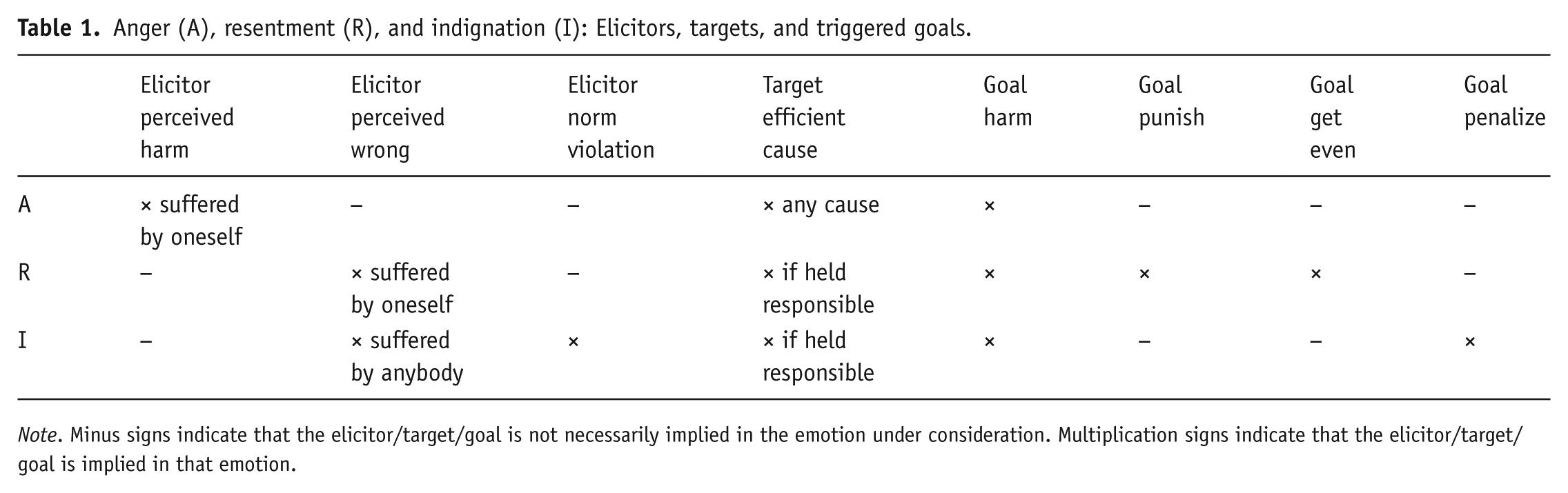
Note. Minus signs indicate that the elicitor/target/goal is not necessarily implied in the emotion under consideration. Multiplication signs indicate that the elicitor/target/goal is implied in that emotion.
The Minimal Belief–Goal Compounds of Anger, Resentment, and Indignation
Based on the analysis we have provided so far, we can now suggest the constitutive belief–goal components of anger, resentment, and indignation. Although we will present them in the form of pseudological propositions, our aim is only to single out, in a clear and systematic way, the basic beliefs and goals implied in each emotion.
The Anger Compound
Anger implies having a goal (p)—either a maintenance goal (wanting p to be true while p is already assumed to be so; that is, wanting not to lose p) or an acquisition goal (wanting p to be true while the state of the world is not-(yet)-p)—and the belief that somebody (B) has caused or is going to cause not-p. We can express this belief–goal compound as:
A wants p (1) A believes B caused (or will cause) not-p (2)
Causing the thwarting of A’s goal implies harming A or somebody else A cares about, and whom A identifies with. Therefore, we can synthesize (1) and (2) into:
A believes B harmed A (3)
The perceived (or anticipated) frustration of p makes A experience anger against the harmdoer, that is, a feeling of annoyance and dislike towards B. Anger in turn triggers A’s goal that B suffer harm, which implies that A believes that B has some goal q, and A wants that B’s goal q is thwarted:
A believes B wants q (4) A wants B not to have q (5)
In some instances, (5) can be instrumental to a further goal of A. Suppose that B’s goal q “competes” with A’s goal p, meaning that these goals refer to “parallel” world states; for instance, either agent wants exclusive possession of the same resource r. By thwarting B’s goal q, A can regain possession of r, thereby “saving” p. However, we do not view such a superordinate goal as constitutive of anger. In fact, anger may prompt an attack tendency even regardless of the advantages it can bring. Those advantages are functions accomplished by anger, not necessarily goals in the “angry mind.”
The Resentment Compound
Resentment includes all the beliefs and goals of anger. However, because resentment is elicited by a perceived wrong rather than a mere harm, anger’s components (1) and (2), synthesized into (3), are no longer sufficient. We need to specify that, in A’s perception, B harmed (or tried to harm) A responsibly and unjustifiably. (As already mentioned, a “responsibly inflicted harm” does not coincide with a wrong if it is viewed as justified. Here, for the sake of simplicity, we are expressing only the basic components of perceived responsibility, and presuppose that A perceives the harm as unjustified.)
Because perceived responsibility implies that the harmdoer is attributed either the goal to harm or at least the power to prevent such a harm while not having the goal to do so, we have to add:
A believes B wanted not-p (6) (which is sufficient to elicit A’s resentment even if B fails to achieve not-p) or, at least, A believes B could have prevented not-p (7) and A believes that B did not want to prevent not-p (8)
Meaning that, in A’s perception, B did not have the goal of avoiding not-p. For instance, suppose that Adam’s goal p to have some rest after surgery has been thwarted by a noisy party organized by his roommate Brian. While assuming that Brian’s intention was simply to have fun with his friends, without any purpose to disturb him, Adam believes that Brian did not bother to consider that having a party would have implied thwarting Adam’s goal. That is, Brian did not have the goal of preventing not-p. This is different from assuming that B had the goal of not avoiding not-p, which would mean that (in Adam’s perception) Brian took into account the undesired effects of his action, and decided to disregard Adam’s needs. In the former case—which, if joined with component (7), is sufficient for viewing B as responsible for not-p—B is considered guilty of negligence because (s)he did not care to prevent the occurrence of not-p. By contrast, in the latter case B is considered guilty of “strict liability,” in that B wanted not to avoid not-p, that is, (in A’s perception) B intentionally omitted to (try to) avoid not-p—which closely resembles component (6).
Components (6), (7), and (8) can be synthesized into: A believes B wronged A (9)
At this point, A will experience resentment, that is, a feeling of annoyance and dislike, against B. Resentment in turn triggers the goal to retaliate.
A basic form of “retaliatory” goal was already present in anger, and expressed by components (4) and (5). Although implied in resentment, (4) and (5) are too “poor” to account for R’s mindset. Feeling resentment implies believing that the harm is “unacceptable” (because it has been unjustifiably and responsibly inflicted), and the goal to punish the wrongdoer so as to “get even,” that is, to make B pay for the wrong suffered by A (or somebody whom A identifies with). This is the reason why A wants that some goal of B is thwarted. Therefore, (4) and (5) should be complemented by other components that we would express as follows:
A believes the wrong is “unacceptable” (10) A wants to “get even” with B (11)
The Indignation Compound
Indignation, implying a perceived wrong, includes most of the components of resentment as well as the constitutive components of anger. However, here the victim’s identity is irrelevant in that it doesn’t matter whether B wronged A or anybody else. What matters is that, in A’s perception, B committed a wrong. Thus, whereas we can include anger’s components (1) and (2), we cannot synthesize them into “A believes B harmed A.” We need to express A’s belief about B’s harmful behavior in impersonal terms, as follows:
A believes B did a harm (12)
Likewise, we can maintain resentment’s components (6), (7), and (8), but we cannot synthesize them into “A believes B wronged A.” We have to say:
A believes B committed a wrong (13)
At this point, however, we cannot yet say that A will experience indignation, unless we introduce some specification about A’s goal p. What we have to express is that p is not (only) a personal interest of A, but something A believes to be, and wants as, a socially shared and prosocial goal, that is, a norm:
A believes p is a norm (14) A wants p as a norm (15)
Components (14) and (15) are not necessarily present in resentment because R, while assuming that goal p is “protected” by a norm (the norm that one’s rights are respected), does not necessarily want p as a norm: p is just a personal goal of his or hers.
In our view, both (14) and (15) are necessary components of indignation. In fact, (14) alone would be insufficient to elicit indignation because, while believing that p is a norm in a given society, A may view it as unjust, and not want it as a norm; as a consequence, its violation is not viewed as unjust, and will not trigger indignation. On the other hand, (15) alone would imply that A assumes that p is not a norm (in a given society) whereas A would like it to be so. We suggest that (15) would be insufficient to elicit indignation against B: if A acknowledges that p is not a socially shared norm, A also believes that not-p does not impinge on the recognized rights of the society at hand. As a consequence, A does not feel entitled to pretend that p be perceived as a norm by B, and its “violation” will not arouse A’s indignation against B.
Perhaps (15) alone might suffice to arouse A’s indignation toward the society at hand and its traditions, and/or its social control agents, who do not establish p as a norm. However, it is unclear whether in this case (14) would be absent, in that A may believe p to be a norm in a different society, or (s)he may view p as an unwritten but universal norm in ethical or religious terms. In fact, if A believes that p should be established as a norm, A is also likely to believe that p, deserving the status of a norm, is already a norm in some ideal sense. As stated, for instance, in the Catechism of the Catholic Church (1994, p. 469), the rights that flow from the human person’s dignity “are prior to society and must be recognized by it . . . by . . . refusing to recognize them . . ., a society undermines its own moral legitimacy.”
From components (13) to (15) it descends that A views B’s wrong as a norm violation proper:
A believes B’s wrong threatens norm p (16)
It is precisely (16) what makes A indignant against the wrongdoing and the agent responsible for it. Indignation in turn triggers the goal to punish the social injustice.
As we know, a basic form of “punishment” was already present in anger, and expressed by components (4) and (5). We can maintain (4) and (5), provided they are complemented by other components. As in resentment, we can include
A believes the wrong is “unacceptable” (10)
although the underlying reason is not A’s need to get even with B—expressed by (11) in resentment—but A’s belief that the wrong threatens norm p, expressed by (16), possibly enriched by A’s assumption that this violation is sufficiently serious to require penalization.
Moreover, components (4) and (5) should by justified by a particular goal of A, which we have not yet expressed: the goal that B be punished for the infringement of norm p. That is, the thwarting of B’s goal q should be viewed as a proper means for penalizing the wrongdoing. We can (roughly) express the abovementioned components as follows:
A wants to penalize the wrong (17) A believes not-q to be a penalization (18)
The intended penalization can concern an actual punishment on B (in terms of resource reduction) which in turn is functional to restoring the norm, as well as a public denunciation, which is not only a form of punishment inflicted on B (in terms of social blame and loss of reputation) but also a means for warning others against B, so as to avoid their becoming victims of B’s misbehavior.
Figure 1 shows the basic cognitive and motivational components of anger, resentment, and indignation, as well as the partial overlaps among their belief–goal compounds. The anger compound is marked out by the smaller rectangle; the larger rectangle delimits the resentment compound; and the irregular polygon delimits the indignation compound.
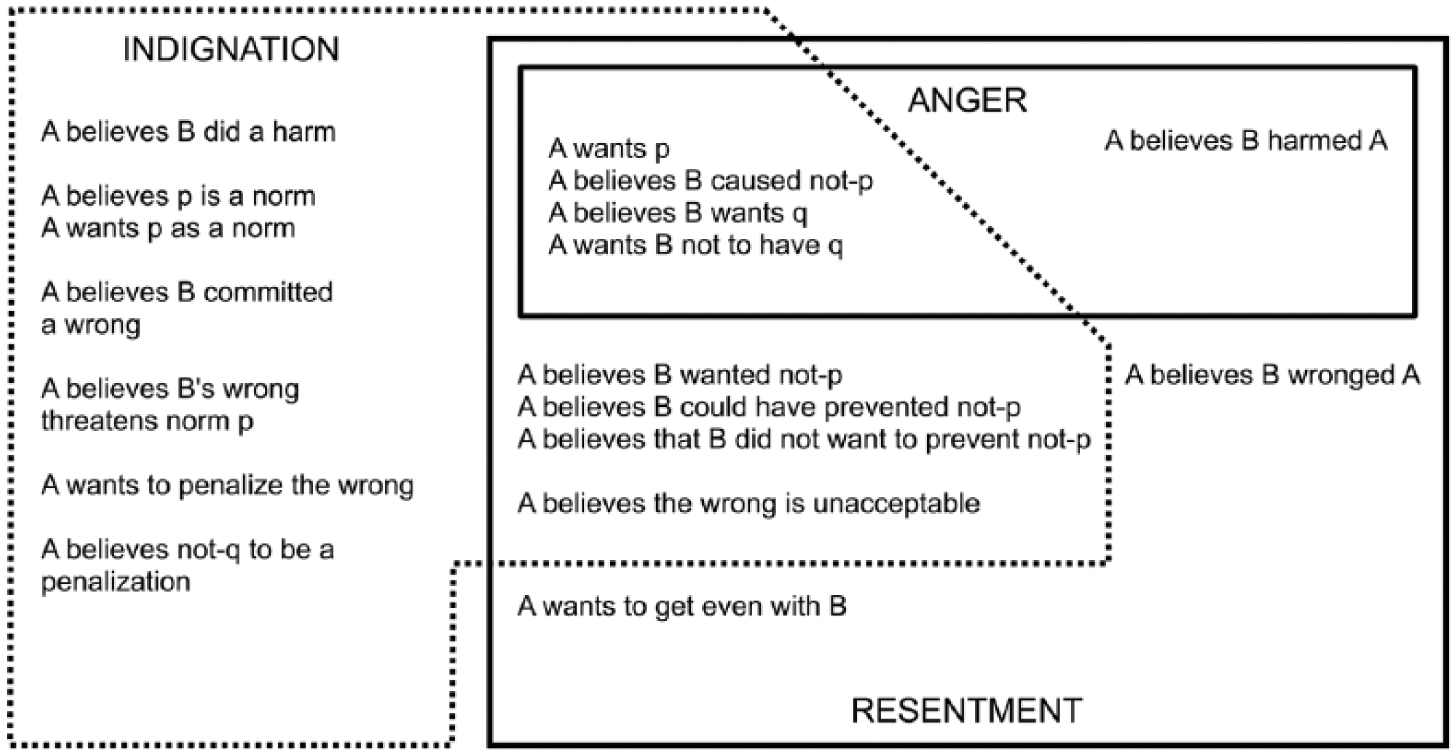
The cognitive-motivational compounds of anger, resentment, and indignation.
Concluding Remarks
We aimed to disentangle the basic cognitive-motivational ingredients of three kin emotions—anger, resentment, and indignation—and to show that each of them deserves a status of its own, because its “cognitive space” does not completely overlap with the cognitive space of any of the other emotions.
Resentment and indignation can be viewed as kinds of anger in that they both include the latter’s components (with the only exception that in indignation the harmed one’s identity is irrelevant). Anger is in fact the common core of this emotion family. However, this should not prevent one from acknowledging that anger can be devoid of either resentment or indignation, and that resentment is not indignation. The common assumption that anger is a response to wrongdoing, and motivates people to sanction it, precludes the possibility of identifying notable differences among hostile emotions, such as their moral or nonmoral character, as well as their specific beliefs, goals, and action tendencies.
To start with, people do experience anger which is not elicited by a perceived wrong, but only by a perceived harm. Admittedly, people may not be very likely to report such angry feelings because they are considered improper. Moreover, as already remarked, anger often leads to perceived injustice, in that people engage in blame-validation processes to legitimize their anger. Still, in some contexts some people do acknowledge that their anger is mere anger. Consider the following example taken from a post on a blog (mentalhelp.net):
The other day I flew into a rage . . ., all by myself, cos I spilled my bowl of porridge. I was screaming and slamming cupboard doors . . . I don’t want this. It is clear to me this is not right.
Consider, also, the so-called “driving anger” which, unlike the previous case of angry outburst, occurs in social contexts: the most common elicitor of driving anger has been found to be “impedance” (Deffenbacher, Stephens, & Sullivan, 2016), that is, traffic jams or obstructions caused by road constructions, which typically do not imply any perception of wrongdoing. Here, the driver feels angry simply because an obstacle prevents him or her from achieving some goal, such as getting to work on time. Quite interestingly, whereas impedance is the most common anger-triggering situation, the perceived discourtesy of other drivers (e.g., stealing a parking spot) has been found to elicit the most intense anger—or better, in our terms, resentment. As pointed out by Deffenbacher et al. (2016, p. 239), of the various factors that trigger driving anger, discourteous behaviors are indeed “the least ambiguous in terms of intent of the other driver,” thereby implying a certain assumption of wrongdoing.
Based on the differences between mere anger and resentment we have suggested so far, we can single out a number of hypotheses about their respective intensity, their more likely consequences, and other possible associated feelings.
We suggest that—other things (e.g., the importance of the thwarted or threatened goal) being equal—anger, being exclusively concerned with the first-order harm, is likely to be less intense than resentment, which implies a twofold suffering—both for the first-order harm and the offense received.
Second, if the harm is neutralized, anger is more likely to be appeased, whereas this is insufficient for resentment to be appeased, because it tends to persist until the offense is punished.
Third, anger is less likely than resentment to trigger aggression, because of its lower intensity, and especially because the angry person feels less entitled to react aggressively, as long as (s)he perceives the difference between nonculpable and culpable harmdoers—which, incidentally, is in line with Batson et al.’s (2000) finding that it is “harm intended,” more than “harm done,” that leads to retaliate. More generally, the expression of mere anger is more likely to be inhibited than that of resentment.
Fourth, if either emotion leads to aggressive behavior, anger will be more likely associated with guilty feelings than resentment, because, whereas the angry person may acknowledge that (s)he has caused harm to a nonculpable H, R feels in credit with W, and views his or her own aggression as a righteous punishment.
Fifth, for the same reasons, the expression of Schadenfreude will be more typical of resentment than anger, being viewed by R as an understandable response to the fact that “justice is done.”
The lack of distinction between resentment and indignation also obscures remarkable differences in the kinds of moral claim and response (namely, need for revenge vs. need for justice) implied by these emotions. For instance, remaining in the “driving” context, consider the possible different reactions of a driver who finds his or her car blocked by a double-parked vehicle, and helplessly stands beside it after having honked for some time, entered the shops nearby, and looked around in search of the owner of the vehicle. This situation can arouse either resentment or indignation (as well as both emotions). If merely resentful, our driver will feel an urge to punish W by inflicting harm on him or her, so as to “even the score,” and this urge can lead to an actual aggression (say, keying W’s car). If merely indignant, our driver will not look for personal revenge: rather than being concerned with evening the score, (s)he will try to punish the wrongdoing (and the wrongdoer) through “impersonal” and morally acceptable sanctions (for instance, [s]he will call the traffic police), so as to restore the infringed traffic norm. Moreover, such an indignant person could behave the same way if the blocked car were not his or her own (or his/her own friend’s), but somebody else’s.
According to our analysis, in fact, whereas resentment is felt by the victim themself (or by somebody who identifies with the victim), indignation can be elicited by any wrong which implies a norm violation, independent of the victim’s identity. The feeling of indignation is indeed the “shield” of justice. As claimed by the Athenian statesman Solon (6th century BC), wrongdoing can be avoided in a State “if those who are not wronged feel the same indignation at it as those who are” (Paley, 1881, p. 37).
A more general objective of our work has been to show the usefulness of a belief–goal analysis for identifying both the common and the distinctive features of emotions that belong to the same family. We believe that focusing on emotion families (rather than on single emotions) is particularly fruitful because, by comparing similar emotions with each other, one can sharpen the analysis and single out the distinctive features of each of them.
Moreover, this approach can help account for the frequent transformations of one emotion into another, depending on the “addition” or “deletion” of some belief–goal component. For instance, anger can turn into resentment as soon as a harm is perceived as a wrong; and vice versa, resentment may “regress” to mere anger if R acknowledges that the harmdoer is not responsible for the negative outcome. In the same vein, resentment can change into indignation if R becomes no longer concerned with his or her own interest and the personal offense—and consequently, (s)he no longer needs to retaliate in order to get even with W—but considers the thwarted goal as a sociomoral norm that should be defended and restored through penalization.
Footnotes
Author note:
We are grateful to Yochi Cohen-Charash and two anonymous reviewers for their precious comments and suggestions, which have substantially helped us to clarify and refine our work.
Declaration of Conflicting Interests
The author(s) declared no potential conflicts of interest with respect to the research, authorship, and/or publication of this article.