







Abstract
Experimental emotion inductions provide the strongest causal evidence of the effects of emotions on psychological and physiological outcomes. In the present qualitative review, we evaluated five common experimental emotion induction techniques: visual stimuli, music, autobiographical recall, situational procedures, and imagery. For each technique, we discuss the extent to which they induce six basic emotions: anger, disgust, surprise, happiness, fear, and sadness. For each emotion, we discuss the relative influences of the induction methods on subjective emotional experience and physiological responses (e.g., heart rate, blood pressure). Based on the literature reviewed, we make emotion-specific recommendations for induction methods to use in experiments.
Keywords
Anger, disgust, surprise, happiness, fear, and sadness are often classified as basic emotions. These emotions are considered adaptations that are innate and universal (Ekman, 1992). Experimentally inducing emotions is the most rigorous means of testing their causal influence on psychological and biological variables. Indeed, there is a rich history of inducing basic emotions in psychology laboratories with numerous methods (e.g., Ax, 1953; Blatz, 1925). However, not all emotion induction methods are equally effective, and researchers are often unsure of which method to use. The aim of this article is to provide research-based suggestions on how to effectively induce six basic emotions (although we note that there is some debate as to whether surprise is truly a basic emotion; e.g., Oatley & Johnson-Laird, 1987).
Although some previous research compared the relative efficacy of emotion induction methods, these articles focused on a few select emotions (e.g., Lench, Flores, & Bench, 2011). To date, there is no literature comparing the efficacy of induction techniques across the range of basic emotions. Thus, for many emotions, researchers may often select induction methods based on available resources, convenience, or at random rather than based on efficacy. A review of the literature is necessary to organize these methods into a coherent framework to advise researchers on impactful methods.
We broadly classify emotion induction techniques into five specific methods. Visual stimuli can be static images or videos selected to evoke target emotions. Listening to music activates affect via specific types of auditory input (e.g., tempo, melody, lyrics; Krumhansl, 2002). Autobiographical recall involves summoning personal emotional memories to reactivate emotions from the original emotional experience (Prkachin, Williams-Avery, Zwaal, & Mills, 1999). Situational procedures involve creating a social situation that elicits the target emotion. Imagery involves participants creating vivid mental representations of novel emotional events. Imagery can consist of reading vignettes (Mayer, Allen, & Beauregard, 1995), often with guidance from the experimenter (e.g., Grossberg & Wilson, 1968). Table 1 provides illustrative examples of these five methods used to induce emotions.
Examples of emotion induction techniques by category.
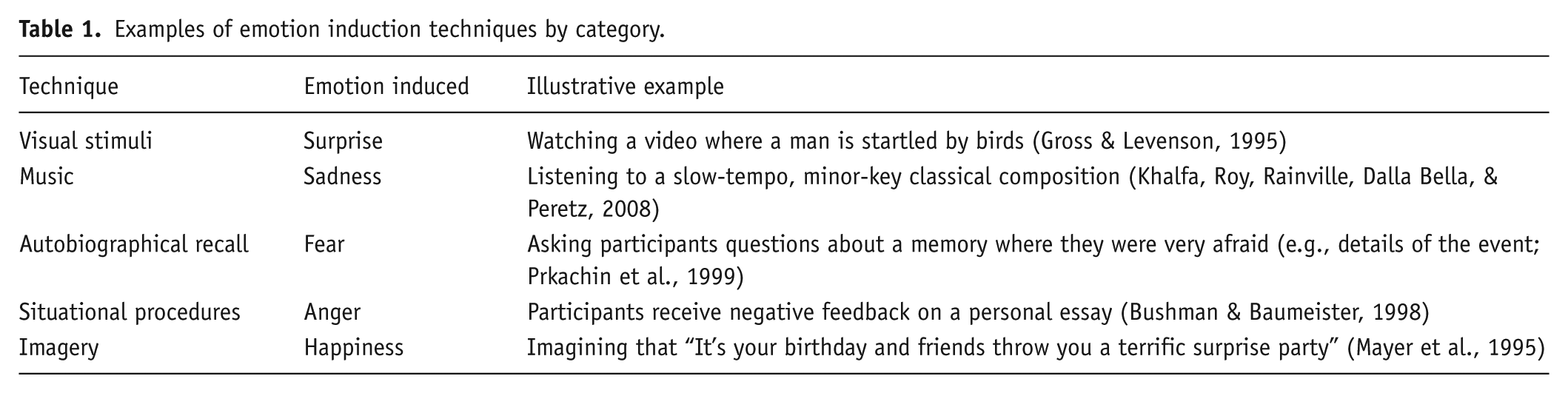
We derived these categories of methods from previous research categories and a meta-analysis, which found that different categories of affect inductions can yield effects of various intensities (e.g., Lench et al., 2011; Westermann, Spies, Stahl, & Hesse, 1996). Of these, we excluded some techniques for ineffectiveness and disuse (which we discuss later). We additionally created two new categories: visual stimuli and situational procedures. Visual stimuli merely combined all static and film stimuli, although these are often discussed in our review separately. Situational procedures combined paradigms related to social situations, such as gift giving and behavioral inductions, as these paradigms are similar to social situations people might experience in real life. Additionally, there were not enough studies using situational procedures (e.g., gifts) to justify creating subcategories of this method.
We identified 427 relevant journal articles through PsycInfo and examination of reference lists. Search terms included the individual emotions (e.g., “anger”) paired with individual methodologies (e.g., “music”), “physiology,” “arousal,” “nervous system,” “physiological response,” “autonomic response,” and the broader terms “emotion induction” and “emotion manipulation.” We only included literature that induced the specified target emotion. For brevity’s sake, we limit the number of references for each induction method in the text, but a thorough list and recommended articles are available at https://osf.io/9dxu2/. For each emotion, we provide recommendations for the best methods of induction. We also provide emotion-specific recommendations for the most effective stimuli within each induction category (as determined by effect sizes; these were independently calculated wherever possible).
We determined the efficacy of the emotion inductions by assessing the combination of both self-reported and physiological evidence. Physiological evidence is an important criterion of efficacy as emotion inductions influence sympathetic and parasympathetic activity (Kreibig, 2010) and may be less susceptible to social desirability and demand characteristics than self-report. Although some researchers suggest distinct emotions are not associated with a specific physiological footprint (e.g., Cacioppo, Berntson, Larsen, Poehlmann, & Ito, 2000), a strong physiological response is most likely indicative of strong affect (e.g., Rainville, Bechara, Naqvi, & Damasio, 2006).
Although strong physiological evidence seems indicative of an effective emotion induction, studies sometimes report contradictory physiological responses within a single emotion (as noted in Table 2). 1 One reason for this contradiction is that emotions may not be unitary phenomena. One example is sadness, which elicits unique physiological responses depending on whether it is approach-related (i.e., a sad film with a positive component related to empathy) or avoidance-related (i.e., a sad film with a negative component related to antipathy; Davydov, Zech, & Luminet, 2011). Similarly, disgust can coactivate both sympathetic and parasympathetic physiological responses depending on whether the disgust is morality-related versus pathogen-related (Ottaviani, Mancini, Petrocchi, Medea, & Couyoumdjian, 2013). Some researchers also suggest that disgust can elicit both sympathetic and parasympathetic responses (e.g., Kreibig, 2010), which might explain the variation in physiological reactions in response to disgust. Surprise evokes different physiological responses depending on whether the surprise has negative or positive valence (Levenson & Ekman, 2002). Overall, our review is consistent with the notion that there may not be specific physiological responses for each basic emotion, at least when induced in the laboratory (see Table 2).
Summary of how each basic emotion influences specific physiological variables within the literature.
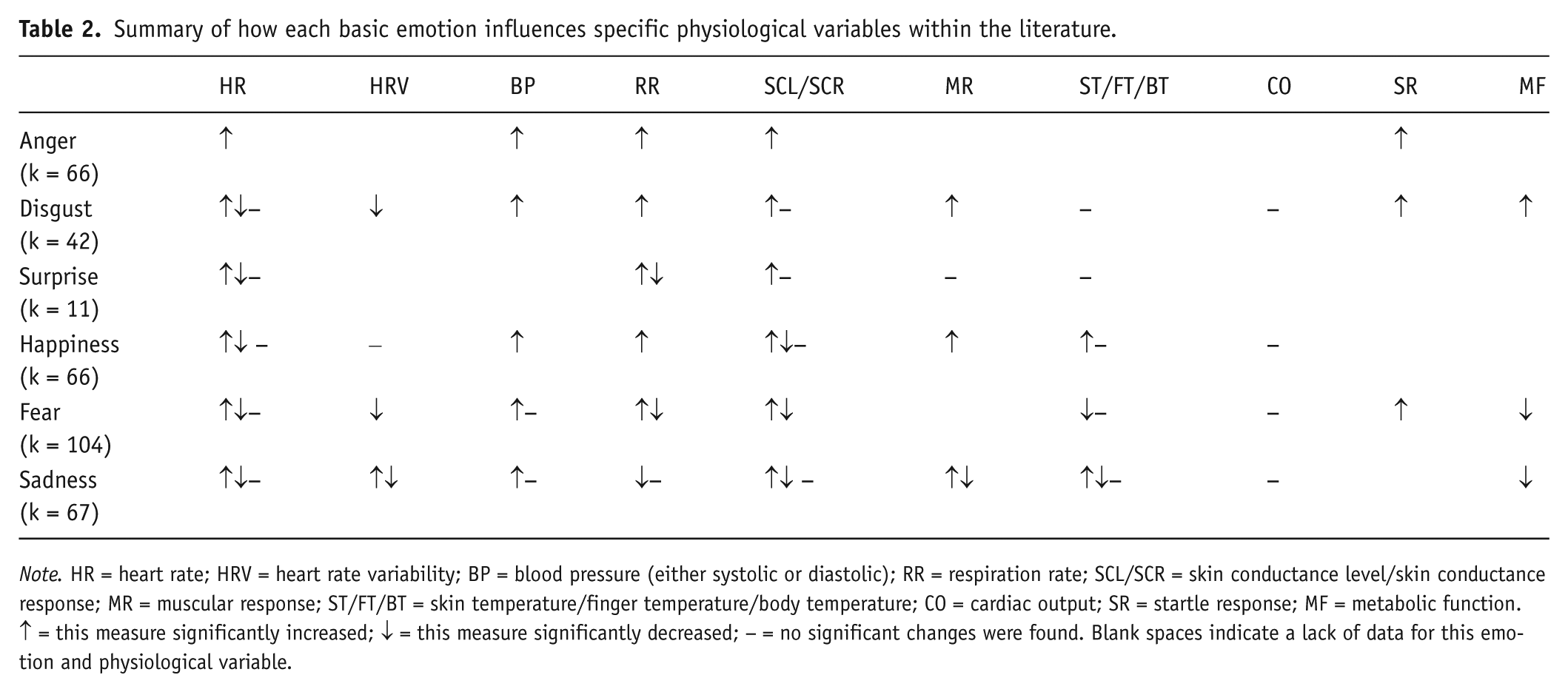
Note. HR = heart rate; HRV = heart rate variability; BP = blood pressure (either systolic or diastolic); RR = respiration rate; SCL/SCR = skin conductance level/skin conductance response; MR = muscular response; ST/FT/BT = skin temperature/finger temperature/body temperature; CO = cardiac output; SR = startle response; MF = metabolic function.
↑ = this measure significantly increased; ↓ = this measure significantly decreased; − = no significant changes were found. Blank spaces indicate a lack of data for this emotion and physiological variable.
Control Groups
Control groups for emotion induction techniques often try to induce neutral affect. Within each induction technique, control groups are largely consistent between different emotions. For experiments using visual stimuli, participants in the control group usually view less evocative still images (e.g., tissues) or movies (e.g., nature documentaries; e.g., Springer, Rosas, McGetrick, & Bowers, 2007). For experiments using music, participants in the control group will often not listen to music, or music that induces a different emotion (e.g., Sharman & Dingle, 2015). Researchers using autobiographical recall often ask participants to think or write about an instance(s) from their past when they experienced an ordinary event (e.g., an interaction with a stranger; Siedlecka, Capper, & Denson, 2015). Control groups for situational procedures usually retain the social aspect of the paradigm, but remove the emotion-eliciting aspect (e.g., writing an essay and receiving neutral, rather than positive or negative feedback; Bushman & Baumeister, 1998). For imagery, participants in the control group typically imagine ordinary situations (e.g., riding a bicycle; Velasco & Bond, 1998). A second type of control group makes use of one or more different emotion inductions. For instance, a researcher might wish to determine whether an anger induction increases aggression more than a fear induction. Creation of adequate control groups is important to consider when evaluating emotion induction techniques as not all emotions can be induced with the same method (see Table 3). Thus, comparing an experimental group to an inadequate control group may lead to results stemming from confounding variables, rather than induced emotions.
Summary of the most effective induction methods for each emotion.
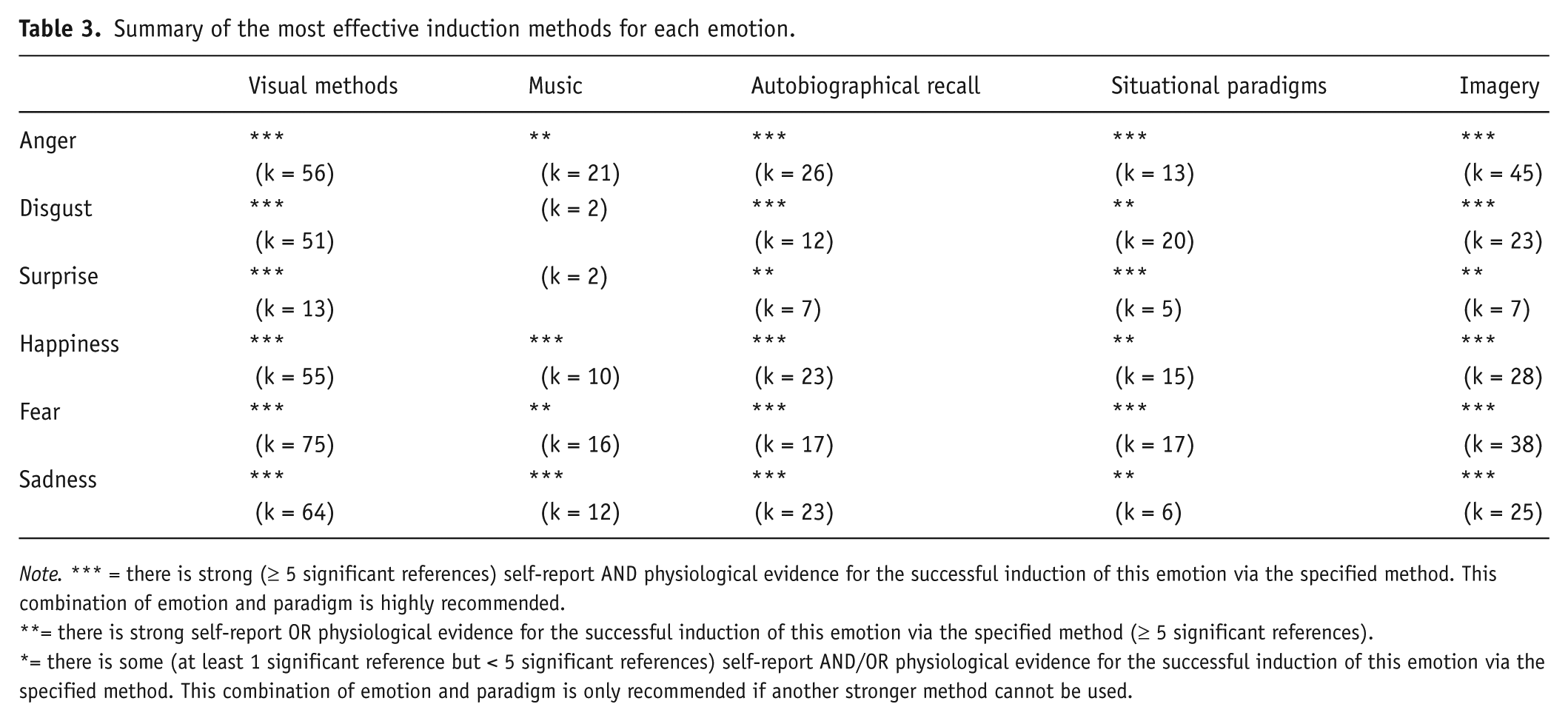
Note. *** = there is strong (≥ 5 significant references) self-report AND physiological evidence for the successful induction of this emotion via the specified method. This combination of emotion and paradigm is highly recommended.
= there is strong self-report OR physiological evidence for the successful induction of this emotion via the specified method (≥ 5 significant references).
= there is some (at least 1 significant reference but < 5 significant references) self-report AND/OR physiological evidence for the successful induction of this emotion via the specified method. This combination of emotion and paradigm is only recommended if another stronger method cannot be used.
Anger
Visual Stimuli
Researchers usually source images and film excerpts from popular culture or prior research. The anger-inducing stimuli typically display scenes of mistreatment, such as domestic violence (Lobbestael, Arntz, & Wiers, 2008). Numerous research articles provided evidence that anger-related static and film stimuli are both effective for inducing subjective anger (e.g., Lench et al., 2011). A review of 26 articles suggested anger-related visual stimuli also increase physiological variables such as blood pressure, startle response, heart rate, and respiration (e.g., Lobbestael et al., 2008).
Music
Numerous studies reported increased self-reported anger in response to music such as rap, heavy metal, and Japanese noise music (e.g., Seidel & Prinz, 2013). Music-induced anger was particularly pronounced for people who favored the anger-inducing musical genre (Gowensmith & Bloom, 1997). However, there is little physiological evidence to suggest music induces anger effectively. Only a small number of studies reported that angry music increased variables such as heart rate, skin conductance, and blood pressure (e.g., Sharman & Dingle, 2015).
Autobiographical Recall
Researchers often ask participants to think or write about an instance(s) from their past when they experienced anger. The idea is that recall will reactivate the anger, thereby causing participants to relive the anger (e.g., Siedlecka et al., 2015). Numerous studies using autobiographical recall observed significant self-reported anger responses, and significantly increased physiological responses such as heart rate, skin conductance, and systolic blood pressure (e.g., Marci, Glick, Loh, & Dougherty, 2007).
Situational Procedures
Situational anger inductions mimic anger provocations that people encounter in real life. Some paradigms challenge participants’ sense of self-worth. Other paradigms manipulate environmental variables, such as raising the room temperature to an uncomfortable level, or asking participants to speak in an angry tone (e.g., Drummond & Han Quah, 2001). Participants may receive insulting feedback on their test performance, a personal essay, or a speech about their life goals (e.g., Bushman & Baumeister, 1998).
Situational procedures increase self-reported anger (e.g., Lench et al., 2011), and physiological variables such as heart rate, systolic and diastolic blood pressure, and skin conductance (e.g., Lobbestael et al., 2008). Socially interactive paradigms are particularly effective at inducing anger as they target personal values and violate norms of polite behavior. For instance, one study found elevated self-reported anger, blood pressure, heart rate, and skin conductance when participants were socially harassed after receiving negative feedback on a quiz, compared to merely receiving negative feedback (Lobbestael et al., 2008).
Imagery
Some researchers instruct participants to imagine scenarios (e.g., reading a vignette involving a norm violation like sexual assault; Salerno & Peter-Hagene, 2013). This technique differs from autobiographical recall as participants do not necessarily recall situations that they have personally experienced. Researchers often use imagery in an interactive way by guiding participants through the imagery process. For example, one study asked participants to read an anger-themed script, then identify bodily sensations they might feel in that situation, to make the mental representation more detailed and vivid (Velasco & Bond, 1998).
Imagining angry situations reliably increases self-reported anger relative to imagining neutral and emotional situations (e.g., Lench et al., 2011). Imagery additionally heightens physiological variables such as heart rate, skin conductance, blood pressure, corrugator muscle activity, and startle response (e.g., Vrana & Rollock, 2002).
Anger Summary
Table 3 summarizes the efficacy of the five methods for inducing anger. Four methods increase both cardiovascular and self-reported measures: visual stimuli, autobiographical recall, imagery, and situational procedures. There is limited physiological evidence to support using music. A meta-analysis found that visual stimuli have a smaller effect on anger than autobiographical recall, situational procedures, and imagery (Lench et al., 2011). Additional research found that situational procedures are more effective than visual stimuli, but that imagery and recall are more effective than situational procedures (Foster, Smith, & Webster, 1999; Lobbestael et al., 2008). We therefore recommend imagery or recall as the strongest techniques for inducing anger, followed by situational procedures, visual stimuli, and music. Within imagery and/or recall, we recommend methods that ask participants to focus on physiological variables, rather than just imagining/recalling events vividly (Yogo, Hama, Yogo, & Matsuyama, 1995). Imagery vignettes that focus on social scenarios (e.g., people cutting into a queue) appear to be particularly effective (e.g., Vrana & Rollock, 2002; d = 2.82, relative to a neutral control).
Disgust
Visual Stimuli
Images from the International Affective Picture System (IAPS; Lang, Bradley, & Cuthbert, 1999) are frequently used to induce disgust (van Hooff, Devue, Vieweg, & Theeuwes, 2013). Other visual stimuli used to induce disgust include erotic images incongruent with participants’ sexual preferences, bodily mutilations, insect invasions, or disgusted faces (e.g., Sarlo, Buodo, Poli, & Palomba, 2005). Disgust-inducing films have included animal dissection, bodily products (e.g., feces, vomit), and painful injuries (e.g., Vianna & Tranel, 2006). Many studies using visual induction methods observed increased self-reported disgust relative to neutral films and images (e.g., Vianna & Tranel, 2006). Visual disgust stimuli increased physiological variables such as skin conductance and respiration, and decreased heart rate and skin temperature (e.g., Vianna & Tranel, 2006).
Music
We could not find any research that used music to induce disgust. There is some evidence to suggest that disgusting noises (e.g., burping, flatulence, and vomiting noises) can increase self-reported disgust relative to neutral sounds (Marzillier & Davey, 2005). However, these studies combined disgusting noises with imagery and recall (Marzillier & Davey, 2005).
Autobiographical Recall
This method relies on asking participants to recall a time when they experienced a strong feeling of disgust (Lane, Reiman, Ahern, Schwartz, & Davidson, 1997). Recalling disgusting memories effectively induced self-reported disgust (e.g., Lane et al., 1997). Some studies additionally found that recalling disgusting memories increased physiological responses such as blood pressure, skin conductance level, respiration, and decreased stroke volume (e.g., Prkachin et al., 1999).
Situational Procedures
There are many situational procedures that induce disgust. These procedures include bad smells (e.g., flatulence sprays), exposure to unsanitary items (e.g., pseudofeces, garbage, pseudoused syringes), or consuming very bitter drinks (e.g., Adolph & Pause, 2012). Situational procedures are effective in increasing self-reported disgust (e.g., Adolph & Pause, 2012). Some research suggests that situational procedures can increase startle blink responses (Adolph & Pause, 2012). However, there is little evidence to suggest that situational procedures alter other physiological reactions often associated with disgust (e.g., decreased heart rate).
Imagery
Researchers using this method asked participants to read guided vignettes. These vignettes involved a violation of purity or fear of contamination, such as describing incest or contact with bodily waste (e.g., Ottaviani et al., 2013). A typical example might be “You go into a public toilet . . . the bowl of the toilet is full of diarrhea” (Marzillier & Davey, 2005). Imagery reliably increases self-reported disgust in comparison to baseline measurements (e.g., Ottaviani et al., 2013). Additionally, imagery increases physiological responses such as startle reflex, salivation, corrugator muscle activity, heart rate, and decreases heart rate variability (e.g., Ottaviani et al., 2013).
Disgust Summary
Three methods reliably influence both physiological and self-reported disgust (Table 3): visual stimuli, autobiographical recall, and imagery. The physiological evidence for situational procedures is mixed. Evidence suggests visual stimuli are more effective than imagery, and that recall and imagery are equally effective (de Jong, Peters, &, Vanderhallen, 2002; Marzillier & Davey, 2005). We therefore recommend visual stimuli as the strongest technique for inducing disgust, followed by imagery and/or autobiographical recall, and then situational procedures. There is insufficient evidence for using music. Within visual stimuli, images and/or films about bodily mutilation (e.g., amputation) appear to be particularly effective (e.g., Britton, Taylor, Berridge, Mikels, & Liberzon, 2006; d = 2.53, relative to a positive control; for a list of effective IAPS images see Stark, Walter, Schienle, & Vaitl, 2005).
Surprise
Visual Stimuli
Research with static images typically uses faces with surprised versus neutral expressions (e.g., Collet, Vernet-Maury, Delhomme, & Dittmar, 1997). Some studies also use schema-discrepant visual imagery (e.g., color inversion of font and background halfway through a task; Meyer, Niepel, Rudolph, & Schützwohl, 1991). Films usually depict situations in which the actor experiences surprise (e.g., being startled by birds; Gross & Levenson, 1995). There is good evidence that both static images and films are effective in increasing self-reported surprise relative to neutral and emotional stimuli (e.g., Gross & Levenson, 1995). However, to our knowledge, only a few studies showed increases in physiological arousal. These studies found an increase in heart rate in children (Anastassiou-Hadjicharalambous & Warden, 2007), and respiratory changes and increased skin conductance, temperature, and blood flow in adults (Collet et al., 1997; Kragel & LaBar, 2013).
Music
We failed to find much evidence that music can induce feelings of surprise. One study did report that music increased self-reported surprise, skin conductance, and altered respiration patterns, but the music was combined with visual stimuli (Kragel & LaBar, 2013). Another study found that inducing fear through music coinduced surprise, but surprise was not analysed (Krumhansl, 1997).
Autobiographical Recall
Participants who recalled memories of unexpected events reported more surprise than other emotions (e.g., Levenson, Carstensen, Friesen, & Ekman, 1991). However, there is little evidence to suggest that recalling surprising events can reliably influence physiological responses (e.g., Levenson et al., 1991).
Situational Procedures
The directed facial action paradigm is one common method for inducing surprise. Participants form facial expressions that mimic those of a surprised person (e.g., raised eyebrows, dropped jaw; Ekman, 1989). Another example of a situational procedure is the use of odorants. Using vanillin and menthol induced surprise in one study (Alaoui-Ismaïli, Robin, Rada, Dittmar, & Vernet-Maury, 1997). Both manipulations are effective in inducing self-reported surprise relative to other emotions (e.g., Boiten, 1996). Directed facial action is additionally effective at inducing physiological variables such as decreased heart rate, skin conductance, muscle activity, and increased finger temperature (e.g., Levenson, Ekman, & Friesen, 1990). However, there is mixed support for the notion that odorants influence physiological responses (e.g., Alaoui-Ismaïli et al., 1997).
Imagery
Only a few studies used imagery to induce surprise. These studies asked participants to visualize schema-discrepant stimuli (e.g., sexual behaviors out of line with their sexual preference; Mosher & White, 1980). There is some evidence to suggest that imagining schema-discrepant stimuli increases self-reported surprise more than schema-consistent stimuli (e.g., Mosher & White, 1980), but too little evidence to support the use of imagery-induced surprise to elicit physiological responses (e.g., Walter & Yeager, 1956).
Surprise Summary
Compared to other emotions, surprise is seldom induced in the laboratory. Of these few studies, only a subset examined physiological responses. Situational procedures and visual stimuli are the only methods that increase both self-reported and some physiological correlates of surprise (see Table 3). Imagery and autobiographical recall may be effective at inducing surprise, pending further research. We recommend either using situational procedures or visual stimuli, followed by autobiographical recall and/or imagery. There is no support for using music. Within situational procedures, directed facial action is the only stimulus with clear supportive evidence, but the effects are not large (e.g., Boiten, 1996; d = 0.26–0.48, for respiratory variables relative to emotional controls). Within visual stimuli, a scene from Capricorn One where agents unexpectedly burst through a door appears to be particularly effective (e.g., Gross & Levenson, 1995; d = 3.06, relative to a neutral control). We additionally recommend making distinctions between positive and negative surprise as valence can differentially influence both emotional and physiological responses (Levenson & Ekman, 2002).
Happiness
Visual Stimuli
Visual stimuli are a popular method for inducing happiness. Researchers often use images from the IAPS or facial expressions (Ekman, 1992). Films are usually humorous and can include comedy monologues, cartoons, and amusing television segments (e.g., elimination challenges; e.g., Hubert & de Jong-Meyer, 1990). Viewing static images and films reliably increases subjective happiness (e.g., Lench et al., 2011) and influences physiological responses. Visually induced happiness increased physiological variables such as zygomatic muscular response, respiration, heart rate, blood pressure, and skin conductance (e.g., Hubert & de Jong-Meyer, 1990).
Music
Happy music usually features a fast tempo, major harmonies, and a dance-like rhythm (Krumhansl, 2002). Listening to these musical excerpts effectively induces feelings of happiness compared to other emotions (e.g., Etzel, Johnsen, Dickerson, Tranel, & Adolphs, 2006). A small number of studies also found increases in physiological factors such as zygomatic muscular response, respiration, and skin conductance level (e.g., Etzel et al., 2006).
Autobiographical Recall
In this paradigm, participants recall experiences where they felt happy. Autobiographical recall of happy experiences is sometimes paired with exercises that enhance vividness. Participants are asked to close their eyes and relive emotions, or read narratives in the second person about their own experiences (e.g., Rainville et al., 2006). Recalling happy experiences is generally effective at increasing feelings of happiness and decreasing negative feelings, relative to recalling neutral events (e.g., Rainville et al., 2006). Recalling happy events additionally increases physiological factors such as heart rate, blood pressure, and galvanic skin response; and decreases factors such as respiratory period and amplitude (e.g., Marci et al., 2007).
Situational Procedures
There are several creative situational procedures to induce happiness. They include being given a gift (e.g., a small bag of gummy bears), the use of pleasant odorants (e.g., vanillin), eating enjoyable foods (e.g., chocolate), success in a difficult task, or playing with a device that produces flatulence noises (e.g., Alaoui-Ismaïli et al., 1997). Situational procedures successfully induce self-reported happiness (e.g., Westermann et al., 1996). The evidence for physiological changes is less robust. Some studies found increased galvanic skin responses, skin conductance, and temperature (e.g., Stemmler, 1989). Other studies did not find changes in heart rate, and some found decreases in skin conductance and heart rate (e.g., Alaoui-Ismaïli et al., 1997).
Imagery
Happiness imagery usually involves the participant visualizing specific hypothetical situations. For instance, researchers might ask participants to imagine situations like reading a good book on a quiet afternoon, an attractive stranger walking towards them, or a professor reading their A+ essay out to the class (e.g., Witvliet & Vrana, 1995). Happiness imagery increases self-reported happiness (e.g., Gehricke & Fridlund, 2002). Additionally, this procedure increases galvanic skin responses, skin conductance, heart rate, and body temperature; and decreases inspiratory and expiratory times: a response consistent with the evidence for the proposed physiological correlates of happiness (e.g., Gehricke & Fridlund, 2002).
Happiness Summary
Four methods increase both physiological and self-reported outcomes (Table 3): visual stimuli, music, autobiographical recall, and imagery. Some researchers have compared the relative effects of multiple techniques on inducing happiness. Of these, visual stimuli seem to be the most effective form of happiness induction (e.g., Lench et al., 2011; Westermann et al., 1996). Similarly, imagery induces more intense happiness than either autobiographical recall or music, and music is more effective at inducing happiness compared to recall (e.g., Lench et al., 2011). Recent research also suggests that the combination of paradigms (e.g., combining imagery or autobiographical recall with music) is more effective at inducing happiness than any single procedure (Zhang, Yu, & Barrett, 2014). Thus, we recommend the use of visual stimuli, followed by imagery, music, and then autobiographical recall, to induce happiness. A combination of methods may be most effective. We tentatively recommend using situational procedures to induce happiness, as we have only found strong supportive self-report evidence. Within visual stimuli, we recommend films over static images. One study compared select films and found a television game segment from Les Trois Frères to be particularly effective (Schaefer, Nils, Sanchez, & Philippot, 2010; ds = 1.62–3.89, relative to neutral controls).
Fear
Visual Stimuli
Static images of fearful stimuli are available from established data sets such as the IAPS. Images may include phobic and threatening stimuli, such as pictures of spiders, snakes, or aimed weapons (e.g., Sarlo, Palomba, Buodo, Minghetti & Stegagno, 2005). Researchers often show horror movies or show content depicting impending death, anticipation of injury, or home invasions (e.g., Montoya, Campos, & Schandry, 2005; Schofield, Youssef, & Denson, 2017).
Viewing fearful stimuli is effective at increasing feelings of fear relative to neutral and other emotional stimuli (e.g., Montoya et al., 2005). Exposure to static images or films is also effective at inducing physiological responses consistent with fear. These autonomic reactions include increased skin conductance response, heart rate, startle response, respiration rate, and blood pressure (e.g., Sarlo et al., 2005).
Music
Fearful music is often taken from classical music such as Holst’s Mars: The Bringer of War and Liszt’s Mefisto Waltz, film scores, or can even be purposely created for the research (e.g., Krumhansl, 1997). Listening to music reliably increases feelings of fear compared to sadness and happiness (e.g., Etzel et al., 2006). However, listening to such music can coinduce other feelings, such as surprise and anxiety (Krumhansl, 1997). There is some evidence to suggest that listening to music can increase heart rate, blood pressure, and rate of breathing, while simultaneously decreasing breath duration, skin conductance, and skin temperature (e.g., Etzel et al., 2006). Although these altered physiological factors are promising indicators of music-induced fear, they may also represent nonspecific arousal or arousal induced by emotions other than fear.
Autobiographical Recall
In this paradigm, participants are asked to recall a time(s) when they felt afraid or were in danger (e.g., Rainville et al., 2006). Recalling scary experiences is effective at inducing feelings of fear compared to other emotions (e.g., Rainville et al., 2006). Autobiographical recall also increases heart rate, blood pressure, and skin conductance; and decreases heart rate variability, stroke volume, respiratory period, and respiratory rate (e.g., Prkachin et al., 1999). However, some evidence suggests that these physiological responses change in comparison to neutral conditions, but not relative to other emotion inductions (Prkachin et al., 1999).
Situational Procedures
Situational procedures target social fear or physical fear. Social fear inductions include anticipated failure at an easy task or preparing a speech to be performed and evaluated by others (Gerritsen, Weigant, Bermond, & Frijda, 1996; Pauls & Stemmler, 2003; Schofield et al., 2017). Examples of paradigms that target physical fear include anticipated electric shock, abseiling down the side of a building, or interrogating participants after forcing them to commit a pseudocrime (e.g., Brooke & Long, 1987). These paradigms are occasionally modified for the sample, such as exposing arachnophobic individuals to real spiders (Castaneda & Segerstrom, 2004). Both social and physical fear inductions are effective at increasing feelings of fear (e.g., Castaneda & Segerstrom, 2004). Additionally, situational procedures increased heart rate, skin conductance response, blood pressure, and decreased metabolic function (e.g., Gerritsen et al., 1996). These autonomic effects occur in comparison to both neutral controls and other emotions (e.g., anger; Pauls & Stemmler, 2003).
Imagery
This paradigm similarly induces both social and physical fears. To induce social fear, participants might imagine performing a speech in front of a group of people, or being unprepared for an exam. Examples of physical fear include imagining being injected with a needle, finding a spider in one’s bed, or being trapped in an elevator (e.g., Vrana & Lang, 1990). Sometimes, researchers cue participants to autonomic or behavioral responses that they could encounter in these scenarios (Vrana & Lang, 1990). Fear imagery is effective at increasing feelings of fear compared to other emotions (e.g., Vrana & Lang, 1990). Imagery also increases physiological variables such as startle response, respiration rate, pulse rate, heart rate, and skin conductance (e.g., Cuthbert et al., 2003).
Fear Summary
All five methods influence both autonomic responses and self-reported fear. We recommend the use of situational procedures, followed by imagery, visual stimuli, autobiographical recall, and then music to induce fear. Within situational procedures, we recommend commonly feared authentic stimuli such as spiders or virtual reality exposure to heights (e.g., Castaneda & Segerstrom, 2004; Wilhelm et al., 2005; ds = 2.24 and 3.57, relative to baseline and low-anxiety controls, respectively). Of those studies that directly compared the effects of specific techniques on inducing fear, situational procedures were more effective than imagery. Combining music with visual procedures was more effective in inducing fear than visual exposure alone (e.g., Castaneda & Segerstrom, 2004). Because music alone induces multiple emotions and nonspecific physiological arousal, we recommend combining music with visual stimuli for researchers using these methods.
Sadness
Visual Stimuli
Static image compilations include faces with sad facial expressions (e.g., Pictures of Facial Affect, FACES; e.g., Ekman & Friesen, 1976). Stronger facial expressions within these data sets evoke more sadness (Wild, Erb, & Bartels, 2001). Films are usually selected for themes of unjust suffering, loss, and grief (e.g., Sakuragi, Sugiyama, & Takeuchi, 2002). Stimuli are sometimes also self-selected by participants (e.g., tragic videos that make the participant cry; Sakuragi et al., 2002). Static visual stimuli and films are both effective at inducing feelings of sadness relative to neutral and other emotional stimuli (e.g., Wild et al., 2001). However, there is little evidence to suggest static stimuli influence physiological factors, other than decreasing heart rate variability (Lane et al., 2009). Sad films, however, alter physiological variables such as heart rate variability, skin conductance responses, finger temperature, respiration rate, metabolic function, heart rate, and blood pressure (e.g., Fernández et al., 2012).
Music
Music used to induce sadness usually has a slow tempo, low volume, and a minor key (e.g., Khalfa et al., 2008). Some researchers have constructed their own compositions based on these properties (Lundqvist, Carlsson, Hilmersson, & Juslin, 2009). Listening to sad music is effective at inducing sadness and autonomic responses (e.g., Etzel et al., 2006). Music decreases skin conductance, respiration rate, and heart rate, and increases finger temperature, tension in facial corrugator muscles, and blood pressure (e.g., Krumhansl, 1997).
Autobiographical Recall
Participants are asked to recall a time when they felt overwhelmingly sad (Marci et al., 2007). Autobiographical recall is effective at increasing feelings of sadness compared to both neutral recall and recall of other emotions (e.g., Marci et al., 2007). Additionally, recalling sad memories increases parasympathetic factors such as heart rate, systolic and diastolic blood pressure, and vascular resistance, and decreases heart rate variability (e.g., Lane et al., 2009).
Situational Procedures
Directed facial action is the only situational procedure whereby participants manipulate their facial muscles into an expression of sadness (e.g., extend the lower lip, furrow the brow; Levenson et al., 1990). To our knowledge, no other situational procedures are commonly used to specifically induce sadness. Directed facial action does indeed induce self-reported sadness (e.g., Levenson et al., 1990) and there is some evidence that it increases heart rate, finger temperature, and skin conductance, while decreasing muscular activity, and expiratory and inspiratory time (e.g., Boiten, 1996).
Imagery
Participants might be asked to imagine a funeral service, a homeless person rummaging through a garbage bin, or listening to a young mother tell the participant how she lost her job (e.g., Witvliet & Vrana, 1995). This type of imagery effectively induces sadness relative to other emotions (e.g., Gehricke & Fridlund, 2002). Imagining sad scenarios can additionally increase physiological outcomes such as heart rate, blood pressure, and corrugator muscle activity, and decrease facial muscle activity and skin conductance (e.g., Witvliet & Vrana, 1995).
Sadness Summary
All five methods influence both autonomic and self-reported sadness (Table 3). Some research has compared the relative efficacy of different methods for inducing sadness. These analyses found that visual stimuli are the most effective method of inducing sadness (Westermann et al., 1996); however, this was only true for film stimuli (Lench et al., 2011). Additionally, imagery is more effective than situational procedures, which are more effective than recall, and recall is more effective than both static visual stimuli and music (Lench et al., 2011). Music may be especially effective when paired with autobiographical recall (van der Does, 2002). Similarly, combining visual stimuli with music is more effective at inducing sadness than static visual stimuli alone (Baumgartner, Esslen, & Jäncke, 2006).
Thus, we recommend visual film stimuli as the strongest paradigm for inducing sadness, followed by imagery, then situational procedures, recall, static visual stimuli paired with music, music paired with recall, and music or static visual stimuli alone. Within film stimuli, scenes depicting grief appear to be particularly effective. These include death-related excerpts from City of Angels and Dangerous Minds (e.g., Schaefer et al., 2010; d = 2.18–2.45, relative to a neutral control).
Discussion
Subjective Emotional Experience
Table 3 provides a summary of the five emotion induction methods. Looking down the columns, the most effective induction method for the six basic emotions is visual stimuli. Music is only recommended for happiness, fear, and sadness. Autobiographical recall is effective for anger, happiness, fear, disgust, and sadness, but less so for surprise. Situational procedures also show breadth as they effectively induce anger, surprise, fear, and happiness. Imagery effectively induces anger, happiness, disgust, sadness, and fear, but may be less effective for surprise.
One consideration for using these induction methods is that creating an adequate neutral control or other emotion comparison condition can be challenging, particularly when investigating multiple emotions. As shown in Table 3, not all emotions can be induced with the same method. Moreover, even within the same method, certain paradigms utilize dissimilar procedures to induce different emotions. For example, in a situational induction, happiness might be elicited by eating chocolate (Macht & Dettmer, 2006), whereas disgust might be induced by consuming a bitter drink (Adolph & Pause, 2012). However, eating chocolate might induce happiness, but also guilt. Similarly, consuming a bitter beverage might induce surprise in addition to disgust. Thus, some procedures may coinduce more than the target emotion. Although we did not allocate much space to control procedures, researchers should carefully construct them to ensure accurate causal inferences can be made. Ideally, researchers should pilot test their preferred induction to elicit high levels of the target emotion and low levels of other coinduced emotions. We also recommend measuring possible coinduced emotions and accounting for them in statistical analyses, whenever feasible.
A combination of paradigms may be more effective than a single procedure. Certainly, some induction stimuli combine paradigms (e.g., films often use evocative music). Although there is often inconclusive evidence regarding the efficacy of these combinations, we might guess a combination of paradigms would be effective in inducing most emotions (e.g., Zhang et al., 2014). However, we only recommended a combination of methods when the literature suggested it was beneficial for a certain emotion. We do not feel we can make such a recommendation for all emotions based on the limited research available on this topic.
Limitations
This review was limited in some aspects. We did not discuss explicitly self-referent statements, priming, or reading stories. We excluded self-referent statements because 30–50% of participants do not respond to self-referent statements and they are often susceptible to demand characteristics (e.g., Clark, 1983). However, we included priming and reading stories as forms of visual inductions and imagery, respectively. Additionally, we did not divide situational paradigms into subcategories as have other reviews (e.g., Westermann et al., 1996), as some situational paradigms can only induce certain emotions (e.g., gift-giving is not used to induce anger).
Notably, there is evidence to suggest some techniques may also be susceptible to experimenter effects and demand characteristics (Västfjäll, 2002). This research is particularly problematic for techniques that rely on asking the participant to attend to an emotion (e.g., recall). However, it is difficult to gauge the extent to which these effects contribute to the induced emotion. When possible, we recommend obscuring the aim of the emotion induction task from participants.
Conclusion
Philosophers and psychologists have long concerned themselves with the study of human emotion. This review highlights the diversity and quantity of experimental research that has produced creative and often powerful emotion induction methods. Many of these techniques reliably induce a range of basic emotions and associated physiological responses. Some emotion inductions require initial evidence or more conclusive evidence before researchers may embrace these methods for specific emotions. However, this review suggests that there are numerous impactful options for the researcher to select from when designing their investigations into basic emotions.
Footnotes
Declaration of Conflicting Interests
The author(s) declared no potential conflicts of interest with respect to the research, authorship, and/or publication of this article.