







Abstract
Loneliness is one of the most neglected aspects of emotion history, despite claims that the 21st century is the loneliest ever. This article argues against the widespread belief that modern-day loneliness is inevitable, negative, and universal. Looking at its language and etymology, it suggests that loneliness needs to be understood firstly as an “emotion cluster” composed of a variety of affective states, and secondly as a relatively recent invention, dating from around 1800. Loneliness can be positive, and as much a part of the body as the mind. Using a longue durée approach, I argue that we cannot understand loneliness as a “modern epidemic” without considering its history, its meanings, its practice, and its links with the body.
Loneliness as a Neglected Subject in the History of Emotions
Loneliness has received little scholarly attention, at least in terms of its definition, and what it has meant in past times and cultures (Snell, 2015, 2017a). Works dealing with similar themes, such as homesickness (Matt, 2011), have opened up profitable avenues of enquiry, but loneliness remains a neglected aspect of the history of emotions, a field that has grown exponentially in recent decades (Rosenwein & Cristiani, 2018). Of course, there are books, programmes, and self-help guides that lament the rise of loneliness as a challenge to health and wellbeing. According to medical journals like The Lancet, and even that old stalwart of “traditional British values,” The Daily Mail, the UK is experiencing an epidemic of loneliness (Kar-Purkayastha, 2010; White, 2011). More people than ever before are living alone and apparently isolated from meaningful relationships. Britain was termed the “loneliness capital of Europe,” even before the self-imposed political isolation of Brexit (Bingham, 2014). Evidencing a perceived social and political crisis, the British government has recently created a Minister for Loneliness (BBC News, 2018).
Through a longue durée approach, this article opens up the history of loneliness, providing signposts to aspects of its terminology, scope, and meanings. Dealing principally with British sources, it argues that the way loneliness is talked about in the present is unhelpful: it is not enough to view loneliness as an inevitable and negative human experience when, like all emotional states, it can be historically situated. I suggest that “loneliness” in its modern sense emerged as both a term and perhaps also a recognisable experience around 1800, soon after ideas about sociability and secularism became important to the social and political fabric. It was reinforced by the 19th-century emergence of an intense ideology of the individual: in the mind sciences, in economic structures, in rational philosophy, and politics. A related point is that loneliness is a bodily and embodied experience, and not merely a psychological one. Loneliness can be positive as well as negative, and not only because most emotions generate mixed feelings. Yet, we can only engage with the multiple, often diverse meanings of loneliness by exploring its history and terminology.
All The Lonely People, Where Do They All Come From?
In the 1960s the Beatles’ “Eleanor Rigby” provided a commentary on the lonely anonymity of modern urban existence (Lennon & McCartney, 1966). Today, loneliness is considered a particular challenge for elderly people, though loneliness is also a problem for the young, whose patterns of social engagement have been changed by the digital revolution (Caplan, 2007). Men tend to have higher loneliness scores than women; arguably because women are typically encouraged to talk about their feelings (Jackson, Ervin, Gardner, & Schmitt, 2001). The highest levels of loneliness are found amongst the poorest social groups, reflecting an increased breakdown in support networks in proportion to the levels of deprivation experienced (Scharf, 2005). Indeed, homeless people are among the loneliest of all, and the most historiographically neglected. Ethnicity provides another important indicator of loneliness, though there has been insufficient research into the connecting variables of ethnicity, poverty, and loneliness (Allen & Oshagan, 1995). Loneliness has acknowledged pathological effects, causing conditions that range from depression and anxiety to heart attacks, strokes, cancers, and decreased immune response (Hawkley & Cacioppo, 2003).
It is hardly surprising, then, that loneliness is described as a modern “epidemic.” But the language of an epidemic is politically powerful. Loneliness can be viewed alongside obesity as a perceived “disease of civilisation,” a condition that is chronic, pathological, and associated with the way we live in the modern, industrial West (James, 2004). Both loneliness and obesity put excessive demands on the health service, being linked to mental and physical illnesses and associated with an inability to conform to social expectations. In both “conditions,” the person is pathologically locked within their own boundaries: in the body in the case of morbid obesity, and the mind, in the case of loneliness.
Given its contemporary import, why has the emotional history of loneliness been neglected? Part of the reason, perhaps, is that those studying loneliness tend to be demographic and social historians rather than scholars of emotion history and theory. Within such a framework, loneliness can be seen as a direct and inevitable consequence of urbanisation, as more than half of the world’s population lives in highly developed, globalised cities. Keith Snell (2015, 2017a) argues that the most significant explanatory variable in the history of loneliness is living alone, which often stems from bereavement. The unstated presumption of such narratives is the emotional impact of the transition from a medieval agrarian, face-to-face society in which multiple generations lived within the same household, social mobility was low, and few people moved outside the boundaries of the village where they had been born (Stivers, 2004, p. 11). But a rise in living alone need not be correlated with loneliness. Olivia Laing’s recent book The Lonely City (2016) identifies the urban revolution, and single dwelling, as having exacerbated loneliness. Yet she also notes how it is the illusion of collective living that compounds the feeling of being alone. Sharing a physical space is not the same as sharing an emotional space.
Loneliness as an Emotion Cluster and a Form of Social Practice
To look at modern loneliness, we need a modern definition. In this article, I use Andersson’s description of loneliness as an enduring condition of emotional distress that arises when a person feels estranged from, misunderstood, or rejected by others and/or lacks appropriate social partners for desired activities, particularly activities that provide a sense of social integration and opportunities for emotional intimacy. (Andersson, 1998, p. 265)
Loneliness is a conscious, cognitive feeling of estrangement or social separation; an emotional lack that concerns a person’s place in the world. As such, I suggest that loneliness is not a single emotion, but a feeling state or “emotion cluster,” a term I find useful in describing experiences that incorporate many separate and even competing emotions and that enables us to traverse the complex, often contradictory history of emotion concepts (Wierzbicka, 1992).
It is this characteristic of loneliness—as a feeling state or cluster—that also helps explain its historiographical neglect. Loneliness does not feature in the “big six” or the “big eight” that continue to be widely discussed as basic emotions, usually on the basis of identified facial expressions (Ekman, 1992; Plutchik, 1980). Ekman’s reductionist biological model has been criticised by more nuanced theorists who demonstrate that rather than being universal, emotions are developed within complex power relations, and through the lenses of disciplinary classifications that are themselves historically specific (Gross, 2015; Plamper, 2015). Recent work within one of those disciplines, neuroscience, suggests that the very notion of boundaried emotions, like anger, or sadness, or fear is incorrect (Barrett, 2006). Emotion theorists, including historians, have tested out a wide range of concepts for understanding the relationships between language and experience, and the political uses of emotions now and in the past. From Carol and Peter Stearns’ “emotionology” to Barbara Rosenwein’s “emotional communities”; from Erving Goffman’s work on “emotional performances” to William Reddy’s “emotional regimes” and Sarah Ahmed’s acknowledgement of the cultural body, attempts have been made to identify not only what emotions are, but also what functions they serve for individuals, social groups, and institutions (Ahmed, 2004; Goffman, 1973; Reddy, 2001; Rosenwein, 2002; Rosenwein & Cristiani, 2018; Stearns & Stearns, 1985).
Central to emotions’ political nature are questions of language and definition. Yet, some emotions, especially those that feature in the big six or eight, get more attention than others. While emotions such as love and sadness have received considerable focus, more complex states like “nostalgia” and “pity” have been neglected. Yet they were important prior to the popularisation of Darwin’s evolutionary approach (1872). For Aristotle, for instance, emotions did not denote single states, but also feelings accompanied by pleasure or pain that might include anger, fear, joy, and love as well as confidence, hatred, longing, emulation, and pity (Achtenber, 2002). Classical ideas about emotion were therefore more expansive than those we use today; and they were based on a different medical and philosophical approach to the mind and body, a theme taken up more fully in what follows (Bound Alberti, 2010).
This theoretical landscape is the context in which I would like to situate my approach to loneliness. In my doctoral thesis, submitted when the history of emotion was a much younger, lonelier field, I used the sociologist Pierre Bourdieu’s theory of practice to describe the performance of emotion in the church court setting (Bound, 2000; Bourdieu, 1997). I found this approach useful for understanding not only the oversimplification of emotional structures in Norbert Elias, but also the rigidity with which historians of marriage and the family had viewed emotional experiences as unchanging over time, rather than recognising emotions themselves had a history (Bound Alberti, 2006a; Elias, 1939/1978; Stone, 1979).
I argued that emotions were brought into being through verbal, gestural, and bodily performances, and that individual internalisation through inscription (what Bourdieu called habitus) helped to bridge the gap between emotional subjectivity and social expectation, what Stearns and Stearns termed “emotionology.” I have maintained an implicit sense of emotions as forms of social practice in my approach to the medicalised history of the body (Bound Alberti, 2006, 2010, 2016).
Since 2000, the idea of emotions as social practice has picked up pace, as has the identification of Bourdieu’s work as a useful way to explain the complexities of emotional performances (Scheer, 2012). Why do I believe this approach is relevant to, and helpful for, the pursuit of a history of loneliness? Loneliness is socially structured as an event and experience but also a distinct way of being, signposted through behavioural codes, that involves a perceived rejection from specific (often multiple) social groups. Loneliness is internalised and enacted through gestures and body language, as discussed next, as well as manifested through language.
The Invention of Loneliness
To develop this argument, I would like to turn to sources. No articulation of emotion is transparent; affective states are articulated according to different linguistic styles, genres, and registers (Bound, 2002). Studying the ways emotion has been framed in medical, literary, philosophical, and religious discourses, however, allows us to explore the ways affective states take on particular significance in distinct times and places, as well as shaping ideas about the broader concepts of mind, body, self, and society. I have searched for “loneliness”—as both word and experience—in a variety of published texts from the 16th to the 21st centuries, including plays and novels, diaries, and medical case notes. The first point to make is how new, comparatively speaking, the term “loneliness” is. I can illustrate this argument in relation to a Google Books NGram, which results from a keyword search of books printed in English between 1550 and 2000. I acknowledge that this mode of research can be imperfect, but this same pattern of results simultaneously maps onto more conventional literature database searches, such as Literature Online (LION).
As shown in Figure 1, there was little mention of “loneliness” prior to the end of the 18th century. Yet, from around 1800, the term was used with increasing frequency, peaking at the end of the 20th century. The meanings of “loneliness” arguably also changed, as this article will demonstrate. In the 16th and 17th centuries, loneliness did not have the ideological and psychological weight that it does today. As texts from the time indicate, loneliness meant simply “oneliness,” and it was less a psychological or emotional experience than a physical one. Oneliness meant simply the condition of being alone. It was also often contextualised as religious experience, in that one was never far from the all-seeing eye of the Almighty. Thomas Blount’s Glossographia (1656), for instance, described loneliness as “an [sic] one [emphasis added]; an oneliness, or loneliness, a single or singleness.” And Elisha Coles’s An English Dictionary (1677) included only one reference to “loneliness” and that was to define “solitude.” I will return shortly to the relationship between loneliness and solitude. First, however, I want to say more about what it might have meant to be “lonely.”
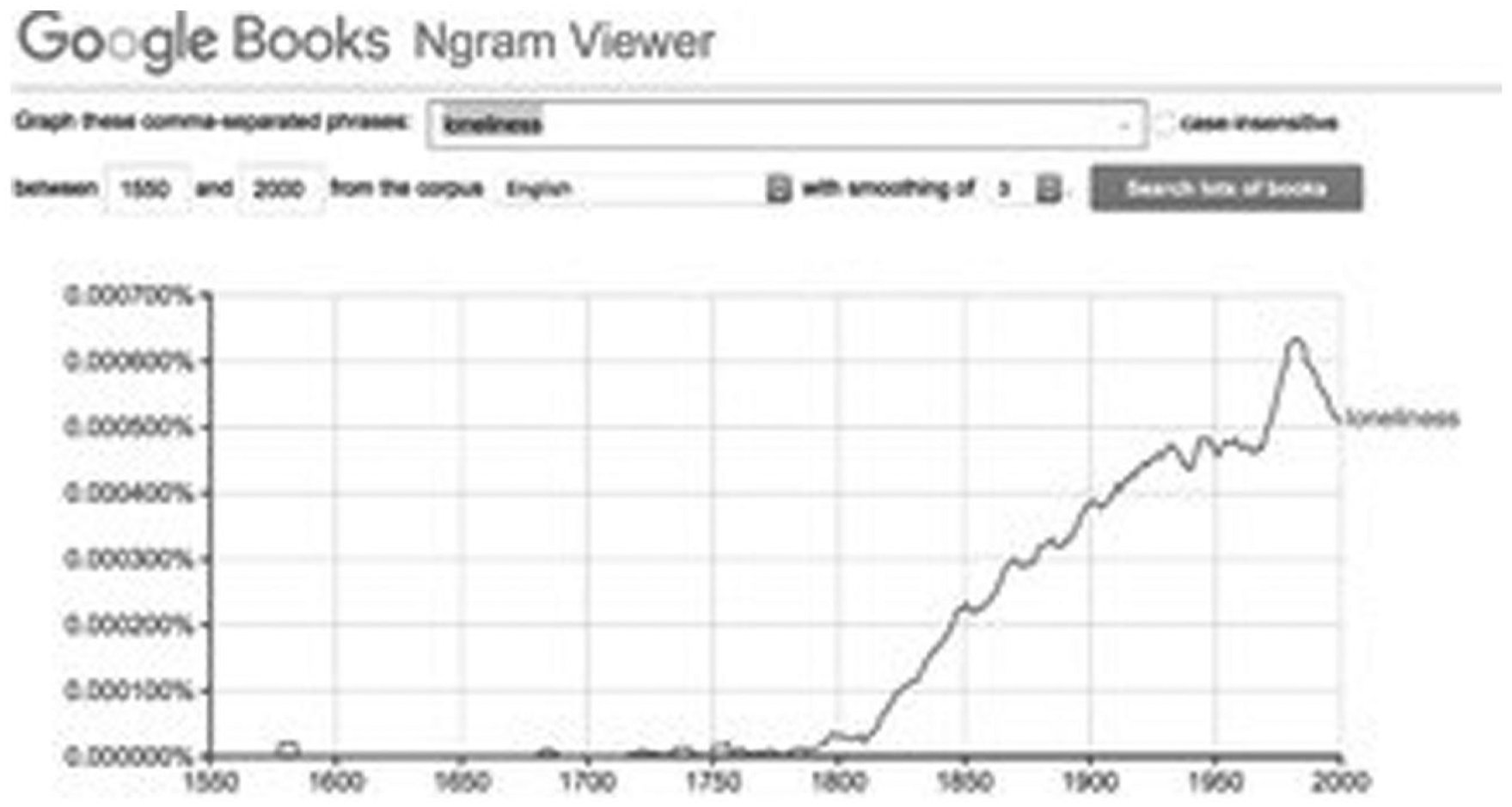
Use of the term “loneliness” in publications between 1550 and 2000, shown in Google Books NGram Viewer.
Although loneliness features little in printed texts prior to the 1800s, the term “lonely” does, and again it is in relation to the physical state of being alone. Attempts to correlate early modern or medieval discussions of being lonely with the modern emotional state of loneliness (as has been attempted through reading the soliloquies of Hamlet, for instance) are anachronistic and misleading, though characteristic of Shakespearean studies that view emotions as historically unchanging (Bound Alberti, 2016; Worsley, 2015).
The definitions of “lonely” given by the Oxford English Dictionary (“Lonely,” n.d.) include the traditional meaning of “unfrequented by men; desolate” and “solitary, lone,” as well as the more modern sense of “dejected because of want of company or society; sad at the thought that one is alone,” the earliest definition of which is the poet Lord Byron’s “One Struggle More” (Rossetti, 1848): “The heart—the heart is lonely still!” Only the first of these meanings—a place “unfrequented and remote”—was commonly used before 1800 (see Figure 2).
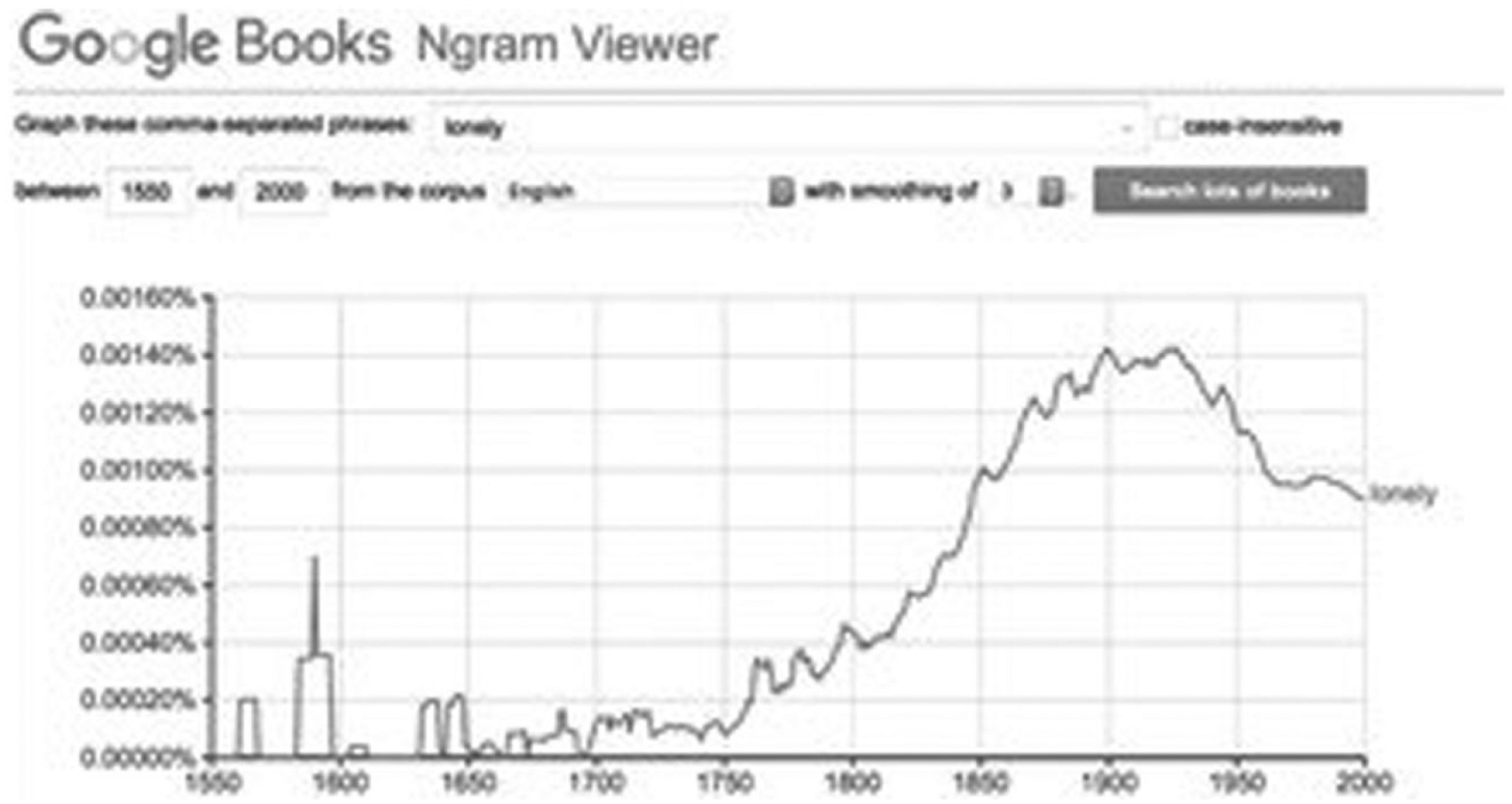
Use of the term “lonely” in publications between 1550 and 2000, shown in Google Books NGram Viewer.
Accounts of being lonely prior to this time include religious revelations and moral accounts of human folly, as well as physical descriptions of isolated places where remarkable events occurred. For example, the use of loneliness in the Bible typically denotes the physical separation of the Messiah from others, as Jesus “withdrew to lonely places and prayed” (Luke 5:16). Even Samuel Johnson’s A Dictionary of the English Language (1766) described the adjective “lonely” purely in terms of the state of being alone (the “lonely fox”), or a deserted place (“lonely rocks”).
The deliberate act of choosing to be lonely—as in being physically alone—was often taken to commune with God, and increasingly by the 18th century, with nature. There is an extensive body of literature linked to discovery of new lands, and the “primitive,” in which solitude is inherent, but not necessarily problematised. Indeed, in Daniel Defoe’s Life and Adventures of Robinson Crusoe (1719), the story of a shipwrecked man who spent 28 years on a remote tropical island, loneliness does not feature, and not only because Crusoe ultimately forms a master–slave relationship with Friday. He does express a “strange longing” when he sees the wreck of a ship, for another castaway like he “to have spoken to me and conversed with”; but I believe that this desire for human companionship is compatible with the intense sociability of 18th-century culture—what Crusoe himself refers to as “the society of my fellow creatures”—rather than modern loneliness (1904, p.191). Indeed, there is not a single reference in the book to Crusoe feeling ‘lonely’ or experiencing ‘loneliness’. At one level this denotes semantic change, but I am also suggesting some more profound emotional, change has taken place. Consider, by contrast, the 20th Century Fox drama Castaway (Hanks, Rapke, Starkey, & Zemeckis, 2000), which borrows from Robinson Crusoe and concerns a FedEx employee, Chuck (Tom Hanks), being stranded on a desert island. Since he has nobody to talk to, Chuck marks a face on a volleyball and calls the ball “Wilson.” (Wilson is an American sporting equipment manufacturer, and the company now sells replica balls on its website. 1 ) For modern viewers, this plot development makes far more sense: it connects to some established human need for companionship and the belief that isolation has a devastating impact on one’s mental health (Smith, 2006).
In Defoe’s time, however, solitude was not necessarily problematic. Johnson’s widely read A Dictionary of the English Language defined loneliness as “Solitude, want of company,” and “loneness” as “from lone [meaning] dislike of company.” The word “solitude” was defined as “lonely life; state of being alone” and “a lonely place; a desert” (Johnson, 1766). It had a similar pattern of incidence to “lonely” between 1550 and 1800, which is why we need to consider solitude in relation to the physical state of being alone, rather than the emotional state of loneliness. However, these two concepts and experiences may have been increasingly knitted together from the late 18th century, as a seemingly modern concept of “loneliness” came into being.
The Importance of Solitude
Having argued that the term “lonely” changed its meaning between the 16th and 18th centuries, I want to talk about the meanings of solitude. Again, dictionary definitions are helpful. The Oxford English Dictionary, like Johnson, defines “solitude” (n.d.), which originated as a Middle English term from the Old French (or the Latin solitudo, from solus meaning “alone”) as a mass noun indicating simply: “1. the state of being or living alone” and “2. Loneliness (of places); remoteness from habitations.” As with “lonely,” there was no emotional experience necessarily attached to solitude; solitude referred to the physical experience of “oneliness.”
Figure 3 shows a notable decline in use of the term “solitude” from the mid-19th century. This decline corresponds with the increasing use of “loneliness” to refer to both a physical and a mental state. Now, because loneliness and being lonely were not cultural preoccupations prior to 1800, these terms do not appear in the medical literature around emotional or physical health. The present-day pathologisation of “loneliness” as a mental and physical affliction or epidemic was nonexistent. What medical writers and others did talk about before the late 18th century was solitude, which had a number of negative and positive connotations.
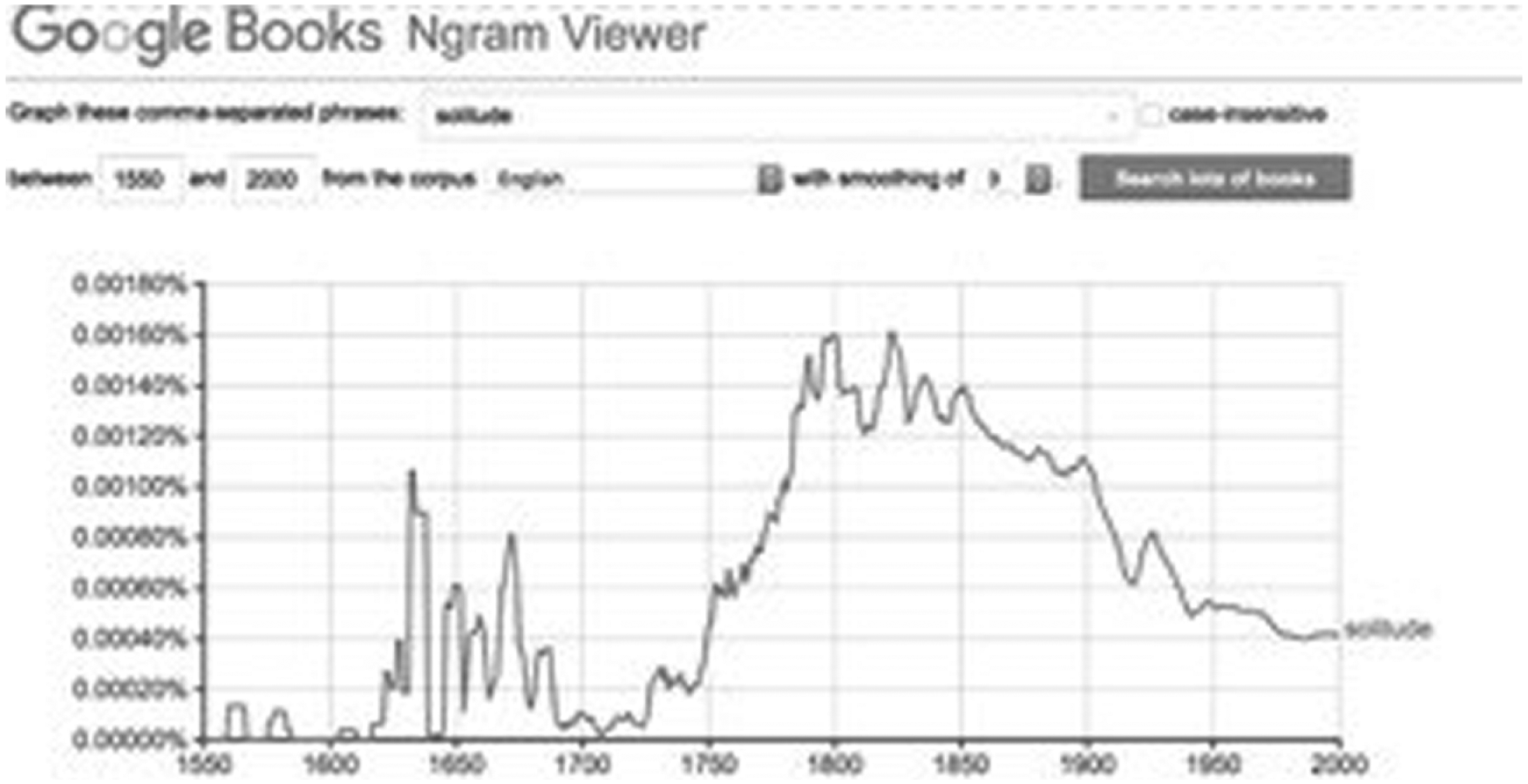
Use of the term “solitude” in publications between 1550 and 2000, shown in Google Books NGram Viewer.
Like loneliness, solitude has a neglected history, despite being an important aspect of the history of emotion. Solitude did not, I have argued in the previous lines, necessarily invoke any negative emotional response. Rather, solitude could be enjoyed and savoured. Barbara Taylor has written of the enjoyment of solitude by Jean-Jacques Rousseau and Mary Wollstonecraft, for instance, especially when linked to those 18th-century passions of nature and the natural world (B. Taylor, 2017). The “retreat” to nature as a means to find happiness links to the psychological root of pastoral literature, and to deistic ideas of God-in-nature (Raillard, 2016). Solitude was not incompatible with sociability, as it could be mentally and physically invigorating, improving the individual so that he or she might better fare in society. In Pleasures of Solitude (1802, pp. 6–7), P. L. Courtier justifies the value of solitude, not as the desire of a “surly misanthrope,” but rather to “escape the throng’s turmoil, To breathe the cooling freshness of the grove! . . . For, all we fondly cherish, dearly prize, All that the fancy or the heart can move; Full oft the busy scene of life denies.” Solitude in nature, then (and in moderation), was crucial to survive the busy-ness of life.
Similarly, in J. G. Zimmerman and J. B. Mercier’s Solitude Considered, in Regard to Its Influence Upon the Mind and the Heart (1792, p. 97) the authors claimed that: The rudiments of a great character can only be formed in Solitude. It is there alone that the solidity of thought, the fondness for activity, the abhorrence of indolence, which constitute the characters of a HERO and A SAGE are first acquired.
These writings refer to a lengthy tradition of viewing solitude either as damaging to the individual and society, or positive; here it is moderation that serves the best purpose. Moreover, this reinforcement of the value of solitude is reminiscent of the ancient hermit ideal, with isolation as a spiritual path (Campbell, 2013; Jotischky, 1995).
Oneliness in the presence of the divine could be for the hermit (as for Christ in the wilderness) a matter of intense creative and spiritual reflection. For the creative, too, there has always been a power in solitude, which in some ways seems to echo and reflect that connection to a higher spiritual power (Long & Averill, 2003). Solitude and loneliness were increasingly linked, however, by the time of the Romantics (Ferguson, 1992). From William Wordsworth, who “wandered lonely as a cloud” in “Daffodils” (Gravil & Robinson, 2015, p. 18) to Virginia Woolf, for whom loneliness was a necessary precursor to artistic inspiration, loneliness allowed some people to see the world differently. In the summer of 1928, a month before Orlando was published, Virginia Woolf was writing her diary in Monk’s House, her Sussex retreat: “often down here I have entered into a sanctuary,” she wrote, “of great agony once; and always some terror; so afraid one is of loneliness; of seeing to the bottom of the vessel.” It was only then that she approached what she called real “reality; something abstract; but residing in the downs or sky; besides which nothing matters” (Woolf, 1954, pp. 129–130). More recently, writers and artists similarly invoke the creative value and physical experience of loneliness; see for instance, Tracey Emin’s “Sad Shower in New York” (1995) and other works (Barnes, 2011). The performative function of loneliness in creating a kind of disembodied, isolated artistic identity needs more scholarly engagement.
“Oneliness” and Solitude by Class and Gender and Pathology
This deliberate choice of solitude or “oneliness” (with or without the corresponding sense of loneliness) was skewed by gender as well as class. Choosing to be alone for artistic purposes was an educated middle-class activity, requiring physical space as well as time away from economic and domestic affairs. It was also traditionally a male activity, since women have long been identified through family structures rather than in terms of their individual accomplishments. There is a rich vein of research into the cultural function of the lone woman (usually an ungoverned spinster or widow) in English social and cultural history (Gowing, 2003). Men could also tap into a longer tradition of being alone for reasons of religiosity or intellect, as depicted in the image of the hermit or the scholar. Indeed, Rousseau gladly took up that self-description when he went in search of solitude (B. Taylor, 2017, p. 212). Women could be alone for religious, and later for creative reasons, but they were far more likely to have solitude imposed upon them, common literary tropes including the abandonment or neglect of a lover. Forbearance and patience became a woman’s lot in such circumstances, which were rather different from the self-imposed ideal of solitude, and a caricature of the female part became that of the imaginary sister of Viola in Twelfth Night: “She pined in thought/And with a green and yellow melancholy/She sat like patience on a monument/Smiling at grief. Was not this love indeed?” (Shakespeare, 1602/1993, p. 75, 2.5.12–127). The “abandoned woman” was often the poetic counterpart of the “solitary man,” and part of a much longer poetic tradition that found its way into personal letters and correspondence in the 17th century and beyond (Bound, 2002; Lipking, 1988).
Excessive solitude could be damaging to health, as indicated by the previous reference to a “green and yellow melancholy,” which alluded to the lovesickness of an abandoned virgin. Solitude was particularly problematic when it was imposed from the outside. And in the premodern, humoral tradition, which dominated Western medicine from the 2nd to the late 18th centuries, solitude could impact on psychological and physical health. Wellness concerned the internal balance of the four humours, and an imbalance in the fluids of the body brought about by the passions or the “nonnaturals”—or the habits of the body that included sleep and movement, food and drink, and bodily excretions—produced a variety of mental and physical ailments, from depression to obesity (Bound Alberti, 2010).
Too much solitude, like too much exercise, could deplete the spirits; too little exercise or companionship made them sluggish and induced melancholia. There was no discussion of the absence of solitude in medical literature (physicians did not recommend more time alone, specifically, as far as I have noted, though they recommended less study and a change of air, food, habits of the body, and the passions). Yet, excessive solitude had long been linked by medical writers to mental afflictions, worry, and self-doubt. In Robert Burton’s Anatomy of Melancholy (1621/1971), the Oxford cleric enumerated all the different causes of melancholia and depression, from which he had long suffered. He did not use the term “loneliness” or even “solitude,” but he used multiple references to the state of being “alone,” which was linked to overthinking and an excess of imagination or fantastical thinking. Scholars were particularly prone to melancholia through excess rumination, and Burton acknowledged this in his introductory “Abstract of Melancholy”: When I go musing all alone Thinking of divers things fore-known. When I build castles in the air, Void of sorrow and void of fear, Pleasing myself with phantasms sweet, Methinks the time runs very fleet. All my joys to this are folly, Naught so sweet as melancholy. . . When I lie waking all alone, Recounting what I have ill done, My thoughts on me then tyrannise, Fear and sorrow me surprise, Whether I tarry still or go, Methinks the time moves very slow. All my griefs to this are jolly, Naught so mad as melancholy. . . Friends and companions get you gone, ‘Tis my desire to be alone; Ne‘er well but when my thoughts and I Do domineer in privacy. (Burton, 1621/1971, p. xx)
The letters of consultation by the 18th-century Scottish physician William Cullen similarly provide a wealth of information about the impact of loneliness on health (Shuttleton, 2015). It was not uncommon by the 18th century for men and women with sufficient recourse to money, literacy, and status to write to physicians to discuss health concerns and to pursue healing (Louis-Courvoisier & Pilloud, 2004). The pursuit of wellness was still a collaborative exercise between physicians and their patients, with the latter picking up ideas from conversations with others and advice manuals like William Buchan’s Domestic Medicine (Buchan, 1769). Patients and physicians drew on a shared understanding about the role of the humours in generating ill-health as well as, by the 18th century, that of the nerves. Though the solids of the body became more problematic than the fluids, “nervous debility” continued to support the narrative of sunken spirits in explaining the debilitating physical and emotional impact of too much time alone.
In a letter regarding one Mrs Rae (Cullen, 1779, ID4509), for instance, Cullen suggested that his patient suffered from “nervous weakness, often tedious but never dangerous.” He recommended exercise—specifically horse riding—in order to physically invigorate her fibres and spirits. In this context, Rousseau and Wollstonecraft’s brisk walks in pursuit of solitude ironically became the very means through which its negative excesses could be mitigated (Taylor, 2017). In Cullen’s view, tea and coffee were to be avoided as they were stimulants, but it was most important that Mrs Rae’s mind be occupied. As Cullen explained, “her mind requires as much attention as her body. However averse she should see her friends both at home & abroad, every amusement & easy occupation are to be sought for while Silence & Solitude are to be avoided” (Cullen, 1779, ID4509). Mrs Allan, a “hysteric melancholic” was similarly urged to seek companionship and engage in conversation (Cullen, 1777, ID4087), though Cullen “never knew reasoning” to have much effect with hysterical women (Cullen, 1777, ID4087; 1779, ID4509).
It may well be that solitude was more problematic in physiology and medicine in the late 18th century, corresponding to a philosophical and political context in which sociability was crucial to learned British culture. In the context of a metanarrative of change in which sociability and connections were fundamental to the social fabric, it makes sense that solitude was more frequently referenced in publications between 1750 and 1850 (see Figure 3). John Mullan has explored the ways in which the rise of the novel from the mid-18th century was entangled with the rise of a particular kind of “public sphere” sentimentalism, and the emergence of literary sensitivity and empathy as part of the development of civil society (Mullan, 1988). In some ways, this approach is reminiscent of William Reddy’s claim that a particular kind of affect emerged in French postrevolutionary society, as one form of emotional regime was replaced by another (Reddy, 2001). In terms of what Bourdieu would term everyday practice, both contexts saw rituals of sociability and emotion being used to define and perpetuate those regimes (Bourdieu, 1997). Demonstrating sociability through public gatherings and collective participation was one of the means by which civil society was manifested and reinforced. And this meant, as emotion theorists have argued, a prevalence of emotional language linked to gender, empathy, and moral and ethical responsibility towards others (Barker-Benfield, 1992).
Polite 18th-century society identified a range of symbolic, bodily, gestural, and verbal display codes through which sociability could be enacted (Klein, 2002). In The Spectator (1711-1712), a daily publication founded by Joseph Addison and Richard Steele, philosophy and manners were taught to aspiring middle-class men and women, with accounts by such characters as Sir Roger de Coverley reminding readers of the “benevolence” that, in an ideal state, “flows out towards everyone” one meets (Addison, 1952, p. 173). A similar sentiment was expressed in stoic philosophy, which emphasised the value of “sensus communis” (the idea that common sense connected the individual and society (Agnew, 2008, p. 108), and in the work of poets like Alexander Pope, for whom “Self-love and Social be the Same” (Pope, 1733, l.318). To a great extent, these philosophical imperatives were manifested in the metaphors of the physical body, by which the emotions that forged connections between individuals were echoed in the nerves and fibres that metaphorically linked one person to another, as well as to the body politic (Rousseau, 1976).
If the 18th century was a hinge point between oneliness and loneliness, when increased concern for the social made manifest an individuals’ need for connection, we can also speculate on the influence of increased secularity. Until the 17th century, God had provided the most common explanation for the origin of the soul and the movement of the body and the spirits, as well as providing a constant paternalistic presence. And how could one be emotionally lonely when He was always there? The birth of Enlightenment humanism, the privileging of reason and the rise of alternative ways of viewing the mind–body relationship allowed for the possibility of a secular world (Bound Alberti, 2016). I am not suggesting that religion disappeared, or that modern life became irreversibly secular. Rather, I am identifying a philosophical and civic trend by which the perception of loneliness depended on the “self” being externally developed and sustained in relation to peer groups and communities that shared, and outwardly performed, rituals of belonging (Taylor, 2007). Some of these rituals, around art, literature, and other 18th-century forms of cultural production, have been neatly explored by John Brewer (1997).
I am conscious that the concept of the “individual” is problematic and historically contingent, and I am interested in the ways that other historians might negotiate this concept in relation not only to the equally problematic concept of “loneliness” but also to connected states like “sociability,” “community,” “belonging,” and the “self” (Porter, 1997). Yet to some extent, the version of individualism I am articulating here as a product of the 18th century, echoes Charles Taylor’s discussion of the “inward turn” that became central to modern, rational, secular versions of identity (C. Taylor, 1992). It also provides a starting point for understanding how loneliness has subsequently been defined and articulated as a modern epidemic.
Nineteenth- and 20th-Century Variations of Loneliness
If loneliness emerged around 1800 as a complex socioemotional response to factors that included the secularity of civil society, then the subsequent economic, philosophical, and ideological changes (many of which were rooted in the 18th century) have been similarly influential. As the remainder of this article shows, significant factors shaping modern loneliness included the development of industrialisation and the Romantic movement, economic discourses of rational individualism, and the development of philosophies of alienation and existentialism. The idea of the individual, isolated mind was reinforced by the mind sciences and by the ideological construction of an individual pitted against an increasingly uncaring world; a concept influenced by the work of Charles Darwin (1859). This is not to say that Darwin intended evolutionary biology and the “survival of the fittest” to support social Darwinism and a model of individualism that polarised the self versus society. But nevertheless, evolutionary biology supported the ideology of industrial capitalism and made its way into a range of cultural outputs, from fictional plots to social metaphors (Beer, 2000).
Little wonder that Victorian novels were full of lonely characters in search of psychological growth and freedom, while pitted against a hostile and uncaring world. There are many lone figures in the world’s literature, from the exile of Rama in the ancient Indian epic poem Ramayana, through the 17th-century French abduction tales of Mademoiselle de Scudéry (Lallemand, 2016; Sheth, Zindadil, & Vankar, 2010). 2 At the heart of most of these stories is the individual pitted against society, or on some kind of transformative quest. What is characteristic of the depiction of aloneness, and subsequently loneliness in the 19th-century novel, I suggest (aside from the growing emphasis on psychological realism since the publication of Samuel Richardson’s Pamela; or, Virtue Rewarded in 1740/2003), is the backdrop of industrialisation and a growing public/private divide, which required women to receive emotional satisfaction and companionship from the domestic sphere (Gooding, 1995). The woman’s space as author and subject of literary fiction was therefore an emotionally and physically contested one (Gilbert & Gubar, 2000).
With an expansion of bourgeois literary forms from the 18th century, aimed at a readership with significant levels of leisure and literacy, and well-versed in the literary tropes of romance and individualism, loneliness began to be used in novels and poems to mark not only a battle for belonging on the part of the protagonist, but also an absence of emotional satisfaction or any desired romantic other. In many cases, the lack of social acceptance and the desirability of a romantic mate are blended, as in I. D. Hardy’s Love, Honour and Obey (1881): Zeb is standing by the companion-way, looking on at the sociable groups around, and feeling rather lonely, [emphasis added] when a gentleman—the same whose attention had been attracted to her before dinner, at which meal, however, his place had been far from her—approaches, gazes at the veiled face searchingly in the dim light to make sure that it is [emphasis added] “the handsome girl with the black eyes.” (1881, p. 233)
Lonely female protagonists move through the pages of Victorian fiction, from Charlotte Bronte’s Villette (C. Bell, 1853) to Anne Bronte’s The Tenant of Wildfell Hall (A. Bell, 1859), from George Eliot’s The Mill on the Floss (1860) to Thomas Hardy’s Tess of the d’Urbevilles (1892). In many cases, these characters, with their themes of emotional resistance or martyrdom, played on earlier variations of women as “Patience on a monument, smiling at grief.” Of course, heroines could overcome their loneliness, but it was typically through a “Reader, I married him” acquiescence to the status quo and the ideal of the romantic love fulfilled—or lost in the case of Great Expectations’ Miss Havisham (Dickens, 1861).
Charles Dickens’s works depicted a variety of models of loneliness, especially for children, in the context of an unfeeling, mechanistic industrial society. Thus, the heroes and heroines of Dickens’s novels—Pip in Great Expectations, for instance, or Oliver in the eponymous Oliver Twist (1865)—found themselves alone, abandoned, and friendless in a bleak and hostile world. This trope draws attention to a psychological paradox in 19th-century metaphors of industrial society: on the one hand, it was necessary for the working classes to operate like cogs in a machine, but on the other hand, that was a potentially dehumanising process, even for those whose life was nasty, brutish, and short (Borunda, 2015). In the late industrial age, moreover, the themes of sociability and social connectedness as central to both the physical body and the body politic took on new metaphors, as the nervous system of Britain and its people were connected by electricity and the telegraph (Morus, 2000). Incidentally, the digital age has developed metaphors of its own, with the brain qua mind as a kind of Google, endlessly connecting and disconnecting from one idea, event, and person to another. It will be interesting to see what new metaphors of mind will develop as the 21st century progresses, in the same way that search engines have taken over 20th-century metaphors of the brain as a computer or, even earlier, a filing cabinet (Bound Alberti, 2016).
The caricature of the lonely individual outside of society through error, weakness, unfeeling social structures, or pure bad luck, was compatible not only with the principles of evolutionary biology, but also with the idea of the individual in early psychiatry: a monadic, delimited self, pitted against an external world (Sandler, Person, & Fonagy, 1991). In the mind sciences, neurological and biological principles began to explain the kinds of nervous disorders that had been seen in the 18th century, especially with the rise of psychoanalytic theory and the work of theorists like the Austrian neurologist Sigmund Freud. Freud did not write specifically about loneliness, but he did write about the fear of being alone (Freud, 1916–1917/1936, pp. 392–411). He used the anecdote of a child who was frightened of the dark unless his aunt spoke to him, at which point “it gets lighter.” Perhaps more importantly, Freud’s subject Dora was a diagnosed hysteric who was unsociable and locked into an incommensurate longing for a distant woman, who would become, perhaps, the mother figure in Freud’s other writings (Spira & Richards, 2003). Loneliness, it was implied, marked a form of neuroticism, an inadequate development of the self that could not adapt and thrive in the world of the social.
To other psychiatrists, including the Swiss psychoanalyst Carl Jung, loneliness manifested the modern dilemma of humankind. For Jung, the lifelong journey of the human being was the differentiation of the Self from others. This process of individuation meant separating out the conscious and unconscious elements of existence, engaging with the overriding themes of the collective unconscious and the set of linguistic and symbolic possibilities available to an individual. Jung’s identification of the “reflective and contemplative” intravert and outgoing or extravert psychological types further differentiated between those who were naturally gregarious and those who preferred time alone (Jung, 1923). Again, there was a degree of neuroticism associated with introversion and the desire for solitude. Since the 1920s, extraversion has been more highly regarded as a psychological type than introversion, especially since the former was linked to self-improvement, social confidence, and success in North America and Britain (Cain, 2012).
The point I am making here, in relation to the birth of the mind sciences and scientific medicine, is that the articulation of loneliness was, by the early 20th century, a mental problem linked to the operation of mind (Bound Alberti, 2016). Philosophies of social alienation, which stressed a low degree of common values and a high degree of isolation between individuals, reinforced this belief that loneliness was a dysfunctional, negative part of the human psyche, caused by the onset of modernisation and a profound disconnect between self and world. The German economist Karl Marx, the French sociologist Émile Durkheim and others predicted the five prominent features of alienation: powerlessness, meaninglessness, normlessness, isolation, and self-estrangement (Durkheim, 1996; Mészáros, 2005; Seeman, 1959). Though I am focusing principally on English sources, it is important to acknowledge this broader European context, in which the precise nature of the relationship between the individual and society was under scrutiny. Thus, for the founder of German sociology, Frederick Tönnies, there were two types of groupings: Gemeinschaft, usually translated as “community” based on togetherness and mutual bonds, and Gesellschaft, or groups sustained for the benefit of the individual. Critics point out that emotional connections are seldom so rigidly defined, yet the nostalgic idea of the “lost Gemeinschaft” is still used in the 21st century to explain loneliness among the elderly (Schirmer & Michailakis, 2015).
Alienation, like the philosophies of existentialism and phenomenology, identified the helplessness of the individual in relation to the world, as well as the complex inevitability (at least for existentialists) of loneliness. Yet, intellectual truth and freedom for the German philosopher Martin Heidegger, for instance, were necessarily found not only in solitude but also in loneliness, since that provided a path towards true self-knowledge. There is a reminder, here, of the intellectual isolationism of the early monastic hermits, in the quest for meaning lying within, though Heidegger refuses a theological voice (Heidegger, 2013; Hemming, 2002; Svendsen, 2017). Others, including the so-called first existentialist Søren Kierkegaard (whose work particularly influenced Heidegger), similarly invoked the idea that, as Jean-Paul Sartre put it in the play No Exit, “Hell is—other people” (Sartre, 1986, p. 47).
While Freud did not express specifically this concept of social alienation, his notion of a subconscious versus a conscious mind, along with ego, super-ego, and id, created a space between the individual and society, and affirmed a disconnect between self and world (the monadic individual referred to before). There is not space here to rehearse all the related philosophical perspectives that emerged during the 20th century, including the German sociologist Max Weber’s recognition that Protestantism individualism was necessary for economic capitalism (Weber, 1991). What is important, however, is that the 20th-century emergence of “self versus world” and “individual versus society” was naturalised in economic, philosophical, and political structures that still govern intellectual discussion in the 21st century. And in that model, loneliness is not merely an inevitable part of the fragmented human condition, but a distinctly psychological state linked to one’s ability to interact with others.
We might argue that in a postmodern landscape characterised by instability, competition, and consumerism, the idea of loneliness as a chronic, destabilising force has been further reinforced. The metaphors and demands of 21st-century selfhood set the individual at the centre of myriad digital networks in which emotional performances and selves are created and reproduced. The paradox of social media is that it produces the same isolation and loneliness that it seeks to overcome (Lup, Trub, & Rosenthal, 2015). In the same way that suicide could spread from person to person through a kind of social contagion (as expressed in 1912 by Durkheim, who used the term “anomie” to explain how individual and social instability was caused by a breakdown of ideals), loneliness has been imagined as a product of the social forces of late modernity. Thus, those social ties—so fundamental to 18th-century ideas of the self—could unravel across an entire network of people, causing the societal fabric to “fray at the edges, like a yarn that comes loose at the end of a crocheted sweater” (Cacioppo, Fowler, & Christakis, 2009).
The Lonely Body
Cacioppo et al’s sartorial imagery reminds us that it is not only the mind but also the material culture of the body that is placed at this intersection of modernity, loneliness, and social networks. After all, the German sociologist Georg Simmel’s observations about urban existence included an obverse correlation between the physical proximity of others and the subsequent loneliness of the individual (Simmel, 1971). I have argued here that loneliness as a concept and a term is historically specific, and that it emerged at the end of the 18th century as a secular response to ideas about solitude and sociability. I have suggested that loneliness has been perceived as a positive as well as a negative experience, but that experience is also laden with concepts of gender and class. I have stressed the significance of political and philosophical context; that prior to the emergence of a secular understanding of the self as a product of mind (and the differentiation of self from society), loneliness could not exist. Before 1800, solitude could be framed in terms of melancholia and sadness, especially when linked to the enforced lack of sociability, and as a whole-body problem. Even before the mid-19th century, when solitary confinement was prevalent as a form of state punishment in the UK and North America, the negative effects of unwanted solitude were widely recognised (Smith, 2006). Solitude itself has come to be seen as negative in the 21st century, however, and often conflated with loneliness, which has become defined as an overwhelmingly negative, wholly psychological affliction.
I want to conclude this article with some thoughts on the body, and the ways we might try to reconstruct the history—and experience—of loneliness as an embodied, lived experience. With some important exceptions, the body is missing in emotion history, or at least in modern history, which tends to have accepted the concept of emotions as mental in origin. When I talk about the body, I mean the representation of somatic, sensory experience, as well as body language and the material culture through which one experiences the world (Bound, 2000, 2016; Downes, Holloway, & Randles, 2018). After all, our engagement with the world is always in and through our physical selves, and the ways we frame the emotional body is telling (Ahmed, 2004).
Since the early 20th-century rise of the mind sciences, as I have argued here, in relation to the metaphors of the brain, we have talked about feelings as mental states and difficult to manage emotional states in terms of psychological overload: “my head is about to explode,” “mental breakdown,” or “cracking up” (Lakoff & Johnson, 2003, p. 28). Emotions are things that happen in and to the mind (which is synonymous with the brain in the neurocentric age), and mental health therapeutics therefore tends to focus on conditions like depression, anxiety, and loneliness as psychological rather than physical emotional states.
The magnitude of this change, and what it means for modern attitudes to loneliness, cannot be overemphasised. Before the 19th century, the body was central to discussions of all emotional states. Physicians bled patients to get rid of “bad blood” or suggested vomits and purges to remove negative and stagnant humours; this practice of bleeding continued well into the 1800s, and has recently been revived, albeit for different reasons (Whitaker, Rao, Izadi, & Butler, 2004). Eighteenth-century excesses of solitude were also tended to in physical ways, as I have observed here, including exercise and the physical proximity between one body and another. The embodiment of loneliness is particularly apparent in the case of therapeutics: nonpharmacological interventions prior to the 20th century were in line with, and incorporated, ideas about the nonnaturals: fresh air and exercise, nutritious food and drink, sufficient sleep, staying connected to people, and developing a balanced way of being in the world rather than withdrawing from it.
More research is also needed into the historical role of the body in conveying loneliness, along with other emotional gestures (Segrin & Kinney, 1995). Today, loneliness attaches a wide range of communicative practices, as befits its status as an emotional cluster. This includes hanging the head as in sorrow, avoiding the gaze of others as in shame, wrapping the arms around the body as in grief, or folding them across the chest as in defiance. Lonely people, especially those who are aged and living with dementia, have been observed holding on to material objects too long, presumably seeking some kind of comfort that can only be conveyed through touch (Fast, 2002, pp. 7–8). And touch is a casualty of a social system that increasingly organises itself through remote forms of digital culture rather than one-to-one social contact. The absence of touch is perhaps one of the reasons why efforts to create digital forms of community among the aged have not been uniformly successful (Jebara, Orriols, Zaoui, Berthoz, & Piolino, 2014). It is also why Olivia Laing has written about social media as a seductive yet ultimately unforgiving alternative to human contact (Laing, 2016). Loneliness as a physical and embodied experience, linked to historical and cultural differences in styles of tactility, warrants more rigorous scholarly attention.
Conclusions
It is clear that broader social, political, and ideological considerations impact on ideas and experiences of emotion, and loneliness is no exception. From “oneliness” in the 16th century to describe an experience of purely physical isolation, to the experience of being “lonely” from the 19th century to describe a far more profound sense of social isolation, the history of loneliness is filled with complexities. In his work on “community,” Snell has shown how parochial English life offered fewer but also more stable forms of social definition than those found in the modern age (Snell, 2017b, p. 242). Today, the potential for multiple choices and attachments abounds, and this is entirely consistent with secular versions of the psychologised self, yet it simultaneously opens up multiple spaces for social rejection and ostracisation. For this reason, Cacioppo et al. (2009) have given loneliness an evolutionary basis, a primal experience connected to our need to belong in tribes. Capiocco’s work is an interesting counterbalance to the presumption of the individual as a monad, and supports a social psychology approach in which individual minds are shaped by and through interaction with others (Burkitt, 2008). However, this understanding of loneliness as a primal threat neglects its historical specificity, as well as its creative and beneficial aspects as an emotion cluster. It is also the most recent manifestation of loneliness as a universal and political problem, rather than a complex, socially and historically situated way of understanding relationships between self and world, individual and society.
The history of loneliness is crucial to understanding the framing of a modern epidemic. Twentieth-century philosophy, with its narratives of social alienation and fragmentation, presumes that loneliness is both a natural and inevitable part of the human condition, a belief that we continue to carry in the 21st century in the language of an epidemic. By a sleight of hand, loneliness is at once both a political condition and simultaneously depoliticised by the sense of its universality. If loneliness is simply part of the human condition, then we need not worry, as a society, about those whose networks are truncated by economic deficit or a lack of care. Loneliness merely becomes part of the evolutionary “survival of the fittest” rhetoric that is at the heart of much 21st-century political rhetoric. But if loneliness is a historical phenomenon that can be rooted in specific times and places, then it is a theme societies can tackle, perhaps by reevaluating the relationship between rampant individualism and social responsibility.
To understand more fully the impact of history on modern loneliness, we need more engagement with the languages used, as well as the ways loneliness and solitude might intersect with related concepts like “homesickness” or “ennui”—the latter of which was coined in the 18th century as a French term for weariness and dissatisfaction, and seems to have intersected with the malaise of modernity (O’Gorman, 2016; Watt-Smith, 2015). More investigation into loneliness in other European languages is needed to inform the argument being made here, as well as research into the historical existence of loneliness in cultures that are supposedly more collective and less individualistic.
What would happen to our late modern understanding of loneliness if we adopted a longue durée, comparative, and relational approach? We would need to acknowledge that there were and are positive and negative forms of loneliness; that there are social practices that are deliberately community building (such as secular assemblies) and others, like victim-blaming, that have the opposite function. And that there are physical and mental experiences of loneliness, just as there are physical and mental therapeutics, an argument I advance in my forthcoming book on the history of loneliness (Bound Alberti, in press). We would need to look at the role of language in creating emotional clusters, and the ways in which political individualism in the West has created a “them” and “us” mentality—seen, for instance, in the 2000s in a widespread lack of empathy towards refugees (Khera, Harvey, & Callan, 2014). Recognising the impact of political, economic, and philosophical theory on shaping loneliness in history is important, as is recognising the different ways it is manifested according to such variables as class, gender, ethnicity, and education. Looking at loneliness in all its myriad life-cycle manifestations, moreover—in childhood and adolescence, in marriage and old age, for homeless people and immigrants as well as for the wealthy and reclusive—can only enrich our understanding of the social and emotional lives of others. It might also help us reevaluate a modern epidemic.
Footnotes
Acknowledgements
Thanks to those who have commented on this article, and discussed loneliness with me, especially Sam Alberti, Aaron Ben-Ze’ev, Jenny Calcoen, Stef Eastoe, Javier Moscoso, Barbara Rosenwein, Kellie Payne, and Clare Whistler. A special debt of thanks is due to Barbara Taylor for insightful comments on an earlier draft of this article, and to John Mullan for discussion of his students’ interpretation of Robinson Crusoe, as well as the relationship between sociability and loneliness. I would especially like to express my gratitude to Peter Stearns and the anonymous referees for their very helpful comments in revising this article for publication.
Declaration of Conflicting Interests
The author(s) declared no potential conflicts of interest with respect to the research, authorship, and/or publication of this article.
