






Abstract
The nature of envy has recently been the subject of a heated debate. Some researchers see envy as a complex, yet unitary construct that despite being hostile in nature can lead to both hostile and nonhostile reactions. Others offer a dual approach to envy, in which envy’s outcomes reflect two types of envy: benign envy, involving upward motivation, and malicious envy, involving hostility against superior others. We compare these competing conceptualizations of envy in an adversarial (yet collaborative) review. Our goal is to aid the consumers of envy research in navigating the intricacies of this debate. We identify agreements and disagreements and describe implications for theory, methodology, and measurement, as well as challenges and opportunities for future work.
Scholars agree that envy is an unpleasant emotion resulting from self-relevant, upward social comparisons. However, the conceptualization, nature, and outcomes of envy are debated. Historically, envy has mostly been viewed as motivating hostile reactions (i.e., cognitive, behavioral, and emotional ways of fulfilling the motivational goals inherent in envy), such as harming the envied person or the desired resource. Nevertheless, envy also predicts nonhostile reactions, such as increased effort to self-improve. This diversity has aroused a debate regarding whether these various reactions result from one envy type or from different types of envy. In this article, we compare two such approaches to envy. 1
Traditionally, researchers considered envy as one emotion, referred to here as the unitary approach. In this approach, the experience of envy involves pain and hostile feelings (for reviews, see Cohen-Charash & Larson, 2017b; Miceli & Castelfranchi, 2007; Silver & Sabini, 1978b; Smith & Kim, 2007) designed to alarm people to their relatively inferior position and to motivate behaviors designed to eliminate this inferiority and the pain it entails. Some researchers from this approach maintain that envy motivates hostile and nonhostile reactions alike, explaining the wide range of reactions to envy. Therefore, they differentiate between the hostile feelings that envious individuals experience and reactions to envy, which do not have to be hostile (Cohen-Charash & Larson, 2017a, 2017b; Leach, 2008; Miceli & Castelfranchi, 2007; Parrott & Smith, 1993; Tai, Narayanan, & McAllister, 2012).
Recently, a typological approach to envy has gained significant popularity. This dual approach proposes that two distinct forms of envy—benign and malicious envy—can explain envy’s diverse outcomes. Specifically, malicious envy entails hostile feelings, thoughts, and action tendencies aimed at harming the superior position of the envied other, whereas benign envy entails feelings, thoughts, and action tendencies aimed at improving the outcome of the envier. Thus, this account maps divergent characteristics of envious reactions on qualitatively different forms of envy (for reviews, see Crusius & Lange, 2017; Lange, Weidman, & Crusius, 2018; Van de Ven, 2016). Lately, it has been further suggested that these subtypes of envy share a common element of pain about inferiority (Lange, Weidman, & Crusius, 2018), which may explain why laypersons refer to them under the inclusive label “envy” in everyday language (e.g., Van de Ven, 2016). Others in this approach have suggested that, additionally, envy can be conceptualized and measured as general envy, subsuming the specific forms (Van de Ven, 2016).
Reflecting evolutionary thinking and social comparison theories, both the unitary and the dual approaches maintain that envy 2 can be adaptive for the envious individual. Both posit that the painful experience of envy alerts the envious individual to self-evaluation threats or to being in an unfavorable position with regard to important resources, motivating corrective action (Heider, 1958; Hill & Buss, 2008; Tai et al., 2012; Tesser, 1991). In line with social-functional approaches to emotions (A. H. Fischer & Van Kleef, 2010; Keltner & Haidt, 1999), the functions of envy may also be conceptualized at higher levels of analysis (e.g., Foster, 1972; Schoeck, 1969). For example, envy may contribute to and be shaped by how people navigate social hierarchies (Crusius & Lange, 2017; Fiske, 2010; Steckler & Tracy, 2014) or motivate economic growth (e.g., “keeping up with the Joneses”; Foster, 1972; Gershman, 2014). However, the two approaches reflect different takes on how envious reactions evolve and contribute to social functioning.
Thus, there is no consensus about how to conceptualize, operationalize, and measure envy. Furthermore, disagreements also exist within each approach, as reflected by inconsistencies in how each group of researchers has conceptualized and operationalized envy. These discrepancies have fueled both confusion and debates regarding envy’s nature, measurement, and nomological network (for reviews, see Cohen-Charash & Larson, 2017a, 2017b; Lange, Weidman, & Crusius, 2018; Van de Ven, 2016).
As proponents of envy as a unitary construct (Cohen-Charash and Gonzalez) and proponents of distinguishing benign and malicious envy (Crusius and Lange), we will compare these competing conceptualizations of envy in an adversarial (yet collaborative) review. We do not intend to resolve this debate in the current article. Instead, our goal is to enable a direct comparison of the two approaches to facilitate informed decisions on how to conceptualize and examine envy, which will hopefully facilitate a resolution of the debate. To this goal, each group of writers will answer the same questions, first by the unitary approach, followed by the dual approach (which Cohen-Charash and Gonzalez refer to as the typology approach).
Question 1: What Is the Nature of Envy?
The Unitary Approach
Envy has received numerous definitions over decades of theory and research. Here, we define envy as: A painful emotion that involves the beliefs that (a) one lacks a desired object that another person has, and (b) the desired object is important to the person’s self-concept or competitive position. Envy includes the motivation to reduce the pain it entails and to improve one’s relative standing. (Cohen-Charash & Larson, 2017b, p. 26)
We view envy as involving both psychological pain (Takahashi et al., 2009) and hostile feelings (e.g., Castelfranchi & Miceli, 2009; Smith, Parrott, Ozer, & Moniz, 1994). The pain results from lacking the ego-relevant resource and being inferior to another on that particular resource (e.g., Leach & Spears, 2008; Parrott, 1991; Parrott & Smith, 1993; Smith et al., 1994; Tai et al., 2012; Tesser, Millar, & Moore, 1988), which hurts one’s self-concept (Smith et al., 1994). Another reason for the pain is the perceived violation of the ought force—how things should be (Heider, 1958; Tai et al., 2012). Thus, the pain is a compound of unpleasant emotions, such as anger (e.g., Leach, 2008); unhappiness, disapproval of the emotion (Parrott & Smith, 1993); resentment, inferiority (e.g., Smith & Kim, 2007); shame and guilt regarding one’s inferiority (e.g., Parrott, 1991; Smith, 2004); disappointment (e.g., Salovey & Rodin, 1986); and depression (e.g., Smith et al., 1994), among others.
Many researchers in the unitary approach also agree that envy requires hostile feelings (e.g., Cohen-Charash, 2009; Miceli & Castelfranchi, 2007; Smith & Kim, 2007), although some dispute it (e.g., D’Arms & Kerr, 2008; Leach, 2008). Hostile feelings can emerge for various reasons, such as associating one’s inferiority with the mere presence of the envied other and wishing that the inferiority-arousing gap with the other would disappear (Castelfranchi & Miceli, 2009), or perceiving either the other’s relative advantages or one’s own relative inferior status as unfair (Smith, 1991; Smith et al., 1994). However, even though envious individuals may feel hostile toward the envied, this does not mean that they will be motivated to harm the envied (e.g., Hill & Buss, 2008; Miceli & Castelfranchi, 2007; see Question 3 for a discussion of context and reactions to envy), which is a major difference between the unitary and typology approaches.
The major motivation of the envious person derives from the pain and hostile feelings characteristic of envy, itself a necessary part of envy: to eliminate the gap with the other person and the pain this gap entails (Heider, 1958). Whereas some researchers argue that envious individuals feel they cannot achieve the resource, and can only eliminate the inferiority in hostile ways, effectively taking away the envied’s resource (e.g., Castelfranchi & Miceli, 2009), others believe that envy involves hope to achieve the resource (e.g., Lazarus, 1991; Leach, 2008), which can lead to nonhostile reactions. Yet others differentiate the emotion of envy (“what envy is”) from its various outcomes (“what envy does”; Tai et al., 2012, p. 107). We (Cohen-Charash and Gonzalez) belong to the last camp, noting that neither the evolutionary, social comparison, or appraisal approaches depict hostile reactions as inherent outcomes of envy. Thus, we believe that envious individuals can eliminate the gap and reduce the pain in various ways, many of which are nonhostile (see Question 3). Thus, contrary to Lange, Weidman, and Crusius’s (2018) treatment of pain and hostility as distinct approaches to envy (i.e., envy as pain or envy as malicious, in their terminology), we view both pain and hostility as belonging to the same approach (e.g., Miceli & Castelfranchi, 2007; Tai et al., 2012).
In our (Cohen-Charash and Gonzalez) view, envy is a complex, formative or aggregate construct, in that it is caused by the combination of feelings, cognitions, motivations, and other components that typically comprise an emotion (see Edwards & Bagozzi, 2000). 3 Therefore, envy does not occur if one of these components is missing. For example, people can feel pain and hostility without an upward social comparison, such as when a goal is blocked (e.g., Berkowitz, 1993) or one is treated unfairly (Cohen-Charash & Byrne, 2008). Similarly, upward social comparisons can cause emotions other than envy, such as admiration, pride (e.g., Tesser & Collins, 1988), or happiness for the other (firgun; e.g., Cohen-Charash, Larson, Natale, Scherbaum, & Erez, 2019). Since we do not advocate for causal relationships between the components of envy, Lange, Weidman, and Crusius’s depiction that in the unitary approach pain leads to action tendencies (e.g., Figure 4 in Lange, Weidman, & Crusius, 2018) is erroneous.
Additionally, Lange, Weidman, and Crusius (2018) advocated for separately examining the feeling and comparison dimensions of Cohen-Charash’s (2009) Episodic Envy Scale—which she theorized and found to jointly constitute envy— and stated that these dimensions conceptually map onto malicious and benign envy, respectively. We disagree and see benign and malicious envy as labels for different strategies for dealing with envy, or methods for fulfilling the motivational goals of envy (i.e., eliminate the gap, reduce the pain), rather than two types of envy or components of it (see Question 3). 4 We agree with our coauthors that conceptualizations and operationalizations of envy should capture its various components, given that envy is complex and consists of various emotions (Johnson-Laird & Oatley, 1989; Parrott & Smith, 1993), cognitions (e.g., Castelfranchi & Miceli, 2009; Lazarus, 1991), and action tendencies (e.g., Heider, 1958; Lazarus, 1991). However, we believe that separately examining these components provides an incomplete and inaccurate picture of envy (see our response to Question 4, for more information). 5
Finally, we believe that data supporting the dual approach do not contradict or negate the unitary approach. In fact, data show that envy, operationalized as a unitary construct, can predict similar outcomes as both benign and malicious envy (see Question 3).
The Dual Approach
The notion that upward comparisons can result in two distinct forms of envy has a long history (e.g., Parrott, 1991; Protasi, 2016), yet empirical research has begun only recently (for reviews, see Crusius & Lange, 2017; Sterling, Van de Ven, & Smith, 2017; Van de Ven, 2016). A central idea is that benign envy motivates people to emulate superior others, whereas malicious envy involves the wish that others lose their good fortunes. From a functional perspective, Van de Ven, Zeelenberg, and Pieters (2009) argued that these forms of envy aim at reducing differences with superior others in distinct ways: by leveling oneself up or by leveling them down, respectively.
Several research lines support a dual conceptualization and often directly contradict a unitary model. One approach focuses on distinct words that, in many languages, reflect this distinction. For example, participants recalled benign and malicious envy episodes prompted by the respective Dutch (Van de Ven et al., 2009; Van de Ven, Zeelenberg, & Pieters, 2012) and German (Crusius & Lange, 2014) words, or rated episodic envy using such words in Urdu (Khan, Bell, & Quratulain, 2017). The episodes differed in components that define emotions across theories (Keltner & Gross, 1999; Niedenthal & Ric, 2017): cognitions, feelings, goals, and action tendencies. Benign envy involved higher appraisals of control, more positive thoughts about superior others, wishing to improve, and upward action tendencies. Malicious envy involved lower appraisals of the other’s deservingness and hostile thoughts, feelings, and action tendencies. Nevertheless, benign and malicious envy also overlapped: Both entailed painful inferiority about self-relevant, upward comparisons with similar others (Crusius & Lange, 2014; Van de Ven et al., 2009), distinguishing them from admiration (which has positive valence) and resentment (which does not require inferiority).
Parallel findings emerged in Spanish and English (Falcon, 2015; Van de Ven et al., 2009)—languages with only one word for envy. Specifically, episodes labelled as envidia or envy, respectively, reflected two discrete benign and malicious envy categories instead of one continuous dimension in latent profiles (Van de Ven et al., 2009) and more conservative taxometric analyses (Falcon, 2015). These findings emerged in methodologically diverse studies using recall and event-contingent experience sampling designs.
Another approach is to factor-analyze responses to envy measures. If envy comprises distinct constructs, there should be systematic variation in how different envy components relate to each other. Conversely, a unitary conceptualization implies highly correlated components. Research on dispositional inclinations to experience envy (Çırpan & Özdoğru, 2017; Kwiatkowska, Rogoza, & Volkodav, 2018; Lange & Crusius, 2015a; Sawada & Fujii, 2016; Sterling et al., 2017) found two-factor solutions supporting a dual conceptualization. Furthermore, the factors are often not or only modestly correlated (e.g., rs = −.07 to .32; Lange & Crusius, 2015a), suggesting that dispositional benign and malicious envy are largely independent.
For state envy, Cohen-Charash (2009) also found a two-factor solution that we (Crusius and Lange) interpret as consistent with the dual approach. Specifically, one factor (labeled “comparison component” by Cohen-Charash) included items such as “feeling lacking some of the things [the envied person] has” or the “desire to have what [the envied person] has.” This factor predicted improvement motivation. Another factor (labeled “feeling component”) included items such as having “some hatred” and “rancor (resentment, ill will)” toward the envied. This factor predicted hostility and aggressive inclinations. Semantically, these components seem to overlap with benign and malicious envy, respectively. Furthermore, their shared variance was modest (rs = .32 to .38).
Earlier research selected potential components of envy via theory-driven reasoning. Consequently, the search space for what envy entails may have been restricted. There might be additional elements, relationships between them, or even other forms of envy that could not manifest. Addressing this limitation, Lange, Weidman, and Crusius (2018) applied a data-driven approach, avoiding theoretical constraints. We exhaustively sampled potential envy items from lay people (by asking them to list elements of envy) and experts (by collecting all items used in prior research). Reflecting previous conceptualizations (Smith & Kim, 2007; see also the definition of our coauthors), these items included cognitions (e.g., opinions about the other, thoughts about relative inferiority), feelings (e.g., torment, desire), and motivation (e.g., emulative and hostile tendencies). Then, other participants rated envy episodes on these items. Factor analyses supported previous theory-driven research suggesting benign and malicious envy as independent forms of envy (rs = −.16 to .19). Importantly, the analyses revealed pain (i.e., feelings about inferiority and torment) as a third factor positively predicting both benign and malicious envy.
Based on these findings, Lange, Weidman, and Crusius (2018) developed the Pain-driven Dual Envy (PaDE) theory. It integrates previous, conflicting research by clarifying the relationship of benign with malicious envy as distinct forms of envy that share a common core of painful inferiority (see Figure 1). Based on these results, we advance a data-driven definition of envy: Envy involves burdensome pain about being inferior to another person. It occurs as benign envy, entailing a longing to improve oneself and emulate the envied person, and malicious envy, entailing hostile thoughts and intentions directed at harming the other.
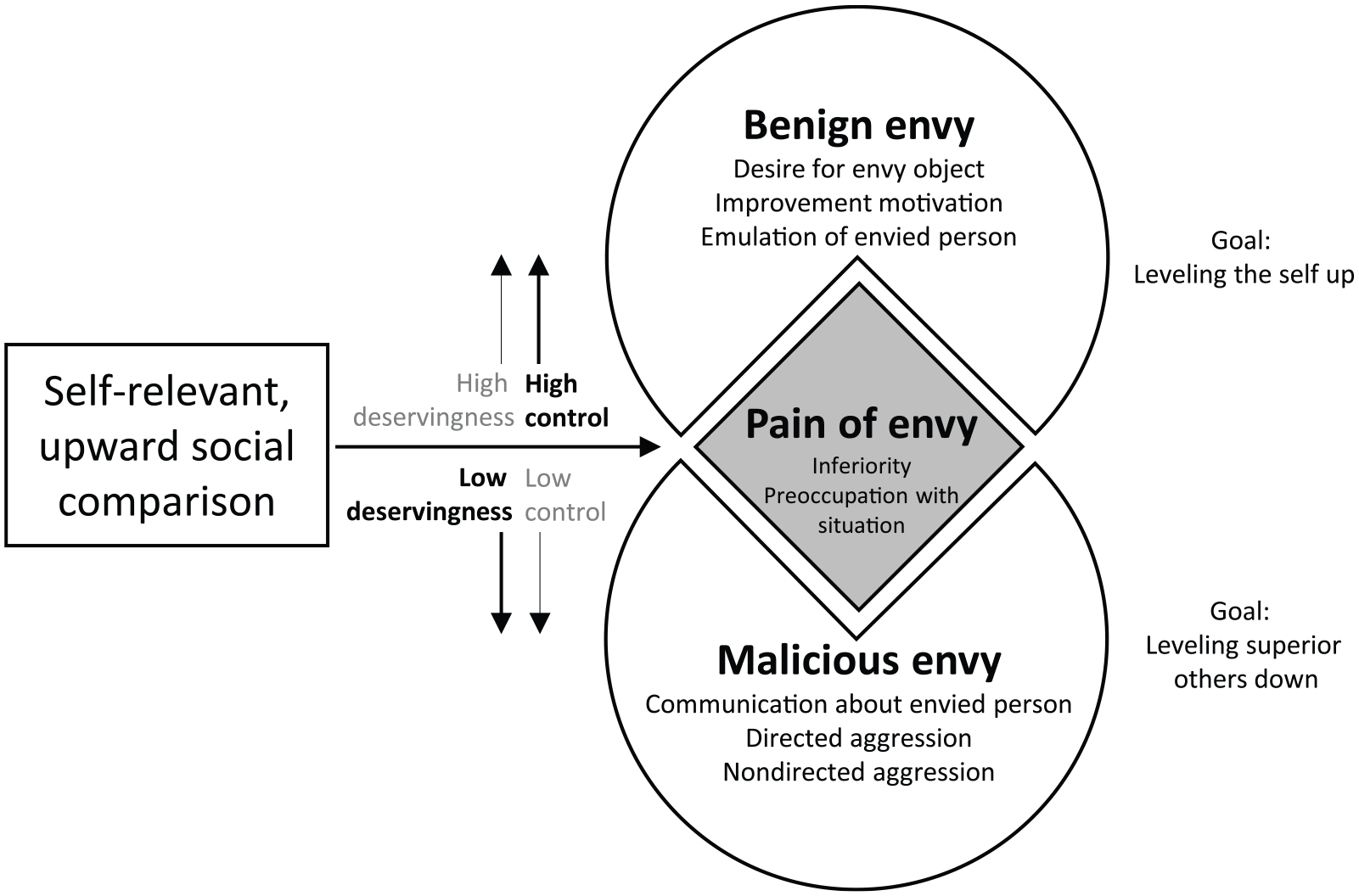
The dual approach as proposed in the Pain-driven Dual Envy (PaDE) Theory (Lange, Weidman, & Crusius, 2018).
Taken together, the findings refute that envy reflects a unitary construct. Consistently, unitary models were incompatible with the data. Instead, ample evidence shows that envy entails multiple, partly independent elements. That is, benign and malicious envy share several appraisals and painful inferiority. However, they also involve different thoughts, feelings, motivations, and action tendencies, explaining the striking diversity in envious responding.
Question 2: What Are the Predictors of Envy?
The Unitary Approach
We draw from social comparison, balance, and appraisal theories, and the self-evaluation maintenance model to discuss predictors of envy. An upward social comparison is the basic requirement of envy (e.g., Heider, 1958; Tesser, 1991). The way this comparison is appraised determines whether envy will occur (e.g., Lazarus & Cohen-Charash, 2001; Roseman & Smith, 2001). Specifically, most envy researchers assert that envy occurs when a person (a) knows or sees a comparison other who (b) has a resource that the person wants, but lacks, and (c) that is ego-relevant and important to the person’s self-evaluation (e.g., self and social esteem, achieving life goals; e.g., Heider, 1958; Lazarus, 1991; Salovey & Rodin, 1984, 1991; Tesser, 1991). These conditions comprise envy’s core-relational theme: “wanting what someone else has and feeling deprived of it but justified in having it” (Lazarus & Cohen-Charash, 2001, p. 55).
Surprisingly, there is scant systematic research on these and other predictors of envy (for a review, see Alicke & Zell, 2008). One exception comes from research on stereotype content, which shows that envy is predicted to occur when outgroup members who threaten one’s social standing are perceived as high in competence but low in warmth (Fiske, Cuddy, Glick, & Xu, 2002). Several researchers have examined trait self-esteem as a predictor of envy (Barth, 1988; Salovey & Rodin, 1991), but did not always find it to be related to envy (Cohen-Charash, 2000; but see also Question 3). Research on dispositional envy (e.g., Smith, Parrott, Diener, Hoyle, & Kim, 1999) also suggests that some people are predisposed to frequently experience envy in general.
One potential predictor of envy, the actual or perceived unfairness of the situation, drew a relatively large amount of research, some of which shows that unfairness can cause envy (Wilkin & Connelly, 2015). However, perceived injustice may relate to envy in additional ways (for reviews, see Mishra, Whiting, & Folger, 2017; Smith, 1991), such as moderating reactions to envy, being a component of envy, or even being an outcome of envy (e.g., Harris & Salovey, 2008; see Question 3).
A major point of disagreement between the unitary and typology approaches pertains to the roles of deservingness and control potential in envy. In the typology approach, deservingness and control potential determine whether a person experiences benign or malicious envy (Van de Ven et al., 2012). In the unitary approach, they serve a more complex role. For example, some scholars argue that people can envy others regardless of whether they deserve their good fortune (Rawls, 1971). Indeed, whereas some researchers found that low deservingness of the envied and high deservingness of the self, increase envy (e.g., Lieblich, 1971), others found that when the comparison other is undeserving, the resulting emotion is resentment rather than envy (Feather & Nairn, 2005; Feather & Sherman, 2002). Furthermore, envious individuals may sometimes rationalize their inferiority by reappraising the other’s success as undeserved, making envy the cause of perceived undeservingness rather than vice versa (Ben-Ze’ev, 1992; Miceli & Castelfranchi, 2007), though researchers have not examined this assertion empirically. Thus, deservingness can predict envy, potentially moderate reactions to envy, and even occur as an outcome of envy (see Question 3).
Regarding control potential, Smith (2004) suggested that envy requires appraisals of low perceived control, whereas Lazarus (1991) maintained that appraising the desired resource as attainable (i.e., one has some control over the situation) will lead to envy rather than to sadness and depression. While researchers in the unitary approach have given limited empirical attention to control potential, we consider it a moderator of strategies and reactions to envy (see Question 3). Importantly, despite its major role in the typology approach, research suggests that control potential does not reliably predict benign and malicious envy. For example, Van de Ven et al. (2009) found that more than half of both benign and malicious envy episodes that participants recalled involved low perceived control, whereas Lange, Crusius, and Hagemeyer (2016, Study 4) found that perceived control positively predicted both benign and malicious envy. Thus, we believe that the role of control potential in the typology approach needs further clarity.
The Dual Approach
Envy stems from upward comparisons. Social comparison research (Corcoran, Crusius, & Mussweiler, 2011; Garcia, Tor, & Schiff, 2013; Tesser, 1991) implies that dispositional and contextual factors that make such comparisons more likely and impactful fuel benign and malicious envy. Indeed, people with higher chronic comparison orientation (Lange & Crusius, 2015a) and those seeking and feeling entitled to social status are more prone to benign and malicious envy (Lange, Redford, & Crusius, 2019). The content of sampled envy episodes also points to perceived similarity to the superior person and domain relevance as precursors of both kinds envy (Crusius & Lange, 2014; Van de Ven et al., 2009, 2012). Situationally salient counterfactuals about envy-eliciting situations (“It could have been me”) increase pain in envy (Van de Ven & Zeelenberg, 2015). Similarly, competitions (Garcia et al., 2013) should fuel the impact of upward comparisons. More causal evidence about the relative effects of these factors on pain, benign, and malicious envy is needed, however.
A central hypothesis in the dual approach is that specific appraisals of the relevant social comparison then shape envy. Appraisal theories argue that a limited number of appraisal dimensions contribute to the unfolding of emotional episodes (Clore & Ortony, 2013; Ellsworth & Scherer, 2003; Frijda, 1986). Perceived control and deservingness are key appraisal dimensions contributing to benign and malicious envy. In short, when people perceive high control about improving their own outcome and if they regard the superior’s outcome as deserved, benign envy is more likely than malicious envy and vice versa (Lange et al., 2016; Van de Ven et al., 2009, 2012). The evidence suggests relative differences in the importance of these appraisals: control is more strongly linked to benign envy, whereas deservingness is more strongly linked to malicious envy (Lange et al., 2016). As control and deservingness are not necessarily correlated, benign and malicious envy can co-occur.
Distal moderators affecting these key appraisals should consequentially predict the outcome of envy-eliciting situations. For example, information about merit reduces malicious envy (Van de Ven, Zeelenberg, & Pieters, 2011a). Similarly, when superior others express authentic pride (signaling that success is attributable to effort), benign envy is more likely. Conversely, signals of hubristic pride (signaling stable attributions to talent) increase malicious envy (Lange & Crusius, 2015b). Thus, contextual variables can clarify how an episode of envy evolves.
How people perceive others’ superiority also hinges on dispositions (Crusius & Lange, 2017; Lange, Blatz, & Crusius, 2018). For example, basic motivational tendencies related to how people construe opportunities for goal pursuit, such as hope for success and fear of failure, predict benign and malicious envy, respectively (Lange & Crusius, 2015a). Related findings stem from research on varieties of narcissism. According to the narcissistic admiration and rivalry concept (Back et al., 2013), grandiose narcissism entails two related but distinct traits: narcissistic admiration (narcissists’ assertive inclinations to maintain a grandiose self) and narcissistic rivalry (narcissists’ antagonistic inclinations to self-enhance). These facets of grandiose narcissism relate differently to the two forms of envy, mediated via their central appraisal dimensions (Lange et al., 2016). Narcissistic admiration predicts perceived control, mediating its relationship with benign envy. Narcissistic rivalry predicts lower perceived deservingness of others’ superiority, mediating its relationship with malicious envy (Lange et al., 2016). Similarly, different forms of trait self-esteem distinctively related to optimism or defensiveness show specific relationships with benign and malicious envy (Smallets, Streamer, Kondrak, & Seery, 2016; Vrabel, Zeigler-Hill, & Southard, 2018). These examples suggest that core appraisals can integrate a diverse set of predictors and outcomes of envy.
Nevertheless, many questions remain about the elicitation of benign and malicious envy. First, more causal evidence on the interaction of deservingness and control appraisals is needed. Some evidence suggests, for example, that perceptions of undeservingness may sometimes override perceptions of control (Van de Ven et al., 2012). Second, there might be additional processes that shape how an episode of envy evolves. For example, counterfactuals fuel both benign and malicious envy by highlighting inferiority (Van de Ven & Zeelenberg, 2015), and qualitatively distinct counterfactuals also seem to contribute to the specific forms of envy. Specifically, additive counterfactuals about the self (“I should have done X”) increase benign envy, whereas counterfactuals about others (“She should have/not have done X”) increase malicious envy (Crusius & Lange, 2019). Finally, that state benign and malicious envy are not correlated (Lange, Weidman, & Crusius, 2018) implies they are not mutually exclusive, posing questions about the elicitation and the consequences of mixed emotional states of benign and malicious envy.
Question 3: What Are the Consequences of Envy?
The Unitary Approach
Envy motivates the envious to alleviate the pain and eliminate the inferiority-causing gap with the other. As Figure 2 illustrates, these interrelated goals can be accomplished through myriad strategies, such as elevating the self’s position, lowering the other’s position, distancing oneself from the situation, and “owning” or accepting one’s envy, among others (e.g., Berman, 2007; Cohen-Charash, 2009; Exline & Zell, 2008; Heider, 1958; Leach, 2008; Parrott & Smith, 1993). These strategies drive behavioral, emotional, and cognitive reactions, such as working harder, harming the other’s reputation, avoiding the other, and reappraising the situation (e.g., Cohen-Charash, Gonzalez, Larson, Lee, & Alenick, 2019; see Figure 2). Indeed, research shows that envy motivates various reactions, which some researchers classify as hostile and nonhostile (e.g., Leach, 2008; Parrott & Smith, 1993), or constructive and destructive (Tai et al., 2012). To embrace a broader array of strategies and reactions, we will discuss other-demotion, self-promotion, and additional cognitive, emotional, and regulatory reactions.
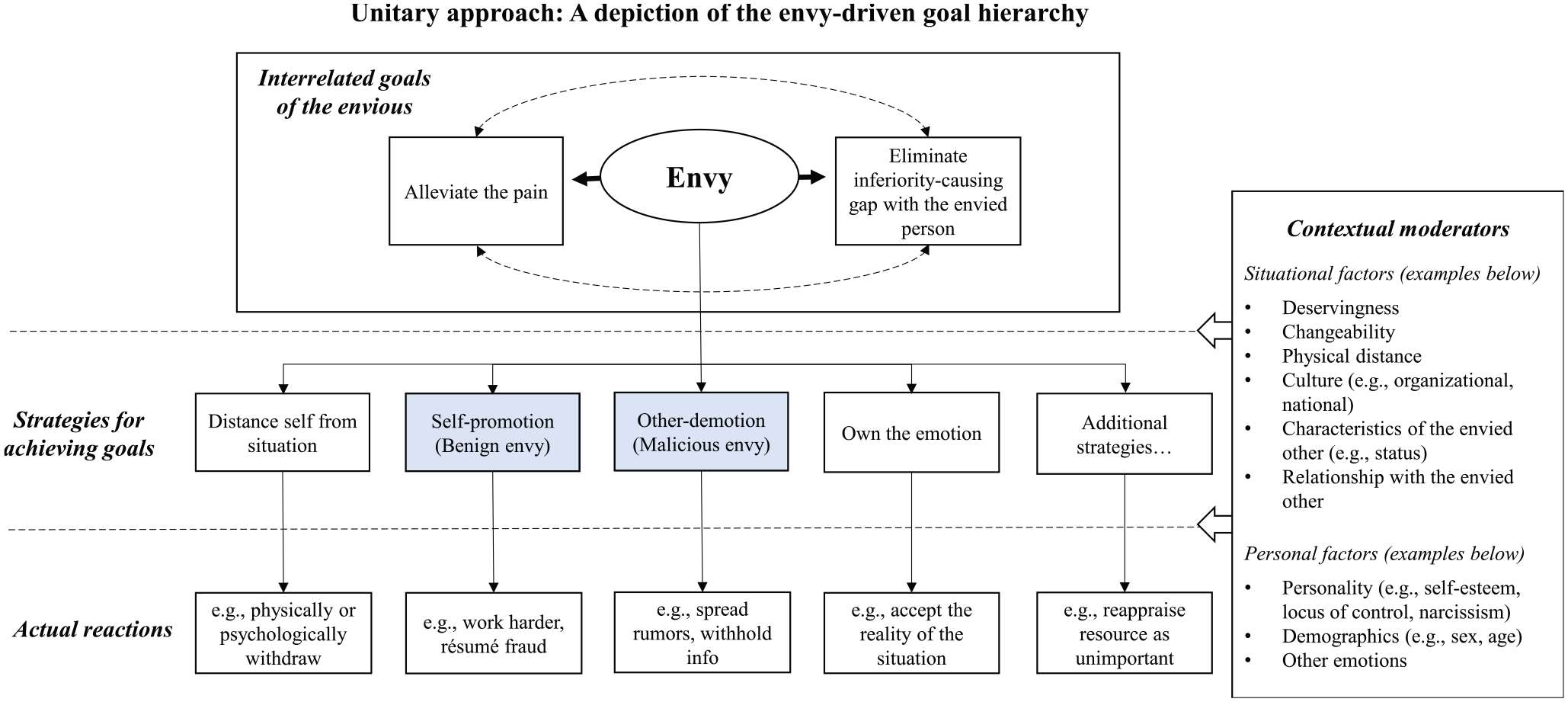
Theoretical goal hierarchy of envious individuals, based on theory and research within the unitary approach, with more proximal strategies and reactions reflected at lower levels of the hierarchy. Contextual moderators are proposed to influence (a) which regulatory strategy/strategies envy motivates, and (b) which reactions evolve from each regulatory strategy. The darker-shaded boxes represent how we (Cohen-Charash and Gonzalez) see benign and malicious envy not as different envy types, but as strategies residing within this model. The strategies, reactions, and contextual moderators in this model are only examples, and many more are possible and should be theorized and examined.
Most research in the unitary approach centers on other-demoting strategies and reactions that harm the envied (e.g., Salovey & Rodin, 1984) and/or the resource (e.g., Elster, 1991; Wobker, 2015; Zizzo & Oswald, 2001). These reactions can be overt, such as undermining or punishing the envied (Duffy, Scott, Shaw, Tepper, & Aquino, 2012; Eissa & Wyland, 2016; Gino & Pierce, 2010; Kim & Glomb, 2014), or covert, such as withholding or providing wrong or low-quality information to the envied (Cohen-Charash & Larson, 2011; P. Fischer, Kastenmüller, Frey, & Peus, 2009; Moran & Schweitzer, 2008).
Researchers have also examined self-promoting strategies and reactions, such as intending to or actually performing better at work (Cohen-Charash, 2009; Lee & Duffy, 2019; Schaubroeck & Lam, 2004), enhancing one’s body or appearance (Arnocky, Perilloux, Cloud, Bird, & Thomas, 2015; Chan & Sengupta, 2013), and expending greater effort during job searches (Dineen, Duffy, Henle, & Lee, 2017). Notably, self-promoting behaviors can sometimes be socially undesirable and even unethical, such as résumé fraud (Dineen et al., 2017), theft (Wilkin & Connelly, 2015), and cheating (Gino & Pierce, 2010).
Another class of reactions to envy include, but are not limited to, cognitive, emotional, and self-directed reactions that do not clearly fit within the categories of other-demotion and self-promotion. Cognitive reactions include reappraising the resource as unimportant or the envied other as incomparable to the self (e.g., Kets De Vries, 1992), allocating greater attention to and better recalling adaptational information (Hill & Buss, 2006; Hill, Delpriore, & Vaughan, 2011), and developing implicit attitudes toward the envied (e.g., Chan & Sengupta, 2013). Potentially, these cognitive reactions could regulate the envious individual’s behavior, such as reappraising the situation to suppress socially undesirable reactions, although this point requires further research. 6 Envy predicts self- and other-directed emotional reactions, such as schadenfreude at the envied’s misfortune (e.g., Smith, Powell, Combs, & Schurtz, 2009), depression (Smith et al., 1994), and anxiety (Cohen-Charash, 2009). Envy also predicts self-directed behaviors, such as pursuing social support in order to self-protect (Berman, 2007). Lastly, given the social stigma around envy, people often hide their envy from others (Silver & Sabini, 1978a, 1978b) and from themselves, for example, by masquerading it as socially acceptable emotions, such as anger at or happiness for the other (Cohen-Charash, Larson, & Fischer, 2013; A. H. Fischer & Cohen-Charash, 2009).
These three major classes of reactions are neither exhaustive nor mutually exclusive. For example, envy predicts social loafing (Duffy & Shaw, 2000), which could reflect withdrawal (self-directed regulatory reaction) or harming the envied (other-demotion). Likewise, in zero-sum contexts, gaining the resource (self-promotion) entails making the envied other lose it (other-demotion; Foster, 1972). Furthermore, reactions from different classes can co-occur, even competing ones, such as disliking the other while improving one’s performance (Schaubroeck & Lam, 2004), and holding negative attitudes toward the other while attempting to improve one’s appearance (Chan & Sengupta, 2013).
Research suggests that personal factors (e.g., traits, attitudes, beliefs, perceptions) and situational factors (e.g., cultural norms, time) determine when different reactions occur. We focus here on classes of moderators, rather than offering a core set of moderators, given that, theoretically, limitless factors can affect the strategies and reactions that an envious individual will use (see also Figure 2). When answering Question 2, we included deservingness and control potential among such moderators. For example, we have found that envy predicts higher levels of both harming the envied other and task performance when the envied was undeserving, rather than deserving (Cohen-Charash & Larson, 2015, Study 4), and that envy more strongly predicts perceived unfairness (Gonzalez & Cohen-Charash, 2019) and harming behavior (Cohen-Charash & Larson, 2011, Study 2) in situations involving high (rather than low) control potential.
Some influential personal factors include trait self-esteem (Cohen-Charash & Larson, 2011, 2015; Cohen-Charash & Mueller, 2007); perceived capability of gaining the resource, entitlement to the resource, and awareness and acceptance of one’s envy (Berman, 2007); core self-evaluations (Lee & Duffy, 2019); perceived organizational support (Tai et al., 2012); social identification with others and moral disengagement (Duffy et al., 2012); emotionality (Wilkin & Connelly, 2015); and level of job performance (Eissa & Wyland, 2016). Perceived unfairness is a subset of personal factors that has yielded mixed research findings, such that when unfairness is high, envy has been found to predict greater harming in some circumstances (Cohen-Charash & Mueller, 2007), and less harming in other circumstances (Khan, Quratulain, & Bell, 2014).
Situational factors impose physical and/or psychological constraints on the types of strategies and reactions the envious can engage in. For example, time pressure, work market opportunities, and job type can predict the extent to which envious job seekers resort to résumé fraud or to effortful job search behaviors (Dineen et al., 2017). Social norms serve as another such constraint. For example, envy predicts more undermining behavior when such behavior is normative (Duffy et al., 2012), and less prosocial behavior when such behavior is counternormative (e.g., in competitive climates; Eslami & Arshadi, 2016). The changeability of the situation (Larson, Gonzalez, & Cohen-Charash, 2018) and one’s physical proximity to the envied (Larson, 2013) are other situational determinants of strategies and reactions to envy. Thus, we believe that researchers should identify boundary conditions that determine when various strategies and reactions to envy occur, rather than doing so by dividing envy into multiple types.
The Dual Approach
The motivational power of envy is well known. Much evidence documents antisocial outcomes (Smith & Kim, 2007). Neverthe-less, envy sometimes also predicted nonhostile inclinations. For example, envy can relate to improvement motivation (Cohen-Charash, 2009), better performance (Schaubroeck & Lam, 2004), desire for status-related goods (Crusius & Mussweiler, 2012), or even the intention to help superior others (Hareli & Weiner, 2002). Although these studies employed unitary envy measures, the predicted outcomes were diverse and partially contradicted the notion that envy is hostile. According to the dual approach, this diversity in envious consequences reflects the duality of envy. This implies a need to disentangle the envy forms in measurement. Doing so should account for the diversity in correlates and outcomes of envy-eliciting situations. In particular, these should be in line with respective functions of the envy forms.
Indeed, manipulations and measures of malicious envy predict outcomes that may serve to bring superior others down. These include hostile action such as choosing punishing tasks (Lange & Crusius, 2015b), counterproductive work behaviors (Braun, Aydin, Frey, & Peus, 2016; Khan et al., 2014; Sterling et al., 2017), and indirect forms of disparagement, such as gossip (Lange et al., 2016) or schadenfreude (Lange, Weidman, & Crusius, 2018; Van de Ven et al., 2015). Conversely, benign envy predicts outcomes that may serve to level up the self. They include attentional bias toward means for achievement (Crusius & Lange, 2014), higher risk-taking for goal pursuit (Kwon, Han, & Nam, 2017), being inspired (Meier & Schäfer, 2018), increased goal setting (Lange & Crusius, 2015a), and more effort, persistence, and better performance (Khan et al., 2017; Lange & Crusius, 2015a, 2015b; Van de Ven, Zeelenberg, & Pieters, 2011b). A consistent pattern is that the measures of benign and malicious envy did not predict the consequences of the respective other form, supporting that they are independent.
The nomenclature of benign versus malicious envy might invite the interpretation that benign envy is the adaptive, socially desirable, permissible form of envy (D’Arms, 2017) or merely unites “constructive” outcomes, whereas malicious envy unites “destructive” outcomes (Cohen-Charash & Larson, 2017b; Tai et al., 2012). However, from a functional perspective, both forms of envy are reactions to threat, involving different self-defensive strategies. Whether these are constructive depends on context, time point, and level of analysis (e.g., envier, envied, or social group). As scientists, we should avoid evaluative and moral assumptions about such phenomena (Paulhus, Fridhandler, & Hayes, 1997).
Specifically, benign envy might be benign in the sense that its proximate goal of self-improvement does not imply harm against others. Neither this end nor its means are necessarily constructive, however. For example, scholars attribute irrational decision-making and economic and environmental problems to the envy-driven pursuit of status-related goods, such as luxury products (Belk, 2011; Frank, 1999; Veblen, 1899; Zheng, Baskin, & Peng, 2018). Unitary measures of envy also predict adverse consequences of comparisons with idealized media images, including cosmetic surgery or risky diet pills (e.g., Arnocky et al., 2015). A dual approach implies that benign envy causes such maladaptive outcomes. Furthermore, along with malicious envy, benign envy predicts morally questionable behavioral inclinations, including deception, strategic compliance, and other forms of manipulative interpersonal behavior directed at self-interested outcomes (Lange, Paulhus, & Crusius, 2018; Vrabel, Zeigler-Hill, McCabe, & Baker, 2019). Malicious envy involves hostility against superior others. However, a social-functional account suggests analyzing the adaptiveness of malicious envy’s consequences—without equating them with low social desirability or destructive behavior. The hostility in malicious envy may nevertheless carry adaptive social implications. For example, being the target of malicious envy can increase prosocial behavior to reduce envy’s harmful consequences (Van de Ven, Zeelenberg, & Pieters, 2010). Thus, malicious envy may be functional in interpersonal interactions.
Malicious envy may also serve group-level functioning. For instance, malicious envy predicts gossip (Lange et al., 2016). Gossip is self-protective for those who receive it (Martinescu, Janssen, & Nijstad, 2014) and ensures cooperation by inducing reputational concerns (Feinberg, Willer, & Schultz, 2014). Malicious envy also predicts schadenfreude (Lange, Weidman, & Crusius, 2018), having partly functional consequences: Expressed by maliciously envious persons, schadenfreude undermined the social status of dominant targets (Lange & Boecker, 2019). Thus, via superficially malicious outcomes such as gossip and schadenfreude, invidious comparisons may fulfill interpersonal and group-level functions (e.g., Inoue, Hoogland, Takehashi, & Murata, 2015; Wert & Salovey, 2004).
Question 4: How Should Envy Be Measured and Studied?
The Unitary Approach
Measures of envy should reflect its complexity. Like our coauthors (see also Lange, Weidman, & Crusius, 2018), we do not see one- or two-item envy measures as valid. We also view measures that mainly capture one component of envy (e.g., motivation, cognitions) as deficient. Instead, to better integrate and compare research findings, we advocate for using validated and comprehensive measures of envy (for a fuller discussion, see Cohen-Charash & Larson, 2017a). This critique applies to both the unitary and typological approaches, and contradicts the call to use different measures in different contexts (Van de Ven, 2016).
We maintain that measures of envy should capture its feeling, cognitive, and motivational components, but not its antecedents or outcomes (see Cohen-Charash & Larson, 2017a, 2017b, for reviews). For example, in the typology approach, researchers have used “benign” envy items such as “I tried harder to achieve my goals,” and “malicious” envy items such as “I criticized the person” (Lange, Weidman, & Crusius, 2018; Van de Ven et al., 2009), which reflect reactions to envy. Unsurprisingly, given that these outcomes are embedded in the measures, “benign” envy predicted self-improvement and “malicious” envy predicted harming in some of these studies. 7 Some researchers have even operationalized benign and malicious envy directly as effort and harming, respectively (e.g., Smallets et al., 2016). Thus, while researchers from both approaches likely agree that measures of envy should capture its motivational qualities, we feel that it must be accomplished without conflating envy with its outcomes. Instead, researchers should measure envy holistically as a complex, unitary construct (Cohen-Charash, 2009), and avoid tautology by omitting antecedents and reactions to envy from the measure.
We further believe that the measurement of envy, like that of any construct, should stem from its theoretical conceptualization (Podsakoff, MacKenzie, & Podsakoff, 2016), and that methods to study envy should be theory-based, rather than primarily data-driven (see Block, 1995, for an analogous discussion regarding personality). For example, Lange, Weidman, and Crusius (2018, Study 1) factor-analyzed responses to an envy item pool originated from previous theory-driven research and found a dimension that they interpreted as meaningless (see Table 2, Factor 3 in Lange, Weidman, & Crusius, 2018), but that we view as resembling envy’s conceptualization in the unitary approach (i.e., feeling envious, longing for the resource, perceiving the envied other as lucky and better off than the self). This envy factor did not appear in Lange, Weidman, and Crusius’s Study 2 (2018), in which participants generated the item pool (a data-driven approach), the majority of which represented behavioral reactions to envy, rather than envy (e.g., “I put on a false smile,” “I invested more effort to also obtain X”). Thus, methodological choices, such as how items are generated, can shape the factor structures obtained. Our previous example also shows that data-driven research, just like theory-driven research, is still subjective, can yield interpretational differences, and nevertheless needs sound, theory-driven methodologies and operationalizations. For additional best practices recommendations for studying and measuring envy, see Cohen-Charash and Larson (2017a).
In their response to this question, our coauthors critiqued our methodology of averaging across all the items in the Episodic Envy Scale to create a single composite envy score. As stated in Question 1, we view envy as a complex and formative construct, and we argue that examining its components individually is inappropriate. Like other formative constructs, envy does not require highly intercorrelated components (e.g., Coltman, Devinney, Midgley, & Venaik, 2008), and aggregating from these components is appropriate if the measure is developed with theoretical and empirical rigor and with clear inclusion criteria to ensure that items capture critical aspects of the construct (Johnson, Rosen, & Chang, 2011). 8 Regarding our collaborators’ critique in their response to this question, the choice to look at a construct as formative or reflective should be guided by a theoretical rationale. While it goes beyond the scope of this article to test such a model here, previous work has laid out a theoretical rationale that supports envy as a formative construct (Cohen-Charash, 2009). 9 Therefore, we think it is methodologically sound for researchers using the episodic envy measure (Cohen-Charash, 2009) to average across envy’s components, and we reiterate the recommendation to do so. Furthermore, the result of an exploratory factor analysis showed that the Episodic Envy Scale explains 75.9% of the variance in envy (Cohen-Charash, 2009).
The Dual Approach
Research on the distinction between benign and malicious envy shows that careful, validated measurement is crucial to prevent conceptual confusion and empirical inconsistency. A dual envy conceptualization and PaDE theory in particular imply that the distinct constructs of benign envy, malicious envy, and their shared pain component need to be taken into account, as they describe the nature of envy comprehensively (for a more complete discussion, see Lange, Weidman, & Crusius, 2018).
Thus, we recommend measuring all three constructs in all envy studies, even if the predictions regard only one or two of them. From PaDE theory follows that it is crucial to specify this focus of analysis. It can be on painful inferiority as shared element. It can also be on the specific forms of envy to clarify the impetus of envious responding. Many variables will primarily affect the pain of envy, leading to common predictors of benign and malicious envy. For example, social comparison orientation (e.g., Gibbons & Buunk, 1999) predicts measures of benign and malicious envy at the state (Lange, Weidman, & Crusius, 2018) and the dispositional level (Lange & Crusius, 2015a; Meier & Schäfer, 2018). Other variables increasing the impact of contrastive comparisons, such as counterfactuals (Van de Ven & Zeelenberg, 2015), will likely increase the pain in envy. Measuring only pain, however, will not capture the whole trajectory of envious responding, leading to less informative findings.
This analysis implies that painful inferiority and the forms of envy should be measured with conceptual accuracy, that is, requiring discriminant validity. For example, when measuring benign and malicious envy, researchers should avoid items likely to result in opposing loadings on the two constructs. Benignly envious persons will be more likely to agree to an item measuring whether they “like the other person” (Crusius & Lange, 2014). However, because malicious envy will reduce agreement to this item, it risks conceptual clarity. Similarly, this item is problematic because it also measures admiration, which is conceptually and empirically distinct from benign envy (Schindler, Paech, & Löwenbrück, 2015; Van de Ven et al., 2011b). For this reason, we avoided terms from neighboring emotions when constructing a scale for episodic envy based on PaDE theory (Lange, Weidman, & Crusius, 2018).
We also advise against using single items such as “envy,” “envious,” or “jealous.” First, single items are often unreliable and unlikely to reflect emotions comprehensively (Weidman, Steckler, & Tracy, 2017). Second, while laypeople may use the label “envy” for both benign and malicious episodes, employing it in an inclusive sense for measurement may be fraught with peril. People could be inclined to avoid the term in self-descriptions. We also suspect that context disambiguates whether people refer to benign or malicious envy when using this label. Thus, single-item measures might render cross-contextual comparisons invalid. As an indication of the difficulties attached to them, the loadings of such items on the factors measuring envy were not entirely consistent across studies when we developed PaDE theory (Lange, Weidman, & Crusius, 2018).
Finally, we advise to use scales of envy as they were validated. For example, the Episodic Envy Scale by Cohen-Charash (2009) and the dispositional Benign and Malicious Envy Scale (Lange & Crusius, 2015a) were validated with two factors. One-factor solutions did not fit the data and the shared variance of the factors was small (see Question 1). Similarly, the state measures of pain, benign envy, and malicious envy as part of the PaDE theory were conceptualized as three separate factors. Thus, when using these scales, their factor structures should be respected.
Contrary to the present claims of our coauthors (Question 1), the formative model they propose was neither tested in Cohen-Charash (2009) nor in the second-order model mentioned in Endnote 4. All models constitute variants of a reflective latent variable model. Fitting the formative latent variable model requires specifying indicators as causes and not consequences of the latent variable. Furthermore, the model is identified only when adding at least two external variables caused by the latent variable (e.g., Bollen & Bauldry, 2011). These requirements, however, undermine the substantive interpretation of the formative latent variable, questioning the usefulness of such models in general (Howell, Breivik, & Wilcox, 2007). As the proposed formative model was neither fitted to data nor rendered interpretable, averaging across the two factors of the Episodic Envy Scale (Cohen-Charash, 2009) is methodologically inappropriate, even though this has been done and been recommended repeatedly (Cohen-Charash, 2009; Cohen-Charash & Larson, 2017a; Cohen-Charash & Mueller, 2007; Hill et al., 2011; Khan et al., 2014).
Question 5: What Are the Advantages of Each Approach to Studying Envy?
The Unitary Approach
We will discuss six advantages of the unitary approach over the typology approach. First, based on principles of process count parsimony (Dacey, 2016), the unitary approach offers a parsimonious model of the process of envy, in which the appraisal of an event leads to envy (Step 1), which subsequently leads to various reactions depending on personal and situational moderators (Step 2; see Figure 1 in Cohen-Charash & Larson, 2017a). We see the process in the typology approach as more complicated: an event leads to pain (or general envy; Step 1), then appraisals of control potential and deservingness cause “benign” and/or “malicious” envy (Step 2), which then lead to their respective reactions (Step 3). Thus, our model is more parsimonious, in that it contains two major processes that explain three major reaction categories, whereas the typology model contains three major processes and predicts two major reaction categories.
Different from our coauthors, we see moderators as necessary for delineating a model’s boundary conditions and increasing its predictive utility (Bacharach, 1989). Furthermore, we do not view the number of unique moderators that influence a given process link as detrimental to parsimony. We see theoretical and practical meaning in identifying when people will use different strategies to deal with their envy, and we do not believe these moderators can be distilled down to a set of core constructs (e.g., control potential and deservingness in the typology approach). Furthermore, in addition to the distal moderators theorized to influence appraisals of deservingness and control potential, the typology model is still relatively young and may eventually need to invoke moderators that affect how people react to benign or malicious envy, and pain/general envy. Therefore, arguing against identifying boundary conditions (moderators) seems counterproductive for both approaches.
Second, despite being parsimonious, the unitary model accounts for more strategies and reactions designed to fulfill the motivational goal of envy than the typology approach (see Figure 2), thus offering more empirically testable hypotheses regarding possible strategies and reactions to envy. The two approaches disagree on how broadly to conceptualize the goals of the envious. Figure 2 depicts our (Cohen-Charash and Gonzalez) view that “benign” and “malicious” envy reflect labels for two of several different strategies for fulfilling the motivational goals inherent in envy of alleviating the pain and eliminating the gap (i.e., elevating the self and demoting the other; see Question 3). While these strategies and their subsequent behaviors vary across situations, people, and time, they all serve the same adaptive goals.
Relatedly, we believe that the current debate cannot be resolved merely by examining the magnitude to which benign and malicious envy are correlated. If benign and malicious envy represent regulatory strategies of envy, as we believe they do, we would expect their correlations to vary across contexts, such that they correlate strongly in some contexts (e.g., zero-sum; see Question 3) and weakly in others (e.g., one can self-promote, but cannot demote the other, or vice versa). Indeed, research documents a wide range of correlations between benign and malicious envy.
Third, the unitary approach offers a holistic understanding of envy. Emotion researchers generally agree that emotions include cognitive, neurophysiological, feeling, expression, and action readiness/tendency components (e.g., Scherer, 2005). In Question 1, we discussed envy’s feelings, cognitions, and motivations within the unitary approach. In the typology approach, benign and malicious envy are often defined and operationalized primarily by their motivations, whereas the characteristics of the other components (feelings and cognitions) are either unclear or under debate (Lange, Weidman, & Crusius, 2018; Van de Ven et al., 2009). For example, both types are described as unpleasant, but benign envy has also been described as uplifting (Van de Ven et al., 2009).
Fourth, the unitary approach has a stronger theoretical rationale than the typology approach. To start, based on appraisal theory, their different appraisals may make “benign” and “malicious” envy two entirely different emotions, rather than two types of envy (see Ellsworth & Tong, 2006, for a similar argument regarding “self-anger” and “other-anger”). Whereas “malicious” envy may resemble envy (but see the differences discussed in Cohen-Charash & Larson, 2017a), “benign” envy seems to resemble emulation. Furthermore, we do not understand how benign and malicious envy can co-occur if they require opposite appraisals of high (vs. low) deservingness and control (e.g., Van de Ven et al., 2012; see Figure 1 in the present article). Since appraisals are necessary for an emotion to occur (e.g., Lazarus, 1991), it is unclear to us how an event can be simultaneously appraised as low and high in control, or as low and high in deservingness. Lastly, despite claims of non-English terms for “benign” and “malicious” envy (see their response to Question 1), these words lack a common root, and our attempts to translate them into English rendered different emotion terms, such as “envy” and “grudge” in German, and “desire” and “resentment” in Dutch (see also Cohen-Charash & Larson, 2017a).
Fifth, studying envy as a unitary construct reduces conceptual proliferation (Podsakoff et al., 2016). Although Van de Ven et al. (2009) increased awareness of the fact that envy can lead to nonhostile strategies and reactions, such theory and findings existed earlier within the unitary approach (e.g., Berman, 2007; Cohen-Charash, 2009; Schaubroeck & Lam, 2004). Thus, separately studying “benign,” “malicious,” and “general envy” (or “pain”) seems neither theoretically nor empirically justified, when a unitary conceptualization of envy predicts the same strategies and reactions and more.
Sixth, we believe the terminology of “benign” and “malicious” envy creates a value judgment (Cohen-Charash, 2019), making one envy type perceivably more desirable than the other. This potentially perpetuates symmetrical psychology, limiting science’s power to explain human behavior (e.g., Cohen-Charash, 2019; Lindebaum & Jordan, 2014). For example, with few exceptions (e.g., Crusius & Lange, 2014; Lange, Paulhus, & Crusius, 2018; Van de Ven & Zeelenberg, 2015), many typology researchers tend to hypothesize about malicious envy’s relationship with hostile outcomes, and benign envy’s relationship with nonhostile outcomes (even if all of these variables are measured in the same study).
The Dual Approach
The strength of a dual conceptualization lies in its capacity to describe envious responding in a comprehensive way. First, the distinction between benign and malicious envy has greatly expanded the scope of envy research. It has allowed to generate a wide variety of novel predictions not only going beyond the idea that envy is an essentially hostile emotion but also based on the notion that envy can be functional in different ways. Thus, by expanding envy’s conceptualization, the distinction between benign and malicious envy contributes to a more complete understanding of envy, its determinants, and its consequences (also see Van de Ven, 2016).
Secondly, a dual conceptualization of envy increases clarity by offering an explicit definition of what envy is and how it should be operationalized. Past research is characterized by highly inconsistent and often atheoretical operational definitions of envy (for an extensive discussion and evidence, see Lange, Weidman, & Crusius, 2018). These resulted in empirical discrepancies. In particular, different measures employed under a unitary approach have tapped into benign or malicious envy to differing degrees, leading to inconsistent relationships with certain outcomes.
Consider envy and schadenfreude. Some research suggests that envy predicts schadenfreude (Smith et al., 1996; Van Dijk, Ouwerkerk, Goslinga, Nieweg, & Gallucci, 2006). Other research contradicts these findings (Feather & Nairn, 2005; Feather & Sherman, 2002; Hareli & Weiner, 2002). Manipulating benign versus malicious envy supports that only malicious envy causes schadenfreude (Van de Ven et al., 2015). Furthermore, a meta-analysis of the research on envy and schadenfreude confirmed that prior studies found a relationship the more their envy measure reflected malicious envy (Lange, Weidman, & Crusius, 2018). Thus, accounting for envy’s systematic diversity in its operationalization increases conceptual clarity and empirical consistency.
Third, the central advantage of studying envy from a dual perspective is that it accounts for the evidence that the experience of envy is not unitary (Falcon, 2015; Lange, Weidman, & Crusius, 2018; Van de Ven et al., 2009). Instead, the evidence shows that there are two qualitatively different classes of envious responding (see Question 1).
A criticism of proponents of the unitary conceptualization holds that some of the research on benign and malicious envy is tautological because measures of benign and malicious envy partly include items assessing upward motivation and hostile intentions. Supposedly, these are then merely linked to corresponding behavioral outcomes. To begin with, this argument does not do justice to the breadth and scope of the measures nor the outcomes that have been investigated in this research. Of course, not all links between self-reported emotion and behavioral outcomes are surprising. Crucially, however, this is irrelevant to the question whether different motivations should be part of how envy is conceptualized. It is not a tautology to account for systematic variance within envious responding with respect to motivational inclinations going along with specific thoughts, feelings, and appraisals—in light of the evidence, it is a necessity.
Fourth, a dual conceptualization of envy is a parsimonious theory of envious responding. It holds that key appraisal dimensions (e.g., similarity, domain relevance, deservingness, and personal control) shape how envy unfolds. These appraisals can be affected by distal dispositional and contextual moderators (see Question 2; Crusius & Lange, 2017). As these distal moderators are not part of the model (see Figure 1), it incorporates a limited set of constructs, yielding parsimony. The unitary model (see Figure 2) is silent about the mechanisms that govern its varied goal hierarchy. Thus, it implies additional moderators without attempting to clarify which of them are essential. Therefore, this model actually incorporates an unknown number of additional constructs. Of course, both approaches cannot be exhaustive in specifying possible moderators. Furthermore, it is likely that research will identify more appraisal dimensions related to benign and malicious envy. Nevertheless, the notion that by ignoring systematic variance, a unitary model can simultaneously be more parsimonious and have more predictive power in explaining the complexity of envy strikes us as paradoxical.
Joint Discussion: Agreements, Disagreements, and Outlook
Thus far, we have shown that our disagreements revolve mainly around (a) the conceptualization and measurement of envy, (b) the necessary and sufficient conditions leading to envy, and (c) the moderators of the envy process (summarized in Table 1). Still, we agree that envy is an important emotion that, despite being unpleasant, can be functional, and that researchers should identify circumstances under which envy, however conceptualized, is adaptive or maladaptive for the self and for others. We also agree that self-promoting reactions are not necessarily socially desired or adaptive, and other-demoting reactions are not necessarily maladaptive (see our answers to Question 3). Thus, regardless of how researchers conceptualize envy, they should avoid value judgments about envy by studying both hostile and nonhostile reactions. Relatedly, we agree that categorizing envious reactions with vague and subjective terminologies like “constructive”/“destructive,” and even “functional”/“dysfunctional” could be presumptuous without clarifying the context in which the reaction occurs (Cohen-Charash, 2019; Lange, Paulhus, & Crusius, 2018).
Side-by-side comparison of the unitary and dual (typology) approaches.

Note. Q# at the end of each bullet point refers to the sections of the article in which a given point is discussed.
We also agree that envy researchers should carefully consider which measures they use. As elaborated here and elsewhere (Cohen-Charash & Larson, 2017a; Lange, Weidman, & Crusius, 2018), we recommend using validated measures that depict envy holistically and reflect its complexity, and using various research methods and samples. Even though in this article we do not resolve the debate on how to conceptualize and measure envy, we argue that researchers should at least present an explicit, theoretically grounded rationale for their specific operationalization of envy.
Finally, regardless of the approach, it is clear that much remains to be learned about envy. Our joint analysis underlines that envy cannot be reduced solely to harming others or elevating the self. Instead, envy can explain a wide variety of psychological and social reactions to upward social comparisons. However, we have little data about the psychological mechanisms shaping how people deal with painful upward comparisons, what moderates these underlying processes, or how envious episodes evolve and change over time. Irrespective of the approach, it is striking that experimental process evidence in particular, such as about fundamental appraisals and other processes, is lacking (though for exceptions, see e.g., Leach & Spears, 2008; Smith et al., 1996; Van de Ven et al., 2012). Furthermore, there is only scant knowledge about ways to encourage people to react to envy-eliciting situations in certain ways versus others. Additionally, we noticed a scarcity of studies examining the social perception of envy and how the envious individual is viewed by the self and others (e.g., Cohen-Charash et al., 2013; A. H. Fischer & Cohen-Charash, 2009; Lange, Hagemeyer, Lösch, & Rentzsch, in press; Rodriguez Mosquera, Parrott, & Hurtado de Mendoza, 2010; Silver & Sabini, 1978a, 1978b). More research on the social and personal implications of envy is thus needed.
The debate on what is envy is likely to remain. Until its resolution, however, we encourage researchers to prevent further conceptual confusion by explicitly stating their theoretical approach to envy and carefully describing how this translates to their measurement of envy. We hope that our joint review helps in navigating the intricate landscape of research on envy.
A final note: We adopted a theoretical, rather than empirical, version of the “adversarial collaboration” format used by Latham, Erez, and Locke (1988) and Mellers, Hertwig, and Kahneman (2001). We anticipated that writing this article would be relatively simple. Instead, it required extraordinary effort, intellectual openness, and mutual respect in an, ultimately, rewarding process. Despite our differences in opinion (which, through the process, lessened at points), we have discovered great colleagues that we would happily collaborate with again.
Footnotes
Acknowledgements
Yochi Cohen-Charash thanks Jonathan Barsade for suggesting the question–answer format for this article and Paul Spector for his helpful advice. The four of us thank Christine Harris for encouraging us to join forces in this adversarial collaboration and supporting us throughout the process.
Declaration of Conflicting Interests
The author(s) declared no potential conflicts of interest with respect to the research, authorship, and/or publication of this article.
Funding
Writing of this manuscript was supported by a grant from the German Research Foundation (Deutsche Forschungsgemeinschaft [DFG]) awarded to Jens Lange (LA 4029/1-1) and a University of Cologne Advanced Postdoc Grant to Jan Crusius.
