







Abstract
Since 1990, research on emotional intelligence (EI) has generated both controversy and promise. Yet little is known about its early conceptual history. This article addresses that shortcoming by tracing the origins and evolution of EI through literature, arts, philosophy, and early social science, outlining how diverse references gradually coalesced into a recognizable construct. We identify “proto-EI” instantiations—precursors that resonate with today's “four-branch” model—and trace how they developed across domains, culminating in a more focused scholarly interest in the late 20th century. Our contribution is threefold: (a) documenting imprints of EI and proto-EI, (b) clarifying the trajectory of EI as a concept rather than an essence, and (c) opening avenues for future research by highlighting forgotten dimensions and interdisciplinary and intercultural possibilities.
I think, so I am. I feel, so I must be. 1
Over the 35 years since Salovey and Mayer (1990, p. 189) first defined emotional intelligence (EI) as “the subset of social intelligence that involves the ability to monitor one's own and others’ feelings and emotions, to discriminate among them and to use this information to guide one's thinking and actions,” the construct has initiated serious scholarly research.
In contemporary research, EI refers to the capacity to perceive, understand, regulate, and use emotions to guide thought and behavior. Following Salovey and Mayer's (1990) seminal definition, EI is generally conceptualized as an ability integrating emotional and cognitive processes, although scholars continue to debate whether it constitutes a distinct form of intelligence or a broader emotional competence. Subsequent “mixed models” (e.g., Bar-On, 1997; Goleman, 1995) expand this view to include motivation, empathy, and personality traits. Despite these differences, most perspectives converge on EI as a multidimensional construct encompassing emotional perception, understanding, regulation, and adaptive use, which serves as the conceptual reference point for our historical analysis. For clarity, our development uses the four-branch model (Mayer & Salovey, 1997, 2 updated in Mayer et al., 2016, and with MSCEIT 2 in Mayer et al., 2025)—perceiving (branch 1), facilitating (branch 2), understanding (branch 3), and managing emotion (branch 4)—as a red thread. 3
With this modern framework as our reference point, we examine in this essay how earlier thinkers anticipated, reshaped, or challenged the components now associated with emotional intelligence. Our goal here is not to impose contemporary meanings on historical sources, but rather to uncover how ideas about emotion, intellect, and moral sensibility coalesced into precursors of today's concept. By tracing these threads across literature, philosophy, education, and psychology, we reveal how the notion of “emotional intelligence” gradually emerged through evolving understandings of affect and reason in human functioning.
Ability models conceptualize EI as a set of cognitive-emotional abilities that can be assessed through performance-based measures (Mayer et al., 2016). Mixed and trait models broaden this view by integrating social competencies, motivation, and personality dispositions (Bar-On, 1997; Goleman, 1995; Petrides & Furnham, 2001). Scholars have also debated whether EI represents a distinct form of intelligence or an aspect of emotional competence (Ashkanasy & Daus, 2005; Cherniss, 2010; Joseph et al., 2015). These complementary perspectives highlight how the concept's scope has expanded, providing a rich backdrop against which to situate its earlier intellectual origins.
To address this issue, we seek here to trace the complex, early history of EI, predating the foundational work of Salovey and Mayer. Our analysis follows a socio-historical and transdisciplinary approach, in various cultural settings, to unearth forgotten works and reflections that have paved the way for the emergence of emotional intelligence in its current form and conceptualization. To our knowledge, the earliest mentions of emotional intelligence as a stand-alone construct date back to the mid-19th century, preceded and followed by occurrences and imprints of the concept with a more or less formalized description or definition (including “proto-emotional intelligence,” i.e., phrasings and terms conveying less refined subsets and variants of the concept). The subsequent sections present our methodology, the results of this review, including potential conceptual extensions, and highlight underexplored avenues for future scholarly inquiry, particularly in cross-cultural and interdisciplinary contexts.
Weaving the Thread of the Emotional Intelligence Construct
This section traces our itinerary and methodological choices while building this review of EI. We first explain our approach before detailing our narrative's red thread.
A Trajectory of and through Knowledge
In this research, we adopted an iterative, theory-informed historical search strategy guided by predefined inclusion criteria linking emotion and intelligence. Bearing in mind Korzybski's (1933, p. 750) observation that “the map is not the territory,” we set out to describe and understand the origins and evolution of the EI concept, in effect tracing part of the metaphorical map of its disciplinary, cultural and temporal territory. Although early occurrences of EI are hinted at in ancient civilizations (see supplementary file), we envisage sources only from the 19th century onwards. As the matrix of modern thinking and behaviors (Johnson, 1992), this era sees the publication of James's (1884) seminal essay on emotion and the establishment of psychology as a formal discipline in Britain, Germany, France, and the United States, with researchers investigating topics such as the senses, emotions, intellect, the nature of the mind, and the mind-body connection (Hatfield, 2003). The period under scrutiny (1811–1990) has evolved throughout our process. We set our study's end date at 1990, but the exact starting date in the 19th century changed several times as we discovered increasingly early references to EI.
We have relied on an iterative approach, going back and forth between different research works (articles, chapters, books, etc.), which we found using various (generalist and academic) databases and platforms, to identify material relevant to understanding the nascent development of the EI concept. This process has led us to examine the earliest occurrences of “emotional intelligence” (in English), along with other terms that may convey the same meaning (i.e., “affective intelligence,” “sentimental intelligence,” “intelligence of emotions,” “intelligence of feelings”) across several digital libraries and search engines: Google Books, Internet Archive, HathiTrust, Web of Science, Scopus and EBSCO. We have also searched them, as well as Cairn, Persée and Gallica—the digital library for online users of The National Library of France (Bibliothèque nationale de France, BnF)—for the earliest occurrences of the same words in French (“intelligence émotionnelle,” “intelligence sentimentale,” “intelligence affective,” and “intelligence des sentiments”). Our selection process has led us to include sources discussing intelligence and emotion together while filtering out references yielded by research platforms which turned out to focus on either concept separately.
Our references treat the subject of EI in a variety of ways—some use the term itself (or other iterations) in passing, others examine it thoroughly—which is why we have crafted the “proto-EI” label, i.e., less precise terms or mature variations of the concept (although this segmentation between EI and proto-EI is porous). This, in itself, is revealing of the EI narrative, shaped by the ever-present mosaic of writings on a concept profoundly connected to human experience.
Instead of following a predetermined narrative, we have kept an open mind and explored all available material within our set parameters (languages, platforms, and resource access) to see what story the sources themselves tell, thus limiting the risk of selection bias. We have also sought to minimize selection bias by systematically searching databases (Google Books, Internet Archive, HathiTrust, Web of Science, Scopus, EBSCO, Cairn, Persée, Gallica), applying inclusion criteria (sources linking emotion and intelligence together), and excluding works that treated the two domains separately. Our evolving database has prompted various understandings of the underlying narrative and alternative or rival interpretations of our findings, which we discussed together (Dumez, 2016). We have wondered if the various writers and academics gradually assembled what has become our current conception of EI, or rather, if this current conception has always existed in the minds of insightful people, who expressed it in various ways over time. Thus, while some might argue that EI reflects an enduring essence expressed differently over time, we believe our evidence better supports a cumulative, evolving construct.
The interpretation that we deem the most faithful to the data is that the concept of EI has developed across various domains (each with its own trajectory) and extended into different fields and periods, reappearing much like musical motifs, and influencing individuals in ways that were not always consciously recognized. The linkage between scholarly and non-scholarly use of EI is not delineated explicitly through our sources. When filiations are apparent (which is sometimes the case for scholarly interest), we outline them, but do not create artificial heritage lines between authors.
In other words, the presence of a form, or rather, a plurality of forms of instantiations of elements of the current definition of EI reflects a non-holistic, fragmented view of a construct anchored in human activity, which gained depth and breadth with the emergence of scholarly interest through several disciplinary fields and gradual coherence as a multi-component construct.
Through the confrontation of each reference against the backdrop of the updated four-branch model (Mayer et al., 2016, 2025) and relying on a hermeneutic process (i.e., back and forth movements between parts of the data and the whole data set in a hermeneutic circle, see Rowe et al., 2024), we have been able to generate new understandings of the concept through the identification of missing links (i.e., the “forgotten dimensions” we mention later) as well as a more nuanced and complex vision of certain elements, giving new substance to a concept which has been streamlined following the development of measuring tests, and food for thought for future scholarly debates. Indeed, other academics will likely craft new narratives on EI, based on further sources and testing.
Describing and Understanding EI's Winding Path
To maintain focus in the main text while ensuring transparency, we provide a supplementary file with additional developments on links between our material and the four branches, as well as extended quotations and biographical notes. This material supports our interpretation and offers resources for future scholarship, while allowing the article itself to move directly to the historical narrative.
Our research also allows us to distinguish two pathways for the early history of the EI concept, one anchored in broad domains of human activity and knowledge (pathway 1) and the other in early scholarly research (pathway 2). According to our findings, Adams (1925) is the first early scholar to explore EI. His work marks a turning point between two eras, one where EI is part of broader musings and arises through a mise en abîme across fields (pathway 1) and one where it is deemed of sufficient interest to be part of dedicated research endeavors (pathway 2). Of course, temporal overlaps exist as EI has, at times, been simultaneously considered for the heuristic qualities coming from associating emotions and intelligence and, at other moments, been subject to targeted focus in order to better understand the inner mechanisms of human thought pattern, decision, action and behavior, both individual and collective.
In effect, therefore, early precursors have left elements from which a more modern and stabilized conceptualization of EI has gradually emerged across disciplinary fields and cultures (see Figures 1 to 3, and supplementary file). Figures 1 and 2 together illustrate the emergence of EI-related terms and their gradual diffusion across domains (with historical landmarks added as signposts to the shifting social context in Figure 2).
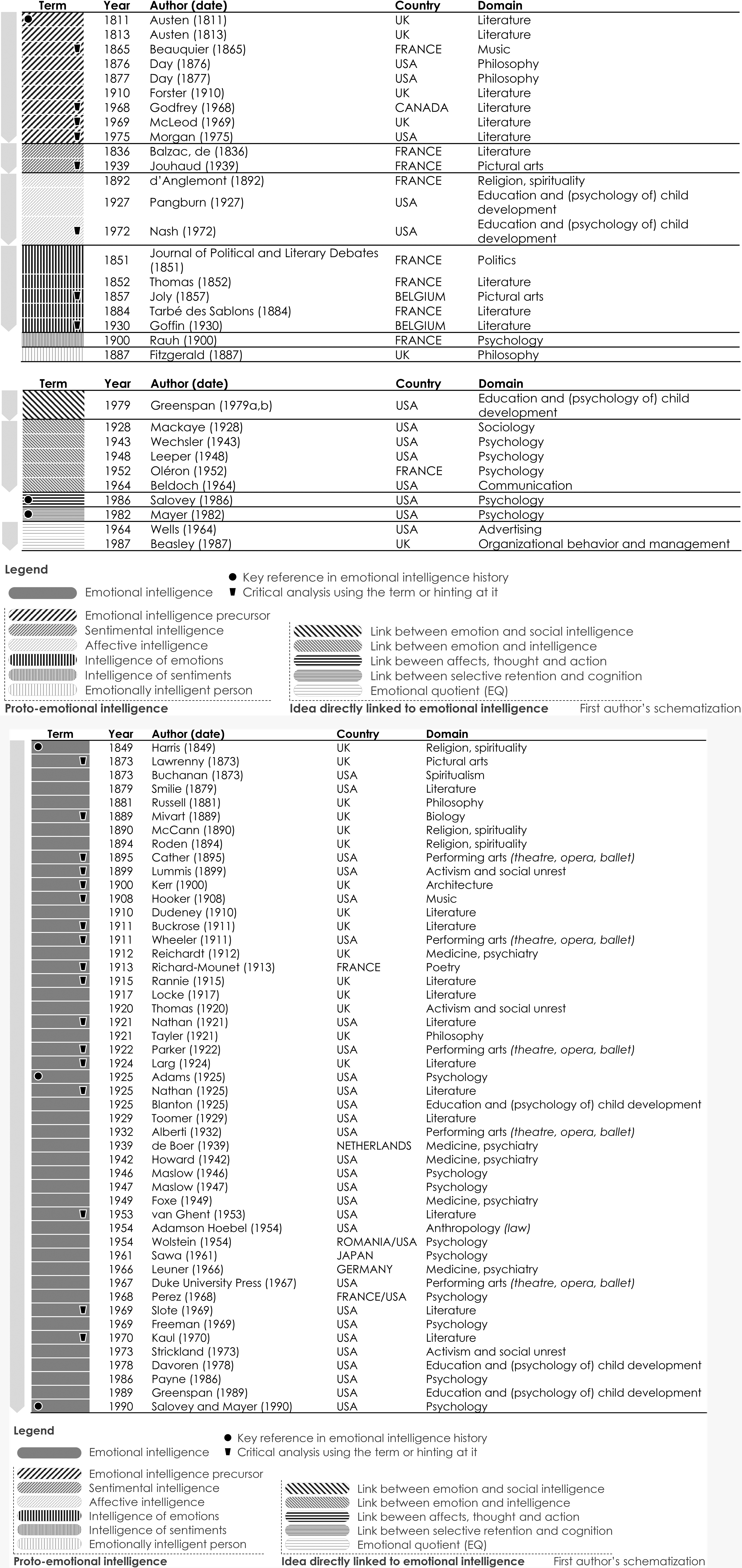
A Detailed Timeline of (Proto-)Emotional Intelligence and Its Occurrences (1811–1990), Chronological Order by Term.
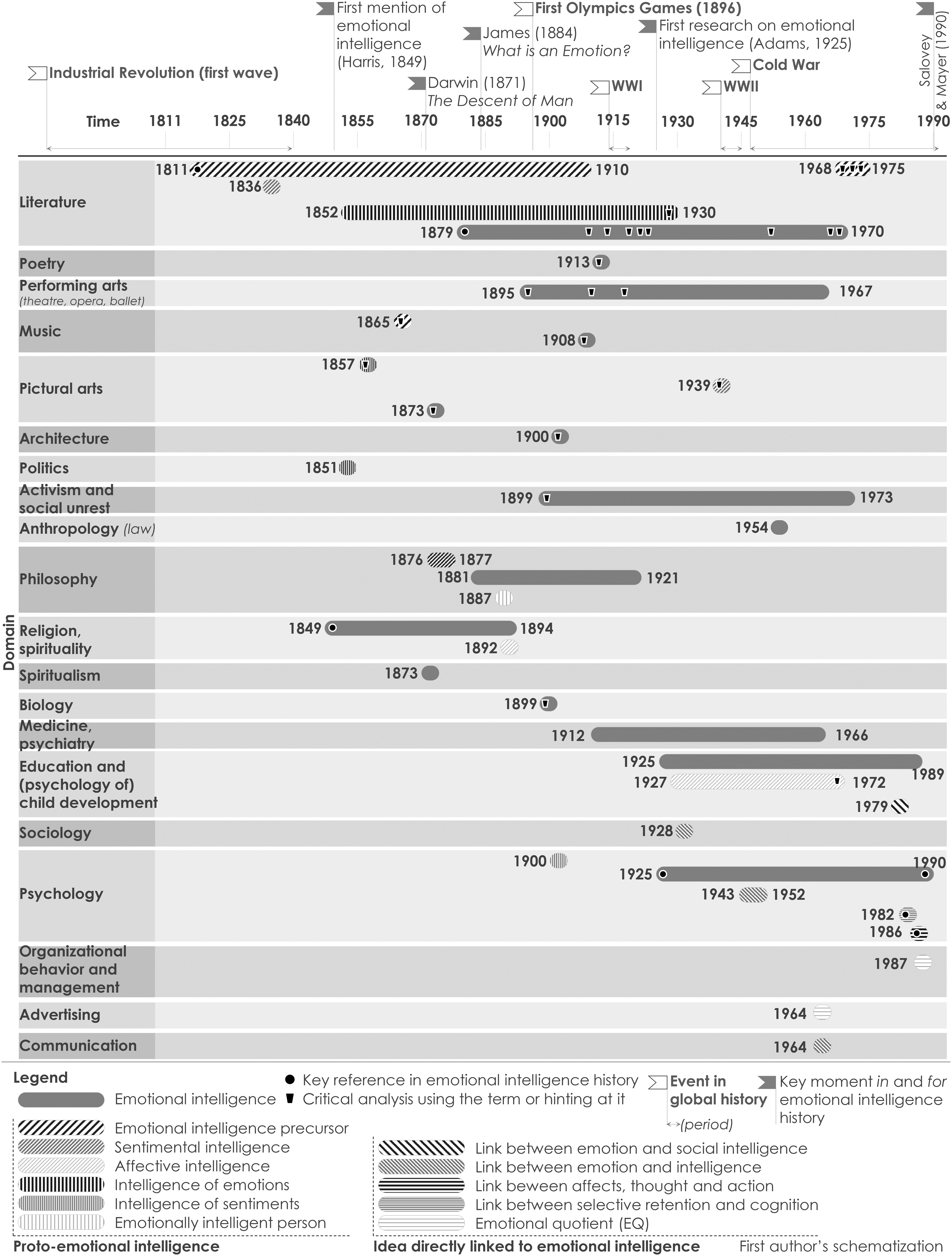
A Contextualized Timeline of (Proto-)Emotional Intelligence and Its Occurrences Through Several Domains and Fields (1811–1990).
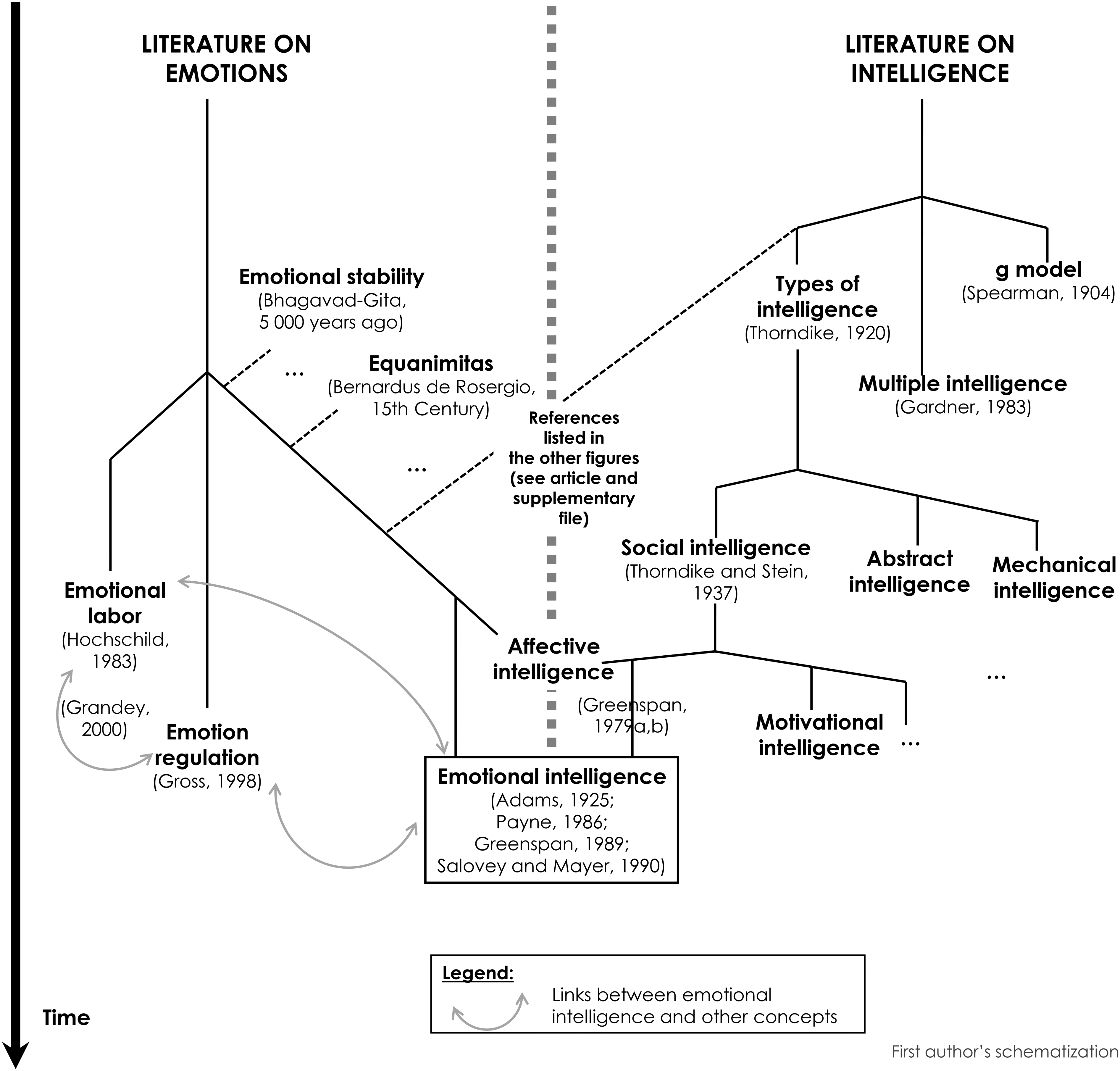
A Timeline of the Theoretical Background of Emotional Intelligence.
(Proto-)Emotional Intelligence in Western Art and Thought: From Ability to the Quest for Transcendence
In this section, we explore pathway 1, covering the relation of early EI instantiations and proto-EI to the ability model through a first dyad comprising branches 1 and 2 (perception and thought), although some occurrences echo other branches.
“Through the Looking-Glass” 4 : The Tension Between Interiority, Expectations and Interactions with Others and the Environment
As a linchpin of various art forms, EI finds its way into literature, visual arts, music, and performance. Literature has dramatized the interplay of sense and sensibility. Austen's (1811, 1813) novels, for example, depict characters whose ability to regulate feelings and interpret others’ emotions foreshadows modern EI. On the Continent, Balzac (1836) invokes “sentimental intelligence” to suggest the intertwining of affect and cognition, showing that the idea has circulated in French culture since well before the 20th century. Comparable examples appear throughout 19th- and early 20th-century writing, reinforcing the link between emotions and intelligence as well as insights pertaining to branches 1 and 2 (see supplementary file).
The arts also reveal how EI is, at the time, conceived as both creative skill and receptive capacity. In music, for example, Cather (1895) praises soprano Fisk's performance with Australian diva Dame Nellie Melba for the “emotional intelligence” it conveys, illustrating how artists are expected to communicate subtle feelings with precision. In the performing arts, Wheeler (1911) describes the Russian Ballet's capacity to infuse choreography with emotional nuance, a clear instance of perceiving and expressing emotion as intelligence. Such references across literature, music, and performance illustrate how proto-EI was already recognized as integral to artistic achievement. Further examples from painting, theatre, and architecture confirm that the association between emotion and intellect was firmly embedded in Western cultural discourse (see supplementary file).
At the Core of Human Characteristics and Values: Cultural, Gendered and Transcendental Perspectives
Philosophical traditions have long linked reason and emotion. The Stoics, for example, emphasized rational mastery over passion, anticipating later concerns with emotional regulation. Harris (1849) refers to “emotional intelligence” (pp. 96–97), the first instance of EI we have uncovered, as the ability to engage with, connect to, and appreciate the divine through one's emotional experiences and responses.
Yet it is not until the late 19th century that scientific accounts of emotion begin to take shape. Darwin (1871) introduces an evolutionary perspective on social emotions. His later work on emotional expression (1872) focuses on patterns of expression and their communicative functions, rather than on evolutionary adaptation per se. Around the same time, James (1884) advances a psychological view, arguing that emotions are constituted by the perception of physiological changes, thereby shifting focus from cognition to bodily processes. Darwin and James together mark a decisive step from philosophical speculation toward systematic science. Their theories integrate affect with both biology and psychology, and foreshadow the modern idea that emotion and intelligence are interdependent. Taken together, these contributions have prepared the ground for the 20th-century research traditions that would later converge in the concept of EI.
In our data, EI is increasingly framed as a fundamental human trait linked to moral reasoning, emotional depth, social connectedness, and transcendence. Key debates address innate aptitude for EI, its potential dominance over other intelligences, and the implications of such hierarchy. Gendered and societal dimensions of EI are explored through fiction (e.g., Locke, 1917) and activism (Thomas, 1920), the latter highlighting its role in mitigating social unrest through moral and emotional development. EI also features in spiritual(ist), poetic, and religious discourses, underscoring its significance in a variety of domains. Specific facets of branch 2 (agency, morality) emerge from our material, and suggest EI's role in shaping organized actions and in the experience of connectedness and transcendence (see supplementary file). At this juncture in our review, these early literary and philosophical explorations frame emotion as both a moral and cognitive capacity. This perspective sets the stage for the next phase of our analysis, examining early scholarly conceptualizations, in which 20th-century thinkers began to treat emotional intelligence as a psychological construct rather than a philosophical virtue.
The Emergence of Emotional Intelligence in Early Scholarly Research: The Beginning of a Conceptualization
In this section, a second dyad comprising branches 3 and 4 (understanding and regulation) of the EI ability model is explored through the lens of early academic interest, i.e., pathway 2 (again, the fit is not perfect, and some references resonate with other branches).
The Shift from Cognitive Dominance to Emotional Insight: Scholarly Foundations and Extension to Daily Life
From an academic perspective, the study of EI uniquely combines two distinct concepts. The term's theoretical background, its relationship with research into emotions and intelligence (see Figure 3), and the boundaries of the concept itself must be considered to fully understand its emergence, particularly as emotion and cognition can be viewed as either separate, “reductive causal” elements or as part of a “complex but integrated system” (Lazarus, 1999, p. 13).
The first half of the 20th century sees EI gradually become a topic of scholarly interest, mainly in (but not limited to) psychology and education. Philosopher and sociologist Tayler (1921), for instance, explores human development as a progression of distinct life stages, each with its own potential for psychological growth. He emphasizes the power of discernment and “emotional intelligence” (p. 229), which allows individuals to gain a deep sense of connection and understanding, and thus to engage with the world more profoundly (this, to a certain extent, reflects branch 3 with the addition of an element evocative of connectedness and transcendence).
In his 1925 psychology book The Ways of the Mind, Adams embarks on the first early scholarly exploration of EI. He outlines four types of intelligence (i.e., “the ability to profit by past experience,” p. 261), with the first three based on cognitive conditions, sensations, and images—perceptual identification, applying experience to a present situation, and using it for future planning—while the fourth one, which he calls “emotional intelligence” (p. 261), is intuitive and driven by feelings and emotional responses. For him, individuals are naturally inclined to seek pleasant experiences and avoid unpleasant ones, a tendency shaped by their past (this echoes branch 3, notably through situation appraisal, emotional transition and affective forecasting, and branch 4's attitude of disengaging with unpleasant emotions). Adams (1925) even speculates that “this fourth type of emotional intelligence may be ranked higher than any of the other three forms” (p. 261).
Adams’ comments are part of a wider landscape of research on the perimeter and measurement of intelligence. Spearman (1904), for instance, attempted to determine and measure “general intelligence” objectively, proposing the “g” factor as a relevant construct for psychometric tests 5 ; however, researchers later challenged the measurement and composition of intelligence (Naglieri, 2015). 6
Mackaye (1928) also contributes to challenging the narrow focus on intellect by outlining the place of emotions. Pointing to a body of research on intelligence tests aimed at high-school age children that reveal “emotional instability,” he argues that a “total organic attitude,” including “attitudes of mind, emotional conditions, ingrained habits, and conditioned behavior” (p. 453), governs intelligence (echoing branches 2 and 3). This view that non-intellective factors are crucial in general intelligence is reiterated by Wechsler (1943), who contends that key non-cognitive factors—emotion, temperament, and impulse—have been overlooked in the technical and compartmentalized structure of cognitive assessment at the time.
Similarly, Leeper (1948) stresses that “functioning in human life” is not limited to a “brainy life of relation” (p. 20) and necessitates emotion regulation skills (branch 4), which contribute to reshaping emotions as organizing and motivating forces that prepare individuals to respond to situations. Success, for instance, is influenced by factors other than intelligence itself, such as “dynamic and affective elements,” as Oléron (1952, p. 434) explains, drawing from Wechsler and E. Thorndike. This perspective—linking success to intelligence—is later taken up by Sternberg (1988) in his “triarchic” theory of intelligence. However, “emotional intelligence” might be difficult to attain because emotions are subjective and fluid (Wolstein, 1954, p. 110), and individuals tend to resist new experiences in favor of established routines to avoid uncertainty and risk (this gives insights into branch 4 from the angle of the absence: missing emotion regulation abilities mean that openness to potentially unpleasant feelings cannot be achieved).
Personality factors are discussed in relation to the definition of intelligence (echoing research on EI traits), especially in connection with intuition and instinct. de Boer (1939/1963), notably, contrasts eight personality types, each with a distinct blend of intelligence, emotions and activity. “Intuitives” showcase a balance of intelligence and emotions, with their intuition coming from “intelligent feeling or emotional intelligence” (1963 translation, p. 259, italics in the original text) and allowing them to engage in various forms of creative work. Likewise, in two volumes examining human experience through the prism of the Rorschach test, P. Maslow (1946, 1947) discusses personality types and their characteristics. EI is mentioned for extraverts and “AM” individuals (i.e., those who tend to see animal movement instead of humans in motion in ink blots and have “introversive intelligence at a lower, less mature level”; Maslow, 1946, p. 9). Extraverts’ “emotional intelligence” stems from the “instinctual wisdom of the body,” which contrasts with the “reasoning wisdom of the mind” that defines intellectual intelligence (p. 38). Their body-based wisdom drives extraverts to react quickly and energetically to external stimuli, making them confident and action-oriented. According to Maslow (1947, p. 76), “AM intelligence is on par with emotional intelligence since both think in terms of obvious, practical, tangible, common sense, socially imitative qualities (i.e., the components of contagion).” Both iterations of EI fall under branches 1 (perception of physical states), 3 (situational appraisal) and 4 (emotional response modulation) while extending them by stressing two components of EI: corporeity and imitation (or mimicry). In summary, these educational and psychological precursors gave the concept empirical traction, marking the shift from scattered uses to systematic scholarly attention.
The question of measuring intelligence, while integrating its emotional component, progressively makes its way into research. In the field of child development and education, Pangburn (1927) notes that Bridges’ theory of personality includes “affective intelligence” as one of three kinds of “intelligence” or “capacity to learn” (p. 371). The “capacities to condition, to modify, and to combine feelings and emotion and to develop sentiments” (evocative of branches 3 and 4) are part of this “affective intelligence” (p. 371) for which Pangburn underlines the issue of evaluation or measurement. While focusing on mental hygiene clinics in Minneapolis schools that administered psychological tests to determine students’ intelligence quotient (IQ), Blanton (1925) mentions these clinics’ wish to establish an emotional quotient alongside the intelligence quotient to assess emotional well-being and understanding, highlighting the importance of evaluating both emotional and cognitive abilities. Indeed, as intelligence is not solely an abstract concept but has concrete manifestations that can interact with temperament, Sawa (1961, pp. 240–241) proposes the existence of an “Emotional Intelligence Factor” that can be measured using various intelligence tests, including specific sub-tests by Wechsler and Japanese tests.
Marketing is the research field where the question of how to measure EI first emerges. Wells (1964) proposes measuring consumer reaction to advertisements via an “emotional quotient” or “EQ.” The concept of EQ is also discussed in a 1987 Mensa 7 magazine entry by Beasley, who argues that an individual's “ability to feel” (i.e., EQ) is the best way to evaluate them. Despite never mentioning the term EI, he also notes the potential benefits of EQ for social welfare and education, as it could promote positive behaviors. Beasley (1987, p. 25) proposes measuring EQ by considering both “sensitivity” (“the type and level of stimuli that ‘moves’ a person”—branches 1 and 3) and “expressability” (“the degree to which emotions are expressed”—branches 1, 2, and 4).
Several practical applications are outlined for a vision of intelligence that includes emotions, notably through specific professional activities and fields, as well as family life. In his critique of U.S. education, Nash (1972, pp. 69–70) laments the emphasis on “quantitative cognition” and the reduced place given to “affective intelligence,” which is part of educators’ “affective learning goals.” The role of educators, 8 evoked here, is reminiscent of an interview with psychiatrist Moore, in which Howard (1942, p. 32) explains that a teacher with “emotional intelligence” can gain a new understanding of a situation (e.g., considering potential issues at home in a bright child's declining academic performance). Likewise, psychiatric social worker Davoren (1978, p. 14) stresses that successful outcomes in child protection depend on the “emotional intelligence” and cognitive abilities of child protective service workers, as well as support systems. Similarly, Perez (1968, p. 31) emphasizes that for counselors, “emotional intelligence” (i.e., being attuned to, understand, and empathize with a client's emotional experience) is a crucial ability. This not only outlines branches 1 and 3, but also hints at branch 4 in the relation that must be built with the target (e.g., child, client).
EI additionally appears as crucial for navigating real-world relationships. Former reporter Freeman (1969, p. 8) thus defines “emotional intelligence” as emotional stamina or the capacity to function effectively in both love and work, linking it to the psychoanalytic goal of making unconscious fantasies conscious to increase an individual's functional capacity. In the same vein, Foxe (1949, p. 42) mentions “intuitive emotional intelligence” as an essential factor in marital compatibility, underscoring its role in fostering balance, understanding, and realistic expectations between partners (branches 2, 3, and 4). For her part, Leuner (1966) views “emotional intelligence” (p. 196) as a feminine attribute—nurtured within the institution that is the family and whose essential function is the care and differentiation of this form of intelligence. She argues that for EI to be fully experienced and integrated during the more general development of abstract intelligence, women must be emancipated.
Finally, in the field of communication, Beldoch (1964) discusses the impact of the mode of communication on the sensitivity to the expression of emotional meaning by drawing on Langer's (1942, 1953) theory of symbolic processes and underlines key characteristics of emotional intelligence, i.e., the “ability to identify communications of feelings” (as part of “emotional sensitivity”) through “symbolic processes” (p. 39). We, again, see resonances with branch 1 (particularly through the diversity of communication modes) and its potential extension to symbolic dimensions.
Through this subsection, we have showcased the multifaceted efforts to expand the definition of intelligence beyond a purely cognitive, IQ-centric framework. Across a variety of scientific fields and daily life domains, scholars’ challenges to the dominant view of intelligence as purely a matter of logic and intellect are illustrated and, thus, exemplify components of branches 3 and 4 as well as elements previously found concerning branch 1 and its potential enrichment, namely, the link with symbolism. In a way, the tensional relation between emotion and intelligence also reflects branch 2.
At this point in our review, we see these diverse formulations converging on a more scientific view of emotion as a measurable and adaptive form of intelligence. This convergence marks a turning point, going from speculative theorizing toward systematic psychological investigation, that sets the stage for the next major development (which we address in the next section).
From Social Intelligence Toward the Definition of Emotional Intelligence as a Standalone Concept
By the late 20th century, ideas about emotional intelligence begin to coalesce across several disciplines. In psychology and education, Payne (1986) devotes his doctoral dissertation to “emotional intelligence,” describing it as a form of self-integration that enables individuals to recognize and regulate feelings, imagination, and desire. Although not widely known at the time, this work is often regarded as the first systematic academic use of the term. In sociology, starting from Goffman's (1955, 1959) account of face-work, which illustrates the social regulation of affect, Hochschild (1979, 1983) develops and demonstrates the idea that organizations regulate feeling through what she calls “emotional labor” 9 (mirroring the “emotion work” done privately). Her analysis reveals that managing emotions is not only a personal capacity but also a socially structured process, linking the regulation of affect to workplace roles and performance.
Meanwhile, researchers in psychology underscore the interplay between emotion and cognition. In this regard, Isen and colleagues (1978) show that positive affect facilitates creative thinking and decision-making, while Bower (1981) demonstrates mood-congruent memory effects. These studies provide empirical evidence that emotions shape perception, recall, and judgment, which are direct precursors to the idea that intelligent functioning cannot be separated from affective processes. Taken together, these contributions have established the groundwork for a coherent construct. By the 1980s, scholars across psychology, sociology, and education (Salovey & Sluyter, 1997) had converged on the insight that emotion and thought are deeply intertwined. These fragments have prepared the field for Salovey and Mayer's (1990) formal definition of emotional intelligence, which integrates these insights into a unified framework. The creation of an academic area around EI begins in earnest with this framework, which they wanted to anchor in the “historical literature on intelligence” (Mayer & Salovey, 1993, p. 433) by favoring the label “emotional intelligence” over “emotional competence.” Indeed, their work echoes Gardner's (1983) theory of multiple intelligences, overlapping with his concept of intrapersonal intelligence (Mayer & Salovey, 1993). 10
Their doctoral dissertations provide a clear foundation for their collaborative work on EI. Mayer's (1982) dissertation explores selective retention, particularly of aggressive words, and the cognitive processes involved, while Salovey's (1986) examines how mood states and the direction of attention affect individuals’ thoughts about themselves and their willingness to assist others. Their partnership has led to two articles published in 1990, which formally define and first measure aspects of EI (Mayer et al., 1990; Salovey & Mayer, 1990), and to an expanding body of research, spurred on by increased interest following the popularization of EI (Gibbs, 1995; Goleman, 1995, 1998) and the emotional revolution in the field of organizational behavior.
While this subsection deviates slightly from previous ones in that the focus on each EI branch is less obvious, it outlines the shaping of an EI area within academia, born from theories of emotions and intelligence (social intelligence, in particular). The emergence of EI as a cohesive and legitimate construct has paved the way for flourishing scholarly discussions with multi-faceted implications.
In tracing the development of EI, we have followed its evolution from diffuse intellectual roots to its formal recognition as an independent field of study. This progression from early ideas about social and adaptive intelligence to the empirically grounded construct defined by Mayer and Salovey completes the historical arc we set out to document. In the concluding section, we draw together the implications of this evolution and reflect on how understanding EI's past clarifies its present meaning and future directions.
Conclusion
In this essay, we have traced the historical development of EI across two centuries and multiple domains to show that the construct did not emerge ex nihilo in the 1990s. Rather, EI developed as a historically contingent 11 construct shaped by contributions from literature, philosophy, early social science, and later empirical research. We argue that, via this lens, EI is best understood not as a timeless essence or a purely modern invention, but as the product of cumulative intellectual development across disciplines and eras.
Our analysis shows, moreover, how fragmented ideas linking emotion and intelligence gradually coalesced into a more coherent conceptual framework. This perspective aligns with broader views of intelligence as a multi-component construct encompassing cognition, affect, and motivation. It also helps explain why the concept of EI remained diffuse for much of its history, appearing intermittently across domains before becoming consolidated within late 20th-century scholarship.
At the same time, examining these historical trajectories allows us to identify several underexplored or “forgotten” dimensions of EI (summarized in Figure 4) including agency, embodiment, symbolism, morality, and transcendence. 12 These dimensions point to a broader understanding of EI that extends beyond problem-solving and cognitive-affective integration, and instead connects to questions of meaning, ethical conduct, and human experience across social and cultural contexts. More broadly, our analysis reveals the diverse range of contributors to the development of EI, including a notable presence of women whose input has often been under-recognized in subsequent accounts (see supplementary file). 13
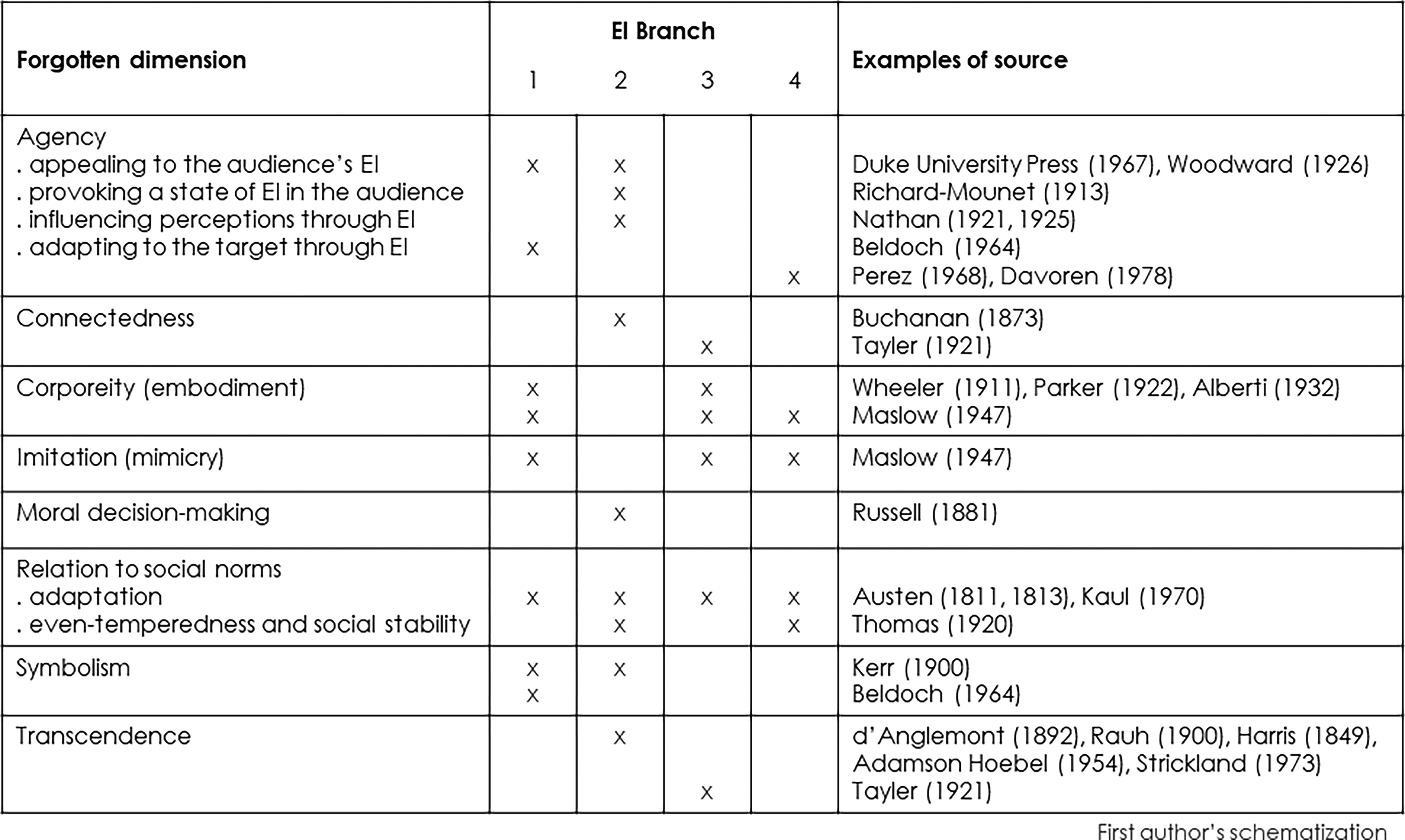
A Matrix of Forgotten Dimensions of Emotional Intelligence.
This perspective also has implications for contemporary research. Developing EI without attention to its historical underpinning risks narrowing the construct or overlooking dimensions that were once central to its meaning. Future research should therefore examine the role and relevance of these forgotten dimensions, as well as extend this inquiry across cultural, linguistic, and epistemological contexts, given our focus on sources from the Global North and on materials available in English and French.
Overall, we show that EI has progressively integrated emotional and cognitive perspectives across time, moving from diffuse and fragmented origins toward a more coherent, though still evolving, construct. Recognizing this developmental trajectory provides a stronger foundation for both theoretical refinement and practical application in contemporary research.
Supplemental Material
sj-pdf-1-emr-10.1177_17540739261444292 - Supplemental material for The Early Western History of the Concept of Emotional Intelligence (1811–1990): From the Era of Proto-Emotional Intelligence to the Dawn of Scholarly Interest
Supplemental material, sj-pdf-1-emr-10.1177_17540739261444292 for The Early Western History of the Concept of Emotional Intelligence (1811–1990): From the Era of Proto-Emotional Intelligence to the Dawn of Scholarly Interest by Rebecca Dickason, Neal M. Ashkanasy and David Hampton-Musseau in Emotion Review
Footnotes

Funding
The authors received no financial support for the research, authorship, and/or publication of this article.
Declaration of Conflicting Interests
The authors declared no potential conflicts of interest with respect to the research, authorship, and/or publication of this article.
Supplemental Material
Supplemental material for this article is available online.
Notes
References
Supplementary Material
Please find the following supplemental material available below.
For Open Access articles published under a Creative Commons License, all supplemental material carries the same license as the article it is associated with.
For non-Open Access articles published, all supplemental material carries a non-exclusive license, and permission requests for re-use of supplemental material or any part of supplemental material shall be sent directly to the copyright owner as specified in the copyright notice associated with the article.
