






Abstract
Social sharing of emotion (SSE) is widespread, yet digital contexts may selectively foreground certain traditional motives and alter how they are expressed. This paper proposes an integrative model explaining how traditional SSE motives are enacted, prioritized, and organized on social media. Drawing on SSE theory and perspectives on self-presentation, hyperpersonal communication, social presence, and media richness, the model distinguishes antecedent factors that activate sharing from structural conditions that shape how sharing unfolds and is interpreted. Heightened visibility, indeterminate audiences, and anonymity selectively foreground five digitally salient SSE motives, taking the form of identity signaling, risk-managed disclosure, networked problem-solving, validation seeking, and visibility mobilization. These forms are conceptualized as context-specific expressions of traditional SSE motives rather than novel psychological needs, preserving theoretical continuity while capturing how these motives are differentially prioritized and expressed on social media.
Introduction
Background
Emotions that prompt sharing can arise from a wide range of situations. For example, you may realize that a project proposal you have been preparing for a long time has been submitted by a teammate, who later receives an award for it, which evokes anger and a sense of unfairness. In other cases, you may feel pride or excitement after receiving recognition for your own work or achieving a long-sought goal. Across such diverse emotional contexts, you may discuss your experiences with friends or share them on social media, where the content becomes visible to broader audiences and subject to social interpretation. This process, known as Social Sharing of Emotion (SSE), was proposed by Rimé et al. (1991) and refers to the sharing of emotional events and associated feelings with others after such events. Such sharing may elicit support, validation, or constructive discussion, but it may also amplify negative feelings, fuel conflict, or lead to unintended social consequences.
Empirical evidence underscores the pervasiveness of emotional sharing, with studies indicating that approximately 90% of emotional experiences are shared with relational partners (Choi & Toma, 2022; Rimé et al., 1998). This remarkably consistent rate has been observed across diverse cultural contexts (Singh-Manoux & Finkenauer, 2001). Previous research has described SSE as serving multiple functions for individuals, including emotional relief and support-seeking, and as enhancing positive affect and emotional well-being (Liu et al., 2019). It has also been conceptualized as a socially motivated process aimed at fulfilling two basic social needs, namely establishing connections with others during emotional experiences and validating the appropriateness of one's own emotional responses through social comparison (Bazarova et al., 2015; Pauw et al., 2019), without assuming that such functions inevitably translate into reduced emotional intensity or distress across contexts.
SSE is an information-transfer process in which individuals communicate their emotional experiences and associated feelings to others (Rimé et al., 1991). The evolution of SSE practices reflects broader technological and social transformations. Historically, SSE occurred primarily through face-to-face verbal communication or telephone calls with close family members and friends, resulting in relatively bounded interpersonal exchanges (Rimé et al., 2020). By contrast, the contemporary landscape of SSE has been fundamentally reshaped by advances in information technology, with the Internet emerging as a “third space” that has transformed patterns of human interaction (Ruggieri et al., 2023).
In this context, online communities have become important venues for social networking, exemplified by the exponential growth of platforms such as Facebook and Twitter (Vermeulen et al., 2018). This shift is evident in the scale of global participation in online social networks (Döveling, 2015). Empirical research has documented how these platforms have altered the reach of SSE, showing that online SSE increasingly involves diverse and expansive audiences (Bazarova et al., 2015). Whereas traditional SSE was primarily confined to face-to-face interactions within immediate social circles (Rimé, 2009), contemporary practices indicate that individuals now routinely share emotional experiences with both close and distant acquaintances through social media.
Beyond this audience expansion, media affordances transform how SSE is produced and managed. The editability of online posts and opportunities for strategic self-presentation enable individuals to compose, refine, and curate narratives before sharing, making SSE less immediate and more deliberately constructed (Wu & Erdenebold, 2024; Luo & Hancock, 2020). Moreover, algorithmic amplification shapes the visibility and circulation of emotional content, selectively extending its reach and thereby embedding SSE within platform-mediated dynamics rather than solely in interpersonal exchange (Bazarova et al., 2015).
These media affordances substantially expand SSE's scope and visibility, enabling dialogue with broader and more diverse audiences and increasing exposure to heterogeneous perspectives and forms of social feedback (Burke & Develin, 2016; Choi & Taylor, 2024). These changes mark a qualitative shift in how emotional experiences are processed and communicated in digital environments. Despite these profound structural changes, however, existing research on SSE motives has not systematically distinguished between traditional face-to-face and digitally mediated sharing contexts. As a result, prevailing SSE motives developed in offline settings may fail to capture the altered incentives, functions, and social dynamics that characterize emotional sharing on social media.
Research Objectives
The social media landscape has become a central arena for SSE, yet SSE continues to unfold across both online and offline contexts. Individuals routinely share emotional experiences with close others face-to-face, as well as on social media. Understanding SSE in contemporary communication, therefore, requires attention not only to continuity across contexts but also to how communicative environments alter the enactment of traditional sharing motives.
Accordingly, the objectives of this paper include (1) clarifying that traditional SSE motives remain the conceptual foundation of SSE and may partly inform channel selection, (2) identifying the key mechanisms through which digital conditions shape the expression and salience of traditional motives once social media is selected, and (3) proposing an integrated model of digitally salient forms of traditional SSE motives. By integrating insights from SSE theory, self-presentation theory, social presence and media richness perspectives, and hyperpersonal communication theory, this conceptual paper offers a context-sensitive model that complements prior motivation research and provides an integrative lens for understanding SSE motives and motivational processes in contemporary communication contexts.
The remainder of the paper proceeds in four steps. First, it reviews foundational work on SSE, clarifies traditional motives, and identifies the theoretical gaps that motivate a new integrative account of SSE on social media. Second, it examines how social media alter the communicative conditions of SSE, with particular attention to media affordances and interactional features. Third, it introduces the three organizing questions that guide the conceptual framework and presents an overview of the proposed model. Finally, it elaborates five digitally salient forms of SSE motives on social media, considers their dual outcomes, and discusses the broader implications of the model for SSE theory.
Literature Review
Social Sharing of Emotion
Previous research on SSE has documented that a wide range of emotional experiences, both pleasant and unpleasant, are frequently followed by interpersonal communication in everyday life (Peters & Kashima, 2007; Rimé et al., 1991, 1998). Using experience-sampling and diary methods, Watson and Stanton (2017) further showed that positive emotional events occur more frequently than negative ones in daily life and are commonly communicated in social interactions. Research also demonstrates that positive sharing serves important interpersonal functions, such as relationship maintenance, and enhances positive emotions (Wang & Wei, 2020). At the same time, other evidence indicates that negative emotions, such as stress, sadness, and anger, are also frequently shared, often reflecting different regulatory and social needs (Nils & Rimé, 2012).
Beyond emotional valence, research has shown that emotional arousal further shapes SSE, with high-arousal emotions (e.g., anger or awe) more likely to be socially shared than low-arousal states (Berger, 2025). Extending this pattern to mediated communication, a meta-analytic review by Chen et al. (2022) found that emotion-expressing messages are more likely than less emotional messages to be retransmitted on social media.
The intensity of emotional experiences shapes not only whether emotions are shared, but especially where and how they are shared. Although Luminet et al. (2000) showed that emotionally intense events are generally more likely to be communicated, Choi and Toma (2014) further demonstrated that intensely adverse events tend to be shared offline first, likely because face-to-face interaction affords greater communicative richness, immediate responsiveness, and access to nonverbal cues essential for regulating intense emotions. By contrast, low- to moderate-intensity emotional experiences are more readily shared online, where asynchronous communication, reduced social threat, and a lower risk of immediate judgment make digital platforms well suited to routine emotional sharing (Winter et al., 2014).
Factors Shaping Motives for Social Sharing of Emotion
Previous research indicates that individuals share emotional experiences not only to regulate emotional distress or prolong positive affect, but also to make sense of events that disrupt their ongoing beliefs and to consolidate the meaning of positive experiences (Yang & Kelly, 2016; Zhang et al., 2023). Delelis and Christophe (2016) showed that SSE facilitates cognitive articulation and meaning-making, such as labeling emotions and organizing emotional experiences into coherent narratives, while also serving affiliative motives, including seeking comfort, reassurance, and social support, particularly when emotional events undermine feelings of security or social belonging (Colle et al., 2017; Nils & Rimé, 2012).
Complementing this view, research on capitalization has shown that sharing positive experiences helps individuals recognize and reinforce the significance of those events, while also strengthening social bonds and sustaining interpersonal relationships through others’ responses to them (Gable & Reis, 2010; Pauw et al., 2019). Accordingly, SSE motives can be broadly oriented toward two classes of needs: cognitive needs, which guide sharing aimed at understanding distressing events and savoring the meaning of positive experiences, and socio-emotional needs, which guide sharing aimed at seeking comfort and reassurance in difficult moments and connection, affirmation, and shared enjoyment in positive moments.
Importantly, different emotional experiences lead individuals to prioritize different needs during emotional sharing, thereby shaping SSE motivations. For example, Ma et al. (2025) found that perspective-taking is particularly effective at regulating anger. In contrast, cognitively oriented strategies, such as cognitive reappraisal, defined here as reinterpreting an emotional event to alter its emotional meaning, and advice seeking, tend to be more effective in alleviating regret-related distress (Pauw et al., 2018). Sadness is more closely associated with loss and vulnerability, thereby orienting SSE motivations toward socio-emotional support, such as comfort and empathy (Nils & Rimé, 2012). Emotions with strong moral and self-evaluative components, such as shame and guilt, further shape SSE motivations by increasing concerns about self-blame and social judgment, often leading to concealment or highly selective disclosure (Zhang et al., 2023).
These emotion-specific motivations are also reflected in the timing of individuals’ choices to share emotional experiences. Rimé et al. (2020) showed that action-oriented emotions, such as anger, are shared more rapidly. In contrast, emotions associated with loss and vulnerability, such as sadness, are more likely to be shared after a delay. Finally, other researchers note that SSE is not limited to distress-related processes: positive emotions such as joy, pride, and gratitude are commonly shared to reinforce social bonds, affirm the self, and sustain interpersonal relationships, reflecting a predominance of socio-emotional and relational motives (Gable & Reis, 2010).
Beyond the emotional events themselves, SSE motivations are shaped by a range of personality traits and socially embedded influences. One line of research shows that need for closure (NFC), defined as the desire for clear answers and reduced ambiguity, influences how individuals respond to emotionally disruptive events (Kruglanski & Webster, 1996). Individuals high in NFC show a stronger orientation toward seeking explanations and restoring cognitive order, making SSE a desirable means of clarifying events, validating interpretations, and achieving a sense of closure (Delelis & Christophe, 2016). Relatedly, Forest and Wood (2012) found that individuals with lower self-esteem or poorer social skills are more likely to perceive face-to-face emotional disclosure as socially threatening. Accordingly, such individuals show a stronger preference for sharing emotions via social networking sites, where disclosure can be more selectively managed, and the risk of immediate negative evaluation is reduced (Winter et al., 2014).
Drawing on survey and interview data, Vermeulen et al. (2018) found that individuals’ decisions about whether, where, and how to share emotions are guided by perceptions of platform-appropriate expression, anticipated audience reactions, and habitual communication practices. Related research on online SSE indicates that different platforms cultivate distinct emotional cultures, signaling acceptable levels of emotional intensity and norms of responsiveness, which in turn shape users’ motivations to engage (Leon, 2021).
More broadly, cultural orientations also provide an important backdrop for shaping SSE motivations. Cross-cultural research suggests that in collectivistic contexts, SSE is more likely to be oriented toward relational regulation (i.e., managing emotional expression to preserve social harmony and relational norms) and group-level coping, whereas in more individualistic contexts it is more strongly associated with self-expression and agentic communication goals (Kanyangara et al., 2007; Singh-Manoux & Finkenauer, 2001).
Finally, SSE motivations are shaped by expectations of how others will respond. Walsh et al. (2020) showed that perceived network responsiveness (PNR), the extent to which individuals expect acknowledgment or engagement from others, strongly predicts SSE, particularly in online contexts. Marwick and Boyd (2014) indicated that before posting on social media, individuals often imagine potential audience reactions, and such anticipated responses play a central role in shaping SSE motivations. Over time, prior sharing experiences and their emotional consequences may further reinforce or attenuate subsequent sharing motivations (Rimé et al., 2020).
Despite its potential benefits, SSE is not uniformly experienced as adaptive. Privacy concerns, anticipated stigma, and feelings of shame may inhibit emotional sharing, particularly when individuals perceive heightened risks of social evaluation or loss of control over personal information (Trepte & Reinecke, 2011). Moreover, in digitally mediated contexts, excessive exposure to emotionally laden content may lead to information overload, emotional exhaustion, and declines in well-being, as evidenced by research on social media overload during the COVID-19 period (Li et al., 2024).
Existing research shows that a constellation of emotional, individual, and social factors shapes SSE motivations. These factors shape the conditions under which emotions are shared but do not directly specify the motivations themselves. The following section, therefore, reviews the core SSE motivations identified in previous research.
Motives for Social Sharing of Emotion
Building on previous work on emotional disclosure, co-rumination, and capitalization, research has consistently shown that SSE serves both intrapersonal and interpersonal functions, including emotional regulation (i.e., ongoing modulation of emotional experiences) and relationship strengthening (i.e., maintaining or enhancing social bonds). Synthesizing this literature, Duprez et al. (2015) identified and validated seven recurrent motives underlying SSE.
These motives include clarification and meaning-making, reflecting the goal of understanding emotional events and reducing cognitive uncertainty; rehearsing, referring to the repeated communication of emotional experiences; and venting, oriented toward expressing negative emotional states. SSE may also be motivated by the desire to arouse empathy and gain attention, to seek support and comfort, to solicit advice and solutions, and to inform or warn others about relevant situations or potential risks (Rimé, 2009; Rimé et al., 2020). Although these motives recur across emotional experiences, they are not enacted in a social vacuum. Rather than determining the motives themselves, communicative contexts shape how traditional SSE motives are enacted, expressed, and responded to.
Contexts of Social Sharing of Emotion: Online Versus Offline
A growing body of research suggests that treating SSE as context-independent may obscure variations in how sharing unfolds. Differences between face-to-face and computer-mediated interaction, particularly in social presence and access to nonverbal cues, have been shown to shape emotional expression, interpretation, and responsiveness (Grondin et al., 2019; Walther, 1996). Drawing on survey data, Contena et al. (2015) found that decisions about emotional disclosure are closely tied to contextual considerations, including when, where, to whom, and through which channels emotions are shared.
In offline face-to-face contexts, high communicative richness and social presence make sharing particularly well-suited to high-intensity emotional experiences that require immediate responsiveness and nuanced attunement (Pauw, 2023). Consistent with this view, Choi and Toma (2014) found that intensely negative events are more likely to be shared offline first, enabling fuller understanding and emotion regulation through direct interaction. At the same time, Gorissen (2024) suggested that offline sharing entails heightened social risks: real-time evaluation, concerns about face and stigma, and potential relational consequences may inhibit the disclosure of shame-related or socially sensitive emotions.
By contrast, online SSE occurs under reduced social presence and limited nonverbal cues, increasing ambiguity in emotional expression and interpretation (Oh et al., 2018). However, Lin et al. (2014) indicated that online communication affords asynchrony and greater control over timing and audience, which can lower immediate social threat and facilitate sharing of vulnerable or stigmatized emotions, particularly in weak-tie or semipublic settings. Yet reliance on these same compensatory features may also entail costs, including misinterpretation, increased cognitive and emotional effort, and uncertainty about longer-term social consequences (Burke & Develin, 2016; Luo & Hancock, 2020).
Beyond the broad contrast between online and offline sharing, SSE unfolds across multiple interpersonal channels, including face-to-face interaction, telephone communication, text-based exchange, and social media, each of which differs in affordances, audience structure, and feedback dynamics. Prior research has shown that these channels afford different kinds of replies, levels of satisfaction, and emotional consequences (Bazarova et al., 2015). Such variation further suggests that channel selection may be shaped partly by the kind of sharing individuals seek to enact: those seeking broad feedback, distributed expertise, or asynchronous expression may gravitate toward social media, whereas those seeking immediate, intimate, and cue-rich support may prefer more bounded interpersonal channels (Choi & Toma, 2014).
These contextual differences may become especially consequential during large-scale crises. Research on events such as the September 11 attacks and the Madrid bombings shows that collective trauma is followed by sharp increases in SSE, often extending beyond close ties to broader publics under shared threat and uncertainty (Rimé et al., 2010; Schuster et al., 2001). During the COVID-19 pandemic, this amplification increasingly unfolded online due to constraints on face-to-face interaction, illustrating how crisis conditions can intensify and reshape SSE by interacting with existing communication contexts rather than replacing them (Ma et al., 2024).
Outcomes of Social Sharing of Emotion
Across studies, SSE has been shown to yield both beneficial and adverse outcomes, depending on how and under what conditions it unfolds. Early work by Rimé and colleagues demonstrated that sharing emotional experiences is widespread and may be accompanied by perceived emotional relief and recovery, as repeated disclosure can facilitate emotional processing and social regulation (Rimé, 2009; Rimé et al., 1991; Zech & Rimé, 2005). SSE also frequently elicits social responses from others, including acknowledgment and support, which can reinforce interpersonal bonds and contribute to share meaning-making around emotional events (Peters & Kashima, 2007; Rimé et al., 1998). Conversely, evidence indicates that SSE does not invariably produce positive outcomes. Luminet et al. (2000) found that higher levels of SSE were sometimes associated with sustained emotional intensity and poorer adjustment. Similarly, Kanyangara et al. (2007) showed that repeated sharing of negative experiences may maintain or intensify negative affect when it takes the form of repetitive rehearsal rather than constructive processing.
The preceding review examined the factors shaping SSE motives, the motives involved, the contexts in which SSE occurs, and its outcomes. Previous research has clarified when and why emotional experiences are shared, highlighting the roles of emotional, individual, and social factors. In digital contexts, however, platform-specific features may further affect both sharing motives and the dynamics of emotional communication. The next section, therefore, adopts a media affordances perspective to examine how social media shape the communicative conditions of SSE and, in turn, its expression and consequences.
Social Media
The rise of social media platforms such as Facebook, Twitter, TikTok, and Xiaohongshu has introduced communication environments that differ fundamentally from face-to-face interactions (Ruggieri et al., 2023). These platforms offer broader reach, greater temporal flexibility, and new modes of emotional sharing, enabling SSE beyond the constraints of physical copresence (Bazarova et al., 2015). Accordingly, a growing body of research suggests that the distinctive forms of SSE observed on social media are closely tied to platform-specific affordances rather than representing a simple extension of offline sharing (Wilson et al., 2012).
Several studies have documented that the structural features of social media provide affordances that influence online SSE, particularly through enhanced visibility and scalability. Meta-analytic evidence indicates that, on social media, emotionally expressive messages are more likely to be retransmitted than less emotional messages (Chen et al., 2022). In addition, high-arousal emotional content tends to attract disproportionate attention, a pattern closely linked to the scalable visibility of digital communication environments. Algorithmic recommendation systems further amplify these dynamics by preferentially promoting emotionally salient content, thereby increasing its exposure and diffusion across platform-mediated networks (Stieglitz et al., 2018).
Other media affordances relate to control over emotional sharing and social evaluation. Editability and asynchronicity afford users greater control over the formulation and timing of SSE. Walther (1996) proposed that selective presentation and information control in computer-mediated communication support more regulated self-disclosure than face-to-face interaction, and subsequent research has shown that editing and timing control facilitate the management of SSE on social media (Luo & Hancock, 2020). In addition, anonymity and reduced social presence constitute important structural affordances that shape the conditions under which emotional sharing becomes more or less feasible (Clark-Gordon et al., 2019). Gorissen (2024) found that anonymity and psychological distance make the disclosure of vulnerable or stigmatized emotions more feasible in mediated settings.
In digital settings, these affordances translate into media contexts that differ from offline SSE. Derks et al. (2008) showed that emotional communication in computer-mediated settings typically occurs in low-cue environments with reduced social presence, thereby altering how emotions are expressed and interpreted. Grondin et al. (2019) further found that empathic understanding in such contexts relies more heavily on explicit verbal signals. Temporal context also differs online, as emotional disclosures on social media are often embedded in asynchronous exchanges in which responses unfold over extended periods rather than in real time. In addition, audience contexts are expanded online: Vitak and Ellison (2013) showed that SSE on social media frequently reaches broader and more heterogeneous audiences, while Burke and Develin (2016) documented that variations in audience composition and network structure are associated with distinct patterns of SSE and response.
At the same time, research suggests that media affordances that facilitate online SSE may introduce constraints and costs that dampen sharing motivations. Grondin et al. (2019) documented that reduced nonverbal cues increase the risk of emotional misinterpretation, which can undermine supportive intentions and lead to unintended negative evaluations. Additionally, research has linked the expanded visibility and persistence of emotional disclosures to heightened concerns about privacy loss and stigma. Trepte and Reinecke (2011) showed that privacy concerns can inhibit emotional self-disclosure in online environments, while Döveling (2015) found that emotionally vulnerable expressions are particularly sensitive to audience exposure and evaluative scrutiny in mediated settings. Vitak and Ellison (2013) noted that context collapse and audience heterogeneity on social media can intensify concerns about unintended recipients when personal disclosures circulate beyond close ties. Beyond privacy-related concerns, Li et al. (2024) found that emotionally saturated online environments can contribute to information and social overload, which is associated with emotional fatigue and declines in well-being. Finally, algorithmic amplification tends to privilege emotionally arousing, often harmful content. Stieglitz et al. (2018) demonstrated that emotional intensity increases the likelihood that content will be amplified.
Research Gap
Previous research has provided rich descriptive accounts of why individuals share emotional experiences and how online SSE differs from offline sharing in terms of media affordances. However, the existing literature has often remained at the level of behavioral description, offering limited theoretical explanation of how media-specific conditions alter how traditional SSE motives are expressed, prioritized, and made salient in digital contexts. Moreover, existing SSE motives, primarily developed in the context of face-to-face interaction (Duprez et al., 2015; Rimé, 2009), do not incorporate media affordances, such as visibility, anonymity, scalability, audience heterogeneity, or algorithmic amplification. As a result, they are less well equipped to account for increasingly prevalent forms of SSE on social media.
Moreover, although existing theories have examined emotional sharing, impression management, weak-tie empathy, media cues, and information richness separately, these perspectives have not yet been integrated into a unified account of how traditional SSE motives interact with media affordances and become especially salient under social media conditions. The absence of such an integrative account limits current understanding of the complexity of SSE on social media and its double-edged consequences.
Conceptual Framework
This section develops the conceptual framework for understanding SSE on social media. It first introduces three organizing questions that integrate the relevant theoretical lenses, then outlines the overall structure of the proposed model. The subsequent sections elaborate on the digitally salient motives identified by this framework and the dual outcomes associated with them.
Three Questions for Understanding SSE on Social Media
Existing research has documented platform-specific effects, individual differences, and diverse sharing motives, yet this body of work remains theoretically fragmented. Prior studies have typically examined digital SSE through partial lenses, such as isolated affordances, individual traits, or discrete motives, without offering an integrative account of how digital conditions shape sharing once social media is selected. Although motives may partly inform the initial choice of communication channels, the present framework focuses on how social media conditions shape the expression and salience of traditional SSE motives after that selection is made.
To integrate these fragmented insights, the present model adopts a three-question organizing lens: (1) why emotional experiences give rise to sharing impulses; (2) how these impulses are organized around concerns of self-presentation, relational positioning, and evaluation by others; and (3) how media affordances shape the expression, interpretation, amplification, and feedback dynamics of SSE once social media is selected. These questions clarify how emotional sharing is activated, socially organized, and shaped by digital conditions, while retaining traditional SSE motives as the model's conceptual foundation.
The first question is addressed by SSE theory (Rimé et al., 1991), which conceptualizes SSE as a typical response to emotional events and as serving functions of emotion regulation, meaning-making, and social bonding (Rimé, 2009). Notably, SSE theory recognizes the inherently double-edged nature of SSE: sharing may foster emotional relief and social support, yet it can also sustain rumination, prolong emotional arousal, or reactivate distress (Nils & Rimé, 2012; Zech & Rimé, 2005). Despite its foundational role, SSE theory primarily focuses on whether sharing occurs and its consequences, offering limited insight into how sharing motivations become differently foregrounded under digital conditions.
The second question concerns how activated impulses are organized around broader social concerns. Self-presentation theory addresses this question by framing SSE not simply as the externalization of internal states, but as a socially situated act of impression management through which individuals signal identities, values, and relational orientations, while also anticipating evaluation by others (Goffman, 2023). While such processes are present in face-to-face interaction, they become more pronounced on social media, where SSE is persistent, searchable, and visible to heterogeneous audiences (Hogan, 2010). As a result, online SSE often extends beyond immediate emotional regulation toward more symbolic and strategically oriented forms of sharing (Choi & Toma, 2022).
The third question concerns how, once social media is selected, media affordances shape the expression, interpretation, amplification, and feedback dynamics of SSE. Regulation and self-presentation alone cannot account for the widespread amplification, rapid diffusion, and intensified feedback commonly observed in online SSE. Hyperpersonal communication theory addresses this question by explaining how digital interaction can intensify, rather than attenuate, interpersonal, and emotional processes (Walther, 1996). Through selective self-presentation, asynchronous exchange, and the over-attribution of meaning to limited cues, SSE may be idealized and highly validated, or labeled and overinterpreted, thereby reinforcing forms of sharing that are especially likely to be amplified and rewarded online (Choi & Taylor, 2024).
Perspectives on social presence and media richness further specify the cue conditions under which such processes unfold. The social presence perspective emphasizes that media vary in their capacity to convey others’ psychological availability, which directly shapes empathy, emotional understanding, and perceived intimacy (Oh et al., 2018). Media that provide visual or vocal cues, for example, tend to elicit stronger emotional resonance than text-based channels (Grondin et al., 2019). Media richness theory complements this view by highlighting systematic differences in media capacity to convey ambiguous, equivocal, or emotionally complex information (Daft & Lengel, 1986). Complex or ambivalent emotional experiences are therefore more likely to be simplified or selectively interpreted in low-cue environments (Pauw et al., 2019).
These three questions suggest that traditional SSE motives may assume more differentiated and patterned forms on social media. Rather than replacing these motives, social media alter the conditions under which they are expressed and responded to. Accordingly, the seven traditional motives (venting, rehearsing/brooding, support/comfort seeking, meaning-making, advice seeking, attention/empathy seeking, and informing/warning; Duprez et al., 2015) may be foregrounded in distinct ways under conditions of heightened visibility, mediated feedback, audience heterogeneity, and reduced social cues (Bazarova & Choi, 2014). The following section summarizes these distinctions in the overall structure of the proposed model.
Overview of the Proposed Model
Figure 1 presents the proposed model. Traditional SSE motives provide the conceptual foundation and may also be implicated in the initial selection of sharing channels. At the same time, psychological and social antecedents activate the sharing impulses. Once social media is selected, structural conditions, including media affordances, media-context differences, and inhibitors, shape the conditions under which sharing unfolds. Drawing on SSE theory and perspectives on self-presentation, hyperpersonal communication, social presence, and media richness, the model specifies a set of mechanistic lenses through which social media conditions influence the expression, interpretation, and social reception of traditional SSE motives. Through these lenses, traditional SSE motives may be differentially foregrounded and patterned. Across these motives, SSE on social media yields dual outcomes: the same affordances that enable connection and visibility may also heighten exposure, ambiguity, and amplification dynamics, giving rise to both adaptive and maladaptive consequences.
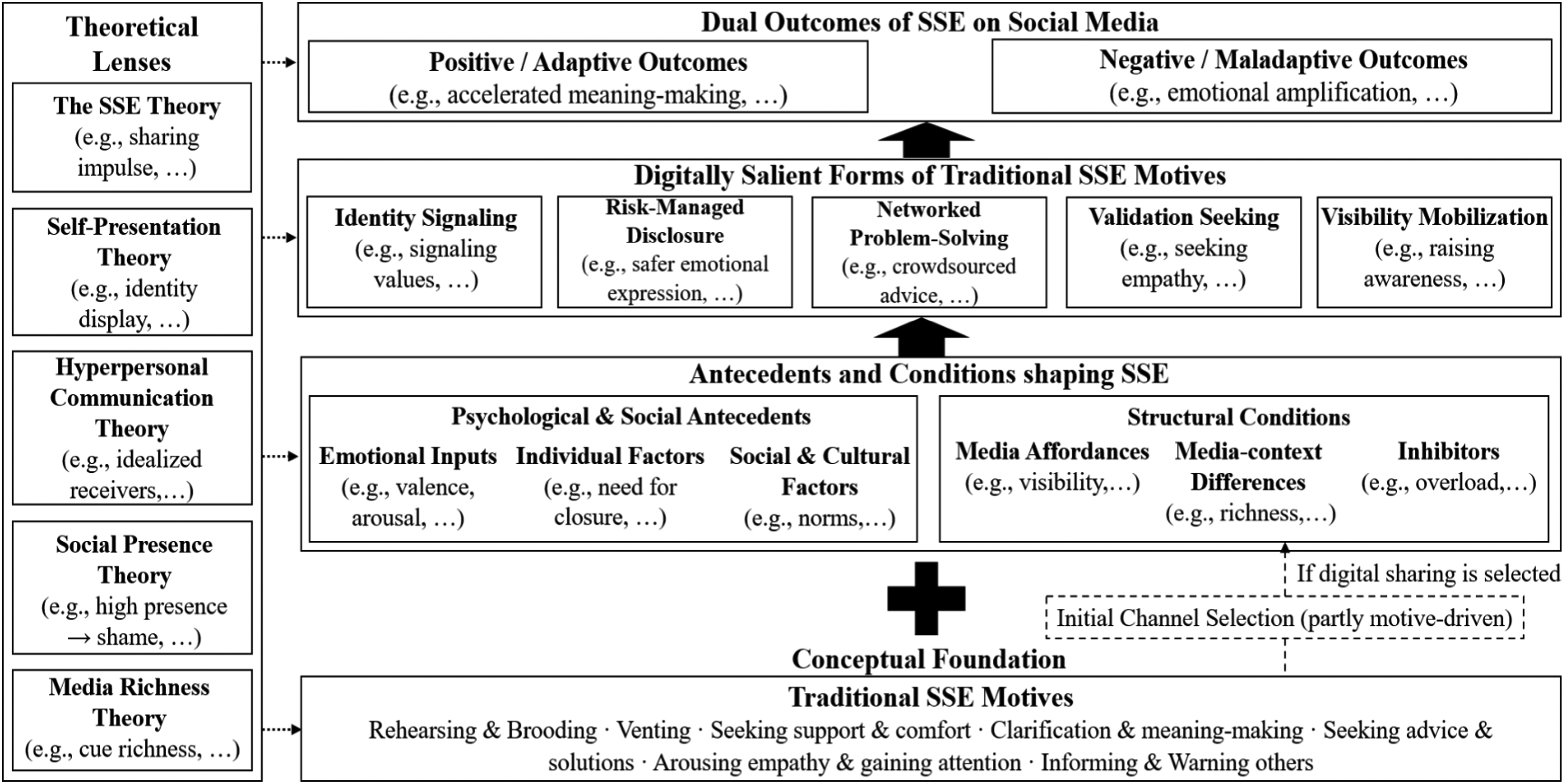
An Integrative Model of Digitally Salient Forms of Traditional SSE Motives.
More specifically, the present model distinguishes among three elements: traditional SSE motives as the conceptual foundation, psychological and social antecedents that activate the sharing impulses, and structural conditions that shape how sharing is enacted and interpreted on social media. Traditional SSE motives provide the basis for more digitally salient forms of sharing across communicative channels, rather than constituting entirely new motives. Emotional inputs, individual differences, and social factors primarily influence whether and how sharing is initiated. By contrast, structural conditions become consequential once social media is selected as the context of sharing. Media affordances, such as visibility, scalability, anonymity, and algorithmic amplification, influence how activated motives are pursued and responded to on social media (Hogan, 2010). These affordances operate through interactional conditions, including variations in social presence, media richness, synchronicity, evaluative risk, and audience heterogeneity. These interactional conditions correspond to the media-context differences shown in Figure 1 and are best understood not as independent antecedents, but as contextual configurations associated with digital environments. In addition, media-related constraints, such as information overload and diminished responsiveness, may inhibit sharing by increasing perceived costs (Li et al., 2024).
A final clarification concerns the scope of the model. Importantly, this model is not anchored to a strict online-offline dichotomy and does not assume that SSE on social media is uniformly public or anonymous. Rather, certain traditional SSE motives may become especially salient under interactional conditions marked by visibility and evaluative uncertainty, regardless of whether sharing occurs online or offline.
Digitally Salient Forms of Traditional SSE Motives
Building on the preceding framework, this section identifies five digitally salient forms through which traditional SSE motives are expressed on social media: identity signaling, risk-managed disclosure, networked problem-solving, validation seeking, and visibility mobilization. These forms do not constitute entirely new motives, but rather patterned expressions of traditional SSE motives on social media. Under heightened visibility, mediated feedback, audience heterogeneity, and reduced social cues, emotional sharing is more likely to foreground concerns related to self-presentation, evaluation, safety, coordination, and audience exposure. The following sections elaborate on these five forms and show how they help explain the characteristic patterns of SSE on social media.
Identity Signaling
Identity signaling refers to a digitally salient form through which individuals share emotional experiences to communicate identity-relevant meanings, such as values, moral stances, and group affiliations, with emotion regulation or support seeking becoming less central (Ma et al., 2024). In digital environments, SSE becomes a symbolic resource through which aspects of the self are made socially legible. Both positive emotions (e.g., pride, gratitude) and negative emotions (e.g., anger, moral outrage) may activate this form, as sharing serves to position the self within broader social and moral landscapes (Peters & Kashima, 2007).
Identity signaling draws on traditional motives of meaning-making, as well as motives related to arousing empathy and attention (Duprez et al., 2015), but foregrounds identity-relevant self-positioning under conditions of heightened visibility and audience breadth. This form is especially likely to arise when emotional experiences carry identity-relevant meaning and are shared under these conditions. Positive emotions (e.g., pride, joy) tend to signal valued traits or achievements, whereas negative emotions (e.g., anger, outrage) delineate moral boundaries and commitments to values (Gable & Reis, 2010; Pauw et al., 2019). In such contexts, identity signaling is driven less by a need for mutual sense-making than by desires for visibility, recognition, and social positioning, especially in weak-tie or public-audience settings (Vitak & Ellison, 2013). Consistent with self-presentation theory, this form places greater emphasis on impression management than on mutual sense-making (Bazarova & Choi, 2014). Media affordances, particularly visibility and editability, support this form by making SSE widely observable and open to strategic shaping. At the same time, identity signaling may be inhibited when individuals anticipate identity-related risks, such as audience heterogeneity, reputational threat, or the perceived irreversibility of online self-presentation. Under such conditions, even identity-relevant emotions may not be expressed through explicit emotional positioning (Pentina & Zhang, 2017).
When identity signaling is salient, SSE prioritizes symbolic clarity and recognizability over intimate disclosure, facilitating alignment with like-minded audiences and reinforcing processes of social categorization (Vitak & Ellison, 2013). While identity signaling can enhance self-coherence and social belonging, it also carries potential costs, including identity labeling, polarization, and increased exposure to social conflict and reputational vulnerability (Pauw, 2023).
Risk-Managed Disclosure
Whereas identity signaling emphasizes making one's values and social position publicly recognizable, risk-managed disclosure foregrounds the minimization of social, relational, and reputational risk. Risk-managed disclosure refers to a digitally salient form of venting and comfort or support seeking in which individuals share emotional experiences primarily to convey vulnerability while maintaining a sufficiently safe context (Gorissen, 2024). Rather than seeking visibility or recognition, this form prioritizes psychological protection and control, particularly when emotions are difficult, embarrassing, or costly to disclose in offline settings (Leon, 2021).
Risk-managed disclosure draws on motives of venting and seeking comfort or support, but is expressed through a disclosure orientation that foregrounds control, selectivity, and the minimization of social risk (Duprez et al., 2015). This form is most likely to arise when emotional experiences are perceived as socially risky to disclose offline. Such experiences include not only vulnerability-related negative emotions, such as shame, regret, fear, or perceived failure, but also emotionally intense positive experiences that may invite social discomfort or appear normatively inappropriate in offline interaction (Zhang et al., 2023). Under such conditions, heightened needs for acceptance and empathy, combined with concerns about negative evaluation, increase the appeal of contexts that offer psychological protection (Contena et al., 2015; Forest & Wood, 2012). Theoretically, reduced social presence lowers evaluative threat and the sense of being scrutinized, while hyperpersonal communication processes enable selective self-presentation and temporal control over SSE (Derks et al., 2008; Hogan, 2010). Media affordances such as anonymity, asynchronicity, and selective audience control support these mechanisms by rendering social media subjectively safer and more controllable for emotionally sensitive disclosure (Clark-Gordon et al., 2019; Gorissen, 2024). However, when these affordances fail to sustain perceived safety, such as in anticipation of hostile responses, identity traceability, or emotionally invalidating feedback, the protective value of online disclosure diminishes, thereby weakening the appeal of risk-managed disclosure.
When risk-managed disclosure is salient, SSE prioritizes safety, containment, and emotional buffering. This form can provide a psychologically safer outlet, facilitating short-term emotional relief and perceived understanding without immediate cost. However, reliance on risk-managed disclosure may expose individuals to cyber-aggression, foster a fragmented self between online vulnerability and offline restraint, and weaken engagement with offline support.
Networked Problem-Solving
Beyond signaling identity or managing disclosure risk, individuals may share online to actively seek guidance for resolving uncertain situations. Networked problem-solving refers to a digitally salient form of assistance- and advice-seeking in which individuals share to obtain concrete advice, information, or actionable solutions from a broad and heterogeneous audience (Gray et al., 2013). Both negative emotions linked to uncertainty (e.g., anxiety, regret) and positive emotions associated with choice or opportunity (e.g., anticipation) can activate this form (Luminet et al., 2000; Watson & Stanton, 2017). In this form, sharing is oriented primarily toward mobilizing distributed knowledge rather than obtaining emotional relief.
Networked problem-solving draws on the traditional motive to seek assistance and advice (Duprez et al., 2015), but foregrounds the use of broad, heterogeneous networks when uncertainty and cognitive needs are high. This form is especially likely when uncertainty is high, particularly among individuals with a strong need for closure, for whom emotional discomfort is closely tied to ambiguity and the absence of a clear course of action (Roets & Van Hiel, 2007). It is therefore primarily driven by instrumental goals, such as obtaining guidance, strategies, or decision-relevant input, with emotional relief serving as a secondary outcome. Media richness theory explains why networked problem-solving is viable in digital contexts: multimodal affordances (e.g., text, images, videos, screenshots) enable the articulation of complex, emotionally charged problems with sufficient informational richness to elicit functional advice (Daft & Lengel, 1986; Gray et al., 2013). As a result, social media may be perceived as especially useful for problem-solving because they provide more diverse information and comparative perspectives than offline settings. However, the appeal of this form diminishes when information quality is challenging to assess, advice is perceived as unreliable or contradictory, or excessive input increases decisional uncertainty.
When networked problem-solving is salient, SSE is oriented toward reducing uncertainty and guiding action. Under negative emotional states, sharing tends to prioritize risk reduction and damage control, whereas under positive but uncertain states, it facilitates option comparison and deliberation (Luminet et al., 2000; Watson & Stanton, 2017). This form can enhance perceived efficacy and reduce decision-related isolation by providing access to diverse perspectives beyond one's immediate social circle (Vitak & Ellison, 2013). However, exposure to excessive or conflicting advice may generate information overload, prolong uncertainty, or undermine confidence in one's own judgment, particularly in highly scalable, algorithmically curated environments (Li et al., 2024).
Validation Seeking
Beyond seeking solutions, individuals may also share emotional experiences online to assess whether their reactions are socially appropriate or shared by others (Rimé, 2009). Validation seeking refers to a digitally salient form of sharing through which such normative confirmation is sought via aggregated, quantifiable feedback, such as likes, comments, shares, or reactions (Brudner et al., 2023). Both negative emotions (e.g., anger, hurt) and positive emotions (e.g., pride, joy) can activate this form, insofar as individuals seek reassurance that their reactions are not idiosyncratic or misplaced (Koudenburg et al., 2014). It functions as a means of socio-emotional calibration, allowing individuals to gauge whether their feelings, evaluations, or responses are understandable, reasonable, or socially endorsed.
Validation seeking draws on motives of meaning-making, as well as motives related to empathy and attention (Duprez et al., 2015), but in digital contexts, it is often expressed through group-level confirmation rather than solely through interpersonal reassurance. This form is most salient when individuals are uncertain whether their reactions are excessive, insufficient, or appropriate (Shrauger & Jones, 1968). It reflects the joint operation of cognitive needs for judgmental clarity and social-emotional needs for belonging and reassurance. Media affordances play a central role in this form. Quantifiable feedback transforms recognition into visible and comparable signals through public metrics; scalability enables the rapid accumulation of responses from diverse others; and heightened visibility, often reinforced by algorithmic amplification, intensifies the subjective experience of collective endorsement (Brudner et al., 2023; Sirivianos et al., 2014). Furthermore, SSE theory highlights the role of emotional sharing in normative matching and social regulation, whereas hyperpersonal processes help explain why online feedback is experienced as concentrated, amplified, and readily internalized. However, the appeal of validation seeking diminishes when feedback is perceived as unrepresentative, strategically inflated, or hostile, or when individuals become aware that platform metrics may distort rather than reflect genuine social consensus (Greville-Harris et al., 2016).
When validation seeking is salient, SSE serves to normalize subjective experience and reduce feelings of isolation by providing salient social reference points. At the same time, reliance on aggregated online feedback may foster dependence on external validation, amplify echo-chamber effects that reinforce extreme emotional responses, and heighten sensitivity to platform metrics. In turn, this may lead to feedback preoccupation and persistent dissatisfaction (Guadagno et al., 2013; Li et al., 2024).
Visibility Mobilization
Beyond forms oriented toward individuals’ own emotions, judgments, or decisions, SSE may also serve more explicitly public-oriented goals. Visibility mobilization refers to a digitally salient form of informing or warning others in which individuals share emotionally charged content online to draw collective attention to events, social problems, or marginalized experiences that might otherwise remain unnoticed. High-arousal emotions, most commonly anger, outrage, or concern, but occasionally intense positive emotions linked to inspiring or uplifting events, are especially effective in activating this form by capturing attention and facilitating diffusion (Ma et al., 2024). It is oriented more toward mobilizing public awareness and engagement than toward foregrounding personal feeling as an end in itself.
Visibility mobilization draws on the traditional motive to inform or warn others (Duprez et al., 2015), but foregrounds public visibility and collective attention as salient goals under conditions of scalability, algorithmic circulation, and heightened exposure. From a hyperpersonal communication perspective, selective disclosure, message editing, and narrative packaging allow emotionally charged stories to be optimized for salience and shareability (Hogan, 2010). Media richness further supports this process by enabling multimodal expression (e.g., text, images, videos, screenshots) that conveys emotional intensity and experiential detail even under conditions of low social presence (Choi & Toma, 2022). In combination, these conditions increase the visibility and circulation of emotionally charged content. Scalability extends reach, visibility structures (e.g., feeds and trending systems) elevate salient content, algorithmic curation preferentially amplifies high-arousal material, and asynchronicity enables sustained circulation over time (Chen et al., 2022; Stieglitz et al., 2018). However, the appeal of visibility mobilization diminishes when amplification is perceived as indiscriminate, manipulable, or decoupled from meaningful impact (Li et al., 2024).
When visibility mobilization is salient, SSE is oriented toward directing collective attention and shaping public visibility. This form can elevate neglected issues into public discourse, foster awareness, and, in some cases, contribute to shifts in public opinion or resource allocation (Berger, 2025; Peters & Kashima, 2007). However, mobilizing visibility through emotion carries distinctive risks, including affective polarization, the amplification of misleading or incomplete information, and the overexposure of individuals or groups. These dynamics may result in secondary harm, retraumatization, or corumination (Anthony et al., 2025; Rimé et al., 2020; Rose, 2002).
These five digitally salient motives represent distinct forms through which traditional SSE motives may be expressed on social media. Importantly, the outcomes of SSE on social media are not confined to any single form, but arise from the shared structural conditions under which these forms operate.
Dual Outcomes of SSE on Social Media
The outcomes of SSE on social media are not confined to any single motive, but arise across motives from shared structural conditions. Across these forms, it can facilitate emotional regulation and psychological buffering, enhance perceived social support and connectedness, promote self-affirmation and self-clarity, and contribute to collective awareness through heightened visibility and information diffusion (Gable et al., 2012; Nils & Rimé, 2012). These adaptive outcomes reflect the core social-regulatory functions of SSE identified in both classic theory and digital-context research.
At the same time, digital SSE is associated with maladaptive consequences that recur across forms, including emotional amplification driven by algorithmic prioritization, misinterpretation under weak social cues, informational and emotional overload, rumination or co-rumination, and broader risks of overexposure, polarization, and secondary distress (Rimé, 2009; Schöne et al., 2023). Crucially, these dual outcomes stem from the same conditions: the affordances that enable SSE on social media to connect individuals and mobilize attention also heighten exposure, ambiguity, and amplification dynamics. Thus, digital SSE operates as a double-edged process, in which adaptive and maladaptive consequences emerge from shared underlying mechanisms.
Theoretical Implications for SSE
Extending the SSE Theory
The present model extends the SSE theory by clarifying how established sharing motives operate on social media. SSE theory conceptualizes emotional sharing as serving core purposes of emotion regulation, meaning-making, and social bonding, and these functions remain central in digital contexts (Rimé, 2009; Rimé et al., 2020). Online SSE does not represent a qualitative departure from these foundational processes. Rather, it shows how traditional motives may be expressed, prioritized, and socially reinforced differently when sharing occurs in environments marked by heightened visibility, mediated feedback, and heterogeneous audiences.
More specifically, when SSE unfolds under these social media conditions, regulatory and social functions that were previously embedded within interpersonal interaction may become more explicitly oriented toward public self-definition, risk management, normative alignment, instrumental coordination, or the mobilization of collective attention (Bazarova & Choi, 2014; Choi & Toma, 2022). These shifts reflect changes in how familiar SSE functions are organized and foregrounded in response to audience structure, feedback dynamics, and interaction timing. In this sense, the present model complements SSE theory by specifying how established sharing functions become differentiated, foregrounded, and socially reinforced under digital conditions.
Motivational Feedback Loops and Ambivalent Outcomes
Media affordances also help explain why online SSE is associated with ambivalent outcomes and how these outcomes feed back into subsequent sharing decisions. The same conditions that shape sharing orientations, such as visibility, scalability, and editability, can simultaneously facilitate connection, affirmation, and coordination while heightening exposure, misinterpretation, and dependence. When sharing is oriented toward identity expression, visibility can enhance self-coherence and belonging while also increasing risks of labeling and polarization (Choi & Taylor, 2024; Leon, 2021). When sharing is oriented toward safety or validation, reduced social presence and quantifiable feedback can provide emotional buffering while also fostering fragility when feedback is absent, distorted, or hostile. Importantly, these outcomes are not tied to any single form; instead, they emerge from the broader media conditions under which sharing motives are expressed and responded to (Rimé et al., 2020). In this sense, outcomes function within a feedback loop: experienced consequences inform subsequent sharing decisions, reinforcing or constraining particular orientations over time. Understanding SSE on social media as a process affected by changing communicative conditions helps explain why adaptive and maladaptive consequences reliably co-occur in digital contexts.
Limitations and Future Directions
Several limitations of the present model should be acknowledged. First, the model is conceptual and is intended to clarify how traditional SSE motives may be expressed under digital conditions, rather than to specify directly testable causal pathways. Future research could empirically examine how specific media affordances, such as visibility, audience scope, or feedback metrics, systematically shift the likelihood that particular sharing orientations are foregrounded across platforms and contexts. Second, the model treats emotional experiences at a functional level and does not differentiate among discrete emotions. Future research could investigate how specific emotions (e.g., anger, sadness, pride) interact with media affordances to differentially activate particular forms of sharing, thereby providing a more emotionally granular account of these motivational processes. Third, the analysis focuses primarily on more publicly visible forms of online SSE. Future work could extend the model to private or semiprivate channels to clarify the boundary conditions under which these patterns become less pronounced or take different forms. Addressing these issues would help refine the scope and applicability of the proposed model while preserving its core premise that digital contexts selectively foreground and pattern the expression of traditional SSE motives rather than replace them.
Conclusion
This conceptual paper advances an integrative model for understanding how traditional SSE motives are expressed and become especially salient in digital contexts. Rather than proposing entirely new motives or suggesting a qualitative break from traditional SSE processes, the model clarifies how traditional SSE motives are selectively foregrounded, differentiated, and stabilized under conditions of heightened visibility, mediated feedback, and indeterminate audiences. By distinguishing five digitally salient forms, namely identity signaling, risk-managed disclosure, networked problem-solving, validation seeking, and visibility mobilization, the model shows why traditional SSE motives, taken alone, may be too coarse-grained to capture the differentiated patterns of online sharing. More broadly, the model highlights that the distinctive patterns of SSE in digital contexts arise not from changes in emotional experience itself, but from the interactional conditions through which sharing is enacted. In doing so, it offers a theoretically coherent account of SSE on social media while preserving continuity with core principles of SSE theory.
Footnotes

Ethical Considerations
Ethical approval was not needed due to the nature of the article (i.e., review article).
Author Contributions
LW: conceptualization, methodology, formal analysis, visualization, investigation, project administration, writing—original draft, and review and editing. SAB: conceptualization, methodology, supervision, and writing—review and editing. All authors approved the final manuscript for submission.
Funding
The authors received no financial support for the research, authorship, and/or publication of this article.
Declaration of Conflicting Interests
The authors declared no potential conflicts of interest with respect to the research, authorship, and/or publication of this article.
Data Availability
The datasets generated and analyzed during the current review are available from the corresponding author on reasonable request.