Abstract

On a rare sunny Saturday in April, over 100 participants attended 30 Euston Square for the Royal College of General Practitioners (RCGP) Junior International Committee (JIC) Annual Conference. Although most delegates were UK-based AiTs or First5® GPs, some were from further-flung locations, including one delegate who had flown in from Sierra Leone that morning. The wide range of expertise in global health among those present generated a rich experience and a palpable enthusiasm that spread beyond the walls of the College; the conference hashtag was delivered to 158 685 twitter feeds. A truly global event!
What is the JIC?
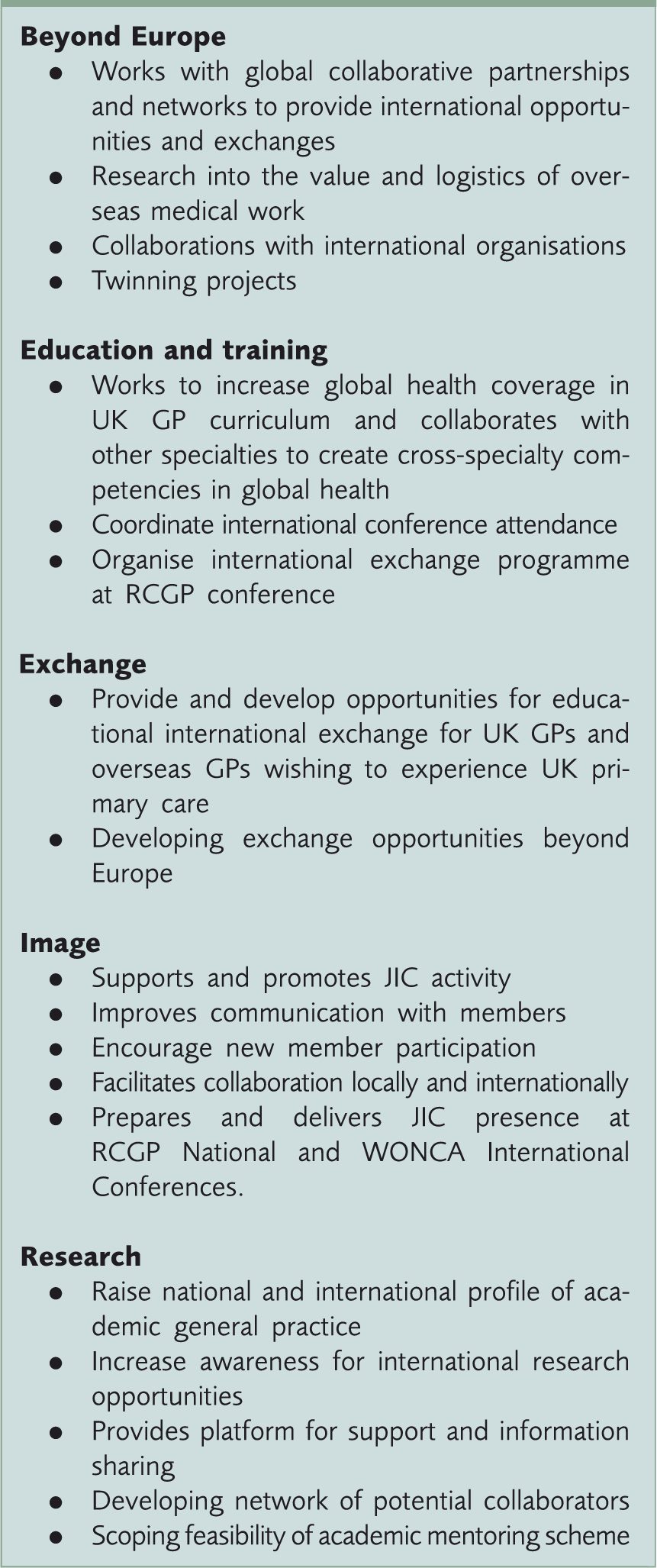
Established in 2009 as a subcommittee of the RCGP International Committee, the JIC is the UK arm of the Vasco da Gama Movement (VdGM) – the World Organisation of Family Doctors’ (WONCA) Europe working group for new and future GPs. The JIC comprises a core committee (Fig. 1) with five working groups (Box 1). Its mission statement, JIC Core Committee members at the JIC Annual Conference. JIC working groups: project examples.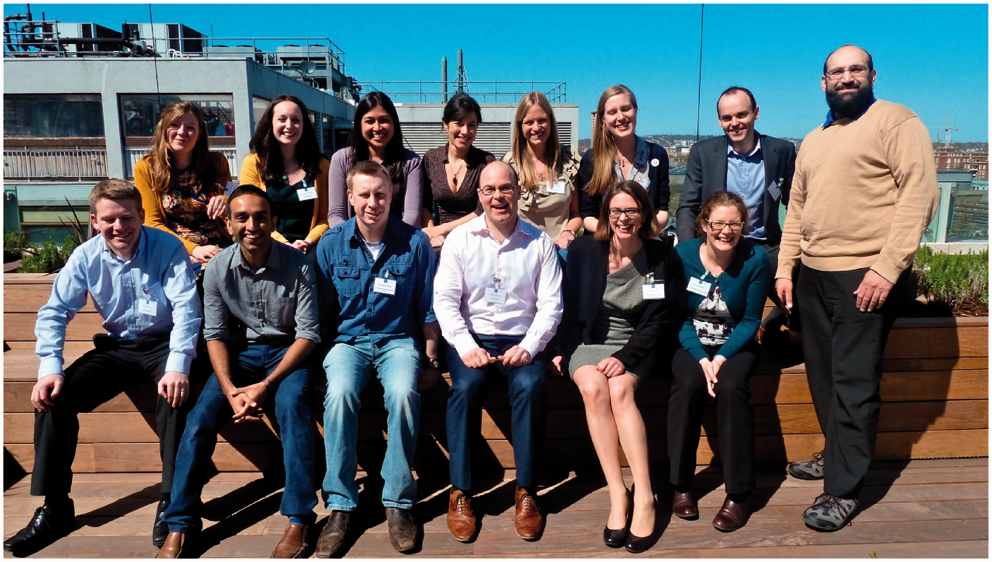
The conference
The JIC Annual Conference aimed to showcase JIC work and provide an opportunity for current and new members to learn, discuss and debate global health-related issues. It opened with a fast-paced ‘PechaKucha’ style presentation that comprehensively summarised JIC activities in an innovative and entertaining way. The main programme comprised two sessions of speakers and an interactive ‘World Café’, which allowed delegates to brainstorm and feedback on important issues. The main themes are presented below.
Primary healthcare and global health development
The RCGP International Strategy recognises that primary healthcare is key to global health development (RCGP, 2011). However, International Health Consultant Monica Burns challenged delegates to think differently about this concept. She proposed that although primary care should be the first-choice global development policy option this might not always be the case describing how, where and why efforts to promote it may be stymied. Professor Roger Jones, Editor of the British Journal of General Practice, also questioned whether primary healthcare is the best and only option by asking the audience to objectively consider the evidence for different healthcare systems. This debate stimulated enthusiastic conversations during the World Café, raising questions including: ‘What is the definition of Global Health?’ and ‘Whose problem is it anyway?’ The ethics of working overseas and aid provision were hotly debated, and delegates considered the need to acknowledge wider economic, political and environmental influences. These are topics that often arise during JIC discussions and it was gratifying to open up the debate.
Out of programme activity
Many AiTs who work overseas do so as part of an out of programme experience (OOPE); the educational benefits of this were recognised in the Modernising Medical Careers Inquiry (Tooke, 2008). A personal insight into her rural South Africa OOPE was provided by First5® GP Dr Afsana Bhuiya. She warned delegates of the difficulties faced when working in challenging and unfamiliar environments, but also spoke of the positive influences on her knowledge and practice, including how the experience helped shape her career.
Delegates were keen to contribute their ideas to developing OOPEs, including independent OOPEs in non-traditionally selected countries. Some, but not all, deaneries have well-established OOPE schemes with integrated mentorship and support. This inequity was highlighted and it is a concern that the JIC hopes to address. Dr Patrick Kiernan, Director of the London Deanery scheme, drew attention to the potential for developing OOPEs alongside future changes to GP training.
Global health partnerships
The UK Government promotes international partnerships to contribute towards development in today’s globalised world (Crisp, 2007). The JIC also focuses on international exchanges to develop long-lasting bilateral partnerships, including collaboration with VdGM to provide the Hippokrates programme of observational exchanges within Europe. The JIC successfully applied to the European’s Commission’s Lifelong Programme for exchange funding, thus in 2012–2013 a total of 35 participants are undertaking fully funded exchanges. Self-funded exchanges across Europe are also supported through liaison with designated national exchange coordinators and a Beyond Europe exchange to Japan was launched in 2013.
Two exchange participants shared their contrasting experiences; AiT Dr Alisha Symonds of her time at a single-handed GP practice in France and First5® GP Dr Catriona Clubb of the 2 weeks she spent in Spain. Both spoke enthusiastically of their exchange, emphasising the benefits of experiencing a different healthcare system and describing examples of positive influences on their practice.
The JIC also promotes twinning projects between UK and overseas primary care providers. Mr Sam Riddell, a practice manager involved in an established Scotland/Malawi project, shared his experiences of the positives and potential pitfalls of such initiatives.
Inspiration to take a global approach
Dr Judith Mbaire, First5® GP in London and first-time attendee.
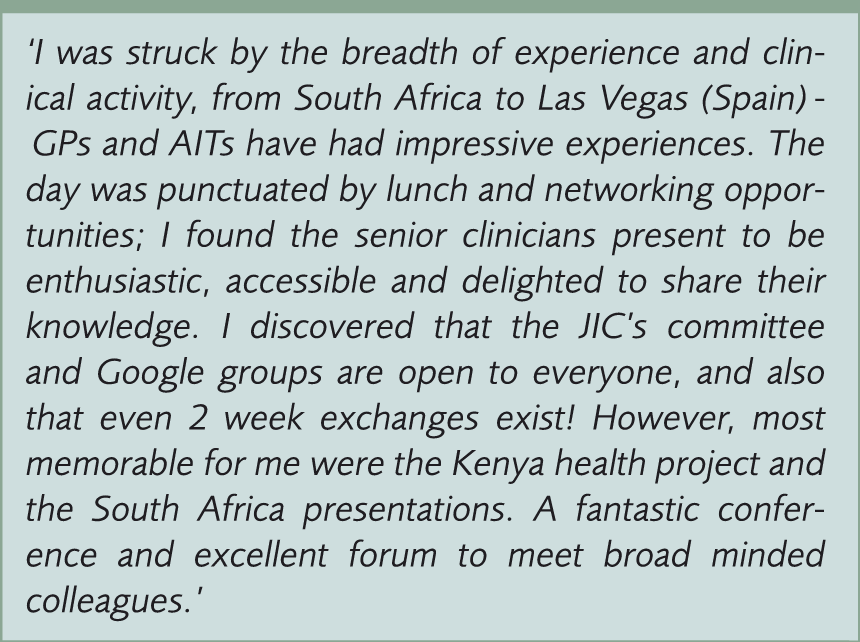
Reflections of Dr Andrea Waldecker, AiT.
Finally, a video made by First5® GPs Kieran Dinwoodie and Sarah Capewell transported delegates to the Bwindi Community Hospital in rural Uganda, where they are currently volunteering. Established with JIC support, this is an innovative primary-care-focused project, made sustainable through teaching and quality improvement activities guided by the local hospital and community. Volunteers are involved in international research through a confidential enquiry into child and maternal deaths. Mentorship is provided by academic GP Dr Merlin Wilcox. This video brought life as a volunteer GP in Africa closer to home, providing a powerful example of what can be achieved through appropriate community-specific interventions in such a setting.
Getting involved
Professor Roger Jones, British Journal of General Practice Editor