







Abstract
Over the last 2 years we have worked our way through the different RCGP curriculum statements, giving ideas across the ePortfolio and Workplace-based Assessment. Having completed our journey, we will be launching a new range of Crammer’s Corner articles next month focusing on individual components of the MRCGP exam. In the meantime we spend this month focusing on the clinical and educational supervisor review meetings.
Focus on the clinical supervisors report and educational supervisors review
The educational supervisors review (ESR) is the 6-monthly review meeting held between a trainee and the educational supervisor (ES) to help review progress, set future goals and inform the annual review of competence progression (ARCP) panel. This review meeting, if planned for correctly, becomes not only mandatory, but an incredibly helpful and beneficial meeting for trainees. We therefore thought it useful to summarise some points about the meeting and contrast this with the clinical supervisors report (CSR), which can help inform the ESR again if done well.
Clinical supervisors report
The CSR is a relatively short report completed by the clinical supervisor (CS) following a hospital post, and often follows a review meeting between a trainee and their CS at the end of an attachment. It is structured covering four clusters that bring together the differing competency areas. Supervisors are asked to grade the trainee in each of the areas in comparison with another doctor at the same stage of training. They are also asked to make a comment for each area and then suggest some recommendations for further development (or note any concerns). While the gradings are helpful, it is the comments and recommendations, which if done well, can be a very useful way of giving feedback to help inform and aid completion of the ESR.
Although not desirable, it is recognised that trainees may sometimes undertake a placement where they may not see their CS very often (e.g. while completing a placement in a wide-ranging speciality), so we would encourage trainees to make regular contact to check the CS is aware of progress and hence can complete a helpful and thorough report. Ideally the CS and ES would discuss the trainee both before and after an attachment, but this often does not occur and therefore trainees could also emphasise the value of the comments and recommendations in the CSR to the CS.
Educational supervisor review
The ESR is a formal meeting that occurs every 6 months between a trainee and ES, during which progress to-date is reviewed and then learning aims and areas that need more focus are decided. They are designed to be evidence-based, timely, open and honest (Gold Guide 6). Meetings should be held at the midway point of the year (after 6 months) irrespective of job rotations, but then may need to be held slightly earlier in the second half of the year (and by month 34 of training in ST3) in time to allow assessment of progress by the ARCP panel. Additional meetings may need to be held at differing times (such as prior to a period of maternity leave). Less than full-time trainees still require 6 monthly reviews to ensure regular feedback.
Minimum evidence requirements for work-placed based assessment (based on full time training).
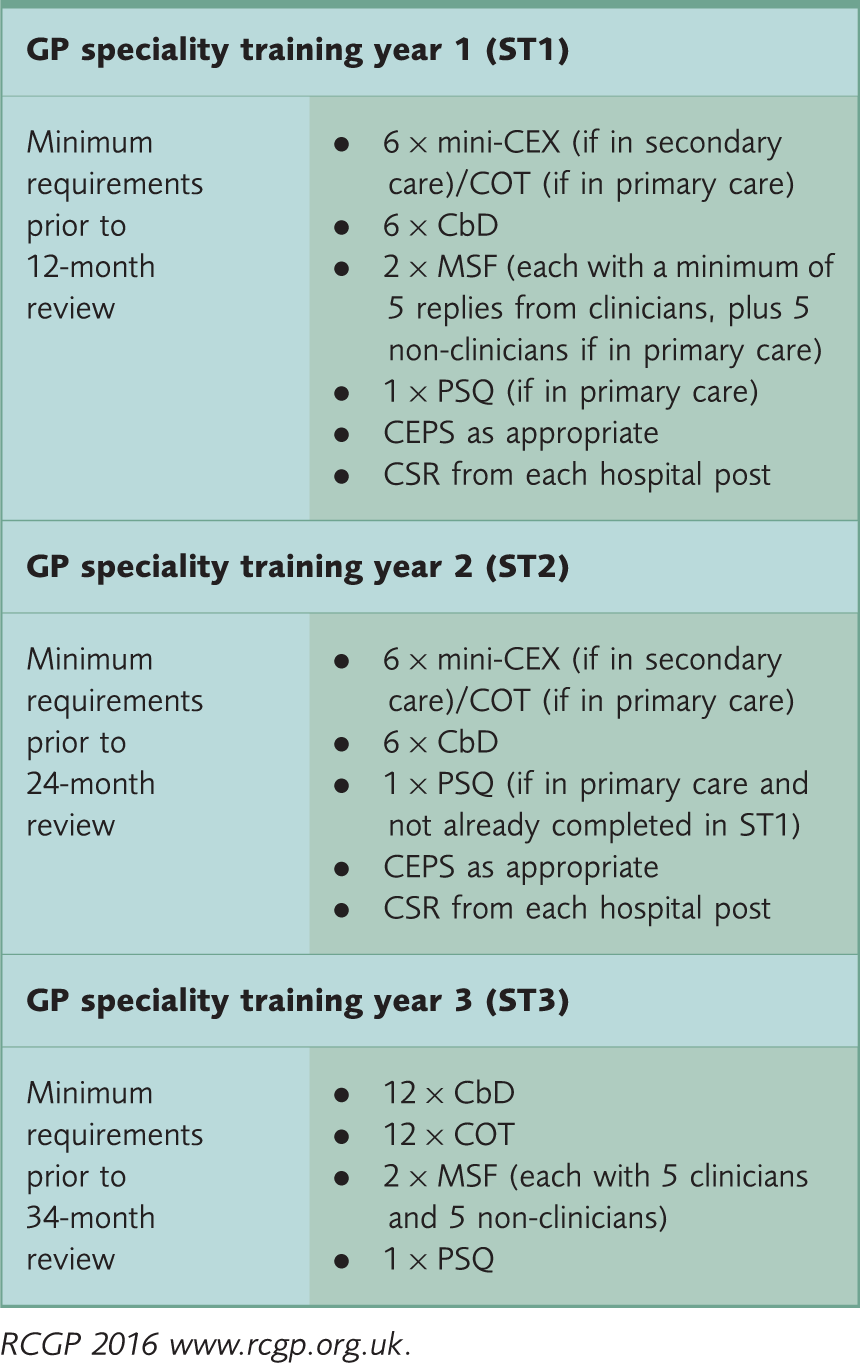
RCGP 2016 www.rcgp.org.uk .
A trainee has several tasks to do in advance of the review meeting and they should ensure they have considered and completed these in a timely fashion as this can help the ES in their preparation. These include reviewing and updating their PDP and then self-rating themselves against the 13 competency areas. During this self-rating, they should reflect and justify the rating they are giving themselves providing evidence from across the ePortfolio. This can include linking up to three pieces of evidence. This is where quality of evidence becomes important, as well written and reflective log entries and wide ranging assessment tools can help provide a range of evidence to support ratings and progression. Trainees should also consider their learning needs going forward, any concerns they have and any other issues they wish to discuss during the review.
The review meeting itself should usually take 1–2 hours, followed by time for write-up in the ePortfolio. This should include discussing any issues or concerns the trainee may have, followed by working through the sections of the ESR. These include a review of curriculum coverage where the ES comments on the development of curriculum coverage and decides on areas for focus going forward. Obviously, earlier in training coverage is expected to be less wide ranging, but by the end of ST3 it is expected that coverage is spread throughout the curriculum with a range of log entries linked to each area. The trainee (and ES) should monitor this and can use our preceding Crammer’s Corner articles to provide inspiration for areas where coverage is less wide ranging. Following this there should be a review of a trainee’s skills log and then review of the PDP, with comments on progress through objectives. Next there should be consideration of the trainee’s competence area self-rating, followed by assessment of these areas by the ES. This should be an evidence-based judgement using the evidence presented by the trainee, as well as additional evidence and again up to three pieces of evidence can be linked. Review of the competency areas is what takes up the bulk of the ESR and this can be helped greatly by proper preparation both by the trainee and the ES. The RCGP provides a step-by-step reference guide to the ESR and this provides some helpful timesaving tips (including setting up a review period at an early stage and completing examples of evidence on a continual basis following the previous review).
The ESR is completed by a review of the quality of evidence provided by the trainee, progress to certification (with all boxes and competency areas expected to be ticked by the end of ST3), review of any significant incidents or complaints and then agreement on action plans (which can be carried into the PDP). Again our Crammer’s Corner series can provide some inspiration if required! Finally, there is a recommendation by the ES on whether progress is satisfactory or not (with supporting comments). Following final submission it is important that the trainee remembers to accept the review through their own ePortfolio. ESs can then create a new review so that the process may begin again.
As we move into our new series, if you have any comments or ideas on how to improve the section please email us at editorialoffice@innovaitjournal.co.uk.