Due to their multicomponent composition, fuels are challenging in thermoacoustic instability analysis, particularly sustainable aviation fuels (SAFs) sought as drop-in fuels. Understanding their dynamics is essential to prevent undesirable consequences in aircraft engines. This requires full comprehension of how each constituent of the liquid fuel affects combustion dynamics through atomization, evaporation, mixing with air, and ignition. This paper investigates a two-component SAF surrogate, composed of dodecane and isooctane, supplying three swirling spray flames subjected to a standing transverse acoustic mode. Results are compared with those of the pure constituents and n-heptane, used as a reference fuel. Using the downstream pressure-based flame describing function, the dynamical responses of isooctane and dodecane are found to be less efficient than n-heptane, and the SAF surrogate’s response is weaker than its pure constituents. Phase Doppler Anemometry measurements highlighted dodecane’s low evaporation rate and showed that the behaviors of isooctane and SAF surrogate cannot be explained solely by evaporation. High-speed OH* imaging showed longer flames for isooctane than for dodecane and n-heptane, while the SAF surrogate produced the longest. Compared to n-heptane, the region of maximum flame intensity oscillations () is weaker and shifted downstream for dodecane and isooctane, promoting more localized flame spreading outside the Rayleigh instability band. This attenuation effect is even more pronounced for the SAF surrogate. The different flame structures and responses arise from evaporation delay in dodecane, ignition delay in isooctane, and a combined effect of both in the SAF surrogate.
Sustainable aviation fuels (SAFs) have been identified in many scenarios as a dominant contributor, in the mid-term, to achieve the aviation net-zero emissions by 2050. These fuels, which are intended to be drop-in fuels, can be blended with the conventional aviation fuels (CAFs) or potentially replace them in the near future. However, despite the similarities between SAFs and CAFs, they have different chemical compositions due to the diversity of raw materials used in the production of SAFs.1 In this regard, it should be verified that the different compositions of the new fuels will not provoke any operational issues such as the occurrence of thermoacoustic instabilities, which are among the most dangerous. Gaining a physical understanding of this complex issue requires examining how the combustion dynamics is affected by fuel properties, particularly those of multicomponent fuels.
Within this framework, several numerical studies from the literature highlighting the effect of the evaporation process could be useful to understand mechanisms that may govern the combustion dynamics. Shastry et al.2 showed, using LES, the effect of low-volatile components in JetA-1 on the flame stabilization, leading to an extended evaporation and reaction zone through the presence of droplet clusters that might burn further downstream. In the same context, 1D simulations of a counterflow spray flame by Bonnani et al.3 found that, when considering preferential evaporation of Jet-A POSF 4658, the more volatile component vaporizes faster but exhibits a longer ignition delay. As a result, the low-temperature chemistry (LTC) zone of the multicomponent fuel shifts downstream compared to the case without preferential evaporation. In addition, due to its high chemical reactivity, n-dodecane significantly enhances the heat release rate (HRR), which peaks in the high-temperature region. Although the more volatile component evaporates faster than n-dodecane, HRR peaks, both in LTC and downstream in the high-temperature region, occur only when sufficient n-dodecane has evaporated. The evaporation process was also investigated by Sekularac et al.4 through LES of n-heptane and n-dodecane binary blends in a swirling spray flame. They showed that the peak of n-dodecane consumption rate happens further downstream compared to that one of n-heptane. Given that the HRR maximum occurs after the peak of n-dodecane consumption rate, they suggested that the maximum HRR location is controlled by the onset of n-dodecane consumption. A recent experimental study by Hodge et al.5 investigated how the fuel temperature of Jet A influenced combustion instability within a piloted swirl flame. They stated that the low injection temperature of the fuel promoted poor atomization and vaporization, leading to localized fuel pockets whose abrupt combustion amplified instabilities. As an acoustic compression wave arrived, this accumulated fuel burned rapidly, producing intense heat release that amplified acoustic perturbations. When fuel was heated, atomization and evaporation were enhanced, which unified fuel delivery and thus dampened instability.
In order to better understand the impact of the fuel type and composition on thermoacoustic instabilities in annular combustors, a collaborative experimental effort was undertaken between CORIA and EM2C laboratories.6–10 Rajendram Soundararajan et al.6 studied the effect of using pure n-heptane or pure dodecane on the excitation of self-unstable oscillations in an annular combustor equipped with 16 swirling spray flames called MICCA-Spray. In parallel, Patat et al.7 studied the impact of using pure n-heptane or pure dodecane on the dynamical flame response under downstream acoustic forcing using a linear combustor called TACC-Spray representing an unfolded sector of three swirling spray flames of the annular combustor.11 The joint results showed that dodecane is less sensitive to instabilities than n-heptane. Recently, the thermoacoustic response of binary mixtures of n-heptane and dodecane has been studied by Latour et al.9 in the self-unstable annular combustor, and by Alhaffar et al.10 under acoustic forcing in TACC-Spray. In both studies, it has been shown that the increase in the percentage of n-heptane in the binary mixture tends to increase the instability propensity of the system. The authors explained this observation through the high evaporation rate of n-heptane compared to dodecane, as detailed in Alhaffar et al.10 In addition, a recent study by Latour12 questions how chemical characteristics reflected in the cetane number values of fuels, which characterize their conversion delay and are linked to their autoignition temperature, can influence the response of flame dynamics to thermoacoustic instabilities.
The present study continues in the same direction by experimentally investigating the dynamic response of swirling spray flames fed with multicomponent fuels in order to find a route for differentiating effects coming from the evaporation process from those induced by chemical reactivity characterized by the fuel ignition delay or autoignition temperature. This is achieved through the use of a binary mixture of dodecane and isooctane considered as a surrogate of the SAF S-8 according to Dooley et al.13 Including the introduction and conclusion, the paper comprises seven sections. Following the introduction, Section “Experimental setup, diagnostics and conditions” describes the experimental setup and diagnostics, and Section “Flame response to acoustic forcing of SAF surrogate and pure fuels” analyzes the flame response to acoustic forcing using the pressure-based flame describing function (FDF). Section “Spray analysis under reactive conditions” examines fuel droplet size distributions and airflow dynamics under reactive conditions via phase Doppler anemometry (PDA). Section “Flame structure and dynamics” presents flame structure dynamics for a SAF surrogate and three pure fuels using high-speed OH* imaging. In Section “Involved mechanisms: evaporation and ignition characteristics,” main results are summarized and correlated with the physical and chemical characteristics of the four fuels, before concluding in Section “Conclusion.”
Experimental setup, diagnostics, and conditions
The experimental study is carried out utilizing the abovementioned linear combustor TACC-Spray, developed in the CORIA laboratory, representing an unfolded sector of three flames of the annular combustor MICCA-Spray.11,14
TACC-Spray setup description
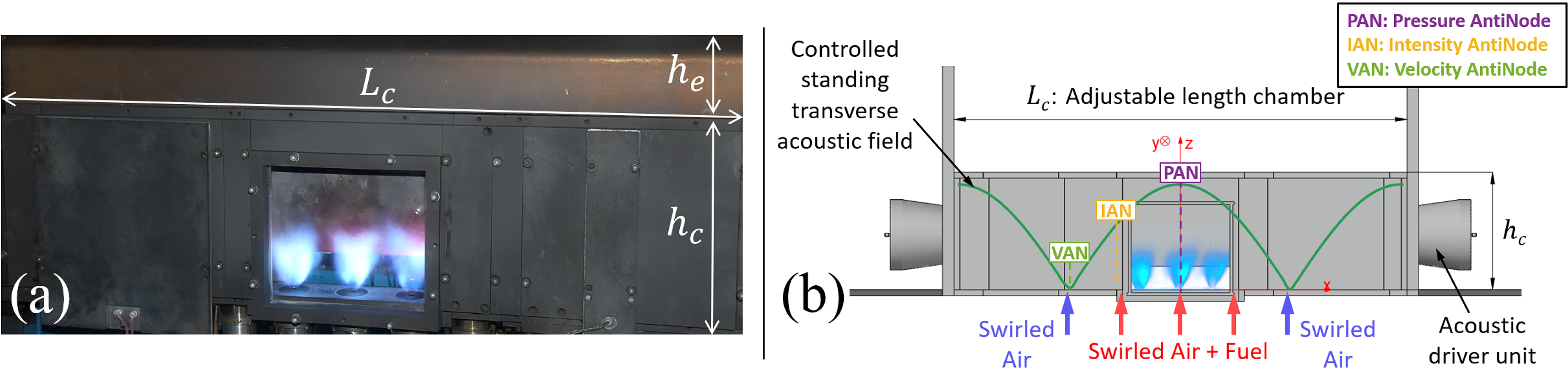
TACC-Spray is an atmospheric combustion chamber composed of a fixed base and movable lateral and front walls. It has a height of 200 mm, a width of 55 mm, and an adjustable length such that the chamber can be used as an acoustic resonant cavity at various frequencies. To prevent outer air entrainment into the combustor through the top, which might disturb the flame environment, a convergent unit with a reduced exhaust section is installed on the top of the chamber. The width of this section is five times smaller than the combustor width () (see Figure 1(a)).
TACC-Spray combustor (, ) with its convergent part (, exit width = 10 mm): (a) Three swirling spray flames of n-heptane without acoustics; (b) front view of TACC-Spray showing the pressure amplitude of the forced standing transverse field and the three flames centered at pressure antinode (PAN).
The injection system features five swirling injectors mounted on the fixed base: three central spray injectors and two adjacent air injectors without a fuel atomizer (see Figure 1(b) and details of the injector design in Alhaffar et al.11). The lateral injectors allow setting the central flame in local aerodynamic and thermal conditions similar to those prevailing in the annular combustor. The flame array is stabilized without the use of walls by means of two additional lateral streams of swirling air that are transparent to the transverse acoustic field (see Figure 1).
An acoustic forcing system is implemented in the cavity such that the transverse 2T1L mode of the cavity, which presents a pressure antinode (PAN) at its center, is excited at the resonance frequency . Exhaustive studies have been performed to quantify this mode (see Caceres et al.,15 Caceres,16 and Patat17). A signal of controlled amplitude and frequency is delivered to two Beyma CP850ND acoustic driver units fixed face-to-face on the lateral walls of the cavity. In the present work, mm, leading to a resonance frequency of Hz, which has been chosen according to the frequencies of the self-sustained oscillations observed in MICCA-Spray.9 The position of the flame array can be changed by moving the set composed of the lateral and front walls of the chamber. Here, the central flame is always located at the position of the central PAN as illustrated in Figure 1(b).
Diagnostics and approaches
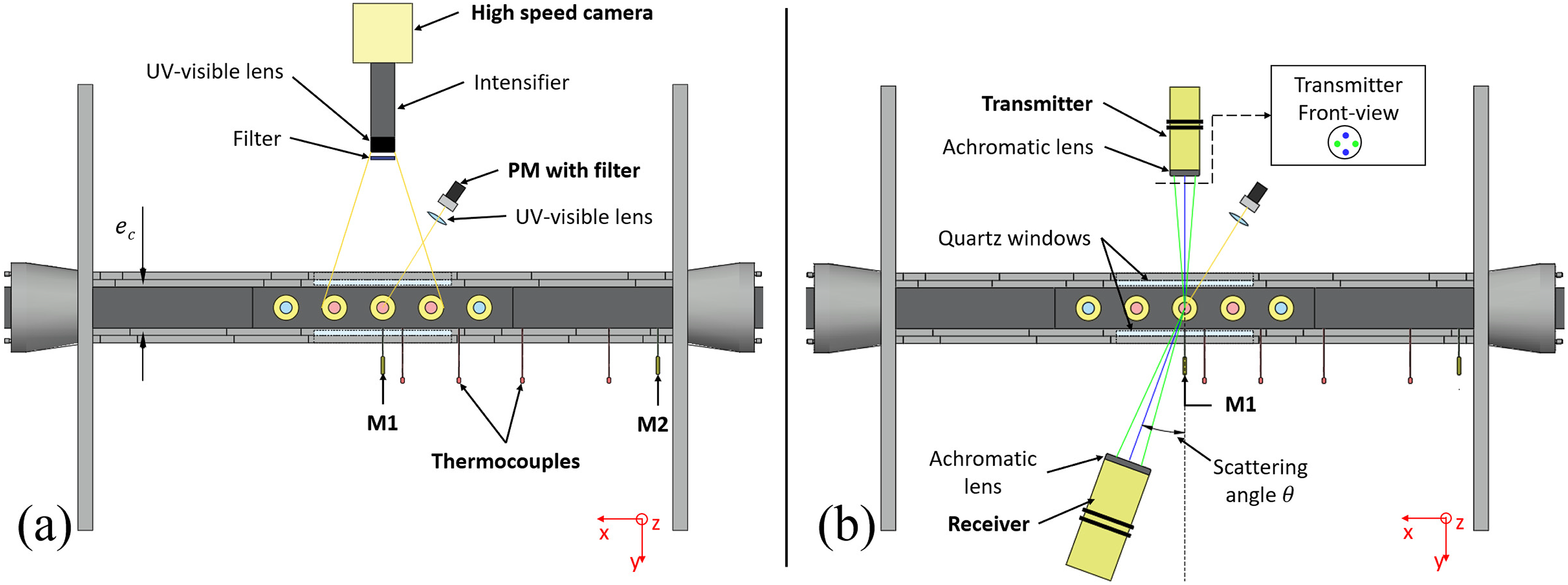
TACC-Spray is equipped with various diagnostics (see Figure 2). Temperature measurements are performed using type K thermocouples flush-mounted on the front walls. Microphones of type 4182 B&K, flush-mounted on the front wall, are used to measure the dynamic pressure inside the chamber. For instance, the microphone M1 in Figure 2 is used to measure the downstream acoustic pressure at the central flame location. It is equipped with a 200 mm probe tube to keep the sensor far away from the heated wall of the chamber. A correction factor is thus applied to the measured pressure signal during postprocessing to consider the phase delay and the amplitude attenuation induced by the microphone tube. The acoustic level is quantified by the reduced acoustic pressure amplitude , where is the root mean square (RMS) value of , the air density, and the air bulk velocity, both calculated at 20°C. The nondimensional parameter evaluates the ratio between the acoustic pressure amplitude and an aerodynamical pressure of reference.
(a) Top view of TACC-Spray showing the high-speed imaging diagnostics and a PM equipped with an OH* filter; (b) the PDA optical diagnostics. M1 and M2: microphones. The convergent unit, placed on top of the cavity during experiments, is not represented here (). PM: photomultiplier; PDA: phase Doppler anemometry.
A photomultiplier (PM) tube equipped with an OH* interference filter (30512 nm) is used to measure the intensity, , of the central flame. Previous investigations8,17,18 established that, for configurations similar to this study, fluctuations in the equivalence ratio are negligible when compared to fluctuations in the volumetric flow rate. Their results showed that the signal calculated based on the ratio of phase-averaged oscillations of CH* to OH* emissions oscillates with an amplitude smaller than %, thereby confirming that equivalence ratio fluctuations remain weak. On this basis, the relative variations in the global heat-release rate can be reliably approximated by the relative fluctuations in OH* emission intensity: . The flame intensity signal is synchronized with the pressure signal using a National Instruments DAQ system at a sampling frequency of about 82 kHz. A high-speed camera (Phantom V2512), equipped with a Lambert HiCATT25 intensifier and a ultraviolet-visible lens, is used to visualize 2D images of the OH* emissions of the three flames. The images are captured with an acquisition rate of 20,000 Hz and an exposure time of 49 s.
A dual PDA system is used to analyze the spray under reactive conditions (see Figure 2 (b)). The diameter of the fuel droplets as well as the three components of the drop velocity, , , and , are measured. The system includes two laser sources with wavelengths of 514.5 and 488 nm, respectively. Each laser emits two beams shifted by 40 MHz, and focused with an achromatic lens of 401.5 mm focal length. The receiver is equipped with an achromatic lens with 500 mm focal length, and placed at 20° with respect to the axis of the transmitter. Measurements were performed at three axial positions above the exit of the central injector: 2.2, 7, and 15 mm. At each height, measurements were taken at about 35 to 85 horizontal locations, the number of which increased with height. The zone of measurement was extended laterally until no droplets were detected, ensuring coverage across the entire spray region at each axial position. Each measurement lasts for 4 s.
Experimental conditions
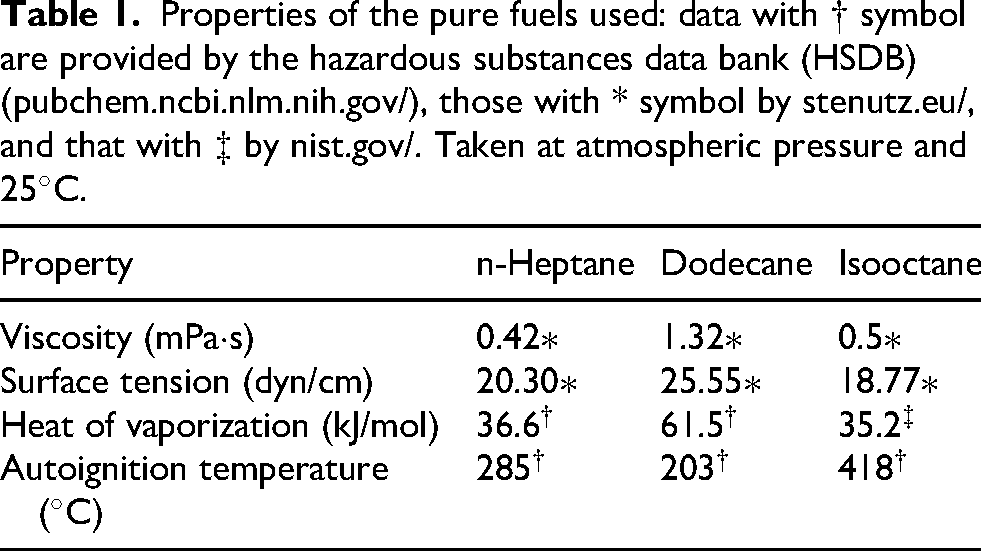
Fuels with different physical and chemical properties are used. First, dodecane and isooctane are chosen as well as a binary mixture of 51.9% of dodecane and 49.1% of isooctane, in molar percentage, considered as a surrogate of SAF according to the work of Dooley et al.13 This mixture will be named “SAF surrogate” in what follows. Dodecane and isooctane notably differ by their chemical and physical properties involved in the fuel evaporation process, but also by their ignition characteristics, both able to impact flame dynamics. The third fuel, n-heptane, is used as a reference due to its physical properties being similar to isooctane, while its chemical reactivity differs. In contrast, n-heptane and dodecane have more comparable ignition characteristics but notable distinct in physical properties. Some selected properties for the three pure fuels are displayed in Table 1.
Properties of the pure fuels used: data with symbol are provided by the hazardous substances data bank (HSDB) (pubchem.ncbi.nlm.nih.gov/), those with * symbol by stenutz.eu/, and that with by nist.gov/. Taken at atmospheric pressure and 25°C.
Property
n-Heptane
Dodecane
Isooctane
Viscosity (mPas)
0.42
1.32
0.5
Surface tension (dyn/cm)
20.30
25.55
18.77
Heat of vaporization (kJ/mol)
36.6
61.5
35.2
Autoignition temperature (°C)
285
203
418
The global equivalence ratio, , is fixed at 0.95, and two flame powers, , are examined, 5.9 and 7.0 kW. Noting that these conditions can lead to unstable operation in the annular combustor MICCA-Spray.9 The resonance frequency, , is around 820 10 Hz, and the downstream acoustic pressure amplitude can reach 1200 Pa (zero-to-peak) at the central flame position.
Flame response to acoustic forcing of SAF surrogate and pure fuels
At PAN, where the downstream pressure oscillations in the chamber are significant, they induce axial flow velocity fluctuations, which generate HRR oscillations.8,19–21 The intensity of the coupling between HRR and downstream pressure oscillations is characterized by the Rayleigh source term, , of the acoustic energy balance. When this equation is integrated over time and over a control volume that includes all the heat release region, the expression of is:
where is a volume comprising the whole heat released, a sufficiently long time interval, the specific heat ratio, the mean gas density, the speed of sound, and and the fluctuations of the local downstream acoustic pressure and volumetric HRR, respectively. When is negative, the energy system is unconditionally stable, while for positive , instabilities may develop if is sufficiently large compared to the acoustic energy losses in the system.22 In the case of an acoustically compact flame with respect to the acoustic modes, the previous expression is simplified as follows:
where is the flame position and the whole HRR delivered by the flame.
The PM signal is used to characterize the dynamic response of the central flame to acoustics. In addition, high-speed images, phase-averaged with the downstream acoustic pressure signal, are used to investigate the flame structure modulation.
Linear and saturation regimes
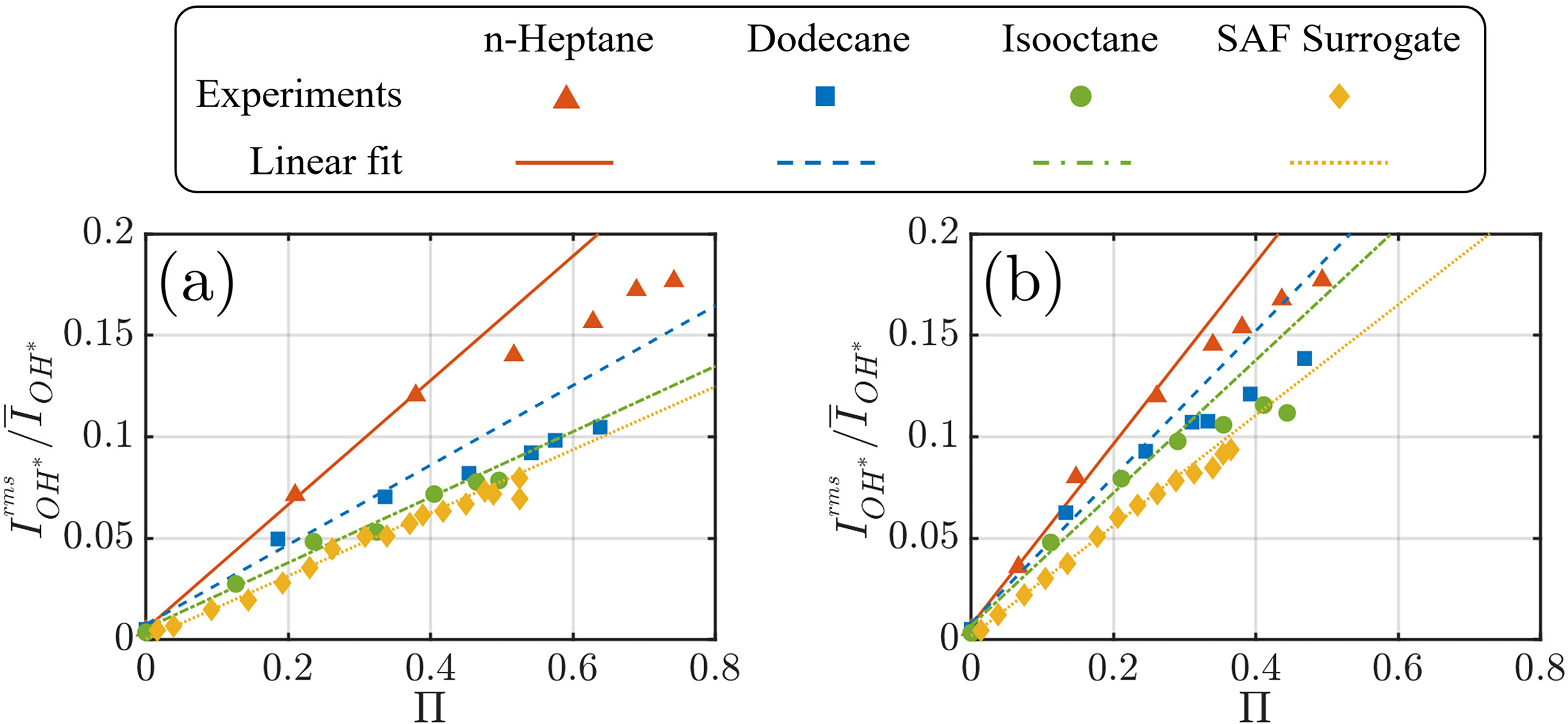
Figure 3 shows the RMS flame intensity signal reduced by the mean value, , plotted as a function of the reduced downstream acoustic pressure amplitude for pure n-heptane, dodecane, and isooctane and the bi-component SAF surrogate, for the two flame powers kW (Figure 3(a)) and kW (Figure 3(b)).
Reduced RMS flame intensity signal , plotted as a function of the reduced downstream acoustic pressure amplitude , for three pure fuels and the bi-component SAF surrogate. The lines correspond to linear fits until . Equivalence ratio , swirl number calculated in reactive conditions at mm. Hz. (a) Flame power kW/flame and (b) kW/flame. RMS: root mean square; SAF: sustainable aviation fuel.
N-heptane has the highest values of , while SAF surrogate has the lowest ones. Intermediate values with pure dodecane and isooctane show no significant difference between them. For the four fuels, the values of are linearly increasing up to with the two flame powers. Beyond this value, the evolution starts to enter into a zone which ensures a transition toward a saturation regime (see Figure 3). This is similar to what was quantified in a previous study by Baillot et al.19 with pure n-heptane, in which , after linearly increasing up to , reached the saturation zone for through a transition zone. In this study, despite the difference in the values of between the four fuels, the associated flame follows almost the same linear and saturation regimes.
Pressure-based FDF
The downstream pressure-based FDF, introduced for spray flames by Baillot et al.,19 can be used to quantify the flame response to acoustic pressure oscillations present in the resonant cavity, as discussed in Patat et al.8 and Alhaffar et al.11 It is defined as follows:
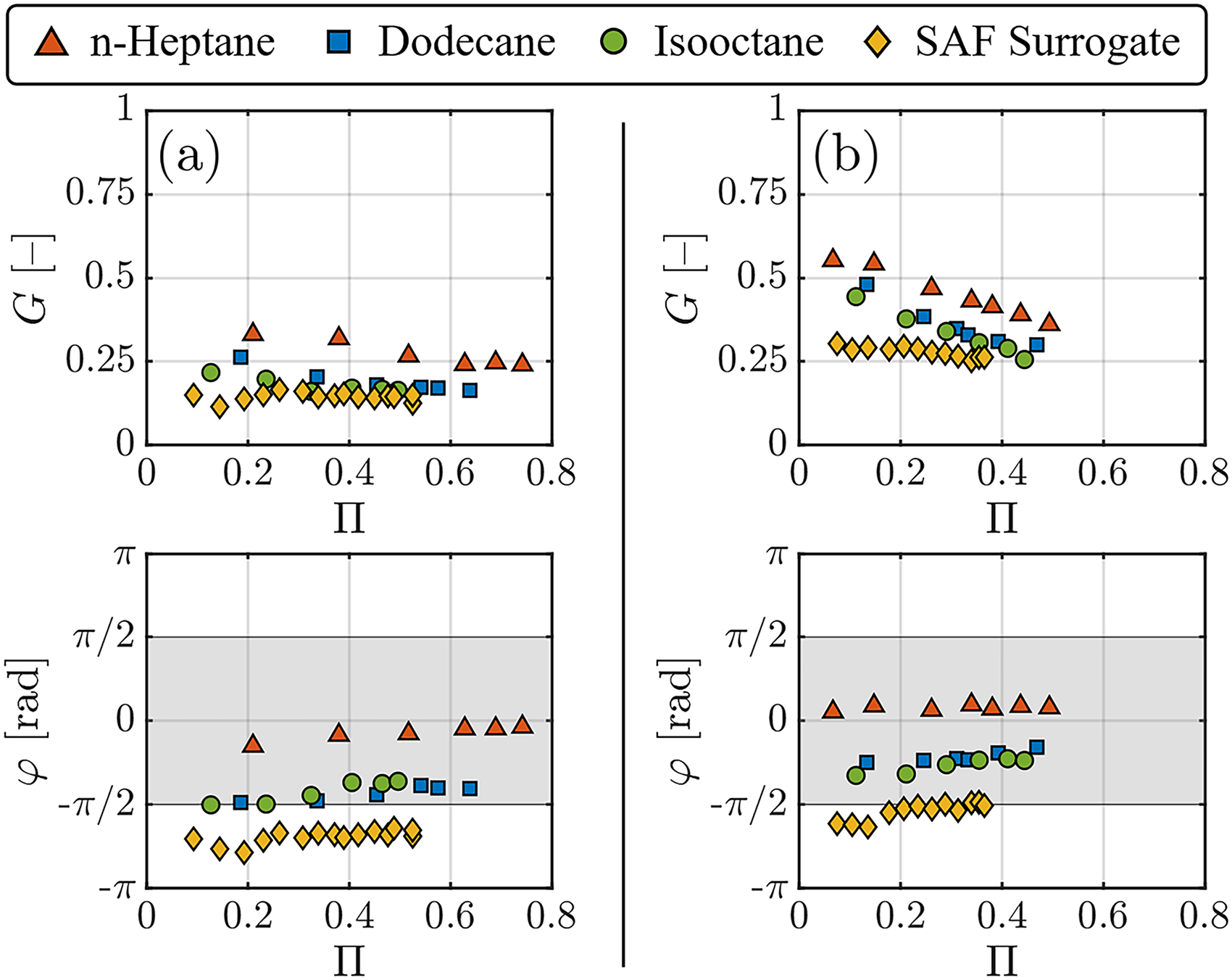
where and are the Fourier transforms of and at the resonance frequency . and are the gain and phase of the FDF, respectively. Figure 4 reports the gain and phase of the FDFs calculated at PAN with the same conditions as in Figure 3. For kW/flame, the gain slightly decreases with n-heptane from 0.4 at to 0.25 at , highlighting the nonlinear behavior of n-heptane’s response. The phase with n-heptane is inside the potential instability range [] according to the Rayleigh criterion, and close to zero, indicating a strong coupling between the HRR and pressure oscillations. The gain values with dodecane and isooctane are very similar and lower than those with n-heptane. They also decrease with , but more slightly, from about 0.27 at to 0.2 at . The corresponding phase angles are inside the potential instability range but close to . This indicates that the instability tendency of n-heptane is higher than that of dodecane and isooctane. The difference between n-heptane and dodecane is consistent with previous studies,9,10 in which the phenomenon was mainly explained by the difference in the evaporation process. For a SAF surrogate, the gain has lower values than its pure constituents and is almost constant with respect to , which highlights a linear response. Its phase is outside the potential instability range, indicating an insignificant thermoacoustic coupling. This indicates that the SAF surrogate is less sensitive to thermoacoustic instabilities than its pure constituents, which is unexpected when comparing to a 50%/50% molar blend of n-heptane and dodecane from a previous study,10 in which the blend exhibited an intermediate response between the pure constituents.
Gain and phase of the downstream pressure-based FDF plotted as a function of the reduced acoustic pressure amplitude . They are calculated with OH* chemiluminescence of the central flame for three pure fuels and the bi-component SAF surrogate. Gray bands: potential instability range predicted by the Rayleigh criterion. Equivalence ratio , swirl number calculated in reactive conditions at mm. (a) kW/flame and (b) kW/flame. Hz. FDF: flame describing function; SAF: sustainable aviation fuel.
For kW/flame, similar trends are observed; however, the increase in the flame power tends toward a more unstable behavior for all fuels. This influence of the augmentation of the flame power is consistent with the results obtained for pure n-heptane by Patat.17 Indeed, the gain values are increased while respecting the same order: n-heptane–dodecane/isooctane–SAF surrogate. The phase angles also fall within the range of potential instability for all fuels, except for the SAF surrogate that remains at the limit of the unstable range. The next section provides an analysis of spray dynamics and evaporation influenced by the type of fuel used.
Spray analysis under reactive conditions
The spray dynamics and evaporation of the central flame are analyzed utilizing PDA measurements performed in the and directions (see Figure 2). The results are shown for 7.0 kW/flame at only two heights above the injector exit, and mm, to grab insights about the evaporation process for each fuel.
Droplet count oscillations and airflow dynamics
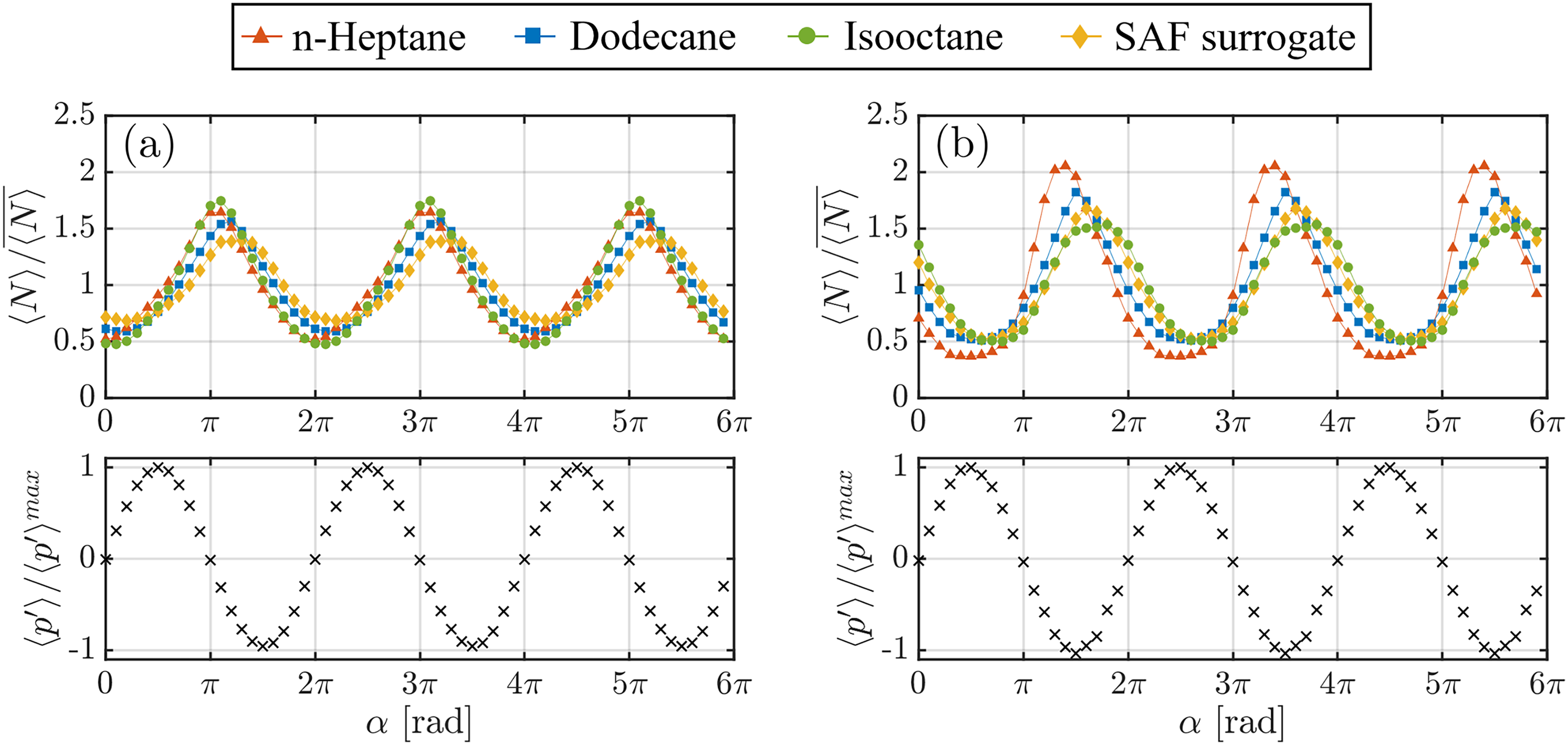
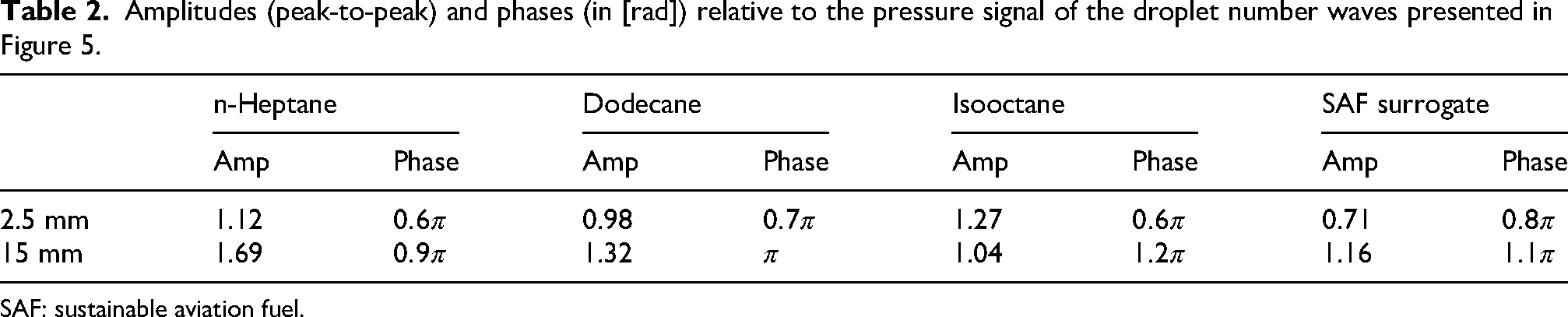
For a given height, the droplet count at each radial measurement is phase-averaged with acoustic pressure, and then the values are summed at each phase angle . The resulting phase-averaged total droplets count is then reduced by the mean value . Data are plotted in Figure 5 for the four fuels and two heights, 2.5 and 15 mm. oscillates during the acoustic cycle, pointing out the presence of droplet count wave induced by downstream pressure oscillations at PAN. At mm, very close to the injector exit, the reduced amplitude (peak-to-peak) of this wave is equal to 1.12 with n-heptane, 0.98 with dodecane, 1.27 with isooctane, and 0.71 with SAF surrogate. They occur with a phase delay of about with the acoustic pressure as reported in Table 2. At mm, for all the fuels expected for isooctane, the wave amplitudes are increased and the nonlinearity of the signal is amplified. They become almost in phase opposition with the acoustic pressure. From droplet count waves measured in the lower region of the flame as here, it has been shown, first, by Patat,17 and then by Alhaffar et al.10 that the maximum amount of fuel is correlated to the maximum of the flame intensity oscillations in the middle flame region, by linearly extrapolating the maxima of the droplet count waves at three heights. Therefore, droplet count oscillations fundamentally participate in the coupling mechanisms between acoustics perturbations and combustion dynamics. Krebbers et al.23 also studied the relation between the number of spray droplets and chemiluminescence of Jet A-1 flames, and they found that the oscillations of the number of spray droplets led to those of the flame chemiluminescence, highlighting the role of the droplet number density in the coupling between the spray and flame chemiluminescence. Despite small differences between the four fuels observed at 15 mm, the formation of the droplet count waves does not appear to vary significantly from one fuel to another. In addition, the droplet velocities (not presented here), shown to be representative of the flow velocity in similar experimental configurations,17 are very much alike for the four fuels. Accordingly, the airflow dynamics can be considered to be independent of the type of fuel used in this study.
Phase-averaged droplet count integrated over the radial positions and normalized by the mean value for the four fuels. (a) mm and (b) mm. kW/flame, , Hz and .
Amplitudes (peak-to-peak) and phases (in [rad]) relative to the pressure signal of the droplet number waves presented in Figure 5.
n-Heptane
Dodecane
Isooctane
SAF surrogate
Amp
Phase
Amp
Phase
Amp
Phase
Amp
Phase
2.5 mm
1.12
0.98
1.27
0.71
15 mm
1.69
1.32
1.04
1.16
SAF: sustainable aviation fuel.
Drop size and volume distributions: Evaporation investigation
The spray characteristics, namely the drop size and volume distribution functions, are investigated at 2.5 and 15 mm above the injector exit of the central flame in order to evaluate the evaporation process submitted to the four fuels. At each height, two sets of measurements are included, one along the -direction and another along the -direction (see Figure 2), to better estimate the droplet size distribution of the entire spray.
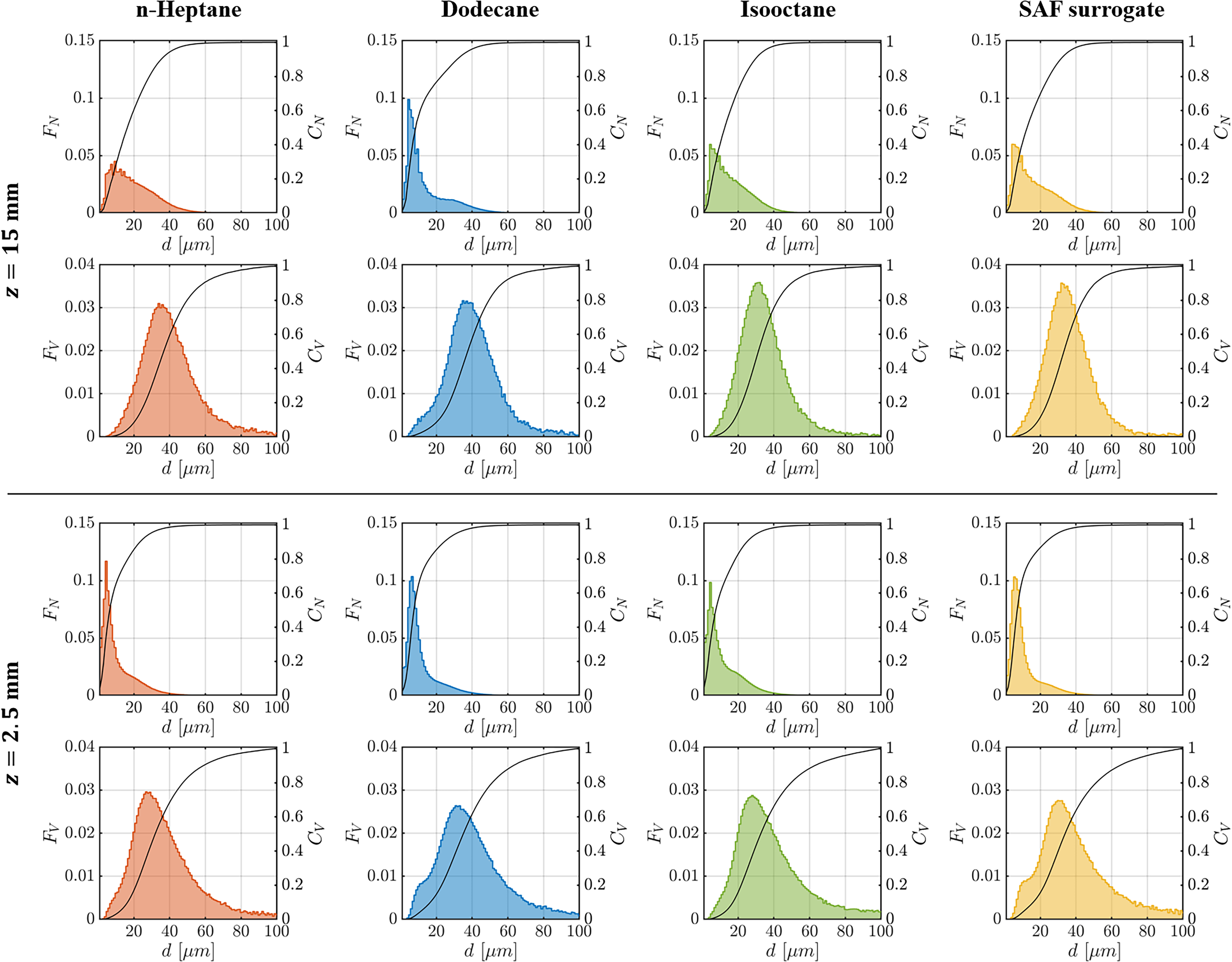
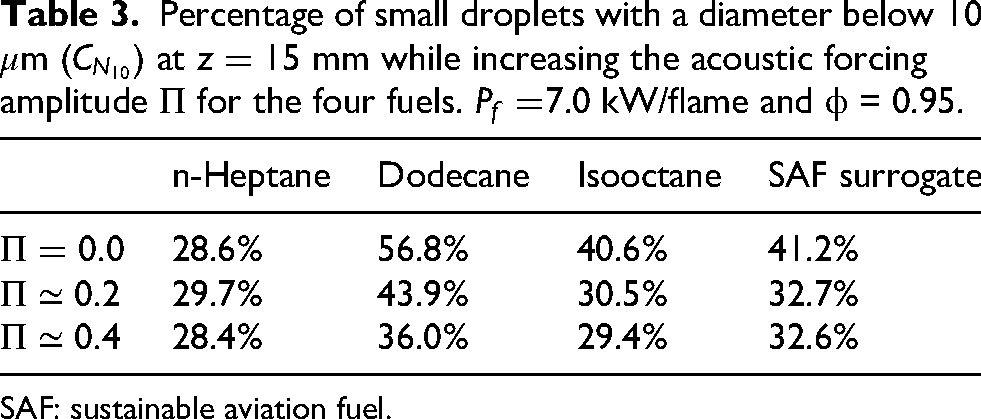
Firstly, the distribution functions, for size and for volume, are established without acoustic forcing. They are presented in Figure 6 with their cumulative functions, and . At mm, shows that the spray consists largely of small droplets with a diameter below 10 m for all the fuels. Indeed, the percentage of droplets with m, named , is 65.5 % with n-heptane, 65.1 % with dodecane, 60 % with isooctane, and 68.1 % with SAF surrogate. However, the volume distributions reveal slightly different bell-shaped functions: n-heptane and isooctane exhibit a single dome bell-shaped distribution with a maximum at around 30 m, while dodecane and SAF surrogate exhibit a first bump at 10 m and a main dome at 35 m. The bump observed at 10 m highlights the higher amount of small droplets with dodecane and SAF surrogate compared to n-heptane and isooctane at the injector exit, and consequently their lower capacity to be evaporated in the early stage. At mm, shows a significant decrease of the small droplets (m) for all the fuels except for dodecane. However, is shifted to the right (toward bigger droplets) for all the fuels, and the bump at 10 m observed at 2.5 mm with dodecane and SAF surrogate has disappeared. The difference observed between distributions at 2.5 and 15 mm highlights the evaporation effects along the downstream direction, especially when comparing with the spray behavior without combustion, recently studied in Alhaffar et al.,24 in which the distributions exhibit higher numbers and volumes of small droplets at 15 mm than at 2.5 mm. The evaporation rate of each fuel can be estimated by the values of at 15 mm. They have diminished significantly with n-heptane to 28.6 %, followed by isooctane and SAF surrogate with 40.6 % and 41.2 % respectively, and moderately with dodecane to 56.8 %. This illustrates the rapid disappearance of small droplets for n-heptane and the slower one for dodecane, pointing out the difference in their evaporation rates. The rate of disappearance of small droplets for isooctane lies between n-heptane and dodecane, and for the SAF surrogate, it lies between dodecane and isooctane. Accordingly, one can expect that the delayed disappearance of small droplets with dodecane and SAF surrogate will lead to combustion occurring at further downstream locations.
Drop size and volume distribution functions, and , with their cumulative functions, and , obtained by PDA under reactive conditions at two heights above the injector exit of the central flame, for three pure fuels and the bi-component SAF surrogate. kW/flame, , and without acoustic forcing (). PDA: phase Doppler anemometry; SAF: sustainable aviation fuel.
Secondly, Table 3 reports the values of at mm for two values of the acoustic forcing amplitude, 0.2 and 0.4, in addition to that without acoustics. The values show that the percentage of small droplets at mm is decreasing while increasing , thus a faster disappearance of the small droplets, and hence a better evaporation. The evaporation efficiency of the binary mixture SAF surrogate lies just between those of its pure constituents, even for high acoustic amplitude. Therefore, it could be stated that the evaporation process plays an essential role in the combustion dynamics, as it can explain the delayed presence of droplet clusters at elevated heights in the flame with dodecane and SAF surrogate. Nonetheless, it cannot explain alone the reduced flame response of the SAF surrogate compared to its pure constituents. This suggests that the ignition capacity is also a significant factor in assessing the dynamical behavior of multicomponent liquid fuels. Variations in ignition delay time, reflecting each fuel’s chemical reactivity, along with differences in evaporation delay, contribute to modifications in flame structure. Consequently, the next section will provide a complementary analysis of how a flame structure is influenced by fuel composition.
Percentage of small droplets with a diameter below 10 m () at mm while increasing the acoustic forcing amplitude for the four fuels. 7.0 kW/flame and ϕ = 0.95.
n-Heptane
Dodecane
Isooctane
SAF surrogate
28.6%
56.8%
40.6%
41.2%
29.7%
43.9%
30.5%
32.7%
28.4%
36.0%
29.4%
32.6%
SAF: sustainable aviation fuel.
Flame structure and dynamics
The flame dynamical structure is analyzed by capturing 6,000 images of the OH* emissions of the central flame at a rate of 20,000 frames/s.
Flame shape modulations
Figure 7 shows Abel-inverted images of the central flame after time-averaging or phase-averaging with the acoustic pressure signal. The results are given for pure n-heptane, dodecane, and isooctane, and for the SAF surrogate for a flame power of 7.0 kW, for which the FDF gain and phase values show the greatest difference between the four fuels. The illustration is presented for the acoustic pressure amplitude , , , and , respectively, for n-heptane, dodecane, isooctane, and SAF surrogate. From each instantaneous image, the flame length is estimated by means of a thresholding technique based on Otsu’s method. The threshold value is set to 70% of the value computed by Otsu’s algorithm. The mean flame lengths, , are then computed from these data.
Abel-inverse transform of the OH* high-speed images (20 kHz) for three pure fuels and one bi-component sustainable aviation fuel (SAF) surrogate. First column: mean images. Second to fifth columns: phase-averaged images at the corresponding phase angle . kW/flame, , Hz, and forcing amplitude , , , and , respectively, for n-heptane, dodecane, isooctane, and SAF surrogate.
Starting with the mean images (first column of Figure 7), one can observe that the mean flame length is higher with SAF surrogate (61.4 mm) and isooctane (54.7 mm), than with dodecane (53.2 mm) and n-heptane (48.6 mm). The fact that with dodecane is higher than the one with n-heptane can be explained by the slower evaporation of dodecane, as shown in the previous section. Once dodecane is evaporated, its mixture with air can ignite easily. However, isooctane, which has an evaporation rate very close to that of n-heptane, is characterized by a longer flame length than that obtained with dodecane. To understand this phenomenon, it is not enough to take the rate of evaporation into account. Chemical reactivity, in particular characterized by fuels’ ignition capacity reflected by ignition delay and autoignition temperature, can introduce dynamical differences in the flame response to acoustics. Indeed, the literature on ignition delay times supports this approach. For instance, Vasu et al.25 report that dodecane exhibits ignition delays of 1 ms maximum even at relatively low temperatures (700 K). In contrast, data from Zheng et al.26 indicate that isooctane has significantly longer ignition delays, exceeding 10 ms at around 850 K. Although Seiser et al.27 showed that n-heptane ignites slightly more slowly than dodecane, with delays mostly ranging between 1 and 10 ms, its high evaporation rate can counterbalance it. Concerning the SAF surrogate, being a mixture of dodecane and isooctane, it can be expected that, in a reasonable manner, its evaporation is slower than isooctane, and its ignition capacity is smaller than that of dodecane, and therefore the consecutive evaporation, mixing, and ignition processes are considerably delayed, leading to an even longer flame. An interesting manner to synthesize this analysis into a single quantity is to introduce the autoignition temperature of the fuels, since these trends align well with the differences inferred from the autoignition temperature values.
The phase-averaged images show that the central flame, located at a PAN, is traveled by a convective longitudinal wave induced by downstream pressure oscillations at the injector exit.19 Despite the overall similarities, the local distribution of the flame intensity oscillation along the direction depends on each fuel. A quantitative analysis is performed in the following section.
Local flame intensity oscillations
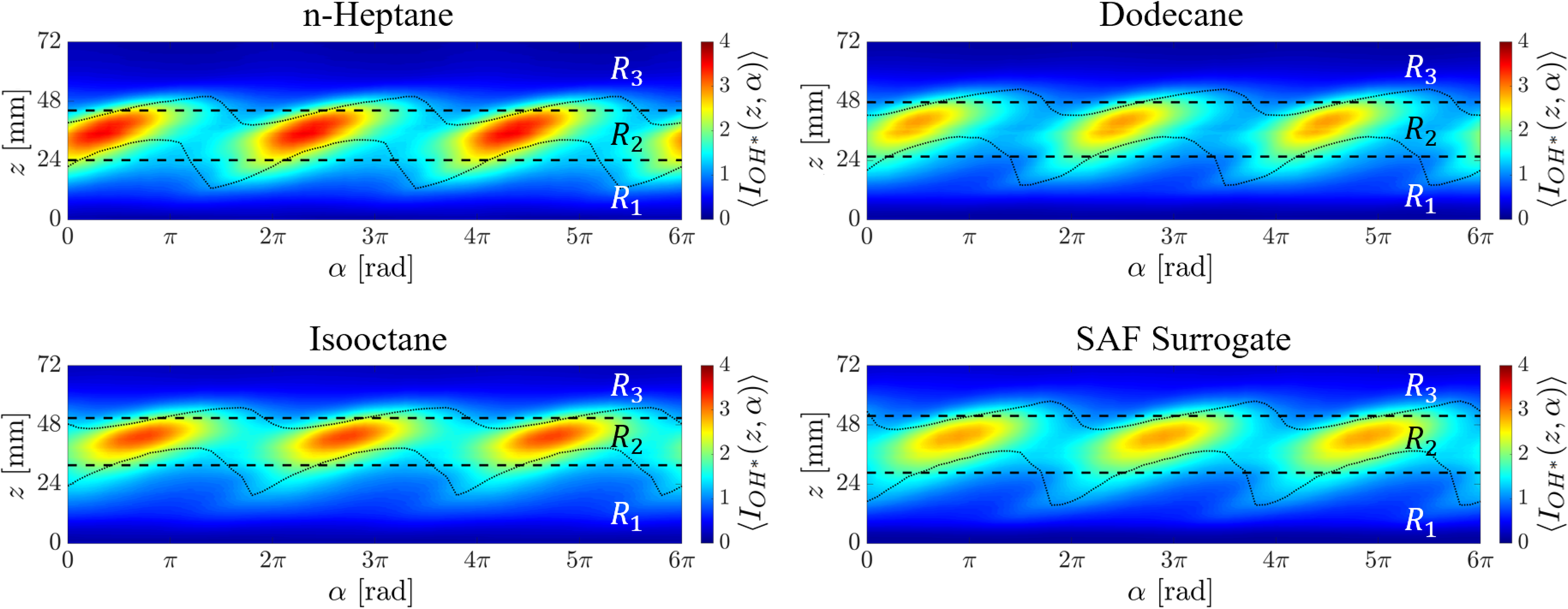
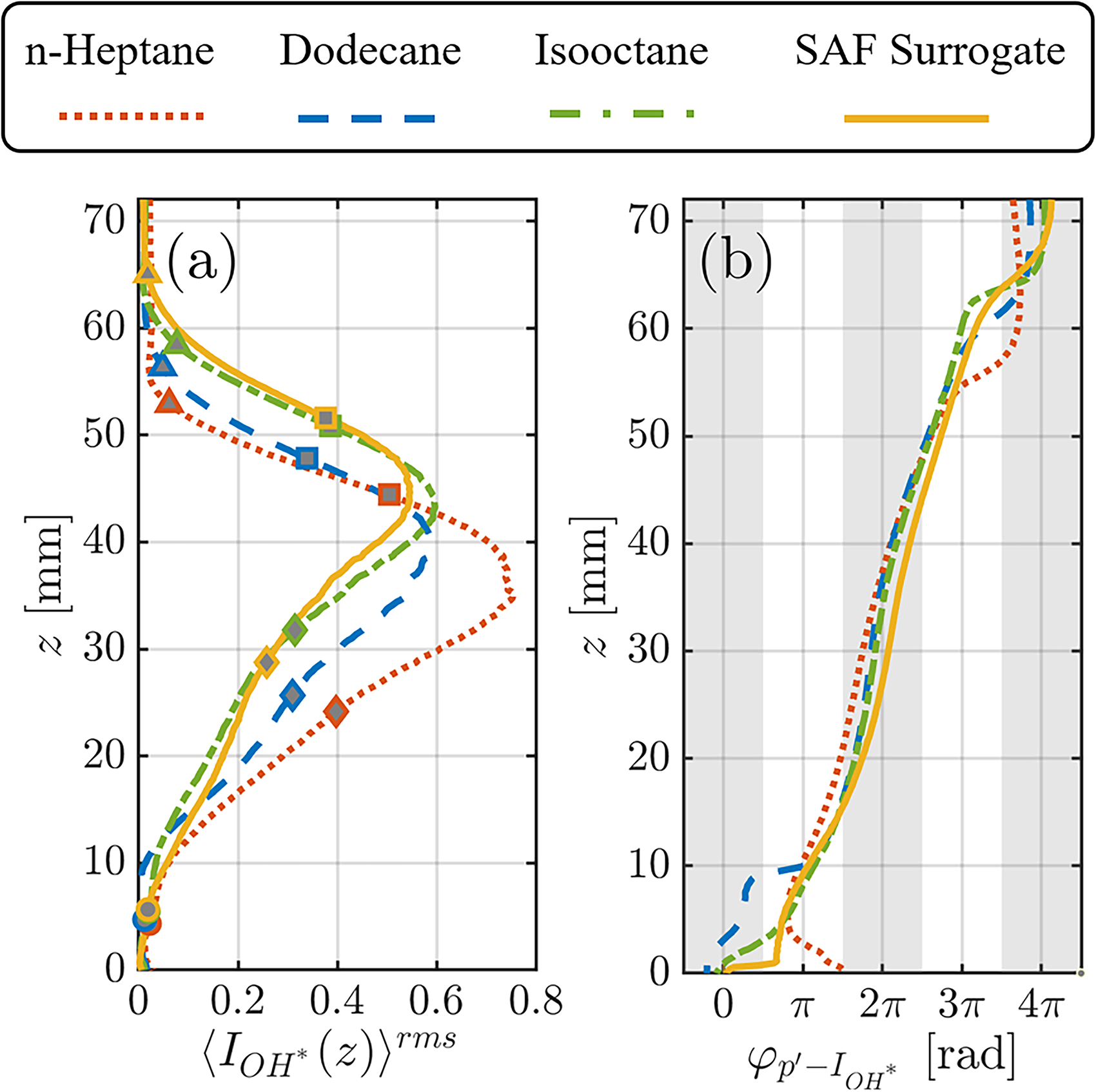
The OH* flame intensity from the phase-averaged images is integrated along the -direction, giving a signal that depends only on and time. The maps of are plotted three times for clarity. This approach has been adopted in previous studies to characterize local flame dynamics, either experimentally by using chemiluminescence imaging10,17 or with numerical simulations.28 The results are presented in Figure 8 for the four fuels and for the conditions specified in the caption. The dotted curves represent iso-contours at 65% of the local maximum flame intensity oscillations, while the dashed lines correspond to their average values, delineating the flame image into three regions: lower region , middle region , and upper region . The method is proposed by Patat.17 The middle region encompasses the peak flame intensity oscillations and is thus considered to be the dominant contributor to the global flame response. In consistency with Figure 4, it is shown that for n-heptane the amplitude of the oscillations in is the highest and occurs in phase with the acoustic pressure (whose maximum is located at ), while dodecane and isooctane exhibit similar but lower amplitudes than n-heptane, with a phase delay of approximately . The SAF surrogate presents the lowest amplitude and a higher phase delay, close to . The difference in their amplitude is also quantified by means of the RMS value calculated at each and reported in Figure 9(a). Indeed, the maximum of with n-heptane is higher than the ones with dodecane and isooctane, and 28% higher than the one with SAF surrogate. The border limits between regions , , and are also indicated. Circle symbols represent the mean stand-off distance of the flame, which gives the beginning of . Triangle symbols represent the top of the flame, namely the end of . Obtained using the above method, the lower and upper limits of , corresponding, respectively, to the upper limit of , namely , and the lower limit of , are indicated by diamonds for the former and squares for the latter. indicates the lowest axial position where significant oscillations are observed.
Phase-averaged local flame OH* intensity integrated along the -direction , reproduced three times for clarity. The dotted curves represent iso-contours at 65% of the local maximum intensity oscillations. The dashed lines represent their average values and separate the flame image into three regions, , , and . kW/flame, , Hz and forcing amplitude , , , and , respectively, for n-heptane, dodecane, isooctane, and sustainable aviation fuel (SAF) surrogate.
(a) RMS of phase-averaged flame intensity integrated along -direction . Symbols: circles indicate the beginning of , diamonds indicate the end of and the beginning of , squares indicate the end of and the beginning of , and triangles indicate the end of . (b) Phase difference between pressure signal and . Gray bands: potential instability range predicted by the Rayleigh criterion. kW/flame, , Hz, and , , , and , respectively, for n-heptane, dodecane, isooctane, and SAF surrogate. RMS: root mean square; SAF: sustainable aviation fuel.
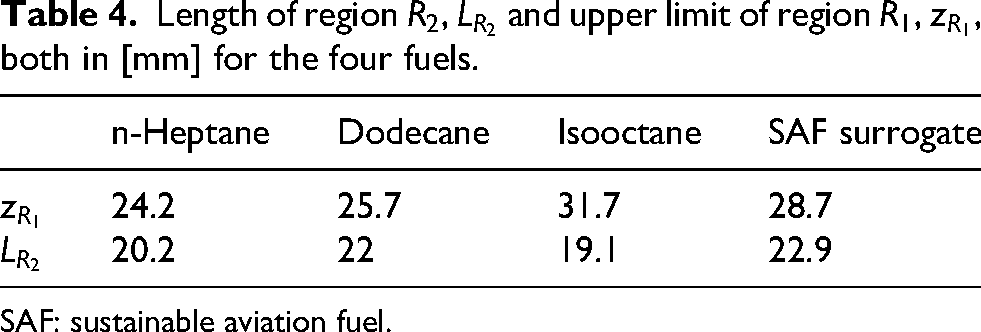
Coupled to the value of , an important feature is how the length of region , varies with the fuel. Both of them are reported in Table 4. N-heptane exhibits the lowest position, followed by dodecane, while isooctane shows the highest. The SAF surrogate lies between dodecane and isooctane. Interestingly, region is longer for the SAF surrogate than for dodecane and isooctane. Given that the surface areas under the curves of these three fuels are similar, this suggests that the flame is more axially distributed with SAF surrogate for the same power. Moreover, compared to n-heptane, is shifted downstream for both dodecane and isooctane, resulting in fewer points within the Rayleigh instability band, noticeable in Figure 9. For the SAF surrogate, with a longer flame length and a higher , its region is characterized by even fewer points in the instability band. These findings highlight the critical role of region and the downstream position at which it occurs, , in determining the dynamic response of the flame to acoustic perturbations. As expected, this agrees with the behavior of the flame length, . Indeed, increasing flame length implies that the convective wave requires more time to traverse the flame. This increased transit time can introduce a phase lag between the flame’s response and the acoustic oscillations, thereby weakening the HRR oscillations in region , as observed. Similarly, this observation is consistent with the results from the pressure-based FDFs.
Length of region , and upper limit of region , , both in [mm] for the four fuels.
n-Heptane
Dodecane
Isooctane
SAF surrogate
24.2
25.7
31.7
28.7
20.2
22
19.1
22.9
SAF: sustainable aviation fuel.
By examining now the shape of profiles in Figure 9(a), one can observe in region that the axial growth rate in flame intensity, represented by the increasing slope of the curve, is the highest with n-heptane and the lowest with SAF surrogate. Additionally, the shape of the profiles reveals distinct characteristics: for n-heptane, the growth is quasi-linear, resulting in a single-peaked, bell-shaped curve. In contrast, the profiles for dodecane, isooctane, and the SAF surrogate exhibit a preliminary small bump before the maximum of the bell-shaped curve is reached, indicative of a nonlinear growth. This difference in shape might be attributed to fuel-specific delays in evaporation and ignition processes. For dodecane, the initial bump observed around mm could be linked to the rapid ignition of a limited number of small droplets that evaporate early. In the case of isooctane, the smaller bump at the same axial location could be associated with a delay in ignition of quickly evaporated small droplets. For the SAF surrogate, the bump near mm persists longer before leading to a significant increase in flame intensity, reflecting a compounded delay in both evaporation and ignition processes. As a result, the SAF surrogate exhibits a lower peak that is also shifted downstream. The decay rate, represented by the decreasing slope of the curve in region , appears similar across all fuels, likely due to similar velocities of the convective wave , where m/s is the bulk velocity. The convective velocity is estimated from the linear evolution of in Figure 9(b) for each fuel.
Finally, it is worth mentioning that regions and oscillate in phase opposition for the four fuels, indicating the presence of destructive interference between the oscillations of the lower and upper parts of the flame. Region is thus identified as the effective part of the flame, whose size is quite compact compared to the convective wavelength, as it can be evaluated by an effective Strouhal number.17,29,30 Indeed, is equal to 0.35, 0.38, 0.33, and 0.39, for n-heptane, dodecane, isooctane, and SAF surrogate, respectively.
Involved mechanisms: Evaporation and ignition characteristics
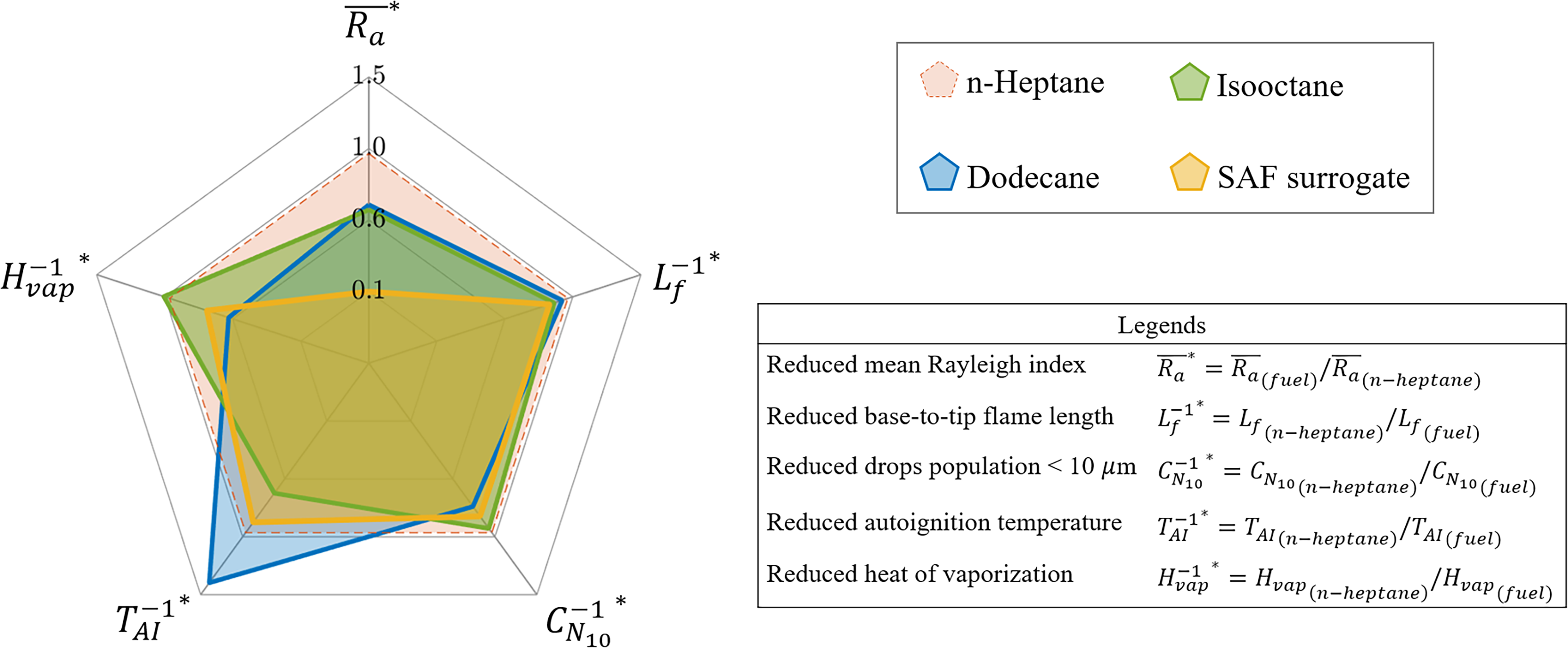
The main elements established in this study, characterizing mechanisms involved in the thermoacoustic coupling, are used here to summarize the behavior of each fuel. Figure 10 presents a radar chart of comparison including two key fuel properties taken at atm and 25°C, namely the heat of vaporization and the autoignition temperature, , together with the mean flame length, , the percentage of small droplets (with m) at 15 mm, , and a dimensionless mean Rayleigh index, , all three evaluated with acoustics for . is defined on the basis of equation (2) and previously introduced in Patat et al.8 and Alhaffar et al.11 as:
A radar chart summarizing three key results taken for kW/flame, , mm, and , along with two fuel properties. Details on the calculation of reduced values are given in the legends.
All the quantities are reduced with the ones obtained with n-heptane. The reduced quantities are denoted with superscript “*”. Except , the chart uses their inverses, that are, , , , and , such that the higher values of the reduced parameters might lead to higher instability tendency. A chart is drawn for given operating conditions: equivalence ratio , acoustic amplitude , and flame power . An illustration is reported in Figure 10 for , , and kW/flame.
The radar chart of fuels compared to n-heptane can give an understanding of their dynamical responses to acoustics: (i) isooctane has a quasi-similar heat of vaporization but a lower autoignition capacity, which leads to a quasi-similar quantity of small droplets at mm with a longer flame height. This results in a lower thermoacoustic coupling, or a lower Rayleigh index. (ii) The heat of vaporization of dodecane is higher than those of n-heptane and isooctane, leading to a higher amount of small droplets at 15 mm (giving that they had almost the same value of at mm); however, its high autoignition capacity results in a medium flame height between those of n-heptane and isooctane. This could compensate for its potential very low response, resulting in a Rayleigh index very similar to that of isooctane. (iii) The heat of vaporization of SAF surrogate is in-between those of its pure constituents, which leads to an important amount of small droplets compared to the one with n-heptane. In addition, its resulting intermediate to low autoignition capacity further increases the flame height, and consequently results in a very low thermoacoustic coupling interpreted by the very low Rayleigh index.
Conclusion
Due to their multicomponent composition, liquid fuels are particularly challenging in thermoacoustic instability analysis. In such a context, an experimental study is performed to understand the dynamic response of a two-component SAF surrogate, composed of 51.9% of dodecane and 49.1% of isooctane in molar percentage. This is achieved by utilizing the TACC-Spray setup, an externally modulated linear combustor equipped with three swirling spray flames. The results of the so-called SAF surrogate are compared with those of its pure constituents, dodecane and isooctane, as well as with n-heptane chosen as a reference fuel for comparison. The principle outcomes are outlined here:
The values of the gain and phase of the downstream pressure-based FDFs indicate that isooctane and dodecane exhibit a lower instability tendency than n-heptane, and the SAF surrogate response is even weaker than that of its pure constituents.
The PDA measurements reported that the droplets take longer to disappear with dodecane, populating the drop size distribution with more small droplets downstream. This emphasizes its low evaporation rate. While evaporation is identified as a key mechanism governing the flame dynamics of multicomponent liquid fuels, it cannot explain the low response of isooctane or the even lower one of the SAF surrogate.
High-speed chemiluminescence imaging of OH* radicals provided further evidence of differences in flame structure. The SAF surrogate flame is found to be longer than those of dodecane, isooctane, and n-heptane. This elongation of the flame correlates with a decrease in the flame response to acoustic perturbations. The region of local maximum flame intensity oscillations is found to be weaker and shifted downstream with dodecane and isooctane compared to n-heptane. With the SAF surrogate, this region is even more attenuated and axially distributed, reinforcing the observation of its diminished response to acoustics.
The difference in flame structure and response of the individual fuels can be attributed to different controlling mechanisms: for dodecane, it is explained by an evaporation delay, while for isooctane, it is attributed to a delay in ignition. SAF surrogate exhibits a combined effect of delayed evaporation and ignition.
Footnotes
Acknowledgements
The authors thank the technical support provided by the RENADIAG platforms of CORIA.
ORCID iDs
A. Alhaffar
J.-B. Blaisot
Funding
The authors disclosed receipt of the following financial support for the research, authorship, and/or publication of this article: This work was funded by the French National Research Agency (ANR) through the project FlySAFe (ANR-22-CE05-0022) and the Normandy Region.
Declaration of conflicting interests
The authors declared no potential conflicts of interest with respect to the research, authorship, and/or publication of this article.
References
1.
J. BrunoTD. LaeseckeAL. OutlastS, et al. Properties of a 50/50 Mixture of Jet-A + S-8, NIST Interagency/Internal Report (NISTIR) - 6647, 2007
2.
ShastryVRiberEGicquelL, et al.Large eddy simulations of complex multicomponent swirling spray flames in a realistic gas turbine combustor. Proc Combust Inst2023; 39: 2693–2702.
3.
BonanniMIhmeM. Interaction of preferential evaporation and low-temperature chemistry in multicomponent counterflow spray flames. Proc Combust Inst2023; 39: 2565–2573.
4.
SekularacNLesaffreTLaeraD, et al.Large eddy simulations of n-heptane and n-dodecane binary blends in swirling multi-component spray flames. Proc Combust Inst2024; 40: 105201.
5.
HodgeAJShahinTTGejjiRM, et al.Fuel temperature effects on combustion stability of a high-pressure liquid-fueled swirl flame. J Propul Power2025; 41: 53–63.
6.
Rajendram SoundararajanPVignatGDuroxD, et al.Effect of different fuels on combustion instabilities in an annular combustor. J Eng Gas Turbine Power2021; 143 : 031007.
7.
PatatCBlaisotJBDominguesE, et al.Response of a spray of n-heptane or dodecane at an acoustic pressure antinode in reactive conditions. In: International conference on liquid atomization and spray systems (ICLASS), Edinburgh, Scotland, 29 Aug - 02 Sept, 2021.
8.
PatatCBlaisotJBDominguesE, et al.Response of n-heptane and dodecane swirl-stabilized spray flames to transverse forcing characterized by flame describing functions based on downstream acoustic pressure or velocity signals. J Eng Gas Turbine Power2025; 147: 041029 .
9.
LatourVDuroxDRajendram SoundararajanP, et al.Effects of fuel composition on azimuthal combustion instabilities in an annular combustor equipped with spray injectors. In: ASME turbo expo 2023: Turbomachinery technical conference and exposition. Volume 3A: Combustion, fuels, and emissions, Boston, Massachusetts, USA, June 26–30, 2023, p. V03AT04A023. New York, NY: ASME.
10.
AlhaffarAPatatCBlaisotJB, et al.Effect of two-component liquid fuel mixtures on the dynamics of a swirl-stabilized spray flames array subjected to a forced transverse acoustic mode. Proc Combust Inst2024; 40: 105566.
11.
AlhaffarALatourVPatatC, et al.Comparison of pressure-based flame describing functions measured in an annular combustor under self-sustained oscillations and in an externally modulated linear combustor. Proc Combust Inst2024; 40: 105249.
12.
LatourV. Investigation of combustion instabilities in annular systems combining symmetry breaking experiments, systematic flame describing function measurements and reduced-order modeling. Université Paris-Saclay, Gif-sur-Yvette, 2025.
13.
DooleySWonSHJahangirianS, et al.The combustion kinetics of a synthetic paraffinic jet aviation fuel and a fundamentally formulated, experimentally validated surrogate fuel. Combust Flame2012; 159: 3014–3020.
14.
PatatCBaillotFBlaisotJB, et al.Swirling spray flames dynamical blow out induced by transverse acoustic oscillations. Proc Combust Inst2023; 39: 4651–4659.
15.
CaceresMBaillotFDominguesE, et al.New experimental setup for thermoacoustic instabilities investigation in two-phase flow swirled combustion. In: 8th European combustion meeting, Dubrovnik, Croatia, 18-21 April 2017.
16.
CaceresM. Impact of transverse acoustic modes on a linearly arranged two-phase flow swirling flames. Normandie Université, Rouen, 2019.
17.
PatatC. Mechanisms of combustion dynamics of swirl-stabilised spray flames in a standing transverse acoustic field. Normandie Université, Rouen, 2022.
18.
Rajendram SoundararajanPDuroxDRenaudA, et al.Swirler effects on combustion instabilities analyzed with measured FDFs, injector impedances and damping rates. Combust Flame2022; 238: 111947.
19.
BaillotFPatatCCaceresM, et al.Saturation phenomenon of swirling spray flames at pressure antinodes of a transverse acoustic field. Proc Combust Inst2021; 38: 5987–5995.
20.
KaufmannANicoudFPoinsotT. Flow forcing techniques for numerical simulation of combustion instabilities. Combust Flame2002; 131: 371–385.
21.
BellowsBDNeumeierYLieuwenT. Forced response of a swirling, premixed flame to flow disturbances. J Propul Power2006; 22: 1075–1084.
KrebbersLMohammadnejadSRostamiA, et al.Relations between the number of spray droplets and chemiluminescence for jet A-1 flames stabilized in a gas turbine model combustor. Combust Flame2023; 257: 113016.
24.
AlhaffarAKhanMABlaisotJB, et al.Influence of swirl number on combustion instabilities through potential modification in spray characteristics. In: 12th European combustion meeting, Edinburgh, Scotland, 7th-10th April 2025.
25.
VasuSDavidsonDHongZ, et al.n-dodecane oxidation at high-pressures: Measurements of ignition delay times and OH concentration time-histories. Proc Combust Inst2009; 32: 173–180.
26.
ZhengJMillerDLCernanskyNP. A global reaction model for the HCCI combustion process. SAE Technical Paper Series, 2004.
27.
SeiserRPitschHSeshadriK, et al.Extinction and autoignition of n-heptane in counterflow configuration. Proc Combust Inst2000; 28: 2029–2037.
28.
VignatGLo SchiavoELaeraD, et al.Dynamics of spray and swirling flame under acoustic oscillations: A joint experimental and LES investigation. Proc Combust Inst2021; 38: 6015–6024.
KimDLeeJGQuayBD, et al.Effect of flame structure on the flame transfer function in a premixed gas turbine combustor. J Eng Gas Turbine Power2009; 132: 021502.