







Abstract
Background
Nurses’ infection control practices are crucial for managing infectious diseases like coronavirus disease 2019 (COVID-19). While various factors influence these practices, they may be mediated by nurses’ intention to provide care. Research on intention-based factors remains limited. This study aimed to identify factors influencing infection control practices based on nurses’ intention to care for COVID-19 patients.
Methods
This cross-sectional study surveyed 240 nurses from three general hospitals in Korea in March 2021 regarding individual and environmental factors. Multiple regression analyzed predictors of infection control practices based on care intention levels.
Results
The findings revealed distinct influencing factors based on nurses’ intention levels. Among nurses with high care intention, individual factors were predominant: COVID-19-related infection control awareness (β = .449, p < .001) and psychosocial stress (β = -.271, p = .012) were significantly associated with their practices. In contrast, for nurses with moderate intention, both individual and environmental factors were significant: infection control awareness (β = .362, p < .001) and the availability of negative pressure rooms (β = .224, p = .042) played key roles.
Conclusion
Factors influencing infection control practices vary depending on nurses’ care intention. Specifically, strategies should focus on maintaining awareness and managing stress for nurses with high intention, while enhancing environmental support and infrastructure is more effective for those with moderate intention. These results emphasize the need for tailored, multi-level interventions—integrating both individual and environmental strategies—to sustain effective infection control during infectious disease outbreaks.
Keywords
Introduction
The coronavirus disease 2019 (COVID-19) pandemic prompted global healthcare system changes, including strengthened infection control guidelines and reorganizations such as isolation wards (Cutler, 2023; Wu and Ho, 2022). Despite the transition to a post-pandemic phase, the continued spread of COVID-19 and the risk of other emerging infectious diseases necessitate ongoing adherence to standard precautions, personal protective equipment use, and environmental controls (CDC, 2024; WHO, 2021). Among healthcare professionals, nurses play a central role in preventing healthcare-associated infections. Their adherence to proper practices directly impacts patient safety, reduces healthcare costs, and protects the workforce (Hessels et al., 2023; Tchouaket Nguemeleu et al., 2020; Wilson, 2021). A meta-analysis reported that nosocomial infections accounted for 44.0% of confirmed COVID-19 cases during the early phase of the pandemic, and 33.0% of these cases involved healthcare workers, with nurses and physicians comprising the majority of the infected staff (Zhou et al., 2020). These high infection rates highlight the significant vulnerability of frontline nurses and underscore the urgent need to optimize their compliance with safety protocols. Consequently, research on factors affecting infection control practices has been consistently progressing (Assis et al., 2021; M. H. Lee and Jun, 2022; Shim and Kim, 2024).
Various individual and environmental factors influence infection control practices among nurses (Russell et al., 2021; Shim and Kim, 2024). Studies have identified individual factors such as knowledge, attitudes, and psychological characteristics—including fear and anxiety—alongside environmental or organizational factors such as safety climate, material availability, and time pressure as significant predictors of compliance (Apisarnthanarak et al., 2020; Assis et al., 2021; M. H. Lee and Jun, 2022; Saqlain et al., 2020). Therefore, a comprehensive analysis must account for this interplay between personal awareness and work-related variables.
While many factors affect infection control practices, one of the critical considerations is healthcare workers’ behavioral intention (Fitria et al., 2023). The theory of planned behavior suggests that intention is the most proximal determinant of behavior, mediating the influence of attitude, subjective norms, and perceived control on action (Ajzen, 1991; Godin et al., 2008). In the context of healthcare, healthcare workers’ intentions influence a wide range of clinical behaviors, including adherence to infection control protocols, hand hygiene compliance, use of personal protective equipment, and integration of new clinical practices (Mutsonziwa et al., 2024). Numerous previous studies have demonstrated that when healthcare workers have strong intentions to comply with guidelines, their actual compliance rates are significantly higher, whereas weak or ambivalent intentions often translate into inconsistent or poor practice (Ajzen, 1991; Godin et al., 2008; Mutsonziwa et al., 2024).
Therefore, this study aimed to identify factors related to infection control practices based on nurses’ intention to care for patients with COVID-19. This study may provide foundational data on infection control practices for managing future emerging infectious diseases. Furthermore, in the ongoing post-pandemic era, examining intention-based factors is crucial for developing tailored interventions for sustainable infection control.
Methods
Study design and setting
This study employed a descriptive, cross-sectional design. Data were collected from March 9 to 19, 2021, from nurses working at three general hospitals with over 100 beds in Gyeonggi Province, Korea. All participating institutions had designated COVID-19 wards and screening clinics. According to the Korean Medical Service Act, general hospitals are defined as medical institutions with 100 or more beds and multiple medical departments.
Participants and recruitment
Participants were recruited using a self-administered questionnaire distributed to nurses via the nursing departments of each hospital. Prior to recruitment, permission was obtained from the nursing departments, and the researcher distributed the questionnaires through hospital wards. Participation was voluntary, and nurses provided individual informed consent before completing and anonymously returning the questionnaires. Inclusion criteria were: (1) registered nurses currently engaged in direct patient care and (2) employed at hospitals with ≥100 beds. Exclusion criteria were: nurses working in administrative roles, temporary staff, or pool nurses. This approach reduced heterogeneity and enhanced internal validity. The sample size was calculated using G-power 3.1 with an effect size of 0.15, a significance level of 0.05, and a power of 0.95, resulting in a minimum of 199 participants (Faul et al., 2009). Considering a dropout rate of 20%, 250 questionnaires were distributed. After excluding six inappropriate responses and four non-responses, data from 240 participants were analyzed (final response rate: 96%).
Variables and measurements
The questionnaire assessed individual factors (age, sex, intention to care for patients with COVID-19, COVID-19-related infection control awareness, psychosocial stress, and COVID-19 infection control practices), and work-related factors (total clinical experience, work department, and experience in caring for patients with COVID-19, experience working in a COVID-19 screening clinic, and the availability of negative pressure rooms). Intention to care for patients with COVID-19 was measured by asking the question, “Are you willing to provide care for patients diagnosed with emerging infectious diseases such as COVID-19?” Participants were categorized into three groups (high, moderate, and low) based on their responses. This measurement approach is consistent with previous research indicating that behavioral intention can be validly and pragmatically assessed using a brief direct question, as supported by Fishman et al. (Fishman et al., 2020). This approach also aligns with the Theory of Planned Behavior (Ajzen, 1991), which conceptualizes intention as the most proximal determinant of behavior. To reflect the categorical nature of the variable, stratified regression analyses were conducted across these groups. The infection control awareness tool, originally developed by Kim for Ebola infection control awareness (Kim and Choi, 2017), was adapted to suit COVID-19 infection control awareness. This tool consists of 13 items rated on a 4-point Likert scale as follows: 1 = not important at all, 2 = not important, 3 = important, and 4 = very important. Higher scores indicate higher levels of awareness. The reliability (Cronbach’s α) was .79. Psychosocial stress was measured using the Psychosocial Well-Being Index-Short Form (PWI-SF) (Chang et al., 2005), which consists of 18 items rated on a 4-point Likert scale, with higher scores indicating higher levels of stress. The reliability (Cronbach’s α) was .82. COVID-19 infection control practices (Yoon, 2020) were assessed using a 13-item scale with a 4-point rating, with higher scores indicating better practices. The reliability (Cronbach’s α) was .91. The full list of survey items used in this study is provided in Supplemental Table 1.
Ethical consideration
This study was approved by the Institutional Review Board of Gachon University (No. 1044396-202101-HR-008-01). Participants were informed of the research purpose, their right to withdraw at any time, and the confidentiality of their data, which were used solely for research purposes.
Statistical analysis
Data were analyzed using SPSS version 29.0 (IBM Corp., Armonk, NY, USA). Continuous variables were expressed as means and standard deviations, while categorical variables were described as frequencies and percentages. Missing data were excluded listwise. Multiple regression and stratified regression analyses were performed by intention groups (high, moderate, and low) to identify specific factors affecting infection control practices. Statistical significance was set at p < .05.
Results
General characteristics of participants by intention to care for patients with COVID-19
General Characteristics of Nurses by Level of Intention to Care for Patients With COVID-19 (N = 240).
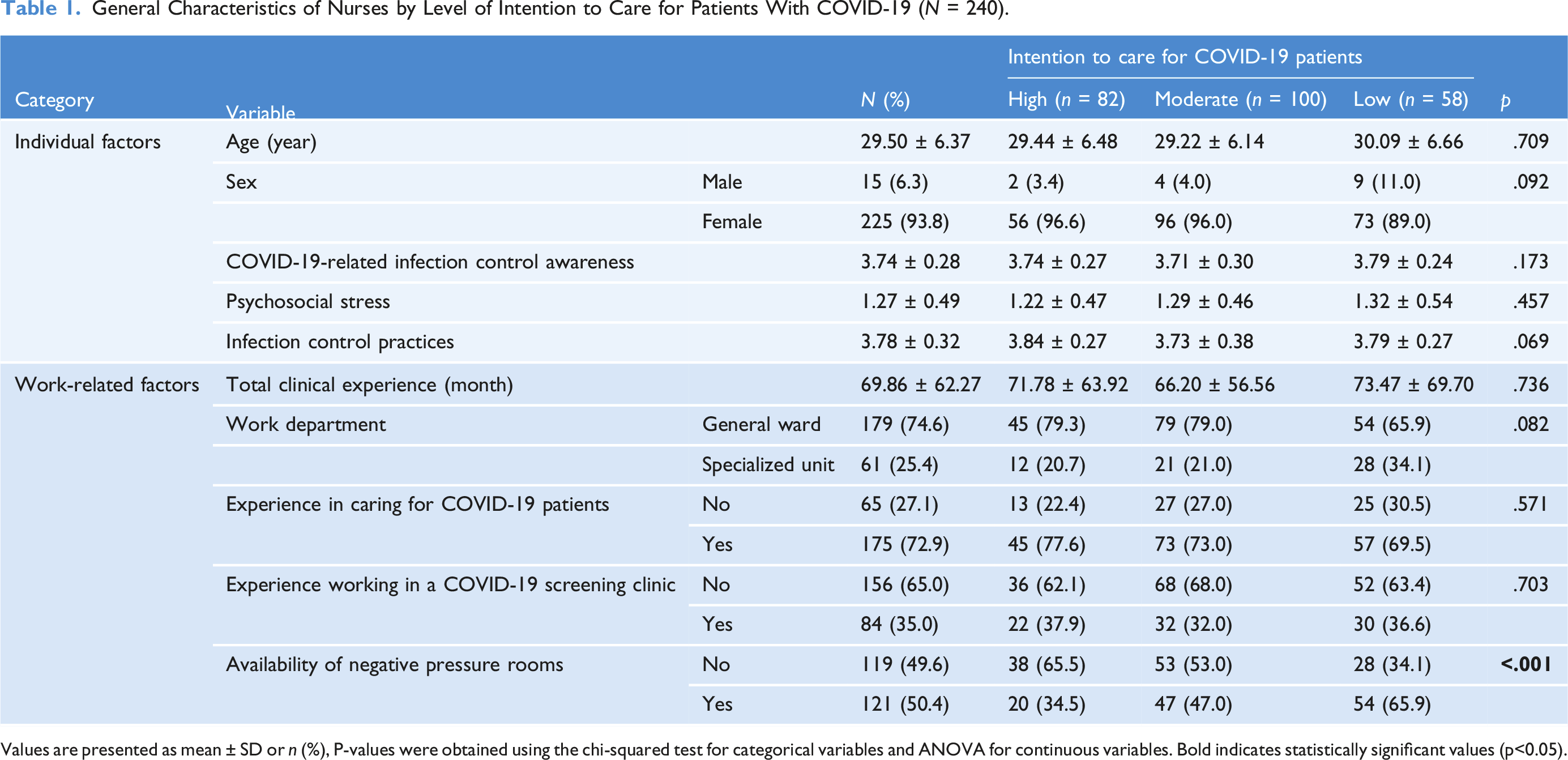
Values are presented as mean ± SD or n (%), P-values were obtained using the chi-squared test for categorical variables and ANOVA for continuous variables. Bold indicates statistically significant values (p<0.05).
Factors influencing infection control practices according to nurses’ intention to care for patients with COVID-19
Factors Influencing Infection Control Practices According to Nurses’ Intention Level to Care for Patients With COVID-19.
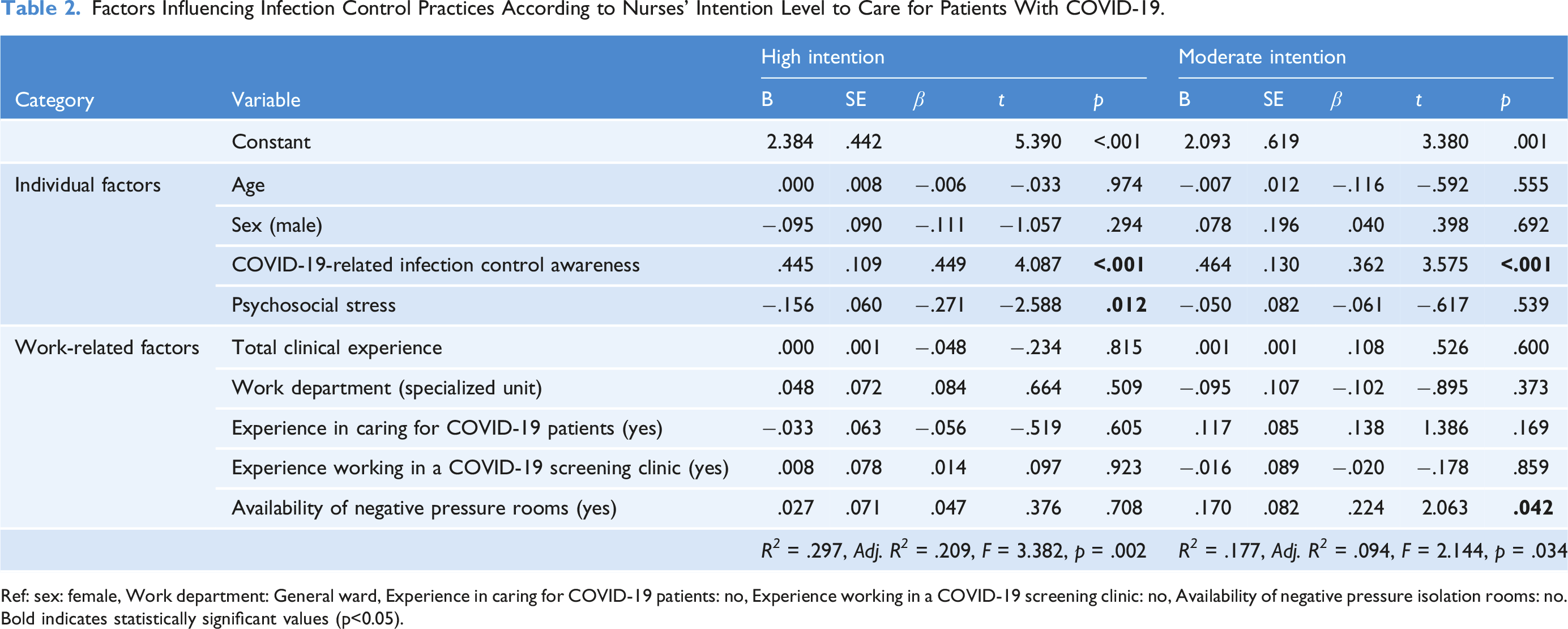
Ref: sex: female, Work department: General ward, Experience in caring for COVID-19 patients: no, Experience working in a COVID-19 screening clinic: no, Availability of negative pressure isolation rooms: no. Bold indicates statistically significant values (p<0.05).
Discussion
This study identified factors associated with infection control practices, focusing on nurses’ intention to care for patients with COVID-19. Among nurses with high intention, COVID-19-related infection control awareness and psychosocial stress were significantly associated with infection control practices. In contrast, among those with moderate intention, awareness and the availability of negative pressure rooms were significant factors. These findings suggest that factors influencing infection control practices vary according to the level of intention.
Intention has a significant impact on job engagement in the workplace (Slatten et al., 2022). Behavioral intention is regarded as a proximal and causal mechanism that predicts the implementation of performance-related behaviors (Fishman et al., 2020). Thus, interventions aimed at enhancing intention are essential for promoting desired workplace practices. Among nurses, work intention has been shown to be associated with better job performance and lower turnover intention, as well as contributing to enhanced professional attitudes and behaviors, which ultimately support the quality of healthcare delivery (Celikturk Doruker et al., 2025; Zandian et al., 2021). Furthermore, intention plays a meaningful role in clinical contexts such as cardiopulmonary resuscitation, where higher intention and motivation among nurses are associated with improved CPR quality, which may in turn contribute to better patient outcomes (Najafi et al., 2024). A study conducted in Korea found that nurses’ intention to care for patients with emerging infectious diseases significantly influenced their adherence to infection prevention and control practices, highlighting the role of intention in shaping clinical behaviors (Jeong and Kim, 2022). Therefore, it is important to analyze how varying levels of intention influence infection control practices and to implement appropriate interventions.
In the current study, COVID-19-related infection control awareness and psychosocial stress were significantly associated with practices among nurses with high intention. Improving nurses’ knowledge and awareness is important for infection prevention and control practices (Sodhi et al., 2022). High levels of awareness and good infection prevention control practices were reported in a study of 571 healthcare professionals in South India (Thazha et al., 2022). The study revealed a significant correlation between awareness of safety guidelines at work and infection prevention and control practices (Thazha et al., 2022). In our study, COVID-19-related infection control awareness was positively associated with infection control practices. Furthermore, when nurses’ intention to care for COVID-19 patients is high, psychosocial stress acts as a significant factor in infection control practices. A study from Japan revealed that certain infection control practices reduce employees’ stress, whereas other practices exacerbate it (Kodama et al., 2022). The study showed that psychosocial stress among workers may increase due to long-term infection control practices, while poor infection control practices may heighten the fear of infection (Kodama et al., 2022). In this study, psychosocial stress was found to significantly influence infection control practices among nurses with high intention.
Conversely, when intention was moderate (relatively lower), both individual and environmental factors—such as awareness and availability of negative pressure rooms—played significant roles. Negative pressure rooms are crucial for protecting patients with infectious diseases, including COVID-19, and for protecting healthcare workers and other patients (Miller et al., 2017). The physical environment plays an important role in decreasing and preventing hospital-acquired infections, particularly the ventilation and air-conditioning systems, which help prevent the transmission of infections (Nadi et al., 2024). Moreover, in a study involving nurses in small to medium-sized hospitals, the environmental factor of safety climate showed the greatest association with infection control practices, followed by individual factors of attitude (Shim and Kim, 2024). These findings highlight that when nurses’ intention to care is high, individual factors—such as infection control awareness and psychosocial stress-play a more decisive role in shaping infection control behaviors. In contrast, when intention is moderate, environmental support, including the availability of appropriate facilities and workplace safety infrastructure, becomes a critical determinant of infection control practices. Therefore, improving environmental conditions, including infrastructure and workplace safety, is essential for supporting safe and systematic infection control practices. Although both psychosocial stress and room availability were statistically significant predictors in their respective intention subgroups, these standardized coefficients represent moderate effect sizes. Although their practical significance should be interpreted with caution, even moderate effects can have meaningful clinical implications, as incremental improvements in awareness or infrastructure may reduce infection risks and improve patient safety. Building on these findings, recent international studies have emphasized the importance of integrating tailored interventions with organizational strategies to enhance nurses’ intention and infection control behaviors. Digital and hybrid educational approaches, combined with programs addressing burnout and psychological well-being, have been shown to improve preparedness and sustain infection control capacity in clinical settings (Kang et al., 2022; S. H. Lee and Choi, 2024; Zhang et al., 2024). Incorporating such approaches may be particularly beneficial for nurses with moderate intention, who may require more environmental and organizational support than those with high intention. Taken together, these results suggest that strategies to strengthen infection control practices should be differentiated according to nurses’ level of intention. Focusing on individual capacities is important when intention is high, while reinforcing environmental and organizational support is critical when intention is moderate.
Limitations
Despite the importance of this study in analyzing the factors associated with infection control practices, several limitations should be considered. First, this was a cross-sectional study; therefore, it was limited in its ability to establish causal relationships. Future longitudinal studies are needed to clarify the associations between infection control practices and individual and environmental factors. Second, the regression model for the low intention group failed to reach statistical significance due to the small sample size, preventing the inclusion of results for this subgroup. This represents a limitation that should be considered when interpreting and generalizing the findings of this study. Third, the survey consisted of a limited number of items to assess intention levels, which may have resulted in missing specific factors that participants considered important. Notably, the study did not include open-ended questions to explore the qualitative reasons for nurses’ high or low willingness to care for COVID-19 patients, thereby limiting the depth of understanding regarding the complex motivations behind their behavioral intentions. Fourth, as the variables in this study were assessed using self-report questionnaires, additional detailed research is required based on these results. Finally, because this study was conducted in a few hospitals in one city in Korea, it has a limited scope, making it necessary to expand the scope of future research.
Conclusions
This study demonstrates that factors influencing infection control practices vary according to nurses’ intention levels. Consequently, these findings suggest that interventions should be tailored to nurses’ specific levels of intention. To sustain effective infection control during infectious disease outbreaks, it is essential to reinforce both individual awareness and institutional infrastructure.
Supplemental material
Supplemental Material - The influence of general hospital nurses’ intention to care for patients with COVID-19 on infection control practices: A cross-sectional study
Supplemental material for The influence of general hospital nurses’ intention to care for patients with COVID-19 on infection control practices: A cross-sectional study by Jeong Ha Choi and Ka Young Kim in Journal of Infection Prevention
Footnotes

Ethical considerations
This study was approved by the Institutional Review Board of Gachon University (No. 1044396-202101-HR-008-01).
Funding
The authors received no financial support for the research, authorship, and/or publication of this article.
Declaration of conflicting interests
The authors declared no potential conflicts of interest with respect to the research, authorship, and/or publication of this article.
Supplemental material
Supplemental material for this article is available online.
References
Supplementary Material
Please find the following supplemental material available below.
For Open Access articles published under a Creative Commons License, all supplemental material carries the same license as the article it is associated with.
For non-Open Access articles published, all supplemental material carries a non-exclusive license, and permission requests for re-use of supplemental material or any part of supplemental material shall be sent directly to the copyright owner as specified in the copyright notice associated with the article.
