







Abstract
Aims:
This paper discusses the use of ethnographic approaches to explore how engagement with natural landscapes might benefit people’s health.
Methods:
Drawing on a selected review of empirical research we identified 30 relevant research papers that utilised qualitative methods to explore health issues and engagement with nature. Three examples of ‘alternative’ – i.e. non-mainstream qualitative approaches – are used to illustrate how different methods can be used to explore people’s experiences of engaging with nature for health.
Results:
While quantitative methods are dominant in health research, qualitative approaches are becoming more widely used. Approaches such as autoethnography can add value to nature and health studies by providing opportunities for researchers to be self-critical of their role as a researcher. Accompanied visits and visual ethnography can afford the researcher rich data about bodily movement, facial expressions and journeys, as well as dialogues associated with the meanings of nature for health.
Conclusions:
The paper concludes by suggesting that ethnographic methods can provide useful and important insights into why people engage with the natural environment and the range of health benefits they may gain from contact with nature.
Introduction
The purpose of this paper is to identify qualitative methods that can be used to understand (as a single method or combined with quantitative approaches) how contact with nature and time spent in nature, i as part of leisure activities, active travel or organized therapeutic programmes, might benefit people’s health. We argue that qualitative approaches can also be used to identify research questions of relevance to specific groups of people, for example those experiencing a particular health issue or problem. The paper provides snapshots of some types of research that might be regarded as ‘alternative’ (visual ethnography, accompanied nature journeys and autoethnography) to more standard quantitative approaches, and useful for nature health-related studies. This paper was developed as part of the activities of the Outdoors and Health Network (OHN) funded for one year in 2009–10 by the Economic and Social Research Council and Medical Research Council. ii The objectives of the network were to bring together an interdisciplinary group of researchers to create new understanding through network events and carry out project work focused on longitudinal surveys and qualitative methods that can be used to explore the relationship between natural landscapes and health.
There is no single definition of qualitative research; however, there is general agreement that it involves a focus primarily on ‘language as data’ whether that is written or oral, but it also includes visual material. It is characterised by an epistemology that is interested in subjective experiences and the meanings people give to and associate with different experiences. Bryman 1 suggests that qualitative research is concerned with the generation of theory and is therefore inductive, while quantitative research is deductive and concerned with testing theory. This is, of course, a deliberate oversimplification; for example, he later demonstrates that qualitative studies may be used to further explore issues raised by quantitative research. Gubrium and Holstein 2 argue that there are four major traditions of qualitative research. All are interpretivist (i.e. centred on the meanings generated by participants in the research setting) and largely constructionist in nature (i.e. adopting the ontological position that people create social properties via their interactions). For example:
Naturalism seeks to carefully describe the processes of social interaction via rich descriptions of people and their interactions in natural settings.
Ethnomethodology explores the creation of social order established through conversation and interaction.
Emotionalism centres on subjectivity and the inner experience.
Postmodernism is characterised by a sensitivity to the ‘multiple realities’ at play in the research setting, vying for authority – ‘whose reality?’
Irwin 3 and Marsden et al. 4 have highlighted the problems of taking a dualistic approach to thinking about and researching nature and people – i.e. one that separates people and nature. Irwin 3 argues for a co-constructionist approach that recognises that environmental matters overlap and interconnect with a wide diversity of social practices. This encompasses the idea that nature does not sit apart from everyday reality but is shaped and constructed by social processes. This is not a unidirectional but a bidirectional process as the social and natural are constructed within environmentally related practices and particular contexts. 3 People gain meaning from nature and its importance as part of local cultural and everyday social practices, and they also attach meaning to nature based on their experiences and interactions with and in nature. This is a dynamic and interactive process that can have an impact on people’s attitudes and actions towards nature. For example, a person who has enjoyed walking in nature may engage more proactively on retirement by getting involved in conservation volunteering, 5 and a young person involved in Forest School iii who explores and learns about nature as part of the Forest School activities may develop a lifelong interest in nature. 6 Qualitative research can address these issues by focusing on questions such as ‘what?’, ‘how?’ and ‘why?’, rather than ‘how many?’ or ‘how much?’. For example qualitative research might ask: What types of people use and enjoy nature spaces? What memories and emotions are stimulated by such experiences? What fears and/or passions arise when contemplating outdoor activity in natural landscapes? To what extent are these experiences influenced by the perceived security, proximity and size of nature spaces and why? Why do some people appear to gain restorative health benefits from being in nature? Why do particular nature health interventions seem to work? How do people’s experiences of nature impact on their attitudes and actions towards nature spaces?
Clearly, while some of the questions suggested above are arguably answerable using quantitative methods, others require the interpretation of language, image, behaviour and negotiation of the messy jumble of texts, performances and meanings that might arise between researchers, the researched and their audiences (readers of the texts). Qualitative research therefore focuses on exploring rather than measuring, in order to understand a particular phenomenon. Studies might, for example, focus on investigating health, health services or illness from the perspectives of communities and individuals affected or from the perspectives of practitioners and professionals who are providing specific health services. Qualitative research might also explore questions about what terms such as health, illness or nature mean in colloquial, institutional and official discourses. Ethnography, which we discuss in this paper, is a particular qualitative research approach used in anthropology and sociology to gather data on humans/groups, societies and culture; it uses methods such as observation, participation in group activities, interviews and focus groups.
Social research has in recent years become more of an acceptable part of health research in particular areas such as primary care, health promotion, nursing and public health. 7 In terms of qualitative methods, health practitioners and policy makers increasingly see the relevance of these approaches that can enhance understandings of health and health behaviour and improve the provision of health services, often as part of a mixed-method approach combined with quantitative studies in an effort to explain phenomena.
There are a range of journals that publish qualitative studies on health, such as the journal Qualitative Health Research, which publishes papers on the description and analysis of experiences of illness, the experiences of caregivers, health and health-seeking behaviours, health care policy and the sociocultural organization of health care. Others include Social Science and Medicine, Sociology of Health and Illness, Medical Anthropology and this journal, Perspectives in Public Health. In the context of those individuals or organizations interested in nature and health, journals such as Health and Place and Ecohealth are of particular relevance as they are interested in the links between people’s health and use and enjoyment of nature.
It appears, therefore, that particular aspects of health and specific parts of the health service/system might see the relevance of qualitative research more easily than other areas where randomized control trials (RCTs) are considered paramount. The rest of the paper therefore presents a brief overview of a selection of the methodological approaches from a range of social science journals, before focusing in on three related methods that explore subjective narrative, memory, ocularity and emotional context. To this end, and following Gubrium and Holstein, 2 we engage in a discourse about competing social realities (postmodernism) and consider methods able to capture some of the emotional content of the subject’s nature experiences (emotionalism). These approaches have been chosen as they represent perhaps the furthest remove from traditional quantitative methods, and arguably present some of the more ‘alternative’ approaches to capturing the ephemera of human emotion and reason in the context of individuals’ use or otherwise of nature spaces and any perceived health benefits accrued.
Methodological approaches in qualitative research and their use in studies of nature and health
A wide range of methods are used in qualitative research. The methods chosen for a particular study will depend on the research questions to be addressed. Questions raised might include: Why do particular doctors refer and encourage people to take up green exercise while others do not? Why do certain groups of people seek solace in nature when others do not? What is going on here and how can sense be made of what people are doing? According to Crabtree and Miller, 8 these types of questions call for research approaches that preserve the complexity, storminess and wealth of lived experiences. Research may focus on nature and the benefits for maintaining people’s health or on health interventions in nature spaces designed to directly improve health and well-being, such as general practitioner referrals for ‘green exercise’. Green and Thorogood 7 group qualitative methods for health into four main categories (Table 1).
Qualitative methods used in health research
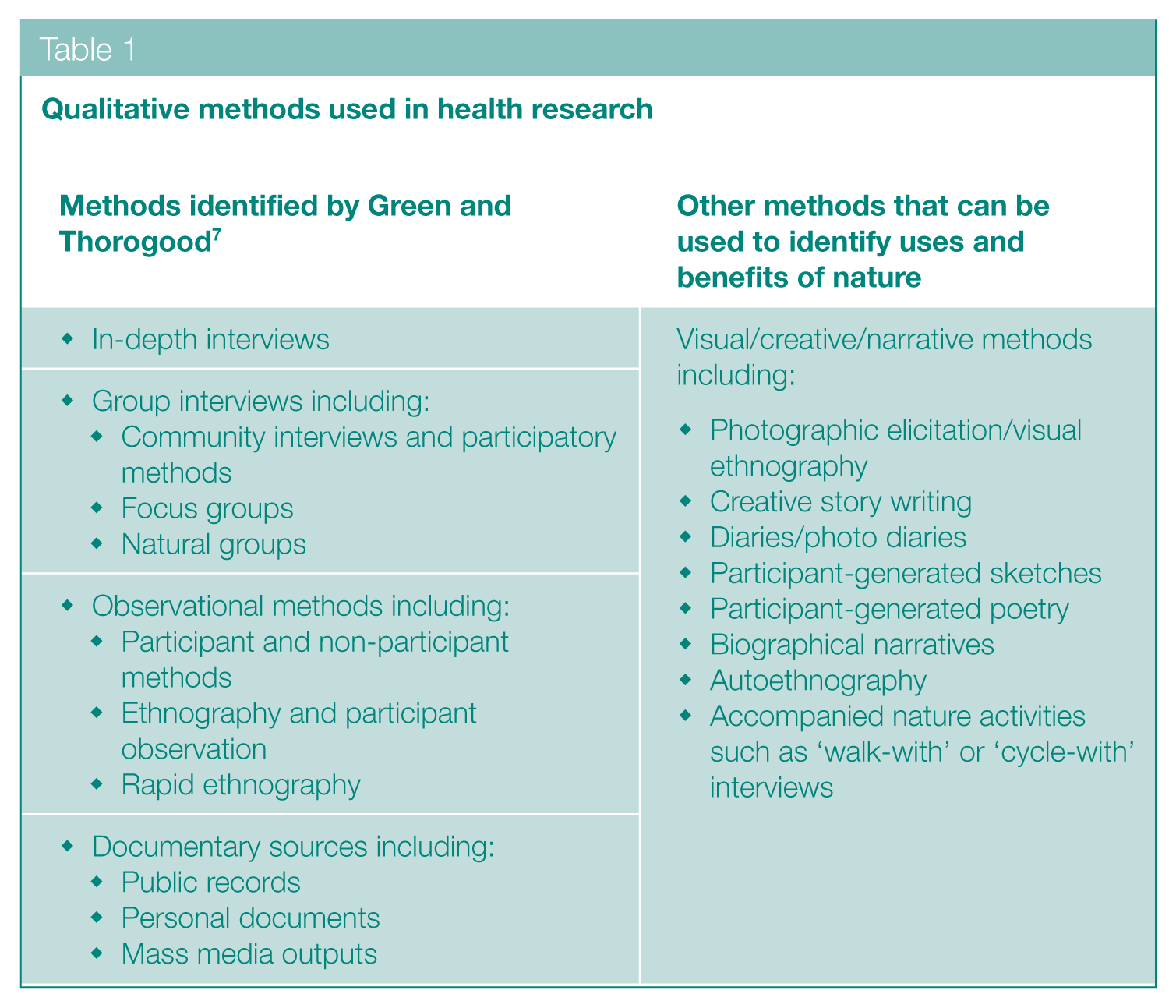
These methods might focus on the individual experiencing particular health problems, a community group that has come together to tackle a specific health issue, a particular nature-based intervention as a treatment for illness, or the institutions and organizations that are trying to improve public health or encourage the use and enjoyment of nature as a health resource. In some cases, multiple methods may be used in a single piece of research that can lead to triangulation of data sources. Depending upon the ontological stance of the audience, findings and conclusions from these types of studies might be seen as more convincing if key findings are based on multiple sources of data. 9 Studies that use similar or the same methods but take place in a number of study/case study locations can usefully highlight commonalities and differences between groups of people. Townsend 10 explored the health and well-being benefits of civic environmentalism in four studies in Victoria, Australia. Through primarily interviews and some quantitative survey data collection, different groups of volunteers explored how their activities in nature led to physical, mental and social well-being. This type of approach starts to illustrate that findings from qualitative studies may be generalizable to wider groups of people.
As part of the OHN activities, we identified 30 papers of empirical research from peer-reviewed journals that utilized qualitative methods to explore health issues and engagement with nature, sometimes in combination with quantitative methods as part of an inter- or multidisciplinary study. This was not a comprehensive review of all relevant papers but a targeted search to provide useful illustrative examples of studies that have used qualitative methods to explore issues of health related to contact with nature and the outdoors. The expertise of those involved in the OHN was utilised to help identify relevant papers, in addition to searches being undertaken. Papers were included from 2004 onwards; we only included papers that involved empirical research and that talked about the links between health, well-being or therapy and nature or green space, and all of the studies had to be primarily qualitative. We excluded papers published before 2004 that were health related but did not have a focus on nature and green space and papers that were primarily quantitative and were not empirically based. The methods used in the studies identified included interviews (semi-structured and in-depth), participant observation, diaries, focus groups, observations, ethnographic approaches, self-assessment, mind mapping and concept mapping. The studies we have looked at make some link between green space/nature/woodland/wilderness/gardens and health or broader well-being. Many of the studies are explorations or investigations. The results of the studies illustrate the importance of therapeutic landscapes,11–16 the use of nature as an escape,17,18 how civic environmentalism can bring people together,5,10 how older people can cultivate health through gardening19,20 and the importance of culture in the links between health and place for indigenous groups in Australia. 21 These studies provide some of the rich detail and thick description of how people engage with nature and gain health and well-being benefits from different types of engagement and contact.
Irvine et al., 22 for example, used interviews in three green spaces in Sheffield to study issues that affect urban quality of life, such as increasing noise levels and the decline in the quality of green space. English et al. 13 used semi-structured interviews with women at various stages of breast cancer to examine where and how they access and create landscapes of healing. Through these interviews women identified the importance of everyday and extraordinary therapeutic landscapes that are created by individuals and in homes as well as in the broader community and nature.
Qualitative and quantitative methods have been usefully combined in a number of studies, for example Nordh et al. 11 examined a 10-week intervention for those on long-term sick leave as part of a rehabilitation programme in a forest environment. The quantitative surveys found that participants improved concerning symptoms of illness and general functioning but not in their quality of life. The qualitative interviews were able to shed light on this issue as through this method researchers found that participants generally enjoyed the programme but expressed worries about their future once the intervention had finished. The participants still faced issues of financial and employment concern that they had previously faced, which were not addressed by the intervention. The methods used in this study could have been combined with biological data, for example tracking participants’ cortisol levels over the period of the intervention to explore changes in stress levels.
Holt et al. 23 used mind mapping with children aged six to 12. They defined high-walkability and low-walkability neighbourhoods and asked children to draw the places in their neighbourhood where they could play and be physically active. Spatial mapping approaches such as this can be a useful way of getting different groups to examine the specifics of what they do and where they go in nature as part of their everyday lives. These could be used with accelerometers to gain objective data on physical movement and activity.
Some studies explore not only the impact on people of contact with nature but also the governance process through which projects or interventions are delivered. For example, O’Brien et al., 24 evaluating the West Midlands Woodland and Health Project, interviewed representatives of organizations involved in running and delivering funded projects. Approaches such as this can be used to illustrate some of the challenges of setting up and delivering projects, as well as publicizing opportunities to the public and exploring the perceived successes of different approaches.
Burgess et al.25,26 published two particularly useful papers exploring environmental values through the medium of small groups. They argued for discursive and deliberative approaches to understanding how local people valued nature. Burgess 27 went on to write a key report for the then Countryside Commission on public perceptions of risk in woodlands in urban fringe areas. The methods used of focus groups and walking with people in woodland highlighted issues not only of enjoyment in woods but also of people’s concerns about safety when alone in the woods.
Utilising ‘alternative’ methods to understand how contact with nature might impact people’s health and well-being
The broad sweep of qualitative enquiry in general and ethnographically informed methods in particular tend to be imbued with the sorts of common-sense doubts that anyone might level at such research: How does one know that what the researcher has interpreted from his/her data is actually the case? Is the researcher leveraging a privileged view of social dynamics in the setting via her/his ethnographic authority – perhaps one that fits the needs of the study? To this end, such criticisms have resulted in what has become known as the ‘reflexive’ or ‘linguistic’ turn. As Denzin 28 suggests, there can never be a final, accurate representation of what was meant or said, only different textual representations of different experiences. There is a considerable literature that develops this line of criticism, drawn from postmodernism and feminism in particular, and it challenges the domination of the observer-author over the voice of the subject.
Methodological responses to this problem have emerged from a number of quarters. An effort to triangulate data sources and methods is one, discourse analysis another, and the reflexive turn is perhaps the most pervasive. The reflexive turn refers to the move toward ethnographers using philosophical self-reflection to ‘self-confessionally’ explore their own beliefs and assumptions; to be methodologically self-conscious about their relationship with those being studied and self-critical in terms of author ‘presentness’ in the setting. 29
While such ruminations provide an important foregrounding for the discussion that is the focus of this paper, it is important to consider what the particular contributions of various forms of ethnographically informed research might be to the study of nature, concomitant social interactions and associated health interventions. The three strategies that follow do not need to be regarded as necessarily discrete methods; rather they can be viewed as tactics that might be employed to solve some of the problems inherent in the social research discussed above.
Visual ethnography
Visual ethnography includes photography, video and hypermedia and is being increasingly used by ethnographers; there is also visual sociology and visual anthropology. In the 1990s a reflexive approach to ethnographic fieldwork methods created new opportunities for the use of photographic technology and images in ethnography. Early approaches in the 1970s and 1980s were criticised for a strong focus on ‘how to’ manuals of methods and analysis. Increasingly interdisciplinary approaches are becoming more common, including sociologists, ethnographers, and the arts and humanities. According to Pink, 30 when ethnographers produce photographs or video, these visual texts, as well as the experience of producing and discussing them, become part of their ethnographic knowledge. Observations, interviews and time spent with participants provide knowledge of what the images mean to the person, what they represent and why they were chosen. However, visual methods are not only visual; the constructedness of the image is important. With exploration of the intersubjectivity between the researchers and participants, a closer understanding of the worlds in which people live can be captured through visual ethnographic approaches.
Visual ethnography such as videoing has been used in health care to explore particular health and clinical practices. 31 In terms of nature and health, visual ethnography could be used in a range of ways such as getting participants to photograph their experiences in nature. This might include photographs of the way in which nature motivates people to go outdoors and undertake healthy physical activities. It might involve images of the barriers people might face in accessing and using local green spaces such as busy roads, burnt-out cars in green spaces, litter and overgrown vegetation near footpaths. Some of these barriers to accessing woodlands have been identified in a range of research.32,33
Recent work by O’Brien et al. 34 explored the relationships between peri-urban woodlands and people’s perceptions of their health and well-being. Using photo-elicitation and focus group methods, participants were asked to take pictures of anything in the woodland environment that had an impact on their health and well-being: positive or negative. Participants focused on woodland flora, canopy shots, infrastructure such as paths through the wood, benches to sit on, as well as taking photographs of other people who could enhance the enjoyment of a visit. In discussions participants talked about the restorative benefits of a woodland visit including aspects such as peacefulness, calm, restfulness as well as stimulation of the senses. Negative experiences were connected to a dislike of seeing neglect, litter and vandalism. A recent review of urban health, health inequalities and the role of urban forestry 35 suggests that it is particularly important to understand more about how people living in poor communities understand and negotiate relationships between trees, woods, green space and health. Visual ethnography could be a useful approach in capturing and exploring this.
Head cameras are increasingly being used by mountain bikers (to show routes to others) on social network sites such as YouTube. When King 36 researched youth mountain-biking identities in Bedgebury Forest in Kent she used observations, interviews and some photographs to explore young people’s experiences of riding in the forest. Two distinct groups emerged: (1) cross-country mountain bikers; and (2) dirt jump/downhill/freeride (DDF) forms of mountain bikers. DDF riders were located primarily in one specific area of the forest that contained constructed ramps and platforms for riding. Through their interactions with nature and through their activities the mountain bikers spoke about how they worked on improving and manipulating the area, and the different qualities of mud in the forest. For young women, mountain biking was a fitness activity and participation was linked with potential health benefits and/or losing weight. Young men were motivated by the challenge of mountain biking in nature and contrasted their activities with other youths who were perceived as pursuing sedentary urban lifestyles. Hence it may be seen that visual ethnographic approaches can aid reflexivity as participants and/or researchers who take photographs or make videos explore and identify why specific subjects were chosen, what these represent and the various meanings associated with nature through different activities.
Accompanied nature journeys as ethnographic method
‘Walking with’ and ‘cycling with’ methods provide important opportunities to experience activities among and with participant members. This approach was utilized by O’Brien and Morris
37
in forests in a lottery-funded programme called Active England. The key aims of the programme were to encourage particular groups, thought to be under-represented in sport, to undertake more physical activity. Projects created by the Forestry Commission as part of this programme at Bedgebury Forest in Kent and Haldon Forest Park in Devon involved improvements to the site infrastructure, such as new walking trails, mountain bike routes and freeride areas with platforms and shaped mud mounds for dirt jumping. There were also organized and led on-site activities such as health walks and cycle rides developed to encourage people to get active in the forest. In an evaluation of these projects the researchers joined health walkers at one of their weekly health walks at Bedgebury and a women’s group on their mountain bike ride at Haldon. The activities were followed by discussion groups held with the participants in the forest during rest periods. For the researchers, participating in the activities provided a very different approach to a more formal focus group or interview:
The dynamics of the group could be observed as they participated in their activities. For example the health walkers mingled a lot with each other throughout the walk rather than walking and speaking to only one or two others; they speeded up and slowed down to take time to walk and talk with each other or to observe different aspects of the woodland.
38
(fieldwork observations and notes, 2008)
The health walk group was of mixed ability with one person in a wheelchair, retired people, part-time workers, a father and young daughter, and residents of a care home who had mental health disabilities. This mixture of people was particularly valued by the group as they felt it important that anyone could join in. Although the health walks were aimed at improving people’s health, the majority of the group felt they benefited most from meeting and socialising with other people in an attractive woodland environment while walking and this motivated them to continue their participation. They walked in all weathers and described the importance of seeing the changes in the seasons, getting out into the fresh air, escaping from everyday concerns, getting to know the forest routes and enjoying the scenery and landscape.
In a related group in the project, the women mountain bikers at Haldon Forest felt that a women’s group was less stressful and competitive than a men’s group would be, in an activity very much dominated by men. During the trip, they discussed details of their ride at stops and pauses in the forest, or when others were catching up:
Tight turns, narrow tracks and the wetness of the mud were of interest to them as well as how they coped with difficult parts of the ride or how they had improved from the week before. They took time to enjoy the views and to encourage each other if one person was struggling with a particular aspect of the ride. The instructor leading the ride gave tips to the participants about balancing their weight and how to approach dips and jumps. The camaraderie between the group was clear and had developed as they got to know each other over the weeks and gained confidence in their riding. The riders clearly valued the opportunity to ride in the woodland enjoying the fresh air and scenery.
38
(fieldwork observations and notes, 2008)
As with the health group, the socialising and support for each other in the woodland setting was a key reason for the women’s involvement. Riding across the rugged terrain of the forest, the adrenaline rush of mountain biking and the weather were all key aspects of connecting to and interacting with nature that the women valued for their health and well-being. They felt their fitness was improving; however, their primary reasons for taking part were to meet like-minded people, to enjoy being outside and to have fun. These types of accompanied methods can provide important insights into how activities are run, what motivates people to get involved and why they stay involved, how perceptions and attitudes might change through interactions with nature, how people participate and engage with others and how the engagement with nature occurs.
Autoethnography
A significant issue, illustrated by the mountain-biking videos/accompanied walks and rides referred to above, was the potential for the researcher’s text and interpretation of the data to be privileged over the text captured directly from the participants in interviews and filmed experiences. The problem may be that the ethnographic writer is set outside of the meanings generated and therefore must strive to reflexively weave themselves into the text, or alternatively (and more controversially) declare themselves as scientifically ‘absent’ and set apart as an observer as in early anthropological studies (a detailed critique of such positions is available 39 ).
In addition, members who are actively engaged in adventurous leisure forms may be particularly difficult to study in this regard. The different psycho-social backgrounds, skill levels, bravery, comfort and fear thresholds and the range of personalities may be aspects that combine to frustrate the best efforts of an ethnographer in any study context. In adventurous natural landscapes, the challenges of observing, listening and recording become all the more acute. The passages below, taken from one author’s study of sea kayakers, illuminate some of these challenges:
A major fieldwork problem was that, during active paddling sessions, there were many times when the members were moving in a widely scattered pattern out on the ocean, and conversations were difficult to eavesdrop on the rare occasions that they occurred. More fruitful during these times was the study of facial expressions, bodily movements (kinesics) and careful attention to the post-experience discussions, (in the minibus back from the coast for example). What has come through therefore in my re-telling of what I saw and experienced, is often a description of my own emotions and feelings as well as more objective descriptions of the setting and practical actions.
40
(fieldwork observations and notes, 2004)
This echoes McGettigan’s
41
contention in his study of tourists on a hippy bus journey across America that, in allowing oneself to experience ‘something like’ what the other customers and group members were immersed in (i.e. immersing oneself as a full member of the group) and then, by providing a personal narrative about how that felt, at least avoided the urge to try and describe how others had felt and experienced things.
40
Likewise, in the sea-kayaking study, insights were gained into the sea-kayaking experience from both a personal-subjective and a stranger-objective perspective. Such accounts are ‘autoethnographic’ in character – a term originally coined by Hayano.
42
Anderson
43
succinctly captures this emergent aspect of social research as:
…variously referred to as auto-anthropology, autobiographical ethnography or sociology, personal or self-narrative research and writing, and perhaps most commonly, autoethnography… linked, explicitly and implicitly by different authors, to various “turns” in the social sciences and humanities: the turn towards blurred genres of writing, a heightened self-reflexivity in ethnographic research, an increased focus on emotion in the social sciences, and the postmodern scepticism regarding generalisation of knowledge claims. (p. 373)
Anderson goes on to explore various ‘turns’ within the genre itself, ultimately arguing for the relevance of a form of autoethnographic representation in which: (1) the author is a complete member researcher within the study group; (2) the researcher is clearly situated within the resultant written text; and (3) the researcher is committed to an analytic agenda in a broader set of social agendas.
43
In some nature settings, the autoethnographer will inevitably struggle with a multiple focus of exploring the setting, participating, interrogating one’s own emotional responses, observing those of others and recording and documenting the fragmented whole of it:
Members occasionally shared their feelings about what they had done, I observed them “doing” it, and considered my own feelings as I experienced something similar. This partial autoethnographic aspect of the work was also important from another point of view. The simple fact is that I struggled at times to come to terms with my uncertain paddling abilities, and with the aches and exhaustion that were a natural aspect of the activities. For some time in the field learning the game was a preoccupation; survival in the setting (or at least endeavouring to stay in the boat) threatened to supersede my research efforts.
40
(fieldwork observations and notes, 2004)
What is significant about this, however, is that one’s memories of fear, joy, comfort and discomfort are, as Simmel 44 argues in his essay on the adventurer, clearly recalled; they stand out starkly against the backdrop of everyday life. Therefore, for example, Varley 40 found that it was fairly simple to recall the few conversations and the many positive and negative ‘ecstatic’ experiences that were had as the Northern Sea Paddlers pushed through rough seas on their second day together.
In terms of the rigour and credibility of the resultant account of the researcher’s experiences, an essential value of such work is what Anderson 43 has referred to as an enhanced textual visibility of the researcher’s self. In short, the personal history, and to some extent the personality of the researcher, is accounted for and woven into the text, without subsiding into what Geertz 45 has referred to as author-saturated texts. Instead, the promise of the autoethnographic turn should allow exposure of the self who is also a spectator. 46
Discussion
As Anderson 43 has suggested, autoethnography has clear applications as part of a wider project of authorial reflexivity – indeed, this aspect was one of the drivers that led to autoethnography’s emergence as a separate genre. In the context of health research, and more particularly in the case of research into the use of natural landscapes for health benefits, autoethnography, combined with the traditional ethnographic techniques of participant observation, setting and context description and (sometimes) the use of key informant interviews, might help to capture the multi-sensual, emotional and contingent aspects of activity in natural landscapes – with or without others. The additional contribution of visual ethnography is that it can afford the researcher rich data about bodily movement, facial expressions and journeys, as well as, in some instances, the noises and dialogues associated with them. What this paper has sought to do is outline and discuss some of the ways in which qualitative ethnographic approaches are utilised in research concerning health and contact with nature, particularly where contact with nature might contribute to people’s physical, social and mental health and well-being and where it might highlight changes in attitudes and actions towards the natural environment. While health research is dominated by quantitative methods with RCTs being seen as the ‘gold standard’ of research, this paper has identified how qualitative approaches have been and are being used to explore questions of what, how and why contact with nature is important for health and capturing the dynamic relationship between nature – people interactions.
Focusing on three methods (visual ethnography, accompanied nature journeys as ethnographic method and autoethnography) that might be classed as ‘alternative’ from mainstream qualitative approaches has illustrated how particular methods can be used to gain different and nuanced perspectives on people’s experiences with nature and their thoughts and views about how this impacts their health and broader well-being. We argue that there is scope to develop interdisciplinary studies between medical scientists, sociologists and ethnographers that bring together qualitative methods such as those described in this paper, along with quantitative biological measures to take forward studies that explore the links between nature and health. There are challenges as different disciplines may not easily acknowledge the methods used by others; however, a holistic approach to studying health, well-being and links to nature would be an important addition to current research in this area.
Footnotes
Acknowledgements
This work was undertaken by members of the Outdoors and Health Network and was supported by the Economic and Social Research Council and the Medical Research Council (grant number RES-355-25-0040).