







Abstract
Aims:
This paper focuses on an innovative intersection between education, health and arts. Taking a broad definition of health it examines some social and psychological well-being impacts of extended collaborations between a theatre company and children with communication difficulties. It seeks to test aspects of Fredrickson’s1 broaden-and-build theory of positive emotions in a primary school curriculum context.
Methods:
The researcher participated in a project called Speech Bubbles. The programme was devised by theatre practitioners and aimed at six- and seven-year-olds with difficulties in speech, language and communication. Sessions were observed, videoed and analysed for levels of child well-being using an established scale. In addition, responses regarding perceived improvements in speech, language and communication were gathered from school records and teachers, teaching assistants, practitioners and parents. Data were captured using still images and videos, children’s recorded commentaries, conversations, written feedback and observation. Using grounded research methods, themes and categories arose directly from the collected data.
Results:
Fluency, vocabulary, inventiveness and concentration were enhanced in the large majority of referred children. The research also found significant positive developments in motivation and confidence. Teachers and their assistants credited the drama intervention with notable improvements in attitude, behaviour and relationships over the year. Aspects of many children’s psychological well-being also showed marked signs of progress when measured against original reasons for referral and normal expectations over a year. An unexpected outcome was evidence of heightened well-being of the teaching assistants involved.
Conclusions:
Findings compared well with expectations based upon Fredrickson’s theory and also the theatre company’s view that theatre-making promotes emotional awareness and empathy. Improvements in both children’s well-being and communication were at least in part related to the sustained and playful emphases on the processes and practice of drama, clear values and an inclusive environment.
Keywords
Introduction
The arts are good for us. Philosophers, artists and musicians have claimed as much since Classical times. This research examines the suggestion that a drama and communication skills project with young children has been particularly good for those suffering from speech, language and communication difficulties.
The health of children in the UK gives cause for concern. Using broad definitions of health, for example that of the World Health Organisation (WHO), 2 the Marmot Review reported a ‘staggering 41% of children NOT achieving a good level of development’ in England.3,4 Relatively poor levels of childhood physical, mental and social health have also been reported by WHO, United Nations Children’s Fund (UNICEF) and major children’s charities.5–8 Perceptions of good mental and social health rest on healthy communication9–11 and, consequently, speech, language and communication have become priorities in UK curriculum and public policy.12–16
Speech Bubbles (SB) was designed by drama practitioners to support schools in areas currently tackling an estimated 50% of children with communication needs. 17 Traditionally, speech language and communication needs (SLCN) have been addressed through occasional visits from visiting speech therapists, psychologists or behaviour specialists. However, in 2009 an Inner London pupil development centre (PDC) approached SB to develop SLCN through an innovative drama-based programme. Twelve primary schools piloted the project and initial evaluations 18 suggested sustained improvements and the contract was extended in 2011. Participants also commonly noted improvements in attitude, motivation, contentment and confidence. Such reports raised questions related to ways in which drama interventions might impact upon the social and mental well-being of children experiencing barriers to their learning.
A theoretical framework established by Barbara Fredrickson’s broaden-and-build theory of positive emotions1,19 underpins observations and interpretations made in this research. Fredrickson suggests that human learning, relating, thinking and physical repertoires broaden and deepen in conditions of ‘positive emotion’. She claims that the tendency to build up mental, social and physical resources in times of happiness provides the resilience needed to face life’s inevitable tragedies, disappointments and difficulties. For Fredrickson, positive experience consists of what individuals feel to be positive and is recognisable via apparently universal physical and expressive characteristics supporting what psychologist Ekman claims is the ‘pan-cultural’ look of healthy happiness. 20 But positivity is never independent of morality and values.
Perceptions of positivity clearly vary from person to person. Fredrickson’s theory makes little attempt to distinguish between ‘good’ positive and ‘bad’ positive. For her, positivity ranges from appreciation to love, from amusement to joy, from hope to gratitude. 1 While her theory arises from well-established earlier research,21–23 its language may suggest somewhat individualistic assumptions. Nonetheless, if institutions or groups attempt to clarify what constitutes a morally good positive state then Fredrickson’s claims may be significant to all working for the well-being of others. Fredrickson’s research has been conducted almost wholly with adults; I ask if the theory may apply to children’s positive experience too.
Children referred to SB showed few and transferrable signs of well-being. In a training session teachers and assistants listed the behaviours typical of the children referred to the programme: Biting, launching objects across the classroom, wetting themselves, negative attention seeking, irrelevant questions or answers, lonely/solitary, frustrated, depressed and anxious appearance/activity, constant interruption, aggressive, over-dominant behaviour, stutters, late verbal responses, saying irrelevant things, frequent crying, invading other’s physical or verbal space, hiding, spinning, “making weird sounds”, lack of friends, “telling on” people, limited vocabulary, parent’s and own verbal lack of confidence (15 September 2011)
Interventions aimed at addressing such behaviour are familiar to schools. Additional educational needs co-ordinators support colleagues in handling antisocial behaviours and SLCN. Outside specialists generally only work with individual children with the highest levels of such need. Financial constraints and changes in school funding have, however, reduced numbers of externally funded professionals visiting schools 11 and SB is one of a range of local solutions. The widespread use of ‘circle time’ 24 where pupils agree to give full attention to each individual’s response to an emotionally relevant topic is an example of attempts to build whole-class confidence and social skills, but these may not be rigorous enough to tackle widespread SLCN.
SB sessions deliberately address neither the whole class nor individuals, but groups of ten referred children with SLCN needs. Sessions occur regularly and over a long period, typically weekly for a year, and are always shared with teachers or teaching assistants from the school. The approach grew from the pioneering work of the national Creative Partnerships programme 2002–11, 25 inspired by British and US government arts reports.26,27 These education reports noted links between engagement in the arts and improvements in child well-being and recommended extended arts experience, especially in disadvantaged communities. Health education researchers similarly claim links between mental and physical well-being and involvement in arts activity.28,29
The use of drama practitioners is an important feature of SB. What Thompson 30 calls the signature pedagogies of artists in schools were evident in the playful, inclusive, emotionally based and collective focus on self and imagination observed in sessions. For many, such engagement and participation rapidly resulted in the motivation to speak, move and relate more confidently.
SB is based upon methods pioneered by educationalist Vivienne Paley. Paley 31 argues that dedicated school time for ‘fantasy play’ – the inventive, narrated, story-making typical of young children – is a powerful means of securing their psychological and social development, particularly regarding communication.
Drama practitioners are in a strong position to make use of children’s stories. They use the disciplined language and skills of drama and their own emotional commitment to affect their relationships with the children and the products they achieve. The company’s artistic director articulates a discourse far from that of ‘targets’, ‘assessments’ and ‘standards’: SB offers children the chance to watch… the playing of emotion, and asks them to empathise with the performance, to feel the emotion. Watching and acting “opens” the performer/child, and extends their emotional range like we extend our vocabulary. (JP, personal communication, 8 May 2012)
Previous research suggested that arts experience can positively transform the well-being of children and their teachers through authentic dialogue. 32 This research now focuses on the single art of theatre-making and asks whether and in what ways a programme intended to improve communication skills can impact on the well-being of participants.
Participation
Each school referred two groups of ten six- and seven-year-olds and a teaching assistant. Children represented the range of backgrounds, cultures and ethnicities typical of inner-city London. The researcher observed three training/evaluation days for teachers and assistants and participated in and videoed six SB sessions in two schools. Conversations with practitioners and teaching assistants were recorded. Parents were interviewed during ‘open days’ and small groups of children made recorded commentaries on video of their work on two further occasions.
Reasons for referral varied. Some children were shy or quiet, unable to contribute in class. Others could form only short sentences or had no English. Some were overbearing and unwilling to take turns or listen to others. Selective mutes and children with Asperger’s syndrome or physical speech difficulties were also referred. All were adversely affected in learning and socialization by poor communication.
Ethics
The researcher held a current Criminal Records Bureau certificate and participated in each videoed session. Teaching assistants, teachers and children’s families were sent letters explaining the purpose and methods of the research and asking for their participation. Parents and schools were assured that images would be destroyed after the research unless specific permission had been given for their further use in an educational context. Research notes were taken in teacher/drama practitioner meetings with permission. Any disclosures or concerns in sessions immediately activated the school’s child protection policies.
The use of control groups was considered but rejected because of our belief that sessions would be particularly beneficial to these disadvantaged children.
Methods
SB training sessions were attended and contributed to by the researcher who, after introduction, participated in sessions as a co-member. Research notes were taken during all meetings and immediately after sessions. Planned conversations with teaching assistants and teachers were recorded. Weekly, individual assessments on turn-taking, acting and engagement made by teaching assistants and drama practitioners were consulted. Well-being behaviours during SB sessions were measured by comparing 12 randomly chosen children against an adapted Leuven Well-Being scale (L-WB). 33 This scale, designed for children three-to-seven years old, uses statements describing variations in demeanour, activity and relationships. Its accessible language and visual/relational focus made L-WB appropriate for this study. A child at the highest level of well-being for example is described in Figure 1.
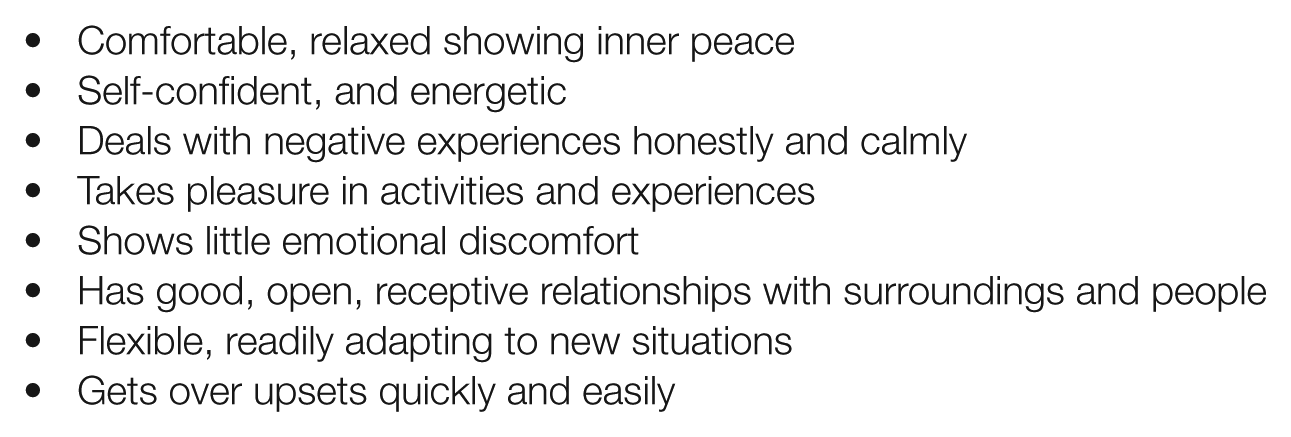
Example description of a child at level five of the L-WB scale
Sessions were videoed from a fixed position and four-minute video summaries of sessions were used to generate commentaries from child participants who explained them to non-SB classmates. The researcher prompted with open questions such as ‘What’s happening there?’ or ‘What’s that about?’ at roughly 30-second intervals. These commentaries were analyzed for themes and used to provide the children’s perspective. The summary videos also prompted conversations with adults involved in SB.
Relevant quotations from the data are shown indented and dated. Children’s contributions are shown in italics. Initials differentiate children (C), teaching assistants/teachers (T), drama practitioners (DP) and parents (P); research notes are shown by (RN).
A typical Speech Bubbles session
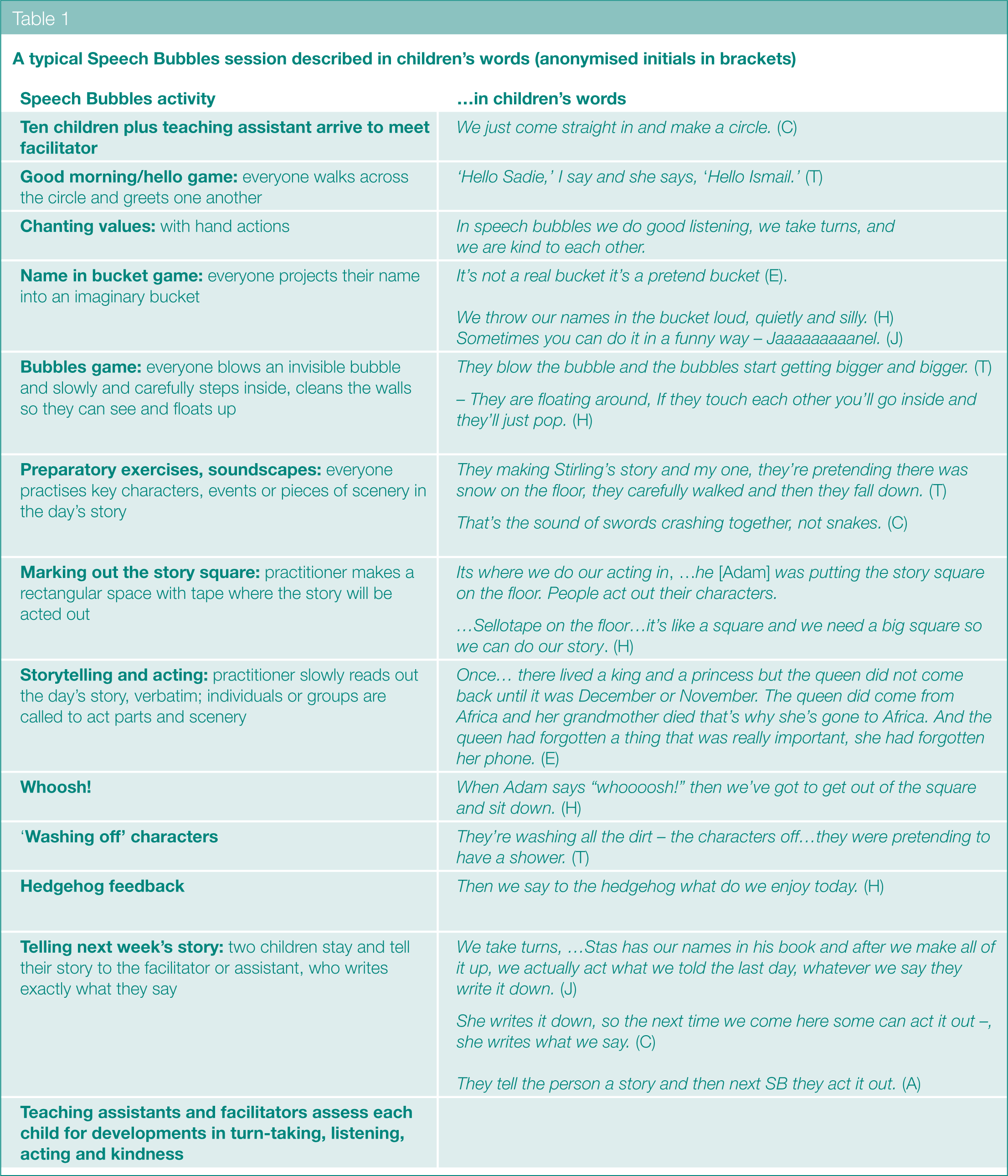
SB sessions last 45 minutes and follow the same format each week. Their predictable structure is considered important in providing a sense of security. This common framework is argued to maximize conditions for connection-making and creativity. Table 1 summarizes a session using the children’s words.
A typical Speech Bubbles session described in children’s words (anonymised initials in brackets)
Methodology
Notes were analyzed using grounded research methods. 34 Themes and categories were therefore allowed to surface during scrutiny of the data. Grounded theory was chosen because of its close relationships with health, education and social research. It was felt particularly important that processes and outcomes should be:
understandable by anyone involved in the area;
general enough to be applicable to a multitude of diverse daily situations. 34
Transcripts and video observations were highlighted to identify repeated themes such as children’s behaviour, enjoyment, confidence and communication. During analysis it became evident that adult responses (doubts, insecurity, enjoyment, improved communication and satisfaction) represented a separate theme.
Themes were subdivided into categories (shown as sub-headings); communication, for example, involved children’s facial and bodily movements, language, interactions, speech and expression.
The researcher was also a participant in the activities researched. Participant action research is clearly qualitative and lies within a wider interpretative paradigm. Denzin and Lincoln 35 warn that the presence of outsiders alters the behaviour of research subjects, but since SB frequently includes outsiders (parents and teachers) as extra participants, it was felt that children would quickly become used to the researcher. The researcher was already familiar in the schools through frequent visits and his positive bias towards arts in schools was balanced by evidence from teaching assistants, teachers and parents more randomly selected. Qualitative methods were chosen because they best address professional and personal fears about ‘the alienating effects on both researchers and audiences of impersonal, passionless, abstract claims of truth generated by… research practices… clothed in exclusionary scientific discourse.’ 36
Positivist approaches seemed inappropriate to studies dependent on interpretations of body language, feelings, experiences and conversations and ‘soft’ values like caring, relationship, positivity and creativity. Positivist research rarely justifies its choice of paradigm and only qualitative and interpretative methods were appropriate to answer the research questions.
The L-WB is clearly based on subjective judgements, but ‘blind’ checking by non-participant teachers confirmed high degrees of consistency. Conclusions however need to be read in the reflexive context of participants already interested in arts practice and well-being among children.
Results
The following themes emerged from observations and analysis:
children’s behaviour;
fun;
children’s confidence;
children’s communication;
and adult responses.
Children’s behaviour
Communication difficulties often show themselves in abnormal behaviour. Parents, teaching assistants and PDC members consistently claimed that SB provoked behaviour improvements, despite their fears of the opposite. Advances in self-control, turn-taking/ giving and empathy and their transferral to mainstream classrooms were commonly noted after just two SB sessions. Post-session assessments in one school recorded progressively fewer challenges, quieter voices and no invasions of another’s space. One teaching assistant summarised significant behaviour change while watching one child’s video commentary: …how confident and articulate… I was amazed. He was sent for behaviour issues, throwing his weight around and being quite intimidating, yet [in SB sessions] he took his turns and listened carefully and behaved really well. (TA, 9 February 2012)
Others highlighted increased participation and engagement by formerly ‘difficult’ children: They’re just “with it” all the way.… the naughty ones have become quite proud of their achievements, eyes smiling heads up… great participation. (TA, 8 December 2011)
Not all were quickly transformed. In one school a child was excluded from SB, and in others practitioners reported initial difficulties with control and devised methods to help children gain self-control. For example, one drama practitioner initiated: …a quiet/calm area for some children at first, for kids to go out to when they got over-excited or cross… but they needed to stay connected to what was happening, so they could see what they were missing, over time this was used less and less. (DP, 8 December 2011)
Fun
When asked what they thought of SB, children’s most common response was: ‘It’s fun.’ Recorded self-assurance and communication improvements were taken as products of this enjoyment. Increased confidence was reflected in a range of measured improvements in vocabulary, fluency, engagement, turn-taking/giving, empathy and length/complexity of interactions. Assured voices, inclusive body language and wider relationships were recorded in most children. For example, nine out of 12 ‘focus’ children moved from L-WB level two to level four during the research period – a progress unusual in the view of class teachers. One child moved to the highest level (five); another originally at L-WB level one, who ‘cried at everything on a daily basis’ (T), was reassessed at the high end of level three after just a term of SB: though still occasionally upset, it’s much less – what really surprises me is that she has this massive voice, she volunteered for the Christmas play, one of the first… much better at acting, much more confident. (T, 9 February 2012)
When asked why children enjoyed SB so much, one assistant answered: Well they would wouldn’t they, we’re all taking notice of their stories… their stories count don’t they? Where else would they be heard? (TA, 27 April 2012)
For some, speech itself was a barrier – they remained silent, contributing few unsolicited remarks throughout two observed terms. Joseph progressed from L-WB level two to level three within each observed session as captured in the following note: J couldn’t remember his story, looked uncomfortable, described many relevant things under his breath but rarely spoke loudly enough to be heard… took a while to say what he wanted, reluctant to take limelight, in last ten minutes made some confident, thoughtful statements with great assurance and smile. (RN, 9 February 2012)
The frequent use of ‘soundscapes’ (forest or city noises, blowing up ‘speech bubbles’, playing with names) instead of words bolstered the confidence of some, but so too did a sympathetic audience.
Confidence
The use of children’s own stories visibly engaged the majority. Three visiting parents made a point of remarking on the growth of confidence in their children, not simply in the SB sessions but at home and in class. Occasionally formerly shy children ventured playful verbal references to taboo areas (e.g. to ‘horse poo’ (7 November 2011)). These distracted the group for a while but were quietly accommodated by the drama practitioner, and the narratives and acting moved on.
Emotional engagement
One warm-up session required participants to open an imaginary present with their ‘mum’ (a male teacher in role, showing gentle interest). Three examples exemplify the levels of engagement commonly displayed: Harriet… opened the parcel and found a letter, which she pretended to read, …the letter was Sulaiman asking her over to play at his house, she moved the drama on and brought Sulaiman into the story square to act-out them playing. Sulaiman entered the drama with great joy. Abdi… found a Nintendo DS and carefully with great detail showed mum how to play with it. Jenny… found nine butterflies, which she gently played with in the story square and then lay down and went to sleep saying goodnight to each butterfly. (DP, 15 December 2011)
Empathy
SB activities were designed to build community and collaboration. Children’s language was rich in references to ‘we’, ‘us’, ‘our’, ‘they’ and ‘ours’. In commentaries on the summary video children often shared narratives, for example: Y. We go in a bubble and you pretend that you’re floating, we can’t touch each other because the bubble might pop and we’ll have to do another one, … H. They’re stepping in the bubbles and walking around, Y. I can see Mohammed my friend – they are floating around,’ H. If we touch each other you’ll go inside and they’ll just pop. (C, 9 February 2012)
Videoed sessions also captured frequent examples of the audience entering into the emotions acted within the ‘story square’ on the classroom floor.
Communication
Vocabulary improvements
Children confidently used drama-based vocabulary during SB. Specialist terms like audience, character, imagine, pretend, performance, stage, scene, acting, act-out, role, object, story square peppered children’s descriptions in sessions and video commentaries. At times children used language differently, sometimes distancing themselves from ‘their’ character or correcting themselves. Enrico, observing himself on video, said: ‘I’m just standing pretending [laughs]
Fluency improvements
By term two, Josh, referred for extreme shyness, non-participation and speech difficulties, displayed many L-WB level four behaviours and assured expression. Speaking loudly, excitedly and smiling broadly, he explained: …I was being a knight shielding. I was trying to look for a dragon… I remember there were some knights, a red knight, a blue knight, a green knight, a yellow knight and I almost forgot, a brown knight as well and then, and then a dragon attacked them. (C, 24 April 2012)
A newcomer to English recounted: …There was a boy and he thinks, [correcting himself]… he thought… that he going to the race, he quickly dress up and he quickly bet when he’s with another boy, he said I think I’m going to have a race, yeah, and then he got two cars and one said ready, go and then they both go. The boy passed him and quickly just off, I went past him and then I winned and every [body] got round in a circle and he winned. (C, 9 February 2012)
Commentaries also showed that while some gained in fluency after two terms, others remained reticent. One girl simply repeated ‘I don’t remember’, looking down and clutching her knees (RN, 24 April 2012).
Better turn-taking/giving
Prior to SB some children found it hard not to interrupt. Others were over-loquacious or aggressively dominant. For many, turn-taking and turn-giving ‘rapidly improved’, according to weekly assessment notes. Hartley’s generous video commentary illustrates his developing ability to share: [with strong eye-contact (JB)] They cheered him… it was Enrico’s story he was racing and I was racing him then he got faster and faster… and then everybody cheered for him, there was a cup… look at… cheering about the winner [JB: I’m sure they were cheering you too.] no they weren’t, it wasn’t about me. When you tell the story they write it down – our words – we’re telling the story – then they tell it.… they act it out – because it’s our story. (C, 21 November 2011)
Longer, more complex interactions
In observed sessions every child participated. In some, children needed the encouragement of a teaching assistant acting with them, but later observations showed them participating independently in warm-ups and acted stories. Verbal interactions were generally excited, fast and sparkly eyed, but increasingly creative. Stories often took unexpected turns, as in the report below: A couple of weeks ago we had a line in a story “The car went so fast that the paint changed from black to orange” and we had to act that out. I threw the problem back to the group “I wonder how we can show that?” and one boy, whose mum had insisted had no imagination, responded “We all put our hands down, and at that part in the story we raise our hands with a whoosh sound”. We tried it and it worked, the group broke into a spontaneous round of applause. (DP blog 2012)
Teaching assistants in both schools and a class teacher independently claimed that selective mutes spoke in SB sessions ‘after a short time’. One once-selective mute ‘amazingly, now, … talks all the time in SB’ (TA, 8 December 2011). One very shy child’s video commentary remembered an imaginative contribution from two months before: ‘There was a spider, a big one and they eat people, he [pointing to Stirling] was the, the squishy bit in the spider’s mouth… (C, 9 February 2012).
Not all improved in verbal communication. One boy, silent for two terms: …was surrounded by a culture supporting his mutism…when we asked for sentences to build up a group story, the group said “he doesn’t speak”, even before he could open his mouth. When it was time for his story we built it up through a system of thumbs up for good, down for not good (eg was there a boy? Was his name Ismail?). As the story developed he began to look stressed so eventually I asked, “do you want to go to the toilet?” He put his thumbs up, but wet himself before he could get out and had to be taken out and changed. The others responded by taking over the story for him. When he came back he looked happy, joining in his own story, his expression and body language had changed. The group stopped saying “he doesn’t speak” all the time and he’s made friends with the boys who completed his story. (DP, 15 September 2011)
His non-verbal communication in the playground and classroom grew significantly after this point and the drama practitioner and teacher expected him to speak by the end of the year.
Adult responses
Teaching assistants’ increased job satisfaction
Assistants are usually the only school-based adults to attend sessions. In training sessions they expressed consistently and unanimously positive responses to SB, many discovering new understandings of children’s learning. One shared: Now I don’t dread Mondays anymore… it’s what I come to school for, I love it. (TA, 15 September 2011).
Others explained their enhanced job satisfaction: I think you see a different side to yourself. (TA, 27 April 2012) For the first time I’m learning with the children. (TA, 9 November 2011) …the children get the attention of several adults – they’re thrilled at that. (TA, 9 February 2012)
Teaching assistants described their distinctive and more responsible roles positively, speaking of a ‘less pressured environment’, having better chances to integrate with ‘their’ children and focusing explicitly on children’s well-being. Two teaching assistants had asked to demonstrate SB methods to their year group because ‘we felt it was so important’ (TA, 24 April 2012).
There were tensions, however. Several teaching assistants noted how standards and philosophies relating to behaviour differed between drama practitioners and schools. While some teaching assistants and teachers quickly and enthusiastically embraced SB ideas, others worried about conflicting pressures and ‘messages’. Allowing children freedom of expression and using their unedited words, for example, were considered by some as impossible in whole-class settings.
Conflicting pressures on teachers
Teachers were also conscious of ideological conflicts. Some stressed that SB was just a part of existing school strategies encouraging children to achieve their potential: …you have to bear in mind some of the other things that go on in class so these things [improvements in communication skills] could be happening anyway, but SB is very popular with the children who go and that says a lot, these children are now reading and writing happily. (T, 9 February 2012)
Many credited SB with initiating transformations. One teacher reported ‘a dramatic change in the children almost straight away’ (T, 15 September 2011); another recognised how acting alongside them increased children’s motivation and learning by creating ‘a protective/supportive space in which each child found it safe to communicate deeply held feelings’ (DP 15 December 2011).
Drama practitioners
Facilitators saw their differing viewpoints as an asset. Delivery styles varied – one drama practitioner was excited and strong-voiced, the other restrained and thoughtful – but children’s responses were consistent across schools. For example, children’s ownership of SB sessions was illustrated in that practitioners’ names were often omitted, even forgotten, as children described weekly sessions to the researcher. The weekly repeated values and structures were expressed as ‘what we do’, rather than what we are told to do.
Inclusive practice was illustrated in the humility, trust, fairness and care that drama practitioners showed during observations, but also in their high expectations as children acted out their narratives. Through the two observed terms challenges decreased, and sessions calmed and became more seriously playful. One drama practitioner’s summary captures this progression: One child said, “I’m not coming to SB because its s**t.” The teacher responded calmly by saying, “well just come along and watch”, now this child is one of the group’s most enthusiastic members. His behaviour changed first in accepting turn-taking and then fully participating (DP, 14 February 2012)
Parental support
Some parents initially saw referral to SB as negative, but these quotations testify to their change of mind: I thought it was a bit of a stigma… were a bit anti, but when we came to the open day, we was just amazed, it’s done my boy a lot of good (P, 27 April 2012) I thought she [her daughter] should not be in the group, “she’s above all this,” but by the end she was saying “I’m going to pretend to be shy this year because I want to go to B again”. (P, 8 December 2011)
Schools expressed surprise at the unusually well-attended and supportive SB parent ‘open days’ (15 December 2011).
Discussion
SB claims to engender the strong development of children’s communication skills, but speech and language generally improve over time without formal interventions. Visiting speech therapists, researchers and PDC representatives have however highlighted the speed and transferability of communication improvements during SB. 37 Questions remain: Are these improvements sustainable in the long term? Does the SB approach confer other advantages on participating children? Is it right for drama practitioners to replace speech and behaviour therapists? This research suggests children’s sustained psychological and social progress over a year within SB sessions but do the improvements transfer to class and at home?
Fredrickson 1 asserts lasting and transferable effects of positive emotions. Joy, interest, engagement and love broaden attention, thinking and creativity; undo the negative physical and psychological results of negativity; fuel resilience; build personal resources; trigger upward spirals of well-being; and seed human flourishing. 1 Such claims are ambitious but not without evidence in the daily lives of many. Fredrickson’s proposal that generalised positive experience can result in increased motivation, better relationships, thinking and functioning appears borne out in these observations. The researcher and adult participants agreed that they saw plentiful examples of joy, interest, engagement and sometimes love in these school- and curriculum-based settings. Such positive emotions observed and paralleled by the L-WB, were evidenced through detailed attention to body language, expression and interactions. These visual indications of well-being improved and were sustained in 75% of the observed children over nine months.
SB’s own survey shows that between 70% and 80% of children also showed ‘academic’ improvements in learning, speaking, listening and in their behaviour. 37 Further research is clearly needed on the relationship between these figures.
Psychologists claim that opportunities to publicly play and play with emotions are central to developments in confidence and empowerment. 22 The enjoyment, receptive relationships, focus, flexibility and relaxation recorded in the SB sessions may arise from novelty or the special attention that children receive. For the large majority of children, however, teachers and managers reported that these improvements transferred to their classroom behaviours. Schools’ confidence in the SB approach is demonstrated in the repeat engagements most have arranged for the coming years.
What causes such successes?
Small groups, appreciative audiences and the attention of respected adults were clearly major factors, but children’s emotional, social and physical commitment to play their stories appeared intrinsically driven.
The art of drama plays a specific role. One drama practitioner described ‘wondering with children how it might feel to be in their story world.’ He encouraged adult participants to ‘co-construct an environment of emotional awareness and empathy… resisting closed meanings or direct interpretations of the children’s images but staying within the story metaphor’ (DP, 2 March 2012). Contrasting strongly with the usual language of education, drama offers a different and challenging lens through which to observe the life and soul of a child. The evidence suggests that SB’s joint aims of addressing SLCN and improving the well-being of children were achieved at some level in child and adult participants. Some children of course were only partly reached, needing teaching assistants to act with them, and ‘reluctant to volunteer answers’ or making little sense in their verbal responses (RN 14 February 2012), but even these were described as ‘beaming with pleasure’ in photographs appraised by independent teachers. Giving disadvantaged children’s stories time, respect and an audience may bestow the sense of environmental and self-control identified by Ryff 38 as essential components of well-being.
Some teaching assistants and parents observed that children responded differently to theatre-makers’ instructions, accepting direction more generously, and imagining more freely than in class. Respected adults’ sustained attention and willingness to play with children may be important in provoking this alternative mindset, as Goouch
39
has argued. Children commonly spoke of their fun in SB, but teaching assistants (some of whom initially described playing with children as their ‘greatest embarrassment and fear’), also demonstrated high levels of shared enjoyment during observations and feedback: smiles and laughter dominated, forward-leaning bodies, relaxed faces, open body language, with excited looks, good eye-contact, rapid speech, twinkling eyes, fast, expressive hand movements and expansive gestures. (RN 27 April 2012)
Conclusions
SB offers more than simply drama. With its narrative and personal focus, clarity of values, drama-based creative practice and playfulness it is credited with positive change in many children and their teaching assistants. The research, with its focus on fine-detailed observation, offers a model for well-being studies among young children. The visible indicators of well-being and unexpected improvements in speaking and listening scores suggest the effectiveness of drama in motivating children with communication difficulties. SB’s successes confirm the experience of other artists working in schools,40,41 but the specific effects of structure and authentic adult participation in children’s play need more research. Implicit in the detail of this study are important pointers towards further study, including the roles of:
humility in adult–child relationships;
identity;
explicit and shared values;
children’s pride;
audience;
adult–child trust, collaboration and enjoyment.
Fredrickson 1 envisages a virtuous spiral generated by the kind of positive experiences described in this research and her claim needs testing in other child-based settings. Healthy child development must rest on the child’s developing sense of self and concepts such as joy, interest, contentment and love. It is time for the arts to evidence their role in promoting these things in school and curriculum.