






Abstract

In terms of healthcare, the United States is unenviable among high-income countries. We spend considerably more on healthcare, utilising, for example, almost twice as much of our gross domestic product (GDP) for healthcare as does the United Kingdom. 1 At the same time, we have poorer health outcomes, including shorter life expectancy and a greater prevalence of chronic disease. 1 To understand the problem the United States faces, it is helpful to evaluate the fundamental nature of chronic disease in Western societies and the failed response to that disease in the United States. The analysis reveals deeply flawed approaches to healthcare, driven in large part by the view that drug discovery and development offer effective solutions to diseases, described below, that are products of modern society. More hopefully, the analysis serves as a lighthouse, illuminating a dangerous, rocky shore that should be avoided and pointing towards a more fruitful approach based on thoughtful and effective public policy.
Chronic inflammatory diseases account for much of the healthcare burden of Western societies. 2 Other common diseases, not labelled as inflammatory diseases, are nevertheless associated with inflammation. Tallying these inflammation-related diseases provides a list of the vast majority of disease seen in Western clinics and hospitals:
Allergies (e.g. asthma, food allergies, hay fever and sensitivity to pets and insect bites);
Autoimmune diseases (e.g. multiple sclerosis, lupus, type 1 diabetes);
Inflammatory diseases of the bowel (Crohn’s disease, colitis and ulcerative colitis);
Depression, anxiety disorders, migraine headaches, Parkinson’s disease and other neuropsychiatric disorders;
Cardiovascular disease;
Many types of cancer;
Women’s health issues, including infertility and mastitis;
A wide range of chronic diseases associated with infection 3 (e.g. ulcers, PANDAS, chronic sinusitis, Lyme disease).
Fortunately, the underlying causes of inflammation in Western society are, for the most part, no secret. The topic of this special issue deals with one of those problems: alteration of the ecosystem of microbes, helminths (worms) and protozoans that live on and in our body. This life, collectively called the ‘human biome’, has been dramatically altered by modern society. The alteration, termed ‘loss of old friends’ or ‘biome depletion’, involves the virtual extinction of some components of the biome (helminths (worms) and protozoans) and rather profound alterations of other components of the human biome (microbes) (see Figure 1). 4
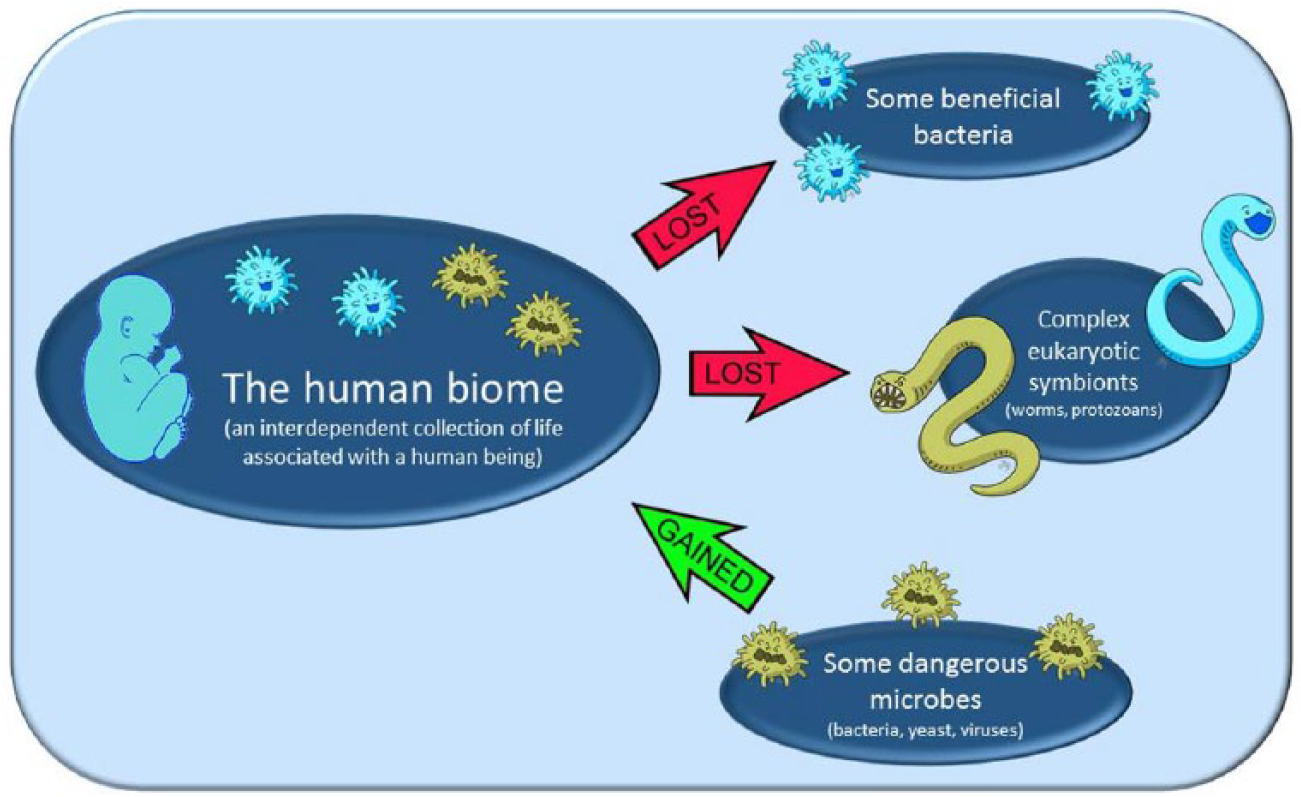
Alteration of the human biome as a consequence of Western culture. The array of beneficial (blue) and dangerous (yellow green) organisms associated with the human biome changed profoundly following the agricultural revolution 10,000 years ago and then again following the industrial revolution 100 years ago. Changes include (top) decreased exposure to some beneficial bacteria, including soil bacteria and some gut bacteria; (centre) almost complete loss of more complex organisms, including benign and pathogenic helminths and protozoans; and (bottom) increased exposure to many disease causing microbes, including viruses and bacteria.
These changes have left the immune system essentially unsuited to the present environment, prone to inflammation and chronic disease. The solution to this problem is expected to include (1) improved hygiene and vaccination to decrease exposure to dangerous organisms, (2) changes in diet and medical practice to protect beneficial bacteria and (3) artificial selection and re-introduction of beneficial organisms such as helminths.
Along with four other factors, biome depletion is one of the ‘big five’ instigators of inflammation in Western societies. Each of the big five is associated with a wide range of inflammation-associated diseases, including allergy, autoimmunity, neuropsychiatric disorders, cardiovascular diseases and cancers. The big five are as follows:
Biome depletion/alteration (primarily a result of technological advances such as toilets and water treatment facilities, but contributed to by other factors such as modern medicine and diet)
Chronic psychological stress (a result of multiple factors in Westernised societies, ranging from sleep disruption to uncertainty in social roles to exposure to fear-inducing media 5 )
Vitamin D deficiency 6 (due to indoor work environments)
Inflammatory diets (diets high in fat and processed sugars, but low in fibre and other nutritional components)
Sedentary lifestyles
Notably, these five factors are attributable to technological advances which, for the most part, are necessary components of modern society. For example, as eloquently pointed out in this special issue by several experts, it is not tenable to abandon modern toilets and water treatment facilities to compensate for alterations in the human biome. Neither is it tenable to abandon indoor work environments which can lead to vitamin D deficiency, and neither can we return to a hunter-gatherer lifestyle that would mitigate problems with diet, exercise and chronic psychological stress.
Although cultural advances which lead to disease cannot be abandoned, we have argued 7 that disease prevention is readily achievable by compensating for the big five causes of inflammation in Western society. A public policy that educates the population and encourages personal responsibility for health would be revolutionary in the United States. In addition, regulatory policies must be developed that promote biome-friendly medical practices and strongly encourage the development of living organisms for use as dietary supplements that enrich the entire biome, including microbial life as well as more complex organisms such as helminths and perhaps protozoans.8,9
When it comes to four of the big five causes of inflammation in Western society, there is no question that prevention of disease by alleviation of the cause is far superior to treatment of disease with pharmaceuticals. Some, however, see biome depletion as a special case. The idea has emerged that we should wait until people are sick before dealing with biome depletion. With this mindset, treatment of disease using drugs derived from helminths and perhaps microbes is a logical step forward for the field of clinical immunology. Opposed to this view, we argue 7 that ‘domestication’ of living organisms in an effective and safe manner and reincorporation of those organisms into the human biome would be more effective and economical than drug development. We argue that this approach, but not a drug-based approach, has the potential to deal with the underlying cause of disease and prevent disease before it occurs. Furthermore, we argue that even an army of drugs cannot recapitulate or effectively mimic the complex biological relationships between humans and their biome that are necessary for proper immune function.
A drug-based approach to treating the pandemics of chronic, inflammation-related diseases completely dominates the current US medical system. This ‘sick-care’ approach is expensive, and attempts to treat disease without addressing the underlying causes of disease. Such an approach, fraught with adverse side effects and less-than-optimal outcomes, is driven by systems which allow commercial interests to drive education and policy. Neither the government nor the governed can bear the burden of this approach.
The world is waiting for a government to lead the way in the fight against the chronic inflammatory diseases that plague Western societies. The solution lies in intelligent policies and education formulated by a government that places public health rather than the public sick care as the highest priority. The policy will be proactive in preventing inflammatory disease by dealing with the fundamental causes of inflammation in Western society. This proactive policy will effectively procure and maintain health for the population, avoiding the vast expense incurred by treating an increasingly sick population using the pharmaceutical-based approach currently embraced in the United States.