






Abstract


Pharmacy teams are well placed to improve the health and wellbeing of their local community. 1 They are appropriately trained in evidence-based communication techniques, such as brief intervention skills, allowing them to raise sensitive issues and enable and encourage people to take responsibility for their own health. They are also well placed to work in partnership with other practitioners and organisations to provide evidence-based advice and signposting which facilitates behaviour change. 2
The Healthy Living Pharmacy (HLP) framework provides a platform through which the pharmacy’s role in delivering public health services, such as weight management, can be maximised in order to meet local need, improve the health and wellbeing of the local population and also help to reduce local health inequalities.3,4
Obesity and overweight remain a public health priority given the high related costs both to the health service and the individual. Given the numbers and associated costs, scalable solutions are required and the HLP model provides an opportunity to reach people who often do not access other primary care services. This ‘in practice’ article explores the feasibility of HLPs referring patients to commercial weight management organisations.
Slimming World (SW) is a commercial weight management organisation with over 16,000 weekly community groups. These groups support people to lose weight through adopting and maintaining healthier eating and physical activity habits. Service provision is continually evaluated, and SW have a portfolio of published evidence. 5 SW have a history of working with healthcare professionals through a well-established general practitioner (GP) referral programme, Slimming World on Referral (SWoR), in order to reduce health inequalities and provide wider benefits to the patient through this partnership working.6,7 In County Durham, United Kingdom, a new model has been used with HLPs being central to the referral process.
This paper reports on the findings of a Durham County Council pharmacy led SWoR programme delivered by HLPs and compares the outcomes with GP-led referral schemes with similar referral criteria.
Process
Twenty-one HLPs were supplied with pharmacy briefing materials, patient registration letters, and promotional materials, and had the opportunity to refer patients to a local SW group providing they met the following criteria:
Aged ≥18;
Body mass index (BMI) of ≥25 kg/m2;
Registered with a GP in County Durham;
Had not paid to attend a commercial weight loss programme in past 3 months;
Demonstrated a readiness to change;
No known eating disorder.
For those patients meeting the eligibility criteria, the pharmacy supplied a registration letter which contained a contact telephone number for SW. On contacting SW, the patient received a referral allowing them to attend, at no cost to themselves, the local SW group of their choice for 12 weeks.
Relationships were built between local SW Consultants and HLPs. SW Consultants signposted patients to other local wellbeing services resulting in positive cross referrals.
Weight and attendance data were electronically collected using standard operating procedures from scales calibrated to the nearest 200g. From the SW electronic database, data were extracted for SWoR GP-led schemes with the same referral criteria. All data were cleaned for any outliers in accordance with SW standard operating procedures. 8 Using Microsoft Excel and SPSS statistical software, mean weight changes (standard deviation (SD)) and differences between the two groups are reported with a p-value ≤0.05 considered of statistical significance. Odds ratios of those achieving a 3%, 5% and 10% weight loss by the end of the 12 weeks are reported.
Findings
Between May and October 2016, 1,020 people were referred by their HLP and attended a local SW group. During the same period, 5,482 patients were referred into local SW groups via GPs using similar referral criteria, from across 12 different local authority schemes. The characteristics of both these groups and mean weight (absolute and %) and BMI changes (SD), using last weight observed analysis, are presented in Table 1. Of note is that those referred through the HLPs were younger and had a lower mean BMI at baseline, although on average still >35 kg/m2. Also a greater percentage of men were referred into SW groups via GPs compared to HLPs. However, clinical outcomes for weight change, especially those achieving a 3% or 5% weight loss after 12 weeks, were comparable for both groups despite attendance being slightly greater for those referred by their GP. Only for the higher weight losses (10%) was there a significant difference between the two groups. For all participants referred via a GP rather than HLP, there was a 1.1 (95% confidence interval (CI) 0.96, 1.25) greater chance of achieving a 5% weight loss after 12 weeks while the odds ratio for achieving a 10% weight loss was 1.6 (95% CI 1.35, 1.85).
Characteristics and weight outcomes for people referred to SW via HLP or GP (mean (SD) values)
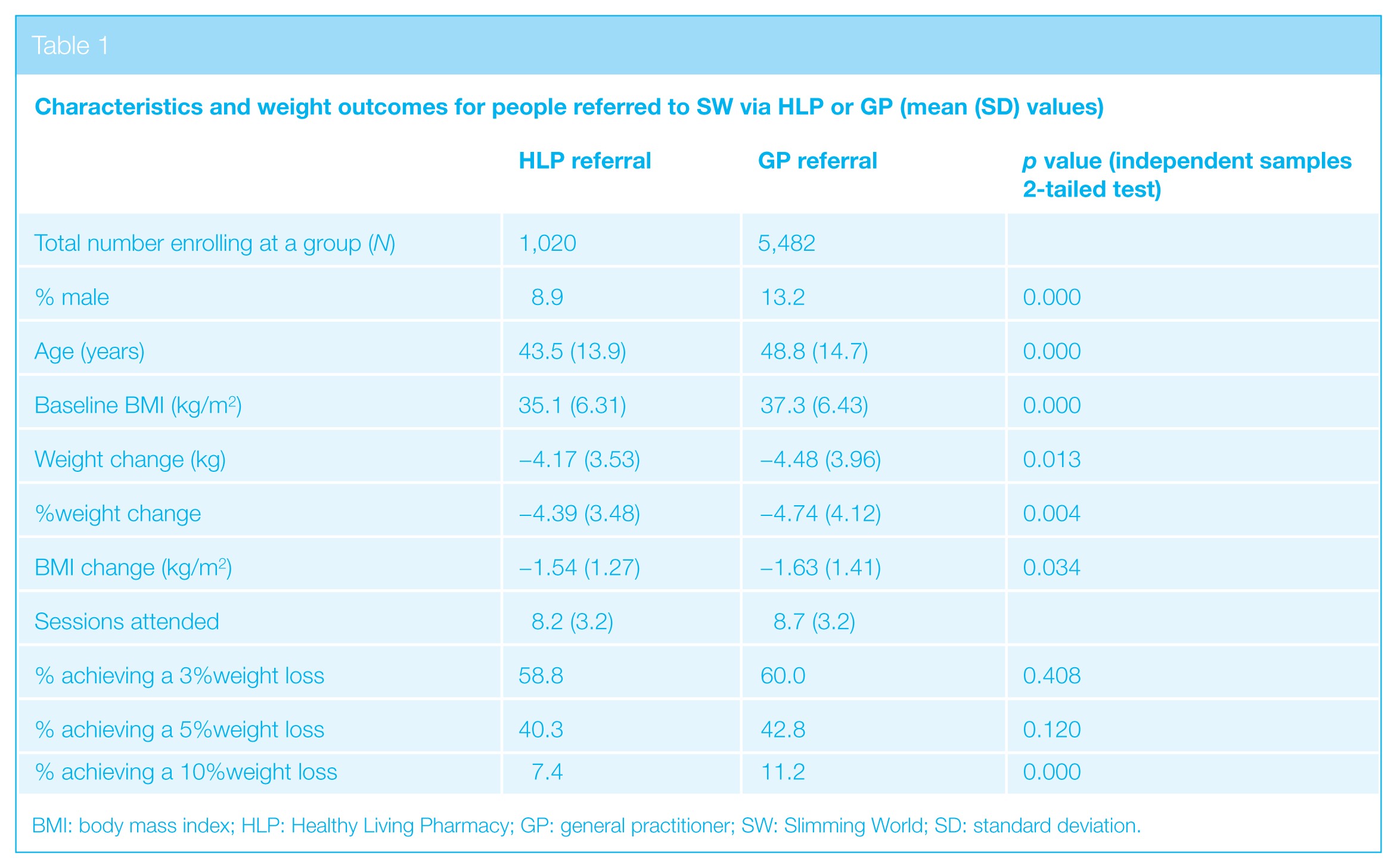
BMI: body mass index; HLP: Healthy Living Pharmacy; GP: general practitioner; SW: Slimming World; SD: standard deviation.
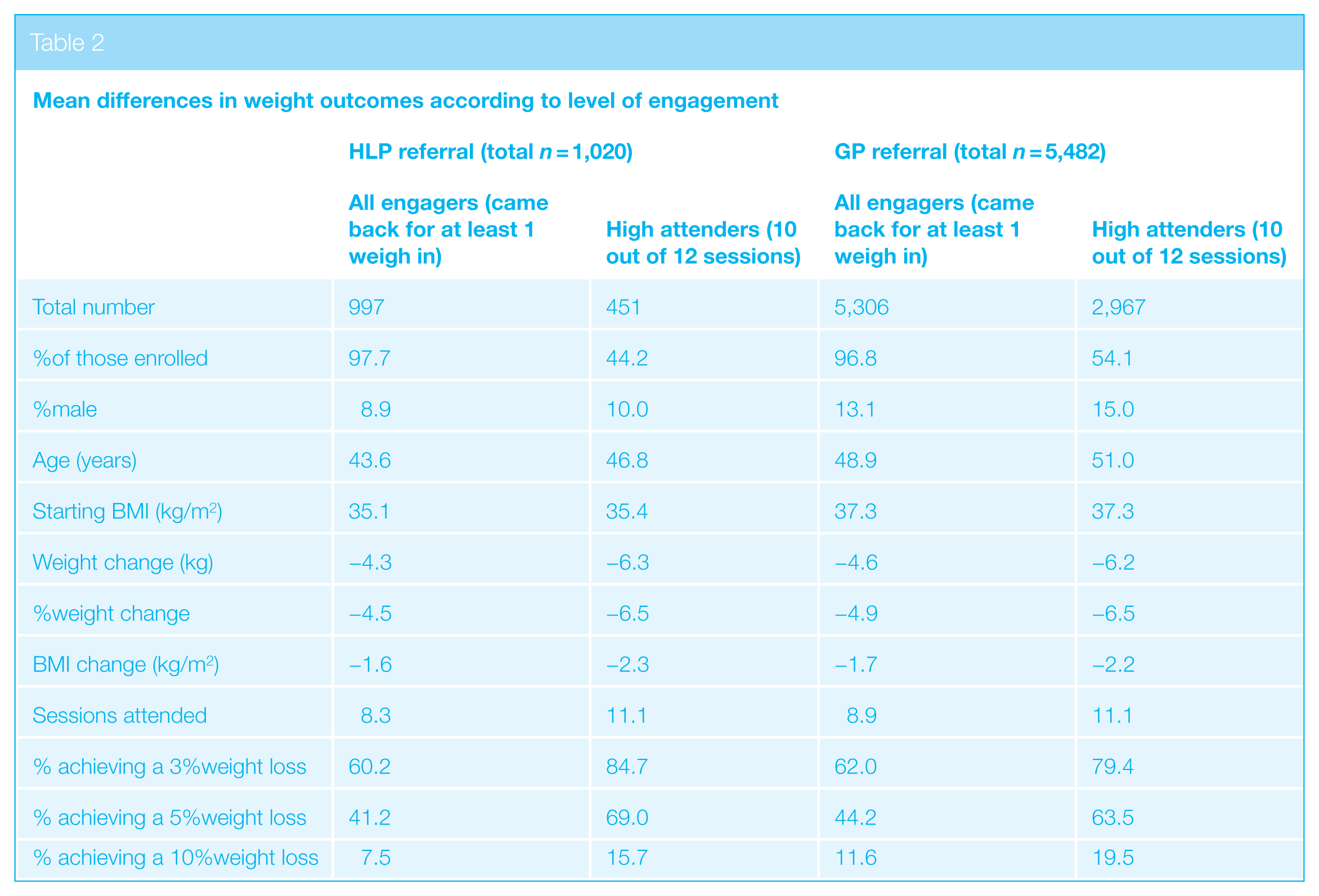
There were small differences in the levels of engagement between the two groups (Table 2). The high attenders (attending 10 out of 12 sessions) were slightly older but had a similar starting BMI for both groups. Greater weight losses were achieved by high attenders, compared to lower engagement, but there was very little clinical difference between those referred via the HLP or GP in terms of weight losses achieved in the high attendance groups.
Mean differences in weight outcomes according to level of engagement
Claire Jones, Public Health Pharmacist, Durham County Council:
Pharmacies are in the heart of every local community. Because HLPs are largely driven by the pharmacy staff who tend to live and work in that local community, there is already a positive friendly relationship between customers and staff. This makes it far easier for pharmacy staff to engage with the local community about the sensitive issue of weight loss.
Participating HLP, York Road Pharmacy, Peterlee:
To date we’ve referred over 200 people from the pharmacy and it shows no signs of slowing down. It’s been a huge success and we’ve had many people coming back to let us know how successful they’ve been on the weight loss programme. This scheme is making a real difference and it’s great to be part of something so potentially life changing for people.
Conclusion
The National Institute for Health and Care Excellence (NICE) 2014 guidelines on lifestyle weight management services for adults recommend an integrated approach, working with local communities and that local services are identified and included in the local obesity pathway. 9 This paper demonstrates the important role that HLPs can play in referring and signposting people with obesity into local weight management services. Participants who engaged with SW groups achieved comparable weight losses whether being referred via the HLP or the more traditional GP route. HLPs may also widen the diversity of people, especially younger people, referred to weight management groups.