






Abstract
Since 2002, Pallant House Gallery has delivered a unique Community Programme combining arts and health. This article discusses the benefits of the Programme and the challenges it faces, while raising important questions for future, similar initiatives.
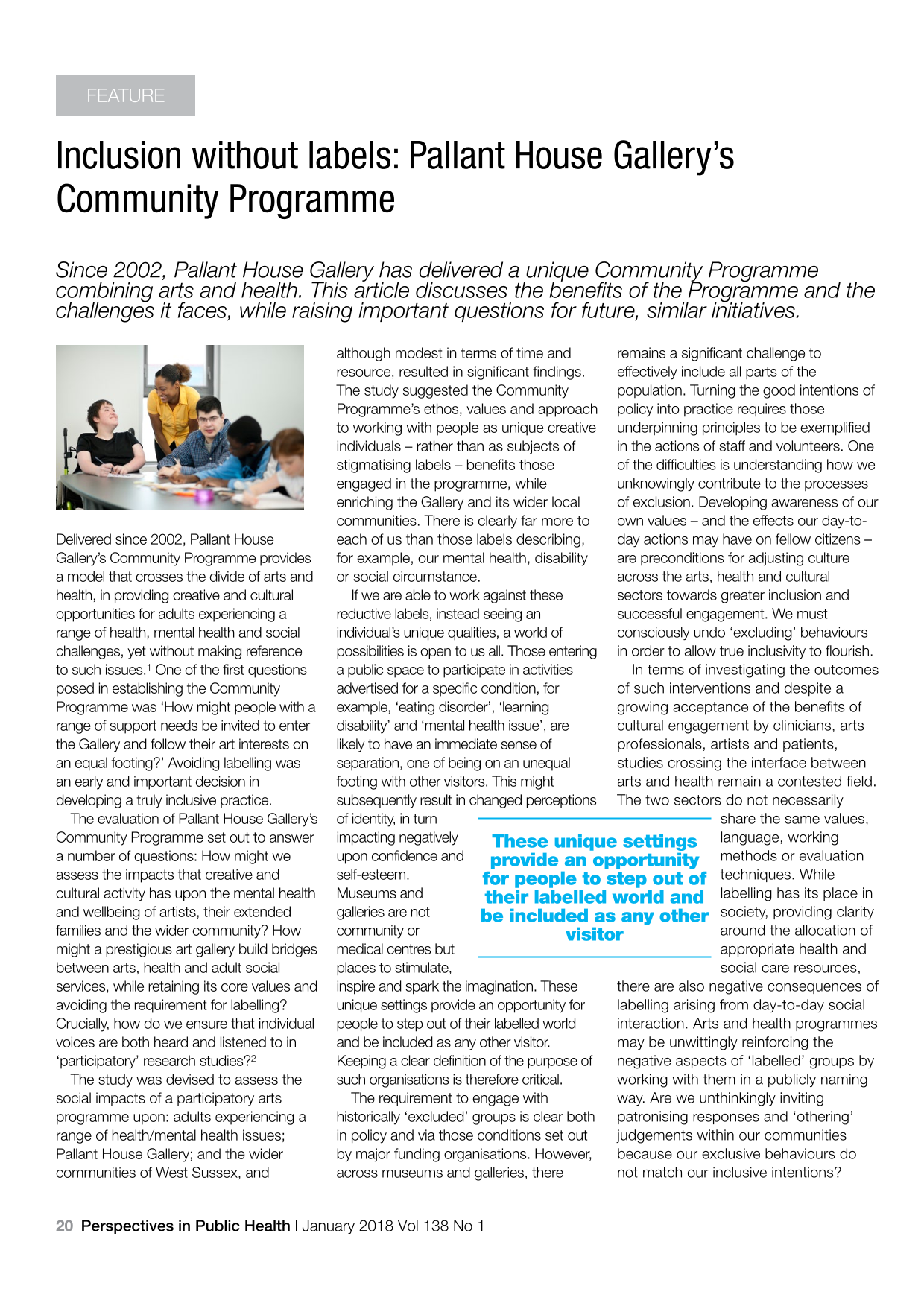
Delivered since 2002, Pallant House Gallery’s Community Programme provides a model that crosses the divide of arts and health, in providing creative and cultural opportunities for adults experiencing a range of health, mental health and social challenges, yet without making reference to such issues. 1 One of the first questions posed in establishing the Community Programme was ‘How might people with a range of support needs be invited to enter the Gallery and follow their art interests on an equal footing?’ Avoiding labelling was an early and important decision in developing a truly inclusive practice.
The evaluation of Pallant House Gallery’s Community Programme set out to answer a number of questions: How might we assess the impacts that creative and cultural activity has upon the mental health and wellbeing of artists, their extended families and the wider community? How might a prestigious art gallery build bridges between arts, health and adult social services, while retaining its core values and avoiding the requirement for labelling? Crucially, how do we ensure that individual voices are both heard and listened to in ‘participatory’ research studies? 2
The study was devised to assess the social impacts of a participatory arts programme upon: adults experiencing a range of health/mental health issues; Pallant House Gallery; and the wider communities of West Sussex, and although modest in terms of time and resource, resulted in significant findings. The study suggested the Community Programme’s ethos, values and approach to working with people as unique creative individuals – rather than as subjects of stigmatising labels – benefits those engaged in the programme, while enriching the Gallery and its wider local communities. There is clearly far more to each of us than those labels describing, for example, our mental health, disability or social circumstance.
If we are able to work against these reductive labels, instead seeing an individual’s unique qualities, a world of possibilities is open to us all. Those entering a public space to participate in activities advertised for a specific condition, for example, ‘eating disorder’, ‘learning disability’ and ‘mental health issue’, are likely to have an immediate sense of separation, one of being on an unequal footing with other visitors. This might subsequently result in changed perceptions of identity, in turn impacting negatively upon confidence and self-esteem. Museums and galleries are not community or medical centres but places to stimulate, inspire and spark the imagination. These unique settings provide an opportunity for people to step out of their labelled world and be included as any other visitor. Keeping a clear definition of the purpose of such organisations is therefore critical.
The requirement to engage with historically ‘excluded’ groups is clear both in policy and via those conditions set out by major funding organisations. However, across museums and galleries, there remains a significant challenge to effectively include all parts of the population. Turning the good intentions of policy into practice requires those underpinning principles to be exemplified in the actions of staff and volunteers. One of the difficulties is understanding how we unknowingly contribute to the processes of exclusion. Developing awareness of our own values – and the effects our day-to-day actions may have on fellow citizens – are preconditions for adjusting culture across the arts, health and cultural sectors towards greater inclusion and successful engagement. We must consciously undo ‘excluding’ behaviours in order to allow true inclusivity to flourish.
In terms of investigating the outcomes of such interventions and despite a growing acceptance of the benefits of cultural engagement by clinicians, arts professionals, artists and patients, studies crossing the interface between arts and health remain a contested field. The two sectors do not necessarily share the same values, language, working methods or evaluation techniques. While labelling has its place in society, providing clarity around the allocation of appropriate health and social care resources, there are also negative consequences of labelling arising from day-to-day social interaction. Arts and health programmes may be unwittingly reinforcing the negative aspects of ‘labelled’ groups by working with them in a publicly naming way. Are we unthinkingly inviting patronising responses and ‘othering’ judgements within our communities because our exclusive behaviours do not match our inclusive intentions? Worse, are our practices reinforcing stigma and exclusion? Are we inviting people into a world that, all too often, still has perceptions of being for a certain sector of society? Crucially, are we ensuring that our research methods are designed to be accessible to the widest range of participants, thereby representing the full scope of voices present in our diverse and evolving communities?
A full version of the social impact study may be accessed via Pallant House Gallery’s website: http://pallant.org.uk/learning-community/learn/learn/community-programme