






Abstract

Preventing the spread of infectious diseases and those associated with the various modes of exposure to water is increasingly challenging as the cruise industry, and consequently the size of passenger vessels, grows. This article discusses the management of water quality on board passenger ships and vessels to ensure the safety of all on board.
Introduction
The cruise industry is growing rapidly with new passenger vessels (PV) increasing in both size and the attractions and facilities they offer. For 2019, it is predicted that there will be a total worldwide input of US$134 billion (approximately £105 billion), over 1.1 million full-time equivalent staff, and estimated 30 million passengers. 1
While there have been improvements in ship sanitation and management of passengers to reduce the transmission of infectious disease, 2 as the size of ships and numbers of passengers increase, it is not surprising that when passengers become ill in such a confined environment, transmission to others is inevitable. This is particularly true for norovirus (NV), which, despite infections being generally short lived, are particularly hard to control because of the low infectious dose.3,4 NV can be transmitted from person-to-person, 5 from the environment where it can persist for long periods on soft furnishings and carpets, 6 and from the consumption of contaminated water, ice and food.7,8 On-board infections are not just limited to NV; there are many reported outbreaks of other gastrointestinal (GI) pathogens including Giardia, Cyclospora,9,10 Shigella, 11 Enterotoxigenic E.coli, 12 and Hepatitis E.13,14 In addition, there are many reports of outbreaks caused by naturally occurring waterborne pathogens such as Legionella and environmental Mycobacteria15,16 often associated with recreational water use.17 –20
Waterborne Risks
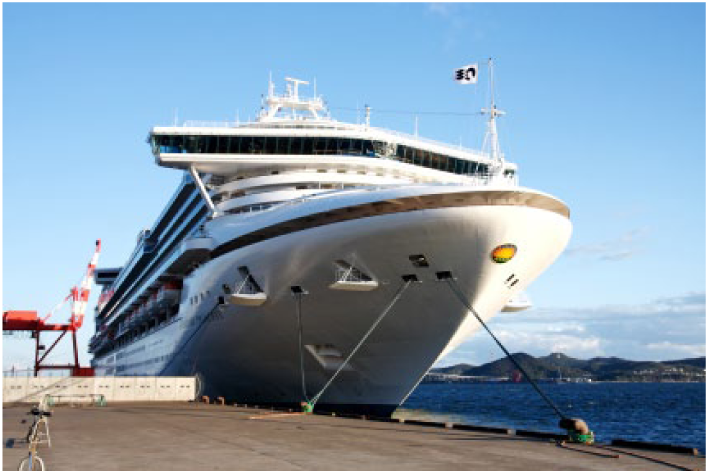
The newer ‘mega’ vessels now hold close to 10,000 passengers and crew. In addition to use for drinking, food preparation and personal hygiene, on-board water is also used in decorative water features, medical facilities and recreational systems such as hot tubs, pools, hairdressing salons and health spas, as well as in air conditioning systems and ballast water used to maintain the stability of the vessel. Water is also made on board primarily for technical purposes. This increased number of uses, complexity and proximity of clean and dirty water systems inevitably increases the risk of cross contamination and colonisation of such systems by pathogens, including legionellae species. 21 Managing water on board ship is therefore a serious challenge, particularly given the age and vulnerability of some of those using the water systems, with those over the age of 65 years being more likely to need medical assistance while on board. 22 Water management in this context is more akin to managing the water infrastructure for a small city, but with many additional challenges than found on dry land. For example,
Passengers arrive on board from distant locations and may be carrying infectious disease when boarding;
For vessels on international routes, the host port may not have access to water which meets international potable water standards, which are mainly based on the 4th edition of WHO Guidelines for Drinking Water Quality (GDWQ); 23
Even when the supplying water is of potable quality, poor management of connectors and hoses, poor hygiene in port while bunkering, management of storage vessels or inadequate water treatment may result in contaminated water entering storage tanks;
On longer voyages, prolonged storage of water on board PV increases the potential for naturally occurring opportunistic pathogens including Legionella which may be present in low and undetectable levels in the supplying water. During the voyage, hazards may increase to harmful levels making the water no longer safe at the point of use, particularly for those more vulnerable to illness (the advice for safe storage times of drinking water within large land-based buildings is to minimise storage of potable water, ideally to less than 24 h to reduce the risks of microbial growth as a result of stagnation);24–26
Water systems within vessels are subject to additional stresses from an aggressive environment and the ship’s movement, resulting in water disturbance. This increases the risk of corrosion and damage to the system infrastructure;
A large percentage of passengers on board cruise ships fall into the more vulnerable category for acquisition of infections 27 and are therefore at higher risk of acquiring infections, including Legionnaires’ disease, due to age, underlying illnesses and compromised immune systems.
The newer ‘mega’ vessels now hold close to 10,000 passengers and crew
For all these reasons, an effective management strategy is essential for all water from source to each point of use on board. Mouchtouri et al. 24 advocate use of the WHO water safety plan (WSP) approach for managing Legionella risks on board. This WSP is a documented proactive approach to water management, first documented in the 2004 WHO GDWQ. 29 It was originally developed for water utilities to ensure the safety of water from catchment to the point of entry to a building and has since been extended by WHO to reduce the health risks associated with water used within buildings for all types of use. 28 It is therefore ideally suited to be applied to ensure the safety of all ships’ water systems and associated equipment. The WSP is an effective approach as it is based on contamination prevention, rather than the traditional reaction to poor monitoring results, through the identification of all possible contamination points and putting interventions in place. This is backed up by training the crew in good hygiene practices, from the bunkering of water in port to each point of use to how to identify and mitigate any possible hazard and hazardous events. These include risks between other water systems on board such as ‘black’, ‘grey,’ and technical water. The WSP is implemented through adopting and validating control measures and support programmes, regular analysis and reporting, effective and timely remedial actions, verification procedures and continual on-board monitoring of the water supply.
A comprehensive WSP includes the following:
Identification and risk assessment of all potential hazards, including chemical, biological and radiological agents;
Reviewing existing control strategies to ensure effective mitigating management measures are effective;
Assessing monitoring and surveillance programmes to ensure the controls remain effective;
Effective communication, training, competence checks and audit programmes are essential supporting programmes.
Water management in this context is more akin to managing the water infrastructure for a small city
Procedures should be in place for both normal operating conditions and when there have been events which put water safety at risk, such as adverse monitoring results or plant failure. A bespoke WSP for a passenger vessel would identify the key personnel to be accountable and take responsibility for water safety across all the various types of water use on board. These key personnel would form a water safety management team (WMT), which would usually be chaired by the ship’s master. The plan would take into account the quality of the supplying water up to each point of use and all potential sources of exposure to water, including technical water made on board, ballast water and waste water, together with all water-using equipment. As part of the WSP, the team would ensure that
A comprehensive risk assessment is carried out by competent assessors familiar with the ships systems;
All potential waterborne hazards (these may be chemical or biological) and the hazardous events that could lead to contamination and/or increases in the levels of hazards are identified;
Effective barriers are in place to prevent contamination from occurring;
There has been suitable validation of the control measures for each use of water;
There is a monitoring and surveillance programme in place to ensure the controls remain effective;
The plan is regularly reviewed and is supported by ensuring there is adequate training and communication together with internal and external auditing protocols.
In the US, external inspections are carried out by the Centers for Disease Control and Prevention’s (CDC) Vessel Sanitation Programme (VSP)30,31 and in the European Union (EU) by the SHIPSAN Joint action inspections programme. 32
When developed and implemented properly, the WSP will ensure the safety of water used for all purposes and all users. However, the human factor cannot be eliminated and is often the cause of water contamination events. The industry needs to ensure that both the operators and crew are adequately trained and aware of the risks from poor procedures and management in the whole area of on-board water safety awareness and health risk management.
Regulations
The most important public health regulations for ship owners and operators are the International Health Regulations (IHR). These came into effect in 2007 33 and are supported by WHO guidelines.34,35 The regulations set the framework and the minimum standards required for water quality given in the Handbook for Inspection of Ships and Issuance of Ship Sanitation Certificates,36 to which vessels have to comply with in order to be awarded a Ship Sanitation Certificate. Their purpose is ‘to prevent, protect against, control and provide a public health response to the international spread of disease in ways which are commensurate with and restricted to public health risks, and which avoid unnecessary interference with international traffic and trade’ and include 6-monthly inspections in IHR-authorised ports. Inspections include the assessment of risks arising from the water quality on board, including recreational water.
European Regulations and Guidance
Within Europe, the European Union (EU) SHIPSAN ACT Joint Action guidelines for water quality on board passenger ships 37 have been developed to rationalise the implementation of regulations across European ports. These have been incorporated by some countries into national regulations and include an agreed annual EU inspection programme for passenger ships supported by European Commission guidelines 38 and underpinned by training programmes to ensure uniformity of inspection procedures and the competency of inspectors. The EU SHIPSAN ACT Information System (SIS) and a web-based risk assessment tool for cargo ships are supporting tools for inspectors.
The Maritime Labour Convention 39 came into effect in August 2013, specifying for the first time the need for high-quality drinking water standards ‘to ensure that seafarers have access to good quality food and drinking water provided under regulated hygienic conditions’. Other regulations and guidelines that have an impact in this area include the UK Port Health Inspectorate’s Public Health Ships Regulations1979, as amended.40,41
The American VSP
In the US, however, the main ship sanitation guidelines are the CDC VSP, 32 developed initially to assist the cruise industry ‘to prevent and control the introduction, transmission and spread of gastrointestinal illnesses’. These have since been updated to prevent illnesses from environmental waterborne pathogens such as Legionella and environmental mycobacteria. There are differences between the EU and US ships legislation. 42 The US inspection programme operates under the authority of the Public Health Service Act with dedicated inspectors and a strict inspection regime but is not as holistic as that in the EU, which also covers chemical and radiation contamination. As with the European scheme, there is a technical manual; the Vessel Sanitation Programme 2018 Operations Manual, 43 with a number of supporting training programmes. Because of the differences between the EU and US schemes, vessel operators tend to make sure that their operating procedures comply with both sets of regulations/guidelines.
Ballast Water Management Regulations
The most important new development is the introduction of International Maritime Organization’s (IMO’s) ballast water regulations in September 2016, 44 which are based on the outcome of discussions at the International Convention for the Control of Ships’ Ballast Water and Sediments in 2004. The IMO Ballast Water Management (BWM) regulations require all ships in international trade of 400 gross tonnage and above, and to which the BWM Convention applies, to manage their ballast water and sediments to a specified standard according to a ship-specific BWM plan; to maintain and keep on board a ballast water record book; and to possess an International Ballast Water Management Certificate. The main purpose of these regulations and guidelines is to provide security against the global spread of disease and the introduction of alien species into new locales. Ballast water taken on board in foreign ports to increase stability can contain freshwater or marine microorganisms and non-native plant, algae and animal species which can then be carried across the globe. 45 When released at the port of destination, they can threaten human health, for example, from pathogenic microorganisms such as Vibrio cholerae, and native populations in areas where they do not normally survive.46,47 Introduction of invasive alien species can have devastating consequences for the survival of native ecosystems, for example, Asian Kelp (Undaria pinnatifida), 45 Chinese mitten crabs (Eriocheir sinensis) 48 and Pacific oysters (Crassostrea gigas). The US has not signed up to the BWM convention but has implemented instead the BWM Regulations. 49 These are regulated by the US coastguard together with the rules for ‘Controlling the discharge of living organisms from ships’ ballast water in US Waters’ which came into force in 2012 and prohibit the release of ballast water in US waters. 50 While similar to the IMO, there are some differences in the terminology and testing regime. However, both require both ship board– and land-based testing in accredited laboratories. The US coastguard blog has a useful explanation of the requirements for BWM in US waters. 51
Wsp Monitoring
Monitoring all water used on board is essential to verify that controls remain effective. The best monitoring parameters are those where target levels can be checked in real time, for example, temperature, turbidity, chlorine and pH, thereby enabling a rapid reaction to adverse results. For some parameters, this can be automated, thus eliminating the human factor. Demonstration of compliance with regulations, including the monitoring of microbiological parameters, is difficult during long voyages. While it is not routine to monitor for pathogens even with a fully equipped laboratory, it is routine to look for microbial indicators of pollution. These include E. coli and enterococci, which inhabit the normal gut flora of animals in large numbers but do not grow in water and are much easier and cheaper to detect. While their presence does not indicate that pathogens are necessarily present, they do indicate faecal pollution of human or animal origin: this is like looking for a needle in a haystack – first find the haystack – but finding one does not necessarily mean there is a needle in it!
Sampling for microbial indicators of drinking water pollution, such as Pseudomonas aeruginosa and Legionella, and verifying water quality within recreational water systems require water samples to be taken and sent to a microbiology laboratory, where it may take days for a confirmed result. This is neither practical nor in the public health interest if a ship takes water on board and then sets sail on a long voyage.
An ideal water quality test method would be safe, simple, easy to perform on board, rapid, reliable, robust, reproducible, specific for the parameters required, sensitive, comparable to standard methods, require no specialised storage facilities, use few consumables and limited equipment and, of course, inexpensive. Not surprisingly, no such single method has all these attributes. However, there are some good real-time molecular microbial tests available from accredited laboratories that can take only a few hours to perform. They are useful for ruling out suspected sources of contamination in suspected outbreaks, but they require a variety of equipment, consumables, special clean facilities and laboratory competence, and in addition, the results can require specialist interpretation.
There are inexpensive tests available, but some of these are not sufficiently specific or sensitive and have not been compared to current International Organization for Standardization (ISO) standard methods using the methodology described within ISO 17994. 52 It is time-consuming and costly to comply with this standard, but is worthwhile doing so as for data to be of use to regulatory authorities the results must be shown to be comparable to those carried out in an accredited land-based laboratory.
Examples which are closest to meeting the above criteria are the IDEXX Quanti-Tray systems, which have undergone extensive international validation together with peer-reviewed publications to show their results are comparable53 –56 and confirm their suitability for use as field methods for water testing including within extreme field conditions. 57 An additional benefit of these culture-based methods is that during outbreak investigations, environmental isolates are recoverable for typing with those from patients. However, as with any method, the competency of the sampler and the place and timing of sampling are key to ensuring that samples are representative of the highest risk to users. On many occasions, samples are taken without regard as to why they are taken, and no thought is given to timing, position within the system and factors such as the proximity to dosing points. For example, hot tub and swimming pool samples are often taken first thing in the morning before the pools are used. Assuming appropriate pool management, this is when the pool water will be at its optimum quality and the results then are not indicative of whether the pool treatment system is able to cope under a heavy bather load.
Conclusion
Preventing the spread of infectious diseases and those associated with all the different modes of exposure to water is an increasing challenge within the relatively confined environment on board PVs, particularly in those housing thousands of passengers, many of whom being more vulnerable to infections as a result of increasing age and underlying conditions. With the increasing size of vessels and range of different water uses, a multidisciplinary approach is essential. Ship owners/operators and crew can have a major impact on how on-board water supply, distribution and consumption are managed to ensure the healthy operation of the ship and the health of its passengers and crew by developing and implementing a WSP for all uses of water. The WSP has been shown to be an effective documented approach to improving water safety and in addition builds resilience as the WMT gains experience and competence and learns from each other. To be able to demonstrate ongoing water safety management, compliance and due diligence, the shipping industry needs to ensure that there is experience, competence and training of the WMT. Reliable risk assessment and control plans are essential to preventing waterborne illness backed up by good documentation, effective communication and robust monitoring programmes using reliable test methods that can be carried out on board so that any adverse results can be dealt with during the voyage.