







Abstract
Aims:
The prevalence of charities and other non-profit organisations sponsoring for-cause physical activity (PA) events has continued to rise. Few studies have examined for-cause events through a public health perspective to determine the reach and potential for public health and PA promotion. This study described participants in a for-cause event supporting breast cancer to determine the reach of the event and identified possible leverage points of for-cause events for public health promotion.
Methods:
Participants registered online for the Walk for Life events in Columbia, SC (Half marathon, 10k, 5k, and Walk-a-thon), were included in this study. Data were analyzed using Microsoft Excel.
Results:
Over 6,000 people participated in the event and 4,942 registered online. Of online registrants, most participants were women (n = 3,800, 78.95%) and most participants, completed the walk-a-thon (n = 3,539), followed by the 5k (n = 829), half-marathon (n = 236), and 10k (n = 209). The average age of participants was 39.79 years (SD = 1.35).
Conclusions:
For-cause PA events often recruit high numbers of participants, particularly high-priority populations in PA interventions. Therefore, these events bear innovative implications for PA researchers and practitioners to leverage these events to promote health and PA while simultaneously supporting charity and non-profit organisations.
Introduction
Physical activity (PA) provides health benefits, 1 but many are not regularly active. 2 Levels of PA vary around the United States as individuals in the northeastern and western regions are more regularly active than those in the south. 2 In fact, about half (50.9%) of adults in the United States regularly achieve aerobic guidelines for PA and less than a quarter (20.5%) of adults meet both aerobic and muscle-strengthening guidelines. 2
Recently, charities and organisations have sponsored for-cause PA events, attracting large numbers of participants. While charity sports events have been investigated previously through a sport marketing perspective, 3 research regarding public health and PA promotion perspectives is lacking. 4 These for-cause events allow individuals to support organisations in a unique manner through PA rather than traditional forms of financial donations and volunteering time, inciting the term, ‘physical philanthropy’. 5 For example, participants in an event supporting a water charity organisation shared that engaging in PA and feeling the need for thirst enabled them to connect more closely with the cause. 6 In addition, researchers have identified participant motivations in for-cause events, drawing potential connections to health behaviour and motivation theories used to promote PA. These motivations include the need to socialise, demonstrate competence, and fulfil a desire to help others and make a difference.7,8
The previous research concerning for-cause PA events suggests there may exist potential leverage points for public health and PA promotion. Therefore, the purpose of this study was to describe participants in a local, for-cause event supporting breast cancer to examine the reach of the event and suggest potential leverage points from the for-cause event for public health and PA promotion.
Methods
Participants of this study were those who registered online for the Walk for Life and Famously Hot Pink Half-Marathon, 10k, and 5k. Following the for-cause event, the first author contacted the organisation and received an infographic report of online registrants and a de-identified list of participants’ age, gender, and event.
The Walk for Life and Famously Hot Pink Half-Marathon, 10k, and 5k occur annually in Columbia, SC. The event’s premier sponsor is the Palmetto Health Foundation. The 27th Walk for Life and Famously Hot Pink Half-Marathon, 10 K, and 5 K occurred on 14 October 2017, and attracted over 6,000 participants from South Carolina, Georgia, and North Carolina. Participation and financial donations contributed to a 7th mammography unit at the Palmetto Health Breast Center and additional technology to improve early detection of breast cancer. Registration for the half-marathon, 10k, 5k, and walk-a-thon events were US$60, US$45, US$40, and US$35, respectively. Participants were encouraged to raise additional funds for the Palmetto Health Breast Center. However, fundraising was not mandatory to participate.
Analysis
Data were managed using Microsoft Excel. Final analyses required complete data for participants’ gender, event, and birthdate. Participants were not included if gender or event were missing and birthdates resulted in a negative age or over 100 years old. Descriptive statistics were used to characterise participants across events. Means and standard deviations were calculated for ages of participants in each event.
Results
In total, 4,942 participants registered online. A total of 129 entries were excluded from the final analysis due to missing gender, event status, or improbable ages. The final sample included 4,813 registrants. Participants were primarily White/Caucasian (55%), followed by Black/African American (33%), Hispanic (2%), and other (10%). The age and gender distributions across the four events are presented in Table 1. A total of 3,800 women (78.95%) and 1,013 men (21.05%) participated. The walk-a-thon had the highest number of participants (n = 3,539, 73.53%), followed by the 5k (n = 829, 17.22%), half-marathon (n = 236, 4.90%), and the 10k (n = 209, 4.34%). The average age of participants was 39.79 years (SD = 1.35), with a range from 1 month to 90 years old.
Descriptive characteristics of participants in the walk for life events
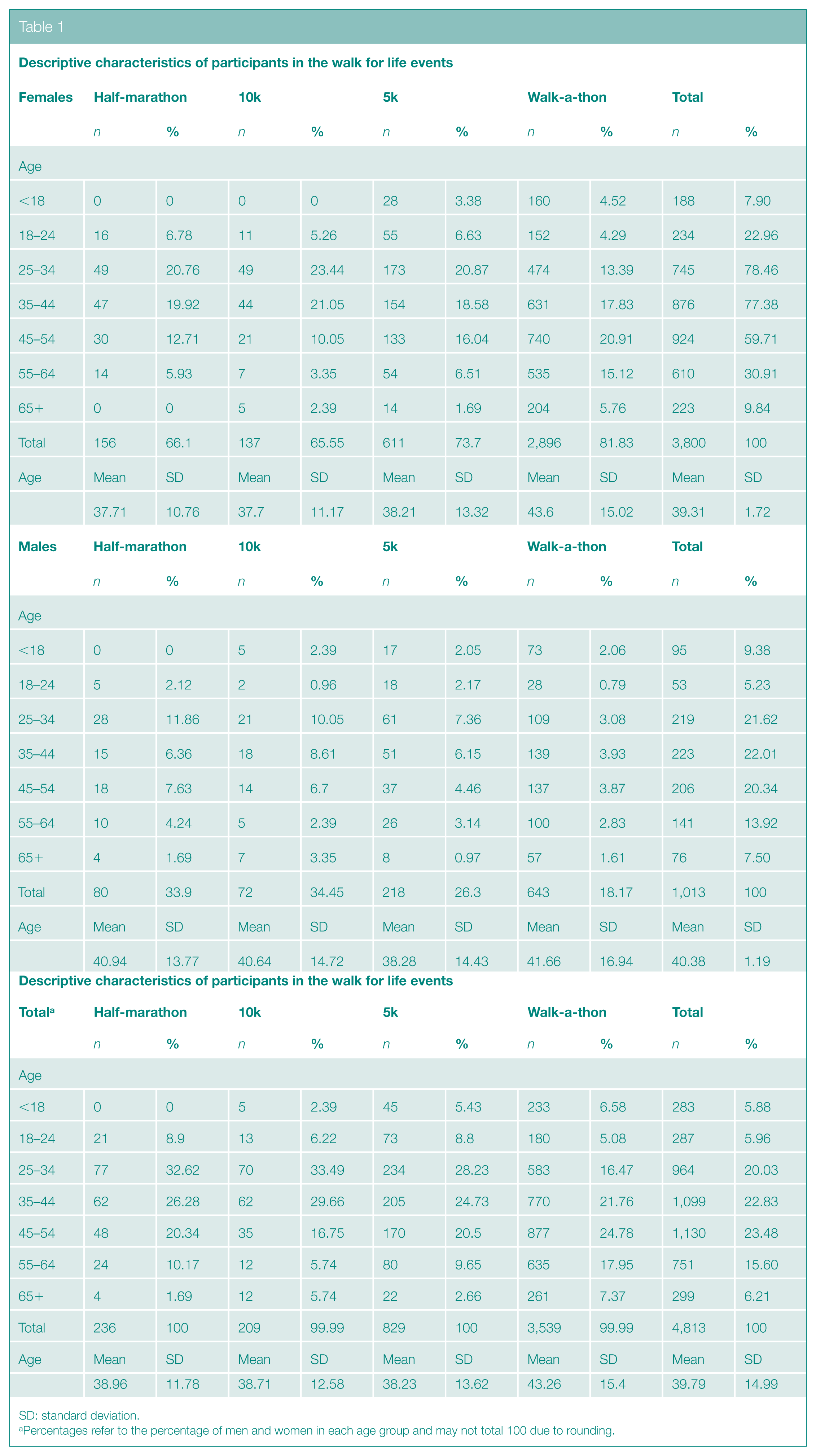
SD: standard deviation.
Percentages refer to the percentage of men and women in each age group and may not total 100 due to rounding.
Discussion
The goal of this study was to describe participants in a for-cause event and to examine the potential leverage points for public health and PA promotion. In this one-day event, over 6,000 individuals, (of which 4,813 pre-registered online), travelled in order to participate in the ‘Walk for Life and Famously Hot Pink Half-marathon, 10k, 5k’, raising money and support for breast cancer research and services. Over three-quarters of online registrants were women. In fact, women aged 25–55 comprised over half of all participants. These numbers mirror results from a study of participants in a for-cause event where women had a higher participation rate than men. 5 In addition, the average age of those participants (41.25 years, SD = 12.41) 5 compared similarly to the average age of participants in this study (39.79 years, SD = 14.99). The higher proportion of women in this study may be due to the relevance of breast cancer in women thus attracting more women than men. Only 48.1% of women in South Carolina met the aerobic guidelines for PA. 2 The Walk for Life for-cause event recruited a high number of female participants, suggesting this and other for-cause events may serve as an introductory step for women to the health benefits and enjoyment of PA.
Additional leverage points for public health and PA promotion from for-cause PA events exist. Most participants (55%) were White and the highest proportion of participants were men and women aged 45–54 years (23.48%). In South Carolina, just over half (53.2%) of White, non-Hispanics meet aerobic guidelines for PA and less than half (44.6%) of adults met aerobic guidelines for PA. 2 Finally, over one-fifth of participants (21.81%) were at least 55 years old. PA remains important with increasing age to assist with activities of daily living and improve quality of life. 1 For-cause events often reach these priority populations exposing them to PA. Previous research has investigated possible mechanisms for leveraging mass sports events to promote and increase sports participation. Findings suggest collaborations between sport and non-sport organisations are needed for successful integration of sports participation into a community. 9 Therefore, charities, non-profit organisations, and public health and PA practitioners and researchers may wish to seek each other as partners to increase participant education and exposure to the benefits of PA.
Additional leverage points for community and public health promotion include increasing advocacy, raising awareness, providing education, and raising money for relevant health issues. In the event used for this study, participants were exposed to breast cancer education, and raised money and awareness for health services. This may lead to participants engaging in preventive health behaviours by enrolling in screenings and advocating further for improved detection facilities and programs.
Another potential leverage point of for-cause events can be attributed to the benefits of increasing feelings of self-efficacy for PA in participants. For example, participants may experience an increase self-efficacy and competence by training for and completing the event, potentially encouraging them to set goals for PA and complete future distances or activities. 7 Completing a shorter-distance walk-a-thon may aspire one to walk further or begin a jogging or running program to participate in future events of longer distances. Even more, the diversity of the types of activities and distances in for-cause PA events has the potential to expose populations to a variety of types of enjoyable PA. As individuals continue increasing self-efficacy and competence for PA, they may begin to maintain PA and participate in future events. 10 Thus, these events may provide participants with an important, introductory first step toward adopting and maintaining a physically active lifestyle.
The final important public health leverage point consists of the economic and consumer awareness benefits received by event sponsors. Considering that for-cause events commonly bring together a sport business and a non-profit or charity organisation, these for-cause events benefit both organisations because participants may purchase merchandise and/or equipment from the sport business while simultaneously raising money and awareness for the host organisation. 3
This study has limitations. First, no measures of PA, self-efficacy, or competence leading up to or after the event were collected. Thus, we could not assess the potential leveraging effects of increasing PA and feelings of self-efficacy and competence by participating in the event. A second limitation is the sample comes from only one for-cause event. While there were many participants, the sample was predominantly Caucasian women, preventing the ability to draw further conclusions about the potential of reaching other populations in these events.
Despite these limitations, this study has notable strengths. This is the first known study to compare participants in a for-cause event to state-level PA data in order to highlight the high reach and potential public health and PA promotion leverage points in these events. Future research should collect measurements of PA of participants before and after the event to determine possible effects on PA attributed to completing the event. In addition, this study highlights key leverage points for potential public health and PA promotion through for-cause events. As the popularity and prevalence of for-cause events continues to increase, this study’s implications carry significance for public health promotion efforts, the individuals participating, and the sponsoring charities and non-profit organisations hosting the events.
Footnotes
Acknowledgements
The authors wish to thank Ms. Kristin Hudson, Events Director for the Palmetto Health Foundation, for partnering with them and providing data for this study.
Conflict of Interest
The author(s) declared no potential conflicts of interest with respect to the research, authorship, and/or publication of this article.
Ethics Approval and Consent to Participate
This research did not involve the participation of any human subjects and was declared exempt by the University of South Carolina Institutional Review Board.
Funding
The author(s) received no financial support for the research, authorship, and/or publication of this article.
