







Abstract

Introduction
Sport England have commissioned 12 Local Delivery Pilots (LDPs) across England 1 that apply a Whole Systems Approach (WSA) to tackling physical inactivity in communities. This article details the approach taken in the South Tees LDP, ‘You’ve Got This’, spanning the local authority areas of Redcar and Cleveland and Middlesbrough. ‘You’ve Got This’ have created a partnership beyond traditional physical activity organisations and sport providers, actively engaging with the local voluntary sector, charities, healthcare and housing providers, commissioners, and private sector businesses. 2
The LDP focuses on four ‘communities of interest’ across South Tees: people waiting for specific types of surgery (prehabilitation), people with or at risk of developing Type 2 Diabetes, people accessing commercial weight loss services, and health professionals to utilise physical activity as a clinical pathway. Concurrently, a whole community approach is taken to increasing physical activity in four of the most deprived wards across the area with stubborn health inequalities, these being Grangetown, Southbank, Brambles and Thorntree, and North Ormesby.
The Common Purpose Model
Whole systems change is overwhelmingly complex. The LDPs reflections on system change have focused on the ever-changing interconnections between different people in different roles and places. They perceive system change to emerge from people working to achieve a ‘common purpose’ of ‘active lives as a way of life’ which is the vision of ‘You’ve Got This’.
The Common Purpose Model was co-developed between the LDP core team and the academic process evaluation team to support learning as part of the ongoing realist process evaluation.3,4 The model illustrates an early understanding of the emergence of common purpose, via a combination of actions and activities driven by the LDP and partners, and the cultural and structural influences of change. The Common Purpose Model provides a framework to guide working practices and learning (Figure 1).
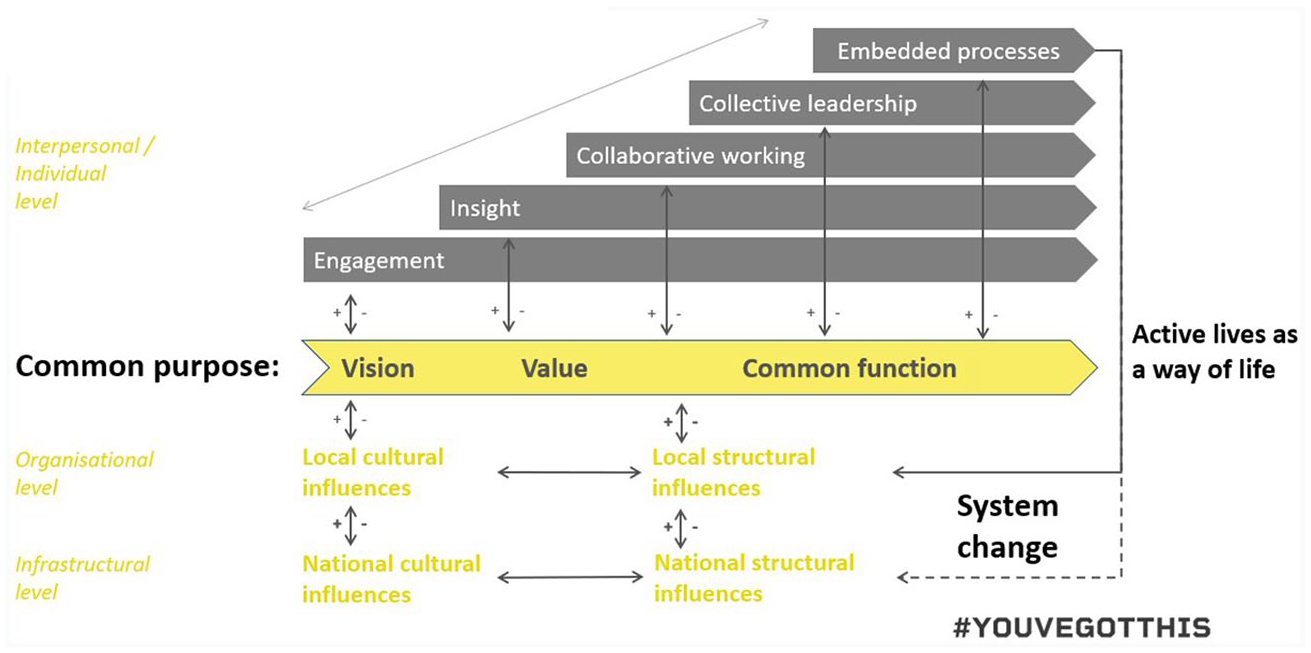
Common Purpose Model for system change.
The model illustrates three key elements which are argued to sustain a common purpose: Vision + Value + Collective function = Common purpose, as detailed in the following people should:
Subscribe to the vision: ‘active lives as a way of life’.
Value that vision. In this case to perceive it has worth relative to their personal or professional objectives.
Perform a collective function(s). That is, to act in line with the vision that produces a result of some kind.
These elements are shown in the model as flowing from one to another – in line with the ways in which the LDPs are seeing system change emerge. It should be recognised, however, that in reality there are feedback loops and the process is nonlinear. 5 Furthermore, it is feasible that people can act in line with the vision without consciously subscribing to it.
The LDPs activities have primarily been aimed at influencing and/or connecting a wide range of people to engage with the vision, see its value and then act in line with it. Most of these activities described below operate at an individual or interpersonal level. People occupy many different roles within the system including senior leadership, policy makers, management, frontline workers across different specialisms and sectors as well as with individuals in the target wards.
These core activities are defined as follows:
Engagement: Activities which are intended to start a relationship of some kind.
Insight: Activities which are intended to gain a deep understanding of (and empathy towards) someone else’s situation. The LDP are utilising behaviour change frameworks, including the influencer model, 6 to understand the lives of the people in the target wards as well as stakeholders working or influencing those people.
Collaborative working: Activities which bring skills, expertise, networks together on a project. This includes collaboration internally, as well as collaboration between partners brokered by the LDP.
Collective leadership: Activities or actions where people are working together towards the same vision. This may differ from collaborative working in terms of the higher level of commitment, trust, shared power, shared responsibility for achieving the aim, shared accountability and shared successes.
Embedded processes: Activities or actions which formalise the new ways of working so that they can remain active beyond the individuals and relationships in the LDP and create a legacy.
Individual behaviour and interpersonal relations are influenced by an individuals’ skills, history of working together, characteristics and demography. The final elements of the model are the external influences that facilitate or constrain progress, separated into cultural influences and structural influences: 7
Cultural influences are the ideas, beliefs and values that operate in the target wards and the organisations. Where these ideas align with the vision and ways of working, it is perceived to be easier to work towards a common purpose. Where they do not, more insight and engagement work is undertaken to attain alignment of sorts.
Structural influences are the processes, practices, hierarchies and roles which exist within and between different parts of the system and constrain choices in some way. Where these structures align with the new ways of working, it is perceived to be easier to work towards a common purpose. Where they do not, more collaborative and collective work is undertaken to change the structures to attain alignment of sorts.
In some instances, local cultural and structural influences are constrained by national cultural and structural influences, for example, national policy, legal, financial and accountability frameworks.
The Common Purpose Model in Action
The Common Purpose Model has been utilised in several different ways to support developing understanding and learning. This includes engaging partners as a visual aid or reference point. It has been used directly with health professionals to identify the elements that may be associated with embedding physical activity in GP surgeries.
Conclusion
The Common Purpose Model has been utilised in South Tees as a tool to guide working practices and learning, it is a framework to support stakeholders to manage complexity when promoting ‘You’ve Got This’ vision ‘active lives as a way of life’.
