







Abstract

In this short article, we introduce the work of the National Centre for Arts and Mental Health (NCAMH) in Denmark and consider how this partnership of statutory healthcare, a charity, artists, healthcare providers, services users, research, and creative expression is a current model for recovery-practice by linking it to the Danish Government’s 10 year plan for psychiatry. 1
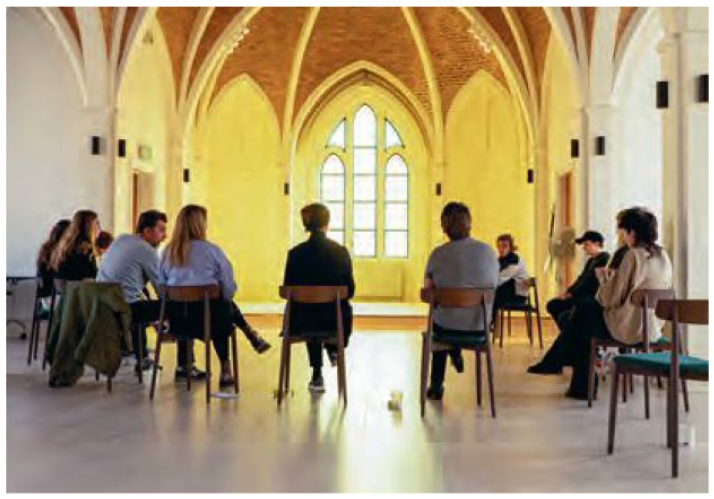
The Danish Government’s 10 year plan for psychiatry was launched in 2022, recognising that the increase in poor mental health in the population is a societal problem that could escalate from minor to major if left untreated. Among the identified challenges in current mental healthcare services, the plan lists insufficient access to services, lack in quality of service, high-level stigmatisation, and shortage of research as well as a lack of interdisciplinary approaches. Since 2018, the Association for Arts and Mental Health (Foreningen Kunst og Mental Sundhed) has been delivering creative writing groups led by professional authors for service users in recovery. 2 Visual arts, video, drama, and hospital-radio have become available as part of the creative platform and additional staff have been recruited which included creating employment opportunities for service users. Financial support from private and statutory funds has been acquired with a recent government grant to scale up the operation with a national remit in Denmark for two years. In short, NCAMH is a multi-arts and research centre located at University Hospital Mental Health Care Center Amager in Copenhagen situated situated in ‘The House of St. Elisabeth’, which used to be a catholic nunnery. NCAMH consists of an interdisciplinary team of artists, mental healthcare professionals, researchers from humanities and medical sciences, and persons with lived experience of mental healthcare.
Photo: Peter Franceschi.
A more holistic and recovery-oriented approach is needed in mental healthcare in Denmark; however, a recent study shows that there are several challenges in the inter-sectional work lacking an understanding of recovery and how to deliver it in intersectoral collaboration. Furthermore, care decisions are often made paternalistically, ignoring the voices of services users and relatives. 3 Findings from this study further suggest that in a hospital setting, the primary focus is on diagnosis and medicine and that in community mental healthcare, the focus is on self-care, self-sufficiency, and accommodation which essentially means that the social, existential, and aesthetic needs of recovery are neglected.
NCAMH seeks to create a space where alongside medical requirements, other health needs are met including providing a platform for building social relations and connections to contribute to the recovery process. Through developing services that are supportive and holistic, NCAMH strives to create a space where the arts can build bridges and help combat stigmatisation and where service users are included in the development of the services and the directions of the centre. This ensures access, sustainability and quality of service delivery in line with the Danish Health Agency’s 10 year plan for psychiatric care. The interdisciplinary staff team will help to deliver a service derived from a synthesis of ideas and with the ability to address a variety of different needs.
NCAMH seeks to (1) develop art-based interventions and activities; (2) establish a curated arts programme and exhibition space for artists with lived experience of mental healthcare, that is open to the public; and (3) develop a research programme that investigates the effects and mechanisms of art-based group interventions and activities led by professional artists.
Service users have opportunities for participation in quality artistic endeavours including participatory art workshops, writing groups, curated exhibitions, poetry and drama performances, hospital-radio and symposia. Service users are involved in various levels of the organisation in the workshops as participants as part of treatment, and in designing exhibition programmes, hospital-radio broadcasts as well as arranging poetry and drama performances that are open to the public. Furthermore, two service users are employed 20 h per week leading different artistic platforms – as the director of the hospital-radio and as a house-poet leading creative writing courses for peers. Beyond providing the two service users with a platform for using and improving skills, it also demonstrates positive role-models for other service users.
Photo: Peter Franceschi.
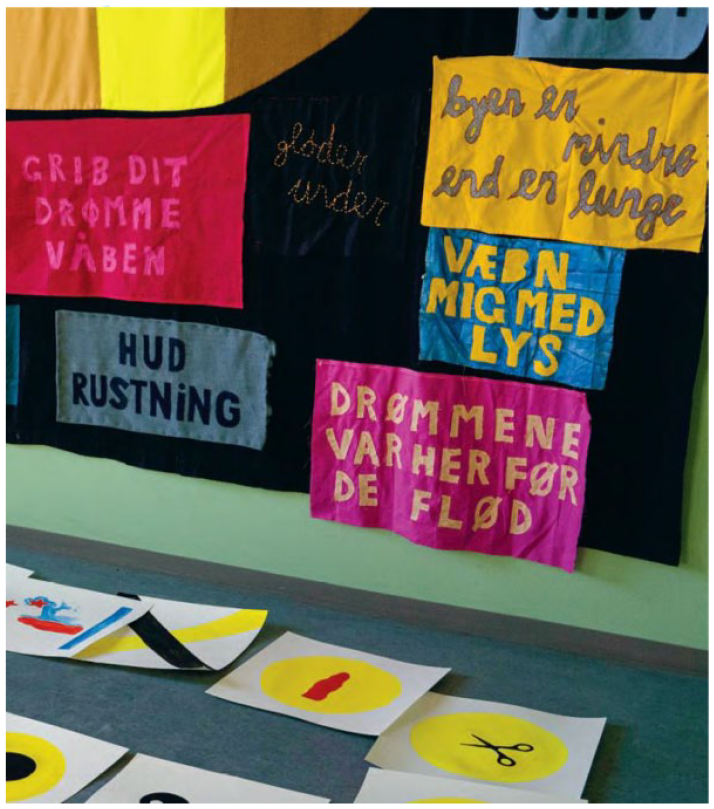
Providing a safe environment where the service users can feel safe to play and be expressive, and where signs of suffering or deviations are acceptable while the focus remains on the aesthetic work and the community, is important.4,5 This allows a focus on the collective artistic practice as a core foundation where all participants have agency and influence over their own artistic work and where art is considered a basic human factor and as an ‘ontological third’ 6 or as transitional phenomena that can be both ‘outside and inside’ and ‘me-yet-not-me’. 7 The emphasis is not on making artists but on making art as a basic human need for being experimental in a creative community and to help towards recovery. 8
One of the major barriers for developing a non-statutory centre such as NCAMH is building a sustainable financial foundation, allowing long-term goals to create a sense of belonging and security for both service users and staff as well as establishing confidence with collaborating partners. This is still a work in process for NCAMH.
