







Abstract
Nepal is now a Federal Democratic Republic state after the promulgation of the Constitution of Nepal in 2015. This viewpoint offers an understanding of the various dynamics that need to be considered in developing a health budget and the challenges that Nepalese policymakers face in the current light of federalism, pandemic and longterm health goals.
Introduction
Nepal is now a Federal Democratic Republic state after the promulgation of the Constitution of Nepal in 2015. 1 The country has three tiers ofgovernment – one federal, seven provincial and 753 localgovernments. 2 Each level of government is authorised to execute its powers by enacting laws, policies, programs, and annual budgets within its respective jurisdiction, as defined by the Constitution. In subjects under their authority, all three levels can write and issue laws governing their financial authorities, charge taxes, collect income, create a yearly budget, establish plans and programs, and put them into action. The early stages of Federalism also met with the global spread of COVID-19 which brought unprecedented difficulties in financing health. Along with the political changes, there has been some fresh data on health outcomes. For instance, life expectancy increased to 70 years in 2017, up from about 38 years in 1960. The infant mortality rate has also declined from 216 per 1000 live births in 1960 to 27 per 1000 live births in 2019, while the maternal mortality rate declined from 553 to 186 per 100,000 live births between 2000 and 2017. Against this backdrop, this viewpoint offers an understanding of the various dynamics that need to be considered in developing a health budget and the challenges that Nepalese policymakers face in the current light of federalism, pandemic and long-term health goals.
Health Sector Budget
The budget for health grew almost three-fold from Nepalese Rupees (NPR) 40.6 billion in FY 2016/17 to NPR 123.3 billion in FY 2022/23. These increases may be attributable to the COVID-19 prevention and control programs. In the newly declared budget of FY 2022/23, the health budget has fallen in comparison to the previous FY (Figure 1).
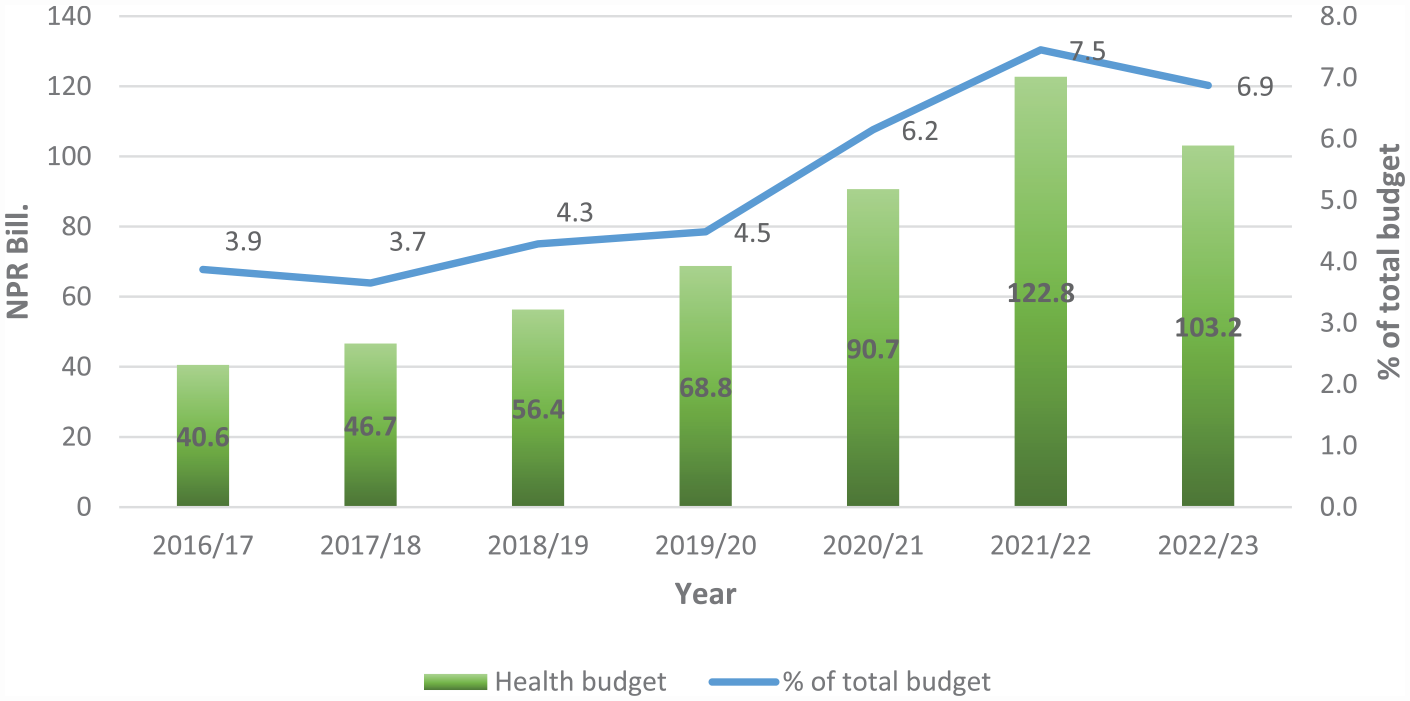
Health budget (left axis) and its rate of growth (right axis)
Broader Trends in Health Financing and UHC
Nepal’s per capita gross domestic product (GDP) increased by 61% from 2000 to 2017 and per capita public spending on health doubled during the same period. The rise in per capita, continuous government spending on health between 2000 and 2017 was mostly attributable to increasing total government expenditures as a percentage of GDP, followed by economic growth. Reprioritisation of the health sector’s proportion of overall government expenditure (or its absence) hampered growth in per capita public spending on health. For instance, reprioritisation of health fell from nine percent of total government spending in 2000 to five percent in 2017. 3
While economic development may recover, government spending on health remains low in comparison to other countries in the region and worldwide. 4 As a result, ensuring that public spending on health does not fall further as a percentage of total government spending is an important policy. Despite the aforementioned health-financing issues, Nepal has steadily improved its Universal Health Coverage (UHC) coverage index from 2000 to 2017, surpassing the low-income country average in recent years. 5 Over time, key health outcomes have improved. As a result, it is critical for Nepal to maintain and build on its gains, as well as to continue to prioritise its health sector.
As per the constitution, budget allocation is split among all three tiers of government, but largely remains within the remit of the federal government. Even though in FY 2022/23, the share of the federal government has declined to 67.2% from 74% of the previous FY, and there has been increase both at the province and the local level in FY 2022/23. 6 It is crucial to enforce allocative efficiency to ensure that the funds are utilised effectively at all levels. Also, federalism has opened up the capacity of the subnational governments to collect taxes and manage their own finances. By tapping into their fiscal space, subnational governments can prioritise resource allocation to address the specific needs and priorities of their communities. It is important for subnational governments to balance their spending with their revenue-raising capacity and to ensure that their fiscal policies are sustainable in the long term.
Challenges in the Recent Years
Impact of COVID-19 Pandemic
Nepal cannot continue to rely on favourable macroeconomic conditions to increase fiscal space for health in the wake of the COVID-19 outbreak, as it has done for the past two decades. The increase in per capita government spending on health between 2000 and 2017 was mostly attributable to both higher government spending and economic growth (as measured by GDP per capita). In the short-to-medium term, the COVID-19 outbreak has resulted in negative economic growth estimates, underlining the significance of at least maintaining the share of the public budget dedicated to health (ref). Furthermore, between March and April 2020, 7 COVID-19-imposed lockdowns reduced coverage of important services, such as reproductive, maternity, newborn, and child health with institutional births, by 52%. 7 The federal Ministry of Health and Populations (MoHP) budget has tripled in five years of federalism, from NPR 33.3 billion in FY 2017/18 to NPR 101 billion in FY 2020/21. COVID-19 is attributed to this increase. However, while there has been an increase in the overall budget, the same cannot be said for the allocation of budget at the subnational level. In other words, the amount of money allocated for COVID-19-related activities by local government, has not increased at the same rate as the national government’s budget for COVID-19.
Additional budget needs for UHC
If the Government evaluates health spending in the spirit of SDG, Nepal can make progress toward achieving UHC. The commitments made by Nepal to achieve the SDGs and UHC by 2030 are heavily reliant on public funding. Effective planning and budgeting processes are crucial for the efficient use of resources in the health sector. Without proper planning and budgeting, even if more resources are allocated to the health sector, they may not be utilised optimally, and the desired outcomes may not be achieved. Also, another challenge is that to reach a conservative goal of 90% coverage of Maternal and Child Health (MCH) services, the government must spend more than five percent of GDP on health. 8 Thus, compared to what would be required to attain UHC, Nepal has been investing significantly less in health as a percentage of GDP.
Limited fiscal space for local governments
Local governments have multi-sectoral deliverables including health services. They are recipients of budget from provincial governments with thematic allocation. Local governments also have their annual budget and work plan. Limited flexibility for local governments to decide when and for what their budget should be spent is hindering the possibility of budget adjustment for investment in health.
High out-of-pocket payment
Out-of-pocket payments (OOP) account for 57.7% of all health expenditures in Nepal despite a variety of treatment subsidies, for instance, incentives programs such as Free Health Care and Safe Motherhood Program and insurance schemes. 9 This high level of OOP is a result of the financial cap on service utilisation, lack of awareness and administrative difficulties to access service, and financial inability to finance the enrollment of the vast majority of the population (more than 80%) that still requires coverage.
Absorptive capacity of local governments
Subnational governments have had trouble absorbing their allocation, primarily because of the COVID-19 pandemic disruptions and lack of capacity. 10 They have made great strides in developing budget procedures, but they have not been able to properly utilise their resources.
Fragmented social security schemes
The management of numerous social health protection programs, including the free health care program, free delivery, health insurance, and so forth, inside the MoHP and elsewhere, continues to be challenging due to a fragmented approach.
Way Forward
Health federalism and the COVID-19 pandemic have brought to light some important issues that, if promptly resolved, could enable effective implementation of public health policies and strategies. The country needs to complete and approve the national health finance strategy, then move forward with its implementation. There needs to be strict consideration of the obstacles to budget absorption with corresponding responses. Federal government needs to encourage subnational governments to spend more money on the health sector. A mechanism should be created for tracking and combining health-related budget allocation and spending across all governmental levels. For example, in Australia, the National Health Expenditure Database (NHE) collects information on health expenditures from all levels of government, as well as private insurers and individuals. 11 The mechanism has generally been effective in tracking and combining health-related budget allocation and spending across all levels of governments and have been used to inform policy decisions and improve the efficiency and effectiveness of health systems. More study is needed on enrollment patterns, service usage, referral management, contribution collecting, and spending management with a long-term sustainability perspective in light of the national health insurance program’s six years of operation. Situation analysis, need assessment, and health impact assessment should be done on a regular basis to determine which priorities should be set to support the growth of the health sector and proper resource allocation at all levels of the government. Regardless of their responsibilities, there is a dire need for collaboration across horizontal and vertical levels of government. It is helpful to have systems in place for them to coordinate their efforts and create consensus to advance their interests. It is advantageous for these units to band together in representative bodies for additional tasks including capacity building and research as well as to offer a common voice. The coming days shall present an opportunity for the country to face the depleted economy and march toward inclusive development and more resilient growth of the health system, guaranteeing that no one is left behind. The economic scars from the pandemic and transition run deep.
