







Abstract
This article endeavours to make public health professionals aware of key priorities for promoting positive health based on the Ottawa Charter. The authors recommend the use of optimum or positive health indicators. They argue that in so doing we may see a paradigm shift in our thinking away from purely sickness and ill health, towards more positive visions of health.
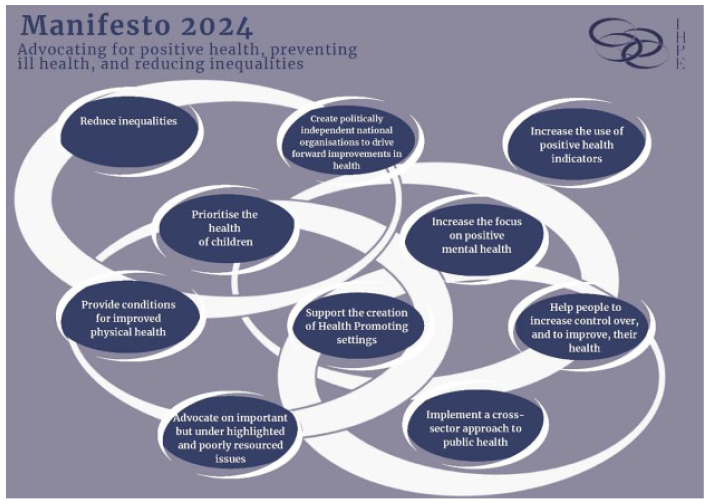
The Institute of Health Promotion and Education (IHPE) 1 has a long history of advocating for positive health, preventing ill health, and reducing inequalities. Our work is based on the principles of health promotion as set out in the Ottawa Charter for Health Promotion 2 and other key documents. Prerequisites for health are peace, shelter, education, food, income, a stable ecosystem, sustainable resources, social justice and equity.
Since the Charter was published there has been profound economic, health and social changes, and these continue to occur. In recent months, the IHPE has developed a positive health promotion manifesto based on the Charter. 3 The overriding aim is the promotion of positive visions of public health.
In this short article, we identify the 10 recommendations as key priorities for addressing health challenges across the lifespan, within all communities, and contributing to the reduction of inequalities. We have provided a few examples of recommended actions.
Reduce inequalities
Over the last 50 years, a wealth of evidence has accumulated linking deprivation with poor health.4,5 Without intensive, immediate, and long-term action, the health of disadvantaged individuals, families and communities will be disproportionately affected during the coming years: inequalities will increase. Co-ordinated action between countries as well as within countries, is needed to tackle the wider environmental, social, and economic factors that contribute to poor health. Integrated, place-based approaches are effective ways to maintain and improve health. 6
Prioritise the health of children
Every child should have the best start in life. Children are our future and healthy children are more likely to become healthy productive adults. Support is needed in different settings. For example, in the United Kingdom, this support would include increasing the number of health visitors and providing a school nurse for each school.7,8
Support the creation of health promoting settings
Health and wellbeing are created and sustained in the settings where people live, study, work and play. This includes schools and colleges, workplaces, hospitals and prisons. 9 National certification schemes should be created to encourage the development of Health Promoting Settings.
Help people to increase control over, and to improve their health
Health promotion supports personal and social development by making information accessible and improving education for health, thereby enhancing literacy and life skills. 10 In so doing, it increases the options for people to exercise better control over their own health and over their environments, and to make choices conducive to good health.
Increase the focus on positive mental health
Mental health needs a focus across the lifespan, taking a positive, holistic approach and emphasising health-promoting interventions for individuals and communities.
As the majority of mental health problems are established early in life the school setting is integral to the strategy. A whole-school community approach is recommended and involves school nurses, teachers, senior leaders, parents and GP practices. However, crucially, it is the voice of children themselves that should be listened to in order to inform policy and practice development. 11
Recently in some countries, the importance of mental health has been recognised and it is moving up the public health agenda. Although there is considerable rhetoric from many quarters, this has yet to be followed with evidence-based interventions and adequate finances.
Provide conditions for improved physical health
Physical and mental health are integrally connected. Safe and healthy environments support individuals in maintaining and improving their health. The promotion of safe and active modes of travel also contributes to health improvement through reducing pollution and the prevention of accidents. 12 Opportunities to increase physical activity for all should be provided. 13
Advocate on important but underhighlighted and poorly resourced issues
Health promotion should support those most in need, including marginalised groups. A focus on improving wellbeing should include issues such as accident prevention, access to the arts, female genital mutilation, forced marriage, homelessness, modern slavery and gambling.
Create politically independent national organisations to drive forward improvements in health
Improving a nation’s health requires a bold vision and strong leadership. All countries need an independent national health promotion organisation to drive this forward. The organisation should work closely with public health specialists, health service organisations, charities and other organisations trying to promote health.
Implement a cross-sector approach to public health
Health implications should be considered in policy decisions, especially those across health, social care, education, planning, finance, housing and culture. This includes policies to reform the benefits system, tackle poverty and racial injustice, end homelessness, and invest in better mental health services.
Increase the use of positive health indicators
Positive health indicators should be used to support a paradigm shift in our thinking. 14 It is time to change the perspective away from purely sickness and ill health and develop more positive visions of health and wellbeing.
Positive health indicators can be identified in relation to individual health knowledge and behaviour, socio-economic conditions and the physical environment. 14 Two examples are the percentage of children undertaking enough exercise per week and the percentage of homes with a working smoke alarm. At a higher level, they can also be developed for example in relation to cycle lanes, swimming pools and various workplace policies.
This type of health indicator can be used for monitoring and evaluation and also importantly for motivating the public and professionals to act. Instead of having a society focused purely on deaths, perhaps it is now time to change the perspective and have a focus on health.
Conclusion
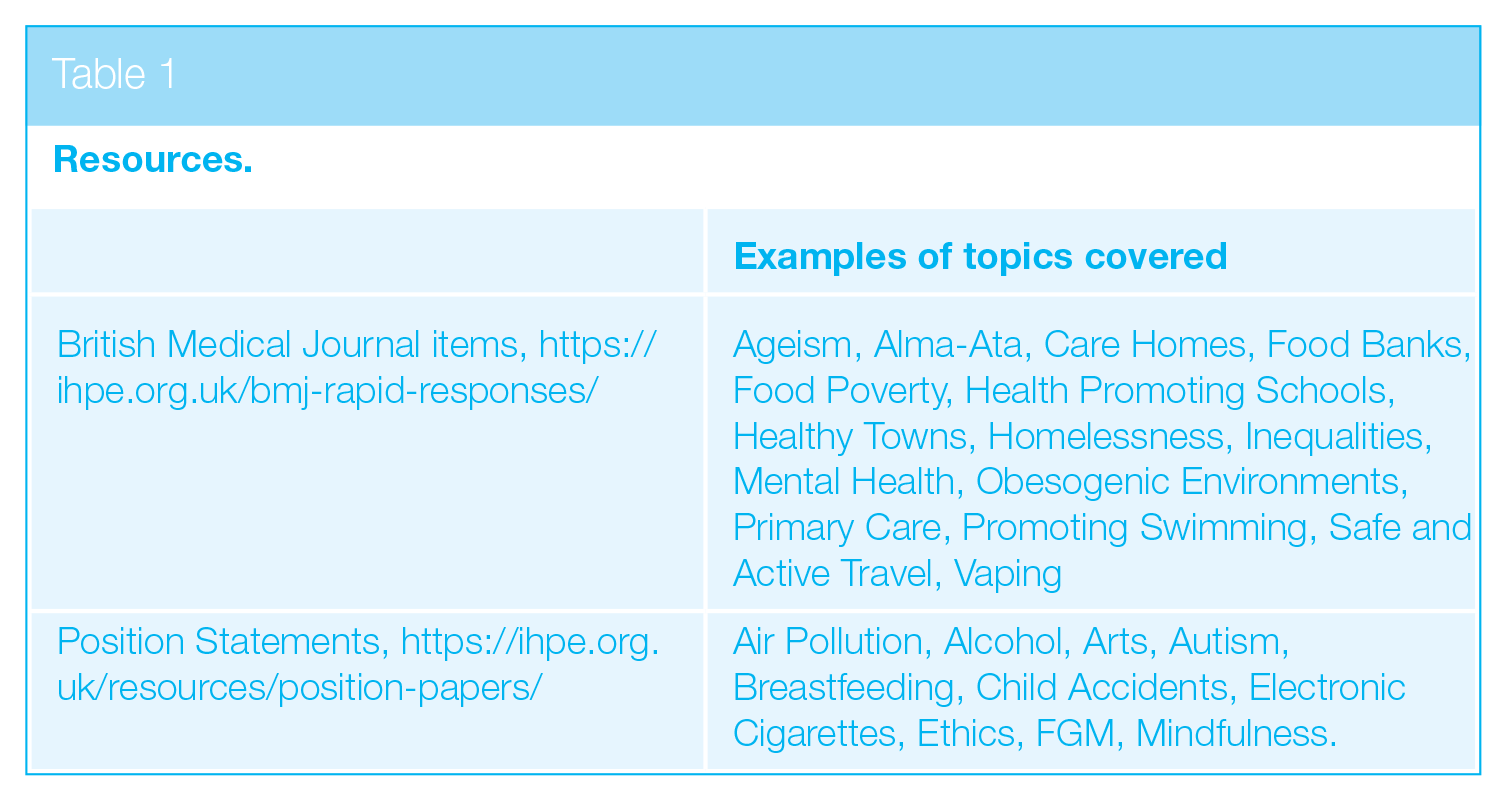
The Ottawa Charter is a seminal document of public health, and although there have been considerable societal changes since it was published, it is still an important guide for directing effective positive health promotion approaches. 2 In order to support those who want to take such approaches, we have produced over 150 items in the British Medical Journal and just over 20 Position Statements on a range of topics as indicated in Table 1. Besides acting as guides the resources will be of use to public health practitioners, policy makers and politicians for advocacy, policy and communication purposes.
Resources.
Footnotes
Authors’ note
MCW and KEN are Trustees of the Institute of Health Promotion and Education, a charity that was founded in 1962. In this article, we endeavour to make public health professionals aware of key priorities for promoting positive health based on the Ottawa Charter.
