







Abstract

Introduction
“Anchor institutions” are large, public organisations that can play a role in positively shaping the wider determinants of health in their area through their social, economic, and environmental levers. 1 A term originating in the United States, an anchor institution approach now forms part of national and local National Health Service (NHS) strategies in the United Kingdom. 2 The role of anchor institutions has been of particular prominence in discussions on addressing the impacts of the COVID-19 pandemic on inequality and disadvantage.
With the opportunities arising from the new Integrated Care Systems (ICSs) in England, the persistence of health inequalities, and the urgency of the climate crisis, ensuring that the potential benefits of health services as anchor institutions are realised is increasingly essential. This article summarises the process and learning from developing such an approach for Barts Health NHS Trust, one of the largest NHS Trusts in England, covering five hospital sites and a population of over 2.6 million in North East London.
First Steps: Addressing Disadvantage Through Employment and Tackling Air Quality
When Barts Health NHS Trust was formed in 2012, it recognised its role in serving highly deprived and ethnically diverse populations in East London. The Trust adopted a mission to address health inequalities and formed a public health team to focus on equity in clinical services and health improvement initiatives for patients, visitors, and staff.
To leverage its status as the largest employer in East London, the Trust launched several programs from 2013 to 2020 to tackle local disadvantage by broadening access to employment, career skills, and training. The Community Works for Health (CWfH) scheme, established in 2012, aimed to increase successful job applications from local residents through a ring-fenced talent pool approach that provided employment skills support. In 2023/24, 109 local residents were recruited through CWfH, with 70% from Black Asian or Minority Ethnic (BAME) backgrounds and 60% receiving state benefits. To address the particular barriers faced by young people with severe learning disabilities, the Project Search scheme was launched in 2014 to provide employment opportunities in health and care through coaching, educational support, and extended work placements. The scheme now runs at three hospital sites across the Trust with over 50% of participants securing employment upon completion annually. Finally, the Healthcare Horizons scheme promoted NHS careers to local young people. Supported by the JP Morgan Chase Foundation, The Prince’s Trust, and the Barts Charity, it offers career events, face-to-face work experience, a virtual work experience platform, mentoring, and pre-employment programs aimed at local young people. To date (as of March 2024), 763 local young people have been offered face-to-face work experience placements, nearly 3,000 students have been engaged via career events, 2,089 young people have accessed a virtual work experience platform, over 200 have received mentoring, and 275 have secured employment within the health sector, with the majority being from BAME backgrounds and Not in Education, Employment or Training (NEET).
In addition to community employment programs, initial anchor institution work is committed to tackling poor air quality, which is linked to an estimated 4,000 deaths annually in London, with areas of greater deprivation, like East London, particularly affected. 3 The Clean Air Hospital Framework, initially developed by Great Ormond Street Hospital and the not-for-profit Global Action Plan, structured this work for three major Trust hospital sites. Key themes include encouraging active travel, access to green space, reducing pollution from patient transport, clean air in energy and procurement, and reducing the volume of deliveries.
Responding to the Covid-19 Pandemic and Establishing a Broader Anchor Institution Approach
In 2019, the NHS Long Term Plan highlighted anchor institution approaches as key to the long-term future of England’s health service. This prompted a review of Barts Trust’s own anchor work, including working in partnership with independent charity The Health Foundation to develop a revised approach in February 2020, just prior to the COVID-19 pandemic. Initially, the pandemic halted further progress as health services focused on delivering critical care. However, a Public Health England (PHE) 4 report on COVID-19 and health inequalities published in June 2020 re-emphasised the importance of addressing economic disadvantage and social determinants of health, especially for non-white and more deprived groups.
This renewed focus energised the anchor institution agenda, with local leaders agreeing on the need for action on structural health determinants as key to the long-term pandemic response. To deliver on these commitments, the opportunity was taken to refresh the local strategy. A comprehensive health needs analysis was conducted to demonstrate the broad range of outcomes a refreshed strategy could affect, to identify where actions should be prioritised, and to provide a benchmark for monitoring future impact. The revised strategy focuses on four priority areas, with two cross-cutting themes (see Figure 1).
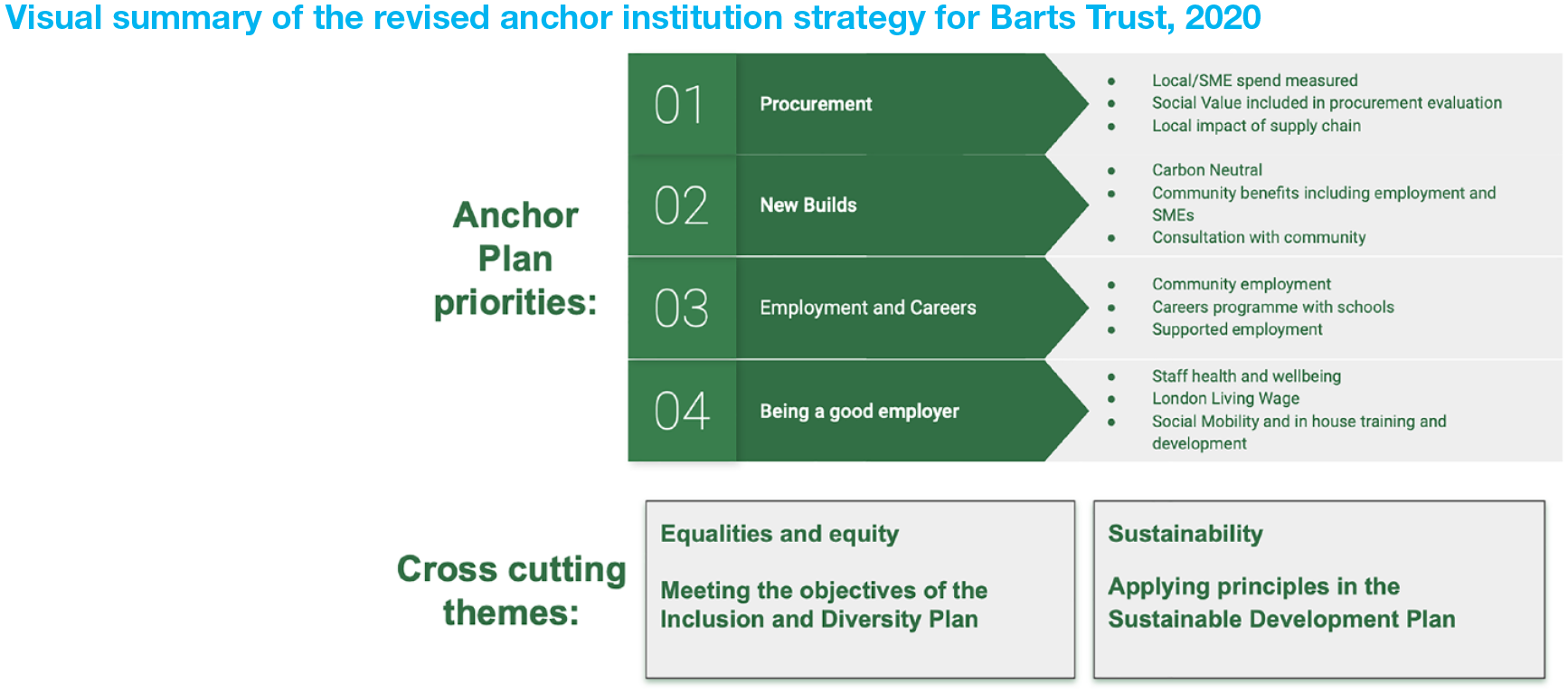
Visual summary of the revised anchor institution strategy for Barts Trust, 2020
The pandemic also provided new opportunities in leveraging a surge in volunteers and building new partnerships. Collaborating with Queen Mary University and the Greater London Authority, Barts Health established ‘Barts Health Futures’ at Newham College, a new dedicated space to offer health skills sessions and employment support for local residents, with approximately 300 individuals using the facility weekly. The establishment of the new ICSs in England in 2022 also presented new opportunities, with local ICS funding supporting work initiatives for marginalised groups, such as Somali and Bangladeshi women. To date, through this funding 23 local residents have secured paid placements, with 13 gaining full employment.
Reflections and the Future 0f Anchor Institutions in the NHS and Beyond
In the ten years since Barts Health NHS Trust was established, its anchor institution work has expanded significantly, revealing both challenges and opportunities for the wider health services. From this experience, the following priorities are proposed for the future of anchor work across the NHS:
The importance of responding to local community needs: designing a truly effective anchor strategy requires a high degree of sensitivity to local needs and inequalities, driven by an understanding of local data.
The importance of fostering partnership, community involvement and an entrepreneurial approach: Strong partnerships with public bodies and local communities are essential for delivering anchor institution programs. Due to public funding pressures, an entrepreneurial approach is also necessary, seeking investment and expertise from outside traditional funding streams, including charitable and not-for-profit organisations.
The importance of evaluation and demonstrating impact: With budgetary and demand pressures, demonstrating the continued value of investing in an anchor approach is crucial. Given the broad range of actions possible within an anchor institution approach and their long-term nature, it is challenging and likely to focus on proxy measures initially. Therefore, organisations may be unlikely to demonstrate an impact on deprivation or health outcomes in the short-term but may show great progress in driving access to education, employment, and better working conditions more immediately.
Moving beyond ‘low-hanging fruit’ to structural and transformational change: Some anchor actions, like including ‘Social Value’ in procurement, are now mandatory in England or are clear ‘win-wins’ with immediate returns (e.g., investing in increasing the pool of qualified candidates for vacancies). Transformational change, however, is likely to need more challenging conversations weighing the value of investing resources in anchor work compared to clinical service provision. This requires strong commitment from local leaders, a shared understanding of the anchor approach, and access to public health skills to justify and evaluate local investment.
Delivering on the opportunities of the Integrated Care Systems: The new ICS in England offer an opportunity to not just share learning and support across organisations but to develop the impact of anchor work beyond single institutions. North East London’s development of an ‘anchor system charter’ exemplifies this approach. 5 Investing in ICS capacity to support and lead this work is essential for delivering a true ‘anchor system’ that can deliver change at scale.
