







Abstract

Introduction
The Ruth Strauss Foundation and the Royal Society for Public Health have been collaborating for the last 12 months to drive change across UK organisations. In the UK, with one in two people developing cancer in their lifetimes, over half a million annual deaths, and six million close bereavements, the potential for positive intervention is enormous. Carers UK 1 reports that every day, 600 people leave their jobs to care for their relatives, while approximately 167,000 2 cancer deaths occur annually. These figures represent opportunities for organisations to make meaningful differences in employees’ lives while retaining valuable talent and institutional knowledge.
Currently, only one-third of UK organisations have established policies to support employees with terminal illnesses, according to the Chartered Institute for Personnel and Development. 3 A review commissioned by What Works Wellbeing 4 reveals that many working-age individuals with terminal diagnoses face difficult choices between continuing employment and managing their health, often resulting in them leaving the workforce prematurely. Marie Curie 5 highlights that 25,000 people of working age die in poverty each year. This raises important questions about how we, as colleagues, managers, and employers, can provide support during what will undoubtedly be one of the most difficult times in these individuals’ lives.
Research consistently demonstrates that employment and wellbeing reinforce each other positively. Studies show that being employed improves wellbeing, while good wellbeing makes it easier to work, creating a powerful foundation for workplace intervention that benefits everyone involved.
Recognising the transformative potential of supportive workplace practices, the Ruth Strauss Foundation and the Royal Society for Public Health have created a comprehensive training programme. ‘Compassionate Management: Supporting Employees Facing Life’s Toughest Tests’ is a 60-min course aimed at HR and line managers. In addition, ‘Supporting Colleagues Facing Life’s Toughest Tests’ is a 20-min awareness programme designed for all staff. Together, these groundbreaking resources address a critical gap in workplace wellbeing.
These programmes emerged from understanding the challenges faced by those living with incurable cancers, yet deliberately address terminal illness broadly to serve the widest possible range of workplace contexts. This inclusive approach acknowledges that while specific diagnoses may differ, the underlying needs for understanding, flexibility, and compassion remain universal across all terminal conditions.
Current data from Hospice UK’s Compassionate Employers programme 6 indicates that only one in five managers feel confident in supporting bereaved employees. In addition, 64% of employers lack guidance on how to support terminally ill staff. However, these gaps present opportunities rather than shortcomings. Organisations that invest in training can shift from uncertainty to confidence and move from reactive to proactive support.
The Foundation acknowledges that organisations genuinely want to support their employees; they simply need the necessary tools and confidence to do so effectively.
Our Approach
The eLearning programme was developed, delivered and evaluated over 12 months. Co-designed with an expert reference group and incorporating lived experience perspectives, the project underwent rigorous development and full piloting with 140 learners across different sectors.
The formative evaluation of the pilot programmes aimed to assess the effectiveness in improving perceptions of topics related to bereavement, confidence in supporting employees and colleagues, as well as the quality of the programmes. Through a comprehensive mixed-methods approach, findings across both programmes showed overwhelmingly positive feedback on learner experience and effectiveness.
Outcome
For the 20-min awareness programme, we observed a positive shift in responses on the importance of this training on terminal illness, dying and grief in the workplace, as well as a significant improvement in confidence in supporting colleagues living with a terminal illness or bereaved (Figure 1). These shifts were further illustrated through positive feedback on how well the programme met expectations. Participants stated that the training was: ‘Very informative and straightforward. Delivered sympathetically. I have personal experience and would have valued this approach in my own work’. While some responses pointed towards areas for improvement, they did not show any need to significantly change the content or pace of the eLearning.
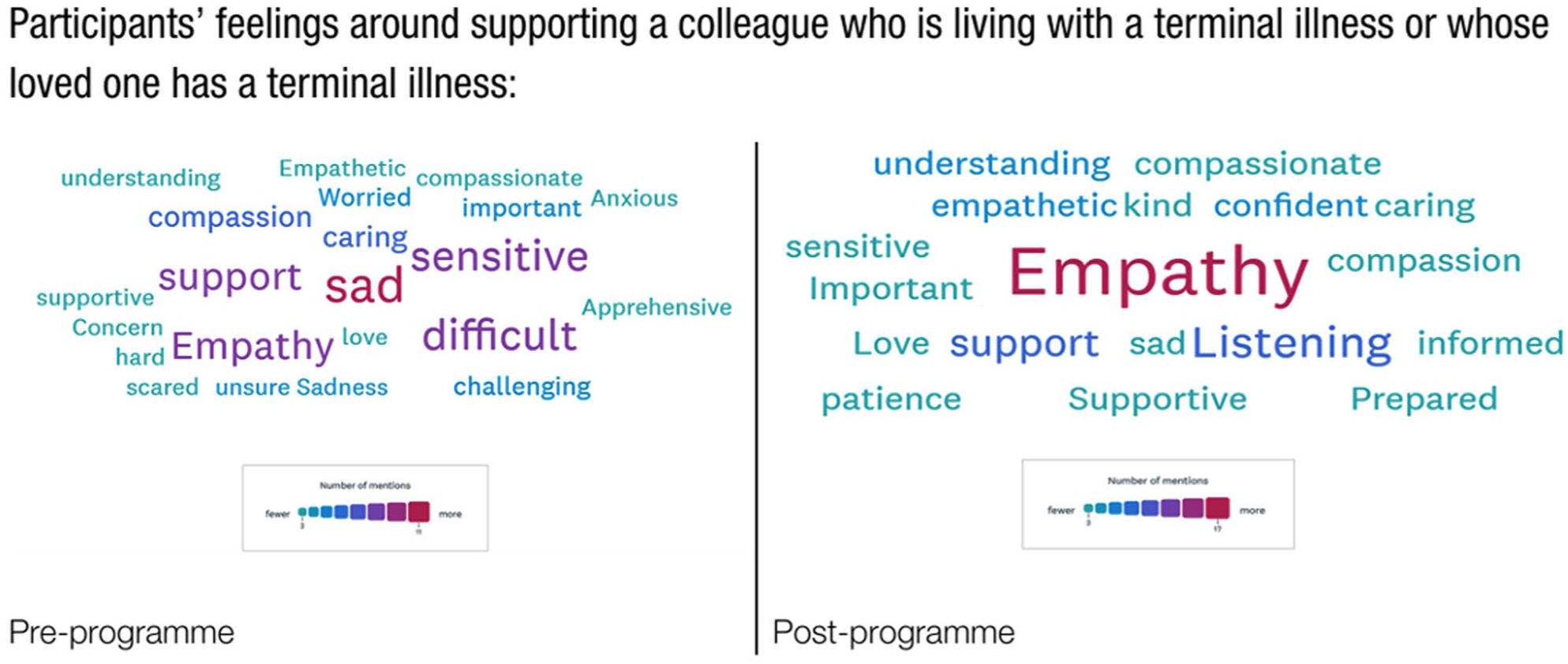
We observed the same trends in the 60-min training for HR staff and managers who demonstrated an increase in importance of training on this topic, and confidence when supporting employees. Participants predominantly found the training to be relevant and did well to meet their expectations. One went on to state that ‘I found this invaluable and think something along these lines should be introduced to companies for all employees – becoming a guide for employees to have access to for when the situation arises. For employers and employees’. The responses showed that there was little that should be removed from the programme. However, there was some insightful feedback which showed areas for more content to be added, such as practical implications, which have been addressed for the full launch in September.
Conclusion
This training provides benefits for society, organisations, and individuals alike. For employers, it serves as a strategic investment in their teams. With 600 people leaving work each day to care for relatives, organisations are able to enhance talent retention, which helps preserve institutional knowledge and avoid costly recruitment efforts.
For employees, the training provides dignity and choice during life’s most challenging moments, eliminating the stark choice between employment and their health and treatment needs. When workplaces embrace terminal illness support, they create psychologically safe environments where seeking help becomes acceptable and employees feel genuinely valued, benefitting not only directly affected individuals but also created more supportive cultures for all staff, their families, and organisations as a whole.
This training demonstrates that addressing terminal illness is more than HR management; it fundamentally reflects human values and shows that compassionate workplace practices are not only morally essential but also strategically beneficial. The issue is not whether workplaces can meet this challenge, but rather how quickly they will adopt the tools to do so with confidence and compassion.
Footnotes
Declaration of Conflicting Interests
The authors declared no potential conflicts of interest with respect to the research, authorship, and/or publication of this article.
Funding
The authors received no financial support for the research, authorship, and/or publication of this article.
AI Assistance
AI assistance was used during the preparation of this manuscript to improve the readability and enhance the structure of this work. After using ChatGPT 4.0, the authors reviewed and edited the content. The authors of this manuscript take full responsibility for the content of this piece.
