







Abstract
Featured Organisation: Junction Arts
Junction Arts is an award-winning community arts charity, based in Derbyshire. Their vision is to create a better future for everyone through the arts. Junction Arts develops and delivers engaging arts experiences within disadvantaged areas to improve wellbeing, build confidence and skills, address inequality and inspire change.
Social Connectivity In Coal-Mining Communities
For the former coal mining communities of North East Derbyshire, employment formed the basis not only of economic life but also of the wider social ecosystem of its communities. Purpose-built housing for colliery employees meant that people worked, lived and socialised together – in thriving social clubs, pubs and miners’ welfares. While it’s naive to assume that these communities were always harmonious, or to forget how difficult these tight-knit communities could be for those who ‘didn’t fit in’, they nonetheless offered an everyday web of knowing one’s neighbours, playing, celebrating and mourning together and for offering and receiving help. With the closure of the collieries, these towns lost not only their major source of work but also a key infrastructure of community connectedness and care. The steady closure of social and welfare clubs was mirrored by the decline of high streets and falling church attendance – a gradual but steady erosion of the community mechanisms that knit us together.
Loneliness and Public Health In Post-Industrial Communities
Fast forward 50 years, and loneliness and mental ill-health are a key concern of public health. The World Health Organization recognises declining social connection as a critical public health priority that ‘harms health, undermines education and economic opportunity and weakens the fabric of our communities’. 1 This epidemic of social disconnection is deeply entwined with issues of economic inequality and with the transition to a post-industrial society. Research by the UK Government’s Department for Digital, Culture, Media and Sport (DCMS) 2 finds that people in lower incomes and those out of work are more likely to experience loneliness.
Community Arts As a Tool for Public Health
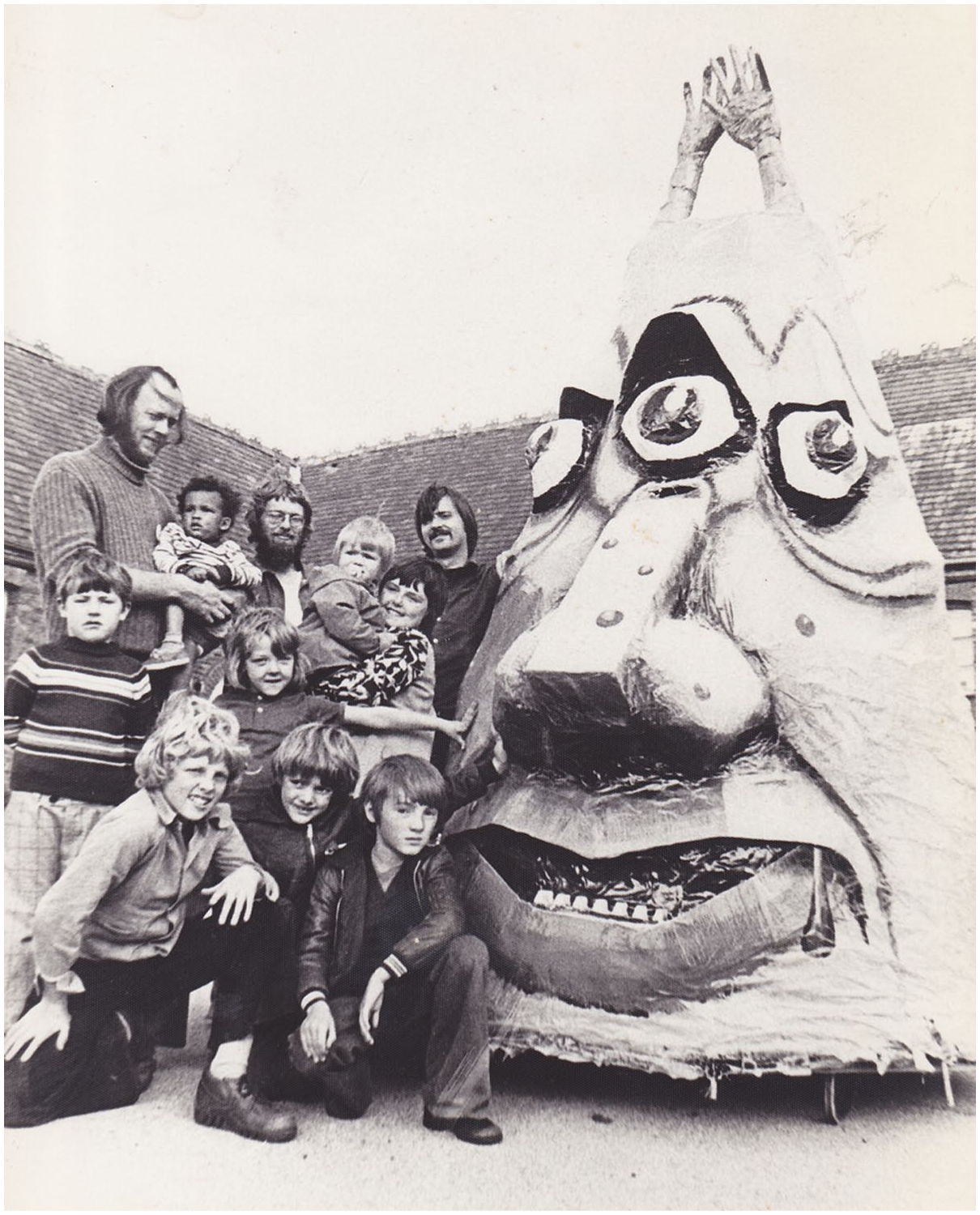
It was with an eye to the future of this rapidly changing society that Junction Arts was formed in 1976 in North East Derbyshire. Over the past 50 years, as the region has faced shifting social, political and economic tides, Junction Arts’ regular programme of creative festivals, performances and workshops has been a constant presence. A key pillar of the organisation’s work today is to improve the quality of life, health, wellbeing and resilience of communities through creative projects, events and skills development. 3 In working locally to address the social connection, health and wellbeing needs of its economically shifting communities, Junction Arts’ half-century of work illustrates the opportunity and potential of community arts as a force for good in public health.
A New Way to Bring People Together
The 2022 DCMS research 4 mapped a cyclical, bidirectional relationship between loneliness and mental health: mental health issues can lead to greater feelings of loneliness, while loneliness can also lead to a decline in mental health. Junction Arts participants report being drawn to join a creative group when they’ve found their social networks challenged – through COVID, after retirement, as a new parent or when new to the area (as one participant describes, ‘[when] my whole world suddenly shrank’). In regular weekly programmes that invite people to simply take part in creative activity – like photography, printing or pottery – with like-minded people, participants find space to repair their social networks – to meet new people, spark conversation and find shared interests. These benefits cross age groups and generations: One older participant describes how a regular weekly group ‘became my community’, while a teacher of one young attendee shares: ‘For someone like this who struggles socially, to be within a supportive group, he has experienced a lot of benefits that go beyond the session. To feel welcomed as part of the group is really nice for him’.
Junction Arts’ success in enabling people to join new groups is built, in part, on recognising and working to address the barriers potential participants face. Some of these barriers are deeply practical: bus routes, the financial costs of attendance and event timing are all carefully considered. Some barriers are social and emotional: Junction Arts noticed some participants need access to a quiet space away from the hustle and bustle of a busy session. Providing food at sessions has proved an effective way to address both practical and social barriers. Junction Arts staff noticed that many young participants were arriving hungry at their creative workshops. Providing healthy snacks and baked treats offers a practical solution to this immediate need and enables participants to refocus on the session. More than that, though, taking the time to gather around a table to eat together creates an atmosphere of care and community, softening the space and strengthening bonds between participants.
Offering and Receiving Support
The stigma associated with mental ill-health and loneliness can make it difficult for people to seek out the support they need. Joining a creative group, on the contrary, is much less stigmatising. Participants rarely need to self-diagnose or declare a specific reason for attending, yet still find the groups an effective space to access a community of like-minded and sympathetic peers.
Junction Arts participants talk about using creativity to help them process, navigate or cope with difficult emotions or experiences. Creative activity acts as a release, an opportunity to explore and process emotions or simply a time to get away from everyday stresses. One regular participant in a group for older people describes this impact plainly: ‘The people here give me a boost (even if they don’t know it) and make me feel worthy for a while’. Participants report that time spent being creative together makes them feel calm, happy, free and relaxed; one carer said that ‘art made it easier to talk about stuff I wouldn’t normally say out loud’. The processes of accessing support and offering support are intermingled; participants become part of an ecosystem in which they listen to one-another’s concerns, share experiences and offer advice.
What stands out from Junction Arts’ experience is the importance of time and long-term support for groups like these. Relationships take time to develop, and building trust with those who might feel cautious, ignored or sceptical can’t be short-cut. As one of Junction Arts’ community artists reflects: ‘You can’t expect you are going to start and get massive numbers [straight away]. The work involved in getting young people even confident enough to attend the sessions is big . . . they need smaller steps and encouragement to engage’. 5
Building Skills and Confidence
The invitation to try new creative activities gives people of all ages the opportunity to be surprised by their own aptitude to develop new skills. A recent participant exclaimed with surprise ‘I didn’t know I could be so artistic!’. Working creatively can help to remove a layer of self-consciousness from participants and provide a new context for them to recognise their achievements, building confidence in themselves and their abilities.
Research from Local Trust 6 suggests a positive cycle associated with the boost of discovering you’re good at something. This translates into feelings of greater self-esteem, and the confidence to give more new things a go; an opportunity to reverse the negative cycles of low mood and increasing isolation. Young people attending Junction Arts’ creative groups reported feeling more confident to go on and try other activities – such as by joining drama clubs, art classes and sports clubs. Moreover, confidence spills over into other areas of their lives – young people attending these groups proved more interested in attending college and exploring their postschool options and also found that their increased ability to recognise their mental health helped them identify when they might need support and to be able to reach out for that extra help.
The importance of building confidence in this way is enabled by Junction Arts’ approach to co-producing creative activity alongside participants. This means that their programmes of activity aren’t fixed in advance, but rather are shaped by and with participants. Creative practitioners might introduce new ideas, artforms, practices and approaches, but participants are given every opportunity to choose which direction the activities take, to adopt leadership responsibilities in sharing skills or supporting new attendees and to make decisions about what their provision looks like. As such, no two groups or activities look the same – each grows and evolves in response to the needs and aspirations of its participants.
Conclusion: Learning for Public Health, Community Arts and Post-Industrial Places
Public health in post-industrial communities today is deeply entwined with their histories of economic change, social (dis)connection and care. Changing societies, like those of north east Derbyshire, experience isolation, loneliness and poor mental health in ways that are intrinsically connected to the loss of everyday opportunities for neighbours to interact with one another. Over 50 years of working in, with and for a community in the throes of change, Junction Arts illustrates the power and potential of community arts in helping people build effective public health interventions that are rooted in the economic, social and political contexts of their communities. The learnings from this work underline (a) the importance of time and long-term support for building trust and allowing relationships to evolve, (b) the need to address participants’ practical, emotional and social barriers in projects that respond to the full complexity of people, lives, places and communities and (c) the value of co-production to allow participants to shape interventions that respond to their needs and aspirations.
Photos for public health journal
Footnotes
Acknowledgements
Junction Arts receives funding from Arts Council England via the National Portfolio, as well as a range of local and national government sources, trusts and foundations and corporate and private donations. This paper is not subject to ethical approval, and the author has no competing interests to report.
Conflict of Interest
The author declared no potential conflicts of interest with respect to the research, authorship and/or publication of this article.
Funding
The author received no financial support for the research, authorship and/or publication of this article.
