







Abstract
Cross-sector collaboration is increasingly relied upon to tackle society’s pressing and intractable problems. Chief among societal problems are unfavorable structural and social determinants of health. The ability to positively change these health determinants rests on the collaborative processes and structures of governance across diverse sectors in society. The purpose of this article is to present a conceptual framework that sheds light on the basic requirements of cross-sector collaboration for social change to promote the health of populations. A search for theoretical articles on cross-sector collaboration in the fields of public administration and public health was conducted within the journal databases ABI/INFORM Complete and MEDLINE. This search strategy was supplemented by an internet search of the grey literature for high-profile models of cross-sector collaboration. The conceptual framework builds on previous scholarly work by placing emphasis on five essential conditions for collective impact, and on the pivotal role of collective learning. Collective learning, at the basis of planning and taking action, is at the core of effective cross-sector initiatives, specifically because of its critical role in constantly adapting strategies to changing circumstances and unanticipated situations within complex socio-ecological systems.
Keywords
Introduction
Cross-sector collaboration is increasingly relied upon to tackle society’s pressing and intractable problems (1–3). Societal problems, with their social, economic and environmental consequences, diminish the quality of life that in turn affects the health of populations (4). Indeed, the ongoing chronic-disease epidemic stems from the effects of unfavorable structural and social determinants of health. These health determinants shape the conditions in which people lead their lives, marked by material disadvantage, exposures to psychosocial stressors and/or environmental toxins both at home and in the workplace, and influence their health-related behaviors, such as dietary habits, level of physical activity, and substance use (5). As Marmot asserts, the poor health status of a population is ‘an indicator that the set of social arrangements needs to change’ (6:1099). Positive social change would necessarily contribute to the prevention of chronic disease by providing a social environment more conducive to healthy living for improved population health.
The ability to positively change these upstream determinants of health rests on the collaborative processes and structures of governance across diverse sectors in society (7). However, working across sectors is often challenging. The purpose of this article is to present a conceptual framework that sheds light on the basic requirements of cross-sector collaboration for social change to promote the health of populations. It begins by identifying leading sources of scholarly and practice-based knowledge in this area. It then examines the evolution of theoretical understanding and the current emergence of practitioners’ insights. Finally, it elaborates on fundamental elements considered critical for effective cross-sector collaboration. Focusing on capacity building for social change to promote population health is not enough; equal attention must be paid to the engagement process, the motivation to engage, and collective learning at the core of effective collaboration across sectors.
Methods
A search for theoretical articles on cross-sector collaboration in the fields of public administration and public health was conducted within the journal databases ABI/INFORM Complete and MEDLINE. The search was limited to scholarly articles published in the English language from January 2005 to December 2015. To be retained, the theoretical articles had to present a broad perspective of fundamental elements of a collaborative arrangement, as a whole, that could be applied to any policy area and involved more than one stakeholder sector. Furthermore, the articles had to draw their evidence from a thorough examination of the existing literature covering a wide range of disciplines, rather than a small number of case studies.
The search strategy was supplemented by an internet search of the grey literature on cross-sector collaboration initiatives to identify high-profile models currently being put into practice in North America. Practice-based models that are being promoted by influential actors have been selected to confirm, and bring further clarity to, existing scholarly frameworks. We define influential actors as individuals who have demonstrated high visibility as knowledge brokers in the area of cross-sector initiatives or who are in a position to champion a particular cross-sector collaboration model, such as funding organizations.
Theoretical frameworks and practice-based models
Scholarly conceptualization of collaboration across sectors has tended to center on one or a few case studies from a single policy area, such as natural resource management. However, some studies have developed theoretical frameworks of a general nature, irrespective of the policy domain, and have described concepts that cover collaboration, as a whole. Other models, found in the grey literature, have been widely promoted within North America, with relevance to global initiatives. These models emphasize essential conditions for effective cross-sector collaboration for social change. In this section, we explore the way in which theoretical understanding has evolved up to now, and how current insights from the practice field are contributing to this understanding.
From the wealth of knowledge that exists on cross-sector collaboration, three theoretical frameworks stand out for their broadness and wide-ranging applicability. First, the earlier work of Bryson et al. categorized the extensive knowledge base that had been accumulating on cross-sector collaboration since the mid-1980s (8). Then two years later, Ansell and Gash presented their own framework by undertaking a meta-analysis of 137 case studies from a wide range of policy areas and settings (9). Later on, Emerson et al. developed an integrative framework that resulted from a series of expert consultations and an extensive review of the literature (10).
All three theoretical frameworks align closely with each other with respect to the elements they contain. Nevertheless, the relationship between these elements has been reinterpreted from one framework to the next. Bryson and colleagues’ framework was kept simple with no consideration for the interactions within and between the two main categories of ‘process’ and ‘structure and governance’ (8). Maintaining similar key elements of collaboration, Ansell and Gash brought out the nonlinear character of the collaborative process, describing it as a virtuous cycle of collaboration—albeit still in a simplistic manner (9). This cycle begins with engagement through face-to-face dialog. As engagement proceeds, trust and commitment are increasingly cultivated. This, in turn, facilitates the adoption of a shared understanding that results in intermediary outcomes, such as a strategic plan and small wins, which further enrich the dialog; and so continues the collaboration cycle. Leadership has been removed from the ‘process’ category, appearing as an element that supports the collaborative process and not as an integral part of it. Emerson et al. have further teased apart ‘process’ elements in their integrative framework, and brought out the dynamic interplay among three major collaborative-governance themes regarding engagement, motivation, and capacity (10). The interconnected cycles of engagement and motivation are posited to reinforce, and be reinforced by, the capacity for joint action.
An internet search for articles on prominent models of cross-sector collaboration revealed the work of two leading organizations in North America: Foundation Strategy Group (FSG), in the United States; and the Tamarack Institute of Community Engagement, in Canada. They are both nonprofit consulting firms offering their expertise in cross-sector collaboration (11). These organizations stand out in particular due to the major charities and heavily endowed private foundations that support their cross-sector collaboration approach (12).
These leaders and champions have adopted a particular approach of cross-sector collaboration referred to as the collective-impact model. FSG coined the term ‘collective impact’ as a contrast to the isolated impact made by various public agencies and community organizations working on similar goals but in isolation from each other. FSG developed their model following in-depth interviews with participants in highly successful cross-sector collaborations to address such issues as unemployment, academic underperformance, homelessness, nutritional deficiencies in developing countries, and environmental degradation—all complex societal problems with implications for population health (13,14). Expanding their research into the field of international aid and development, FSG examined how some international nongovernmental organizations (INGOs) have been moving away from a dependency on corporate philanthropic funding and forging gainful collaborations with corporations and other key actors to enhance the quality of life of people in low- and middle-income countries along the lines of their collective-impact model (15). By collaborating across sectors, such INGOs may hold the key for strengthening civil society and delivering goods and services in countries where governments need additional support or lack the political will to provide for their citizens.
The collective-impact model offers a consistent language for the rigorous pursuit of cross-sector collaboration by focusing on conditions identified as critical for success: a common agenda, mutually reinforcing activities, continuous communication, a shared measurement system, and a backbone-support organization (13). These conditions are deemed essential but not sufficient. Additional consideration has been given to the use of a comprehensive, yet simple and flexible, strategic framework for engagement purposes; collective vigilance to detect emerging opportunities; cascading levels of governance for better coordination of local action; and collective learning (14,16).
Echoing these success factors is the constellation model of collaborative social change, conceptualized by Surman and Surman (17), experts in the area of multi-stakeholder partnerships. The constellation model is based on years of experience with working on cross-sector initiatives. Many achievements were made possible through a fluid governance structure that was based on ‘light-weight’ agreements by a voluntary but steady executive-level stewardship group (17). A fluid governance structure at the operational level ensures greater responsiveness to the natural fluctuations in participation on action teams. This model also emphasizes the need for coordination support by a separate ‘third party’ agent (e.g. a consultant or consulting firm). The collective-impact and constellation models are consistent with the theoretical frameworks presented earlier, and provide additional knowledge for implementing social-change initiatives.
Integrating scholarly and practice-based knowledge
The field of cross-sector collaboration has flourished over the years due to the persistent need to know how diverse stakeholder groups could work together more effectively. In this section, we introduce a conceptual framework that builds on the integrative work of Emerson et al. (10) by placing emphasis on the five essential conditions for collective impact, and on the pivotal role of collective learning at the core of cross-sector collaboration. This conceptual framework brings to light the complementarities of theoretical understanding and current practice-based insights about effective collaborative arrangements for social change. As shown in Figure 1, it consists of three main dimensions: the collaborative-engagement process, itself; motivation for collaborative engagement; and the capacity for collaborative action and adaptability. Overlapping all three dimensions is the central element of collective learning that makes adapting to a complex and unpredictable environment possible.
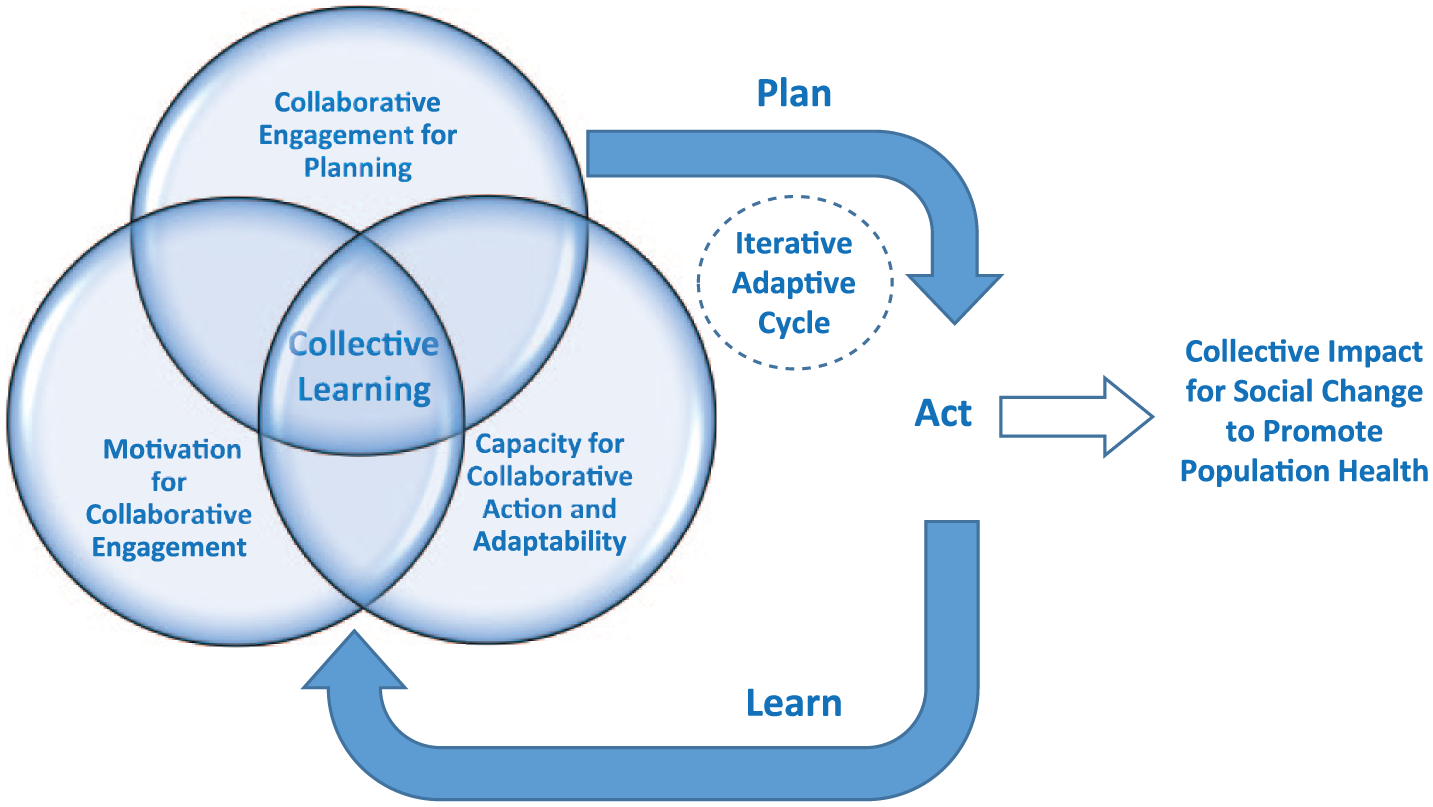
Conceptual framework of cross-sector collaboration for social change to promote population health.
Collaborative-engagement process
Engaging many actors in a cross-sector collaboration is a process that must skillfully strike a balance between reaching a common understanding and encouraging a diversity of perspectives for effective planning. A common understanding provides the foundation on which to unite collaborating partners. Scholars speak of collaborative engagement as a “dynamic social learning process,” which begins by discovering shared interests, concerns, and values, and then endeavors to generate, on an ongoing basis, a shared meaning of what the collaboration is all about (10, p.11). Shared values are important to foster collaborative behavior, especially when there are significant differences regarding organizational mission and culture among collaborators (18). Erakovich and Anderson describe organizational values as “an integral part of the organizational culture (…) that influence what is perceived as acceptable” (19, p.165). Through shared values, reaching agreements become more feasible.
However, a major challenge in engaging across sectors is knowing how to bridge the great divide between corporate profit-seeking attitudes and social/environmental aspirations. The practice of corporate social responsibility may not be completely adequate to advance the objectives of both for-profit and not-for-profit sectors (20). For both economic and social development efforts to thrive, corporations must embrace the principle of shared value, defined by Porter and Kramer as the creation of “a meaningful benefit for society that is also valuable to the business” (21, p.6). Trailblazing corporations that engage in collective-impact initiatives are focusing on creating societal benefits, around the world, and attaining financial success at the same time—they understand that their long-term profitability rests on the health of the populations with whom they wish to do business (22). On the basis of shared value, major business roadblocks (e.g. government corruption, transportation issues, unskilled workers, limited access to supplies) that are exacerbating such conditions as poverty and environmental degradation may be overcome by having multiple actors come together to tackle all the interrelated obstacles, at once.
Engaging multiple actors calls for the establishment of shared meaning through the use of a common language and through ongoing deliberation on the purpose of the collaborative arrangement, the goal to be achieved together, roles and responsibilities, the general nature of the current problem, and its potential solutions, all along the life of the collaboration (9,10). When pointing out this requirement, the collective-impact model makes reference to the creation of a common agenda, the first essential condition for producing the desired social change (13). A collaboration’s cohesiveness depends on a common understanding centered around a shared goal, but its problem-solving capabilities would be deficient if all participants were to think exactly in the same way about how to achieve this goal.
Encouraging a diversity of perspectives is another collaboration attribute (2). As Kania et al. (23) point out, a major weakness of many collaborations is that they ‘still omit critical partners in government and the nonprofit, corporate, and philanthropic sectors, as well as people with lived experience of the issue’ (23:2). Participating actors typically perceive a common problem from their own vantage point. Voicing different perspectives in order to learn from each other may provide an expanded and more realistic picture of the problem, and allow the detection of emerging solutions that a narrower outlook would have missed (14). Diverse perspectives can also enhance the collective undertaking of fact-finding tasks and other analytical work (10). When each participating organization shares their unique strengths and expertise, the collaboration is likely to be more successful (8,24). That being said, encouraging the exchange of diverse perspectives may pose a challenge to group cohesion. This challenge manifests as a unity–diversity tension that is so often characteristic of cross-sector groups (25). Skillful conflict-management approaches are usually employed to mitigate this tension during deliberation and planning. Conflict-management practices include negotiating decision-making rules and putting in place fair and constructive processes for safely exchanging ideas, ensuring equal voice, and resolving impasses (8,26,27).
With respect to collaborative planning, emphasis on flexibility has become paramount in today’s society marked by complexity and uncertainty. Traditionally, mandated collaborations have been expected to engage in deliberate, formal planning with a pre-defined logic model, and undergo performance evaluation following full implementation of the strategic action plan that was prepared before undertaking any action (8,28). However, rigid planning is counterproductive for social innovation (17). The common agenda that is characteristic of collective-impact initiatives involves a simple, flexible strategic framework (14). Flexibility leaves space in strategic planning for accommodating the ongoing input of a cross-sector leadership table, or stewardship group, as they remain constantly vigilant to detect emerging opportunities and creative ideas that cannot be known or discovered until some set of actions has been initiated first (16,17). This approach facilitates a more responsive iterative process of learning, planning, and taking action, in order to adapt better to the surroundings and make greater progress (14).
Functioning in a collaboration relies as much on learning through taking action than on expertise from external sources, especially when needing to know ‘how to work with diverse people, analyze situations in real time, or seize the moment’ (29:271). A focus on learning enhances alertness to new opportunities that may lead to more productive ways of working together or to additional resources that had gone unnoticed (16).
Flexible strategic planning is particularly useful for adapting activities to reflect the natural energy flow of working groups, or action teams (17). This means that activities are adjusted, upwards or downwards, to better fit with existing levels of interest and resources. Planning is thus directed toward areas where efforts show more promise of being productive. However, it is the alignment of plans and their strategies that makes all the difference. Aware that isolated planning by multiple groups results in limited impact, actors of collective-impact initiatives ensure that their action plans are well coordinated by identifying mutually reinforcing activities for each of their respective organizations—the second collective-impact condition (13). Integrating efforts in this way can leverage the skills and resources of multiple actors to produce substantial results on a large social scale (11).
Motivation for collaborative engagement
Participants’ motivation to maintain their engagement rests on a number of interacting elements: the frequency and nature of communication, the extent of trust-building behavior, the appraisal of mutual benefits, and the level of commitment. Continuous communication for the purpose of building trusting relationships is the third essential condition of collaboration promoted by the collective-impact model (14). Meeting regularly and exchanging information in-between meetings keeps participants engaged, as they gain a better appreciation of working towards the same high-level goal even though their organizations are pursuing different sets of activities (13). However, group meetings and the use of communication technologies are unlikely to be enough to sustain common motivation. Regular one-on-one contact with participants in leadership roles, often undertaken by process facilitators, can further ensure continued contributions to the collaboration’s vision (17).
Although continuous communication helps generate mutual trust, the extent to which trust is cultivated depends on participants’ personal behaviors. Behaviors that build trust include the act of being mutually supportive and transparent as well as the demonstration of ‘competency, good intentions, and follow-through’ (30:514). Trust is the most commonly cited determinant of collaboration effectiveness. It is the ‘glue’ that binds a collaboration together, and it can facilitate the safe expression of diverse views (31).
In particular, trust promotes candid discussions about needs and how they could be met. Candid discussions can help identify mutual benefits that make continued engagement worthwhile (9). For instance, sharing difficult experiences in order to learn from others about ways to overcome obstacles has been found to be a rewarding practice in collective-impact efforts, especially when engaging with those who share the same deep concern about an issue (13). If participants do not regularly view their collaboration as a legitimate means to gain some benefit and advance their organizations’ objectives, they will disengage (8).
Taken together, trust building and sustained mutual benefits contribute to participants’ commitment. Commitment to the engagement process involves the collective belief that improved organizational performance and desired outcomes are best achieved through the existing collaborative arrangement (9,26). It is strengthened by a sense of shared responsibility whereby all collaborating actors take ‘ownership’ of their collective endeavor (9). This shared commitment creates the bonds that seal participants’ motivation to work across organizational, sectoral and jurisdictional boundaries and embark on a common path (10).
Capacity for collaborative action and adaptability
Engaged and motivated participants build capacity for collaborative action by securing or providing knowledge, resources, leadership, and institutional structure. These elements of capacity, in turn, support the collaborative-engagement process and the motivation to engage (10). For example, knowledge is fundamental for learning, which has been presented above as both an integral aspect of the engagement process and a benefit arising from cultivating mutual trust. Knowledge derived from rapid feedback loops fuels learning in collective-impact initiatives. Rapid feedback loops entail regularly scheduled site visits and frequent interviews with key actors for ongoing assessments and reflection. Rapid feedback loops can generate improved learning of unexpected opportunities and previously overlooked resources to produce quick wins and keep momentum going (16). When these feedback loops uncover what is not working well, they can lead to the creation of new strategies to move progress further along. Knowledge also takes on the form of content and process expertise. Whereas content expertise shapes the views of participating actors, process expertise bolsters the performance of interconnected organizations (26).
Resources that can be pooled and leveraged through collaboration represent another collaborative advantage. Generally required resources include time, funding, logistical and administrative assistance, and specialized professional skills (10). However, no matter how well resourced an initiative may be, its effectiveness would be lessened without investing in monitoring and evaluation that takes the whole cross-sector collaboration into account. A critical resource, and the fourth collective-impact condition, is a shared measurement system. The measurement of a core set of indicators that are used consistently across collaborating organizations is indispensable for tracking progress over time and aligning mutually reinforcing activities (13). Besides performance measurements, human resources are needed to conduct different evaluation approaches (i.e. developmental, formative, and summative) along the different stages of a cross-sector initiative (32). This provides the necessary capacity with which to ensure that efforts are well directed. It is through such resources that knowledge can be generated to promote the continuous learning that is so vital to the success of collective-impact initiatives. Agreements on goals and strategies would be meaningless without the means to measure the extent of progress made towards these goals and evaluate how and why progress is being made, or not (16,33). Performance measurement and evaluation are vital to make sound judgments about adapting and improving cross-sector collaboration.
In addition, collaboration initiatives that span across sectors necessitate both formal and informal styles of leadership. Collaborative leaders in formal positions, such as chairing a cross-sector committee, behave differently than the authoritative type of leadership generally seen in organizations. Formal leaders in a collaborative arrangement are more likely to remain neutral by letting participants come up with their own solutions while not favoring one point of view over another (10,14). Furthermore, collaborative leadership is multifaceted, and includes a variety of functions such as convener, enforcer of group norms and rules, conflict manager, mobilizer of key stakeholders and resources, motivator, relationship broker, facilitator, negotiator, and knowledge synthesizer (9,26,31,34). Distributing these functions across participating actors in the role of informal leaders avoids both burnout and control by a single individual (35). Leadership may also be shared in the sense that participants can equally influence decision making and can serve as thought leaders around issues falling within their respective area of expertise (35). Whether formal or informal, collaborative leaders play a particularly important role in collective learning. Collaborative leadership facilitates collective learning by encouraging frequent interactions among collaborators and cultivating trust (36).
The last element of capacity is institutional structure, which refers to governance procedures and structural arrangement. Consensus-oriented decision-making procedures, although ideal, tend to lead to either a stalemate or a broad agreement that lacks specific expectations (9). Therefore, consensus building may not be the best approach, especially when the collaboration is meant to encourage a diversity of perspectives. In this situation, other decision rules would need to be followed. What matters most is that participants perceive the decision-making procedures as transparent, fair and inclusive (26). Such procedures legitimize decision making and increase commitment to the engagement process by allowing equal voice and by reassuring participants that the views of all those concerned and affected by the problem have been heard and are seriously taken into consideration (9,26,37). Open and inclusive procedures for deliberations and the creation of interconnected groups for knowledge-sharing are factors that promote collective learning as well (36).
With respect to structural arrangement, experts in cross-sector collaboration for social change propose a fluid structure, run by a stable executive body. A cross-sector executive committee, also referred to as a stewardship group, sets the broad strategic framework and guides the progress of interconnected working groups (14,17). These working groups, or action teams, develop their own action plan with the adaptive flexibility to incorporate opportunities as they arise from an ever-changing environment. Their membership may be ever changing as well, due to fluctuating levels of interest and resources (8,17). For greater stability, the cross-sector collaboration needs to be supported by ‘backbone’ functions, which constitute the fifth collective-impact condition. Attempting to pursue a shared goal without establishing a backbone infrastructure is one of the main reasons for failure (14). In collective-impact initiatives, a backbone infrastructure ensures that dedicated staff provide the ongoing support, coordination, and progress reports that are essential for sustaining collaborative efforts (13). This infrastructure may involve third-party coordination or other suitable types of administrative arrangement (14,17). It is meant to support governance-related operations and create essential linkages across and within multiple governance levels, from executive and steering committees to working groups and the community at large.
The more complex the initiative is, the more structured the infrastructure must necessarily be. Global initiatives require a multi-layered backbone structure through which to coordinate activities at various levels and in many locations—a feat that has yet to be mastered (38). In providing guidance to leaders and funders of global collaborations, Patscheke et al. elucidate the key roles of the global, regional, and local backbones corresponding to each of the five essential conditions of collective impact (38). Although challenging, global initiatives are making headway in addressing major societal problems with these conditions in place.
Collective learning
There cannot be effective collaboration without addressing the need for ongoing learning at the basis of planning and taking action. Many scholars place learning at the center of collaboration (39). Among collective-impact proponents for social change, collective learning is at the core of effective cross-sector initiatives, specifically because of its critical role in constantly adapting strategies to changing circumstances and unanticipated situations within complex socio-ecological systems (16).
Ongoing collective learning enriches the collaborative-engagement process to plan wisely; enhances motivation to continue to engage; and is supported by the collaboration’s capacity, especially in terms of continued investments in performance measurements and evaluation of actions taken. Collective learning may also take place less formally through appreciative inquiry exercises, reflection time at the beginning of meetings, and retreats/forums to explore questions and exchange information and ideas for continuous improvement (32). The iterative cycle of ‘learn–plan–act’ allows a cross-sector collaboration to continuously adapt, making course corrections as necessary, seizing opportunities as they arise, and adjusting the alignment of activities accordingly.
The importance of social learning and adaptability is increasingly receiving attention in the environmental and natural resource policy literature, yet the literature on cross-sector collaboration has been focusing primarily on the capacity for action, lagging behind in its consideration of adaptive capacity (40). Emerson and Gerlak define adaptive capacity as ‘the ability of individuals and groups to respond to and shape change through learning and flexibility’ (40:770). They use the term flexibility in the sense of being open to experimenting and trying out innovative approaches. Learning through trial and error is a prominent feature in collective-impact initiatives, where unpredictability may give way to emergent solutions for producing the desired outcomes (14,16). Many insights about adaptability within the social domain are currently being captured through practice-based knowledge from these social-change efforts.
Conclusion
The conceptual framework of cross-sector collaboration for social change brings together theoretical knowledge and current practice-based insights. Much effort is required to undertake a collaborative engagement, cultivate motivation to engage, and build capacity for collaborative action and adaptability, while fostering a culture of collective learning. However, no other approach will be able to make substantial progress on today’s most pressing societal problems due to their sheer complexity and persistence. Through the five essential conditions for collective impact and the iterative adaptive cycle of learning, planning, and taking action, a cross-sector collaboration may enhance its ability to create positive social change, which may in turn lead to improved population health.
Footnotes
Acknowledgements
The authors would like to recognize the valuable comments that Dr. Robert Geneau and Dr. Rachel Rodin, at the Public Health Agency of Canada (PHAC), provided on the manuscript.
Declaration of conflicting interests
None declared.
Funding
The first author’s work on this article was supported through a fellowship position at PHAC, in partnership with the Quebec Population Health Research Network’s Training Program in Transdisciplinary Research on Public Health Intervention: Prevention, Promotion and Public Policies.