







Abstract
This paper describes a poverty reduction approach to addressing an important determinant of health and well-being among Canada’s First Nations. The Poverty Action Research Project (PARP) has its origins in the Make Poverty History Committee established by the Assembly of First Nations (AFN) in 2008. Academic members of the Committee in cooperation with the AFN subsequently applied for an action research grant to the Canadian Institutes of Health Research (CIHR). The project selected five volunteer First Nations from different parts of Canada, hiring a coordinator in each, undertaking background research, developing a profile and working with First Nation representatives in the development of a strategy to address upstream determinants of health and well-being. Subsequently, project team members within each region assisted where needed with plan implementation, supporting some initiatives with small grants. This paper provides insights from the project in several key areas, including First Nation rejection of the concept of poverty as usually defined, the importance of taking action to strengthen collectivities as well as individuals, the feasibility of assisting First Nations who are at different points in their development journey, the strengths of the leadership within the First Nations, and finding the appropriate balance between the elected and business leadership. These insights emerged from dialogue and reflection among project team members and community participants over the life of the project. We also describe what we have learned about how to engage effectively and with mutual respect with First Nations in this kind of project. The paper concludes with a review of our experiences with the policies and practices of the national research granting councils and the universities, which have not fully adjusted to the requirements of action research involving First Nations.
Introduction
The Poverty Action Research Project (PARP) has its origins in the Make Poverty History Expert Advisory Committee (MPH) established in 2008 by the Assembly of First Nations (AFN) (1). Composed of leading Indigenous and non-Indigenous academic personnel from across Canada, the Committee was mandated to review available statistics on First Nation poverty as a fundamental determinant of health, map out a program of research on the topic, and advise the AFN on strategies for dealing with the issue. The issue of poverty is of great concern to the AFN leadership in light of figures showing how extensive material deprivation is among First Nations (2).
In 2009–2010, the Institute of Aboriginal Peoples Health (IAPH) of the Canadian Institutes of Health Research (CIHR) invited proposals for action-oriented research projects designed to address social determinants of health in Indigenous communities. Members of the MPH Committee were of the view that poverty was one of the most important but neglected determinants of health among First Nations. It was believed that making progress on dimensions such as employment, income, and business development – in effect helping to rebuild First Nation economies – would ultimately contribute to improved health outcomes through intermediate variables such as housing, nutrition and self-esteem. Members of the MPH Committee in partnership with the AFN were successful with an application for funding.
The proposal envisaged the project team working with five volunteer First Nations from across Canada. It set out a common process to be followed in each First Nation:
Engage a part-time First Nation-based coordinator
Undertake background research on the history of the First Nation; use secondary data and key informant interviews to develop a profile
Work with First Nation representatives to develop a multi-year strategy to address poverty as a determinant of health
Have project team members located within the same geographic area offer to work with the First Nation in the implementation of the plan as needed
Offer modest annual funding to the First Nation to support action projects
While the project had these common process features, it did not set out a common strategic path to be taken by each First Nation. Instead, since PARP used a community-based action research approach, it was left up to each First Nation working in conjunction with project team members from each region to develop its own approach to community development. As a result, there is considerable variation in approach, not only in what was done but also in terms of how it was done and who the main participants were.
In selecting the five First Nations, it was decided we would begin by bringing the opportunity to participate to the attention of all who were AFN members which meant mailing 633 First Nations across the country. Some 80 responded, expressing their interest and more than 40 followed through by providing more detail about their First Nation, its challenges and vision for moving forward. The ‘final five’ (see Figure 1) were selected using a process that avoided ‘cherry-picking’ First Nations and ensured that the selected First Nations met a range of criteria such as varying degrees of remoteness from urban areas and inclusion of a French-speaking First Nation, among other criteria (3).
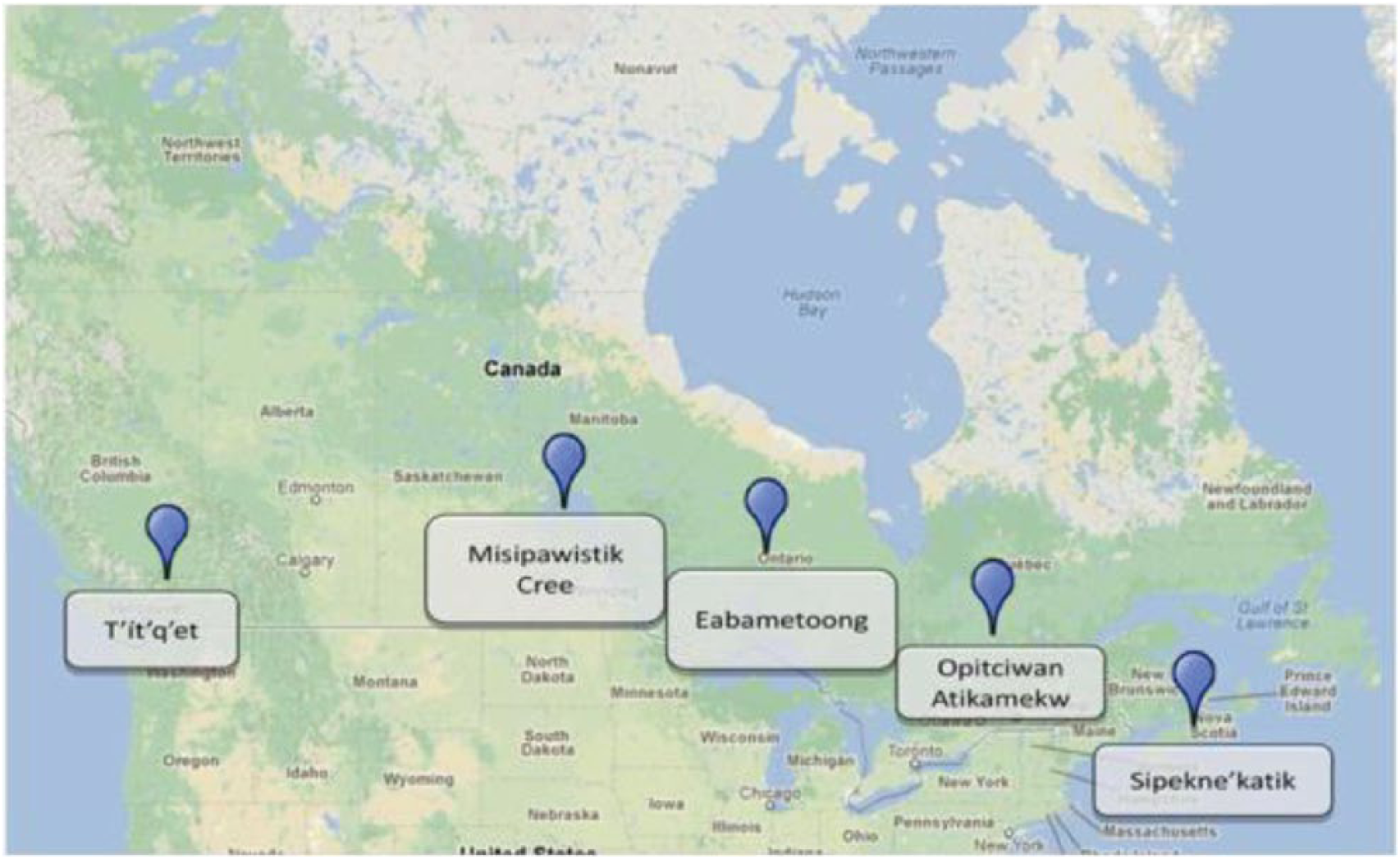
Location of five communities participating in PARP.
In the following pages, we describe our approach to supporting First Nations as they pursue achieving higher levels of health and well-being. It is different from conventional approaches in part because the strategies pursued are community-driven. As a consequence, it is more broadly based than usual, going beyond particular health conditions and programs to include a wide array of activities driven by a holistic conception. The strategies developed by the communities also seek to achieve a balance between programs and services directed to individuals and those that seek to strengthen First Nations as collectivities. d
The five First Nations
Sipekne’katik First Nation in Nova Scotia
Sipekne’katik First Nation is the second largest Mi’kmaq community in Nova Scotia. Formally known as the Shubenacadie Band of Indians, it includes Indian Brook Indian Reserve (IR) #14, New Ross, Pennal, Dodd’s Lot, Wallace Hills and Grand Lake. Sipekne’katik First Nation has 2588 Band members, with approximately 1244 members residing within the First Nation and 1344 members residing off reserve. The largest is Indian Brook located 68 km from Kijipuktuk (Halifax) and 29 km southwest of Truro.
Opitciwan First Nation in Quebec
Opitciwan is part of the Atikamekw nation, which is comprised of three communities: Manawan, Wemotaci and Obedjiwan-Opitciwan. Atikamekw means ‘whitefish’ and refers to the species of fish the people have eaten for ages. Opitciwan was formerly located at the tip of Mékiskan, a site that is accessible by water and is one hour by canoe from the spot that the community occupies today. In 1920, the Gouin Dam flooded the community, causing the families to move closer to the bay. The people settled slowly in the territory where the rising rivers meet, hence the name ‘Opitciwan’, which means ‘the meeting place of the rising rivers’. Opitciwan is located in the heart of the province of Quebec, north of the Gouin Reservoir in the region of La Mauricie.
Eabametoong First Nation in Northern Ontario
Eabametoong First Nation (EFN; also known as Fort Hope) is located on the north shore of Eabamet Lake, 360 km north of Thunder Bay, Ontario. EFN is a member of the Nishnawbe Aski Nation and the Matawa Tribal Council and is a signatory to Treaty 9. Eabametoong is a traditional name, which in Anishinaabemowin (the Ojibway language) means ‘the reversing of the water place’. Each year, due to water runoff, the flow of water from Eabamet Lake into the Albany River temporarily reverses.
Today, EFN has approximately 2400 Band members, of whom about 1300 live on reserve with the balance living in Thunder Bay, Geraldton, and other surrounding communities. EFN is accessible year-round only by air with flights operated by two airlines. During recent years, the ‘winter ice road season’ has shortened due to climate change.
Misipawistik Cree Nation in Manitoba
The Misipawistik Cree Nation (MCN) is located on the northwestern shore of Lake Winnipeg where the mouth of the North Saskatchewan River enters Lake Winnipeg at Grand Rapids 400 km north of Winnipeg. Traditionally, people from the Misipawistik Cree Nation have considered their community to be the geographic centre of Manitoba. As of 2012, the total membership was 1753, with 34% under the age of 15 years, of whom 20% were under 5 years of age.
T’ít’q’et in British Columbia
T’ít’q’et (formerly the Lillooet Indian Band), situated adjacent to the town of Lillooet, is approximately 254 km northeast of Vancouver, British Columbia. T’ít’q’et is 1 of 11 communities within the St’át’imc Nation that share a common language, culture, history and territory. T’ít’q’et currently has 394 registered members. The Band has seven reserves, including the main reserve Lillooet IR #1 and a shared reserve with the Bridge River Indian Band.
Organizationally, PARP established an executive committee that met monthly by phone and that included members of the academic team from each region as well as AFN representation. In addition, community and academic members met annually for several days of discussion about progress made, barriers encountered, and lessons learned. It is through these meetings and discussions that several important themes emerged and we describe them below (4).
Building relationships
While our project was responding to each First Nation’s request to be involved, nevertheless ‘we came from away’ and had to develop a mutually respectful and supportive relationship. This was easier if our project team member already had a well-established relationship with the First Nation, but that was not usually the case.
What did we learn about building relationships? We give a few examples here.
It is crucial to have the active involvement and support of the Chief, Council and senior staff. Projects such as ours need to respect the leadership and decision-making structures within the First Nation and seek broad support for the initiatives being proposed.
First Nations often have a culturally based protocol for building relationships. Initially, it might involve sharing a meal and gifts as part of a process of getting to know each other. Longer-term, it means taking active measures to care for and strengthen the relationship through clear communication, regular visits to permit face-to-face interaction, as well as listening, flexibility, effort, patience and understanding.
Engaging with First Nations involves recognizing their foundational strengths, including their resilience over centuries of time and in the face of enormous pressures. Coming in with a focus on deficits is not appropriate and contributes to discouragement.
It is important to recognize that we inhabit different worlds and that these differences need to be acknowledged. Under pressure from promotion and tenure timetables, academic members may need to do research quickly and to publish the results of their work, yet this might not be in keeping with the need to establish trust with the First Nation over a long period of time and to follow the requirements of community-based participatory research.
It is important to understand the pressures faced by First Nations and their leadership. We were impressed by the range, pace and severity of demands facing the First Nations and their leadership at any given time. Further disruption was caused by the 2-year election cycles in effect in most of the communities. In the case of Sipekne’katik, for example, we saw three different Chiefs and some councillors elected to office during the life of the project.
First Nations are typically grappling with capacity issues, to varying degrees.
For example, there is a constant need for professional development programs in Band administration. Information technology such as bandwidth may be rudimentary, making communication difficult.
First Nation conceptions of well-being
‘You won’t find anything of interest here: we are all rich’ (Older man at Opitciwan).
Rejecting ‘poverty’ in favour of holistic conceptions of development
Mainstream approaches to defining and measuring poverty tend to emphasize the material aspect, relying heavily on levels of income in absolute terms – is it sufficient to buy a given basket of goods and services – or in relation to the income of others. Indices that have been constructed with broader names still adhere closely to measures such as income or employment such as, for example, the 2018 United Nations Human Development Index (income, education, life expectancy) and the Community Well-being Index compiled by Indigenous and Northern Affairs Canada (income, education, employment and housing) (5,6).
According to these kinds of measures, there is a lot of poverty in First Nations but the concept was not embraced by them (7). We were told that Indigenous languages do not contain terms that can directly translate into ‘poverty’. If people feel poor in the mainstream sense, we were told, it is because it is a condition that was imposed on First Nation peoples through colonisation and through government responses to deprivation that prioritised the provision of ‘welfare’ over that of rebuilding First Nation economies and societies.
A much broader conception than material deprivation
‘What makes me feel rich is being in the woods with my grandson and seeing the big smile he has running around on the land, looking at the trees, the berries, the road we walk, the air we feel, the whistling of the wind on my face, the chirping of the birds, whatever we see on the land; that’s richness for me; that’s happiness’ (EFN community member). ‘For Anishinaabe people, the good life does not mean making money, buying things, or winning awards. Rather, it has to do with taking care of yourself, your family and your community. It is showing love by performing acts of kindness. It is having the courage to be honest with ourselves and with others. It is getting wisdom through years of listening to others and learning from our mistakes. It is being generous to our family and community without expecting anything in return. It is living life as a kind, humble member of the community. This is the idea behind The Good Life, Bimaadizwin (7)’.
At Sipekne’katik, for example, the strategy document is called ‘Building our community together’ and includes elements that range from community services to culture, education and training, strengthening governance, and employment and business development.
What is not so clear is whether governments are able to respond in a similarly integrative manner, or whether the divisions within and between departments mean that a holistic plan emerging from the communities is diverted in six different directions with little assurance that the implementation of the plan as a whole can be supported.
The idea of balance and harmony
First Nation conceptions, then, are not only broader but capture the idea as well of achieving balance and harmony, as illustrated in the four directions model depicted in Figure 2. The chart was developed by project team members working with the Eabametoong First Nation. It is adapted from traditional Anishnaabe teachings and reflects the philosophy underlying project implementation. It has been used in a separate paper to organize a discussion around different dimensions of well-being and perceptions of poverty.
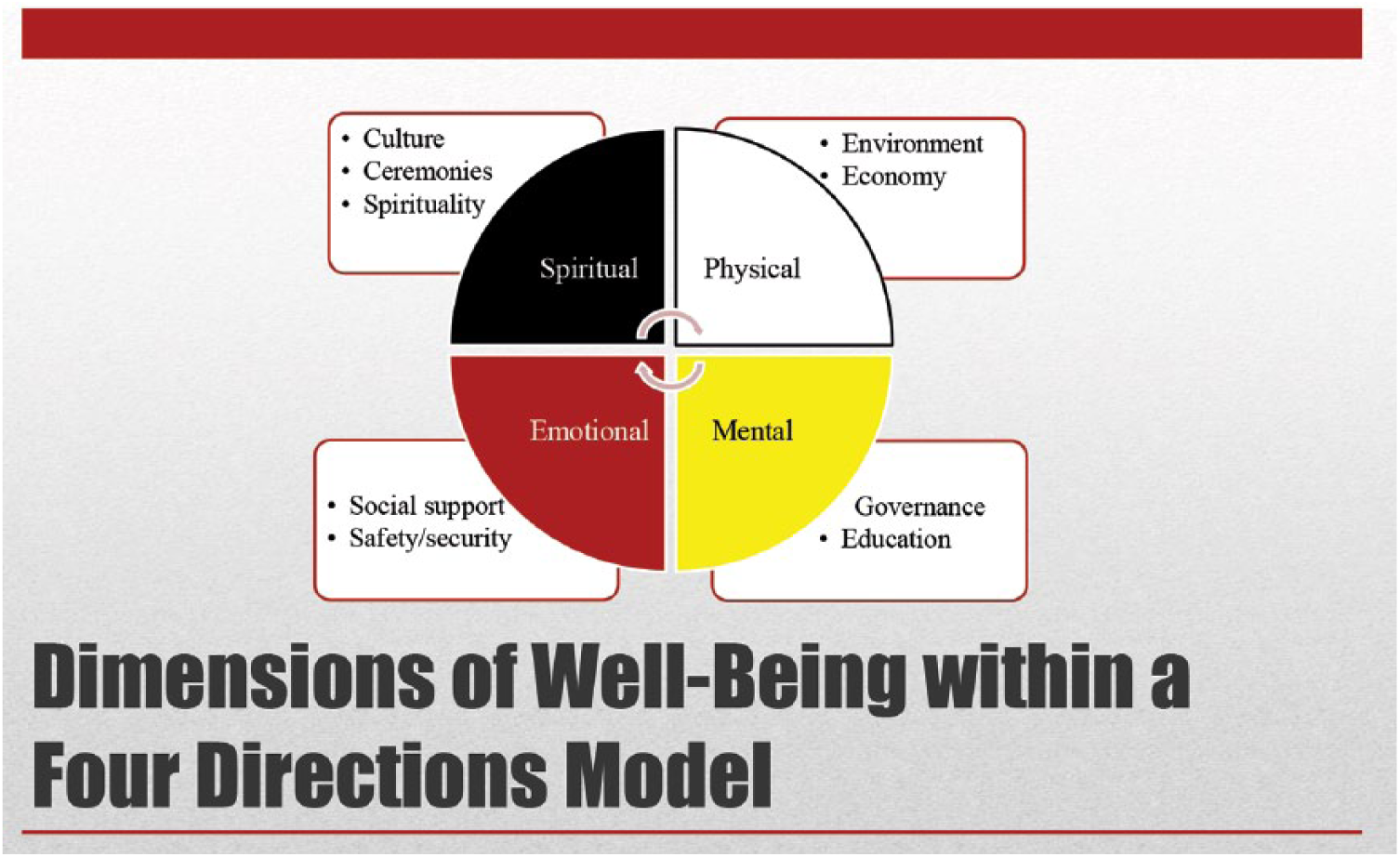
Four directions model.
Well-being at multiple levels
The Indigenous dream includes protecting Indigenous sovereignty, honouring treaties, and retaining decision-making control and environmental stewardship of Indigenous lands… Indigenous nations want ‘viable economies’ and are ‘committed to improving the material standard of living of their peoples’, but not at the expense of ‘group identity, political autonomy, and freedom of cultural choice’ (9).
Conceptions of the good life often go beyond individual considerations to capturing the well-being and future of the community and nation.
Avoiding stigmatization
Finally, we found a reluctance on the part of the First Nations to develop strategies for addressing ‘poverty’ that would serve to identify, isolate and stigmatize a portion of the community. At the Misipawistik Cree Nation, the preferred term was ‘E-Opinitowak’, meaning lifting ourselves up, empowering the community and promoting self-reliance.
Understanding levels of action
When we think about improving health and well-being, it is natural to focus first on individuals and families and to advocate for strategies and services that would improve their lives. If we take addictions as an example, one would want to see treatment programs in place, perhaps make methadone available, and so forth. In the PARP project, a number of our community initiatives involved working at the individual level. In Mispawistik Cree Nation, for example, we supported a driver education/licensing project, and an initiative linking elders and youth in caring for the waters of the lake.
However, we found that the most effective strategies were multi-faceted. With respect to addictions, to continue this example, First Nations are finding that action needs to be taken against drug dealers. The Band needs to have a well-developed human resource policy in place to deal with employees facing substance abuse issues. It is of great benefit for the Band to have own-source revenues available to support treatment and prevention programs, and it helps to break the addiction cycle if there are jobs available for those who complete their alcohol or drug treatment programs. Some of these measures are centred at the collective First Natio level in recognition of the fact that strategies that focus on individuals, while necessary and even essential, do not adequately respond to the situation and may not work very well in the absence of a supportive collective context either.
Thus, at Eabametoong, for example, we became involved in establishing an economic development corporation as well as developing a policy that the First Nation could use in distributing gaming revenues accruing to the community. At T’ít’q’et, we undertook a survey of the health status of the population so that the leadership would have more information for decision-making and, at Sipekne’katik, we are piloting a case management approach to providing services with the expectation that such an approach would be more effective in helping social assistance recipients transition into employment.
One of our project team members, Stephen Cornell, has commented on the individualizing effects of government policy. He notes that governments see Indigenous people as a persistent policy problem. In the CANZUS countries (Canada, Australia, New Zealand and the United States), governments address Indigenous issues by focusing on Indigenous persons, believing that if you address enough individuals then the collective problem will be solved.
… I believe the approach is backwards. The collective, in fact – the nation, the community, the people, the tribe, whatever you call it – the collective is the heart of the matter. Invest in the aspirations and well-being of peoples and the well-being of individuals will follow….
Our research evidence from the Harvard Project and the Native Nations Institute is clear. Government policy does better when it is designed not around individuals but around nations, communities, peoples, and the goals they have for their own futures (10).
History and culture are everywhere
History
References to history are pervasive in the narratives of the First Nations. They refer to loss of access to traditional lands and resources as well as lack of control over lands, resources, and resource development projects that occur there. They share a history of pervasive controls exercised through the Indian Act and through requirements of Ministerial permission; they have been subject to a history of assimilative measures culminating in the establishment of residential schools and some have been vulnerable to the harm and disruption arising from the building of hydro dams and other resource development projects.
This shared history has contemporary legacies affecting development strategies in many ways. If current boundaries and barriers continue, for example, development prospects will be sharply constrained because of a very limited land and resource base. Time and other resources need to be allocated to court proceedings and political negotiations to have treaty and Aboriginal rights recognized. Development strategies need to incorporate health and healing initiatives to help First Nations cope with the legacy of residential schools and addiction issues. A certain level of suspicion exists toward outside initiatives given the history of externally imposed efforts in the past, many of which have failed.
Culture
References to culture also arise frequently in First Nation narratives, sometimes in ways that are not so obvious. We heard about a desire to revitalise, celebrate and apply Indigenous teachings, whether as part of a path toward health and healing or as an integral component of achieving success in education. These desires for cultural revitalisation often require balancing with a strong church presence in some communities. We also noticed changes in governing institutions and decision-making practices as First Nations departed from the standardizing impositions of the Indian Act and re-established forms of governance that are more congruent with their traditions such as, for example, the constitution developed at T’ít’q’et. We also took part in celebrations of culture geared not only to community members but also to the non-Indigenous community, as expressed through the bridge-building motivations of the Sipekne’katik fishing derby or the cultural tourism showcase launched by the Eabametoong First Nation.
Accepting First Nations where they are and where they want to go, and the role of external supports
One of the questions that can legitimately be asked about a project such as PARP is whether First Nations at different points in their development journey can each benefit from the supports and resources the project offers. This question arose when we were making our initial selection of communities and it became clear that one of the candidates had recently been in an emergency crisis situation. In this instance, we were advised that our efforts would likely be unsuccessful because of the many issues that still remained.
In the end, we decided to build this question into the design of the project by deliberately choosing communities that were at different points in their development journey, with different levels of institutional development and challenges that varied from moderate to severe. We conclude that each of the First Nations was able to benefit from the project, which was able to at least modestly assist the First Nation reach the development goals that it had established for itself. What helps in achieving this understanding is the fact that the path is chosen by the community itself. We did not assume that there was only one set of goals in the development process, one path to reaching them, nor one set of indicators or milestones that a First Nation was required to achieve. With appropriate leadership and determination from within and some external support, it was possible to make progress no matter the starting point from which the First Nation began.
We are making two key points here. One is that external supports, even if modest in scale, can be quite helpful to the development trajectory of First Nations. Of course, communities will look to governments to provide resources. They will make the point that it is not enough simply to support the development of strategic plans, but that there must also be a commitment to providing resources to implement them. Secondly, we suggest that, when it comes to providing external supports, the latter do not always or exclusively need to be provided by governments. The academic sector has a role to play, as do the non-governmental and private sectors. This conclusion is particularly relevant in light of the mobilisation of interest and commitment that has been sparked by the Truth and Reconciliation Commission, with many entities in Canada wanting to contribute to reconciliation but not being clear on how to do so.
The importance of leadership and continuity
In all five First Nations, the Chief, Council and their staff have a very prominent role in the life of their communities. It follows that a First Nation greatly benefits from strong, visionary leadership. We would go further to say that the leadership that is displayed – both in dealing with the many pressures and challenges faced by the First Nation as well as making plans for the future – is not fully recognized and appreciated perhaps because, in the mainstream, we place considerable emphasis on credentials such as formal education, whereas non-institutionalized forms of education are viewed as valuable by First Nation leaders. There may also not be a full appreciation of the fact that many of the institutional supports that mayors and other elected leaders in mainstream society can count on, such as industrial parks, chambers of commerce, legal and other personnel, charitable and other societies, and a strong economic base, simply do not exist in most First Nations, thereby making the functions of leadership even more challenging.
In this context, we note that supports for leadership development, such as executive development and other kinds of training programs that would include the senior public service, are quite limited. Those that do exist may be offered in a format or location that makes them difficult to access.
A related issue is the matter of the stability of leadership. We know from case studies of First Nations that have successfully made the transition toward a more self-reliant, self-determining future that not only is the quality of leadership crucial but so, too, is the stability of leadership (11). Even when the conditions for making this transition are favourable, such as leadership, location advantages, access to capital and the like, we know that such a transformation takes at least 15–20 years to accomplish. One can imagine that an election cycle that occurs every 2 years impedes the stability criterion if personnel change occurs every time. In fact, the period for getting things done is less than 2 years because the several months of campaigning in advance of the election and the several weeks needed to re-establish administrations after the election further limit the time available.
Understanding the appropriate roles of politics and business
When beginning to report on its research in the late 1980s, the Harvard Project on American Indian Economic Development struck a chord with American Indian and Canadian First Nations with its emphasis on sovereignty (that is to say, just do it!), the need for a match between cultures and institutions, the importance of leadership and strategic planning, and the need for a well-developed civil service to carry out decisions (12).
The Harvard Project also pointed out the difficulties that ensue if the political leadership gets too involved in making decisions that should better be made on economic rather than political grounds. This is likely to occur when the First Nation has Band-owned businesses and when economic development institutions are not well developed. From this arose the idea that politics and business should be separated, but this short-hand formulation is both a misreading of what the Harvard Project had to say and a misunderstanding of the realities on the ground in First Nations (12).
The issue is more about understanding what the appropriate roles of the political and business sectors should be, rather than to separate them. In the five PARP First Nations, we found that the political leadership, in fact, has a very important role to play in leading community and business development. Political leadership is central to many decisions that affect the environment and resources for economic development, such as developing community visions and strategic plans, putting in place a qualified civil service, enacting by-laws and regulations, and dealing with external government and private sector interests, and more. At the same time, we found at Eabametoong, for example, that the elected leadership had far too much on its plate and was, perhaps, lacking the expertise that was required to make decisions on day-to-day matters of business development. For that reason, at the request of the leadership and following numerous community-wide meetings on the subject, we worked toward the establishment of an economic development corporation that would play the lead role in economic decision-making while still respecting the First Nation’s vision, strategic plan and accountability requirements, being accountable to the elected leadership through annual or semi-annual meetings and reports.
Implications for universities and granting councils
The policies and practices of the national research granting councils, such as the Canadian Institutes of Health Research (CIHR) and the Social Sciences and Humanities Research Council (SSHRC) are rooted in decades of mainstream research norms. These define what counts as research, what ethics review mechanisms and standards are required to be in place, how universities are to manage and be accountable for the research grants that are made to faculty, and so on.
Research involving Indigenous people follows a different trajectory, one that emphasises community participation throughout the research process, recognition of the value of Indigenous knowledge as well as ‘Western’ scientific knowledge, and avoiding research that is exploitative of communities and that fails to meet community needs. With respect to ethics, the major granting councils have responded by including Chapter 9 in the Tri-Council Policy Statement: Ethical Conduct for Research Involving Humans (TCPS2), which sets out the culturally appropriate parameters for conducting research in Aboriginal communities (13).
We are not alone, however, in finding that, in practice, many of the granting councils’ policies and practices are not aligned with the model of community-based research that is set out in Chapter 9. In particular, we found that certain cultural expectations held by communities contrast with the financial practices of the universities as the latter including the need to be accountable to the granting councils and also apply practices suitable for large organisations. This discrepancy is illustrated by the difficulty of having certain kinds of expenses met, such as stipends for ceremonial practices; a lack of respect for elders whose remuneration is considered to be a gift delivered in the form of cash along with tobacco and not requiring social insurance numbers; major time delays in providing reimbursement for expenses in an environment where participants expect to be reimbursed in cash on the spot.
Additionally, some language and other related practices are not compatible with community involvement. For example, we applied for what was called an ‘intervention’ research grant, but ‘intervention’ is not a term that First Nations are comfortable with since they have experienced countless external interventions that have been harmful. In addition, curriculum vitae and other forms try to fit all participants into an academic mould and fail to recognize the contribution and importance of community partners.
Finally, many First Nations have rebelled against research practices that involve students or other researchers determining the research agenda and then extracting information from them. They leave very little behind in terms of benefits, often not even returning results to the First Nation. Increasingly, First Nations demand that research respond to their needs and that there is a mutually beneficial exchange. In PARP’s case, that involved working with First Nations to develop strategic plans and then assisting in their implementation to the extent allowed by our human and financial resources.
The ‘action’ component , however, does not sit well with the granting councils, raising questions about whether ‘implementation’ is part of their responsibility or, instead, something that governments should take on. Additionally, the granting councils are not set up to handle the financial and ethical implications of the action, as opposed to the research components.
It is the federal granting councils which give the universities their marching orders when it comes to matters of ethical and financial accountability. Thus, change will have to come from the federal level perhaps in the form of revised protocols to give the universities and other research bodies the guidance and flexibility they need to adapt their practices in order to accommodate research and action involving Indigenous peoples.
Implications for policies and programs
In conclusion, we note that our experience in working with five First Nations over several years on strategies to strengthen health and well-being leads to several important recommendations for change. Among them are the following. First, funding support is necessary for First Nation development based on strategic plans developed by the First Nations themselves and the contribution that can be made by the non-governmental sector must be recognized. Secondly, there is a need for governments to have the administrative capacity to respond to strategic plans that are holistic in nature. Thirdly, it is important to provide enhanced support for leadership and infrastructure development. Finally, support is required by the granting councils for community-based action research and adaptation of policies and procedures to accommodate the distinctive characteristics of such research by, with and for First Nations.
Footnotes
Acknowledgements
We are deeply appreciative of the five First Nations who invited us into their territory and shared their knowledge with us. They are Sipekne’katik First Nation, Opitciwan Atikamekw First Nation, Eabametoong First Nation, Misipawistik Cree Nation, and T’it’q’et.
Conflict of interest
The authors declare that there is no conflict of interest.
Funding
The Poverty Action Research Project is funded by the Canadian Institutes of Health Research (Institute of Indigenous Peoples Health and the Institute of Population and Public Health). It represents a partnership between the Assembly of First Nations and an academic research team with the lead based at Dalhousie University.