







Abstract
The critically endangered Indian Courser (Cursorius coromandelicus) is a rare resident bird species in Sri Lanka. This bird species is restricted to the northern avifaunal region of Sri Lanka, and even there it has been recorded from only a few locations. Thus, it is identified as one of the rarest birds in Sri Lanka. A 1-year study was conducted to investigate Indian Courser population and their distribution within the Delft Island from 5th of January to 20th of December 2020. Ten (10) randomly selected points were investigated in this study. Of the 10 sampling points, the Indian Courser was observed within three (03) sampling points year around while several sightings were recorded in points 8, and 9 during 3 months of the year. Their abundance significantly varied among sampling locations (one-way ANOVA, F = 15.04, p < .05). The maximum number of individuals recorded was 18 ± 4.64 in December and the minimum number was 4 ± 4.64 during the non-migrant season. Although most of the area in the island is covered with dry grasslands, their distribution in Delft is largely confined to a few grassland patches where human activities are minimum. Hunting, egg collection, and trampling of their nest by the Delft ponies (feral horses) can be identified as the main threats of this species. It is of utmost importance to immediately implement holistic conservation measures to save this critically endangered bird as Delft is the only known location where a viable resident population of Indian Courser is found.
Introduction
Sri Lanka is a medium-sized (65,610 km2) biodiversity-rich tropical island located between 79°39′ E−81°53′ E and 5°54′ N-9°52′ N.1,2 Given its rich biodiversity, Sri Lanka together with Western Ghats of India is considered as one of the 35 biodiversity hot spots in the world. 3 Nevertheless, recent anthropogenic activities such as habitat destruction, fragmentation, overharvesting, pollution, and illegal poaching have caused many species pushed into the endangered categories.4 Hence, many faunal and floral species have already become threatened with extinction, particularly many species of birds. 4 Of the 520 bird species 5 recorded on the island, 66 bird species have been listed as nationally threatened species. 4 Of the 66 nationally threatened species, 18 species have been categorized as critically endangered (CR) including the Indian Courser (Cursorius coromandelicus). 4 Sri Lanka presently records 226 migrant species including vegrants. 6 However, the majority of them are considered as wetland associate birds according to the definition given by the Wetland International.7,8 Most migratory wetland associated birds such as ducks, waders, and terns that end their southward journey to Sri Lanka are found in the northern avifaunal region, 7 which include the Jaffna peninsula. Of the 33 families of wetland birds in the world, 21 families are found in Sri Lanka. 7 A total of 116 species of waterbirds that belong to 23 families have been recorded from the northern avifaunal region. 8 However, eight (08) water bird species are believed to be restricted to the northern avifaunal region. 7
The Indian Courser is an endemic bird species in the Indian Subcontinent.12,13 Their population is considered to be very small in Sri Lanka. 8 However, it is a somewhat common bird species in the mainland of India such as Haryana, Gujarat, Nepal, and East to South-west Bengal.14,15,16 Hence, their population status in mainland India is considered to be least concern (LC). 20 In India, it is found mainly associated with wastelands, saline grasslands, fallow land with scattered scrub, and stony pastures and dry fields.13,15 It tends to avoid heavy rainfall and harsh desert conditions17,18 and prefers arid and semi-arid climatic conditions. 14 This bird has not been observed in coastal and sandy beach habitats in India. 13 However, its population has declined to lower level in some areas of mainland India too.13,15,19
The critically endangered Indian Courser 4 is present only in the northern avifaunal region of Sri Lanka. Historically, this bird was recorded in the narrow belt of coastal grasslands from Marichchukkaddi to the Jaffna peninsula. 9 The northwestern dry coastal belt from Marichchukkaddi to the Jaffna peninsula was sparsely populated in the past. In 1966, T. S. U. de Zylva had found three nests in Talladi area in Mannar where the Talladi army camp is established at present. 10 W.V. Legge 11 has stated that the Indian Courser ranged from the Jaffna peninsula southwards to Pomparippu which is now located within the Wilpattu National Park. Later, in 1978, C. S. de Saram and Ranjit Perera reported an Indian Courser sight record from a short grassland patch next to the Mannar—Pooneryn main road north of Mannar. 10 Sightings of this bird have also been recorded from areas such as Arippu in Mannar in the northern avifaunal region. 9 Two birds were recorded in February 2021 in Mannar Island closer to the Vayu Resort (pers. comm.). According to past observations, their juveniles have also been reported confirming this bird’s breeding resident status. Although this bird was recorded from many locations in the past, their historical habitats have been taken over by the present-day developments, namely, road construction, cultivation, and re-settlements activities, and it appears that they have disappeared from most of their historical range. At present, this bird species is confined to a few locations namely Mannar, Delft, and Jaffna in the northern avifaunal zone of the island. Given its rarity, the Indian Courser is very difficult to observe in Sri Lanka. Unfortunately, the Indian Courser has not been studied in the Sri Lankan context. Therefore, the ecology of this bird is largely unknown in Sri Lanka. Hence, the present study focuses on investigating their population status, abundance, and distribution in Delft Island to bring attention to initiate information-based conservation projects to sustain viable population to ensure their existence in Sri Lanka.
Methods
Study area
The study area in Deft Island is located in the northern avifaunal region which belongs to the arid climatic zone of Sri Lanka (Figure 1).
21
The northern avifaunal region is one of six avifaunal regions in Sri Lanka
22
that shares similarity with the south Indian avifauna.
4
Delft Island is the largest island in the Jaffna Peninsula (9°30′31.69″N and 79°41′39.42″E).23,24 It is located close to the Palk Strait and 10 km away from mainland Jaffna.23,24 The total area of the island is about 50 km2, and the length and width are 8 km and 6 km, respectively.
23
The average annual rainfall, which is received mainly from the northeast monsoon, is about 750 mm.
23
The temperature varies from 26°C to 33°C with an average of 28.2°C.
23
Despite its small size, Delft Island has its unique historical, climatic, archeological, and biological diversity.23,25 Delft Island has a mosaic of diverse vegetation types that include natural, semi-natural, and human-altered habitats.
24
Semi-arid environmental conditions that prevail in Delft can be identified as ideal conditions for the Indian Courser.13,29 Part of Delft Island was declared as National Park in 2015 mainly to protect the introduced feral horses (Equus caballus).
21
The study area and sampling points located in Delft Island within the northern avifaunal region of Sri Lanka.
Fieldwork
Data collection on the Indian Courser in Delft Island was conducted for 1 year from 5th of January to 20th of December 2020. The study area was selected based on a yearlong preliminary observational study prior to this study for the presence of Indian Courser (pers. comm.). Ten (10) random sampling points were selected using the random number table in Delft Island representing all types of habitats on the island (Figure 1). A circular plot of a 300 m radius was employed to search birds at every sampling point,26,27,28 using a standard meter tape. Each sampling point was separated at least 1 km apart from each other to minimize double counting of birds. The observations were conducted during the daytime from 0630–1030 h and 1500–1800 h (during the time the birds are most active). 8 The sampling points were investigated only randomly selected 1 day per month. For observations, a pair of binoculars with an optic power of 10×42 (FOV330FT) was used. Indian Courser was identified according to the popular field guide of Birds of Sri Lanka 29 by Depal Warakagoda. Photographs were taken using a Digital Camera (Canon 7D fitted with a 500 mm telephoto lens). GPS receiver (Garmin eTrex Venture HC GPS Receiver) was used to obtain the GPS coordinates where the Indian Courser was present.
Statistical analysis
Data were analyzed using Minitab 19.1 and Excel 2016 software packages. Analysis of variance (one-way ANOVA) was conducted to see if there is significant variation between the abundance versus sampling locations. Arc GIS 10.3 was used to create the study area map and the Indian Courser distribution map.
Results
Among the 10 sampling points, the Indian Courser was found in only five (5) sampling points (Figure 1.). Of the five (5) sampling points in which they were observed, the Indian Courser was frequently present (year around) in points 3, 4, and 5 while in point 8 and 9, the Courser was present only during January, February, and March. The abundance of the Indian Courser significantly differed among the sampling locations (one-way ANOVA, F = 15.04, p < .05). The Indian Courser was found to inhabit only the short dry grassland habitats where short grasses with sparsely distributed small bushes are found. Sampling points 1, 2, 6, 7, and 10 are located in areas where human activities are common, while points 3, 4, 5, 8, and 9 are located in grasslands where minimum human activities were observed. Moreover, points 3, 4, 5, 8, and 9 are situated within the boundaries of Delft Island National Park. Therefore, the least human activities were observed due to the legal protected status of the park.
The maximum abundance was recorded in December which is 18 ± 4.64 and the minimum population was recorded as 4 ± 4.64 between May and August which is the non-migratory period. There is a notable increase in the population of the Indian Courser during the winter period (Figure 2). According to the distribution map prepared based on preliminary observations and the current study, 90% of the island area is covered with the grassland habitat (Figure 3). Human activities are confined to the north and northwestern portion of the island, and the southern portion is somewhat free from human habitation and intense human activities. Even though the Indian Courser could be observed throughout the daytime (0600–1800 h), they were active more in the morning compared to the evening hours. Intense ground-feeding was observed especially in the morning hours (0630–1030 h). Single individuals were observed on most occasions, while close associated pairs were observed during the migratory season (Figure 4). The bird is very well camouflaged in these dry grassland habitats due to its dull colors thus making it rather difficult to spot them (Figure 5). It is also a very shy bird and runs away with the slightest disturbance. We could not record breeding activities such as nests, eggs, and juveniles during the present study. Month-wise sightings of Indian Courser in Delft Island. Distribution of the Indian Courser within the Delft Island National Park. An adult Indian Courser (Cursorius coromandelicus) from the Delft Island National Park. Typical Habitat of Indian Courser within the Delft Island National Park; the bird is very well blended to its dry short grassland habitat.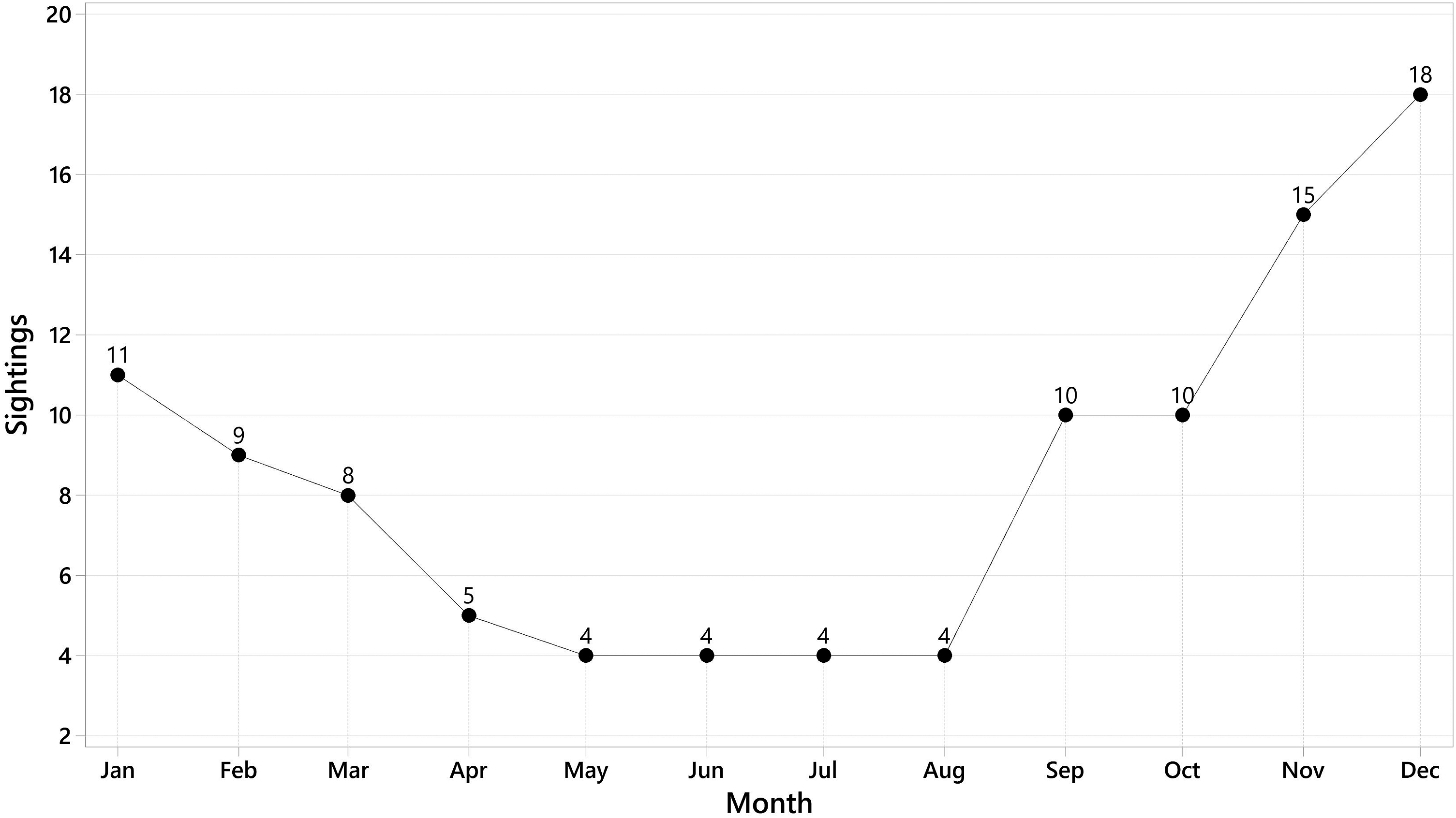


Several species of birds were occurring together with the Indian Courser, namely, Red-wattled Lapwing (Vanellus indicus), Yellow-wattled Lapwing (Vanellus malabaricus), Pacific Golden Plover (Pluvialis fulva), Grey Francolin (Francolinus pondicerianus), Indian Thick Knee (Burhinus indicus), Lesser Sandplover (Charadrius mongolus), Paddyfield Pipit (Anthus rufulus), Ashy-crowned Sparrow-lark (Eremopterix griseus), Common Myna (Acridotheres tristis), Blyth’s Pipit (Anthus godlewskii), and Richard’s Pipit (Anthus richardi) that share the grassland habitat with Indian Courser. Moreover, these grasslands are also an excellent habitat for the introduced feral horses and they frequently share the grassland with the birds.
Several threats were recorded during this study which may cause serious pressure for this population of the critically endangered Indian Courser. Even though the island is isolated from the mainland, several human-centric threats to this habitat were also observed. The local community has a habit of hunting wild birds for food, especially lapwings, flamingoes, and ducks. Hunting activities are more intense during the migratory season. Local people do not possess proper knowledge of island wildlife and their status. Collecting the lapwing eggs in the grassland is a common practice by the local people, and they may also collect Indian Courser eggs assuming that they are lapwing eggs. Therefore, egg collection from the grassland and habitat alterations activities are serious concerns for the Indian Courser population in Delft. Feral horses may also disturb the nesting behavior of this bird. Trampling of the nests and juvenile may occur during their movements in the grassland. Moreover, there were several raptors such as Brahminy Kite (Haliastur indus), Common Kestrel (Falco tinnunculus), Crested Serpent Eagle (Spilornis cheela), Black Kite (Milvus migrans), Shikra (Accipiter badius), and White-bellied Sea Eagle (Haliaeetus leucogaster) recorded during the study period that may pray on the Indian Courser.
Discussion
Delft Island is a good place that can be observed the Indian Courser and there is no other known location recorded it throughout the year. Points 3, 4, and 5 can be identified as the core areas for this bird where their activities are observed year-round. Moreover, we have recorded only four (04) sightings in the non-migrant season from May to August. Thus, the resident population size is at a critically low level and immediate conservation action is vital to protect this population. The low population and declining trend of this bird are observed in mainland India as well.15,30 Significant variation of the bird’s abundance has been observed between each sampling location. The Indian Courser preferred to inhabit in the short dry grasslands with sparse small bushes where human activities are at a minimum. These areas may provide enough food for them. 13 This study confirms that Sri Lankan population also prefers similar habitat attributes as India and assures that dry grasslands in Delft are ideal habitats for this rare species. Short grasslands with small bushes also provide ideal environmental conditions to protect them from predators. The Indian Courser can be considered as a ground feeding bird as extensive ground feeding was observed early hours in the morning (0630–1030 h).31,32 The Indian Courser distribution map in the Delft shows that they are distributed only within the grassland and tend to avoid human settlements. The areas where the Indian Courser was mostly recorded were located within the Delft Island National Park; therefore, it is expected that their habitats are protected from human activities. However, there are tensions and disagreement with the local people on the boundary demarcation of the park, which is yet to be clarified.
This restricted population is also facing many human-related threats. Hunting, and collecting their eggs, and even the presence of humans in this habitat has negative impacts on their free movements. The local people tend to hunt and collect lapwing (Red-wattled Lapwing and Yellow-wattled Lapwing) eggs in the area where Indian Courser is also present. These harmful actions negatively impact the Indian Courser population as non-targeted species since they share the habitat with the lapwings. Being an isolated island away from the mainland, it is clear that laws and regulations that protect this species are not functioning properly. Hence, special attention should be given to protect their habitats in the Delft Island National Park. Law enforcement activities are hampered by the absence of clear boundaries of the park that separate it from the human settlements. Hence, proper boundary demarcation of the park as a protected area is of utmost importance. Therefore, it is pragmatic to implement special conservation actions to protect this endangered species. Protecting the grassland by targeting Indian Courser would automatically protect many other species that call this area home. Furthermore, being the best place to observe and photograph this endangered bird species would help to boost the tourism activities of Delft which in turn helps to improve the economic benefits to the island community.
Conclusions
Delft Island has the ideal habitat for the Indian Courser; thus, it may be the only remaining place in Sri Lanka where a considerable resident population is found. However, the species is considered as a critically endangered (CR) bird species in Sri Lanka. Hence, special care should be taken to conserve them. Even in Delft, the resident population is considerably low and they are very sensitive to habitat modifications. Further, they are facing many threats within the island. Therefore, their breeding biology and other ecological information is important to protect them thus conducting further detailed studies is pragmatic for the long-term survival of this bird species. Proper boundary demarcation for the national park is recommended to strengthen law enforcement activities in reducing human activities that are adversely affecting the bird population. Delft Island National Park is currently being governed by the Department of Wildlife Conservation and the Delft Divisional Secretariat. There have been several attempts of discussion with the local people to place proper boundaries for the park with little success. Hence, this should be immediately resolved with the participation of all the stakeholders. Proper awareness programs for authorities and the local people may play an important role to resolve this problem. We intend to take action to conduct such activities with the result of this research and establish a community-based conservation program. Indian Courser will become an iconic species for such implementation. Recording breeding activities within Delft Island (northern avifaunal region) will be the next step of this work. Further studies are recommended to explore possible localities of the Indian Courser in the northern avifaunal region. Finally, comprehensive species conservation program with full community participation is strongly recommended to protect this endangered bird and its habitats. Without adopting the above-recommended actions, we could hardly assure the long-term existence of this endangered and fascinating bird species in Sri Lanka.
Footnotes
Acknowledgments
We wish to acknowledge the Divisional Secretariat of Delft Island for granting permission to conduct the study. Further, we especially thank Mr. Vimukthi Weerathunga and two anonymous reviewers for their valuable comments to improve the article.
Declaration of conflicting interests
The author(s) declared no potential conflicts of interest with respect to the research, authorship, and/or publication of this article.
Funding
The author(s) received no financial support for the research, authorship, and/or publication of this article. This study is self-funded by the study team.
Availability of data and materials
The coordinates of the centers of distribution will not be made available for public access in order to prevent unscrupulous action on the protected species.
Ethical approval
The Delft Divisional Secretariat of Sri Lanka granted permission for this study. This work complies with the current laws of Sri Lanka. It was based on simple field observation without any experimental manipulation or damage to the studied birds.
