







Abstract
Habitat degradation and fragmentation are crucial factors which result in biodiversity loss among the world. Understanding how species respond to the habitat change is helpful and essential for the conservation of the endangered ones. Therefore, the aim of current study is to explore how to carry out biodiversity conservation from the perspective of the habitat selection of species. We studied the microhabitat selection of blue eared pheasant (Crossoptilon auritum) during its breeding time (including mating, incubation, and feeding periods). The field research was carried out from April to August in 2014 at Helan Mountains, China. Six nests of blue eared pheasants were found; 323 used plots and 171 control plots were recorded. Results indicated that blue eared pheasants prefer mountainous coniferous forest at shady slope with domination of Picea crassifolia, and its habitat selection was mainly influenced by shrub density, tree density, altitude, slope degree, hiding cover, water resource, and human disturbance. However, there were slight differences among the three periods. Our study firstly compared factors that affect the microhabitat selection of blue eared pheasants among the three periods of its breeding time. Meanwhile, combining the current study with the previous ones, specific strategies could be applied on the works of endangered species and biodiversity conservation.
Keywords
Introduction
Nowadays, widespread habitat loss and fragmentation leading to habitat degradation has been shown to be a crucial cause of global biodiversity loss.1–4 However, the birds’ geographic distribution, population density, breeding success rate, survival rate of adult birds, etc. were directly affected by the quality of habitat.5,6 It’s not difficult to understand that human beings must be responsible for the reduction of the quantity and quality of habitat. Unfortunately, deforestation due to the encroachment of man-made settlements and agricultural lands has been reported to be responsible for the loss of more than one-third of the forest cover worldwide.7,8 Luckily, birds can select the most suitable habitat for themselves from a variety of available habitat types in a phenomenon known as habitat selection. 9 The habitat research on birds especially the rare and threaten ones has become a significant portion of bird conservation biology.10,11
Blue eared pheasant (Crossoptilon auritum) is a rare species of Chinese endemic bird,12–14 belongs to Order Galliformes, Family Phasianidae, and Genus Crossoptilon, and ranks Ⅱ grade in key protected wildlife in China. The blue eared pheasant is found throughout mountain forests of central China such as Qinghai, Tibet, Gansu, Sichuan, and Helan Mountains in Ningxia.15,16 The diet consists mainly of berries and vegetable matter. Researchers studied the factors which influenced the nest-site and forge-site selection of eared pheasant and its change.17–20 Blue eared pheasants prefer stay at Picea asperata and Populus davidiana forests during winter, sometimes forging at the edge of forests or the place close to residence. 21 And in Helan Mountains, the pheasants prefer mountainous coniferous forest at shady slope with dominated of P. crassifolia and prefer the habitat with higher tree density, higher shrub density, steeper slope degree, higher hiding cover, thinner snow cover, and higher altitude during winter 22 ; besides, similar conclusion was gotten during spring and summer. 22 In addition, it would like to nest under dense shrub or fallen logs with high hiding cover and low human disturbance during breeding time. 21
Systematic studies on the habitat selection of blue eared pheasants have been carried out, and more comprehensive understanding about its habitat characteristics was gotten. However, we firstly subdivided its breeding process into three periods, aiming to get more details concerning habitat information of its mating, incubation, and feeding periods. Based on previous studies, it was hypothesized that the hiding level and human disturbance would affect the habitat selection of the pheasant obviously. Besides, there may be slight difference in the habitat characteristics among the various breeding periods of the species. Combining the studies of predecessors and ours, there was more complete understanding among the habitat selection of blue eared pheasants. Hence, targeted strategies could be taken to protect and recover the habitat which was suitable for the pheasant, so as to protect not only this endangered and rare bird but also the biodiversity of the ecosystem.
Methods and techniques
Study area
Helan Mountains Nature Reserve (N38°21′-39°22′, E105°49′-106°42′) is located in the place where the Ningxia Autonomous Region and Inner Mongolia Autonomous Region meet in the northwestern of China, at an altitude of 2000 m–3000 m. With the character of typical continental climate, there is a clear distinction between the four seasons of the reserve: its summer is short but not extremely hot and winter is long but not extremely cold. The annual mean temperature is 9.4°C; the highest temperature is 35.2°C occurred in August and the lowest temperature is −27.7°C occurred in January. Average annual precipitation ranged from 180 mm to 200 mm and there is a significant difference between months. 23 The Helan Mountains are an important geographical boundary in Northwest China as the boundary between temperate desert and temperate desert steppe. In addition to blue eared pheasants, there are snow leopards (Panthera uncial), goitred gazelles (Gazella subgutturosa), blue sheep (Pseudois nayaur), red deer (Cervus elaphus alxaicus), etc.
Data collection
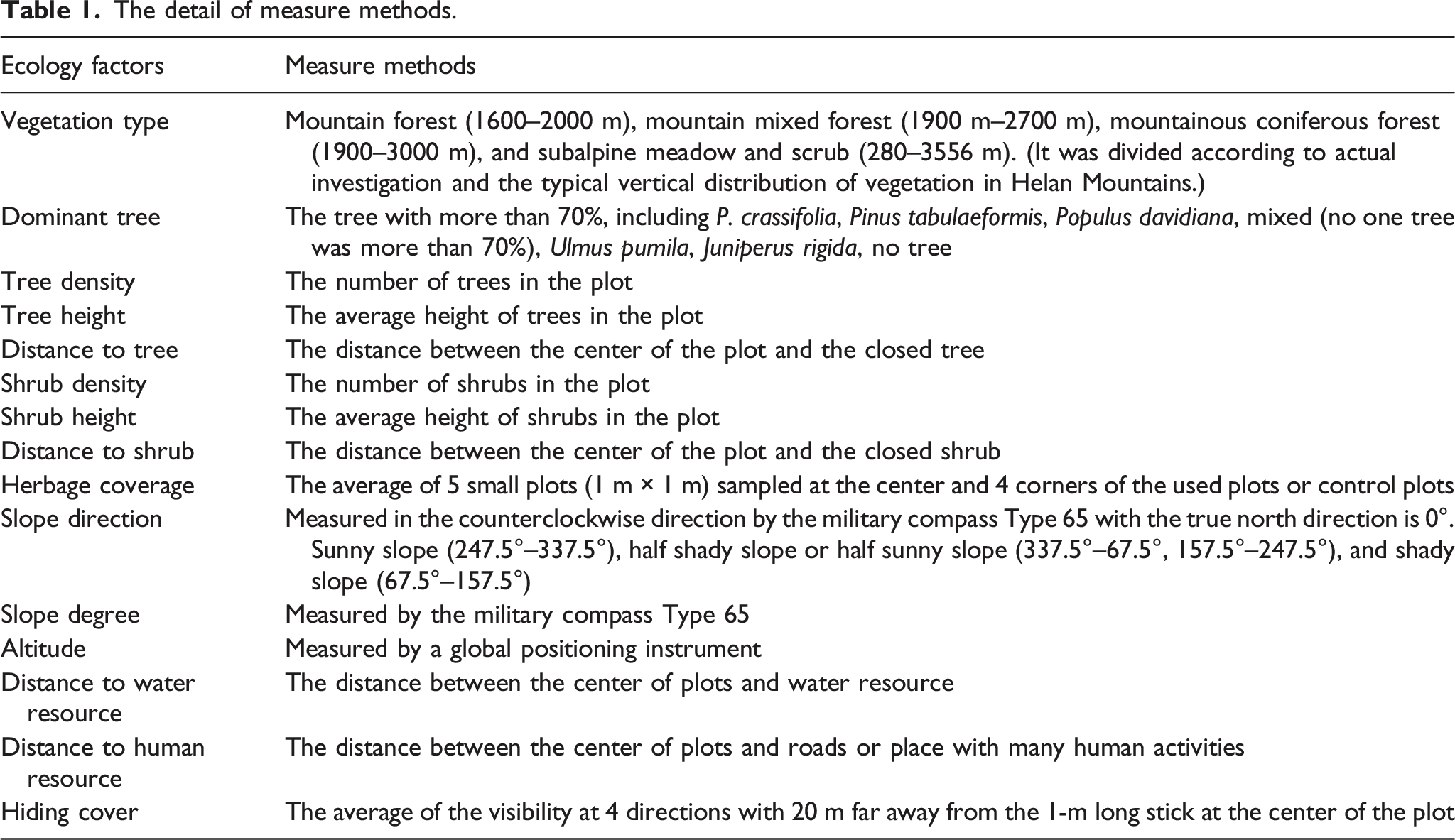
The detail of measure methods.
Data analyses
The one-sample Kolmogorov–Smirnov test was used to check out the numerical ecology factors (tree density, tree height, distance to tree, shrub density, shrub height, distance to shrub, slope degree, altitude, distance to water resource, distance to human resource, hiding cover, herbage coverage, and herbage coverage) and made sure if they were normal distribution. For the normal distribution ecological factors, independent samples T test was used to identify if there are significant differences between the used plots and control plots, and for the abnormal ones, the Mann–Whitney U test was used.25,26 Chi-square test was used to compare the difference of ecological factors among the nests of blue eared pheasants. Besides, resource selection function was applied to analyze the effect of different ecological factors and detect the preference of blue eared pheasants.27–29 Because the abnormal distribution ecological factors counted a high rate among those variances, we applied Spearman’s rank correlation coefficient test to check out the correlation among them and removed the factors with absolute value larger than 0.5. After removing those factors, we adopt binary logistic regression to analyze chosen factors and build a resource selection function model. All the data was handled and analyzed by Excel 2013 and IBM SPSS Statistics 20.
Results
The selection of non-numeric factors of blue eared pheasants during breeding time
Results showed that blue eared pheasants prefer mountainous coniferous forest at shady slope with dominated of P. crassifolia during mating, incubation, and feeding periods (Figure 1). In the matter of vegetation type, more than 88% of the used plots of blue eared pheasants were found in mountainous coniferous forest during the three periods, and there was significant preference among dominant tree and slope direction. More than 80% of these used plots were dominated by P. crassifolia and the highest selection proportion occurred in the feeding period (98.1%). However, in point of slope direction, more than 94% of used plots were found in shady slope. The selection of vegetation type, dominant tree, and slope direction of blue eared pheasants during mating, incubation, and feeding periods (Sms: subalpine meadow and scrub; Mcf: mountainous coniferous forest; Mmf: mountain mixed forest; Mf: mountain forest; Pc: P. crassifolia; Pt: Pinus tabulaeformis; Pd: Populus davidiana; Mi: mixed; up: Ulmus pumila; Jr: Juniperus rigida; Nt: no tree; Sus: sunny slope; Shs: shady slope; Hshosu: half shady slope or half sunny slope).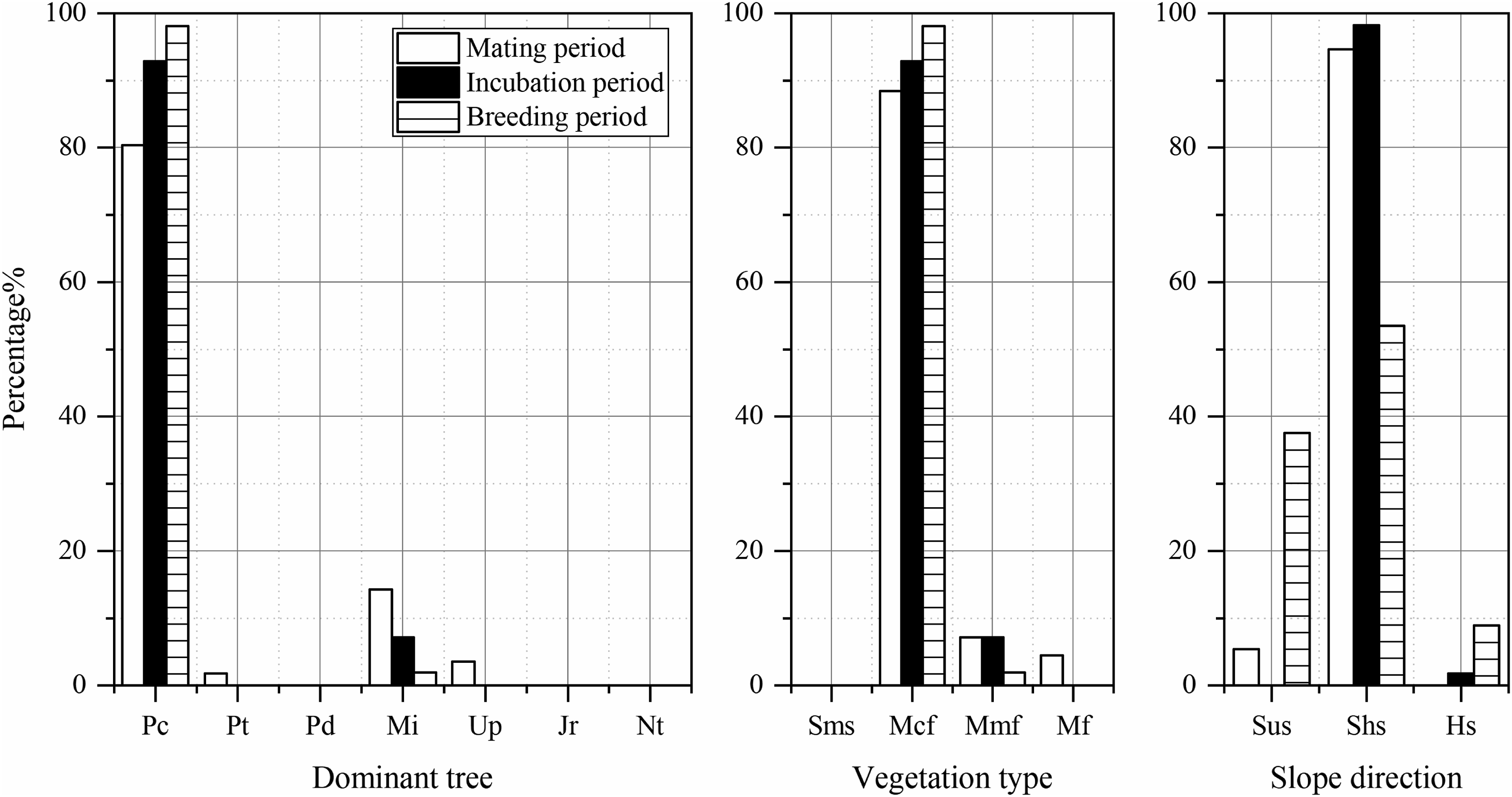
The microhabitat selection of blue eared pheasants during the mating period
Independent samples T test and Mann–Whitney U test showed that there was a significant difference among shrub height and slope degree (p < 0.05) and extremely significant difference among shrub density, tree density, distance to tree, distance to water resource, distance to human resource, distance bare rock, altitude, and hiding cover (p < 0.01). Blue eared pheasants prefer the habitat with lower shrub height, lower shrub density, higher tree density, closer distance to tree, further distance to water resource, further distance to human resource, long distance to bare rock, steeper slope degree, higher altitude, and higher hiding cover when comparing with control plots.
Selected factors from the logistic equation during the mating period.

The microhabitat selection of blue eared pheasants during the incubation period
Independent samples T test and Mann–Whitney U test showed that there was a significant difference among shrub density, distance to shrub, and herbage coverage (p < 0.05) and extremely significant difference among tree density, slope degree, distance to water resource, distance to human resource, and hiding cover (p < 0.01). Comparing with control plots, blue eared pheasants prefer the habitat with higher tree density, higher shrub density, further distance to shrub, higher herbage coverage, less steep slope degree, closer distance to water resource, closer distance to human resource, and higher hiding cover.
Selected factors from the logistic equation during the incubation period.

The microhabitat selection of blue eared pheasants during the feeding period
Independent samples T test and Mann–Whitney U test showed that there was a significant difference between slope degree (p < 0.05) and extremely significant difference among tree density, tree height, shrub density, shrub height, distance to shrub, distance to human resource, hiding cover, and altitude (p < 0.01). Blue eared pheasants prefer the habitat with higher tree density, higher tree height, lower shrub density, lower shrub height, closer distance to shrub, steeper slope degree, further distance to human resource, higher hiding cover, and higher altitude when comparing with control plots.
Selected factors from the logistic equation during the feeding period.

Habitat selection comparison of blue eared pheasants between the mating period and feeding period
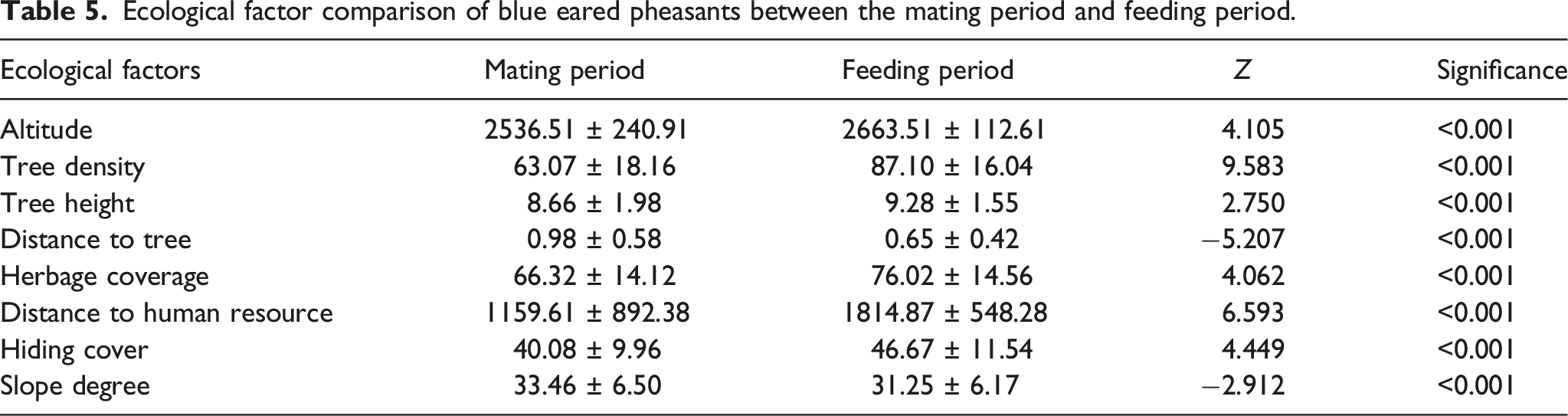
Ecological factor comparison of blue eared pheasants between the mating period and feeding period.
Habitat characteristics of the nests of blue eared pheasants
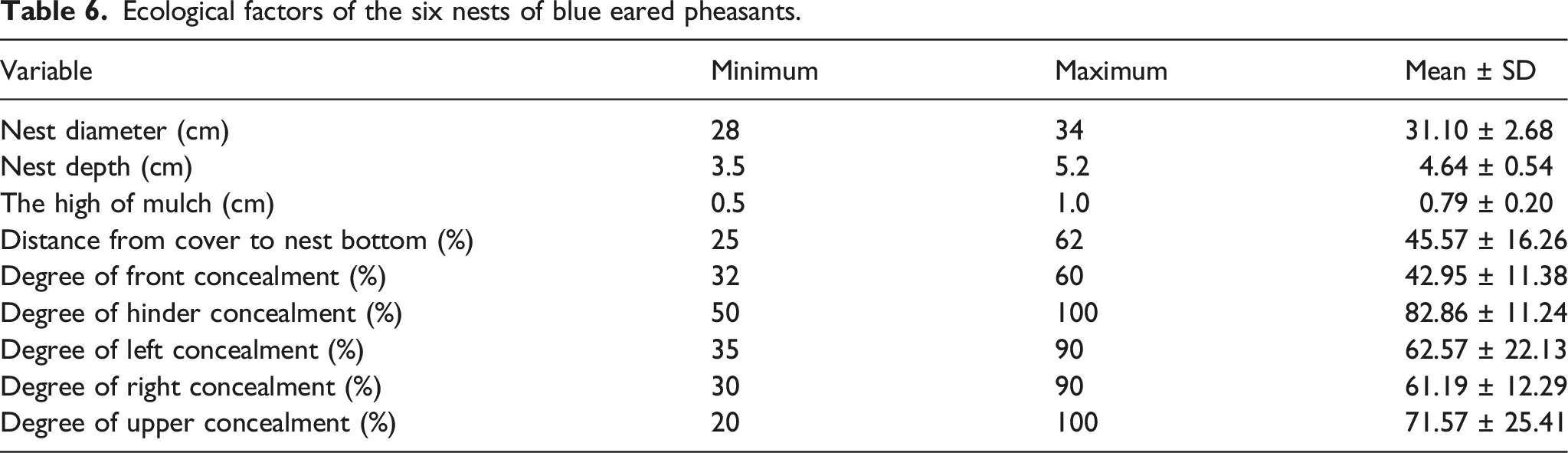
Ecological factors of the six nests of blue eared pheasants.
Discussion
In the current study, investigation on the habitat characteristics of blue eared pheasants was performed, and six nests of the species were found. Besides, we record 323 used plots in the habitats where they used in mating, incubation, and feeding periods as well as 171 control plots in which no traces of the species were found. After comparing the difference between the used and control plots, the results indicated that the shrub density, tree density, hiding cover, water resource, human disturbance, etc. are crucial factors in affecting the habitat selection of them (Tables 2–4), which is similar to our hypothesis. The breeding time of blue eared pheasants was divided into three independent periods by us creatively, which could supply more details and is helpful for the conservation strategies on the species.
Habitat is the space where organisms live in and the individuals would select the most appropriate one to meet the need of surviving and reproduction. What influence the habitat selection of wildlife mostly are the food resource, water resource, and shelter condition in the habitats. 30 Besides, the factors which determine the habitat selection of wildlife are complex; the characteristics of habitat itself and the characteristics of animals, food availability, predation, and competition are included.31,32 As a typical alpine bird, a blue eared pheasant inhabit in medium and high mountain forests and meadows at an altitude of 2000 to 4000 m. During the non-breeding seasons, for adapting to the surrounding environment better and facing the interference of different factors together, blue eared pheasants live in clusters of dozens of individuals. While during estrus, the number of the clusters would decrease to five to six individuals because of the fight between males. In the breeding seasons, a couple of blue eared pheasants would occupy and live in a certain area.
The current study showed that blue eared pheasants prefer forging in mountainous coniferous forest at shady slope with domination of Picea crassifolia. Besides, the shrub density, tree density, altitude, slope degree, hiding cover, water resource, and human disturbance are the main factors that affect its habitat selection during breeding time (Tables 2–4), which is similar to previous research studies.21,22 Our results revealed that the habitat selection of blue eared pheasants is highly connected with slope degree and altitude during the mating period, while both in incubation and feeding periods, it is highly connected with shrub density and tree density. However, there was a slight difference in the habitat characteristics among the three periods of the breeding time of the blue eared pheasant.
In the mating period, the main behavior of female blue eared pheasant was foraging, while the male one was warning, which not only forbids other pheasants to enter their territory but also guards against predators and humans. Hence, the food resource and concealment were both considered by blue eared pheasants when selecting habitats. The P. crassifolia forest in Helan Mountains can supply suitable habitats for the blue eared pheasant due to its sufficient food resource and shelters for avoiding the hunting of carnivores. Besides, the low density of shrub under the tree met its activity needs such as foraging, walking, and running away. In the incubation period, blue eared pheasants would not leave their nest too long and they may forage nearby. The eggs in the nest are easy to be found by predators and easy to be preyed on. Hence, the blue eared pheasant must always be near to the nest so that the nest and eggs are not found by predators, aiming to ensure its successful reproductive rate. In addition, hatching requires a relatively constant temperature, so the blue eared pheasant needs to return to the nest in time to maintain the temperature of the eggs, so they can’t go too far.
In the feeding period, for ensuring the growth and safety of chicks, the food resource and concealment condition become the crucial factors that influence the habitat selection of blue eared pheasants. Ecological factors of blue eared pheasants between the mating period and feeding period were compared and the result revealed that there was a significant difference among parts of those factors (Table 5). Particularly, the distance to human resource in the feeding period was significantly larger than the mating period. The reason may be that blue eared pheasants have to take care of the fragile chicks, so they are more sensitive to the distance of human interference. Besides, the tree density, herbage coverage, and hiding cover in the feeding period were also higher than those in the mating period, all of which may be due to the security consideration of the chicks. As a consequence, blue eared pheasants prefer to forage at the P. crassifolia forest with high density and height of tree which can afford adequate nutriment and shelters. In our study, the correctly predicted rate of resource selection function model of all the three periods is larger than 83% (Tables 2–4), so we can simplify our work and easily predict the habitat selection of blue eared peasants with some certain factors by building the resource selection function model.
In general, blue eared pheasants prefer the forests characterized by mountainous coniferous at shady slope with dominated of P. crassifolia and prefer more tree and shrub, higher altitude, steeper slope degree, higher hiding cover, closer to water resource, and further to human disturbance. These kinds of habitats can avoid more outside disturbances and supply plenty of food for them when breeding chicks. We firstly compared the three periods (mating, incubation, and feeding periods) of breeding time of the habitat selection of blue eared pheasants, and the result showed that there are no significant differences among the three periods and their habitat selection was similar to previous research studies. 33
Footnotes
Acknowledgments
We are grateful for the support of the Inner Mongolia Helan Mountains National Nature Reserve in the field work of our study.
Declaration of conflicting interests
The author(s) declared no potential conflicts of interest with respect to the research, authorship, and/or publication of this article.
Funding
The author(s) disclosed receipt of the following financial support for the research, authorship, and/or publication of this article: This work was supported by the Fundamental Research Funds for the Central Universities (2572014CA03), National Natural Science Foundation of China (31870512, 32071649, 32070519), and Heilongjiang Touyan Innovation Team Program for Forest Ecology and Conservation.
