






Abstract
Background
No studies compare outcomes of anatomic total shoulder arthroplasty to reverse total shoulder arthroplasty with more than five-year follow-up.
Methods
A multicenter prospectively collected shoulder registry was utilized to review all patients undergoing primary anatomic total shoulder arthroplasty or primary reverse total shoulder arthroplasty with a minimum five-year follow-up utilizing a single platform stem implant system. One-hundred-ninety-one patients received an anatomic total shoulder arthroplasty and 139 patients received a reverse total shoulder arthroplasty. Patients were scored preoperatively and at latest follow-up using the simple shoulder test (SST), University of California Los Angeles (UCLA), American shoulder and elbow surgeons (ASES), Constant, and shoulder pain and disability index (SADI) scores as well as range of motion. Radiographs were evaluated for implant loosening or notching. Complications were reviewed. A Student’s two-tailed, unpaired t-test identified differences in preoperative, postoperative, and pre-to-postoperative improvements.
Results
Reverse total shoulder arthroplasty patients were significantly older than anatomic total shoulder arthroplasty patients. All patients demonstrated significant improvement in functional metric scores and range of motion following anatomic total shoulder arthroplasty or reverse total shoulder arthroplasty. There was no difference in final outcome scores between anatomic total shoulder arthroplasty and reverse total shoulder arthroplasty patients at midterm follow-up; however, reverse total shoulder arthroplasty patients demonstrated significantly less motion.
Discussion
We demonstrate equivalent outcomes with five scoring metrics at mean follow-up of 71.3 ± 14.1 months. Although postoperative scores were significantly greater than preoperative scores for both anatomic total shoulder arthroplasty and reverse total shoulder arthroplasty patients, significant differences in outcome scores between cohorts were not observed.
Keywords
Introduction
Shoulder arthroplasty has become a reliable and widely used treatment for glenohumeral arthropathy. Reverse total shoulder arthroplasty (rTSA) is most commonly indicated for the treatment of glenohumeral arthritis in patients with severe rotator cuff insufficiency, although the indications are expanding to include complex fractures, revisions, and primary arthritis in elderly patients. The usage of both anatomic total shoulder arthroplasty (aTSA) and rTSA has increased significantly worldwide due, in part, to the predictability of acceptable outcomes achieved with each prosthesis type for its respective indications, but also due to the aging population and the increased use of the rTSA.1–6 As surgeons are expanding the indications for rTSA, there is an increasing percentage of primary arthroplasty with rTSA. 2 Although patients requiring aTSA are typically less impaired than patients requiring rTSA, both groups have previously shown significant improvement after shoulder arthroplasty in short-term follow-up. 7
Whereas several studies have published data on survivorship of both aTSA and rTSA, few have compared outcomes between the two treatments; and those that do only utilize short-term data.1,7,8 The purpose of this study is to compare patients undergoing either primary rTSA or aTSA with a minimum of five-year follow-up with multiple functional metric scores, quantitative range of motion (ROM), and radiographic evaluation.
The authors hypothesize that, similar to short-term outcome studies, both cohorts will see significant improvements in pain and function following treatment with either aTSA or rTSA. With this midterm data, the authors hypothesize that there will be a statistical difference in the magnitude of change of pre- to postoperative functional metric scores and all ROM measurements in the rTSA cohort compared to the aTSA cohort.
Materials and methods
A multicenter prospectively collected shoulder arthroplasty registry was utilized. Preoperative and postoperative data were analyzed from 330 patients (average age: 69.3 ± 8.3 yrs; min = 36 yrs and max = 89 yrs) who received a primary aTSA or primary rTSA with a minimum of five-year follow-up (average follow-up = 71.3 ± 14.4 months) utilizing the same implant system that incorporates a platform stem (Exactech Equinoxe, Gainesville, Florida). One-hundred-ninety-one patients with an average age of 67.0 ± 8.8 years (min = 36 yrs and max = 86 yrs), 103 females (average: 69.0 yrs), and 88 males (average: 64.6 yrs) received a primary aTSA shoulder for treatment of osteoarthritis (OA), post-traumatic arthritis, or inflammatory arthropathy. One-hundred-thirty-nine patients with an average age of 72.5 ± 6.4 years (min = 55 yrs and max = 89 yrs), 96 females (average: 73.3 yrs), and 43 males (average 70.8 yrs) received a primary rTSA. In 83 cases the indication was rotator cuff arthropathy, rotator cuff tear in 14, primary OA in 17, inflammatory arthropathy in 8, osteonecrosis in 7, acute fractures in 4, malunion in 2, and post-traumatic OA in 4.
Nonaugmented, all-polyethylene glenoid components were used for aTSA procedures. Sixty-five arthroplasties utilized a keeled glenoid component and 126 arthroplasties utilized a pegged glenoid component. All aTSA glenoid components were secured using polymethyl methacrylate bone cement. For rTSA cases, a standard, nonaugmented glenoid baseplate was utilized for all procedures.
The patients were evaluated and scored preoperatively and at latest follow-up using the simple shoulder test (SST), University of California Los Angeles (UCLA), American shoulder and elbow surgeons (ASES), Constant, and shoulder pain and disability index (SADI) scoring metrics. Additionally, the patients’ active abduction, active forward flexion, active external rotation, and passive external rotation were also measured preoperatively and at latest follow-up. Internal rotation was measured by vertebral segments and was scored by the following discrete assignment: 0° = 0, hip = 1, buttocks = 2, sacrum = 3, L5–L4 = 4, L3–L1 = 5, Th12–Th8 = 6, and Th7 or higher = 7.
The average follow-up for aTSA patients was 73.8 ± 16.3 months and the average follow-up for rTSA patients was 67.8 ± 10.5 months. Improvements in outcome using each metric score were normalized on a 100-point scale, correlated, and compared. Radiographs were evaluated for evidence of implant loosening or notching. Complications were reviewed and recorded. A Student’s two-tailed, unpaired t-test was used to identify differences in preoperative, postoperative, and preoperative-to-postoperative improvements, where p < 0.05 denoted a significant difference.
Results
Average pre- and postoperative outcome scores of aTSA patients.

ASES: American shoulder and elbow surgeons; aTSA: anatomic total shoulder arthroplasty; IR: internal rotation; SPADI: shoulder pain and disability index; SST: simple shoulder test; UCLA: University of California Los Angeles.
Average pre- and postoperative outcome scores of rTSA patients.

ASES: American shoulder and elbow surgeons; IR: internal rotation; rTSA: reverse total shoulder arthroplasty; SPADI: shoulder pain and disability index; SST: simple shoulder test; UCLA: University of California Los Angeles.
There were 18 complications reported. Of the 10 complications reported in the aTSA cohort, five required surgical intervention. The most commonly reported complication was RTC, occurring in three patients. Of the eight complications reported in the rTSA cohort, only two required surgical intervention. The most commonly reported complication was acromion/scapular spine fractures, occurring in three patients, all of whom were treated nonoperatively. All periprosthetic fractures were the result of falls.
Figure 1 compares the preoperative outcomes between the aTSA and rTSA cohorts. As described in Figure 1, rTSA patients had a significantly worse preoperative Constant score and had significantly less preoperative active abduction, forward flexion, and strength, though they had significantly better active and passive external rotation, as compared to aTSA patients. Figure 2 compares the postoperative outcomes between the aTSA and rTSA cohort. As described in Figure 2, no difference in clinical metric scores was observed between aTSA and rTSA patients at midterm follow-up; however, rTSA patients had significantly less motion as measured by four of the six ROM (active abduction, forward flexion, and active and passive external rotation) measurements. Figure 3 compares the preoperative-to-postoperative improvement in outcomes between the aTSA and rTSA cohort. As described in Figure 3, no difference in improvement was observed with any clinical metric scores between aTSA and rTSA patients at midterm follow-up; however, rTSA patients had significantly less improvement in motion as measured by three of the six ROM (internal rotation score, active, and passive external rotation) measurements.
Comparison of average preoperative outcome scores of aTSA versus rTSA patients. ASES: American shoulder and elbow surgeons; aTSA: anatomic total shoulder arthroplasty; IR: internal rotation; rTSA: reverse total shoulder arthroplasty; SPADI: shoulder pain and disability index; SST: simple shoulder test; UCLA: University of California Los Angeles. Comparison of average postoperative outcome scores of aTSA versus rTSA patients. ASES: American shoulder and elbow surgeons; aTSA: anatomic total shoulder arthroplasty; IR: internal rotation; rTSA: reverse total shoulder arthroplasty; SPADI: shoulder pain and disability index; SST: simple shoulder test; UCLA: University of California Los Angeles. Comparison of average improvement (Δ preoperative-to-postoperative outcomes scores) of aTSA versus rTSA patients. ASES: American shoulder and elbow surgeons; aTSA: anatomic total shoulder arthroplasty; IR: internal rotation; rTSA: reverse total shoulder arthroplasty; SPADI: shoulder pain and disability index; SST: simple shoulder test; UCLA: University of California Los Angeles.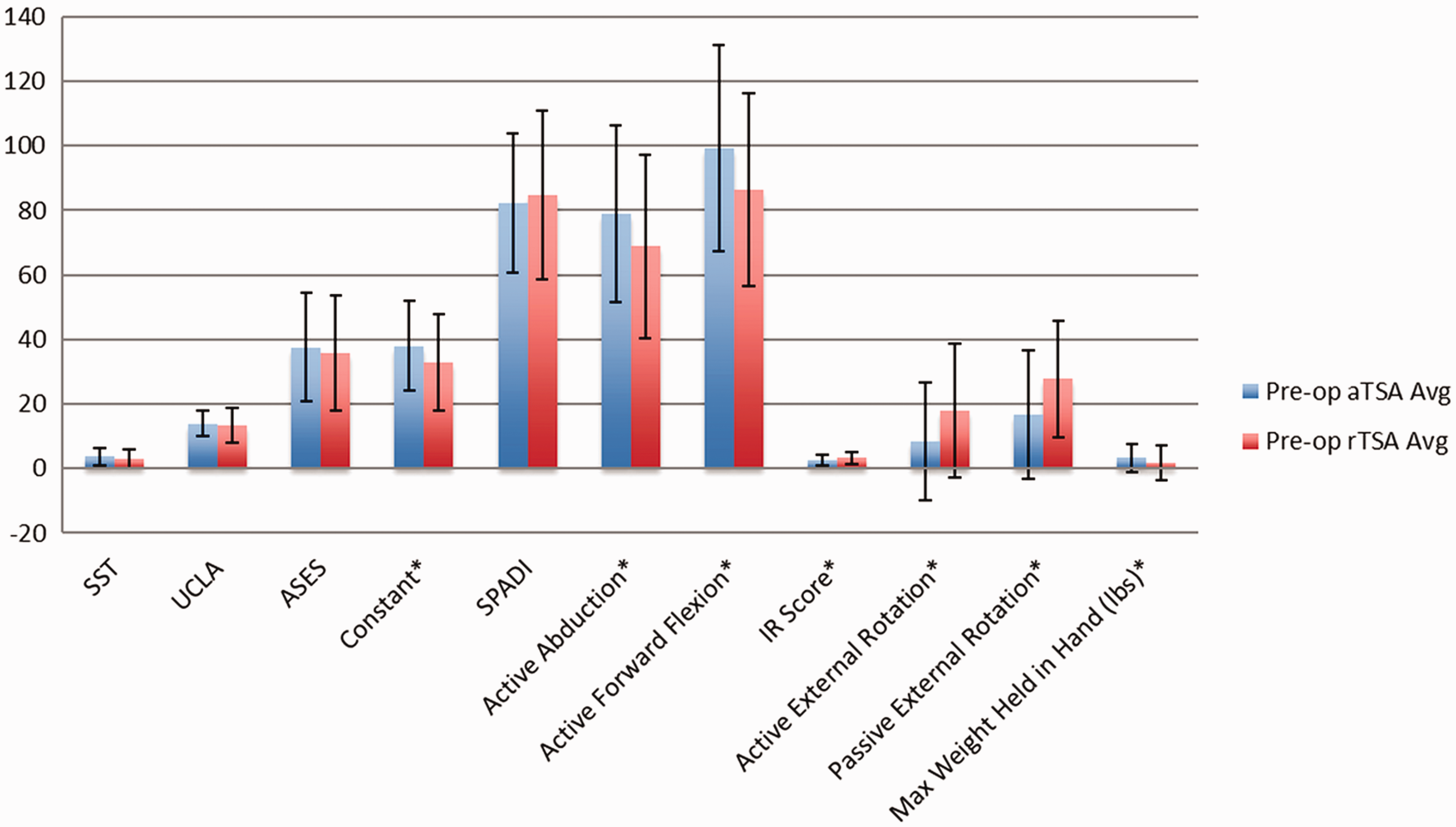


Discussion
The results of this study demonstrate significant improvements in pain and function following treatment with both aTSA and rTSA utilizing a single platform shoulder system at a mean follow-up of 71.3 ± 14.1 months. While aTSA and rTSA were used to treat different preoperative conditions, each treatment method provided significant improvements in all outcome score measurements. Each cohort saw significant improvements in all motion measurements, strength, and pain postoperatively as well.
There were several significant differences between the preoperative data of the two shoulder arthroplasty cohorts. On preoperative evaluations, rTSA patients were older, weighed less, and had less active abduction and active forward flexion, though they had significantly better active and passive external rotation compared to aTSA patients. Strength was also greater in the aTSA patients preoperatively. Preoperatively, rTSA patients had a significantly worse Constant score. These preoperative findings are similar to other comparison studies.1,6,11,12–18
In both aTSA and rTSA cohorts, the patients had significant improvements in all functional metric scores and ROM pre- to postoperatively. Interestingly, this study did not find a statistical difference in the rTSA versus aTSA magnitude of change of preoperative-to-postoperative functional metric scores or ROM, which has been described in previous studies.1,11 This finding may be due to the rTSA cohort’s heterogeneity of the preoperative diagnosis. In this study, rTSA patients had preoperative diagnoses of rotator cuff arthropathy, RTC, and OA. There was also no significant difference in improvement in strength in terms of the magnitude of preoperative-to-postoperative improvement in strength between the two cohorts.
One of the more interesting findings is the lack of statistical difference in any of the five postoperative functional metric scores between the aTSA and rTSA groups at minimum five-year follow-up. This finding shows that both the functional measurements and the patients’ perception of function are similar between aTSA and rTSA at a minimum of five-year follow-up. While aTSA patients had significantly greater postoperative active abduction, forward flexion, internal rotation, and external rotation, there was no significant difference in passive external rotation between the two groups. Although these slight increases in mean ROM were statistically significant, their clinical significance is unknown. It is doubtful that a difference in forward flexion of 8°, or internal rotation of one anatomic segment, would be noticed by a patient and is likely not clinically meaningful. However, it is possible that an improvement of 9° in active external rotation favoring an aTSA might be perceived as clinically meaningful by the patient.
Complications of aTSA versus rTSA.

aTSA: anatomic total shoulder arthroplasty; rTSA: reverse total shoulder arthroplasty.
Scapular notching was present in 19.3% of rTSA with a mean scapular notching grade of 0.28, which is lower than previous studies that have reported rates of 30–35%.11,22,23 Of the 29 rTSAs with radiographic evidence of notching, 27 were either grade 1 or 2 (93%). There were only two rTSA with grade 3 notching. No grade 4 notches were noted. No patients required a revision due to scapular notching.
There are several limitations of this study. While the shoulder arthroplasty registry utilized is prospectively collected, the data were retrospectively reviewed for this study. As a result, there are inherent limitations as with all retrospective studies. It reports on the midterm clinical results of a single platform shoulder system for 330 patients with minimum five-year follow-up. The comparative results may continue to change with time, as the long-term outcome beyond 15 years of the reverse shoulder prosthesis in particular is unknown. 24 The durability question is a draw between the two implants at a minimum of five-year follow-up. Additionally, registry analyses such as this can contain numerous variables that can limit impact such as multiple centers with different patient populations, different surgeons, different surgery centers, different rehabilitation methods, and different data collection methods. However, the authors have standardized the practices of each center and facilitated the use of standardized data collection forms to quantify outcomes using multiple different scoring metrics. The shoulder registry data are also regularly audited to confirm the quality and completeness of the inputs. Another limitation is that the radiographic analyses are performed at each individual institution by the operating surgeon. Future work could incorporate the use of a single or multiple independent reviews of all radiographs to further minimize bias.
This comparative clinical study of aTSA and rTSA using a single platform shoulder system demonstrates equivalent outcomes with five different scoring metrics at a mean follow-up of 71.3 ± 14.1 months. While both aTSA and rTSA cohorts observed significant improvements in all preoperative-to-postoperative functional outcome scores and ROM values, there were no observed statistically significant differences in outcome scores between the two cohorts at final follow-up. aTSA had slightly improved ROM compared to rTSA in this study, but the clinical significance of this is unknown. The complication rates are similar between the two groups, and much lower for rTSA than previously reported. Longer-term follow-up is needed to determine if these results hold up over time.
Footnotes
Declaration of Conflicting Interests
The author(s) declared the following potential conflicts of interest with respect to the research, authorship, and/or publication of this article: Mr Roche is an employee of Exactech, Inc. Thomas W Wright receives royalties and has a consultancy agreement with Exactech, Inc. Zuckerman is a paid consultant for Exactech, Inc., and receives royalties from Exactech, Inc. Flurin has a consultancy agreement with Exactech, Inc., and receives royalties from Exactech, Inc. Crosby has a consultancy agreement with Exactech, Inc., and receives royalties from Exactech, Inc. Friedman has a consultancy agreement with Exactech, Inc. The University of Florida Department of Orthopaedics and Rehabilitation receives research support from Exactech, Inc. The remaining authors, their immediate families, and any research foundations with which they are affiliated have not received any financial payments or other benefits from any commercial entity related to the subject of this article. IRB Information: WIRB study number 1112376.
Funding
The author(s) received no financial support for the research, authorship, and/or publication of this article.
Ethical Review and Patient Consent
The study was approved by the Western Institutional Review Board, study number 1112376.
Research Material Access
Please contact Thomas W Wright, Orthopaedics and Sports Medicine Institute, University of Florida, 3450 Hull Road, Gainesville, FL 32611, USA; email, wrightw@ortho.ufl.edu, to request access to underlying research materials. The paper is not based on a previous communication to a society or meeting.