






Abstract
This review gives a summary of the records of shoulder dislocation management throughout history until the point that anaesthetics were introduced and modern medicine improved dislocation management exponentially. A dislocation is a mechanical injury that has been managed in different ways throughout history. The shoulder reduction methods described in Hippocrates Corpus have been described and adjusted throughout history by later physicians. For example, in ancient Greek, Hippocrates considered the ambe, a device used to reduce the shoulder, to be the most powerful tool. However, Cooper, a physician in the 19th century, considered it to be the last resort due to substantial damage to the ribs and discomfort of the patient. This review demonstrates that there were many physicians that contributed to shoulder dislocation management. These physicians paved the way for modern shoulder dislocation treatment strategies.
Introduction
Shoulder trauma has presumably been around for as long as humans populate the earth. Orthopaedic pathology and treatment have already been described in the Edwin Smith papyrus that dates back to ancient Egypt in 1300 BC, which outlines treatment for fractures, spinal injuries and clavicle dislocations. 1 In addition to the medical papyrus, an image of a construction site was found in the tomb of the building master Ipuy depicting something that resembles a technique that is now known as Kocher's method to reduce the shoulder following a dislocation (Figure 1). 2 However, there is still no consensus on whether this image depicts a shoulder reduction or that it may depict something else, such as a worker waking up his colleague. 3 It is plausible that shoulder dislocations and its management are of all times and that ancient civilisations, like the Babylonians and Assyrians, used reduction techniques to treat a shoulder dislocation. However, specific information from that time is lost. The oldest surviving text on shoulder reduction seems to be written by Hippocrates (460 – 377 BC), namely the Hippocratic Corpus. 4 The Corpus is believed to be the collected works of multiple physicians of that time assigned to Hippocrates. These methods form the basis for techniques described by physicians in the Middle Ages and (Early) Modern times. Knowledge of the historical background of the conservative treatment of shoulder dislocation helps understand how current treatment strategies developed without the use of X-rays or other modern tools. Furthermore, it demonstrates how the ingenuity of physicians created and improved these treatment strategies. Some of these are still used up to this point, whereas others are no longer in use. The aim of this review is to summarize the management techniques of shoulder dislocations throughout history until the point that anaesthetics and radiology were introduced and the science behind developing new techniques to manage dislocations changed drastically.
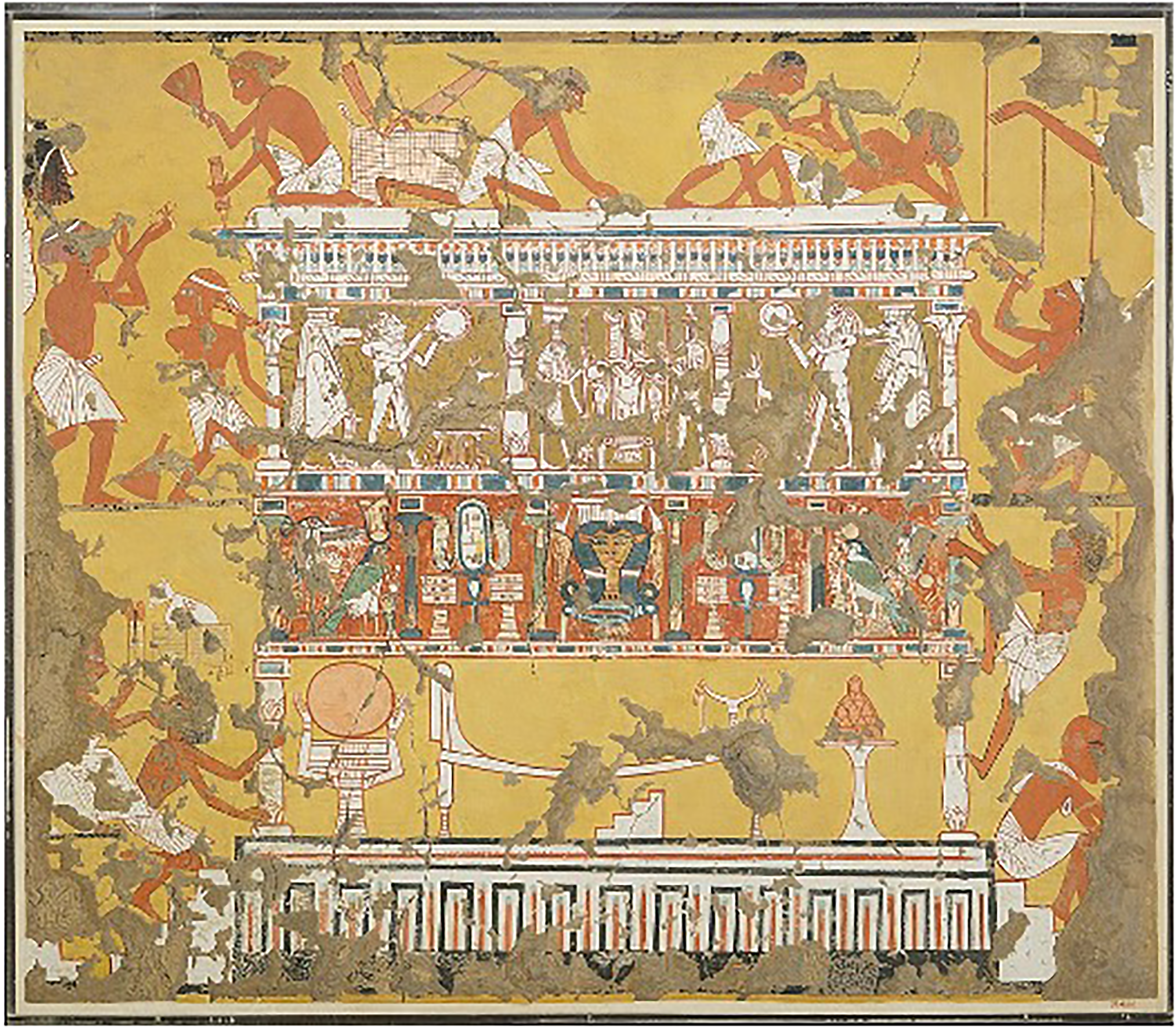
Possibility of shoulder reduction technique in the building of a Catafalque, Tomb of Ipuy TT210 at Deir El-Medina (public domain image).
Classical antiquity (8th century BC – 6th century AD)
The classical antiquity, which comprises the ancient Greek and Roman civilizations, is well known for its development in medicine and philosophy. The name of the Greek physician Hippocrates (460 – 377 BC), known as the father of medicine, is still attached to the well-known shoulder reduction technique in which the physician places his or her heel in the armpit of the patient and applies traction on the arm to reduce the shoulder. However, this method is not the only reduction method that Hippocrates described and taught, as can be seen in his work: The Hippocratic Corpus.5,6 The original Greek text was translated by E.T. Withington (1860 – 1947) into English and describes seven techniques to reduce the shoulder and that all techniques should be mastered to become an expert, as great variety exists in the difficulty of reducing a shoulder. Hippocrates believed that this variety was primarily caused by individual differences such as ligament structure (some ligaments could stretch easily and some were constricted) or could be explained by the physique. He identified a muscular physique as a risk factor for dislocations and noted that reduction is more of a challenge in these patients compared to patients with a slim figure. He even observed that some patients were able to dislocate and reduce their own shoulder without pain. In addition, the text reveals that Hippocrates had only observed shoulders that dislocated into the axilla. He had never seen a dislocation going in the outward, upward or forward direction. He described that other practitioners believed that a dislocation in the forward direction was possible as well, as an anterior projection of the humeral head could be present. However, Hippocrates argued that they were deceived by the shape of the humeral head, which has a naturally forward projection, while the rest of the bone is curved outwards. The first reduction technique that is described can be used by patients with frequent dislocations and practitioners. Patients should make a fist with the opposite hand, put it in their armpit and push the humeral head back, while pressing the elbow against their chest (Figure 2, image 1A). A practitioner could imitate this technique by placing his head on the acromion for countertraction and pulling the arm towards himself with both hands (Figure 2, image 1B). Simultaneously, the practitioner uses his knee or asks an assistant to press the arm against the chest of the patient. For the second technique, the practitioner places the forearm backwards on the spine, uses one hand to push the elbow upwards and the other hand to press at the back of the joint to reduce the shoulder (Figure 2, image 2). In the third technique, the practitioner's heel is used, while the patient is lying on the ground. A hard and small ball, such as a ball of sewn pieces of leather, is placed deep into the armpit (not under the humeral head). An assistant sitting at the head of the patient places a leather strap around the ball and pulls the strap towards him, while placing his foot on the shoulder to apply counter pressure. The practitioner sits on the ground and pulls the arm of the patient with two hands, while creating counter pressure with the heel in the armpit. A second assistant is sitting at the other side of the patient to prevent the patient from turning during the reduction (Figure 2, image 3). For the fourth technique, the practitioner should be taller than the patient. He or she takes the arm of the patient and places the point of his or her own shoulder (acromion) in the armpit, while pressing the patient's arm against the chest (Figure 2, image 4). The body weight of the patient is used to reduce the shoulder and the patient can be shaken to increase the counter pressure. If the patient does not weigh enough, a small child can hold on to the patient to increase the weight. For the fifth technique, a pestle with a soft band wrapped around the tip is placed in the armpit of the patient. The practitioner pulls the arm downwards along the pestle, while an assistant puts his arms around the neck and pulls downwards simultaneously (Figure 2, image 5). It is mentioned that this method may be dangerous, as the pestle can slip away from under the armpit. The sixth technique is similar to the previous method in terms of reduction, but the steps of a wooden ladder are used instead of a pestle. It is described that this method is preferred as the ladder is more stable than the pestle. A rounded shape must be applied to the ladder to facilitate the reduction (Figure 2, image 6). The seventh method is described to be most powerful and uses a piece of wood that is approximately four fingers in width and two cubits long (cubit is an ancient length measure and equals a forearm). One end of the piece of wood should be rounded with a projecting rim (ambe) at the extremity with a soft band attached to it. The piece of wood is placed as far as possible into the armpit with the ambe above and facing the humeral head. The arm is tightly bound to the piece of wood and the armpit is placed over a wooden bar, similar to the sixth technique. The patient should only be able to stand on his toes and is pulled down on both sides, identical to the fifth and sixth techniques (Figure 2, image 7).
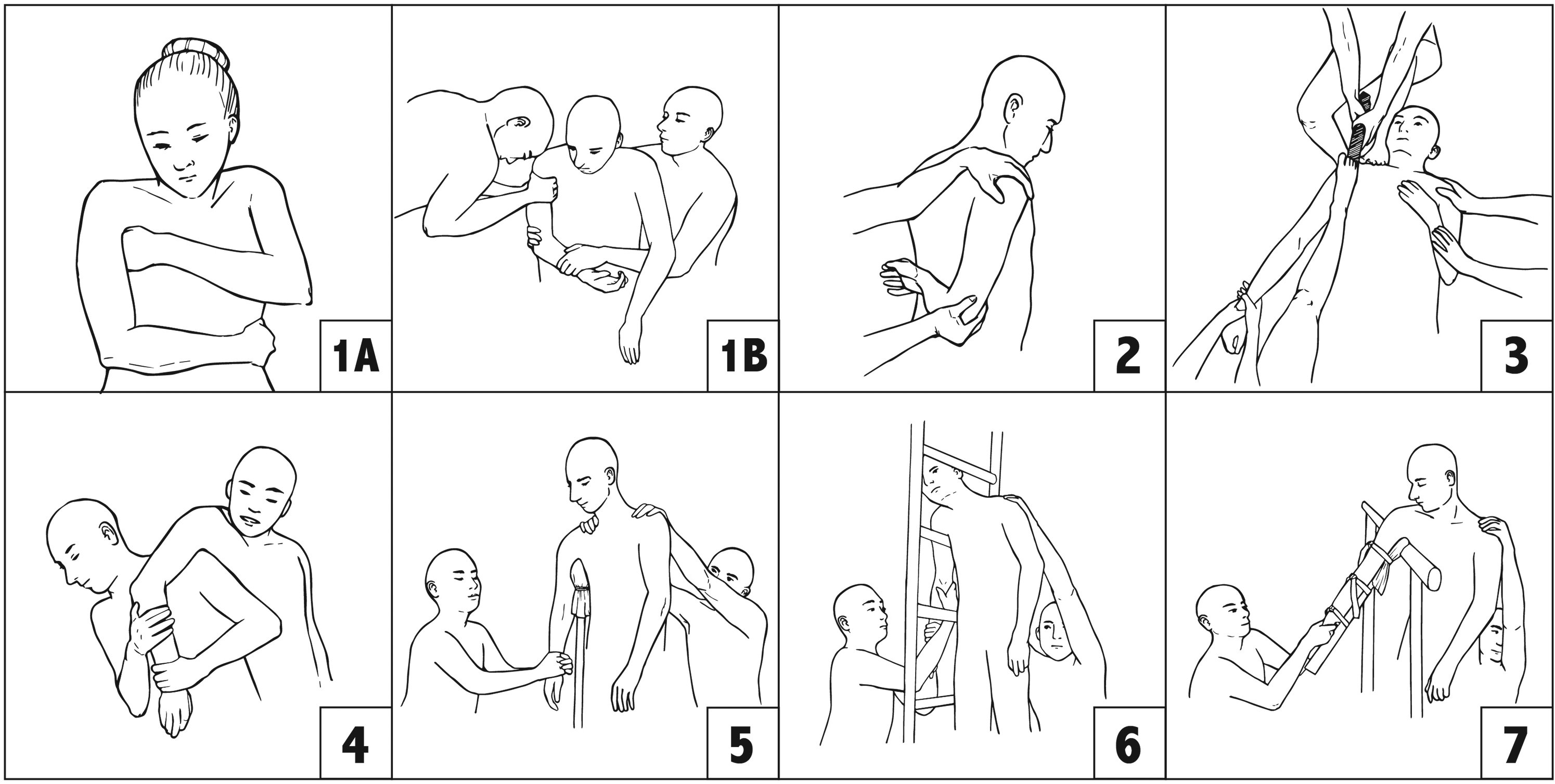
The seven techniques of shoulder reduction as described by Hippocrates. Source: illustrations drawn by K.A.N. Akkermans, image created by T.H. Staal.
Besides from a wooden bar, it is described that this technique can also be performed with a ladder, the chair-back of a large (Thessalian) chair or a double door. This technique was considered to have the optimal counterpoise and to be safest for the bone of the arm. 6
Recurrent shoulder dislocations, especially those of gymnasts and patients who battled in war, were treated with white-hot irons by cauterizing ‘excess’ skin in the armpit followed by immobilization until the wound was completely healed. The ideas of Hippocrates about selecting reduction techniques based on patient characteristics reappeared in ‘Treatise On Joints’, written by Cyprus-born Apollonius of Citium (first century BC). He considered not only physique as a risk factor, but also age, gender and profession.7,8 Diagnostics on shoulder dislocations were described by Aulus Cornelius Celsus (c. 25BC – c. 50AD) in ‘De Medicina’. He was a Roman encyclopaedist and, even though it was unclear whether he was a physician himself, wrote a book on the initial management of shoulder dislocations. 9 According to the book, a dislocated shoulder (into the axilla) is diagnosed if the affected arm cannot be raised to the level of the ear at the same side. Also, the affected arm might be longer than the opposite side. Two assistants and a physician are needed to put the shoulder back in place. One assistant will fix the scapula (‘blade-bone’) by pressing on the head of the scapula (probably the acromion), while the other assistant stretches the arm. The physician will put one hand in the armpit and presses the elbow to the side with the other hand. If that is not successful, a wooden board as long as the arm was applied under the arm and strapped down at three places from the wrist to the armpit. This technique resembles the seventh technique described by Hippocrates using the ambe. Celsus refers to Hippocrates describing many more techniques to reduce a shoulder, however he found that the technique using the ambe proved most useful in practice. Celsus 10 recommended immobilizing the arm following reduction, using a bandage and some wool in the armpit.
Galen (129 – 199 AD) was a physician born in Pergamon who worked for several emperors such as Marcus Aurelius, his son Commodus and Septimius Serverus. He is, together with Hippocrates, considered one of the most important and prominent physicians from antiquity. Both of them spread their ideas through writing. Galen was a physician that treated the gladiators and probably came across a lot of dislocations and other trauma caused in the gladiatorial combat. Most of Galen and Hippocrates’ works were preserved in Arabic translations, as most of his original work did not survive the fires in the Alexandrian library, where they were stored. 11 However, Galen's techniques were the basis for the Greek school of anatomy and several physicians later on, like Ambroise Paré. 12
Oribasius (325 – 379 AD) was, just like Galen, born in Pergamon. He recommended a tool for the reduction of shoulder dislocations described by Hippocrates, called ‘scamnum’ or ‘Hippocratic bench’. 11 This instrument used the mechanical power of a screw to apply traction to put the shoulder back in its place.
Middle Ages (5th century AD–15th century AD)
After the fall of the West Roman Empire, good infrastructure in Europe disappeared and communication between regions was lost. 13 The medical knowledge in Europe stagnated as people relied more on the church for knowledge and treatment instead of medical science. Also, barbers, among other paraprofessionals, often treated injuries like shoulder dislocations. Only near the end of the Middle Ages medical schools began to be set up and medical sciences started to develop again. In the Middle East, however, the medical sciences kept flourishing during this time with prominent physicians like Avicenna (980 – 1037 AD), Al-Razi (856 – 935 AD) and Albucasis (936 – 1013 AD). Hippocrates’ work was still an important guideline for these physicians.
Avicenna, born in the Samanid Empire, was known as one of the most important physicians in the Islamic Golden Age. In the Canon of Medicine, Avicenna described several techniques, including Hippocrates’ third method (Figure 2, image 3), on how to reduce shoulder dislocations using traction. According to the Canon of Medicine, dislocations could be recognized by symptoms like pain, loss of movement, abnormal dimpling, asymmetry of shoulder morphology and abnormal prominence. 14
Abu Bakr Muhammad ibn Zakariya al-Razi (865 – 935 AD), another important physician of the Middle East, went to the Greek school of anatomy where most of the teachings were based on Galen's work. He described a reduction technique based on Hippocrates’ traction-countertraction technique. 15
Albucasis (936 – 1013 AD) stated, just like Hippocrates and Apollonius of Citium, the importance of risk factors like nutrition and age. In addition, he mentioned that patients with a dislocated shoulder of several days old should first take a warm bath with a mix of relaxing ingredients to relax the muscles before reducing the shoulder. 16
In Europe, methods described by Hippocrates were still widely spread and physicians used the methods or a variation on these to manage shoulder dislocations. And, as a newfound interest in medical sciences emerged from the West at the end of the Middle Ages and beginning of the Renaissance, the works of Albucasis were translated into Latin. 17
The writings of Paul of Aegina (610 – 641 AD) are mostly a compilation of methods and instruments used by his predecessors, like Avicenna and Hippocrates. He described that the shoulder is most frequently dislocated downwards. Before reduction, patients were advised to bath and relaxing affusions were applied. In his works, he described five of the seven methods used by Hippocrates, namely the third to the seventh method described above and illustrated in Figure 2. He recommended to only use the ambe for shoulders that were dislocated for a longer period of time, causing ‘hardness of the body’. Post-reduction care included placing a ball of wool in the armpit, either dry (if there were no signs of inflammation) or dipped in oil (if there were any signs of inflammation). The shoulder was immobilized for at least 7 days using a bandage in the form of a letter X, placing the hand of the affected side by the neck. 18
Ideas from the Greek antiquity were reflected in the works of the Italian-born physicians Theodoric Borgognoni (1205 – 1296/8) and Lanfranc of Milan (1245 – ca. 1315). Theodoric Borgognoni came up with the Borgognoni's test for the diagnosis of shoulder dislocations, much like the method described by Celsus. The test is positive if the patient is unable to touch the opposite ear or shoulder with the hand of the affected arm. 19 Lanfranc of Milan used a reduction method based on Hippocrates’ third method, using cloths to tract and counter-tract the shoulder back into the socket. Pre-reduction, the patient was advised to bath in water with herbs like common mallow, common hollyhock or linseeds. The skin was covered in soothing creams. As post-reduction management, he described wrapping the arm in rose oil imbedded cloths and immobilise the arm for 10 days. 20 Interestingly, modern evidence suggests that rose oxide found in rose oil is, in fact, anti-inflammatory. 21
The Flemish surgeon Jan Yperman (ca. 1260 – 1331) described another variation on Hippocrates’ first method, where one person grabs the patient around the middle and a second person pulls on the arm of the affected side. The doctor will then press the shoulder downwards whilst his other hand is located in the armpit. This will make the humerus slip back into the original position. 22
Guy de Chauliac (ca. 1300 – 1368) based his ideas on the works of Hippocrates and physicians from the Middle East, like Avicenna and Albucasis. According to Guy de Chauliac a shoulder dislocation can be recognized by a protrusion or a dent in the shoulder, or when the movement of the shoulder is complicated or even impossible (Figure 3). He referred to the Persian physician Rasis (854 – 925 AD) when describing the importance of recognizing shoulder dislocations, as they were frequently missed diagnoses. He used five different methods to relocate the dislocated shoulder. According to the first method, the arm of the dislocated shoulder is pulled downwards while the fist, fingers or shoulder of the physician is placed in the armpit. This resembles the fourth method of Hippocrates. His second method describes Hippocrates’ third method, placing a ball in the armpit of the patient and pulling that upwards using a cloth, or pressing the ball with the heel of the physician's foot while pulling the arm downwards. The third and fourth methods described by Guy de Chauliac are based on the fifth and sixth methods of Hippocrates, respectively. 23 The works of Guy de Chauliac provided a guideline for the German military surgeon Hans van Gersdorff (1455 – 1529). He used screw traction to put the shoulder back in its place, as is written in ‘Feldtbuch der Wund-Artzney’. 24

An illustration by Guy de Chauliac in ‘La Grande Chirurgie’. Source: Den Haag, Huis van het boek, MMW 10 C 16, f. 207r, republished with permission.
Early modern (15th century – 18th century)
After the Ottoman conquest of Constantinople in 1453, the Roman Empire had disappeared for good. The emergence of new scientific research and the voyaging of the world ushered in a new time period that would last until the French revolution of 1789. With the emergence of Scholasticism and the increase of anatomical knowledge, the scientific paradigm shifted. Partially lifting the cleric interpretation of medicine. This climate was ideal for the introduction of medical universities in Europe. They brought about an influx of academically trained medical personnel. The decreasing influence of the church gave way to dissecting dead criminals, as before this was prohibited due to religious reasons. Sensory perception became very important for the acquirement of medical knowledge in the new scientific paradigm and thus the number of dissections surged. After the introduction of the printing press in the 15th century, medical knowledge could be spread through pamphlets and booklets. And even in this early modern time, as can be seen in the classification of shoulder dislocations and reduction techniques of the French barber-surgeon Ambroise Paré (1510 – 1590), the works of Hippocrates and Galen still functioned as a guideline. Paré based his reduction techniques on the third to the sixth technique described by Hippocrates and stated the importance of immobilization of the arm against the torso by placing a bandage in the form of the Greek letter X across the shoulder for 4 to 5 days. He made a distinction between simple and complex dislocations using the presence of associated injuries like a fracture or infection. He thought about the aetiology of dislocations and described internal, external and hereditary factors that could cause dislocations. To reduce pain and swelling he used ointments, like the cooling ointment described by Galen. 12
Modern times (18th century – introduction of anaesthetics and radiology)
The advancements of science accelerated in the 19th century. With the systematic analysis of symptoms, improving hospitals and the introduction of anaesthetics the development of medical practise was acclivitous. The spreading of knowledge via books and other literary sources was now standard and global.
Techniques described in ancient history were still mentioned by later physicians. The English surgeon Astley Cooper (1768 – 1841) dedicated a chapter of his ‘Treatise on Dislocations and on Fractures of Joints’ to dislocations of the os humeri. He used several reduction techniques that can all be traced back to the ideas of Hippocrates. He found the ‘by the heel in the axilla’ reduction technique most effective. Other techniques he used were by means of cloth to create traction-countertraction, ‘by the means of the pullies’ and ‘by the knee in the axilla’. However, he noted that some inventions by Hippocrates should not be used, as they were not convenient for the patient. For example, he did not recommend the ambe for general use as it can cause too much injury to the ribs and is too painful when the dislocation is not recent. 25
In ancient China, writing down reduction methods used by medical practitioners was uncommon and therefore English translations of works originating from this period are scarce. Wu examined the works of Hu Tingguang, a Chinese healer who specialized in traumatic injuries who completed a treatise in 1815. 26 Among others, Hu described methods that reduce the shoulder using the weight of the patient or a pestle (originally described by Wei Yilin in 1337), therefore resembling the fourth and fifth technique described by Hippocrates. However, Hu recommended a method in which the patient is held around the waist and both the practitioner and an assistant pull at the opposite arm of the patient to create counter-traction, and thereby reducing the shoulder (Figure 4). This reduction method was not seen in previous literature by physicians from the West or the Middle East.
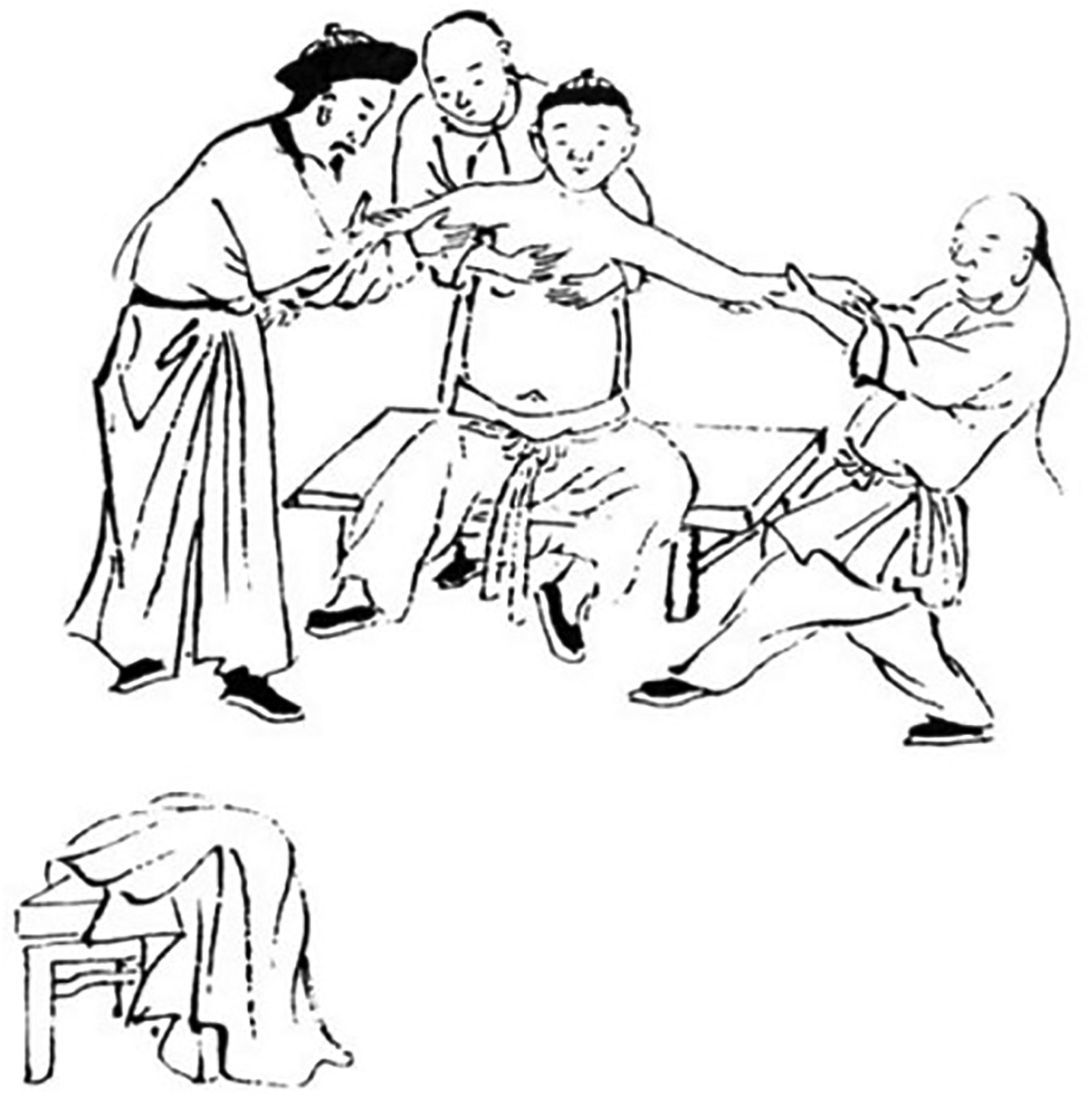
Shoulder reduction technique as described by Hu Tingguang. Source: “Method for reducing a shoulder joint by manually pulling from both sides” (plate detail), HuTingguang, Shangke hui zuan, manuscript from the rare book collection of the Beijing University Library. Reproduced from the facsimile reprint published in Fu, et al., eds., Beijing daxue tushuguan, vol. 8, tu zhu (annotated images section): 17b. Digitally retouched for clarity by Yi-Li Wu, republished with permission from Yi-li Wu.
Discussion
Several shoulder reduction techniques have been described throughout history and successful treatments were passed on through many generations. Shoulder dislocations are of all times and it is therefore thinkable that reduction techniques date back to the origin of homo erectus.
However, the oldest surviving text that we could find came from ‘the father of medicine’ Hippocrates. He described methods of shoulder reduction techniques and further management of shoulder dislocations that were used as an important guideline throughout history and are considered to still be used in the present day. Hippocrates’ third method is used to date and Kocher's method of shoulder reduction is said to be based on the ideas of Albucasis. 17 However, this statement could not be confirmed with the original content, mainly because the original source or a proper English translation was not found. Also, the idea of relaxing a patient prior to reduction by Paul of Aegina, Albucasis and Lanfranc of Milan is still relevant. Nowadays an anaesthetic block can be used for muscle relaxation and pain relief. 27 Moreover, the idea of risk factors, like age and hyperlaxity, for a problematic treatment outcome made by several historic physicians is still accurate today. 28
However, not all techniques survived throughout history, for different reasons. For example, hanging a small child on the arm of a patient to increase body weight, is nowadays considered to be patient or child unfriendly. Furthermore, the ambe, considered as the most powerful tool to reduce a shoulder by Hippocrates, was considered to be the last resort by Cooper in the 19th, due to the substantial damage it can cause to the ribs and the discomfort of the patient. Newly developed reduction techniques seem to focus more on muscle relaxation instead of traction-countertraction. 29
A limitation of this review is that not all primary sources could be consulted. This could be due to the lack of English translations or that the primary source could not be found. For example, Avicenna wrote about orthopedic treatment strategies in Canon of Medicine IV, however, an English translation was not available. 30
Nevertheless, this review demonstrates that historic physicians paved the way for the modern conservative treatment of shoulder dislocations.
Footnotes
Declaration of Conflicting Interests
The authors declared no potential conflicts of interest with respect to the research, authorship, and/or publication of this article.
Funding
The authors received no financial support for the research, authorship and/or publication of this article.
