







Abstract
The markets around transport and mobility are undergoing significant changes. One of the central drivers for these changes is the deployment of information and communications technology throughout the transport system, which in turn enables a wide range of smart mobility services. At the moment, however, smart mobility services are rather fragmented and work in isolated silos. A key issue in future development is how these isolated systems will become interconnected and in general more open. In this article, we apply the framework introduced by Ali-Vehmas and Casey (2012) to model how the evolution toward an open value system for smart mobility services could occur in Finland. In particular, we apply analogies from the emergence of GSM-based mobile networks and the Internet where the former has followed a more centralized path and the latter a more decentralized path.1
Introduction
The markets around transport and mobility are undergoing significant changes where one of the central drivers is the deployment of information and communications technology (ICT) throughout the transport system. Infrastructure, vehicles, and end-user handsets are becoming increasingly intelligent and instrumented with sensors and broadband connectivity. This in turn enables a wide range of smart mobility services, for example, from usage-based vehicle insurance to multimodal trip planning and to seamless door-to-door mobility services.
Overall, transport and mobility play a significant role in society. They typically represent the second largest cost item for households and a significant cost for enterprises. The transport system has traditionally been considered a relatively stable environment where change is difficult to realize with strong reliance on fixed physical infrastructure (roads, fueling stations, rail network, ports, etc.) and strong regulation (Geerlings et al., 2009). However, today, many ICT-driven trends are reshaping the current structures around the transport and mobility market (i.e. related infrastructure, vehicles, and services). The emergence of mobile broadband internet connectivity, satellite positioning technologies, and smartphones enables new business models that could also reshape the way many mandatory services, for example, related to vehicle insurance and vehicle taxation (or road charging) could be organized, and make them more real time. Such trends are also challenging the public sector to come up with new ways to organize services and regulate the market.
Furthermore, the Internet is fueling the emergence of services such as Uber that works on a sharing economy principle. Statistics show that the utilization rates of vehicles are currently rather low and ridesharing services such as Uber (also Lyft and Zipcar in the United States and Didi Chuxing in China) could enable a better utilization of this vehicle capacity. The market is becoming a global one with, for example, Uber expanding aggressively on an international level.
More broadly, we are witnessing an overall ICT-fueled evolution trend toward service-based business models, that is, from owning products to buying services. This is expected to shape the mobility sector with the emergence of concepts like Mobility-as-a-Service (MaaS) (Heikkilä, 2014), which envisions a seamless door-to-door mobility service for end users combining several modes of transport (e.g. local- and long-distance buses, trams, taxis, demand-responsive public transport, and shared private vehicles) and offering it as an integrated simple package for the end user. The evolution toward such a new paradigm is driven by many trends such as urbanization and by the fact that young people are not acquiring driver’s licenses as often as before, that is, do not necessarily want to own a vehicle but would instead like to have access to a better supply of transport services.
At the same time, one can argue that the current smart mobility services are rather fragmented and they work in isolated silos. Fragmentation is observable both in public sector–driven intelligent transport systems (ITS) and in market-driven services such as the in-vehicle infotainment systems provided by vehicle manufacturers. A key issue in future development is how these isolated systems will become interconnected and in general more open.
A challenge for the future success and scalability of these services therefore is how the value system can evolve from a closed vertically integrated state to an open horizontal state. Two possible paths can be recognized: Firstly, a more centralized path where centrally controlled public transport and mobility services are gradually liberalized following possibly a similar evolution path as to what took place in the evolution of first- and second-generation mobile communications and Secondly, a more decentralized path where fragmented and isolated solutions are loosely coupled in a similar manner as to what occurred in the historical evolution of the Internet.
The purpose of this article is to model how a transition from a closed model to an open one could occur for smart mobility services in Finland. Finland is an interesting market to study since it has been at the forefront in developing horizontal and open service architectures for smart mobility (Heino et al., 2013; Leviäkangas et al., 2012) and has also been an incubation hub for concepts like MaaS (Heikkilä, 2014).
To model the potential evolution in Finland, this article applies the modeling framework introduced by Ali-Vehmas and Casey (2012) and draws examples from other industries, namely the emergence of GSM-based mobile networks and the Internet where the former has followed a more centralized path and the latter a more decentralized path. The work also builds on the initial rough level modeling work conducted by Ali-Vehmas and Casey (2015). Data for the article are gathered from different public sources (prior publications, market reports, Internet websites, etc.) and through 10 semi-structured expert interviews of public and private sector actors.
The structure of the article is as follows. In the section “Modeling background,” we give a background introduction to some key theories of value system modeling and to the modeling framework applied in this article. In the section “Potential smart mobility evolution from closed to open models in Finland,” we apply the framework and describe, on an overall level, how the value system around smart mobility services could evolve from closed to open models in Finland. In the section “Examples of transitions,” we analyze in more detail few cases of centralized and decentralized evolution examples. Finally, in the section “Summary, discussion and conclusions,” we draw a summary and conclusions.
Modeling background
Theoretical background
Value system modeling has been the focus of extensive research and can be conducted from many different perspectives. As it relates to business architectures, that is, the individual business models and the business linkages between those, the foundations can be traced back to Porter’s (1985) definitions of a value chain, which describes a single firm and a value system, which consists of several individual companies.
Later, focus has been put on how actors work together to coproduce value (Normann and Ramirez, 1993; Allee, 2000) and on the different ways value can be created. Stabell and Fjeldstad (1998), for example, present three value creation logics: (1) a long linked technology, where value is created by transforming inputs into products; (2) an intensive technology, where value is created by solving unique customer problems; and (3) a mediating technology where value is created by linking customers to each other or to other service providers. Stabell and Fjeldstad (1998) argue that a mediating firm can be seen as a kind of a club manager that admits members who complement each other and excludes those who do not. They also go on to define the value system created by many mediating firms as a set of layered and interconnected networks. Similarly, Iansiti and Levien (2004) refer to a keystone function and Jacobides et al. (2006) point out that some firms can gain architectural advantage by enhancing both complementarity and mobility (i.e. competition and modularity) in parts of the value system, where they are not active and subsequently attain high levels of value appropriation without the need to engage in vertical integration.
Related to the mediation, value creation logic, multisided industry models, and digital platforms have recently become an important issue. Multisided industry models connect the interdependent customer groups together, create new value through network effects, and allow the platform player to share costs and prices among the customer groups in an optimum way. (Evans, 2003; Rochet and Tirole, 2003). Platform leaders are organizations that establish their product, service, or technology as an industry platform, on which other companies build their products and services (Gawer and Cusumano, 2008). This in turn allows them to exert architectural control over the overall system. Such business actors often become de facto regulators of their platforms (Boudreau and Hagiu, 2008). While many traditional businesses are highly competitive, when platforms enter the same market place, the platforms virtually always win (Alstyne et al. 2016).
Value system modeling framework
A holistic value system modeling framework is introduced by Ali-Vehmas and Casey (2012) that combines many of the existing value system modeling frameworks. We introduce the framework shortly in the following sections and apply it in the later sections to model how the evolution toward an open value system for smart mobility services could occur in Finland.
Four-value system states
The value system modeling framework (Ali-Vehmas and Casey, 2012) describes how a given value system can be configured to four different dynamic models as shown in Figure 1. First, there is a centralized and closed model where the value system is dominated by one actor with vertically integrated closed technical components, henceforth the Monopoly model. In this state, one actor controls the tools of service production (e.g. information systems, vehicle dispatching, and payment systems in the case of mobility) in the value system. The value system is centrally optimized and thus has many rules and is slow to adapt to changes coming from outside.
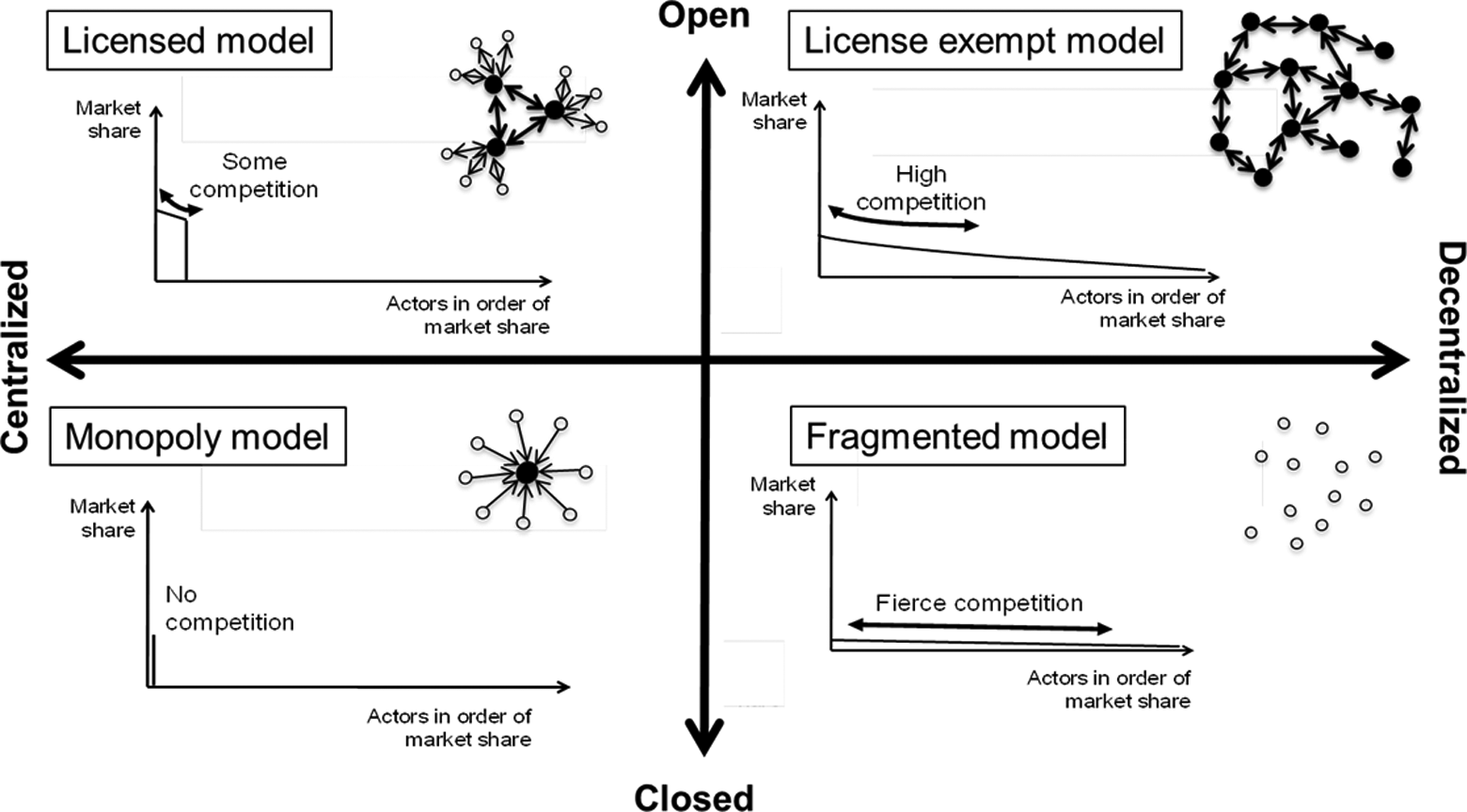
Four-value system states (adapted from Ali-Vehmas and Casey, 2012).
Second, there is a centralized and open model with few tightly coupled market actors and technical components, henceforth the Licensed model. Such a subsystem features a limited set of market actors cooperating and competing (e.g. oligopoly competition between large mobile network operators). Harmonized and interoperable technologies are utilized (and can be mandated with regulator licensing) which in turn means that users can rather easily switch between service providers (e.g. ITS operators) and platforms and thus induce some competition between the market actors.
The third model is a decentralized and open model with many loosely coupled market actors and technical components, henceforth the License exempt model. Tools of service production and distribution are democratized and used by all for all (corresponding to the so-called shared economy approach 2 ). There is a great heterogeneity of actors, technologies, and services with plenty of local innovation and competition. However, the operation model is not completely without external control, that is, while licenses are not needed, some basic rules are followed by the community of actors. This forces the actors to collaborate and makes the services and technologies interoperable so that valuable high-demand services are able to scale in flexible way from bottom up. Switching costs are low and end users can freely switch and roam between services.
Fourth, there is a decentralized and closed model with many isolated market actors and proprietary incompatible technical systems, henceforth the Fragmented model. Here, the actors are fiercely competing against each other and no (or very limited) coordination exists, and no specific regulative rules or licenses are considered. Isolation and intense competition lead to the erosion of resources where nobody is able to scale services bottom up.
Figure 2 presents a detailed version of the modeling framework with which a value system can be described with a modular structure and with different parts of the system having different states (i.e. the overall value system can be a combination of centralized and decentralized elements). Furthermore, the value system can be described using three layers: actors operating in the value system (e.g. public transport authorities (PTAs), bus operators, etc.), the roles that the actors can take (e.g. operating a vehicle or a service), and technical components related to the roles (e.g. back-end servers running the services or onboard modules in buses and private vehicles).
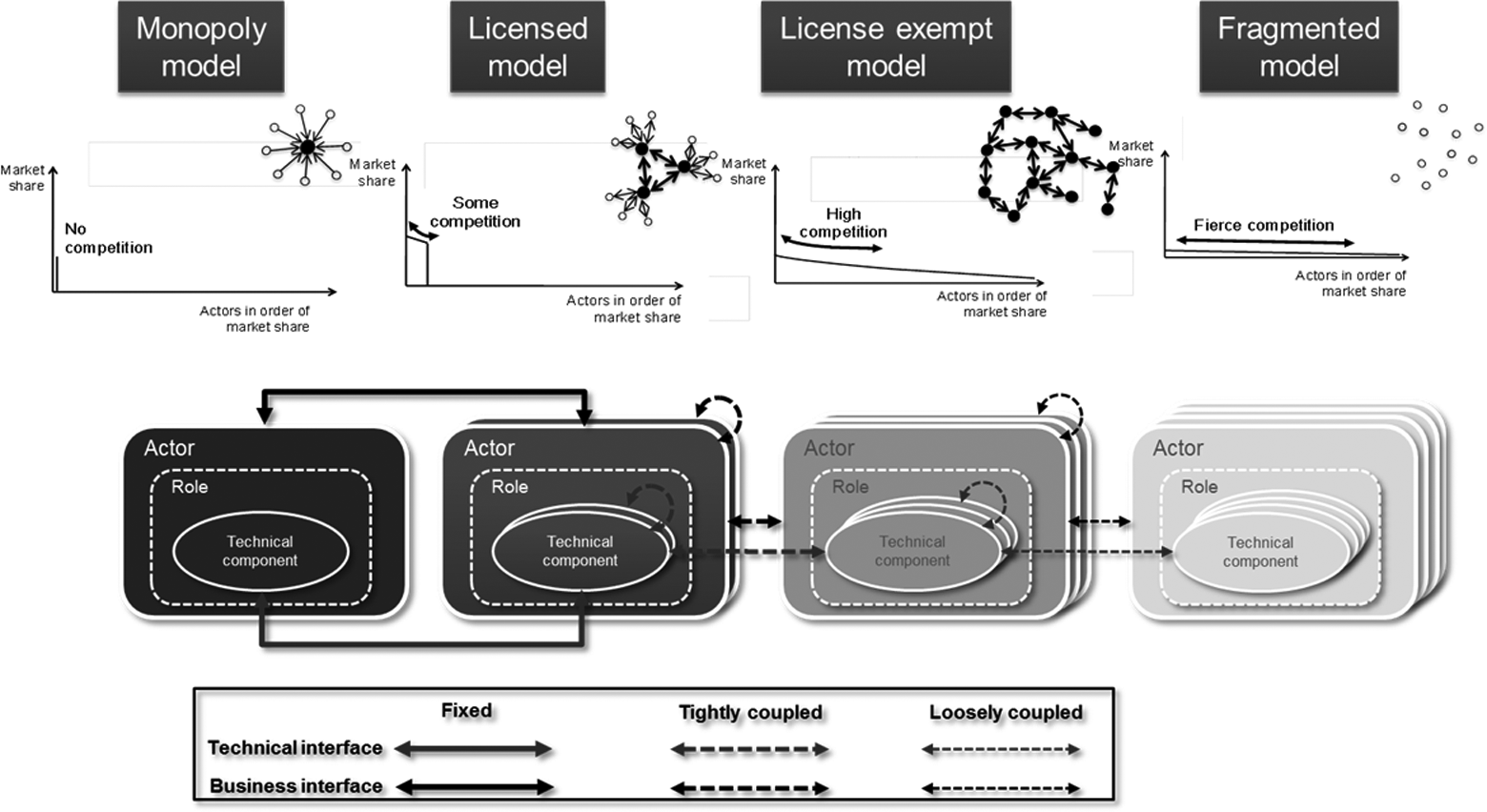
Detailed value system modeling framework (adapted from Ali-Vehmas and Casey, 2012).
As depicted in Figure 2, business and technical interfaces can also be described with different strengths, that is, whether closed or open interfaces are used. The open interfaces can be divided into tightly coupled interfaces corresponding to the Licensed and into loosely coupled interfaces corresponding to the License exempt model.
Examples of value system transitions
As a basis for the modeling, we describe two examples of transitions that have occurred during the evolution of GSM-based mobile networks and the Internet. In this article, we examine how the evolution of smart mobility services in Finland could follow similar development paths. Figure 3 shows a summary of these two transitions. 3
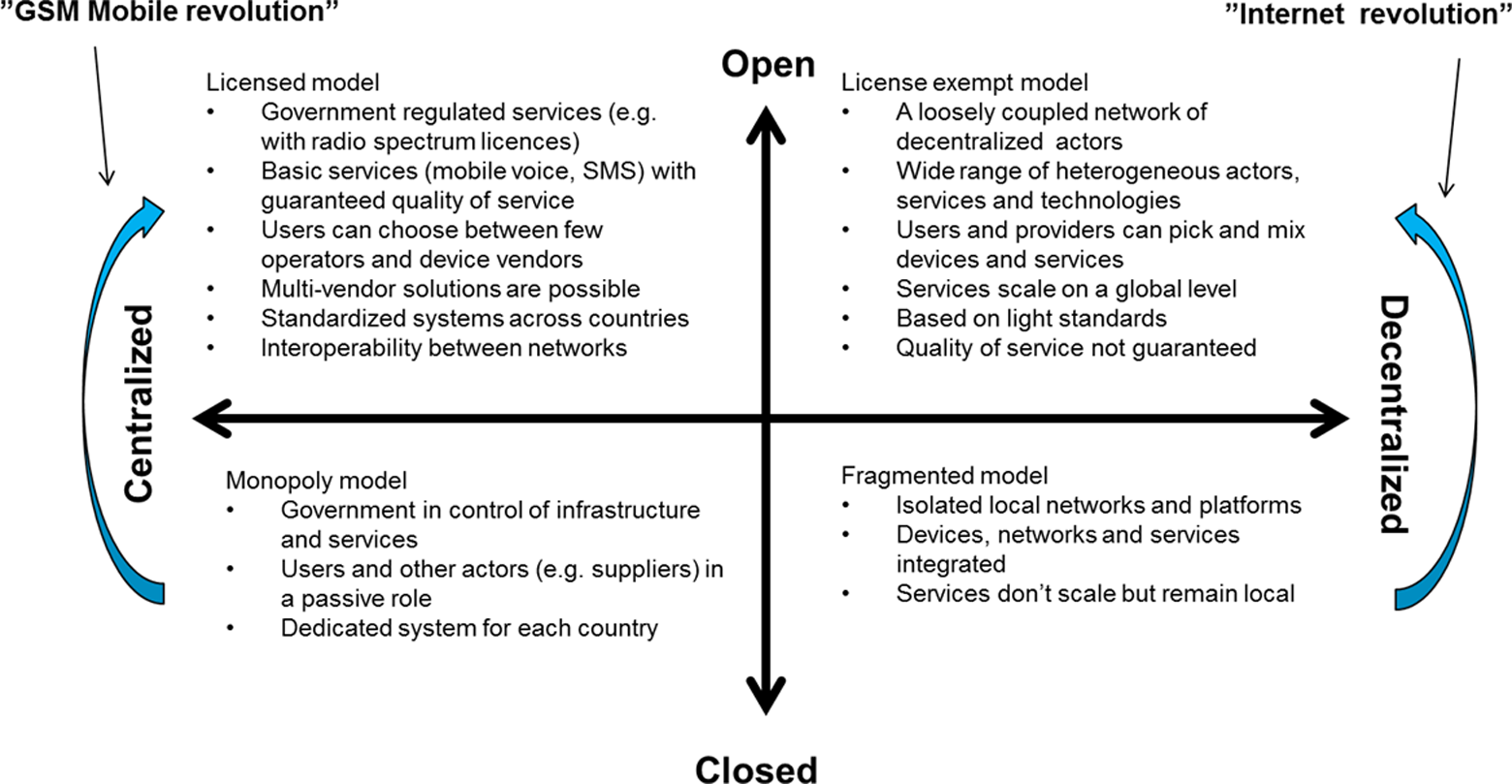
GSM mobile networks and the Internet as examples of transitions from a closed to an open model (Ali-Vehmas and Casey, 2015).
Example of transition
From Monopoly to Licensed model: As it relates to the transition from a centralized and closed model to a centralized and open model, the transition that has occurred in mobile communications can be used as an example (Ali-Vehmas and Casey, 2012) as shown on the left side of Figure 3. The starting point for traffic and public transport is very similar to what was the starting point for mobile communications 30 years ago. Public transport is typically a monopoly for municipalities in their dedicated areas, while end users and other actors remain rather passive and all the systems and services in different regions are typically incompatible to each other.
The development of mobile communications in Europe took a drastic change enabled by liberalization and facilitated by new digital technologies as depicted in Figure 3 (discussed in more detail by Ali-Vehmas and Casey (2012)). The modular structure and liberalized regulation enabled new business models for separate mobile service providers and mobile virtual network operators, opened up the infrastructure business for competing technology and product vendors, and with the introduction of portability of the consumers’ identity and data (enabled by the SIM card) changed the dynamics of the service completely. Interoperability of the standardized interfaces, competition between service providers, and consumer choice were the key ingredients for the dynamical change.
Example of transition
From Fragmented to License exempt model: As it relates to the transition from a decentralized and closed model to a decentralized and open model, the transition that has occurred in the evolution of the Internet can be used as an example as shown on the right side of Figure 3. Roughly put, before the transition, computers were connected to each other only locally and the services they provided were vertically integrated with each other and with the lower layers of local networking and even with computing hardware and other related devices and pieces of proprietary equipment. No open interfaces or modularity was available and services did not scale.
The Internet brought about a new paradigm and created a loosely coupled network of decentralized actors. The new model led to a wide range of heterogeneous interconnected actors, services, and technologies where users and providers were able to pick and mix devices and services in a modular manner. Networks were connected on an international level and services were created using lightweight standards (e.g. HTML, TCP/IP) with a “narrow waist” principle ensuring only minimum interoperability. Subsequently, services developed over the network were able to scale on a global level. On the other hand, the lightweight standards mean that the model works with a so-called best effort principle and that the quality of service cannot be guaranteed. Therefore, the License exempt model is not suitable for critical applications in all cases, for example, related to safety critical operations where sufficient quality level must be guaranteed.
Data and trust models in smart mobility services
A key question in the evolution of smart mobility services is what kind of governance models are used for data and trust and how end users of transport mobility services (both consumers and enterprises) are able to control their data and move it across service providers. Based on the four-value system states, the following four categories of data and trust can be identified:
Monopoly data trust model applies to data for governmental and other public sector use. Examples include the identities of the drivers, driver’s license, and car registration information. This essentially refers to data which must not be compromised and which are not negotiable (e.g. related to road taxation).
Licensed data trust model applies to data that reside in and flow across licensed systems. This could relate, for example, to public transport ticketing systems.
License exempt data trust model applies to data that are voluntarily given by users to service providers using open and harmonized data structures.
Private data trust model applies to data that are private and reside with the end user or enterprise. This relates to dedicated closed systems used by private actors.
Overall, the digitalization of transport systems and services will result in a large range of different data sets. In the long run, there is a need to simplify the complexity of the data models especially from the end user point of view, which in turn could be done applying the above described data trust models.
As an example of analogy, money has been broadly used for this purpose in all traditional businesses where trust is the key factor building the linkage between money and the value. Accordingly, trust can be used as a proxy to model the connection between the data and the final value of the digitalized traffic and transport products and services.
As another example, the data and their categories can be seen as having a similar role as to what the radio spectrum has had for mobile communications. The radio spectrum is a scarce resource and in that sense has a strong limiting impact on the value system dynamics and typically needs to be licensed. While there are already huge amounts of all kinds of anonymous data available, identifiable real-time data are rather scarce. When focusing on creating new services for the consumers, the services based on, for example, anonymous data only have very limited value directly to the consumers. The high-value, personalized services can only be created using identifiable data. The personalized nature of the digital services makes the services more valuable, the more real-time information they can provide. These data are immediately less frequently available and thus scarce. The laws of physics become the limiting factor to the availability of real-time information in a similar way as they limit the availability of the radio spectrum.
Potential smart mobility evolution from closed to open models in Finland
The markets around transport and mobility in Finland are expected to undergo significant changes in the future where one of the central drivers is the deployment of ICT throughout the transport system. Overall, when analyzing the current situation using the value system modeling framework, it can be argued that currently the markets around ITS and smart mobility services are mostly locked on one hand: In a centralized and closed Monopoly model where the public sector actors have tight control of the systems (as depicted on the lower left corner of Figure 4) and on the other hand In a decentralized and closed Fragmented model where small actors are operating and developing services without interoperability (as depicted on the lower right corner of Figure 4).
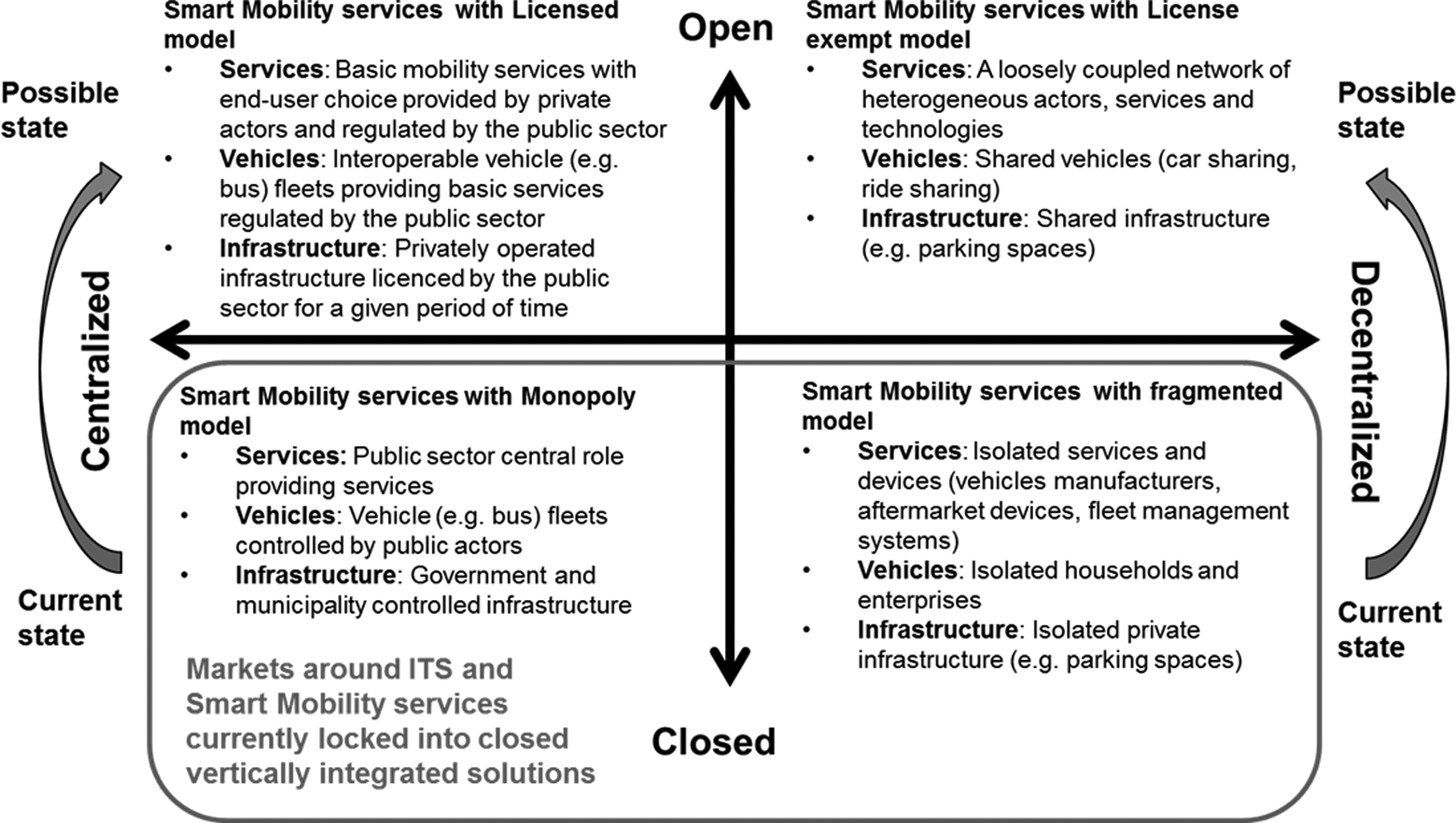
Current value system state around smart mobility services and possible value system transitions following the Licensed and License exempt models. Source: VTT (2016).
At the same time, evolution toward a more open model can be seen in a similar manner as what occurred in the more centralized GSM transition and the more decentralized Internet transition. As it relates to smart mobility services and the transport system in general in Finland, there are already now examples following a more open, market-driven approach. For example, already today, vehicle insurance, vehicle inspection, bus operation, and road construction and maintenance can be seen following a centralized and open model resulting from deregulation, market liberalization, and decoupling of production activities from service provision (the so-called purchaser–provider model). Furthermore, the opening of application programming interfaces (APIs), for example, to journey planners, at least partly, follows a decentralized and open model. These examples are further discussed in the following sections where value system modeling is conducted in more detail.
Historical states
As depicted earlier, the historical structure of smart mobility services and the transport system in general can be characterized as being a combination of a Monopoly and a Fragmented model. Figure 5 shows the state using the following four layers:
end users of the services, services (e.g. vehicle services for vehicle owners and drivers, and mobility services for end users (i.e. passengers) including supplementary information services such as journey planning, reservations and ticketing, etc.), vehicles (e.g. buses, taxis, and private vehicles), and infrastructure (e.g. roads, streets, yards, and parking spaces).
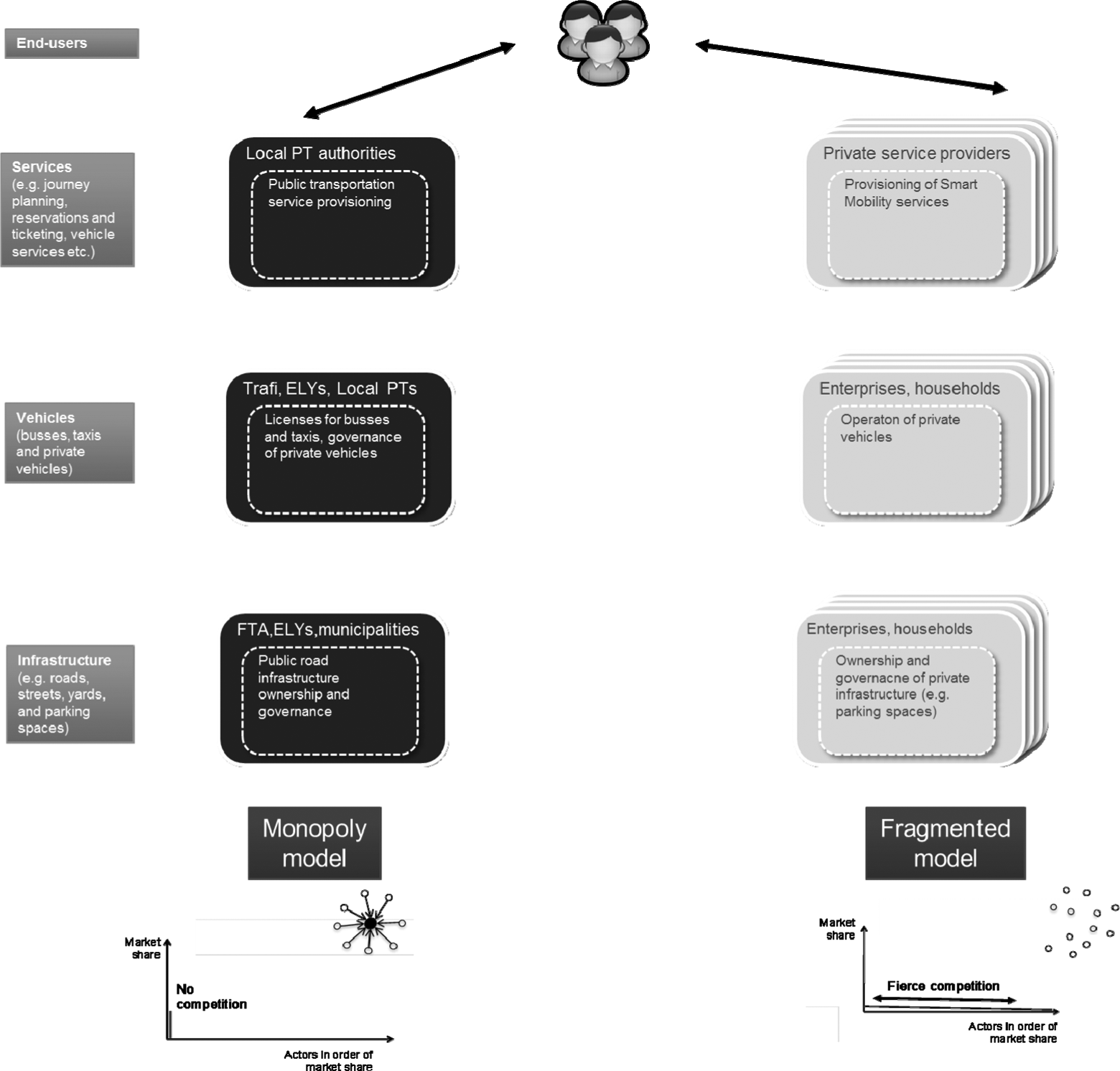
Rough depiction of the current state of the value system. Source: VTT (2016).
Figure 5 depicts how, roughly put, end users currently have access to two types of transport and mobility services, that is, ones that are organized around a Monopoly model and a Fragmented model. When services are organized with a Monopoly model, one actor plays a central role in organizing and providing access to a service. For example, in Finland, local PTAs, such as Helsinki Regional Transport (HRT), are responsible for the planning and procurement of public transport services in their areas as defined in the law for public transport. They also typically control key information systems such as ticketing, timetables, and journey planners. The Finnish Taxi Owners Federation (Taksiliitto) and the association for bus companies (Linja-autoliitto) and their related organizations have traditionally had a central role in their service provisioning. Licenses for taxis and long-distance buses are granted by The Centres for Economic Development, Transport and the Environment (ELY centers). Private vehicles and related basic services are governed by the Finnish Transport Safety Agency (Trafi). Quite recently, new legislation on transport serivces (The Act of Transport Services) has been approved in Finland. This decision enables MaaS to emerge and consequently this could lead to the integration of most of the transportation systems through ICT. The decision also liberalizes taxi services, which enables the market to move toward a self-organized value system. 4
As it relates to infrastructure, the Finnish Transport Agency (FTA) is responsible for planning, construction, and maintenance of the national road network and related information services. Similarly, municipalities are responsible for streets and related information services in their dedicated areas.
It can be argued that some parts of the transport system should continue to be operated with a centralized and closed model. However, it can also be argued that especially given the increasing access to information, in many cases, resources are not optimally allocated without a more market-driven approach where end users can make choices and are able to switch between service providers and stimulate competition.
On the other hand, as it relates to private services, drivers of vehicles and end users are often locked into dedicated islands. For example, households typically use vehicles mostly for themselves and do not provide transport services for others. Furthermore, most private parking spaces are used only by the party that owns it and information systems that would make these available are not widely used.
For many private actors, the corresponding information systems are also vertically integrated (e.g. telematics solutions for vehicle services, dedicated in-vehicle infotainment systems provided by vehicle manufacturers, or companies deploying integrated enterprise resource planning systems) leading to a lock-in to dedicated solutions. This leads to a situation where end users cannot access many of the services and resources (e.g. parking spaces, vehicles, and services) outside of their “island” because they are locked into isolated solutions.
Possible future states
The value system around ITS and smart mobility services has already now taken steps toward more open structures (with e.g. private bus companies operating local public transport routes and private construction companies being used for road construction and maintenance) but it could in the future evolve toward even more open structures and better end-user choice. The services that still mostly follow a centralized and closed Monopoly model could evolve toward a centralized and open Licensed model where the public sector could still remain in control and regulate the private actors in a similar manner as is done currently with mobile network operators. On the other hand, activities following the decentralized and closed, that is, Fragmented model, could evolve toward more networked and open structures where end users could more easily gain access to different private services. Figure 6 gives an overall level depiction of how the different parts of the value system could be organized in the future state.
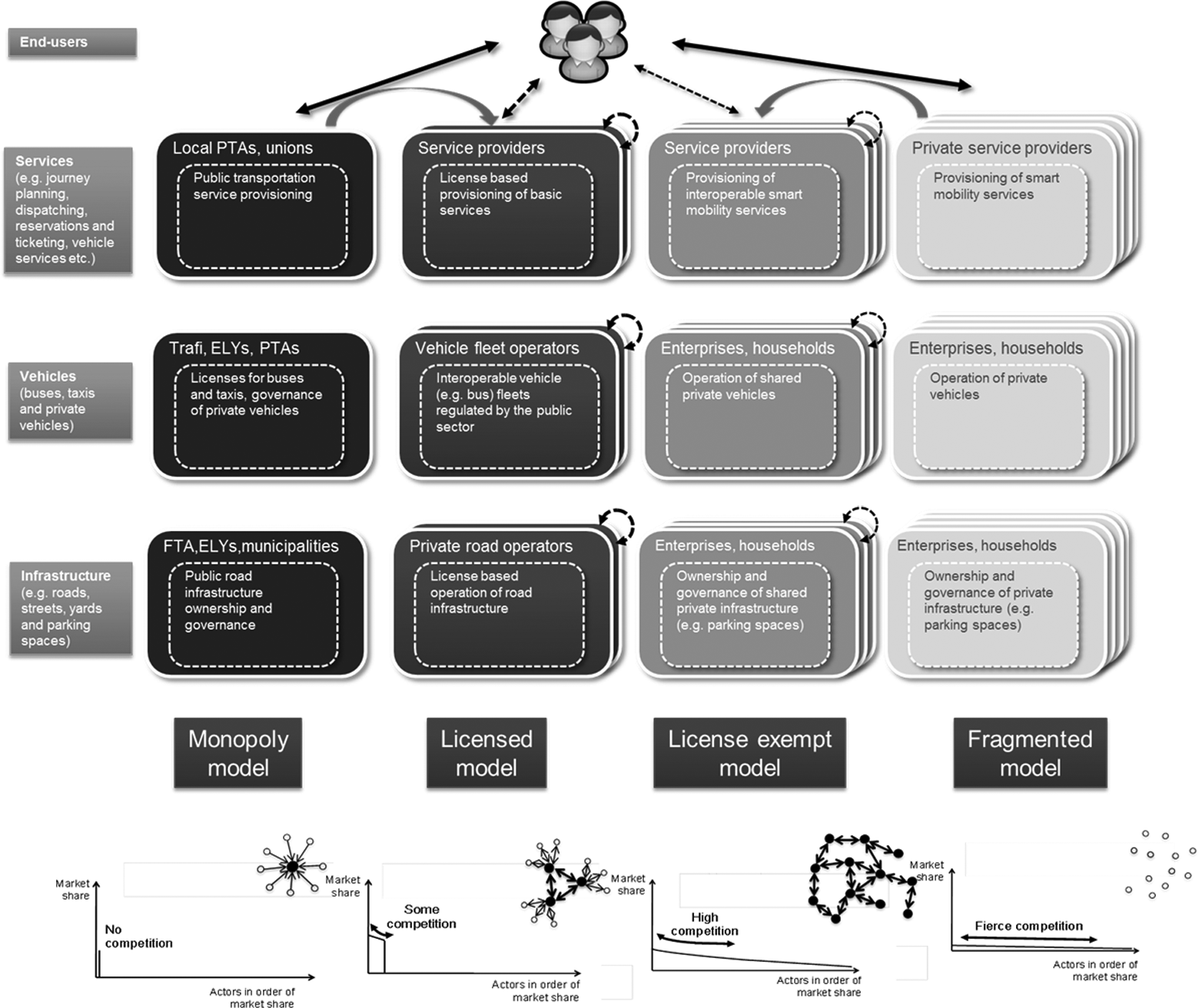
Example depiction of the possible future value system. Source: VTT (2016).
For all the future models, the key raw material is the data of all the stakeholders and actors in the future systems. The principal characteristics of the data will set the boundary conditions to all the system states. Using appropriate trust models for data provides the possibility to see the different possible system states as well as their possible interworking models more clearly.
Toward the Licensed model
In the future, a major part of the services provided earlier by one centralized public actor could be provided by multiple competing companies regulated by the public sector. The public sector would still remain in control and could regulate the market actors and ensure that service quality is high enough, that open interfaces are used and that competition is sufficient among the market actors. This could lead to well-functioning licensed markets where standardized, open interfaces are used and where the service providers would build interoperable services, procure multi-vendor solutions, and leverage economies of scale. Furthermore, in such markets, end users could switch between service providers thus inducing competition and also, for example, roam between cities. Seamless roaming across regions, for example, is one of the main requirements for open MaaS operations and since it can be very hard to implement afterward, it could be created ex ante and enforced by some kind of licensing system.
At the same time, there is a threat that competition can lead to a situation where transport services are not universally available (e.g. in rural areas) meaning that appropriate regulation (e.g. service obligations) is still needed so that rural areas are also served. 5
As it relates to vehicles, for example, vehicle inspection in Finland has already been largely deregulated and market-based actors are providing the service (regulated by the Finnish Transport Safety Agency). Alternative models to road taxation could also be introduced where usage-based road charging could be utilized (suggested by Ollila et al., 2013) where ITS operators could be in charge of collecting this information and reporting it to the government. 6
Furthermore, as it relates to government (or municipality) road infrastructure, a transition to a model could be envisioned where the government (or municipality) would grant a license to a part of the road infrastructure for a private actor who would be responsible for planning, building, and operating that part of the infrastructure. If road usage information would be available from ITS operators, the road operators could also charge the vehicles according to their actual road capacity usage and make further investments based on demand. A similar transition has already occurred with road construction in Finland where the responsible government or municipality agency procures services from individual market contractors. Road construction and road maintenance thus currently already follow a rather market-driven oligopoly structure.
Toward the License exempt model
In the future, the decentralized and isolated private actors could interconnect their systems and provide public license exempt access to different mobility services and unused resources (such as vehicles and parking spaces). In this state, the private actors could start interconnecting their systems with harmonized Application Programming Interfaces (API) in an emergent manner. The new model could lead to a wide range of heterogeneous interconnected actors, services, and technologies where users and providers are able to pick and mix services in a modular manner. However, these applications typically do not provide any guaranteed service level or coverage (e.g. availability in rural areas) but are purely market based.
Such a loosely coupled architecture could also enable data roaming between services and for end users to own their data (i.e. so-called MyData (Poikola et al., 2015)). Intelligent context-aware autonomous agents would conduct the service aggregation and management on behalf of the users. Interoperability would be encouraged but voluntary or very minimal regulation would be enforced by public authorities, thus making it possible that all innovations could freely be explored. This would also enable more widespread end-user innovation, that is, smaller actors and even individual users becoming value creators and contributors. We are already currently witnessing the emergence of several so-called two-sided platforms that, for example, provide an easy way for end users in need of a ride to gain access to private drivers (ridesharing applications like Uber, Lyft, etc.) or for drivers to pay for publicly available parking spaces (applications like ParkMan and EasyPark).
The role and the power of these emerging platforms are visible only in limited fashion. Strong network effects shaping all the networks with mobility and continuous interconnectivity enable exceptional opportunities for the platform leaders. However, these platforms are typically closed, meaning they are not interconnected to each other and that end users are locked to one platform. Furthermore, driven by strong network effects, in many cases, the platform that has gained economies of scale and a dominant position takes over the entire market (a so-called “winner-takes-it-all” scenario) for some period of time (Parker et al., 2016). Therefore, to reach a true open License exempt model, these platforms need to be interconnected using common and open interfaces. For the public transportation case specifically, local market variations and limited number of global mobile customers will limit the power of multisided platforms in MaaS.
Examples of transitions
Next, we move on to constructing more detailed value system models to describe the examples of transitions in the smart mobility-related value system. On an overall level, the examples follow the division introduced above, that is, both more centralized services that have a strong public interest and more decentralized services operated by private actors are discussed.
Centralized structures
Long-distance public transport
The FTA is responsible for the overall national level development of public transport. FTA, together with regional ELY centres, operates databases that contain public transport–related licenses (e.g. for buses and taxis) and a database that gathers information from different transport operators and local PTAs (e.g. related to timetables).
ELY centers issue licenses for public transport routes outside of cities and for taxis on a regional basis. Bus transport across cities and the corresponding services have historically been centered around Linja-autoliitto, an association for bus companies operating the routes and Matkahuolto, a service and marketing company owned by Linja-autoliitto, which has been a central actor providing information services for the member companies of Linja-autoliitto. The historical model can be characterized as centralized and closed as depicted in Figure 7, since almost no competition existed between the bus companies. Competition between bus companies and public railway system, however, does exist.
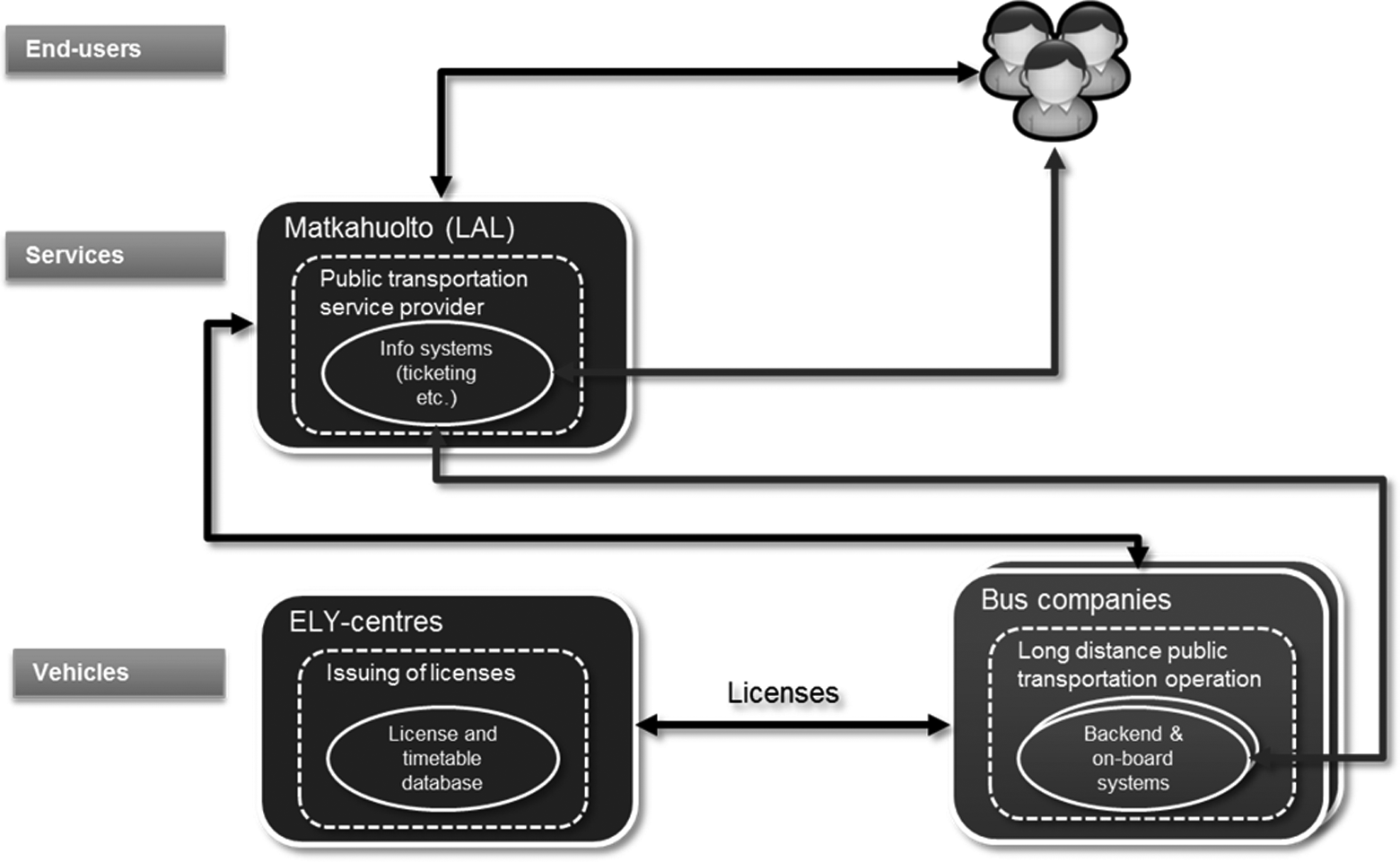
Historical model for long-distance public transport. Source: VTT (2016).
More recently, competition has also emerged, mainly driven by new EU legislation with companies like OnniBus.com entering the market. This evolution could eventually lead to an open Licensed model structure where there would be many companies acting as service operators (in addition to Matkahuolto) with interoperable ticketing and information systems between the bus companies and service providers as depicted in Figure 8.
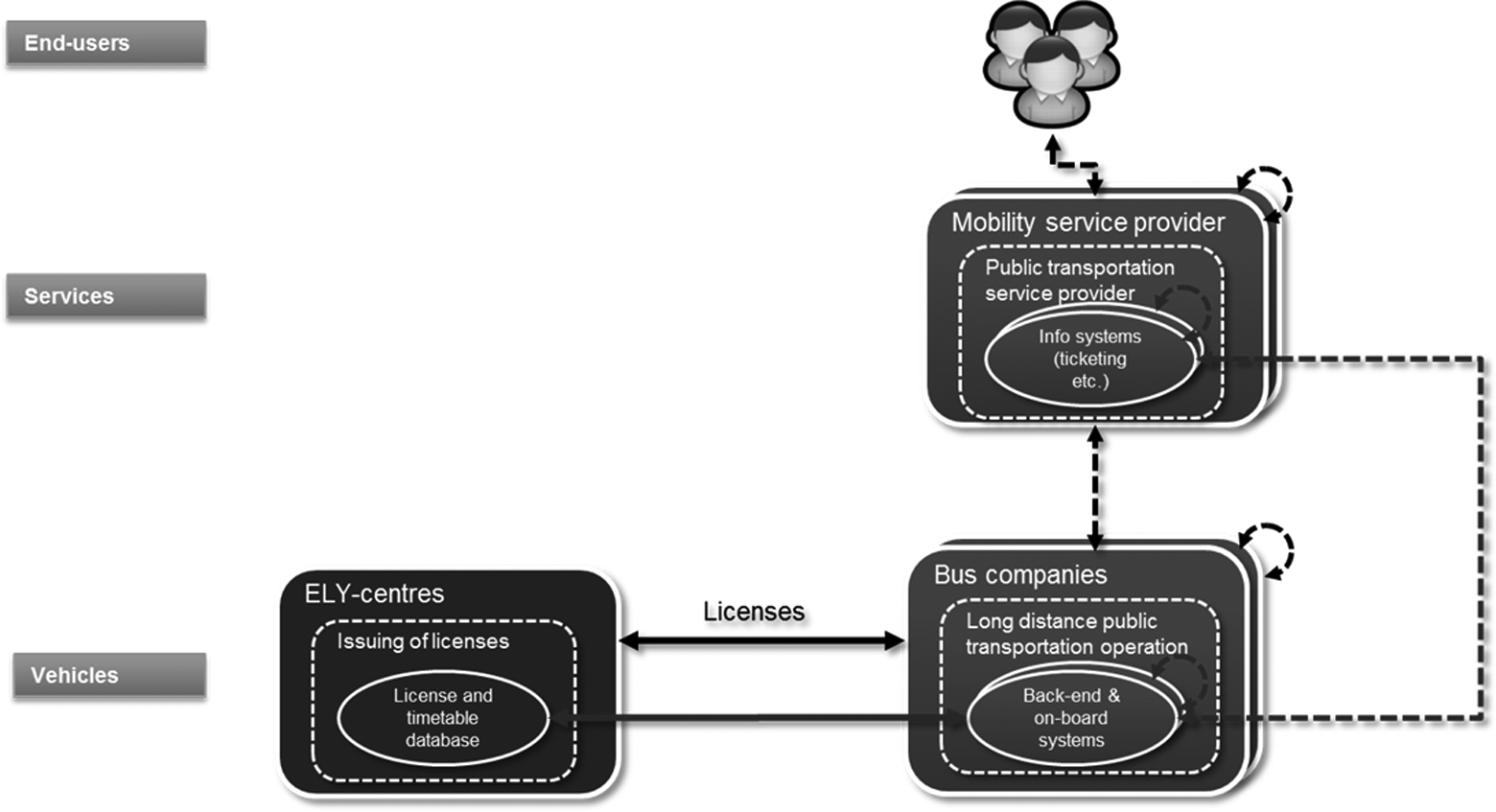
Possible future model for long-distance public transport. Source: VTT (2016).
Here, the licenses given by ELY centers could mandate interoperable systems that would enable end users to switch between service providers. 7
Local public transport
As it relates to local public transport, local PTAs can be seen as local regulators and service operators. They centrally plan the timetables and routes of the buses in their regions and procure the transport operation from the bus companies as well as sell the transportation service to the consumers, for example, issue tickets. According to the current law for public transport, the PTAs are in charge of defining service levels for their areas, issuing licenses for routes (and for demand-based public transport), and procuring the corresponding transport services from the bus companies. In the current model, municipalities subsidize public transport from their budgets. Overall, the model is mostly a centralized and closed one (on a regional level), that is, Monopoly model.
Helsinki Region Transport Authority (HRT) 8 is used as a case example. The related model can be found in Figure 1A. HRT is responsible for the planning and procurement of public transport, for marketing and passenger information, and for the public transport ticketing system in the Greater Helsinki area. Their central system is the public transport register (joukkoliikennerekisteri, JORE) which maintains information about routes, timetables, stops and which is used to provide journey planning services to end users. An in-house agency, Helsinki City Transport, is responsible for running the trams and the metro and state-owned railway company VR for operating local trains. HRT procures bus transport from bus operator companies.
As it relates to ICT systems operated by HRT, one notable one is the ticketing system (currently under revision). The journey planner is another important ICT system for HRT. In terms of more dynamic demand-based public transport, HRT ran a pilot called Kutsuplus. 9 The system was separated from HRT’s main ticketing system and it used separate payment mechanisms (i.e. the HRT travel card could not be used in the Kutsuplus service). Furthermore, the system did not utilize the possible synergies with the journey planner. Although Kutsuplus was a notable step toward more dynamic public transport, the model was still rather closed with HRT defining the service area and having a dedicated fleet of minibuses, that is, that the service area and number of vehicles did not scale based on demand. Even though the service was heavily subsidized by the member municipalities of HRT, it did not reach sufficient viability during the pilot. As an observation, the opportunities of positive network effects of a multisided industry model were not utilized.
In the future, however, the demand-based transport model could evolve to a more market-driven model with many companies acting as minibus operators and with many service companies. These service companies could also aggregate other local public transport services to a larger mobility package.
Also, as it relates to public transport, operators of buses, for example, in the case of HRT are private companies, meaning that an oligopoly market structure is followed already (the information systems, however, are still controlled by HRT). Such a model could gain even more momentum when demand-responsive public transport becomes more common where several market actors can become transport operators, leading to a situation where less static bus routes are necessary. Here, HRT could still regulate the demand-based public transport market in its area with public transport licenses and enforce service obligations and interoperability requirements for the information systems.
Based on the new legislation entering into force in 2018, local public transport could evolve to a model where HRT would in fact mostly regulate and give licenses for transport operators but would give freedom for the operators to organize the routes based on market demand as depicted in Figure 9. 10 HRT could still remain in control of critical central routes (such as trains) but public transport services would be provided by dedicated operators (e.g. MaaS operators) with their own ticketing and information systems that are interconnected with the systems of transport operators following a Licensed model.
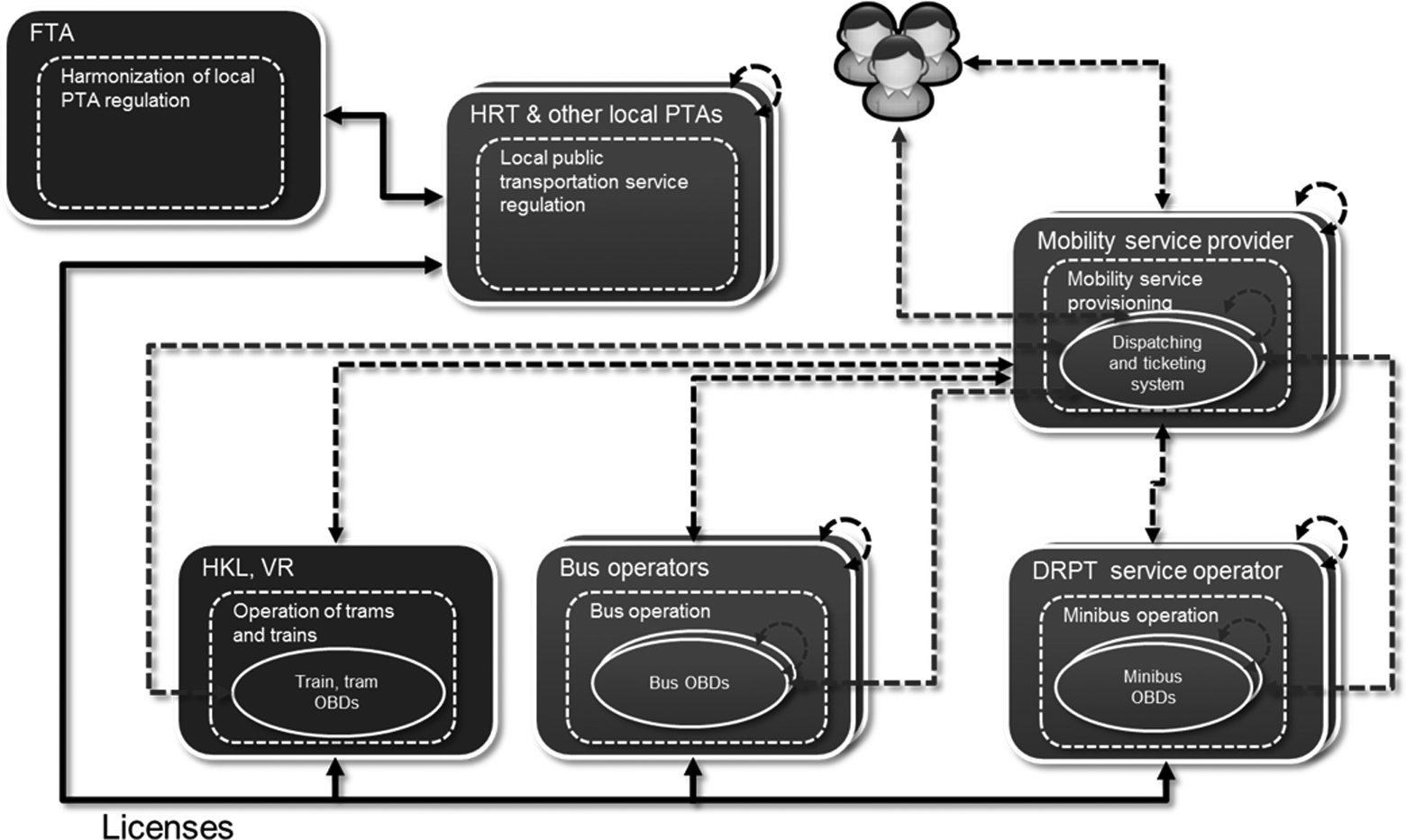
Potential future model for local public transport. Source: VTT (2016).
Here, regulation by local PTAs could be harmonized on a national level, for example, to ensure that ticketing systems are interoperable across regions where FTA could act as an enabler (this could also be conducted more broadly on an international level).
Transport for special groups and taxis
As it relates to other public forms of transport, municipal and state transport services for special groups that are not able to access regular public transport (e.g. people with disabilities, patients, and students) but need dedicated services, can be considered as a notable example. The city of Helsinki, for example, serves special groups with a travel service center (Matkapalvelukeskus) with dedicated minibuses and taxis that provide demand-based services for the groups. Travel service centers often try to combine trips for customers going approximately to the same destination at the same time using dedicated information systems. Dedicated public transport compensated by the Social Insurance Institution of Finland (Kela) on a national level also forms a major part of the transport for the special groups.
Taxis that locally serve the larger public also forms an important part of publicly available transport services. In Finland, according to the law on taxi transport, the taxi operations have been subject to license for which permission is granted by the ELY centers based on local quotas. The annual revenue of the taxi market is roughly 1 billion euros with the share of publicly subsidized rides (i.e. to the special groups) being approximately 40%. The service obligations for taxi permits are very high which means that the taxi service has very good coverage and availability, is very reliable, and is able to serve special groups (such as patients and the elderly).
The taxi entrepreneurs are mostly self-employed and members of the Finnish Taxi Owners Federation 11 which is a central actor. A taxi is typically obtained through a local dispatch center as depicted in Figure 1B. The dispatch centers have been the central information systems locally and are typically owned by the local taxi association and its members. The dispatch centers need to notify the local ELY center of their operations.
Roughly put, these dispatch centers have had a local monopoly (i.e. have been the main dispatch taxis to end users) as shown on the left side of Figure 1B. The centers are often directly linked to the systems of the Social Insurance Institution of Finland (Kela) covering mobility needs for some social services.
Recently, new services have emerged that are disrupting the current state. For example, in the Oulu region, the local taxi association has been experimenting with a solution from Taxify 12 that provides a service to connect end users with taxis. Taxify is essentially a closed mediating platform that is not interconnected with the dispatch center but drivers need separate mobile handset to access the service and also end users need separate applications to access Taxify services.
Furthermore, Uber has recently entered the Finnish market and is currently operating in the Helsinki region (even though the legality of the service is unclear since the drivers are operating without taxi licenses). The end-user demand for community services like Uber is rather high with many end users saying that they do not necessarily need the service levels that the current taxi system offers (e.g. in terms of service availability for special groups) but could cope with a best effort quality level.
The new transportation law will renew the current taxi permit legislation. With the emergence of Uber and other community-based ridesharing services and concepts like MaaS, the Ministry of Transport and Communications took the initiative for making changes to the current legislation in order to make it more flexible to acquire taxi permits and combine personnel transport and logistics. With the next steps of new legislation, it could be possible for individual households and end users to provide taxi-like services for each other. This could lead to a more decentralized and open ecosystem following the License exempt model as depicted in Figure 1C. In this case, there would be many service operators providing dispatch and payment services to the taxis and also to ridesharing communities and the service could be combined to other modes of transport (e.g. public transport). This would eventually lead to a fully implemented MaaS service model. The dispatch centers would be interconnected using open interfaces. In order to enhance competition, the regulators (e.g. ELY Centres and Trafi) could mandate interoperability between the dispatch centers and encourage interoperability of the modules and devices used in the vehicles.
Here, also the historical data and mobility preferences of end users could be utilized to provide better services. This so-called mobility-related MyData (Poikola et al., 2015) is typically lost or locked to the fragmented systems of individual transport providers. It could, however, be a key ingredient when providing user-tailored MaaS services. Furthermore, dedicated MyData operators using open interfaces and data structures could be introduced. They would maintain these personal mobility data which could be used as input for the MaaS services and thus prevent the end user from being locked into a specific service provider.
Although some MaaS operators could operate with License exempt model principles and serve end users that are able to adapt to different service levels, services for special end-user groups and rural areas should be available that would not be served with purely market-based models but would need to be guaranteed. Therefore, different regulation models (i.e. both Licensed and License exempt) are needed.
Appropriate regulation is important in order to make sure that one platform (possibly a global one) does not gain full dominance and take the market to a so-called winner-takes-it-all scenario. Ensuring low barrier to multihoming is important, including portability and compatibility of end users’ data assets. The traditional models to assess competition have significant limitations in the case of multisided industry platforms. 13 Figure 10 presents a depiction of such a scenario where one market-based actor gains a gatekeeper role and controls the dispatch center and the mobility-related MyData.
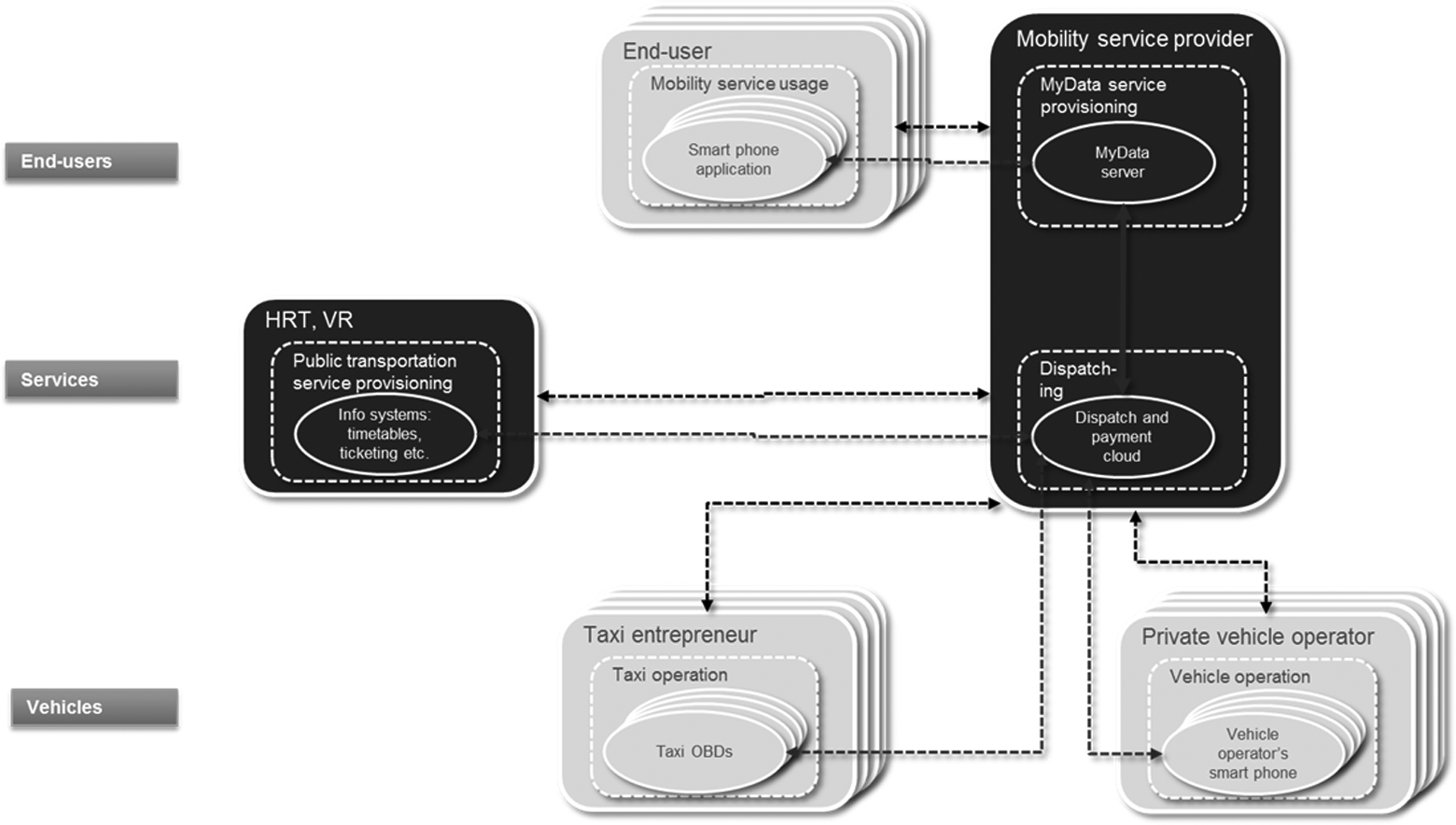
Possible future scenario where a global platform gains dominance. Source: VTT (2016).
Decentralized structures
Private parking spaces
Private parking spaces are another important part of infrastructure, which is in many cases underutilized. For example, it has been estimated that a significant part of vehicles moving in the downtown areas of cities are looking for parking spaces. Information related to the availability of parking spaces, for example, in large parking halls (hosted e.g. by enterprises for their own workers) is often isolated to fragmented localized information systems as depicted on the right side of Figure 1D. The payment solutions related to parking are also typically dedicated to specific locations and facilities.
At the same time, new applications (such as ParkMan and EasyPark in Finland) are emerging that provide a payment platform that connects parking space owners with drivers of vehicles. The service is also provided in many public parking spaces owned and maintained by municipalities.
The platforms, however, are still closed in the sense that the platforms are not interconnected, that is, that an end user of, for example, ParkMan cannot use the parking spaces that are served only by EasyPark. Having many dedicated applications for each platform results in high multihoming costs both for end users and parking space owners.
In the future, with the emergence of sharing economy paradigms, new platforms could be created that give access to individual, unused private parking spaces of companies and households, extending the Airbnb 14 model of accommodation to car parking as already operated by, for example, Divvy Parking 15 in Australia. Furthermore, these mediating platforms could potentially be interconnected as described on the left side of Figure 1D and thus move to a License exempt model. However, the interconnection here would have to be largely voluntary and would not be mandated solely with regulation. 16 The platforms have a tendency to grow vertically where APIs enable next layer services to be provided on top of the leading platforms. Some of the new services become platforms of their own by introducing another set of APIs for next generation applications. This opportunity is quite obvious in the case of MaaS due to the real-time availability of the end users’ location data to the service providers.
Private traffic
Private transport by households and companies forms the majority of traffic in Finland. Overall, the utilization rates of private vehicles, in terms of personnel traffic, are rather low where, for example, households typically use vehicles mostly for themselves and do not provide transport services for others, meaning that the current model is rather fragmented. Enterprise traffic consists mostly of logistics (roughly two-thirds) but a major part is also personnel transport (roughly one-third). Information about the availability of these resources is also rather limited, that is, locked to fragmented vehicle or fleet-specific systems.
At the same time, satellite positioning technologies and real-time broadband connectivity to vehicles and through smartphones to the drivers is enabling the emergence of various ridesharing services. Two-sided platforms mediating the connection between drivers driving empty vehicles (i.e. unused resources) and end users in need of rides are gradually emerging which indicates a transition toward the License exempt model.
For example, in Finland, it is legal to share gasoline costs, for example, related to longer trips and examples of such ridesharing platforms already exist, for example, applications like Tziip and Ridefy and dedicated websites such as GreenRiders, Kimppakyyti.fi, and kyydit.net. 17 Another relevant activity is the emergence of car sharing communities such as Kortteliauto and City Car Club. 18
On an international level, the dispatching of users who are in need of transport to drivers of private vehicles has become a strong development trend especially driven by Uber but also by services such as Lyft and Sidecar. 19 Although all of these vehicle or ridesharing platforms are based on nominally open, two-sided business models utilizing the open Web and Internet, interoperability between the platforms does not exist and end users need to use separate clients to access different service providers. Thus, the next evolution step could be the interconnection of the ridesharing platforms as depicted on the left side of Figure 11.
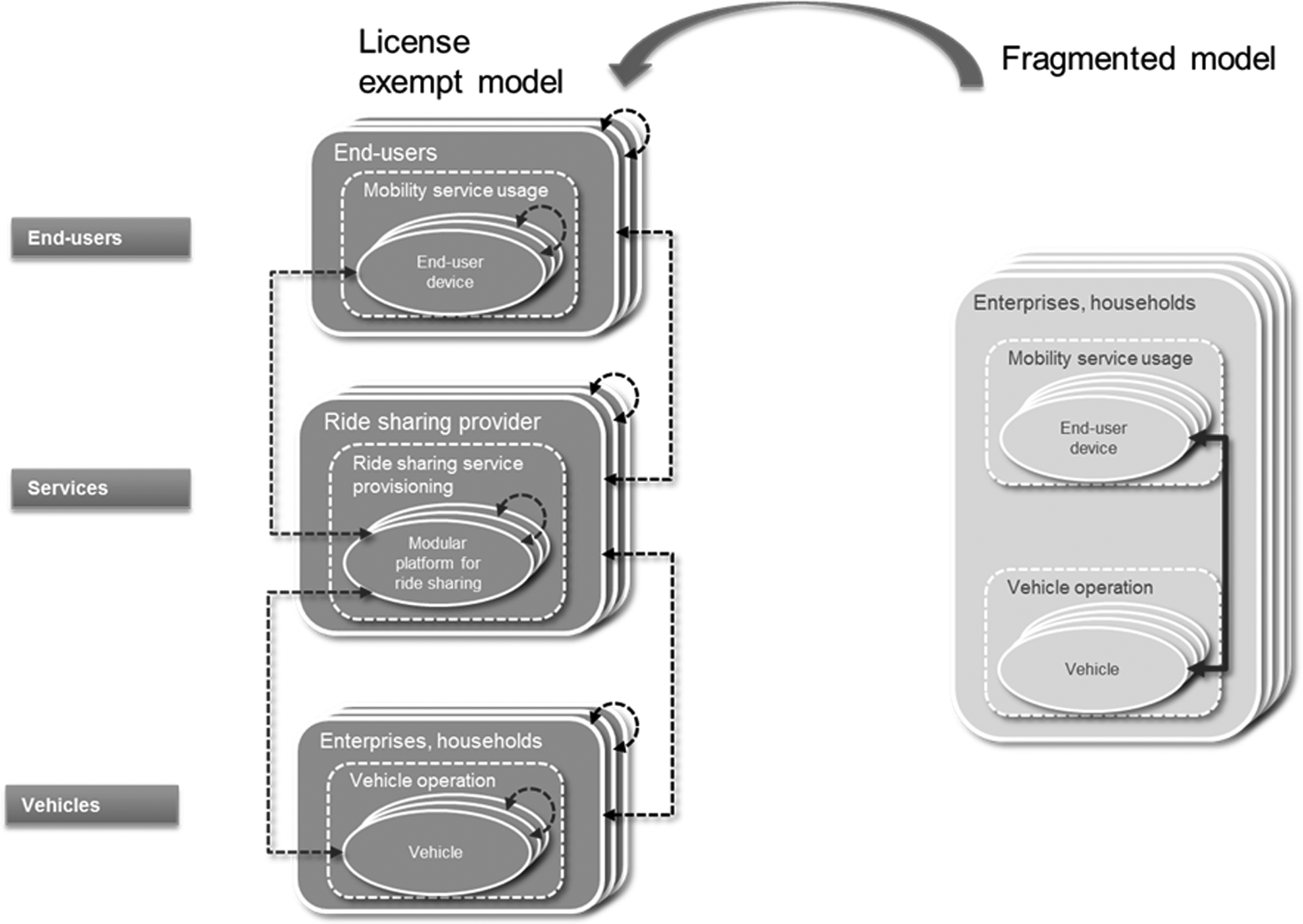
Shift from Fragmented model to License exempt model for ride and vehicle sharing. Source: VTT (2016).
The challenge is that platform providers do not necessarily have incentives to interconnect their platforms since it will, at least in the short term, increase competition. On the other hand, interconnecting the platforms creates a larger market. If light License exempt regulation models would be used for the drivers providing the services (i.e. a lighter version than the current taxi license), it could be coupled with requirements or recommendations that the platforms should be made interoperable.
End-user services and MaaS
The end users (e.g. consumers and households), enterprises (i.e. their workforce), and municipalities (acting on behalf of e.g. special citizen groups) who need different mobility services (e.g. public transport, taxis, shared vehicles, bicycles, and private vehicles of households) have already now access to a wide range of information services (e.g. local public transport journey planners and trip reservation and payment systems) that help them organize their mobility needs. However, from an end user perspective, these services are fragmented. Dedicated information systems have historically been used for different forms of transport and also for different regions, for example, for vehicle dispatching, reservation, and ticketing and payment and thus end-user services have followed a Fragmented model as depicted on the right side of Figure 1E.
Some steps have been taken toward a more open Internet-oriented approach, for example, by opening APIs from these isolated systems for developers. HRT, for example, has been actively providing APIs for developers, which has led to a wide range of mobile journey planning applications for different operating systems. However, these APIs are not harmonized with that of other cities, meaning that developers need to tailor their applications to each city separately. The Finnish Taxi Owners Federation has also been active in developing a mobile application Valopilkku with which one can order a taxi anywhere in Finland and which provides a similar user experience as that of Uber and Taxify. The national railway operator VR is also working on an open API to its information system. These APIs could be gradually harmonized which in turn could lead to a License exempt model depicted on the left side of Figure 1E, where it would be easy to access different transport services through a single application.
Such evolution could support the emergence of MaaS operators (Heikkilä, 2014) that would provide a seamless door-to-door mobility service for end users combining several modes of transport (e.g. local- and long-distance buses, trams, taxis, demand-responsive public transport, and shared private vehicles) and provide it as one simple package for the end users. To enable this, open APIs are needed to the timetables, real-time location information, and payment systems of existing transport service providers. Better mobility services could provide the incentive to reduce the personal usage of private vehicles in favor of sharing the vehicles for significantly improved productivity. Many households, for example, have a second car that is not necessarily utilized that much. Such harmonized APIs could make it easy for MaaS operators to build their service coverage nationwide.
As it relates to the emergence of MaaS operators, a key question is how modularity can be ensured so that, for example, end users and transport providers are not locked into single MaaS operators but can switch between them (as depicted earlier in Figure 1C, which presents a group of loosely coupled MaaS service providers). The historical data and mobility preferences of users, which are typically lost or locked to the systems of individual transport providers, that is, mobility-related MyData (Poikola et al., 2015) could be a key ingredient when providing user-tailored MaaS services.
Summary, discussion, and conclusions
Many ICT-driven trends are currently reshaping the structures around the transport system, enabling new smart mobility services, and paving the way for disruptive new business models. At the same time, one can argue that these ICT-enabled services are rather fragmented and work only in isolated silos. Therefore, a key issue in future development is how these isolated systems will become interconnected and in general more open.
In this article, we have used the framework introduced by Ali-Vehmas and Casey (2012) to model how the evolution toward an open value system for smart mobility services could occur in Finland. In particular, we have used the emergence of GSM-based mobile networks and the Internet as analogies where the former has followed a more centralized path and the latter a more decentralized path.
Using the framework, we have modeled how the ITS system could evolve from a centralized and closed Monopoly model where the public sector actors have tight control to a more open Licensed model, where the public sector could still remain in control and regulate the private actors in a similar manner as is done currently with mobile network operators. The needs to regulate the transportation market and telecommunications market are similar, based on the scarcity of the resources with obligations to serve all the people also in rural areas as well as multiple conflicting needs to utilize end users’ data. The less tight control, however, would enable competition and make it possible for end users to choose their service providers.
Most of the MaaS applications do not benefit from rigid regulative requirements. Therefore, we have further modeled how the system could evolve also from a decentralized and closed Fragmented model where private actors are operating and developing fragmented services that cannot be easily scaled to the wider public, toward more networked and open structures and a License exempt model where end users could more easily gain access to different private services. The Internet and World Wide Web domain services typically follow the best effort paradigm. This, however, does not significantly limit the look and feel of the quality of the services. Similarly, it is likely that most of the MaaS services can be implemented with premium quality also based on voluntary interoperability.
While one future threat is that the fragmentation of license-exempted smart mobility services continues, another notable threat is the “winner-takes-it-all” scenario. This could lead to a challenging situation where many important public services that should be under democratic decision-making are in fact controlled by private, possibly international, ICT platform giants who would unilaterally make many of the policy decisions (i.e. become the de facto regulators as discussed by Boudreau and Hagiu (2008)). This threat highlights the importance of collaboration across countries and regions when mandating and encouraging the use of open interfaces.
The results highlight the overall importance of pursuing public policies that mandate and encourage the usage of open and harmonized interfaces in a systemic way. For such open value systems to emerge, it is important to enforce and encourage market actors to develop and deploy interoperable products and services so that information can flow on a proper level of trust across systems. To enable this, public sector policy makers need to consider the application of both license based and license exempt type of regulation.
Overall, our study has been future oriented and explorative where the goal has been to describe the different scenarios of how open and interoperable smart mobility services could be deployed. We recognize that many simplifications have been made. For example, it can be argued that mobile communications and transport are not completely analogous and that both have their unique characteristics. Still, it can be argued that both are networked industries and many of the lessons learned in the evolution and structural changes in other field can be leveraged in another, since many principles are the same. Furthermore, the focus of this study has been on the Finnish market and the result does not necessary apply in other markets that can be in a different phase of evolution or where services have been organized with a different model historically.
In terms of future work, the analysis could in fact be expanded to similar evolution paths in other countries. Additionally, the modeling could be complemented with quantitative analysis in terms of existing systems. Furthermore, it could be interesting to examine in more detail what policy measures are needed (both in terms of Licensed and License exempt regulation) to help the market evolve toward more open structures.
What can be concluded is that the large-scale deployment of interoperable smart mobility services is not purely a technical issue, but large structural changes are needed both to public policies and the corresponding legislation and also to the current business and operation models of enterprises. Therefore, the restructuring of the market and evolution toward smart mobility services in their fullest potential will take a long time.
Footnotes
Declaration of conflicting interests
The author(s) declared no potential conflicts of interest with respect to the research, authorship, and/or publication of this article.
Funding
The author(s) disclosed receipt of the following financial support for the research, authorship, and/or publication of this article: This research has been conducted in part within the context of the Traffic Lab program of the Ministry of Transport and Communications of Finland and funded in part by Tekes --the Finnish Funding Agency for Technology and Innovation.