






Abstract
Ride-hailing services have had a widespread impact on urban transport in cities around the world as countries modify their regulations to incorporate these new services. However, whether these new norms incentivize market competition or constitute restrictions in favor of traditional taxi sectors, is still under discussion. Based on the study of 17 local laws in Mexico (2015-2021), this article uses a categorical data analysis and Firth’s logistic regression model to study companies’ and drivers’ legal obligations, user rights, and the heterogeneity of regulations. The findings show that some restrictions are significantly related to the size of the taxi sector and the absence of user rights in new regulations. Contrary to the situation in developed countries, some legal modifications possibly undermine competition in local markets by excluding a significant number of users through legal entry barriers, such as the prohibition of cash payments in a country with low levels of formal banking.
Introduction
Around the world, the arrival of Transportation Network Companies (TNCs) provoked serious conflict with traditional services (Dudley et al., 2017), with violent protests by taxi drivers breaking out in many cities (Lesteven & Godillon, 2020; Matharu, 2015). The main argument against TNCs was the lack of fair competition, as platforms did not conform to local transport regulations, nor were they subject to taxes. In contrast, taxi services are a highly regulated sector (Dudley et al., 2017; Fielbaum & Tirachini, 2021; Flores & Rayle, 2017; Thelen, 2018; Wang & Yang, 2019). In Germany, opposition by taxi drivers halted the regulation and incorporation of ride-hailing services in most cities (Thelen, 2018), while in many places in the USA, authorities incorporated the new services with minimal regulations. This has given rise to a regulatory heterogeneity between different cities, even within the same country (Hong & Lee, 2018; Tzur, 2019; Wang & Yang, 2019).
In San Francisco, California, the acceptance and legalization of TNCs is attributed to the support of the platforms, service users and drivers, as well as the proactive backing of the San Francisco mayor and the regulatory authorities of the State of California (Flores & Rayle, 2017). In London, United Kingdom, TNC services were regulated by the local transport authorities. Uber was accepted by Transport for London from the outset, despite protests from local taxi drivers (Dudley et al., 2017). The success of their acceptance by the regulator is attributed to their disruptive innovation and their capacity “to exploit rules that were framed in another age” (Dudley et al., 2017, p. 3).
However, not all countries and regulators have incorporated TNCs into the transport market. The Netherlands limited service-provision to drivers in possession of a special taxi driver’s license and an on-board computer, characteristics of traditional taxi services (Pelzer et al., 2019). This failure to modify regulations to incorporate TNCs into the market is partly explained by the joint lobbying of the national government by the national taxi drivers’ lobby and municipalities in the large cities. While certain dispositions regarding private transport were modified, rules that prevent their entry into the market were not (Pelzer et al., 2019).
In Latin America, Mexico City is an interesting case as it was one of the first cities in the world, and the first in the region, to incorporate TNCs into the local transport market (García Tejeda, 2016; Goletz & Bahamonde-Birke, 2021; Puche, 2019). As in certain European cities (Pelzer et al., 2019) and in the U.S.A. (Collier et al., 2018; Tzur, 2019), the main TNC platform began operations in August 2013 without prior authorization from local authorities. Uber was later able to gain approval into the local market with a combination of support from local authorities, users, and drivers in public discussion forums known as “Digital Debate CDMX” (García Tejeda, 2016; Uber, 2021). As a result of this regulation, TNC services have become common in other Mexican cities and states. From 2015 to 2021, 17 new state laws or modifications were passed that incorporated ride-hailing services into the market. While regulations are valid in more than half the country (53.12% of States), they are yet to be fully analyzed.
Current literature discusses whether the legal obligations of companies and drivers ensure a quality service for users, or inhibit the entry of new providers and consumers to the ride-hailing services market. On one hand, Harding et al. (2016) argue that compulsory requirements, such as vehicle age or minimum cost, are quality controls that correct transport market failures and protect the rights of users. In contrast, Tzur (2019) maintains that such rules may be restrictions promoted by the taxi sector to increase the entry costs to the market and dissuade new suppliers. The study of the characteristic of the regulations in Mexico and their local variations allow these theoretical hypotheses to be compared. The research tested whether some restrictions, such as the prohibition of cash payments, are associated with the size of the taxi sector or with the establishment of user rights.
In order to answer this research question, this study jointly analyzed the heterogeneity of regulations, the legal obligations of companies and drivers, and the implementation of user rights. A table of frequencies was developed with dichotomous variables to register operational and working requirements. The analysis classified the regulations according to quality and quantity controls, as well as tariff regulations, based on the QQE model (quantity, quality, and economic controls on operators) (Cooper et al., 2016; Harding et al., 2016). The study identified entry restrictions in some regulations which have not been studied in other countries, such as prohibitions of cash payments or of prepaid cards for ride-hailing services.
Previous studies attribute the regulatory variation between countries to the strength of the taxi sector, the absence of user rights in regulations, and the establishment of new taxes (Harding et al., 2016; Pelzer et al., 2019; Thelen, 2018; Tzur, 2019). Despite the increased awareness of the characteristics of new laws, it is unclear whether these legal restrictions, such as the prohibition of cash payments, are, in fact, aimed at ensuring the functioning of the market, or whether they constitute entry barriers. If legal barriers that take advantage of the local context could be identified, we may, perhaps, understand which regulations foment competition and create more efficient transport in cities of the developing world. The results show that the prohibition of cash payments is significantly associated with the size of the taxi sector and the absence of user rights in terms of TNCs. This suggests that the regulations that establish the prohibition of cash payments are likely to result from the lobbying of taxi groups, as these restrictions increase entry costs for consumers who do not have access to banking services and are therefore excluded from ride hailing services. Taxi groups are thereby able to ensure their participation in the transport market through low-income consumers.
This finding complements previous studies that argue that while the formal approval of TNCs incorporates ride-hailing services into the market, some regulations maintain a regulatory status quo that is favorable to traditional competitors, but detrimental to consumers. (Goletz & Bahamonde-Birke, 2021; Thelen, 2018; Tzur, 2019). In accordance with this perspective, the preservation of the regulatory status quo-that may include the prohibition of TNCs or restrictions that are only applicable to ride-hailing services - benefits the traditional taxi sector, given that it favors the predominant operators in the market (Hong & Lee, 2018, p. 284), in addition to restricting innovation (Posen, 2015, p. 408) and affecting market efficiency (Rogers, 2015, p. 86).
The prohibition of cash payments may be a regional characteristic of Mexico or Latin America due to low levels of participation in the formal banking system, while regulators in other countries may impose similar restrictions that correspond to the local context of each city or country in which the approval of TNCs is under discussion. However, this study was limited by the fact that only 17 regulations were analyzed. In fact, alternative methods have been tested to compare regulations of TNCs due to the low number of cases in Latin America. New research proposes an index for 21 countries and cities in the region, complementing the quantitative approach with qualitative insights (Sáenz-Leandro, 2025). However, studies typically select a few cases for in-depth analysis. In any case, the results should be interpreted with caution until more data becomes available or more appropriate methods are used to confirm or refute the statistical associations identified in the research.
The following section presents the literature on regulatory changes for the approval of TNCs and the main studies that analyze the context of the regulation of these services. This is followed by a presentation of the data and methodology used to analyze the 17 regulations of ride-hailing services in Mexico. The analysis of the categorical variables and the Firth logistic regression are contained in the results section. Finally, the discussion and conclusions of this study are presented.
Regulation of TNCs
The regulation of ride-hailing services has been studied from a labor perspective (Fielbaum & Tirachini, 2021; Hagiu & Wright, 2019; Mäntymäki et al., 2019; Means & Seiner, 2015), considering the traffic and pollution externalities they generate (Erhardt et al., 2019; Ke et al., 2020; Roy et al., 2020; Tirachini, 2020; Ward et al., 2021), and with regard to the economic competition of the sector (Bryan & Gans, 2019; Contreras & Paz, 2018; Cramer & Krueger, 2016; Jiang et al., 2018). From an efficiency perspective, the study of regulations has been done with an analytical approach (Cooper et al., 2016: 34), where the effects of regulations on market efficiency have been explored (Castillo et al., 2024; Horan, 2017; Yu et al., 2020; Zha et al., 2016), including the regulation of autonomous vehicles (Bahamonde-Birke et al., 2021; Bösch et al., 2018; Fagnant & Kockelman, 2015).
The literature also discusses the difficulty facing regulators in promoting the innovation of the sharing economy, protecting service consumers, and fomenting competition with the taxi sector, all within the same set of regulations (Harding et al., 2016; Ranchordás, 2015; Rauch & Schleicher, 2015; Wang & Yang, 2019). Although the services function identically in any city in the world where they are contracted, regulators have established different requirements for the vehicles used and the drivers offering these services. Models such as “disruptive regulation” have been proposed to explain the variation in results: the more lax regulations are attributed to the success of the TNCs and to the support of users in achieving a favorable regulation for the services where previous regulation did not exist (Collier et al., 2018). In the USA, Germany and Sweden, regulatory changes are attributed to legal loopholes for these types of services and the technological innovation of the TNCs themselves (Thelen, 2018).
Once ride-hailing services are legally incorporated into the market, there is an ongoing debate as to whether the regulations encourage competition and quality services or constitute regulatory restrictions. Tzur (2019:9) argues that some requirements, such as the maximum age of the vehicle or the establishment of a limit on the number of licenses issued, are regulatory limitations on ride-hailing services, promoted by taxi interest groups. In contrast, for Harding et al. (2016: 17-18), these regulations are quality and quantity requirements for the provision of services, similar to taxi services, necessary for the protection of users against failures in this market. Regulators also establish tax policies and take advantage of technology “to collect taxes from practices that previously largely remained under the radar of tax authorities” (Pelzer et al., 2019: 11). However, other authors (Thelen, 2018,942) suggest that the new regulations have a limited collection capacity, as self-employed drivers may under-report their earnings. Thus, it is still unclear which restrictions are correlated with pressure from taxi groups who seek to create entry barriers, and which facilitate market efficiency through the use of technology.
Local level research has furthered the study of regulatory differences. Tzur (2019) looked at regulations in 40 US cities. His study analyzes lax and restrictive regulations for the provision of taxi services (licenses, restrictions, and medallion systems). He found that with the arrival of TNCs, a regulatory change occurred in 77.5% of cities regarding entry barriers, and quality and quantity controls. This gave rise to the formal or informal approval of ride-hailing services in most of the cities studied. Regarding specific entry limitations, he found no regulation that established barriers for users. Finally, the new services were only prohibited in 3 cities.
Likewise, Beer et al. (2017) undertook a qualitative analysis of 15 major American cities and found significant variations in legal requirements in terms of quality control measures for drivers (verification of criminal records and driver’s licenses) and TNCs’ obligations (to report the number of vehicles in operation and share data of journeys in the city). Similar findings were reported by Goletz and Bahamonde-Birke (2021), who observed that ride-hailing services in Paris are more strictly regulated than the same services in San Francisco, California.
In Latin America, Puche (2018) qualitatively analyzed the regulation of TNCs in Bogota, Columbia, and in Mexico City, based on the framework proposed by Beesley (1973) and Harding et al. (2016). In Bogota, Puche (2018, p. 47) found a regulation based on the taxi service, where TNCs were considered luxury taxis, and thus no legal modifications existed. In Mexico City, the city authorities created a new regulation that reduced entry conditions based on quality controls rather than quantity controls (Puche, 2019, p. 46). These changes meant that the regulation of TNCs was distinct from the legal framework of traditional taxi services in the city. For Goletz and Bahamonde-Birke (2021, p. 13), the Mexico City regulation benefitted a specific socio-economic sector in the city. “In Mexico City, TNCs were regulated to fit into a specific niche-market for a wealthy, new middle class.”
Despite the studies of regulatory variation at the local level (Rauch & Schleicher, 2015; Tzur, 2019), insufficient attention has been given to regulations in developing countries, where restrictions exist that may increase entry costs, such as the prohibition of the use of cash. In other countries, with better access to banking services, this would not constitute a barrier to the market. Local laws thus carry under-explored social effects, where legal restrictions are not equally distributed and depend on where the service is contracted. In order to identify the main characteristics of local laws and compare regulations, we present below the logic of economic regulation.
Law and Economic Regulation of Ride-hailing Services
The study of the content of laws analyzes the regulatory variation of cities and countries (Wang & Yang, 2019, p. 147). One proposal is to understand the law and economic regulation of taxis and establish the connections and differences between the two types of transport (Harding et al., 2016). For the taxi market, Cooper et al. (2016, p. 36) developed a model based on quality controls, quantity controls and economic regulation (QQE). According to this regulatory perspective, categories are composed of the regulation of minimum standards of security and vehicle quality, the aptitude of drivers, the number of vehicles and driver’s licenses, and the regulation of tariffs. While these types of laws may be considered entry barriers to the taxi market, as not all providers can fulfil the legal obligations (e.g., vehicle age or minimum cost), for Cooper et al. (2010:39), this is justified in the regulation as attending to market failures and to their externalities, such as pollution and road congestion (Salanova et al., 2011, p. 157). The QQE model explains how to deal with failures of asymmetrical information, of open access that creates externalities, and of the challenge of a thin market. Quality control and the regulation of prices reduce the costs of asymmetrical information between passengers and drivers. Legal limits on the number of vehicles or licenses tackle the externalities. For Harding et al. (2016, p. 17), the regulatory standard could be used to understand and compare the regulation of ride-hailing services in different places.
However, the QQE model cannot be rigidly applied, as the arrival of platforms modified the traditional taxi market (Contreras & Paz, 2018, p. 63; Kim et al., 2018, p.118; Ranchordás, 2015, p. 413) by reducing asymmetrical information between drivers and passengers through the use of smartphone technology (Harding et al., 2016, p. 20). Establishing consumer rights is necessary for achieving efficient results, as drivers and passengers interact rationally and benefit from the effects of the network in this market, as two parties matched through the TNC platforms (Rochet & Tirole, 2003; Wang & Yang, 2019). For this, the law and economic regulation model assumes that users receive sufficient information, at low cost, to undertake and fulfil the contract (Coase, 2013), for example, the establishment of clear rights and resolution procedures in the event of conflict over the service provided. This type of rule cannot be negotiated privately between each user and the TNCs or drivers due to the high costs of the transaction, and thus regulations must take this into consideration (Stigler, 1972, p. 9). In this way, in addition to the legal basis for protecting the consumer, such as to prevent fraud and accident responsibility (Ranchordás, 2015), the establishment of rights in ride-hailing services is a condition for the functioning of the market “to protect the consumer from negative outcomes during the use of such goods” (Harding et al., 2016, p. 18).
Regarding the appropriate operationalization of the sharing economy’s regulatory framework, various approaches have been used to quantify and compare its most important characteristics. For hosting platforms, Hong and Lee (2018, p. 287) surveyed expert opinions of regulations to estimate the “favorable policy environment for short-term rental”. The values of this variable reflect whether platform regulations exist, whether there are restrictions on digital services, and the existence of new taxes, among other things.
In the case of TNCs, Tzur (2019) proposed an “Extent of Regulatory Reform Grade” ranking to compare regulatory changes in American cities that formally approved Uber. The variables consist of requirements to obtain licenses, registration limitations, quantity and quality controls, and compensations for taxi drivers, among others. The purpose of the ranking is to describe regulatory changes or their inhibition, without seeking defined statistical correlations: “This basic statistical analysis, therefore, does not seek to prove definite statistical correlation…” (Tzur, 2019, p. 10). Thelen (2018, p. 942) registered issues of interest for the regulation of ride-hailing services in public documents and in press coverage. Her approach contributed to the analysis of the frequency of such issues in public discussions in the USA, Germany, and Sweden.
This research studies the current laws in Mexico to analyze quantity and quality controls, as well as TNCs’ tariffs, based on Harding et al. (2016) and Cooper et al.’s (2016) QQE model and the existence of new taxes in local laws (Pelzer et al., 2019; Thelen, 2018). The study noted the presence or absence of these characteristics in order to undertake a categorical data analysis, as detailed in the following section.
Material and Methods
Data
In Mexico, the federal courts argued that ride-hailing services fell under the legal jurisdiction of state governments (SCJN, 2017). As a result, each of the 32 states in the country can legally establish their own regulation. During the period covered in this study (2015–2021), 17 states were identified with transport regulations that incorporated TNCs into the local market (Map 1). The research was designed to develop a base of categorical variables and their analysis in relative frequency tables so as to jointly compare local laws. States in Mexico that incorporated TNCs into the local market by year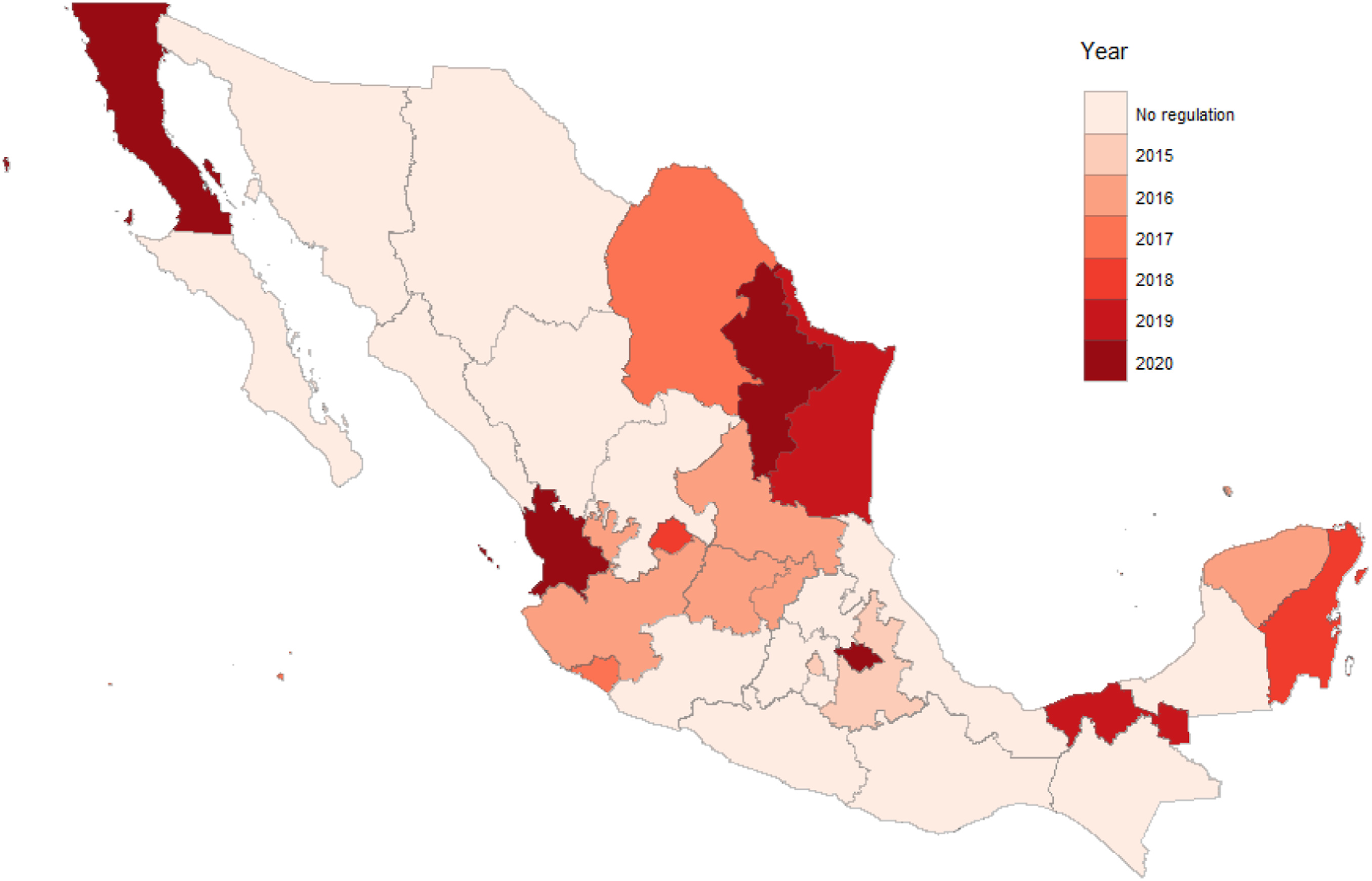
Operationalization of Regulatory Frameworks in Mexico Based on the QQE (Cooper et al., 2016; Harding et al., 2016) and Other Rules (Goletz & Bahamonde-Birke, 2021; Puche, 2019; Thelen, 2018)
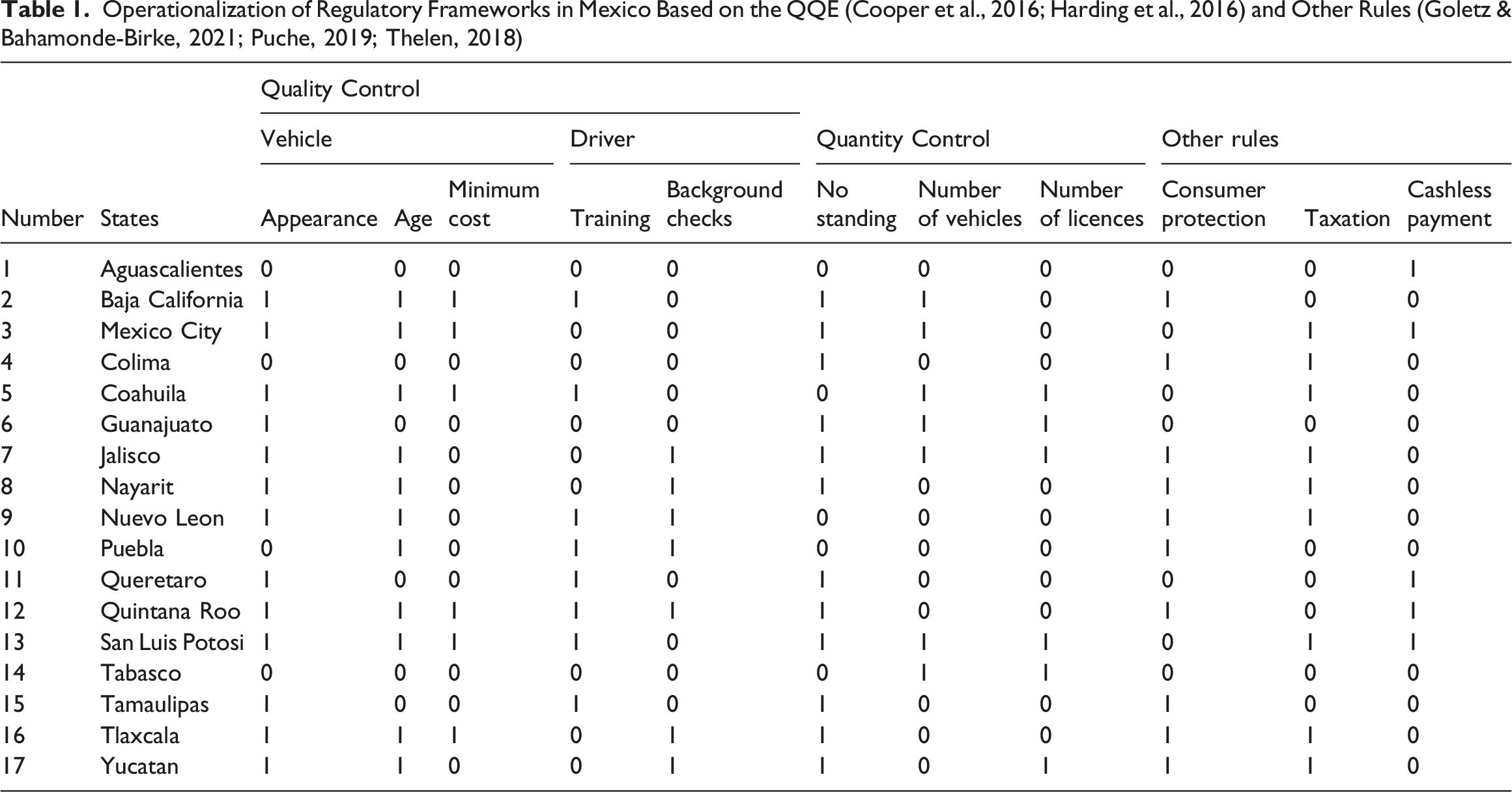
For each regulation, the presence or absence of the above characteristics were analyzed by quantifying the dichotomous variable with a value between 0 and 1. The standards are contained in local laws and regulations and are public and legal documents. Eighteen regulations were identified during the period 2015 to 2021, however one was excluded as no additional information was found in regulatory or administrative agreements beyond an article of law that stated that TNCs be appropriately regulated without establishing requirements or restrictions (Mobility Law of the State of Mexico, article 34, section E). As such the study comprises the analysis of 17 local laws. The list of legislations reviewed can be found in appendix 1.
As in Tzur’s (2019, p. 9) study of 40 cities in the USA, none of the 17 states analyzed proposed tariff regulations for TNCs, and thus price regulation was not considered in the results. Finally, the analysis identified the prohibition of cash payments as a variable of interest in various regulations. This had been identified in the relevant literature on Mexico City (García Tejeda, 2016; Goletz & Bahamonde-Birke, 2021; Puche, 2019) but has not been sufficiently studied. Although these types of limitations have not been considered, in detail, in the literature regarding other countries, this entry barrier for the user is important, as Mexico has low levels of formal banking. On a national level, 34% of adults have access to credit cards and only 22% use banking services via cellular telephones. In contrast, 95% of adults use cash when paying US$24.39 or less (INEGI 2018). With the prohibition of cash payments, many people cannot use ride-hailing services as they lack access to the formal banking system. Furthermore, these local regulations also include the prohibition of prepaid cards sold in convenience stores.
Methodology
The analysis of regulations identified that cash transactions and the sale of prepaid cards for the use of ride-hailing services were prohibited in five local laws. The database allowed for the testing of various hypotheses on the regulation of ride-hailing services, as discussed in the literature review: first, whether the prohibition is associated with the size of traditional taxi groups in each state, as they possibly promote restrictions on TNCs to minimize their market losses (Tzur, 2019, p. 18); second, whether new digital taxes are a significant factor given the role of TNCs in tax collection (Pelzer et al., 2019, p. 11; Thelen, 2018, p. 942), as a simple way of monitoring tax compliance is by prohibiting the use of cash which may hide transactions subject to taxation; finally, whether there is a negative association between the rights of users of ride-hailing services, and the cash ban, as such a prohibition may be negatively associated with consumer rights that contribute to the efficiency of the market (Harding et al., 2016, p. 18).
The following statistical model was employed for analyzing data:
Dependent Variable
Cashless has a value of 1 if there is a legal prohibition on cash payments and 0 in the event of no prohibition.
Independent Variables
Taxis refers to the number of traditional competitors in each state. The Taxis variable was estimated using the number of taxis per 10,000 inhabitants, taken from official national registries of vehicles in circulation and the population census by state (INEGI 2020a, 2020b). According to the literature, a significant positive correlation is expected: the greater the presence of traditional groups, the higher the probability of restrictions on ride-hailing services (Tzur, 2019).
Consumer is a dichotomous variable with a value of 1 if the analyzed regulation contains at least one consumer protection right. For this variable, I analyzed whether the regulation established an obligation to provide information on the vehicle, the driver, as well as the approximate total for the service, and whether a system of qualification or any other right associated with the use of the service that contributes to market efficiency was evident, according to the economic analysis of law perspective. In this case, a significant negative coefficient is expected, as if user rights are evident, there is less probability of impeding entry into the market to preserve competition in the sector (Harding et al., 2016).
Taxation is a dichotomous variable that registers new digital taxes for ride-hailing services. In regulations where new taxes were included, these correspond to 1.5% of each journey. According to the literature, a significant positive association is expected, given that the new taxes require greater monitoring mechanisms, such as the prohibition of cash to avoid the underreporting of taxes (Pelzer et al., 2019; Thelen, 2018).
Firth Logistic Regression
A Firth’s logistic regression model was estimated, as the dependent variable assumes the value of 0 or 1 according to the absence or presence of a cash prohibition. In addition, only 5 of the 17 local laws established a prohibition on cash payments, resulting in the data being unbalanced. Firth logistic regression is used to analyze small databases in the field of health (Puhr et al., 2017; Suhas et al., 2023; Wang, 2014), and to a lesser extent in the social sciences and transportation studies (Gim & Ko, 2017; Zorn, 2005). The technique addresses the asymptotic bias of the logistic regression in small sample sizes and few successes, it produces finite estimates when data separation is present, and continuous covariates are included in the model (Firth, 1993; Heinze & Schemper, 2002). As such, the Firth logistic regression was chosen as it is applicable in cases with perfect prediction problems, as well as low numbers of observations, and unbalanced data (Firth, 1993; Heinze & Schemper, 2002; Hilbe, 2016).
The independent variables were the number of taxis per population, the existence of user rights, and the establishment of new digital taxes (Table 1 and Appendix B). Multicollinearity problems were discarded with a point-biserial correlation test. The estimated coefficients should be interpreted with caution due to low numbers of observations. However, the p-values estimated by the Firth model are similar to those obtained in unpenalized logistic regressions (Gim & Ko, 2017). Thus, the discussion of the results focuses on the significance and direction of the statistical association. The model used also allowed for the observation and direct measurement of the variable of interest, as a ranking or composite indicator, which has been used in other investigations to analyze regulatory changes in digital platforms, was not developed (Hong & Lee, 2018; Tzur, 2019). Finally, although a study of causality was not conducted due to the limits of the methodology and the available small data. The software used was the language R.
Results
In Mexico, regulations establish more quality controls than quantity controls (Figure 1, above). Of the analyzed regulations, 76.47% established rules regarding the appearance of vehicles, such as the type of car, the number of doors and the availability of air conditioning. Regarding the age of the car, almost 2 of every 3 regulations (64.71%) required a maximum age of the vehicle for the operation of TNCs, with a median of 5 years and a standard deviation of 3.24 years. However, extreme values are observed. In the state of San Luis Potosi, automobiles must be practically new (1 year) for ride-hailing services. In contrast, in Mexico City, automobiles can be up to ten years old. With regards the minimum cost of a vehicle, 35.29% of the laws analyzed required a minimum value of between US$7,315 and US$13,116, with an approximate average of US$10,533. Heterogeneity of local regulations for ride-hailing services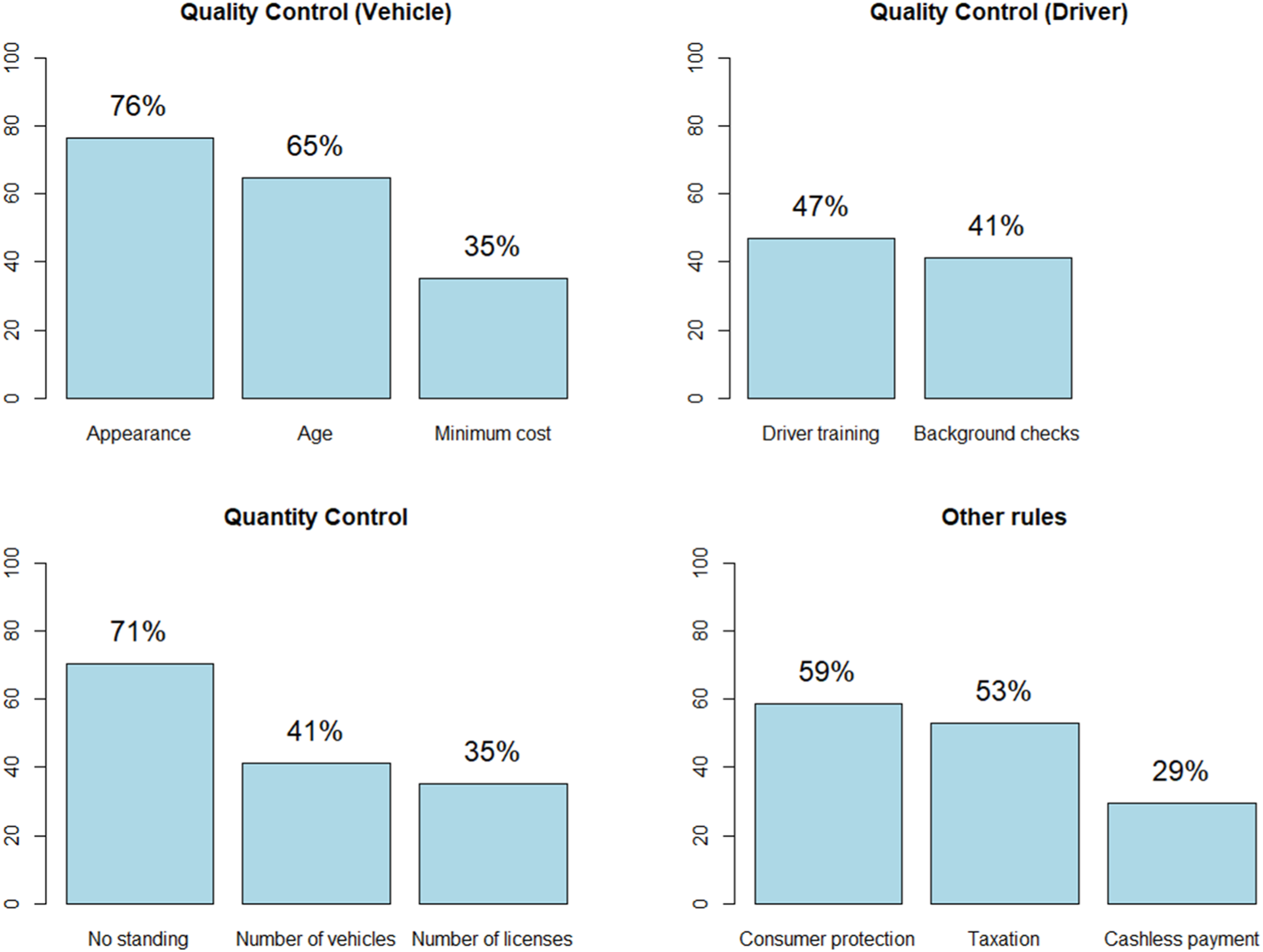
Quality control measures for drivers of ride-hailing services include training and driving ability as well as criminal records (Figure 1, top right). Courses and other forms of compulsory training to certify driving skills are required by 47.05% of regulations. Seven of the 17 states (41.14%) review criminal records. On average, there are fewer quantity controls in the regulations (Figure 1, bottom left). Restrictions on the number of licenses granted are evident in 35.29% of regulations, with 41.17% limiting the number of vehicles that can operate within ride-hailing services. However, the most frequent quantity control measure contained in the regulations is the prohibition of stands, which appears in 70.58% of regulations. A taxi or cab stand is reserved for traditional transport service providers only.
Regarding other forms of rules and restrictions, it is notable that 11 of the 17 regulations (52.94%) establish new taxes (Figure 1, bottom right). In all cases, taxes comprise a 1.5% contribution for each journey taken through the TNC applications. This amount is earmarked to improve infrastructure or mobility, though no control and accountability mechanisms for such funds are established. Although consumer protections may be widespread in the local regulations to protect market efficiency, only 10 of the 17 (58.82) specifically define the rights of the users. Finally, the prohibition of cash payments and the use of prepaid cards are stipulated in 5 of the 17 regulations (29.41%).
In summary, controls over the quality of vehicles and drivers are more frequent than quantity controls. Regarding the latter, the most significant quantity restriction is the prohibition of stands in highly transited areas, where only taxis can park. Finally, no local legislation was found to contain tariff controls.
Regression Analysis
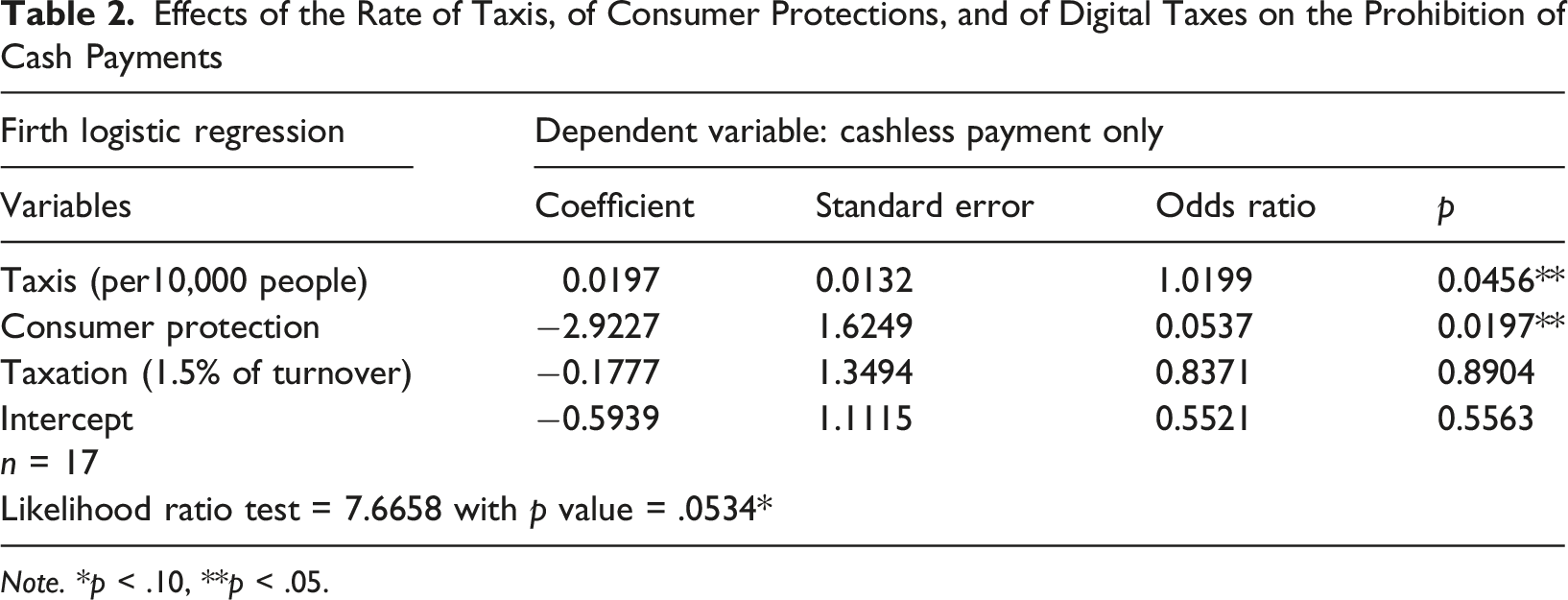
Effects of the Rate of Taxis, of Consumer Protections, and of Digital Taxes on the Prohibition of Cash Payments
Note. *p < .10, **p < .05.
The estimated odds ratios show that 1 additional taxi per 10,000 people represents an increase of 1.99% in the odds of a regulation prohibiting cash payments, with all other predictors remaining constant. Regarding the rights of users, the odds of establishing a cash prohibition is 94.63% less if the regulation contains consumer protection rights (e.g., to provide information on the vehicle, driver, and the approximate total for the service). Another Firth logistic regression included only the significant variables, resulting in a better fit (Likelihood ratio test = 8.150,771 with p value = 0.0169). The coefficients and p-values were similar for taxis (0.0218, p value = 0.0332**) and consumer protection (−3.2297, p value = 0.0143**) in the second model.
Discussion
In Mexico, the five regulations that prohibit cash payments appear to be the result of lobbying by traditional groups. The logistic regression shows a positive and significant association between the size of the taxi sector and the prohibition. Taxi drivers are likely to have lobbied for increased entry costs for those without access to banking services, thereby securing their share of the market. This is similar to the case of the Netherlands, where taxi drivers were able to ensure the obligation of a taxi-driver license in order to offer services, considered an entry barrier (Pelzer et al., 2019).
The estimated coefficients (Table 2) show that 1 additional taxi per 10,000 people represents an increase of 1.99% in the odds of a regulation prohibiting cash payments. This result is consistent with previous studies (Tzur, 2019, p. 18), where the inclusion of restrictions in regulations is attributed to taxi groups seeking to minimize losses. In cities such as New York, the cost of individual medallions to operate a taxi, on average, fell from US$1 million to almost US$200,000 from 2013 to 2017, attributed to the entry of ride-hailing services (Song, 2018, p. 94). Thus, traditional competitors have attempted, and, on occasions, succeeded in ensuring that TNCs operate within new boundaries, such as in The Netherlands, and Bogota, Columbia (Pelzer et al., 2019; Puche, 2019).
It is possible that taxi unions have pushed for the inclusion of such entry limitations in order to maintain economic benefits at users’ expense. While more taxi drivers could inhibit collective action by these groups, the many affiliates in taxi unions are represented by only a few leaders who may receive benefits from local authorities and administer them on behalf of their members. For example, 39.92% of taxi stands in Mexico City are controlled by 10 groups, whose leaders can discretionally exclude other taxi drivers from offering their services from these stands (García Tejeda, 2016, p. 58). This may reduce the challenge of collective action (Olson, 2012; Tzur, 2019).
Furthermore, the negative coefficient for consumer protections in the estimated model and its p-value show that the inclusion of user rights in regulations significantly decreases the probability of a cash payment prohibition. This evidence supports the hypothesis that the presence of user rights that protect market efficiency is correlated with a lower probability of inhibitions on market entry. On the other hand, the presence of new taxes in 9 of 17 regulations has no effect on the probability of a cash payment prohibition. Consequently, there is no evidence that that the prohibition could serve to monitor digital tax payments, despite the role that TNCs may have in withholding and collecting taxes (Pelzer et al., 2019; Thelen, 2018).
The ban on cash payments may also have harmful consequences on the law and economic regulation of ride-hailing services in the five states in Mexico where it was implemented, with a combined population of 17 million. This prohibition could impede market density, necessary for dealing with issues of pairing and thin market that the TNCs have contributed to resolving (Harding et al., 2016). Furthermore, this prohibition may encourage a future monopoly or collusive agreement between TNCs, given that it discriminates against low-income users while simultaneously identifies users with access to the banking system. The TNCs’ technology can develop profiles with geolocation of places and journeys, personal data, and preferences, and thus in states with a cash payment ban, the prohibition aids the identification of users with greater economic capacity. This has the potential to create price discrimination and other monopolistic behaviors. This issue needs to be investigated further.
Moreover, the categorical data analysis of regulations shows a wide variety of controls and restrictions on ride-hailing services. The findings reveal that regulations are based more on quality controls than on quantity controls, as has been previously documented in Mexico City (Puche, 2019). However, quality requirements for vehicles are not justified in the regulations, as shown by the inclusion of extreme values of requirements, such as the age and cost of the car, even in neighboring states. This discrepancy in car specifications is possibly not justified by the efficient regulation of services. On the other hand, it is interesting that more regulations establish new taxes than quality controls on drivers. It is possible that most states see ride-hailing services as an opportunity to increase state revenue, rather than to place quality controls on drivers and protect market efficiency. This heterogeneity of regulations should be studied in other developing countries where regulations are also established by city or state.
Finally, the use or prohibition of cash payments and other similar restrictions may have different effects depending on whether they are implemented in developed or developing countries, even when the ride-hailing services and their regulations are the same. In countries with low levels of formal banking, restrictions on cash payments may be entry barriers driven by taxi drivers, who take advantage of local contexts to preserve their participation in the market. In addition, cash payments could have an impact on crime in transportation. Studies report an increase in opportunistic crimes linked to changes in travel frequency and passenger routines following the arrival of TNCs (Jaydarifard et al., 2025; Tillewein & Cox, 2024). In U.S., motor vehicle theft has likely increased because vehicles parked overnight in insecure location (Dills & Mulholland, 2018). In Mexico, the use of cash payments could also make drivers and passengers more frequent targets of crime, as some interviews with drivers suggest (Castillo-Villar et al., 2024). This phenomenon could also be relevant in other cities across Latin America, a region particularly hard-hit by crime (Sabogal-Cardona et al., 2021). As such, the Mexican experience may be useful for understanding what regulations incentivize transport market efficiency in cities or have effects beyond economic issues.
This study was limited by the fact that only 17 regulations were analyzed. In addition, the taxi rate improved its estimated p value in the presence of user rights. This may be attributed to the fact that the last variable absorbs part of the residual variability in the small data set, as multicollinearity problems were discarded with a point-biserial correlation test. Nevertheless, the negative correlation between the rights of users and the cash prohibition is significant in all Firth model estimates. The future adoption of local regulations in the 15 remaining states in Mexico will increase the size of the data set and consequently, allow for the estimation of a better model. In fact, alternative methods have been tested to compare regulations of TNCs due to the low number of cases in Latin America. New research proposes an index for 21 countries and cities in the region, complementing the quantitative approach with qualitative insights (Sáenz-Leandro, 2025). However, studies typically select a few cases for in-depth analysis. Another research examines the trajectories of platform regulation in Chile, Colombia, and Costa Rica, and the particularities of local environments (Sáenz-Leandro 2026). An alternative to the Firth logistic regression is to use machine learning to model the complex relationship in small databases (Sáenz-Leandro, 2025; Suhas et al., 2023). In any case, the results should be interpreted with caution until more data becomes available or more appropriate methods are used to confirm or refute the statistical associations identified in the study.
Another limitation, that may be a possibility for future research, relates to taxis as the group most affected by TNCs. In fact, public transportation may also be affected. Ride-hailing services can serve as either a complement to or a substitute for public transportation (Diao et al., 2021; Hall et al., 2018; Young 2020). In Mexico, passengers use these services as a complement due to the limited coverage and problems of public transportation (Calonge-Reillo 2025). However, the situation depends on the local context. In Mexico City, ride-hailing services could serve as a complementary option to public transportation García Tejeda, 2016), with factors such as gender and age influencing their use (Sabogal-Cardona et al., 2021). In contrast, in Quintana Roo, clashes between taxis and drivers competing for tourist passengers are particularly violent near the Cancun International Airport (US 2023), where public transportation options are virtually nonexistent. Future research could examine the interaction between taxis, public transportation, and TNCs at the local level.
Conclusion
In Mexico, quality controls are more frequent than quantity controls for ride-hailing services. Nevertheless, restrictions vary. For example, almost two thirds of the laws establish a minimum age for automobiles, but this varies between 1 and 10 years with no justification for this variance. Quantity controls are not frequent, with the exception of bans on taxi or cab stands, which are included in 70.58% of regulations. The creation of digital taxes is another element established in half of the laws under study. Within this regulatory heterogeneity, the regulations that establish prohibitions on cash payments and the sale of prepaid cards are notable. These exclude many users given the low levels of participation in formal banking in the country.
These legal entry barriers are significantly associated with the size of local taxi groups and the lack of user rights. On average, an increase of 1 taxi per 10,000 people corresponds to a 2% increase in the odds ratio of prohibiting cash payments, and if regulations protect consumers, the odds ratio is 95% less than in those local laws with no protection of these rights. It is likely that interest groups have pushed for the inclusion of restrictions on cash payments, thereby maintaining economic benefits at the expense of low-income users. These results are consistent with previous research on the role of traditional agents in restricting ride-hailing services (Pelzer et al., 2019; Tzur, 2019). Thus, laws that formally approve TNCs do not automatically favor market efficiency but may introduce restrictions that impose new entry barriers. The prohibition on cash may be a significant barrier in Mexico and Latin America, while regulations in other countries or regions may establish similar restrictions in accordance with the context of each city or country.
The regulation of TNCs is a work in progress, with many cities and countries still debating regulations and the content of laws. As of 2021, 15 states in Mexico were yet to introduce local regulations. In these legal standards, the probability of obstacles to competition increases if the taxi sector has an extensive presence and if legislators omit user rights. This has given rise to heterogeneous regulation in various legal areas that are difficult to justify and affect local transport market efficiency in the cities.
Supplemental Material
Supplemental Material - Ride-Hailing Services: New Entry Barriers in Local Regulations
Supplemental material for Ride-Hailing Services: New Entry Barriers in Local Regulations by Enrique García-Tejeda, in Competition and Regulation in Network Industries
Footnotes

Funding
The author received no financial support for the research, authorship, and/or publication of this article.
Declaration of Conflicting Interests
The author declared no potential conflicts of interest with respect to the research, authorship, and/or publication of this article.
Data Availability Statement
The local regulations that support the findings of this study are available online in local government sites.
Supplemental Material
Supplemental material for this article is available online.
References
Supplementary Material
Please find the following supplemental material available below.
For Open Access articles published under a Creative Commons License, all supplemental material carries the same license as the article it is associated with.
For non-Open Access articles published, all supplemental material carries a non-exclusive license, and permission requests for re-use of supplemental material or any part of supplemental material shall be sent directly to the copyright owner as specified in the copyright notice associated with the article.
