







Abstract
This article describes a study of early childhood teachers’ understanding of teaching and learning in children 4 and 5 years of age in technology education. The research aimed at assisting teachers’ understanding of learning in technology using a developed framework. This study investigated the development of dispositions and attitudes including the building of children’s confidence and self-belief in their capabilities, within four aspects of learning and across five predetermined behaviours relevant to technology education. The study employed qualitative research methods to assist teachers with the use of an observation and conversation framework aimed to improve their ability to assess formatively their children and their own ability to give specific feedback. Observations and interviews were used to gauge teachers’ developed understandings of children’s learning in technology. The study shows that the framework used benefitted teachers and children. It allowed for insight into understanding how and what children learn in technology and teachers’ understanding of technology.
Introduction
Reported in this article is research undertaken in the use of a tool, the Technology Observation and Conversation Framework (TOCF) developed by the researcher, to assist early childhood (ECE) teachers’ understanding of technology to formatively assess 4–6-year-old children’s learning in technology. This is part of a wider study undertaken in England, Sweden and New Zealand with teachers of young children. It presents the final framework and the impacts of the framework. The study offers perspectives on ways to broaden and deepen teachers’ (with no formal training in teaching technology) understanding of technology and early childhood children’s learning using technology. This paper reports on data gathered from two ECE centres in Sweden, which has a rich history in design and technology. It contributes to the field of learning in early childhood technology education. Two early childhood teachers were given a framework to inform their conversations with their children while engaging in technological activity.
Learning in technology education
In technology education, students design, develop and evaluate technological outcomes. To do this successfully it is necessary to situate technology within the human world, and identify and understand the impacts and influences technology has on people and their environment (de Vries, 2017). Learning occurs through a range authentic learning contexts (Snape & Fox-Turnbull, 2013; Turnbull, 2002) and areas to solve technological problems (Department of Education, 2013b; Ministry of Education, 2007).
Wagner (2008) advocates a number of skills vital for success in today’s world. These include critical thinking, problem solving, adaptability, initiative, entrepreneurialism, effective communication, analysing information, curiosity and imagination. Claxton and Carr (2010) suggest thinking about learning through three dimensions: robustness, breadth and richness, which can be used to measure progress. Claxton, Chambers, Powell and Lucas (2013) discuss the building of learning power within children through the development of dispositions and attitudes, including the building of children’s confidence and self-belief in their capabilities, within four domains of learning, rather than the building of specific sets of skills. Within Claxton et al.’s four domains – resilience, resourcefulness, reflectiveness and reciprocity – sit a number of capabilities, some of which are particularly relevant to technology education, such as: noticing, perseverance, managing distractions and absorption in the resilience domain; making links, questioning and imaging in resourcefulness; planning and distilling in reflectiveness and collaboration, empathy, inter-dependence in reciprocity. Claxton et al. (2013) state that increasing children’s curiosity, sense of adventure, perseverance and independence, along with teaching children how to be better learners, also increases their capabilities for learning.
Learning technology presents teachers with a challenge of equipping children with skills and knowledge necessary to thrive in their current and future worlds. Technology education is a learning area that deals with the ways people develop their technological environment to better suit their needs (de Vries, 2009). It explicitly deals with the technological processes of investigating, designing, making and appraising technological outcomes (products and systems) for identified problems or recognised opportunities within any given social or cultural context and requires students to design and develop solutions for identified problems or to meet specific needs (Ministry of Education, 2007). Technology education should recognise and enable children to be mindful of the future as they use, critique, design and develop technological outcomes.
Development of a teacher’s pedagogical content knowledge relies on and develops with sound content knowledge and pedagogical knowledge (Gudmundsdottir & Shulman, 1987; Shulman, 1986). Technology pedagogical content knowledge (TPCK) has been the focus of numerous recent studies and found to be vital to developing quality understandings of technology (Doyle, Seery, Gumaelius, Donal Canty & Hartell, 2018; Hulten & Bjorkholm, 2016; Rohaan, 2009; Williams, Eames, Hume & Lockley, 2012). Fox-Turnbull (2006) and Moreland, Jones and Chambers (2001) identified that teachers’ technology content knowledge (TCK) influenced the quality of their teaching in technology. Hulten and Bjorkholm (2016) also stated that teachers need both TCK and TPCK to be able to teach technology. Teachers also need to have a deep knowledge of their students in order to develop student-centred programmes. Acknowledgement of students’ funds of knowledge (González, Moll & Amanti, 2005) plays an important role in learning, as children draw on cultural knowledge and practices to enhance engagement and influence their learning. Fox-Turnbull (2016) and Mawson (2011) identify that children draw on their funds of knowledge to inform their technology practice.
Assessment of children’s learning and development in technology involves intelligent observation of and conversation with children by teachers with the purpose of improving children’s technological literacy (Compton & France, 2007). Progress in technology is not linear, but rather a holistic process which can be difficult to assess (Kimbell, 1997). Achievement in technology includes children’s conceptual understanding of subject matter and their ability to transfer concepts to future learning and both new and unfamiliar situations (Harwood & Compton, 2017; Pellegrino, 2002). National or state curricula such as New Zealand’s national curriculum technology achievement objectives (Ministry of Education, 2007) and the England’s Key Stages (Department of Education, 2013a) in design and technology (d&t) go some way to identifying learning progressions in technology education. Compton and Harwood, (2005) Jones (2009) and Pellegrino (2002) suggest more research is needed around the notion and specifics of learning progression in technology. As students develop, they can consider a wider range of aspects related to their technology practice; however, in ECE there are no formal linear progressions in national curricula in England, Sweden or New Zealand.
Technology education in early childhood
Early childhood education is based on a holistic approach to education, with care, socialising and learning at the heart of programmes (Ministry of Education, 2017; Skolverket, 2010). Sweden’s early childhood curriculum document outlines that curiosity and initiative are to be encouraged and developed and that children be given opportunities to engage with and develop cultural heritage values, traditions, language and knowledge, to be reflective and to work collaboratively – all critical components in technology practice. It also encourages exploration of the surrounding world (Skolverket, 2010). Technology is very evident within both the New Zealand (Mawson, 2011) and Swedish early childhood curriculum documents, illustrated through the following quote from the Swedish early childhood curriculum. Creating and communicating through different means of expression such as pictures…provide both the contents and methods to be used by the preschool in promoting the development and learning of the child. This also involves building, designing and using various materials and technologies…Preschool should provide scope for the child’s own plans, imagination and creativity in play and learning, both indoors and outdoors. [Skolverket, 2010, pp. 6–7]
This study
This research was situated within a sociocultural paradigm and employed interpretative qualitative research methods as outlined in Ritchie, Lewis, McNaughton Nicholls and Ormston (2014). Teachers used the TOCF to assist in broadening their understanding of children’s learning and to facilitate the giving of relevant feedback to children as a part of the formative assessment process in using technology. The University of Canterbury, Christchurch, New Zealand ethics committee gave ethical approval for the study. The main data was gathered over a four-week period in 2016 and came from semi-structured interviews with two teachers. The teachers were initially interviewed to identify their current knowledge and understanding of and experience in teaching technology education. They were subsequently presented with the TOCF and then used it to inform observations and conversations with their children. The second round of interviews occurred after teachers had used the framework. Researcher observations and audio recording of teachers’ conversations with children triangulated the data. Data analysis occurred through repeated coding and recoding to enable a rich description of the teachers’ experiences using the framework. The framework presented in this paper is a modified version resulting of teacher feedback at the time of initial interviews.
The participants
Two Swedish early childhood educators (ECE) voluntarily took part in the study. Jenna, with 18 years’ teaching experience, worked with 1–6-year-old children in a large urban central setting in Stockholm. As an ECE-trained teacher, she received no technology education training in her initial teacher education programme. Similarly, Anthea, an experienced teacher of 19 years, worked with 1–6-year-old children in a leafy suburban setting approximately one hour north of Stockholm. Heavily influenced by the Reggio Emilio philosophy of teaching, she too, as an ECE-trained teacher, received no technology education training in her initial teacher education programme. Pseudonyms protect the identity of the teachers. During the study, each teacher worked with a group of five to seven children. In both cases, the principal granted access to the students; parental consent was not obtained, as the students were not part of the sample.
Interviewed before and after the teaching episodes, both teachers used the framework to guide interactions with students engaged in technological activity. The researcher also observed teaching over a period of two sessions of two hours in each centre. During the observations the research noted teacher and student behaviour, photographed and videoed aspects for later recall. Interviewed in her place of work for only the first interview, Anthea’s second post-teaching interview occurred via Skype, within which she described her practice. Both teachers were interviewed in English and had a strong command of the language, although Anthea was less confident than Jenna. After her Skype interview and at her request, Anthea provided a written response to the interview questions, to enable her to consider her answers in English.
At the point of the first interview, both teachers understood that technology was about the ‘made-world’ and that children design and make technological outcomes. Neither understood the need to understand the impacts of technology on people and places as part of their teaching about technology with children.
Technology Observation and Conversation Framework (TOCF)
The researcher through her extensive knowledge and experience of technology education developed the Technology Observation and Conversation Framework (TOCF). The process also included a review of current research related to technology (Ministry of Education, 2018; Snape & Fox-Turnbull, 2013; Spendlove, 2015; Sundqvist & Nilsson, 2016; Williams et al., 2012). Literature based on the building of learning capacity (Clarke, 2014; Claxton, 2007; Claxton et al., 2013) was also carefully considered. The framework was subsequently modified after being used in England and New Zealand contexts with four teachers. The framework identifies five behaviours – resilience, transference, flexibility, reflection and socialisation – considered as desirable for success in learning and living in the 21st century and identified by the researcher as particularly relevant to technology education.
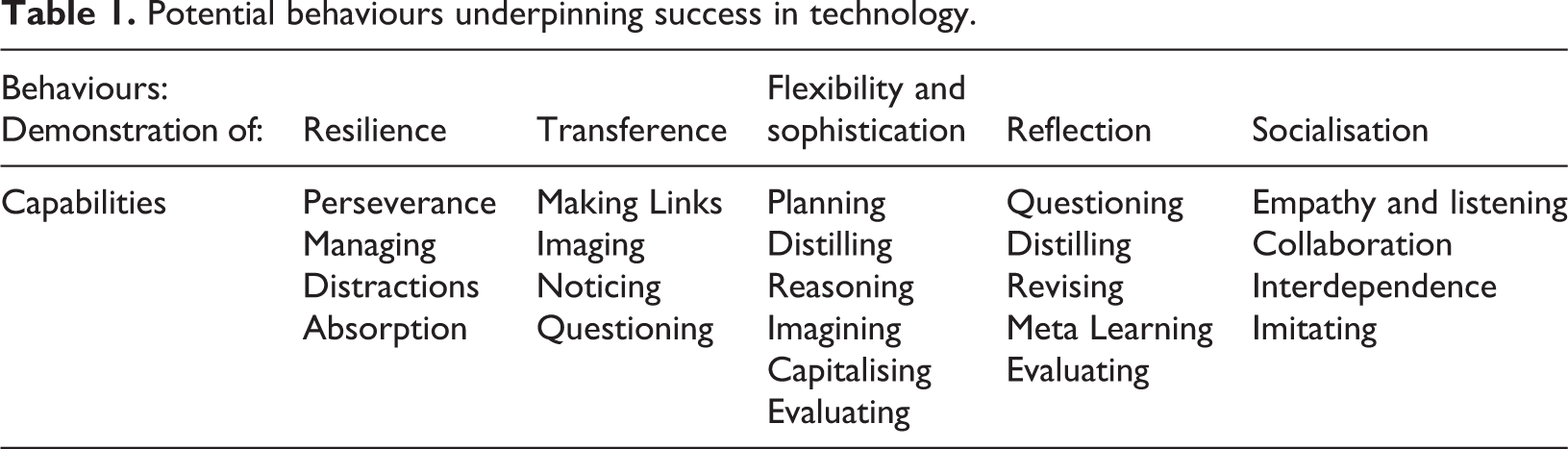
The first behaviour, resilience, includes capabilities of perseverance, especially after initial failure; managing distractions from peers, other activities and people around them; and absorption in any given task (Shernoff, Csikszentmihalyi, Schneider & Shernoff, 2003). Absorption, likened to Csikszentmihalyi‘s (1990) state of ‘flow’, is described as a state of deep absorption in an activity that is intrinsically enjoyable, as when artists and athletes are focused on their play or performance.
Transference includes making links to technologies experienced or seen, and experiences undertaken previously, such as using existing cultural knowledge and experiences or Funds of Knowledge (González et al., 2005). It also includes questioning the relevance of previous experiences and imaging how existing knowledge and skills are transferrable to new situations to assist and or improve performance.
Flexibility and sophistication indicate a depth to understanding as well as an openness to new and potentially strange ideas. This involves use of questioning, reasoning, distilling information of relevance and asking questions of others. Planning ideas and actions and capitalising or making the best use of resources also characterise this behaviour. Recent research suggests there is an intuitive connection between creativity and cognition (Lewis, 2008; Runco, 2014). Spendlove (2015) identifies strong societal benefits of being creative within technology education. Increased sophistication of ideas therefore may lead to improved creativity.
Reflection describes the strategic and self-managing aspect of learning. This includes the planning and anticipating of needs and potential issues, and distilling information for potential of future use. Revision of prior learning and its evaluation is seen as a part of the distilling process to identify relevant transferable learning to a new context with the assistance of reflection. It also involves self-generated questioning and self-monitoring of progress through being cognisant of what, how and why learning is taking place (Clarke, 2008, 2014).
Socialisation identifies with the inherently social nature of technology and technology education and the huge physical, social and environmental impacts of technology. Whether engaging in the use or the development of technology, children will be interacting in a social manner. They may be collaborating with others to develop single or parallel technologies; they will experience interdependence, or the balancing of self-reliance and socialisation, as the need for resources and skills arise. Even when interacting with technology in a solitary manner, children are still engaging with people. Their evaluation of the technology and decisions about whether to come back for further engagement or not will impact other people in the long term, if not sooner; for example, teachers will not purchase a technological device, toy or piece of equipment that their children choose not to engage with.
These behaviours incorporate cognitive, social and physical behaviours and are a modified and blended version of Claxton and Carr‘s (2010) perspectives and Claxton et al.‘s (2013) domains and capabilities. Within each behaviour are several capabilities, which informed the development of the questions and the ‘look for’ statements in the framework and assist teachers in the recognition of the behaviours. Table 1 outlines the behaviours and capabilities.
Potential behaviours underpinning success in technology.
The next step involved subsequent extrapolation of behaviours through the four common aspects of technology education identified in early childhood curricula of Sweden, England and New Zealand in the wider study. These aspects are child engagement in: exploration of the made-world; communication of ideas about the made-world; independent engagement in and with technology; contribution to the made-world through making and construction in a range of areas.
In each aspect and across all behaviours, potential child actions and teacher questions were written to assist teachers in developing understandings and recognition of children’s learning using technology. The framework, given to teachers at the first interview, was modified after the initial interviews in response to participants’ feedback. This enhanced usability. Table 2 shows the final version of the Early Childhood Education Technology Observation and Conversation Framework (ECETOCF).
Technology observation and conversation framework early childhood edition (ECETOCF).
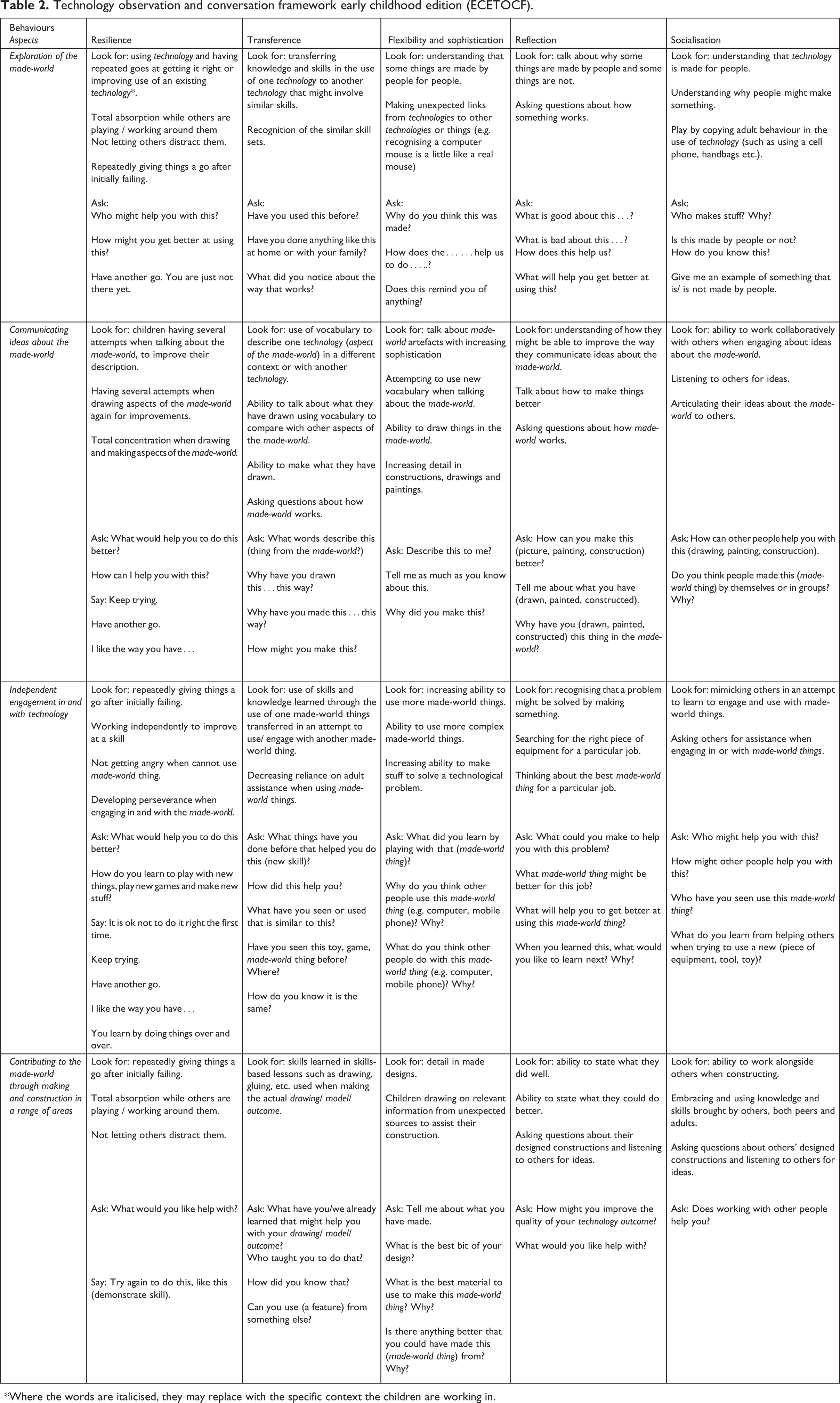
*Where the words are italicised, they may replace with the specific context the children are working in.
Findings
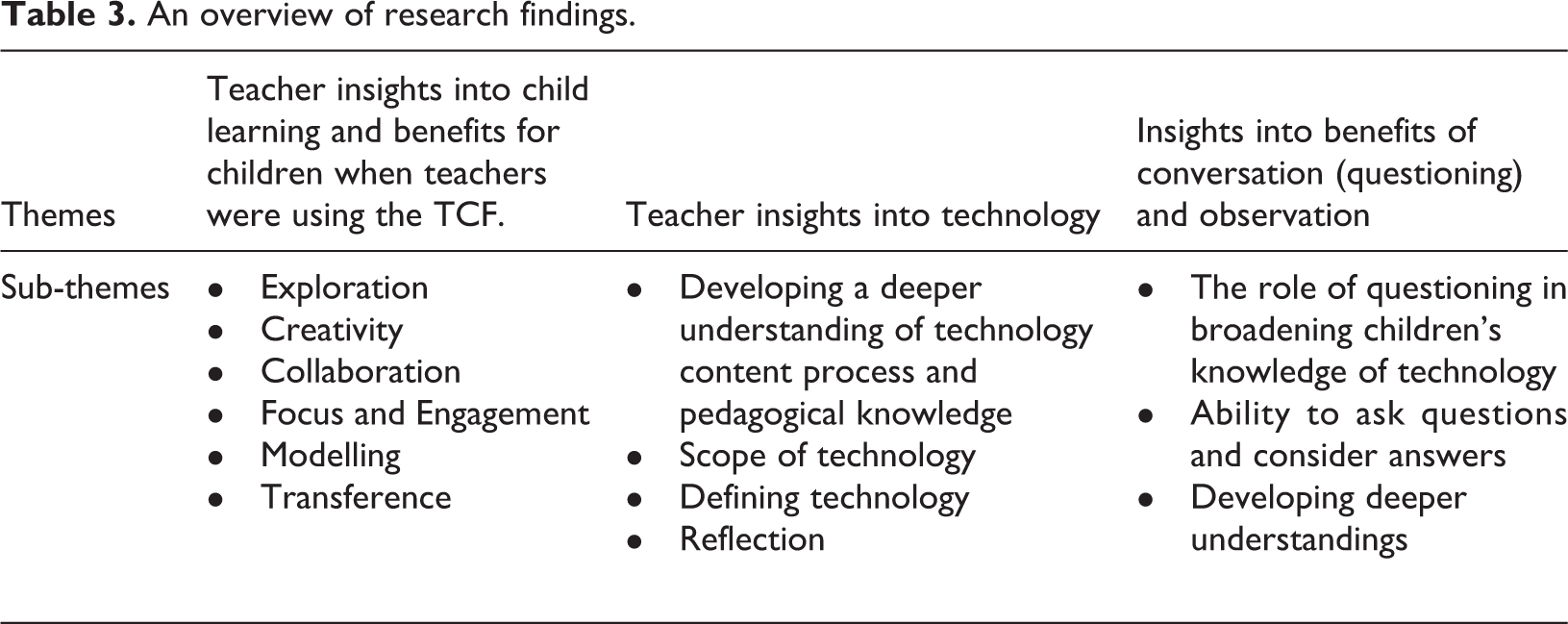
The teachers used the framework as they worked with their children undertaking technology activities. Data presented insight into three main themes: the teachers found the ECETOCF useful for developing their understanding of how children learn in technology; both teachers also indicated that the framework assisted development of their understanding of technology. It also assisted and guided their questioning and teacher/child conversations about technology. Each theme included a number of subthemes (see Table 3).
An overview of research findings.
Insights into children’s learning
That I can help the children develop their learning of technology on a deeper level than I thought before I started using the framework. (Anthea) [Without the framework] we [would] have missed how they explore the material, how they explore the world. (Jenna) I am very glad that they now use their imagination and work together to construct all kind of things. One child used a board to make a cat with legs made of rolled paper, ears made of fabric, whisker made of straws etc. (Anthea) …my idea, with your idea, and we do it together. They are strong together, and they could do it, and I think their happiness to solve a problem… I asked them how they learned to build so fantastic together. For a month ago we built separately, and now we build together. So we have learned to use each other. Yeah, and solve problem, and I think it’s possible to do it and they know they can do it together, and they find material, so built together to, and have own ideas when they collaborating together. (Anthea) Intense and focused, focus, they have their eyes on it all the time and they have a motor inside, driving inside. They could [have] gone [a] long [time]. They could have gone a whole day. They could pick it up now too, after and go back, and go back and do it over, over again. I’m very surprised that they built a system, Cars, trains, tunnels, loops it was very fascinating, and when they use, I think it’s um important they have many different materials in the preschool too. (Jenna) Throughout the process we have been given the children free access to all kind[s] of material to build their own creative things using their technology skills and it has been fantastic to see how the children work with the material and trying to build things from the real world, or new creative constructions that they are proud of. (Anthea) They had that three-dimensional thing in their mind and then they pick up trains and try to use it so I saw we could work together. (Jenna) It is very big project and for trains too, so I think, and we have parents who work to build train[s]. (Jenna)
Teachers’ insights into technology
I think it’s helped many preschool teachers to look for technology in preschool. (Jenna) That I have to learn more about technology myself over all! (Anthea) I think we have to work on a deeper level with children in technology and in early age to give them all the possibilities to develop the technology of tomorrow, for years and years ahead. (Anthea) I think it’s a little bit [of an] issue in the preschool too, because it’s [been] for several years we found we should work in technology in preschool and [wondering] how should we do it? So, I am very glad we have this framework now. (Jenna) I think it’s a difference because I think, I thought a lot of it because in Sweden, we paint first and then we build and now we can paint again and build again. (Jenna)
The participants also developed an understanding of techniques needed to deepen children’s learning and understanding of technology, such as engaging them in evaluation. They also recognised that reflection played an important role in students’ technology practice even at this young age. That I can help the children develop their learning of technology on a deeper level than I thought before I started using the framework. (Anthea) I think the children need to learn how to make reflections [about technology] and that it is an ability that will help them learn many other things in life. If you learn to think about things in a reflected way you learn more and more every day and can use other people perspective to reflect over and over again. Life is not a matter of right and wrong. I also think that it is important that they reflect about things made and why so that they go through life making their own choices and decisions based on their own knowledge.
Insights into the role of conversation (questioning) and observation
Anthea identified the value of questioning children about their learning: I have learned that there are more for me to learn about how children learn technology. That we are not used to ask children questions about the made-world and make them reflect about how to develop already made things…I now see how valuable it is for the children to be able to develop more of their technology skills on a deeper level and that I as their teacher has to make it possible for them. The questions were hard to use since the children in my group are not familiar with that kind of questions, but the questions are similar to the ones I have used earlier in my career. (Anthea) I think I have to study it many times. (Jenna) My learning and I think it’s so fascinating the children collaborating so much together and we’re seeing something that I don’t see before. (Jenna)
Discussion
Internationally (Sweden, England and New Zealand), early childhood curricula offer a holistic approach to technology. Technology is both implicitly and explicitly mentioned in the three ECE curricula studied (Department of Education, 2014; Ministry of Education, 2017; Skolverket, 2010). However, the teachers in this study agree with Sundqvist and Nilsson‘s (2016) claim that although technology should be taught in early childhood settings, teachers have limited understanding of technology education and how to teach it, mainly due to the fact that neither had had professional training in technology education. The teachers in the study found that the ECETOCF offered guidance in their ongoing communications with their students while developing their understanding of technology.
Recent advances in understanding suggest a range of skills and dispositions necessary for successful learning in the 21st century and that students need a varied range of competencies and dispositions to flourish (Claxton, 2007; Claxton et al., 2013; Wagner, 2008). This study evidences a number of these desirable dispositions and abilities in the field of technology education for young children. Both participants recognised that undertaking technological practice facilitated and enhanced several aspects that were highly advantageous to students and in doing so supported literature in this area. These included creativity (Spendlove, 2015), collaboration (Wagner, 2008), focus and engagement (Csikszentmihalyi, 1990; Shernoff et al., 2003), transfer of funds of knowledge (Fox-Turnbull, 2012; González et al., 2005; Hedges, 2007; Mawson, 2011) and high-level thinking (Claxton & Carr, 2010; Claxton et al., 2013; Clarke, 2014, among others).
During the study, teachers gained richer and deeper understandings of children’s learning and their own understanding of TCK and TPCK. Several studies in technology have identified that the quality of teaching in technology is dependent on both these phenomena (Barak, 2017; Compton & Harwood, 2005; Miranda, 2017; Rohaan, 2009). The study’s participants recognised the potential of the ECETOCF to develop teacher PCK and content knowledge identified as very important to teaching technology by Hulten and Bjorkholm (2016). Both were keen to continue using the framework and to use it with peers, as illustrated by Jenna in her final interview: I want to lift it up with my colleagues and I want to work with the younger children and the parents are very interested too.
Conclusion
In conclusion, using ECETOCF assisted two Swedish ECE teachers’ understandings of technology education and their ability to have conversations with children to enhance learning. It is significant in the field, because the ECE teachers in the country of study have little or no formal training in technology education. The study suggests that using the framework as a teaching tool could benefit other non-trained ECE teachers and student teachers by assisting development of their TCK and TPCK. The study does have a number of limitations, such as the small sample size. The wider study involved six teachers, but only the Swedish teachers taught only preschool children. Another limitation was the fact that the students were not involved in the study. A major practical implication of the study is that the framework could become a tool to easily assist early childhood teachers’ and student teachers’ thinking in and about technology and understanding of how students learn about and develop their technological world. However, further investigation is needed into the nature of children’s learning when teachers are familiar with and use the framework, as also is investigation into the impact on student teachers’ understanding of technology education when they use the framework.
Footnotes
Declaration of conflicting interests
The author(s) declared no potential conflicts of interest with respect to the research, authorship, and/or publication of this article.
Ethical Approval
The University of Canterbury, Christchurch, New Zealand ethics committee gave ethical approval for the study.
Funding
The author(s) received no financial support for the research, authorship, and/or publication of this article.