







Abstract
Phonological awareness (PA) and alphabet knowledge (AK) are two of the strongest predictors of reading acquisition, and evidence shows that many New Zealand children are entering school with low levels of emergent literacy (EL) skills. The current research showed that four-year-old children identified as having low levels of EL, who participated in an evidence-based 10-week intervention using games and books, made significant gains in PA and AK in comparison to a control group. The children were assessed pre-intervention and post-intervention using the Phonological Awareness Literacy Screening PreK and it was found that the PA and AK intervention used in this research was effective in significantly raising the levels of upper-case letter naming, letter-sound awareness and beginning sound awareness.
Introduction
There are many factors that can affect a child’s reading success at school. Socio-economic (SES) factors, such as low income and limited parental education have been associated with reading difficulties (Buckingham et al., 2014; Strang & Piasta, 2016). Early childhood literacy experiences and inadequate reading instruction have also been shown to affect reading acquisition (Dymock, 2017; Terrell & Watson, 2018). This research, however, focuses on the emergent literacy (EL) knowledge of four-year-old children, in particular phonological awareness (PA) and alphabet knowledge (AK), which research has shown to be influential on early reading success (Arrow & McLachlan, 2014; Gillon, 2018; McLachlan et al., 2013; National Early Literacy Panel, 2008).
In New Zealand, 96.8% of children attend early childhood education (ECE) prior to entering school (Ministry of Education, 2017a). ECE in New Zealand caters for children five years and under. Over the past 10 years there has been a steady increase in the number of children participating in ECE prior to school entry, especially Māori and Pacific students (Ministry of Education, 2017b). The New Zealand Government funds 20 hours of ECE a week for all children aged three years to five years and offers equity funding for children from low SES communities and for ECE services that teach in a language other than English (Ministry of Education, 2016). The aim of these policies is that family income should not prevent children from attending good quality ECE in New Zealand.
In New Zealand there are a range of ECE settings that can be broadly grouped into teacher-led or parent-led centres. Regardless of set up, all the providers work with Te Whāriki, the Ministry of Education curriculum document, which has recently been revised (Ministry of Education, 2017c). The “curriculum is specifically designed for children from the time of birth to school entry, and it provides links to learning in school settings” (Ministry of Education, 1996, p. 9). Underpinning the early childhood curriculum document are four guiding principles: empowerment; holistic development; family and community; and relationships. The curriculum also has five strands: well-being; belonging; contribution; communication; and exploration (Ministry of Education, 2017c). How teachers translate and emphasise the principles and strands is not prescribed and relies on professional judgement, and varies a great deal between centres (Blaiklock, 2013). Although literacy is highly valued in society and EL knowledge is strongly related to later reading success, it is an area that receives only limited attention in the revised Te Whāriki document under the communication strand. The learning outcome “recognising print symbols and concepts and using them with enjoyment, meaning and purpose” (Ministry of Education, 2017c, p. 56), although worthy, provides only a general outline (there is no specific mention of letter names, AK or letter sounds) and therefore requires early childhood teachers to have a sound understanding of EL in order to create the literacy-rich environment that is recommended (Blaiklock, 2013; McLachlan, 2010).
Background
The 2016 Progress in International Reading Literacy Study (PIRLS), which included 40 countries, showed that not only was there a statistically significant drop in New Zealand literacy results but New Zealand has the largest disparity among developed countries in reading achievement between good and poor readers (Chapman et al., 2017; Ministry of Education, 2018) and there is a notable disparity in the early literacy knowledge of children at school entry (McLachlan et al., 2013). Numerous studies cite the strong relationship between essential reading related skills on entry to school and later reading achievement (Shanagan & Lonigan, 2013; National Early Literacy Panel, 2008).
There has been much debate for and against the introduction of explicit teaching of EL skills in ECE (Saracho, 2017; Lonigan & Cunningham, 2013) and research into the role ECE centres play in the preparation of children for school and their contribution to literacy acquisition. The early arguments against introducing literacy skills in an ECE setting were based on the theory of “reading readiness” and if reading was introduced too early, children would become frustrated and may be put off reading long-term. Later developmental theories indicated that literacy development did not only occur during formal teaching of reading but rather from birth, key literacy skills were emerging through developmentally appropriate experiences and that these early skills impacted on later reading achievement (Saracho, 2017).
In New Zealand, the holistic nature of early childhood centres mean that explicit skills instruction is not generally seen as fitting within this philosophy (Zhang, 2015), but international research shows that preschool children who have a higher risk of experiencing future reading difficulties, can significantly benefit from some form of intervention that boosts EL skills (Bailet et al., 2011). Researchers also dispute the idea that teachers need to choose between play-based activities and EL-promoting activities, and suggest instead, that explicit EL instruction can be successfully integrated into the preschool programme alongside explorative and imaginative play (Saracho, 2017).
Research has shown that children entering school with poor EL skills display a developmental trajectory whereby they fall further and further behind their reading peers (McNamara et al., 2011). Such struggles early on in literacy development have also been linked with psychological wellbeing, as well as self-esteem (Gustafsson et al., 2010). Explicitly teaching EL skills at kindergarten has been shown to be especially effective, not only for children at risk of future reading difficulties, but for consolidating reading skills for all children (McNamara et al., 2011). In order to help children to get off to the best possible start in reading, EL therefore needs to be actively promoted in early childhood centres and in the home (Westerveld et al., 2015). Research in New Zealand and abroad, found that teachers generally promoted literacy by providing a literacy-rich environment then waiting for “teachable moments” to extend children’s knowledge, but many felt they were not up-to-date with current research on EL and best practices to use in building skills for a strong foundation for future reading (Meeks et al., 2017).
The purpose of this study was to examine the EL knowledge of four-year-old children in New Zealand and to explore whether an intervention focused on teaching PA and AK could be beneficial in boosting these critical reading skills. The research question addressed in this study was: Can four-year-old kindergarten children with limited EL knowledge be successfully taught PA and AK?
Methods
Settings
In New Zealand the choice of ECE is extensive; however, for this study participants were recruited from six public kindergartens from a diverse range of areas within a small New Zealand city in order to give a representative sample of the larger population. Although only native English speakers were included in the sample, this did not mean the sample was not comprised of a mix of cultures, simply that English was a language all of the children in the intervention had been exposed to from birth. Each kindergarten runs on a sessional basis (8.30am–2.30 pm Monday, Tuesday, Thursday and Friday and 8.30am–12.30 pm Wednesday) with most children attending four to five days a week.
All of the chosen kindergartens work from the same curriculum, Te Whāriki (Ministry of Education, 1996), but have developed their own personal philosophy and teaching programme, which varies from kindergarten to kindergarten. Free play is a large part of the day, with rolling kai (the children choose when they would like to eat) and a mat time which may be at the start or finish of the morning or afternoon session. Mat time is often seen as a whole group teaching opportunity and may involve a number of the following: a shared book; music and movement; sharing of news; number or letter activities; discussing manners; and appropriate kindergarten behaviour.
Study design
An experimental pre-test/post-test control group design was chosen for this study to test the hypothesis that four-year old children can benefit from an intervention that promotes phonological processing skills and letter-knowledge.
Measures
The Phonological Awareness Literacy Screening PreK (PALS-PreK) (Invernizzi et al., 2004) was selected for this study because of its focus on PA and AK of preschoolers. The PALS-PreK (Invernizzi et al., 2004) is a standardised assessment designed at the University of Virginia, Charlottesville Virginia, specifically for four-year-old children with the aim of providing information that will aid teachers in designing their early literacy programmes. PALS-PreK consists of six tasks: name writing; AK (split into upper-case (UC) and lower-case (LC) letters and letter-sounds (LSs)); beginning sound (BS) awareness (initial phoneme identification); print and word awareness; rhyme awareness; and nursery rhyme awareness. For this research, four of the six tasks most relevant to the research questions were administered: name writing; AK; BS awareness; and rhyme awareness. Name writing and letter naming assess children’s AK, and PA is assessed with BS and rhyme awareness tasks.
Intervention
The intervention focused on explicit, small group instruction of phonological awareness and letter-sound knowledge using games and books for between 10 and 15 minutes twice weekly. The intervention design was based on the theory that PA develops in a continuum, from larger sound units, for example, rhyme awareness to smaller, more difficult to discern, sound units such as phonemes (International Literacy Association, 2020). The lessons introduced the concept of rhyme, using rhyme detection activities initially, with the gradual introduction of rhyme generation – Onset and rime tasks involved identifying the phoneme at the beginning of words and grouping words according to this BS, working towards the blending of the onset and rime and eventually phonemes.
Within the PA activities there was the introduction to letters and the associated sounds. The AK activities aimed to teach only a small number of correspondences between letter and phoneme. The phonemes and associated letters that were chosen (s, m, l, p, t, and a) had been identified as common in speech by Byrne and Feilding-Barnsley (1991). An outline of three lessons can be found in the Appendix.
Procedures
Ethics
Ethical approval for this research was granted by the University of Waikato, Faculty of Education, Human Research Ethics Committee (FOE073/10), and a letter was sent to the General Manager of the North Island Kindergarten Association requesting permission to approach the six kindergartens. Telephone contact was made with the Head Teachers of the kindergartens regarding the study, with a follow up letter posted out containing details of the study and a permission slip if they were interested in participating. Parents/caregivers whose children met the study criteria were given a letter explaining what the study would involve for their children, how the data would be used and requesting written consent for their child to participate. It is important to note that the assent of the children to take part was requested on an ongoing basis throughout the whole study, and at any stage during the assessment or intervention the children were able to withdraw.
Selection of participants
The following criteria were applied for the initial selection of participants.
Participants needed: to be aged between four years and four years nine months; to be native English speakers; to have had written parental consent given; and to attend kindergarten a minimum three days a week.
Forty–two students at the six kindergartens met the criteria.
Each of the 42 participants was individually assessed by the researcher on six EL skills. Four of these related to AK (i.e., name writing, UC and LC letters, and LS awareness) and two relate to PA (i.e., BS awareness and rhyming). All parts of the assessments could be stopped at any stage if the task was found to be too difficult for the participant.
From the original sample of 42, 25 participants (14 boys with a mean age (Mage ) of four years five months and 11 girls with a Mage of four years five months) scored at or below the set minimum scores (described below) in at least three of the six sections of the PALs-PreK assessment. The 18 children not recruited for the study continued on as usual in their kindergarten sessions with no extra instruction.
The following criteria were used for selecting participants for the study: Name writing: A score of three or less (maximum score is 7). Rhyme awareness: A score of four or less (maximum score 10). UC alphabet recognition: A score of five or less (maximum score 26). LC alphabet recognition: A score of five or less (maximum score 26). LSs: A score of five points or less (maximum score 26). BS awareness: A score of four points or less (maximum score 10).
The 25 participants were then paired according to score similarity, and randomly selected to be in the intervention or control group (note one participant was not paired due to an uneven sample group and was placed in the intervention group). The control group continued to take part in their kindergarten programme without any extra literacy support. Early in the intervention one participant from the control group moved from the area, hence only 24 participants are reported on.
Implementation of intervention
The intervention group received 15 minutes of small group instruction which was aimed at boosting PA and AK, and delivered by the researcher, twice a week for 10 weeks. Although the intervention was presented in a fun and informal style, the instruction was explicit and systematic, with each session building on the skills and knowledge that had been introduced in the previous session.
Results
The kindergarten attendance rate for the whole group over the 10 weeks (n = 42) was 87%. The kindergarten attendance rates for the intervention group (n = 13) and control group (n = 11) were 89% and 86%, respectively. Attendance records of the intervention sessions showed 12 of the 13 children (92%) attended 17 or more of the 20 sessions.
Can four-year-old kindergarten children with limited EL knowledge be successfully taught PA and AK?
Table 1 shows the mean and standard deviation for the intervention and control groups, pre-test and post-test on the six assessment measures. These data suggest some growth in all the measures over the 10-week period for both groups. Individually all the children in the intervention group made some progress in their learning regardless of their initial EL skills, whereas two out of the 11 children in the control group showed no growth in their scores across the 10 weeks.
Changes in emergent literacy performance from pre-test to post-test.
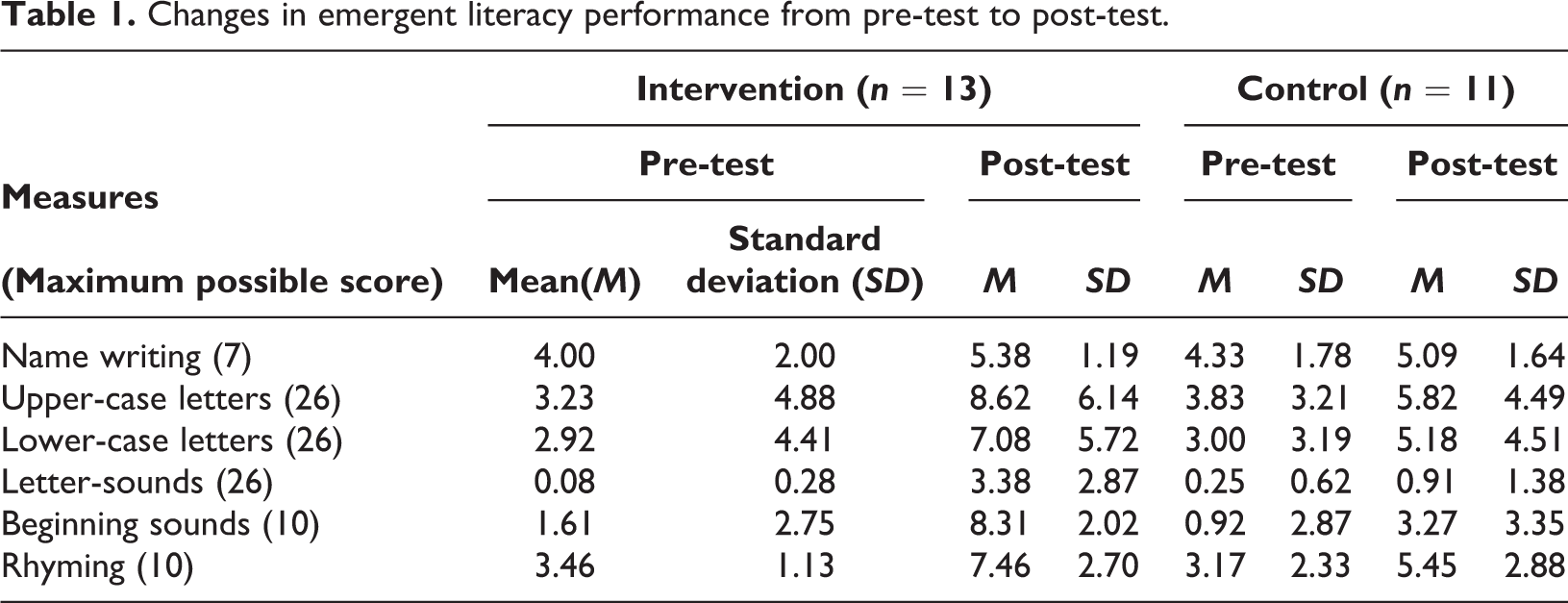
Mean scores from both groups were highest for the name writing and rhyming tasks, in contrast to the LS task with pre-test mean scores being less than one out of a possible 26. The BS task also proved to be challenging with mean pre-test scores sitting below two out of 10. The children generally knew similar numbers of LC and UC letters, as is evident in both pre-test and post-test scores.
In order to answer the research question regarding the effectiveness of the intervention, the data were analysed using multivariate analyses of variance to determine the influence of the EL intervention. Results showed that the intervention group made significantly greater gains in scores on three measures: UC letters, F(1, 23) = 11.521, p = 0.003; LS, F(1, 23) = 9.054, p = 0.006; and BS, F(1, 23) = 12.254, p = 0.002.
Upper-case letters, LS and BS were also analysed to compare the effect size (d). LS and BS showed large effect sizes, according to Cohen’s criteria, scoring d = 1.38 and d = 1.82 respectively. UC letter knowledge showed a medium d of 0.52. The three measures that showed significantly different scores, pre-test and post-test between the intervention and control group are shown in Figures 1 –3 using the data from Table 1.
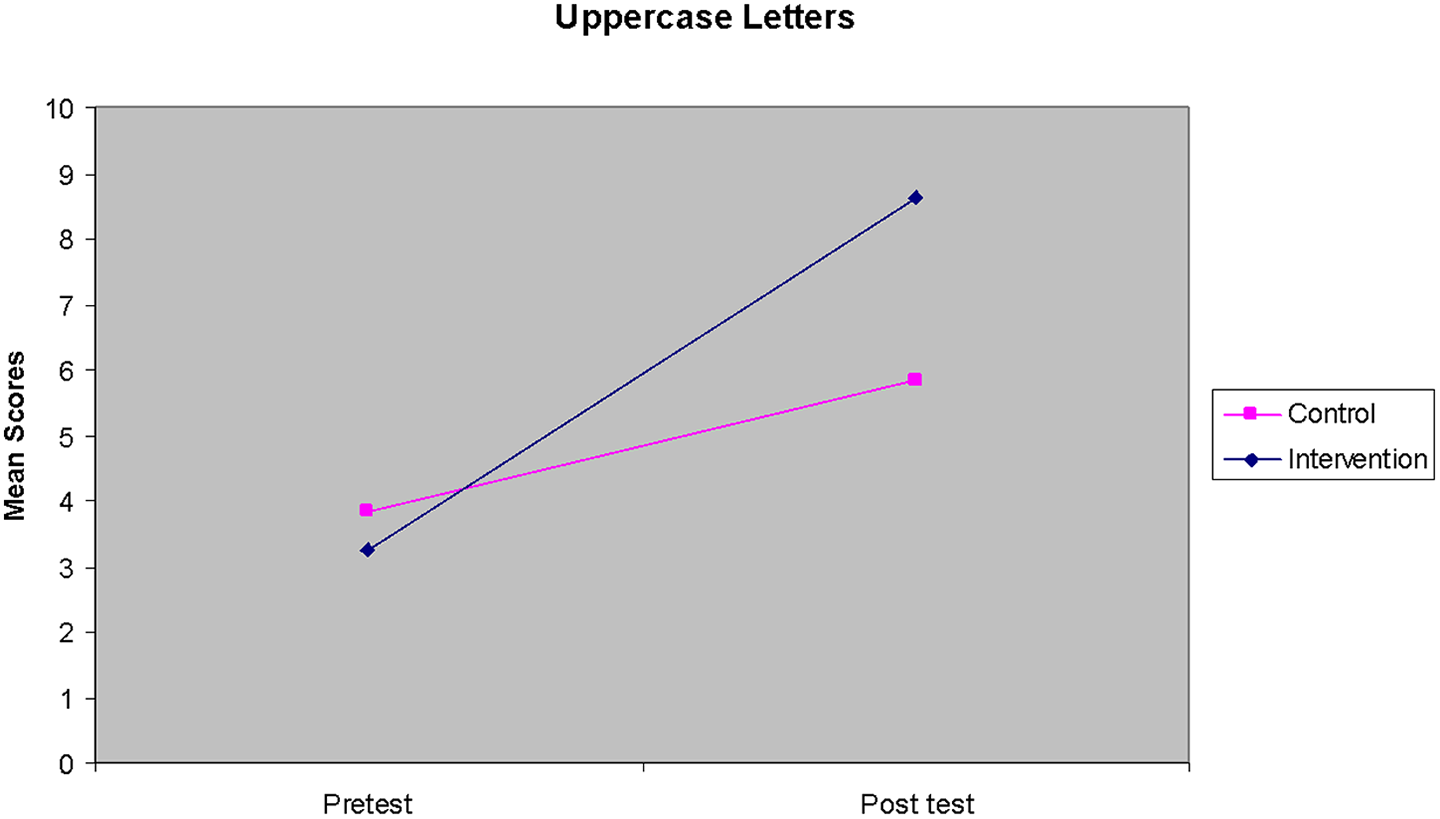
Mean scores (pre-test and post-test) for significant gains in upper-case letter knowledge.
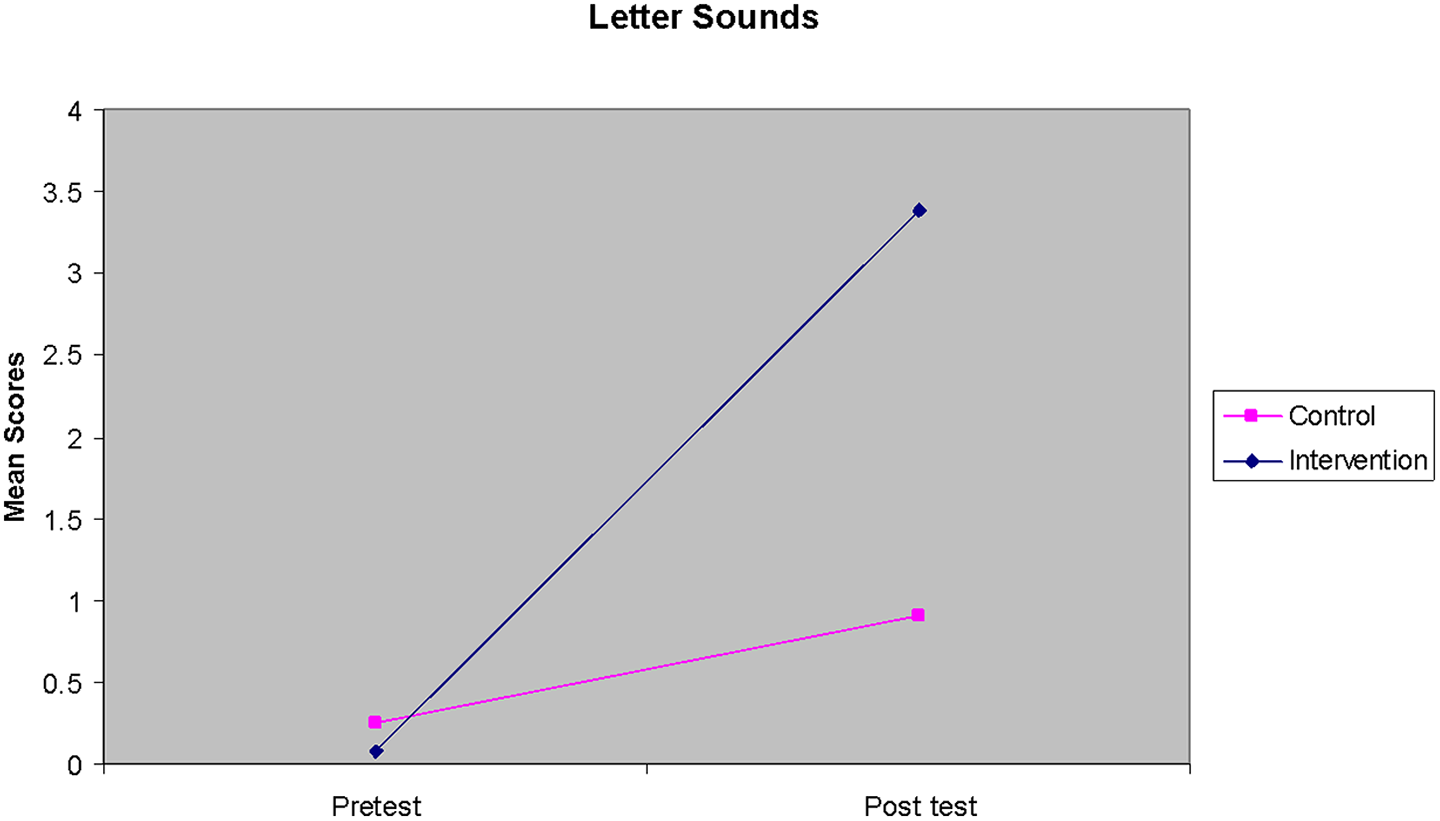
Mean scores (pre-test and post-test) for significant gains in letter-sound knowledge.
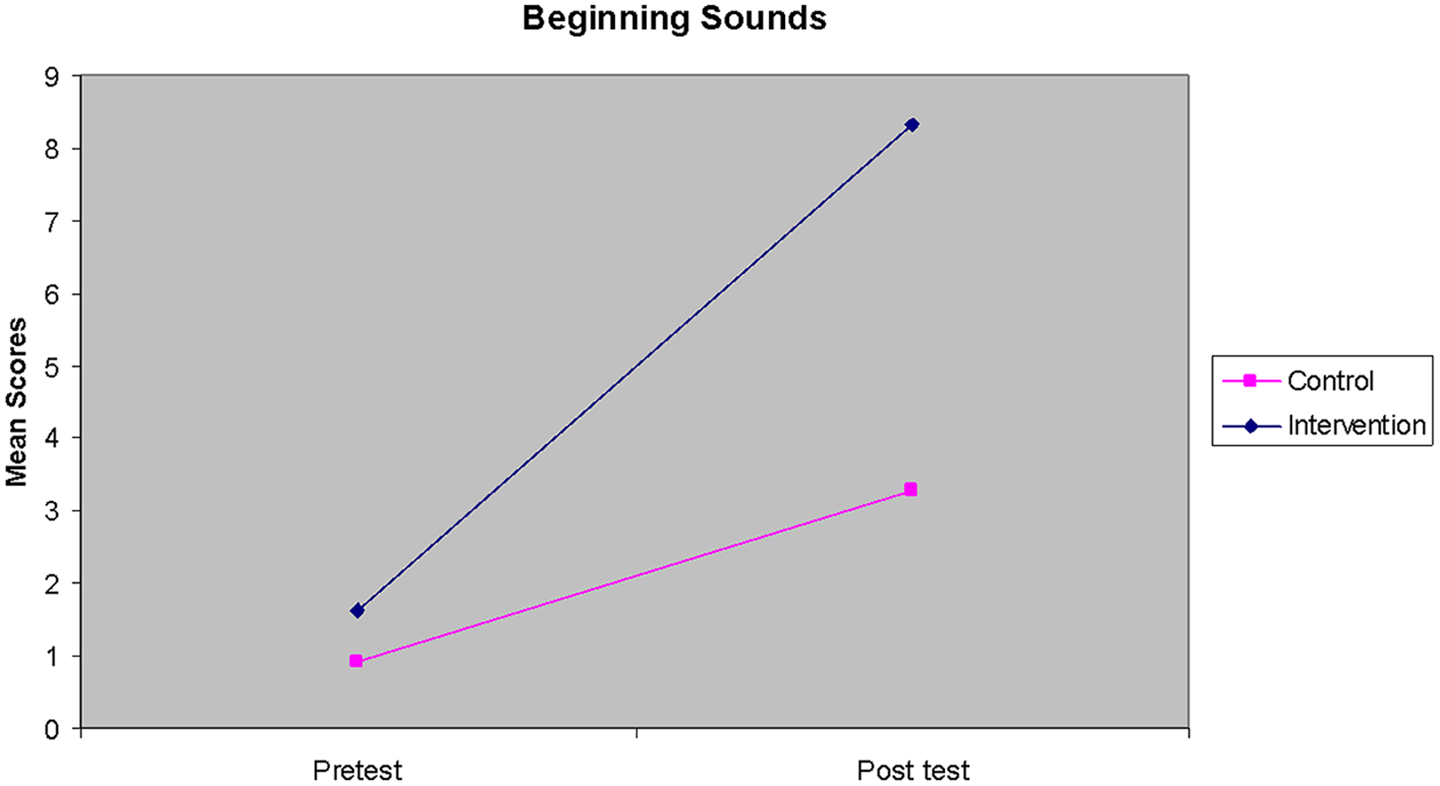
Mean scores (pre-test and post-test) for significant gains in beginning sound knowledge.
Three measures elicited no significant difference between the two groups: name writing, F(1, 23) = 0.142, p = 0.095; LC letters F(1, 23) = 2.873, p = 0.104; and rhyming, F(1, 23) = 1.642, p = 0.213. However, although a significant difference was not seen between the control and intervention group, it should be noted that the intervention group scored more highly than the control group on all of the three measures.
Discussion
The purpose of this study was to examine the EL knowledge of four-year-old children in New Zealand and to explore whether an intervention focused on teaching PA and AK could be beneficial in boosting these critical reading skills. There is a large amount of research on the efficacy of preschool literacy interventions, though there is very little originating from New Zealand (Lonigan & Cunningham, 2013; National Early Literacy Panel, 2008).
The research question addressed was: Can four-year-old kindergarten children with limited EL knowledge be successfully taught PA and AK? Statistical analyses of the data revealed that an intervention can help improve progress in the learning of AK and PA.
The growing gap between literacy achievement in New Zealand children, apparent in the 2011 and 2016 PIRLS studies, is seen as one of the biggest challenges in literacy education in New Zealand (Chapman et al., 2017). A similar disparity in literacy knowledge has been shown in children entering school in New Zealand and is equally concerning (Arrow, 2010). The results of this study are consistent with previous findings and show large variability in EL knowledge of a group of four-year-old children in a small New Zealand city. The similarity with previous studies’ findings underlines the existence of this phenomenon in New Zealand, and the need to find a way to address this issue.
The children with the higher scores tended to be able to name most of the letters, (UC and LC), were beginning to make connections between letters and the corresponding sounds, and showed relatively high levels of PA. This was in comparison to the children with lower scores, who struggled to name more than one or two letters, generally had not developed any understanding of LS correspondences, and had little PA. Name writing, and rhyming task scores were higher than any of the other measured scores across both groups, and from experience, these activities are more likely to be addressed in early childhood centres and at home. This range in EL knowledge suggests that there are many children starting school who will be well equipped to begin the formal reading programme. This range, however, also indicates that there will be others who may struggle to learn to read and will be at higher risk for reading difficulties (Lonigan, & Cunningham, 2013; National Early Literacy Panel, 2008; Pelatti et al., 2014).
These findings give an indication of how the “Matthew effect” can develop (Stanovich, 1986). The children with lower levels of EL skills at school entry may have more difficulty breaking the alphabetic code and therefore learning how to decode efficiently. This may lead to less desire to read and this lack of practice then slows down the development of automaticity in reading. Automaticity in reading is critical as it allows more cognitive resources to be allocated to comprehension, which is the ultimate aim of reading (Nicholson & Dymock, 2015).
It has been suggested that in order to prevent this range from widening and get all children off to a good start in reading, interventions focused on the critical skills needed to read, PA and AK, should be introduced at preschool level (Bailet et al., 2011).
On the basis of the results from this study, it appears a 10-week intervention that focused on PA and AK can be beneficial to preschool children with low levels of EL skills. Children in this study who received the intervention scored higher than the control group across all six measures, significantly so on BS, UC letter naming and LS measures. Such growth in children’s EL skills after an intervention has also been shown in studies by Lonigan, et al. (2013); Hilbert and Eis (2014).
Improvement in the scores of the control group over the 10 weeks was also seen although none of it was significant. Research has shown that many children develop EL skills from day to day interactions at home and being immersed in holistic, literate early childhood settings (Terrell & Watson, 2018). What should be noted was that all of the children in the intervention group made some progress in their learning regardless of their initial EL skills, whereas two out of the 11 children in the control group showed no growth in their scores across the 10 weeks. This supports the idea that for some children, PA and AK need to be explicitly taught and that simply being immersed in a rich literate environment may not be enough (Westerveld et al., 2015).
The aim of a preschool literacy intervention is usually to boost the EL skills that are seen as critical to later reading acquisition (Shanahan & Lonigan, 2013); however, not all interventions are equally effective. Research has shown that integrating PA and AK instruction leads to a stronger transfer of knowledge to reading performance than teaching either of these areas in isolation (Gillon, 2018). This style of intervention helps children to make links between spoken and written language (Gillon, 2018). Instruction focused on the lower levels of PA such as word and syllable level, appears not to transfer to phoneme analysis skills, which are skills that have been shown to be important for future reading (National Reading Panel, 2000). Therefore, in order to promote skills that impact on reading and spelling, age appropriate phoneme level activities need to be included in any PA intervention combined with AK (Gillon, 2018).
To be effective any EL intervention needs to be research-based and able to be implemented by the teachers within their preschool programmes. Age appropriate assessment at preschool should be used to determine children’s existing knowledge and meet the literacy needs of all children, especially children who have been identified as having particularly low levels of EL knowledge. An intervention, such as the one outlined in this present study, could easily be embedded within ECE programmes as it allowed explicit teaching of PA and AK in a fun and informal way.
Limitations
This study used a relatively small sample of kindergarten children, however; the diverse range of SES areas in which the kindergartens were situated resulted in a fairly representative sample of the larger population. A replication of this study with more participants would be useful, as some of the results may have shown significance had the sample been larger. Furthermore, as New Zealand becomes more multilingual, opening the study up to participants who are not native English speakers would be important in this area of research to ensure it is generalisable to the changing population.
There are always challenges when working with preschool children inside their early childhood setting as a researcher. Unlike a teacher, who is able to choose the best time for explicit teaching moments, in the present study not all six kindergartens received the intervention at the most opportune learning times; for example, just before lunchtime or at the end of the day were more difficult times for the children to concentrate as opposed to first thing in the morning or straight after food. Also, the intervention may have been even more effective if the kindergarten teachers had implemented it as the researcher did not know the children and had to establish a relationship with them.
There were many factors that were difficult to control in such an environment, such as distractions, attendance and the challenge of accurately assessing the knowledge of four-year old children. There was also an awareness of children in the control group being near enough to hear the lesson content or friends in the intervention group sharing their new learning with others in the control group. In one case a teacher was listening to the lesson on rhyming and started to repeat the activity with the other children not participating in the intervention.
Future research
The EL research in New Zealand is limited and future research following from this study could help build on the knowledge base in New Zealand. Further research could involve following the 42 children into school to observe reading acquisition and to examine which EL skills correlate with later reading success. Another possibility for future research could be a comparison between the reading development of the intervention group and the control group at the end of Year 1, which could indicate if this intervention has had long-term effects on children’s reading. Further research working with ECE teachers could investigate if they can implement this intervention as part of the early childhood programme and how it sits within Te Whāriki, and the ECE curriculum.
Conclusion
The present study set out to examine if an evidence-based intervention that focused on PA and AK could be effective in raising the levels of these skills. The research showed that four-year-old children identified as having low levels of EL, who participated in the 10-week intervention, made more progress in their literacy learning than the control group, significantly so, in upper case letter-naming, LSs and BSs. These results suggest that certain areas of AK and PA require explicit exposure in order to develop. The results further showed that when interventions are designed appropriately with regard to focus (PA and AK ), length (10–15 minutes a session) and group size (small), they can be effective.
The success of the intervention used in the present study underlines the importance of the conclusion of Hilbert and Eis (2014) who stated that “the opportunity to successfully develop emergent literacy skills is vital for a young child's future academic success” (p. 105).
Footnotes
Authors’ Note
Rachel Rachmani is now affiliated with Ministry of Education, Hamilton.
Declaration of conflicting interests
The author(s) declared no potential conflicts of interest with respect to the research, authorship, and/or publication of this article.
Funding
The author(s) received no financial support for the research, authorship, and/or publication of this article.
Appendix: Outline of three lessons
An overview of three sample lessons from the intervention is given here and activities are labelled according to whether they focus on phonological awareness (PA) or alphabet knowledge (AK).
Lesson 1a began with the introduction of Lime the monster hand puppet who loved to rhyme (PA). We talked about what a “rhyme” was and Lime gave some examples, cat-hat, dog-log. The book Dragon in a Wagon (Dodd, 2001) was then read, emphasizing the rhymes. At the end of the book, Lime wanted to remember the rhymes but needed some help when his attempts went wrong, (e.g., a snake eating popcorn, a snake eating pizza…. oh yes, a snake eating cake).
The next activity provided some practice in matching rhyming objects (PA). The children were given two bags: one was full of animals; and the second had items that rhymed. The aim was to work together to match the pairs. The lesson was finished with some nursery rhymes, “Here is a beehive, where are all the bees, hidden away where nobody sees, watch as they come out of the hive, 1,2,3,4,5 bzzzzz” and “1,2 buckle my shoe”.
The first activity in lesson 5A involved the children matching the phoneme /s/ to the letter Ss (PA and AK). The children were asked to identify pictures that began with the phoneme /s/ and then match these pictures with an example of a printed Ss which was written on a large piece of paper.
To revise rhyming, the first 31 pages of Dr Seuss (2003) Hop on Pop was read to the children (PA). We talked about the similarities in word pairs such as hop/pop, red/bed, and tree/bee, and what they could hear that is the same in these words. How do they know they rhyme? The last activity focused on connecting the phoneme /m/ with the letter Mm (PA and AK). The children were shown upper-case (UC) and lower-case (LC) letters and talked about the differences between UC M and LC m, the sound the letter Mm makes, and what words they knew that began with Mm. Using toy animals, the children made an UC M and with pipe cleaners, and shaped a LC m. UC M and LC m were then added to their letter/sound books and they chose a picture that started with the letter M to stick in their books.
Lesson 10b began with a game called “Letter jumping” (AK). Cards with the letters Ll and Aa written on them in large font were laid on the ground. A letter would be called out and the child needed to jump on that letter. Slowly, other letters were added, for example, UC and LC Mm, Tt, Ss, and Pp, until they began to recognise the six letters they had been learning. The next game was “Beginning sound freeze” (PA). The children walked around and when a word was called out, they needed to freeze, and they could only “unfreeze” when they called out the beginning sound of that word. Words called were: cat; bear; tiger; penguin; mouse; ant; snake; lion; dog; fish; and goat. To finish, Julia Donaldson’s (2008) book Stick Man was read.