







Abstract
The Internet of Things is reshaping many households’ digital landscape and influencing children’s play and learning, especially in the form of toys that are named the Internet of Toys (IoToys). IoToys may generate a significant influence on children’s growth. While increasing attention is drawn to the IoToys, confusion around their conceptualization and use is evident. Without a thorough understanding of what the IoToys are, the progress of meaningful research on this topic will be greatly hindered. We, thus, conducted a systematic review to determine existing definitions of the IoToys using seven major databases over the past 20 years. After analyzing the definitions identified, we found that the previous definitions neglected the significance of defining “toys” in their work. The review led to a discussion around how to understand “toys” and then a more precise conceptualization of the IoToys, based on which implications for future research are offered.
Introduction
With digital technologies becoming ubiquitous in many children’s lifeworlds, exploring children’s use of these technologies has been a popular topic in early childhood research (Selwyn, 2018). Most recently, the Internet of Toys (IoToys) are regarded as the latest technological advancement permeating children’s lives (Arnott et al., 2019). Toys, in general, have a prominent impact on children’s growth (Bradley, 1985). The change and development of toys are closely related to the background of the times (Sutton-Smith, 1986). From the phenomenon of electronic toys’ booming in the electronic age, we seem to be able to foresee that in the era of the Internet of Things (IoT), the popularity of the IoToys will keep increasing. It is predicted that by 2025, the number of IoT devices around the world will reach 75.44 billion and be four times larger than the number reported in 2015 (Statista, 2019). In this way, the IoToys are expected to be more accessible to the majority of children in a few years (Mertala, 2019). These IoToys may generate a significant influence on children’s development, as well as on the future of human beings. At present, research on the IoToys is in a very early stage, so the specific influences that they may bring to children’s play, learning, and growth still need to be investigated.
However, the conceptualization of the IoToys in academia remains ambiguous and controversial, having the potential to hinder future research in this area. According to Wang et al. (2010) who coined the concept, IoToys refer to a special type of the IoT devices. This conceptualization is revolutionary, but seems to be too general. It is hard to differentiate the IoToys from other modern devices. For instance, terms like IoToys and smart toys are used interchangeably (e.g., de Albuquerque & Kelner, 2019). Peter et al. (2019) tried to distinguish between the IoToys, smart toys, and social robots conceptually. They then concluded that the IoToys, smart toys, and social robots “differ in rather subtle ways” (Peter et al., 2019).
Without a clear and updated conceptualization, mixed terminologies will keep being used in confusing ways and many studies will keep focusing on certain products’ names instead of trying to group a series of products into a unified category, which may further lead to fragmented research conclusions and repetitions of previous works. This article will, therefore, make a significant contribution to our understanding of the IoToys at this critical juncture in their development, by proposing a more definitive conceptualization of the IoToys that will help researchers to successfully consider the modern devices and also enable researchers to establish shared understandings about the parameters of their projects. For example, researchers need to understand what constitutes the IoToys so that they will be able to research the IoToys’ role in the play of young children or study the multimodal lives of young children (Arnott & Yelland, 2020) that incorporate nondigital and digital play. To better apprehend the existing conceptualizations and to avoid repetition, we firstly reviewed available conceptualizations in the literature and then propose a reconceptualization of the term, which builds on existing studies and incorporates new perspectives.
Method
In order to capture a broad and rigorous understanding of the existing conceptualizations of the IoToys, a systematic review process was adopted. It followed the guidance of Gough et al. (2017).
Research question
The review was conducted to answer a core question: How does current research conceptualize the IoToys?
Search strategy
Databases
Databases explored and search constraints used.

The search was limited to journal articles and conference papers published in English from January 1999 to July 2020. Although the term, IoToys, was coined in 2010, researchers had been imagining a future when all toys would become connected and could “communicate” with each other (Yelland, 1999). In order to capture as many definitions as possible, we started the search in the year of 1999 when Kevin Ashton from the Massachusetts Institute of Technology’s (MIT) Auto-ID Labs proposed the concept of the IoT (Ashton, 2009). Besides, we considered both peer-reviewed and not peer-reviewed articles in the search.
Search string
As mentioned above, many terms have been used to refer to the IoToys, such as smart toys, even though they can be differentiated. In addition, before 2010, the year when the term the IoToys was initially proposed, other names had also been used to denote Internet-enabled toys. Therefore, we not only searched items like Internet of Toys, IoT toys, and so on by putting in the first string (C1), which was “(Internet OR IoT) W/3 toys,” but also searched items like smart toys, interactive toys, and so on by putting in the second string (C2), which was “(connected OR smart OR intelligent OR interactive OR humanoid) W/3 toys.” Additionally, we further constrained C2 with a key word “Internet.” C1 and C2 were constructed by Boolean logic as follows: ((Internet OR IoT) W/3 toys) OR (((connected OR smart OR intelligent OR interactive OR humanoid) W/3 toys) AND Internet).
Inclusion and exclusion criteria
Our selection of studies to be included was based on the following inclusion and exclusion criteria: Inclusion criteria: (1) articles that can be found in full texts; (2) articles that were in English; and (3) articles that were published between January 1999 and July 2020. Exclusion criteria: (1) articles that do not meet the inclusion criteria; (2) articles on toys which cannot be connected to the Internet directly nor indirectly; and (3) articles that do not contain a conceptualization or definition.
Applying the aforementioned search strategy, we conducted a search on 1 July 2020, which resulted in 986 records, with 117 duplicates being removed. The titles, abstracts, and key words of the remaining 869 articles were firstly examined, and 605 articles that were clearly irrelevant were eliminated. As certain articles’ titles and abstracts contained insufficient information for a decision, such articles were left for a further assessment. We, then, carefully read the full texts of the 264 articles remained. According to the inclusion and exclusion criteria, another 225 articles were excluded. Finally, 39 journal and conference papers containing a conceptualization of the Internet-connected toys were obtained. Further, we added three reports, one conference paper and six book chapters that were identified as important and relevant to this topic in a snowball strategy into this review. As a result, 49 pieces of work were analyzed. The selection process is presented as a flow diagram in Figure 1 (adapted from the Preferred Reporting Items for Systematic Reviews and Meta-Analyses [PRISMA] flow diagram, Moher et al., 2009). Systematic review process.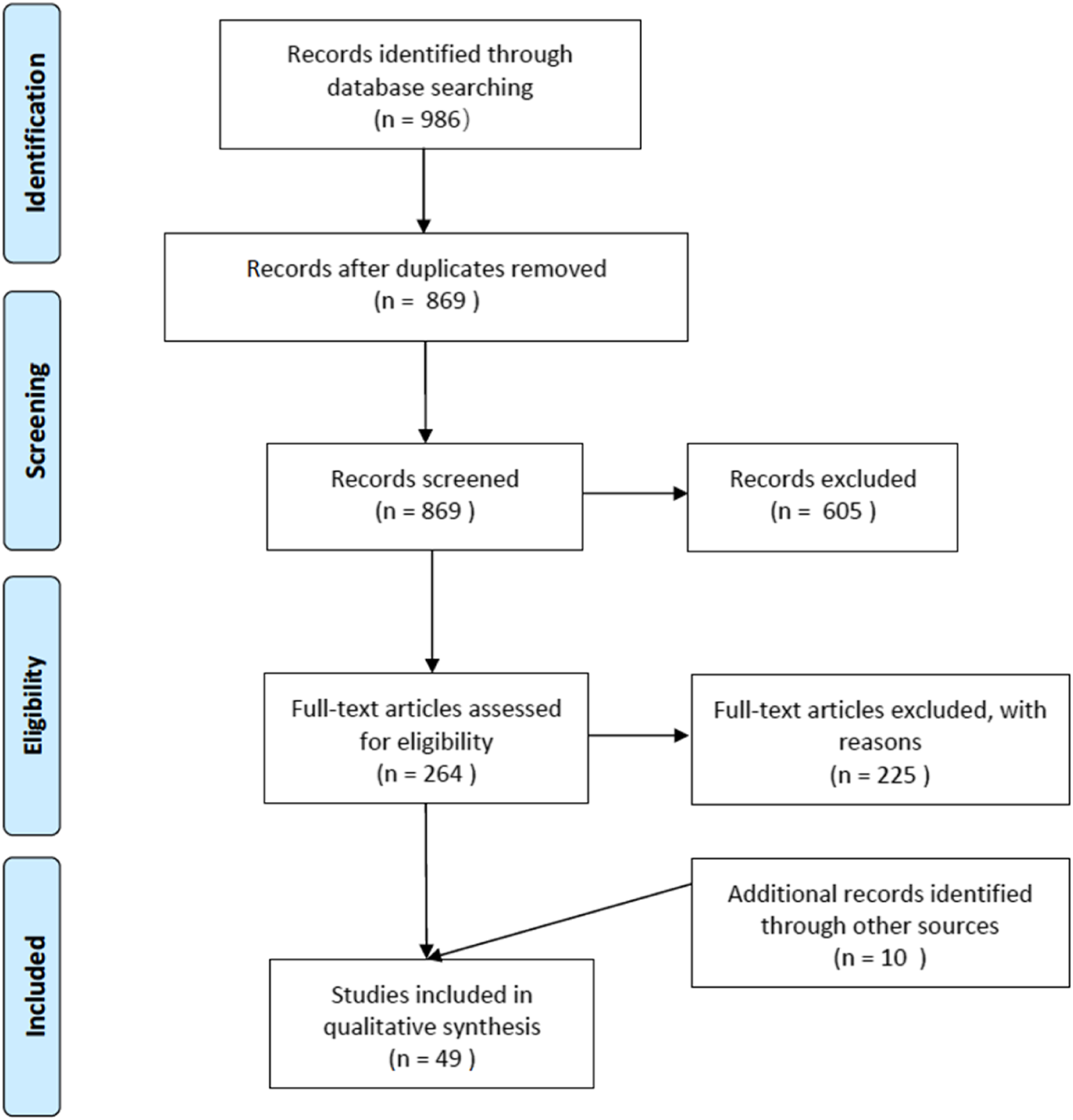
Analysis
An inductive content analysis process consisting of open coding, categorization, and abstraction (Elo & Kyngäs, 2008) was adopted to derive the key characteristics of the conceptualizations identified from 1999 to 2020.
In the open coding procedure, many subcategories descriptive of the IoToys’ features were generated. These subcategories were then compared and some of them were grouped into higher order headings, in order to reduce the number of categories. Two main categories were, at last, developed in the process of abstraction. An example of the abstraction process of IoToys’ characteristics is shown in Figure 2. An example of the abstraction process.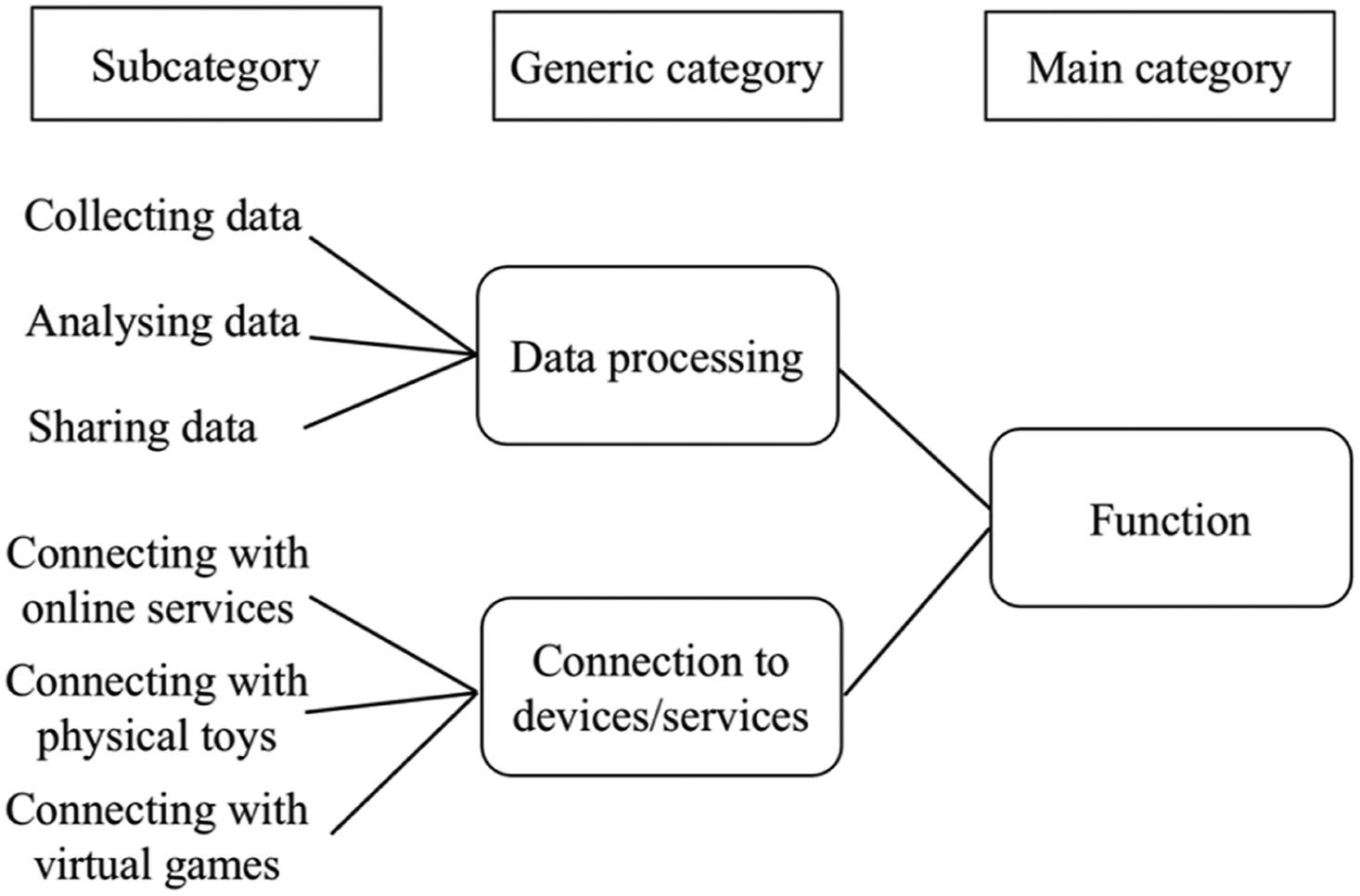
Results
The details of the 49 research identified are listed in https://bit.ly/2RxsFxq. It was worth noticing that although studies on Internet-enabled toys were available before Wang et al. (2010) coined the concept, the IoToys, researchers did not include explicit definitions of such devices until 2010. Figure 3 depicts the distribution of the studies containing an explanation about the IoToys during the last two decades. Between 2011 and 2014, no study offered a detailed conceptualization. In 2015, two articles explained what the IoToys referred to. Since then, an increasing number of studies have included a conceptualization of the IoToys. This upward trend dropped in 2020, probably due to the fact that the systematic search was conducted in the first half of the year. Distribution of the studies containing an IoToys conceptualization.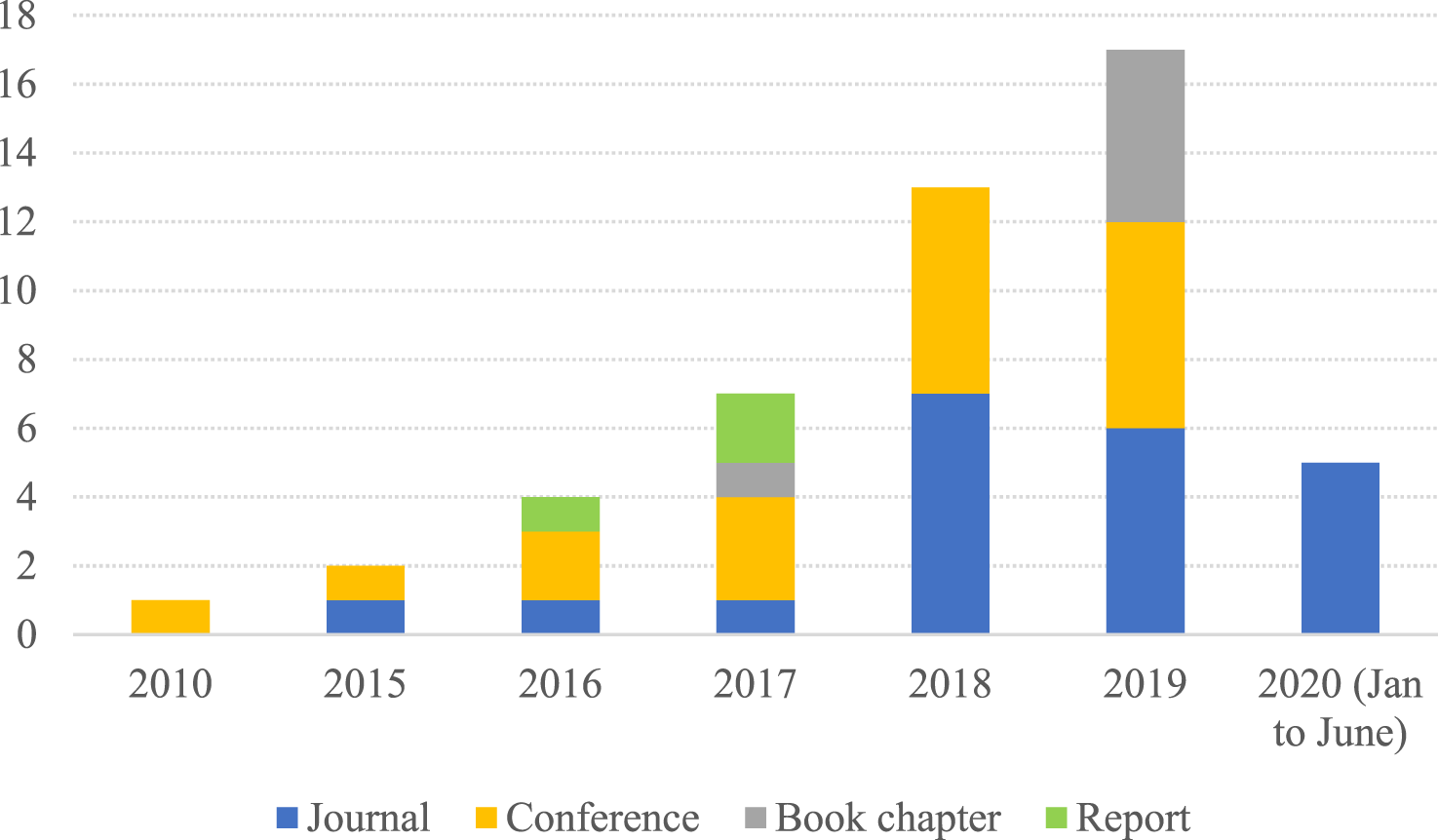
Previous conceptualizations of the IoToys
Among the studies, 63.3% proposed their own interpretation of the IoToys (N = 31), while 36.7% cited or synthesized other people’s conceptualizations (N = 18) (see https://bit.ly/2RxsFxq). Except that two citations could not be traced, all the other original sources of the cited conceptualizations were included in this review.
Characteristics of the IoToys
Characteristics of the IoToys identified in previous conceptualizations.
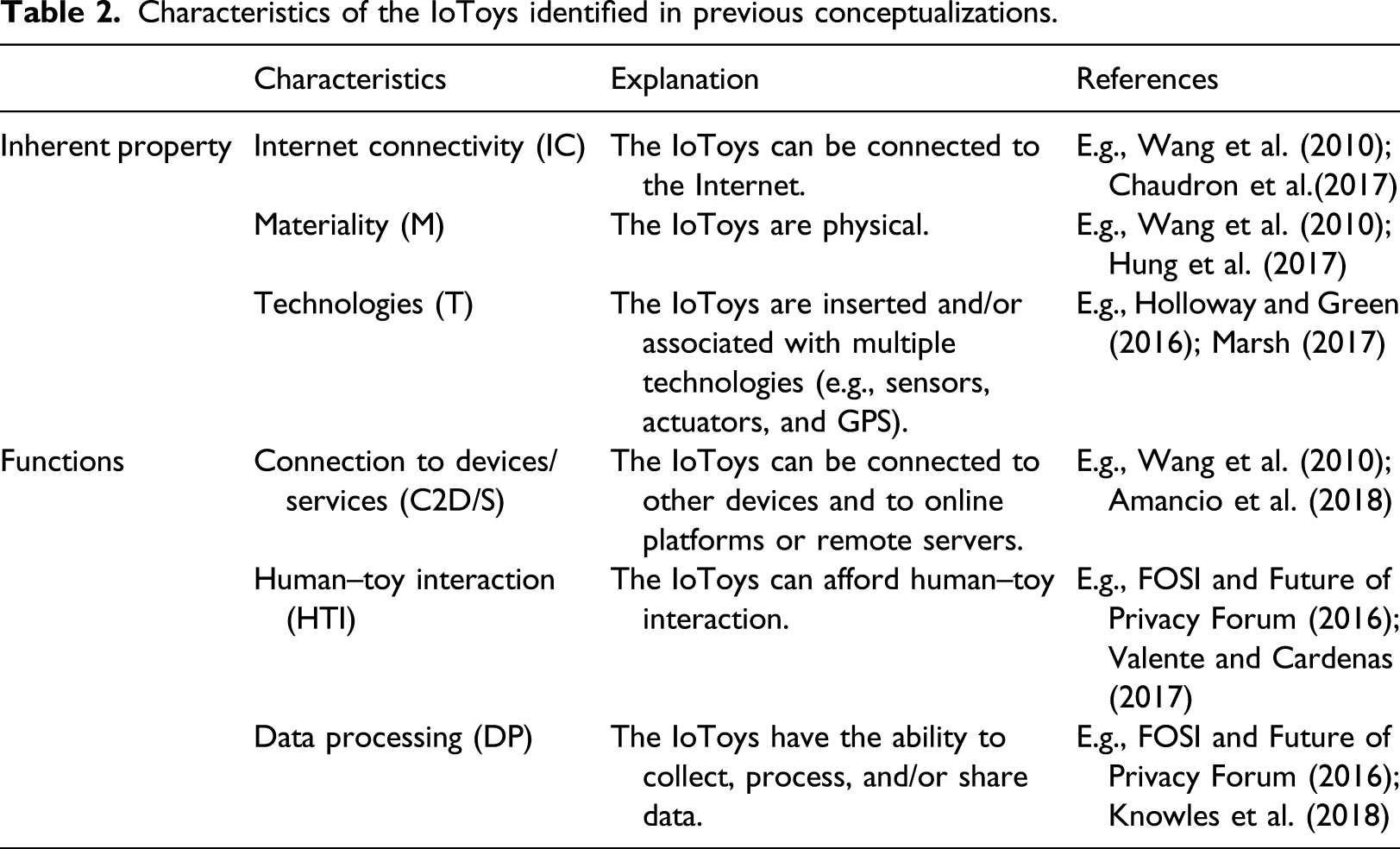
According to these previous conceptualizations, the IoToys have three inherent properties, which are Internet connectivity, materiality, and technologies. Because of these inherent properties, the IoToys are able to afford three kinds of functions, including connection to other devices/services, human–toy interaction, and data processing.
Evolvement of the conceptualizations
Characteristics of the IoToys identified in each conceptualization.
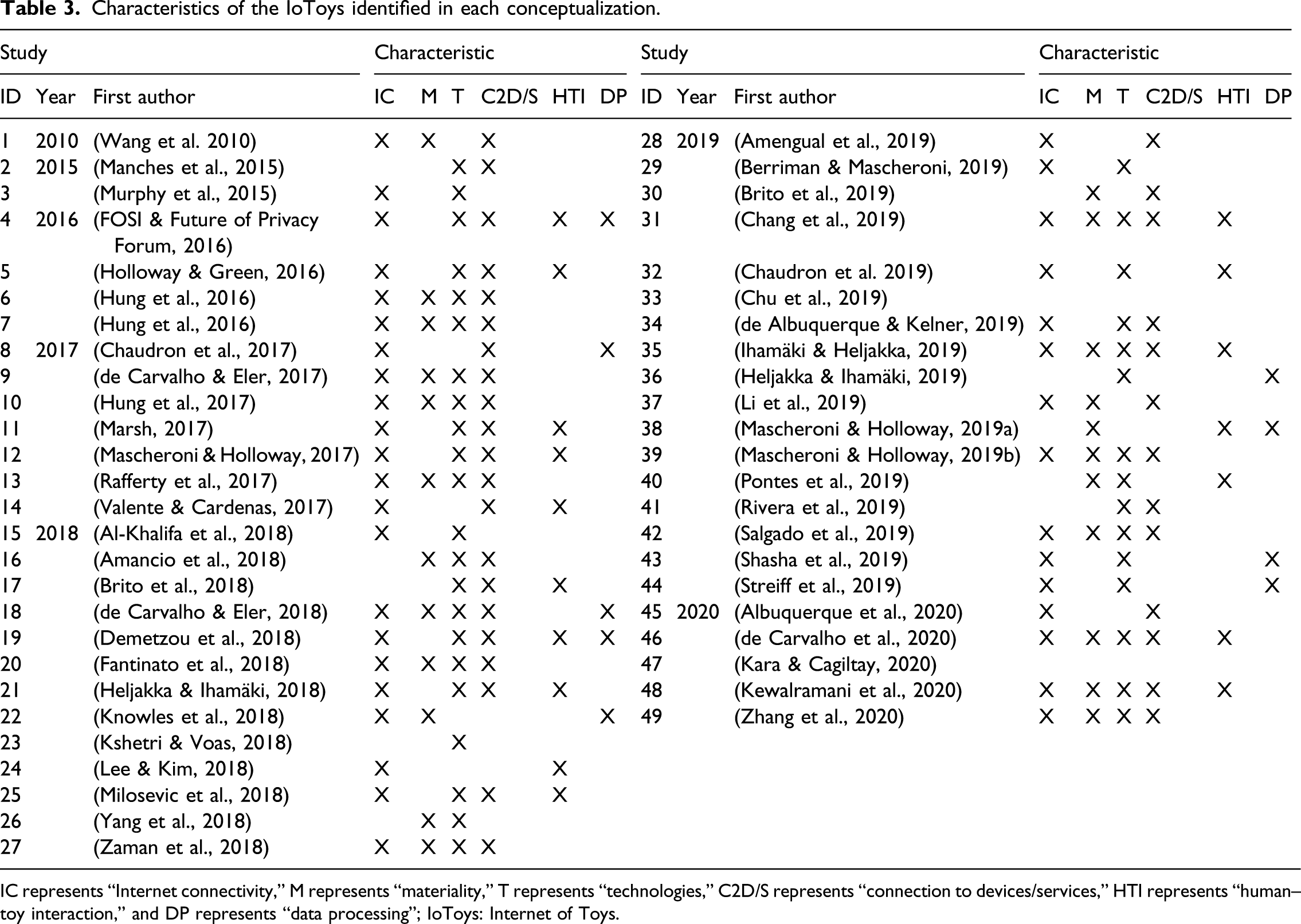
IC represents “Internet connectivity,” M represents “materiality,” T represents “technologies,” C2D/S represents “connection to devices/services,” HTI represents “human–toy interaction,” and DP represents “data processing”; IoToys: Internet of Toys.
From Table 3, we can see that since 2010, the conceptualization of the IoToys has been developed by many researchers. Initially, Wang et al.’s (2010) conceptualization laid the foundation for the IoToys to be regarded as physical products which can be connected to the Internet, so as to obtain various services.
In 2015 and 2016, researchers started to add in explanations about other characteristics of the IoToys. For instance, the toys are usually embedded with multiple technologies (Hung et al., 2016), can afford novel human–toy interactions (Holloway & Green, 2016), and can “collect, use and share data” (FOSI & Future of Privacy Forum, 2016).
In fact, the year of 2016 can be regarded as a milestone in terms of thinking about the IoToys’ conceptualization development. Holloway and Green (2016) proposed a popular and influential conceptualization in that year. According to them: The Internet of Toys refers to a future where toys not only relate one-on-one to children but are wirelessly connected to other toys and/or database data…Such toys include: Hello Barbie and Smart Toy Bear, which use voice and/or image recognition, connecting to the cloud to analyse, process, and respond to children’s conversations and images. (Holloway & Green, 2016, p. 1)
They were thinking beyond the then present about how the IoToys might be conceived and what characteristics they could have.
In the same year, FOSI and Future of Privacy Forum’s (2016) report not only started to draw people’s attention to the IoToys’ capacity to collect and share data but also tried to differentiate smart toys, connected toys (IoToys) and connected smart toys (smart IoToys) for the first time in the literature. They argued that The distinction between smart toys and connected toys is important: a toy can be very smart, but not connected (e.g. a self-contained interactive action figure), and a connected toy can be either smart or not smart. (FOSI & Future of Privacy Forum, 2016, p. 2)
Post 2016, very few new interpretation of the IoToys emerged. In 2019, Chaudron et al. (2019) extended the classification of what constituted the IoToys. They said, By IoToys, we mean not only Internet-connected toys, but any Internet-connected device that interacts with children, such as puericulture and monitoring devices. (p. 224)
Their attempt to clarify what modern devices might be included into the IoToys was meaningful, but they seemed to indicate that anything that could interact with children were toys, which may arouse questioning.
The missing part in the previous conceptulizations
Baras and Brito (2018) offered a summary of several widely acknowledged features of any IoT devices. According to them, the IoT is a network of objects, which have (1) unique identification, (2) ability to “capture the context (sensors),” (3) Internet connectivity, (4) ability to “transmit and/or receive data,” and (5) little need for direct human intervention in terms of the aforementioned context capture and data transmission.
By comparison, we found that the six features of the IoToys ( Tables 2 and 3) could all be regarded as features of any other IoT devices, except that “human–toy interaction” (Holloway & Green, 2016) is a specific feature of smart toys (Bouck et al., 2017). Meanwhile, two commonly recognized features of the IoT devices were not included in the previous conceptualizations of the IoToys. These two features are unique identification and minimal need for human intervention in capturing and transmitting data. Thus, we concluded that the previous researchers tried, to varied extents, to explain the features that the IoT (technology) could bring to the IoToys.
However, the systematic review revealed that none of the sources included a clear definition of the term “toys.” Instead, most researchers seemed to regard “toys” as something that was already understood. For example, it was stressed in many studies that the IoToys were traditional toys with enhanced or extended functionality because of the new technologies (e.g., de Albuquerque & Kelner, 2019; de Carvalho et al., 2020; Li et al., 2019; Salgado et al., 2019; Zhang et al., 2020). No illustration was made about what “traditional toys” referred to. Chaudron et al. (2019) did not explain the term, toys, either, but they proposed to include all the IoT devices that enabled interactions with children into the family of IoToys.
Overall, the previous conceptualizations of the IoToys have been technology-oriented, with the main features of the IoToys illustrated being the features of IoT devices. No explanation of “toys” has been offered, although “toys” is the main component of the IoToys concept. This lack of clarity concerning what toys mean could potentially lead to more confusion even when the technical features of the IoToys are carefully examined. Thus, in seeking a new conceptualization, we thought it was relevant to clarify what constitutes a toy.
Discussion
Conceptualization of toys
Toys and toy products
When the term toys is applied, it is normally associated with products designed and manufactured to function primarily for play (Kudrowitz & Wallace, 2010). However, toys and toy products are different things (Kudrowitz, 2014).
Toys existed before the prevalence of industrial machines and modern tools (Gröber, 1932; Neuschütz, 2013; Sutton-Smith, 1986). Historically, children used natural items like fir-cones, pieces of wood, or stones for play (Gröber, 1932; Neuschütz, 2013). These natural objects were not “produced” to be toys, but when they were played with by children, they functioned as the children’s toys.
Apart from these toys obtained from nature, children were playing with various kinds of products which were not originally designed to be playthings. For example, the wooden statues carved for sacred purposes by Cadaveo South American Indians were sometimes played with by children (Lévi-Strauss, 1963). When the sacred statues were played with, they became toys. This trend continues throughout history. More recently, evidence has been found that children actually converted computers into toys, despite the “seriousness of parental plans” at home and the aim of using computers for academic learning at school (Seiter, 2004). Therefore, the conceptualization of toys should not be limited to those products designed for play.
A toy is in the mind of the user
Definitions of “toy” can be found in authoritative dictionaries and encyclopedias. According to Oxford English Dictionary (Oxford University Press, n.d.), a toy is “a material object for children or others to play with (often an imitation of some familiar object); a plaything; also, something contrived for amusement rather than for practical use.” In The SAGE Encyclopedia of Out-of-School Learning, Hassinger-Das et al. (2017) define that: “Any item that can be used for play may be considered a toy, including formal toys that are manufactured as dolls, or blocks, as well as everyday items that children transform into informal toys, such as a cardboard box used as a dollhouse.” These definitions unveil a significant point about toys, which is that any object used by people to play with can be called a toy, just as Kudrowitz and Wallace (2010) wrote, “a toy is in the mind of the user” (p. 4).
Levinovitz (2017) further explained how toy-play occurred as an interaction between the object, subject, and context. After reviewing the previous works on toy-play, Levinovitz (2017) found that although many scholars did not offer a clear definition of “toy,” they seemed to intentionally, or unintentionally, indicate that to become a toy depended greatly on the subject (player) and context. Based on the speech act theory, Levinovitz (2017) proposed: “An object is only a toy in virtue of its relationship with a player in a particular context” (p. 278). Specifically, an item may send out “an invitation to play with its identity” (Levinovitz, 2017, p. 271) to its potential player and the person may recognize the invitation and choose whether to play with this item. If he/she plays with it, the item becomes a toy in that context. Thus, in this article, we adopted the conceptualization of toys as any objects that are being used by people for play.
Conceptualization of the IoToys
After analyzing the previous definitions of the IoToys, we believe that it is necessary to include an explanation of what constitutes a toy in any conceptualization of the IoToys. Additionally, since the IoToys is a subset of the IoT devices, they should also be uniquely identifiable and require minimum human intervention in capturing and transmitting data (Baras and Brito, 2018). Therefore, an explanation about what toys mean together with these two features are added to form a new conceptualization of the IoToys, which is The Internet of Toys are any Internet-enabled objects that are being used by children and/or adults for play. These playthings have sensors and are equipped with other technologies of varied sophistication. Connected to the Internet, they are uniquely identifiable and can capture, receive and exchange information with little need of direct human intervention, so they have the ability to ‘communicate’ with other Internet-enabled devices and/or services.
This conceptualization emphasizes two major criteria for readers to consider whether an object can be included in the IoToys. First, if an item is to be included in the IoT devices and secondly, if the object is also used for play. When an IoT product with Internet connection is played by someone, despite its design purpose, it becomes a member of the subset of the IoToys.
Returning to the classification issue raised in the Introduction, we can now see that although smart toys, social robots, and the IoToys are not synonymous, when smart toys and social robots are connected to the Internet and are played with by users, they become the IoToys.
In everyday life, an increasing number of smart devices can be connected to the Internet to gain more capacity, such as smart phones, smart watches, and smart speakers. According to the conceptualization proposed here, these devices may be regarded as belonging to the IoToys if they act as playthings. Meanwhile, with the rapid escalation of technological developments, many unexpected hybrid products with greater degrees of sophistication will be produced in the future. As long as these products can be deemed as the IoT devices, they can also be called the IoToys when used for play.
Conclusion
Here, we present a conceptualization of the IoToys, which sets clear criteria for future researchers to ascertain when and how a multifunctional modern device may be regarded as belonging to the IoToys. This conceptualization is grounded in a systematic review of the literature pertaining to the IoToys over the past 20 years. It was found that previous definitions attempted to characterize the IoToys as part of the IoT devices but did not distinguish them specifically as toys.
The new conceptualization presented is not only inclusive of the common features of the IoT devices but also clarifies what toys are. In doing so, it lays the foundation for future researchers to conduct related studies with a unified category and indicates that future research on the IoToys may not just focus on products manufactured to be toys, but can include more everyday IoT devices which children play with. These might include smart phones, tablets, and smart watches since, when these IoT devices are used for play, they meet the criteria for becoming the IoToys. Besides, as the IoToys can be played with by people from different age groups, not just by young children, it would be meaningful for researchers to investigate teenagers’ and adults’ IoToys usage as well.
Footnotes
Declaration of conflicting interests
The author(s) declared no potential conflicts of interest with respect to the research, authorship, and/or publication of this article.
Funding
The author(s) received no financial support for the research, authorship, and/or publication of this article.
Ethical Approval
This article adopts a review approach to gather all the previous conceptualizations of the IoToys, so it requires no primary data collection and no ethics approval is needed.
