







Abstract
The Victorian Government has engaged in multiple reforms in early childhood education and care, marketed to support quality education and increase investment in social reform. Initiatives accompanying reforms, aiming to assist teacher knowledge and skills. However, with each new initiative more pressures are placed on early childhood professionals. Throughout 2021 and 2022, a group of early childhood teachers employed in kindergartens across Melbourne participated in focus groups and interviews, sharing experiences of working with these initiatives and providing recommendations for their roll out. The Capability Approach has been used to analyse their experiences and recommendations to identify how teacher's agency was enabled and constrained. We identified three key recommendations for Governments to consider during current and future early childhood reforms to support an agentic profession. Specifically, focused support for teachers, an urgent need for increased consultation with the EC community and new opportunities for career progression were identified.
Keywords
Introduction
The role of an ECT is diverse requiring them to support children’s learning and development through assessment, planning and teaching, building partnerships with families, and connecting with the local community (Molla & Nolan, 2020). This involves a wide range of administrative, leadership and professional learning tasks undertaken by a single person. Comparatively, in school settings these same responsibilities are typically undertaken by multiple roles comprising of teachers and leaders. Adding to their workloads, ECTs may be the Nominated Supervisor in their service having increased day-to-day responsibility overseeing child safety, security, meals, staffing and medication (ACECQA, n.d.a). They will also often be the educational leader, having responsibility for “inspiring, motivating, affirming and also challenging or extending the practice and pedagogy of educators” (ACECQA, n.d.b).
In the state of Victoria, where this study is located, ECTs have experienced a significant level of policy reform over the past decade including, but not limited to free 3-year-old and 4-year-old kindergarten (Andrews, 2022), school readiness funding (DET, 2022a) and more recently, a transition from 4-year-old kindergarten to pre-prep (Andrews, 2022). Alongside the expansion of the Best Start, Best Life (Andrews, 2022) policy reforms, there have been initiatives introduced to support ECTs and children, carrying a significant financial investment. For example, Kindergarten Inclusion Support [KIS] (DET, 2022b), provides eligible EC services with funding to ‘enable greater inclusion of children with a disability, developmental delay or complex medical needs’. Most recently, an Early Years Assessment and Learning tool is being rolled out across the state aiming to strengthen quality practices and is described as enabling ECTs to ‘make consistent observations and assessments of children’s learning, helping with planning and delivering quality kindergarten programs’ (DET, 2022c).
Reforms, initiatives and administrative burdens
The reforms and initiatives are focused on supporting all children to learn and thrive, giving every child the best start in life (Andrews, 2022). However, the administrative burdens associated with accessing government initiatives have been described as outweighing the funding benefit associated with them (ACECQA, 2019). The multitude of responsibilities that teachers in standalone kindergartens enact can feel like they are taking on the role of everyone, from the equivalent of a school principal to the cleaner (Ciuciu, 2022). These increased responsibilities and pressures of unpaid work have been created by ongoing regulatory burdens, limiting the professional autonomy of teachers (Fenech, et al., 2022).
Administrative burdens have long been identified as placing pressure on EC professionals (Irvine et al., 2016; Jovanovic, 2013; Logan & Sumsion, 2010). Irvine et al.’s (2016) study found the most common complaint from EC professionals was related to the overwhelm they experienced with administration and paperwork pressures, including curriculum documentation. Paperwork was seen by professionals as undermining rather than supporting them in their work (Irvine et al., 2016; Storer, 2022). ECTs describe significant burdens of administrative work, which often take place outside of their working hours, impacting their job satisfaction (Ciuciu, 2022; Jovanovic, 2013). Inadequate time allocations for administrative tasks also restrict their ability to teach children (Ciuciu, 2022), with ECTs interpreting an array of forms and paperwork requirements being represented as a measure of accountability (Logan & Sumsion, 2010).
Professional value
Reports and research studies have shown that EC professional in Australia feel undervalued as reflected in their salary, conditions and community perceptions of their work (ACECQA, 2021; Irvine et al., 2016; Social Research Centre, 2022). This perception has been identified as one of the factors driving ECT attrition, but also a potential area where change could improve retention. ECTs can experience undervaluing of their specific professional role when ‘top down’ performative policy implementation does not involve consultation and allow for professional autonomy (Ciuciu, 2022; Fenech et al., 2022). ECT are key players in achieving policy reform outcomes. Accordingly, successful policy implementation requires that their professional perspectives, values and contexts for practice are taken into account (Day & Gu 2007; Molla & Nolan 2020; Nolan & Molla, 2021; Oosterhoft et al., 2020).
Oosterhof et al. (2020) describe how professionalism can be imposed on teachers from ‘above’ and involve performance, accountability and regulation. Alternatively, professionalism that comes from ‘within’ is produced in the workplace between colleagues and leaders, involving ‘collegial, cooperative relationships and competences that are to be guaranteed by education and training’ (p. 140). This sort of professionalism also includes values and ethics of care, professional judgements that Biesta (2007) sees as moral as much as technical, and integral to teachers’ sense of professional identity. There is a strong theme in literature on the importance of professional autonomy and a teachers’ sense of competence, and recognition of that competence, for teacher wellbeing (Fenech et al., 2022; Jeon et al., 2018). Where policies are externally imposed on a teaching workforce without consultation and/or accounting for professional values, ethics and working contexts, there is likely to be stress, tensions, and undermining of teachers’ sense of autonomy and self-esteem. These in turn can negatively affect teachers’ commitment to the profession and their role in EC (Day & Gu 2007). Ensuring there are opportunities for consultation with EC professionals can lead to the development of more refined ideas and actions when introducing new initiatives. Involving stakeholders can help support informed engagement with the EC profession and wider community (Miller, 2015).
Theoretical framework: The capability approach
The Capability Approach (Sen, 1993, 1999) evaluates the social arrangements that enable individuals to pursue and achieve outcomes that they regard as important, and which reflect their values (Sen, 1999). Capabilities are enabled when there are “freedoms for people to be able to make decisions they value and work to remove obstacles to those freedoms” (Walker & Unterhalter, 2007, p. 2). For ECTs, freedom is afforded by professional agency, which involves the “active contribution to shaping their work and its conditions – for the overall quality of education” (Biesta, et al., 2015, p. 624). For ECTs, having professional agency is imperative for the achievement of their valued outcomes (Molla & Nolan, 2020) and workforce retention (Ciuciu, 2022).
The Capability Approach conceptualises achievement of outcomes as functionings (Sen, 1993). A study conducted by Molla and Nolan (2020) found there to be five functionings imperative to the professional values of 10 ECTs working in Victoria, enabling their capabilities to best support children’s learning. In a later paper they state: agentic teachers who can support improved student learning outcomes are those who actively seek learning opportunities, think effortfully about their beliefs and assumptions, demand to be valued and respected for their professional work, are committed to addressing educational disadvantages and injustice, and act ethically, making morally justifiable decisions. (Nolan & Molla, 2021, p.460-461)
Functionings can be individual or shared, but to be achieved ECTs require opportunity to enact their agency (Walker & Unterhalter, 2007). Importantly, it is the opportunity and potential to be agentic that is examined by the capability approach, not whether or not functionings are achieved. Agency can be both enabled and constrained by political, cultural, social, material and physical arrangements (Biesta et al., 2015; Molla & Nolan, 2020; Sen, 1993). For example, in Ciuciu’s (2022) study of four former ECTs, agency was found to be both enabled and constrained by relationships with colleagues and leadership, policies and processes enforced by management, and working conditions. Agency can also be constrained by physical resources and individual knowledge or skills (Walker & Unterhalter, 2007).
In this paper, the capability approach is used to examine the experiences and recommendations of early childhood teachers working in centre-based education and care during an ongoing early childhood reform in Victoria, Australia. The research questions guiding the study are: Question 1: What are Victorian early childhood teachers experiences of working in early childhood education during a reform, and what recommendations do they have to strengthen their capabilities to provide education and care during this time? Question 2: How are Victorian early childhood teachers’ agency enabled and constrained during the planning and implementation of statewide reform?
Methodology
The research study was initiated as part of a multi-iteration project titled Early Childhood Professional Practice Partnerships (EC PPP), funded by Victoria’s Department of Education and Training [DET]. This project has run six iterations between 2019 and 2023. It focusses on encouraging more pre-service teachers into the EC workforce by strengthening professional placement experiences with 3-5-year-old children for both pre-service teachers [PSTs] and their early childhood mentor teachers (ECTs). Placements were from one of the following four EC degrees: undergraduate ECE, undergraduate ECE/Primary, and a Master of Teaching ECE or Master of Teaching ECE/Primary. The EC PPP project uses the Research by Design methodology (Cotton et al., 2009). Research by Design provides opportunities for research projects to ‘address educational practice in naturalistic contexts’ rather than just collecting data that is disconnected from the context it relates to (Plomp, 2013, p. 1112). Research by Design is an iterative methodology that provided this research with a ‘clear fitness for purpose’ (Cohen et al., 2011, p. 115) as was required for the ongoing long-term EC PPP project. This project is continually adjusted and responsive to the needs of participants by asking for feedback during and after each iteration, each iteration was adjusted based on participant feedback. Each phase, connected and aligned with professional placements in early childhood degrees are known as ‘iterations’ and therefore, numbered accordingly. Research by Design was chosen for this project as it provides affords researchers with opportunities to design meaningful interventions that advance and extend knowledge, and the ability to work through solutions to complex problems in education (Plomp, 2013).
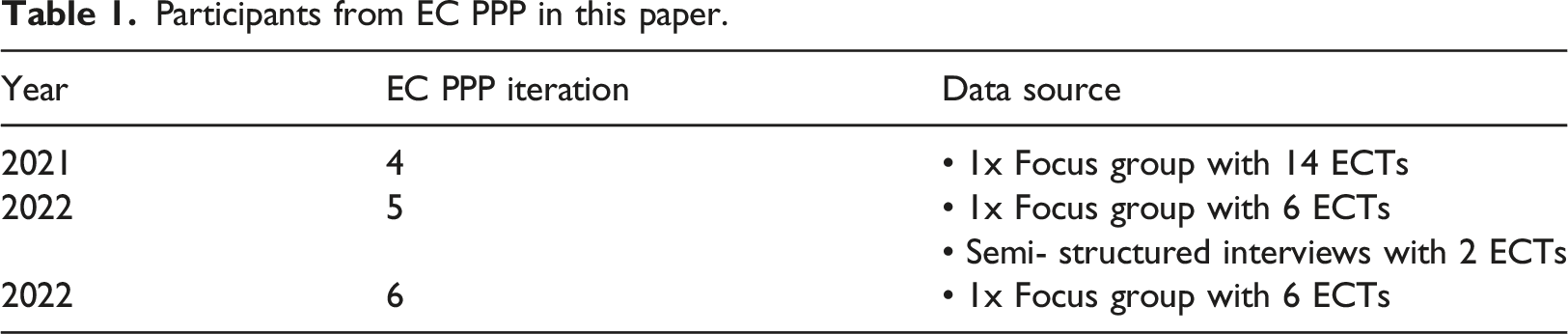
As part of the EC PPP project, ECTs and PSTs participated in separate focus groups so that they could connect with their peers and community during the blocks of professional placement. If needed, ECTs and PSTs could feel comfortable raising issues about the placement. The focus groups were up to 1-h in length and were audio recorded with consent. The project has approval from Deakin University’s Human Research Ethics Committee: Project No.: HAE-19–128. This paper reports on data collected with ECTs during a series of audio-recorded focus groups, held at the beginning of each iteration of the project and a series of individual audio-recorded semi-structured interviews held in 2021 with ECTs following the conclusion of the placement.
Participants
Participants from EC PPP in this paper.
Data generation and analysis
After each iteration data was generated through audio interviews and focus groups and transcribed, the authors engaged as a collective group in a process of deductive thematic analysis. Deductive concepts taken into the data analysis process and applied to all data were the EC PPP project outcomes set by DET. This included any dialogue relating to EC careers; placement experiences; mentoring relationships; partnerships between the supporting University and EC services; quality of EC; and initial teacher education for ECTs were examined by the research team. While examining data related to project outcomes a series of notations were made and refined into extended categories to extend understandings within the data. Through a process of summarising key ideas that participants expressed in the data, a series of themes were identified from comments in individual interviews and focus groups. This included recurring findings related to a range of workforce pressures that were addressed by ECTs over several iterations of the project. However, we noted, as the iterations progressed workforce challenges dominated discussions when ECTs met together either in person or over zoom. The pressures ECTs described are subsequently addressed with evidence provided through data below.
Findings
Teachers are experiencing increased administrative burdens
ECTs reflected that during Melbourne’s COVID lockdowns (2020 – 2021), paperwork requirements were reduced to help them focus on supporting children and families through this difficult time. However, their administration pressures had returned with a vengeance once the lockdowns ended: We were treated really gently last year [2020 COVID lockdowns] ... but coming back in term four it has skyrocketed.... the workload keeps on increasing day-by-day... I work double my hours unpaid. (Focus Group, 2021)
Not only had administration pressures of completing extensive paperwork, often after hours, increased, but teachers noticed a significant increase in numbers of children with disability and support needs. We feel like a sudden workload is hanging on our head all the time. I have noticed with COVID… many children have gone through the stress and mental stuff at home. We have increased the number of children with additional needs and support. (Focus Group, October 2022)
Many teachers commented on the delays for children and families in obtaining referrals for intervention services due to COVID lockdowns. One teacher shared her concern at the significant delays for children and families needing these services in 2022: Because of COVID, children weren’t seeing paediatricians or [having] their maternal health checks. Trying to get support for these kids now, they’re all still on waiting lists. (Focus Group, October 2022)
She shared her feelings of stress when contacting a family services support community organisation, but she was turned away. The burden this teacher shared in the focus group weighed heavily on her, placing undue stress on her role as a teacher: I tried to call Child First the other day to refer a family and they said to call back in two weeks because they’re too busy, so that adds to my stress when I’ve gone home because I’m thinking, ‘They need support. What if she does something to herself tonight? I’ve literally done nothing to support her.’ (Focus Group, October 2022)
Keeping on top of documenting children’s learning was also impacted by the extensive paperwork required for the range of allied health specialists that children in kindergarten required: Any child that might be going to a specialist school, they have their own reports. I have speechies and occupational therapists coming in pretty much every week. They ask for reports and notes from me. It all comes out of your planning, and then KIS applications, they take ages at the start of the year. (Focus Group, October 2022)
Adding to their large administrative workloads, has been new requirements associated with the roll out of new Government initiatives. ECTs share their experience of having the time doing what they love, ‘supporting children learning and working with families’, reduced in order to meet increasing administrative requirements: They keep bringing all of these initiatives in, which then just puts another layer on. A lot of people are feeling that the focus is more on the admin than on the children. What’s valued more? What do they want from us? How far can we stretch our time and stretch our mindsets, and keep doing what we love to do?... While some of the initiatives are great, they can also be very time consuming... that’s playing a lot on retention as well. (Interview, 2022) I appreciate the School Readiness Funding (SRF), and it is keeping us up to date, it is fantastic, but it comes with a lot of paperwork. It’s not only that, child safe standard training is another layer, all these wonderful things, but no time… SRF funding, MARAM [Multi-Agency Risk Assessment and Management] training. They are all important, but there’s no time added… within working hours. (Interview, 2022) My percentage of actual time teaching children is the tip of the iceberg. The rest is dealing with all the other stuff. When children are there for 5½-hours I start work at 8:00am, children come at 8:30am and they’ll leave at 2 or 2:30pm. Most days I would leave there [at] 7/7:30pm (Focus Group, December 2022)
All of the ‘other stuff’ that the teachers described often referred filling in extensive paperwork to obtain and maintain funding in the kindergarten, which had become a regular part of their work, requiring additional time in out of work hours.
ECTs needed more support for administration requirements
ECTs shared their concerns about the lack of support they were experiencing to work with children and families despite the multitude of initiatives being introduced by the state government. There’s all this push for getting children into kinder, which is fantastic, but if we don’t have these resources, they’re setting us up for failure. (Focus Group, October 2022)
In a focus group ECTs collectively discussed the challenges related to completing extensive paperwork for children’s Transition Learning and Development Statement (DET, 2022d) in order to maintain kindergarten funding. ECTs are provided with 15-min of time per child to complete these statements. However, the discussion between two ECTs below indicates this is not accurately representative of the time needed: There’s no time to write what you really want to write. One statement takes more than an hour, and then we get 15 minutes… I’m sorry, that’s way too [little]. Not even 50%. (Focus Group, October 2022)
Another ECT acknowledged that ‘it’s not appropriate, but there is some sort of recognition for it.’ They instead queried the lack of time and support provided for completing KIS applications, which they perceived as being ‘way more important’. This led to a vigorous discussion in the focus group about their collective challenges with finding time to compete KIS applications in their paid work hours: They take forever. It is no less than two hours [to complete a KIS application] …. It should be part of the funding. For each application you put in; you [should] get two hours. They take time, and you want to do it properly, but I felt like mine was really rushed last time, and I felt [dis]pleased with what it looked like in the end. (Focus Group, October 2022)
Other ECTs shared their frustration for the stringent criteria for obtaining KIS funding, with all ECTs sharing that most of their KIS funding applications were rejected. I think the criteria should be changed… we do all paperwork, I understand the job responsibilities, but they can’t understand the risk hazards in the room. I think they should do some visits, to see the severity of the child, because sometimes the children who really need it, they miss out. (Focus Group, October 2022)
When asked for suggestions of ways to provide more support for ECTs one ECT recommended the provision of extra hours in order to complete the multitude of forms that are requested: Additional hours for doing forms… would be good. Specific forms, not just any old forms, not just whatever, but specific if you’re doing a Vineland [Vineland Adaptive Behavior Scales], if you’re doing KIS, if you’re doing specialist reports for specialist schools. (Interview, 2022).
ECTs made comparisons with the support provided in schools
While the pressure of paperwork is well-known to the role of the teacher across all levels of education, the ECTs discussed the support afforded to teachers in schools in comparison to teachers in EC services. At school you’ve got people who will support you in different areas as a teacher whereas if you go into a kindergarten you’re it for that family. You might have the support of the leaders around you but it’s up to you. Whereas in a school often you can… refer that family on… there’s a vast difference. (Focus Group, 2021) The linking that we do [with] allied health professionals and the cohorts that we refer families and children on to… [whereas] in primary school there is a student welfare officer that gets shared with. I don’t think politically they [government] know the complexities of what we’re doing on a day-to-day basis. (Focus Group, 2021)
The sense of responsibility and associated workload for ECTs to build connections with allied health and a range of other education professionals was critiqued by these teachers. When asked for recommendations of how to support ECTs with their paperwork one ECT recommended an opportunity that schools regularly receive: Schools get curriculum days, so why [aren’t early childhood] teachers getting curriculum days to do extra?... They [could] provide more child-free days for us... once or twice a term, then we can focus on all the extra documentation that we are doing on top of teaching. (Interview, 2022)
ECTs want to be consulted with
ECTs perceived that their profession was undervalued both by policymakers and the community and reported on the low morale of teaching colleagues in the face of growing demands. In particular there is a growing anxiety about the pre-prep kindergarten reform announced mid-2022. ECTs described how a lack of information and consultation about the reforms are leading ECTs to consider leaving the profession: It’s great that they’ve got all these big plans for 5 years’ time... but I think they need to be looking after the educators they’ve got now because I feel like we are not feeling valued and respected, and we’re just getting more and more overwhelmed and more of us are going to want to leave, because we are not coping. (Focus Group, October 2022) I know we have one of our teachers currently looking into moving back to the primary school sector. Purely because of the upcoming 30-h and the uncertainty of not knowing how that’s going to look. (Interview, 2022)
The participants acknowledge the need for change and continuing improvement. Their dissatisfaction was stemming from what they saw as a lack of consultation and professional respect. Many of the changes and initiatives being implemented as part of the reforms represent impositions ‘from above’ focused on regulation and accountability, bringing uncertainty. The importance of informed advocacy in response to the new initiatives was shared by teachers: I suppose it’s staying strong to your values and staying strong to your pedagogy and practices. ... if we can’t advocate for ourselves, then nobody else will. (Interview, 2022) I think they’re going to have to make sure that they get informed or get the right people to let them know how it’s going to work. I don’t want people deciding who have no idea about this type of important thing. (Interview, 2022)
Their concerns represent a perceived tension arising between their own professional experience, expertise and values, and the implementation of the new initiatives: Having all these hours for children, the three-year-olds didn’t cope with 5 hour [sessions]… Knowing where the future’s going, it puts me off because I’ve been there. I know that its most likely not going to work. (Focus Group, October 2022)
ECTs were surprised about some of the initiatives, noting they were not what they needed. For example, they took professional offence at the introduction of a new Early Years Learning and Assessment Tool: You hear the government is implementing a new tool for observing children and you think ‘get stuffed’, we don't need a tool for that, we're doing that every day of our lives. (Focus Group, December 2022)
Teachers want more opportunities to work in leadership roles
ECTs shared their experience of having a lack of career progression into leadership roles. Opportunities to progress into the role of educational leader or nominated supervisor at their individual services were acknowledged as being a positive option for early or mid-career teachers ‘anyone was looking for the responsibility’. However, for many of the participating ECTs, they are already working in these roles and now had a sense of ‘deflation of where to go to next’. Such deflation was collectively viewed to affect motivation and professional identity: I am educational leader, and that’s where I stop. When progression stops, that’s where motivation stops, and passion goes away. (Interview, 2022) Other professions have a progression. We just stay where we are…. to keep people motivated there should be a progression. (Interview, 2022) There has to be a hierarchy system… so you can say “Oh, yes, I have achieved this, and I will strive for that now” … It’s not about the money, it’s about the titles and the respect that comes along with that title. (Interview, 2022)
Some ECTs shared their disillusionment when talking about the opportunities that employers and providers of further education suggest there is for career progression, compared with the reality of what is available and the support that is provided for those roles: We can have conversations, and set appraisals, and ask to pursue particular things, and have opportunities to go to professional development to meet those. But ultimately, are we just ticking a box? Are we just getting a certificate on paper? (Interview, 2022) Even with further education you can do your master’s, but, where is that career path? Primary is more clearcut… [with] a whole road to leadership, moving up into principal, assistant principals… we don’t have that. (Interview, 2022) If I’m going to be encouraged to pursue those particular things (leadership roles)… Am I going to get time? Sometimes they dangle the time card, often it’s not followed through. (Interview, 2022)
There was a wide consensus that more roles in leadership need to be created because ‘there’s so many of us and less leadership positions up there’. One teacher recommended: Every teacher has acquired a skill that will benefit other teachers. So, use that. Create pedagogical excellence... I could lead quality improvement plans. There could be a leader in nature pedagogy or leading sustainable practice... somebody is just in charge... leading a few kinders or teachers... reducing the workload of every teacher. (Interview, 2022)
Discussion
The findings of this study suggest that in regard to current reforms, the agency of ECTs is not being enabled at this stage of the reform process. ECTs were unclear about what the reforms involved and were yet to be convinced of their value. The interviews also identified several of what Pendergast et al. (2005) call inhibitors of successful policy reforms. These included perceptions of a lack of appropriate support and insufficient funding for implementation of the reforms, leading to a feeling of being overburdened and resistant. Teachers perceived a lack of consultation and feeling that their professional capability and agency was being undervalued (Molla & Nolan 2020; Sen, 1993, 1999). Not only can these perceptions inhibit successful policy reform, the sense of being overburdened and professionally undervalued have been identified as factors in EC workforce attrition (ACECQA, 2021; Irvine et al., 2016; Social Research Centre, 2022).
In applying Molla and Nolan’s (2020) facets of professional agency, it is evident that the ECTs in this study were being constrained in their capability to practice responsive agency. This is associated with their capability to be a change agent and ‘respond creatively and knowledgeable to situated and emergent problems’ (p. 76). Participants felt unprepared to be responsive to the current reforms because they were not being included in discussions about the reform aims and process (Sen, 1999). Garvis et al. (2012) asserts the importance of effective dissemination of information during policy reform to support understanding of policy aims and ‘the implications for changes to their thinking, language and practices’ (p. 92). In their evaluation of the implementation of the VEYLDF, a major initiative in a previous early childhood reform, Garvis et al. found early consultation to be present, along with meetings allowing discussions with Government representatives and colleagues to be important steps in the reform process. To support the workforce to feel capable to respond to the policy reforms, it is recommended that urgent consultation occurs with stakeholders. Consultation during these early phases may take form in regular updates disseminated across the sector; the opportunity to provide feedback and engagement in professional discussions with Government representatives. Such public forums that enable ECTs to express what is valued to them is crucial to this group of participants and important for their capability to be agentic (Sen, 1999).
Being engaged in consultation about the reforms will also support ECTs to feel more valued in through the contribution of their professional expertise and experience. The data has highlighted that current policy reform practices are leaving ECTs feeling undervalued and not respected. Accordingly, their recognitive agency (Ciuciu, 2022; Molla & Nolan, 2020) is becoming constrained as they have been unable to see goals they value included in the initiative. As Storer (2022) states in her opinion piece noted: ‘the various levels of government keep asking us why we are leaving. We tell them and they ignore us....I scream in frustration at each new “initiative”....No, I don’t want a “tool” for observation and assessment. I want you to fix the funding system to get an extra person in the room to support a child who needs help.”
Storer’s frustrations reflect those of the study participants. The reforms are not seen as addressing the real issues that ECTs face in striving to achieve their professionally valued outcomes, outcomes that they see as leading to the quality desired by policymakers, practitioners and the community. Furthermore, resources provided were not seen as addressing their interests or needs. Notably, when ECTs feel their professional competencies are not recognised or respected, it can negatively affect their motivation to continue in the workforce, as their sense of individual freedom and achieving social development are interconnected (Sen, 1999). Providing opportunities for ECTs to provide feedback and see that their expertise and voice is being heard may strengthen their feeling of professional recognition, improve capability to engage creatively and critically with policies, and boost motivation (Molla & Nolan, 2020; Oosterhoff et al., 2020).
A further recommendation to strengthen recognitive agency is to review the current structure of leadership roles within the sector to enable more opportunities for senior ECTs to share their specialist knowledge and skills. It was of great concern to participants in this study that they had already reached the pinnacle of their careers and could not see any further room for future growth as a professional. New opportunities for professional growth would enable ECTs to be able to set and pursue new goals and challenges they value (Molla & Nolan, 2020; Walker & Unterhalter, 2007), while also retaining them in the ECT workforce by strengthening motivation (Oosterhoff et al., 2020).
There are certainly opportunities for new leadership roles to be considered as the sense of burden and extra work associated with the policy reforms is currently constraining ECTs capability to be agentic. Whilst ECTs felt that policymakers did not recognise the unpaid work they already undertake, they also reported feeling debilitated in their capabilities to work with children and families in the ways they value. The uncertainty of the reforms and increased burdens of administration is constraining their ‘deliberative agency’ (Ciuciu, 2022; Molla & Nolan, 2020). This is their capability to ‘problematise attentively one’s own thoughts and practice’ to identify contradictions and inconsistencies and become adaptive professionals in the process of change (Molla & Nolan, 2020, p. 74). Currently, the ECTs are unable to be deliberative because they do not have the time to critically reflect on their practice and the implications of new initiatives. Accordingly, they are becoming resistant to the reforms as they interpret them as constraining practice rather than supporting it.
The extent of administrative work required to obtain extra support for the successful inclusion of children with disability was a particular source of stress and frustration. While all of the participants in this study were experienced in working with a broad range of children and families, they were concerned at the delays in receiving support from intervention specialists that work directly with families. Specifically, the administrative time required for funding applications was constraining their capability to support those very children. Furthermore, their applications were frequently not approved due to the availability of funds or assessment of detail provided in the form. Not only did this leave the teachers without support for these children and families, but their responsive agency (Molla & Nolan, 2020) was impacted. To reduce the burden of applying for funding for resources when there is no funding left, consideration needs to be given the transparency of the availability of the funds and resources. Furthermore, we echo the recommendation of teachers to have observational visits included in the application process.
To resolve some of these experiences with administration, ECTs made comparisons to school contexts, where greater support structures are put in place to support teachers, children and families. For example, a recommendation from ECTs was to establish part-time wellbeing officer roles to work with services to complete KIS fundings applications, conduct observations to assist in the assessment of those applications and provide mentoring to the ECTs. Such roles would create new part-time leadership pathways for ECTs that build their professional capabilities, while still maintaining their part-time teaching positions. A further recommendation of having curriculum days was suggested. The paperwork burdening ECTs requires the expertise they have as the teacher, through their pedagogical knowledge and personal relationship with the child and family. Accordingly, we echo this recommendation as one way to relieve ECTs burden and strengthen their recognitive agency.
Conclusion
This paper reported on the experiences of and recommendations from experienced ECTs during Victoria’s expansion of the Best Start, Best Life policy reform (Andrews 2022), comprising of multiple initiatives to increase quality and investment in social reform. While initiatives are aimed at supporting teacher knowledge and skills, participants of this study experienced higher levels of administrative burden and pressure. Using the capability approach (Sen, 1993, 1999), we examined how ECTs agency is being enabled and constrained during this time. We found that ECTs recognitive, responsive and deliberative agency (Molla & Nolan, 2020) was being constrained by current policy implementation practices, which poses risks for successful policy implementation. To relieve burden and support ECTs deliberative agency, we recommend the provision of curriculum days, as is provided to teachers in schools. Furthermore, ECTs agentic capabilities can be strengthened during policy expansion with increased and ongoing consultation through the EC community and development of new leadership opportunities enabling career progression that provides ECTs with focused support.
Footnotes
Declaration of conflicting interests
The author(s) declared no potential conflicts of interest with respect to the research, authorship, and/or publication of this article.
Funding
The author(s) disclosed receipt of the following financial support for the research, authorship, and/or publication of this article: This work was supported by the Department of Education and Training (RM42015).
