







Abstract
It has been well-established that highly gendered, early childhood education workforces face major temporal, material, physical and psychological barriers to being well. This issue is particularly pressing in this political moment: a national childcare policy program is being rolled out for the first time in Canadian history. It is in this context that we take a grounded theory methodological approach, rooted in feminist care ethics, to centre and analyse the voices of early childhood educators in both conceptualising well-being and identifying ideas and strategies for moving closer to it. We suggest that concurrently addressing the material and discussive value of early childhood educators is necessary to disrupt existing social structures that rely on early childhood educator’s exploitation. We conclude that truly dismantling what is and building a something better can only be done when early childhood educators’ voices and embodied experiences are centered in the decision-making process.
Introduction
It has been well-established that the highly gendered, early childhood education workforces face major temporal, material, physical and psychological barriers to being well (Cumming et al., 2020, 2021; Cumming & Wong, 2019; Wong et al., 2022). For decades, chronic workforce issues – low wages, poor benefits, high turnover rates, low staff morale, mounting paperwork – have made being an early childhood educator (ECE) an unsustainable (financially, physically and psychosocially) career (Association of Early Childhood Educators of Ontario, 2017; Boyd, 2013). At the same time, a plethora of bio/psycho/social “evidence” asserting the importance of children’s early experiences immediately and throughout the lifespan has driven a shift to the professionalisation of the early childhood workforce. The Ontario, Canada context is nationally and internationally unique in that ECEs have been legislatively recognised (through the establishment of a regulatory body) as a professional group since 2009.
Of urgent concern is the fact that the ECEs themselves - who care about, for and with children day in and day out – rarely have the opportunity to shape understandings of their own well-being and build on these understanding to shape public policy discourse and/or decision-making. In comprehensive reviews of ECE well-being literature, Hall-Kenyon et al. (2014) and Cumming (2017) illustrate a preference for survey, Likert-scale types of data collection to study ECE well-being. This approach embraces pre-conceived, researcher-driven ideas of what “well-being” means as well as how it can be measured. While such information is unquestionably helpful, it is limited in its ability to open space for ECEs to shape the conversation. While there has been a broadening of methodological approaches in studying ECE well-being in recent years (e.g.,Corr et al., 2014; Cumming, 2015; Jovanovic, 2012; Kilderry, 2015), narrative methods remain the minority. Grounded in feminist care ethics, this qualitative analysis centres the voices of ECEs in both conceptualising well-being and identifying ideas and strategies for improving it. This issue is particularly pressing as Canada is in the process of rolling out a multi-billion-dollar, national childcare system requiring the creation of more childcare spaces. As children, families, educators and researchers well know, the success of this system is entirely dependent on the recruitment and retention of qualified, decently remunerated and well ECEs.
Outline of paper
Bringing practical and/or policy attention to workforce issues has largely fallen to non-governmental organisations in Ontario, particularly since a Conservative government came into power in 2017. The paper will begin by reviewing the policy structure of ECE in Ontario and Canada. We will then take a closer look at the contrasting roles of the College of Early Childhood Educators (CECE) and the Association of Early Childhood Educators of Ontario (AECEO) and how these institutions engage with (or not) ECE well-being. From there we explore key concepts from contemporary feminist care ethics that has shaped our thinking (Kittay, 2015; Sevenhuijsen, 1998; Tronto, 2013). The findings section analyses and synthesises the thoughts, ideas and feelings ECEs expressed through an feminist care ethics lens. Finally, the discussion section brings these pieces together in light of existing ECE well-being literature, both cautioning and offering generative insights to understanding and ultimately improving ECE’s well-being.
ECE context in Ontario, Canada
Ontario is Canada’s most heavily populated province within a federation where early childhood education policy, programs and services (hereby referred to as ‘childcare’) fall under provincial jurisdiction. Each province receives a lump sum payment for all social and educational programs, some of which is allocated to childcare. A market-model dominates childcare provision across the country 1 which translates into high childcare fees for families and poor wages and working conditions for ECEs. Currently, middle-class families face significant barriers in finding and affording regulated childcare (Macdonald & Friendly, 2021) while the ECEs providing care rarely enjoy a middle-class lifestyle (especially outside of a partnership/marriage) (Association of Early Childhood Educators of Ontario, 2017).
It is important to point out that childcare in Canada officially falls within provincial jurisdiction making it “consistently inconsistent” (e.g., cost to parents, educator qualifications, government funding models, etc…) across the country (Richardson & Langford, 2018). The new national childcare program, branded by Trudeau’s current Liberal 2 (minority) government as “$10/day Child Care for Families”, is the first-time childcare policy has been successfully legislated at the national level. The plan is guided by a set of principles prioritising “high quality, accessible, affordable, flexible and inclusive” childcare (Employment and Social Development Canada, 2022). Bilateral agreements (outlining the parameters of funding) between the federal and provincial governments with all provinces were signed by March 2022. Ontario, with its Conservative 3 majority government, was the last province to sign on and arguably has the weakest agreement – particularly in relation to the ECE workforce.
The majority of provinces and territories committed to developing a comprehensive wage grid for ECEs in their respective agreements with the federal government; Ontario was not one of these provinces, instead implementing only small wage improvements for the lowest paid registered ECEs (RECEs). Beginning this year, the salary floor for ECEs has been increased to $18/hour and will continue to increase $1/hour until 2025. Additionally, all RECEs making under $25/hour will receive a $1/hour top up. The sector has widely criticized these wage top-ups as being too low and has been calling for a wage grid built on a foundation of at least $30/hour for all RECEs working in licensed childcare. The Ontario agreement also makes no commitments to health benefits (i.e., pharmacological and dental plans, physiotherapy, psychotherapy, chiropractic, etc…) or access to a pension plan. In other words, it is entirely possible that even with national childcare legislation and significantly more funding allocated to childcare, ECE workforce issues will remain unchanged. Given the inextricable connection between ECE well-being and decent work (OECD, 2020) and the unprecedented funding flowing to childcare in Canada at the moment, the stakes are high.
A perfect storm: Professionalization of ECEs without ECEs
It is perplexing that ECE’s voices have been and continue to be largely absent at the public policy table in Ontario. As in other jurisdictions nationally and internationally, dominant professionalisation discourses emphasise human capital through a child development frame (Bullough & Hall-Kenyon, 2017; Langford & Richardson, 2022). This has left ECEs in a confusing, contradictory, and stifling, space. The human capital discourse practically traps ECEs in the role of a technician (applying what they know to children to maximise children’s developmental outcomes) while legally categorising them as “professionals” (a group of people held to the highest standards in their ethical decision-making with children and families). And of course, ECEs chronically lack the material and/or human resources required to do either role, technician or professional, well.
In terms of solutions to this bind, some researchers continue to task individual ECEs with developing more skills (i.e., Kotamon’s (2016) discussion insisting ECEs develop their/her “emotional skills”). Others, such as Bruce and Powell (2022), make explicit that the ever-increasing externally imposed demands of ECEs are harming, not helping, ECEs. They make the claim that ECEs are already enough. Reflecting a feminist care ethics theoretical orientation, we believe it is only through prioritising ECEs’ subjective experiences of their daily lives that we can figure out not only what to do, but how to do it.
Professional tensions navigated by ECEs
Ontario is the only jurisdiction in Canada, and to the best of our knowledge the world, that has a mandatory, regulatory college (as opposed to union or professional associations) of ECEs. Achieving legislative recognition for ECEs through the establishment of this college was a key goal of the AECEO
4
for decades. The motivation to pursue legislative recognition of ECEs was rooted in the assumption that respect and decent work would follow, but neither of these have materialized (Powell & Ferns, 2020a, 2020b; Powell et al., 2021). Furthermore, mandatory membership with the CECE meant a drastic reduction in membership (and funding) for the AECEO (dropped from 10 staff in 2007 to 2 by 2013)
5
. To this day, many ECEs remain confused between the role of the professional association (AECEO) and the college (CECE). Where the AECEO’s mission is to “support a strong collective voice for early childhood educators (ECEs) so they can participate in and influence positive change that benefits ECEs, children, families, and communities”, the mandate of the CECE is to: “protect the public interest establishing and enforcing registration requirements, determine and hold ECEs accountable to ethical and professional standards of practice, monitor professional ongoing professional learning and [institute a] complaints/disciplinary process for professional misconduct, incompetence and an incapacity” (CECE, 2023).
In this way, the CECE has significant state-sanctioned powers over the ECE without any responsibility to listen and/or engage politically with her/them 6 . At a very basic level, educators cannot use the title “early childhood educator” without being registered with the CECE. The CECE’s main function is maintaining a publicly accessible registry of ECEs in “good standing” and carrying out a formal investigation process should a complaint be filed (by a member of the public) against a registered ECE (RECE). In this way, ECEs are being held to the highest ethical and practice standards while no one is acknowledging the very real, material, systemic barriers that make it virtually impossible to enact these standards. This downloading of care to the individual level, in exploitative conditions, leaves ECEs (overwhelming women and often marginalised in other ways) to suffer the consequences.
Theoretical framework: Feminist care ethics
The AECEO’s work post 2010 has been rooted in a feminist care ethics. At this critical juncture, when the CECE was established and membership began to decrease rapidly, the AECEO’s leadership turned to the theoretically grounded academic community to help strengthen advocacy activities. While the AECEO has always acknowledged the centrality of care in ECE, scholars such as Joan Tronto (2013, 2015), Selma Sevenhuijsen (Sevenhuijsen, 1998, 2003) and Eva Kittay (2015) came to deeply influence the organisation’s thinking about care in both to the work itself and how it was approached. Twenty-five years ago, Sevenhuijsen (1998) asserted: “By uncoupling care from symbolic forms of femininity, and at the same time listening to women’s multiple voices in the social practice of caring, we might come nearer to moral responsibility” (p. 19). Similarly, Kittay (2015) challenges neoliberalism’s contemporary obsession with autonomous individuals when she asserts that “dependency, when managed and fairly dealt with, is paradoxically not the enemy of freedom but the very condition of the possibility of our freedom” (Kittay, 2015, p. 67).
In this way, feminist care ethics requires professionals to abandon the objective, rational, technician role and instead embrace interconnectedness in our relationships with children, families and the broader social/economic/political contexts in which they/we exist. It requires us to genuinely listen and act with others to move towards a more equitable, just and democratic politic (Richardson et al., 2023). One ECE, who is in a leadership role in the AECEO, described finding a “home” in feminist care ethics (Bruce & Powell, 2022). When many ECEs “come home” (feel understood, supported, heard, valued) we believe it becomes possible to first reveal and eventually unsettle (if not blow up) the exploitative conditions in which ECEs understandably struggle on a daily basis.
On a more practical level, Joan Tronto’s (2013) five phases of caring offer a framework through which to think about and evaluate care as an ethical and political constitutive and constituted social practice. While not a “how to” guide, these phases of care help us to both break down/recognise caring relations and their potential to be fulfilling – or not. The phases are: caring about (noticing need), caring for (taking responsibility for that need), caregiving (the act of meeting a need), carer-receiving (response from person/place/thing receiving care) and caring with (the ways in which needs are met are done with democratic commitments to justice and equity). Feminist care ethics brings into focus the oft ignored reality that ECEs are not just caregivers, they also have inevitable needs thereby concurrently conceptualising them as care receivers. Finally, feminist care ethics provides some guidance to the political process of equitably engaging in the process of negotiating needs. The purpose of this project is precisely that: to highlight the voices, experiences and ideas of ECEs as both caregivers and receivers in a social/economic/political context that overwhelming overlooks them as humans with inevitable needs.
Methods
Data from this project emerge from an adapted version of the Early Childhood Educator Well-Being Survey – a tool developed by an Australian research team to empirically measure indicators of ECE’s levels of well-being (see Cumming et al., 2021). The original survey was modified to better reflect the Ontario context, 7 ethics approval obtained through Brock University (REB 20–2044). While the survey mainly focused on gathering quantitative data 8 (with a third of the questions specifically focused on COVID-19 responses) three open-ended qualitative questions probed ECEs’ conceptualisations of well-being: 1) What does ECE well-being mean to you? 2) What ideas or strategies might you suggest to sector leaders (employers, policy-makers, advocates) to increase your overall level of well-being as an ECE? and 3) Is there anything else you would like to tell us in relation to your well-being? Overall, there were far fewer responses to the third question, and data that did emerge had been captured in the answers to the first question. For that reason, data from the first two questions comprised the data analysed in this paper.
The survey was distributed in the fall of 2021 (September to November) online through the AECEO’s networks (a link to the survey was sent to our members and affiliates through an online newsletter and made available on the AECEO website). In an effort to bring attention to the project and recruit participants, the AECEO held a webinar to discuss the project and what we intended to do with the data. Respondents primarily identified as “white” (70%) (the remaining 30% identified with a racialized group or preferred not to answer). Interestingly, over 50% of respondents had worked in the field for more than six years, with an additional 12% having worked in the field between 3 and 5 years (only 7% of respondents had worked in the field for less than 2 years). The large majority of respondents (75%) had a two-year college diploma in ECE, the basic requirement to register with the CECE (15% having more qualifications and 10% having less qualifications). Only 30% of respondents were unionised.
While we had over 600 ECEs respond to the survey, just under 200 respondents completed the survey in its entirety. The less-than-ideal attrition rate mostly likely reflects the fact that the survey was long – taking a 1–2 hours to complete in its entirety. Furthermore, the qualitative questions were numbers 83, 84 and 85 – the last questions asked before the survey moved onto the COVID-19 content. In retrospect, we realise that this methodological approach deprioritised ECE voices and truly should have come earlier in the survey. Having said that, we felt it was vitally important that the voices of the 200 ECEs who completed the open-ended questions were prioritised in data analysis and publication efforts. Hence, this paper.
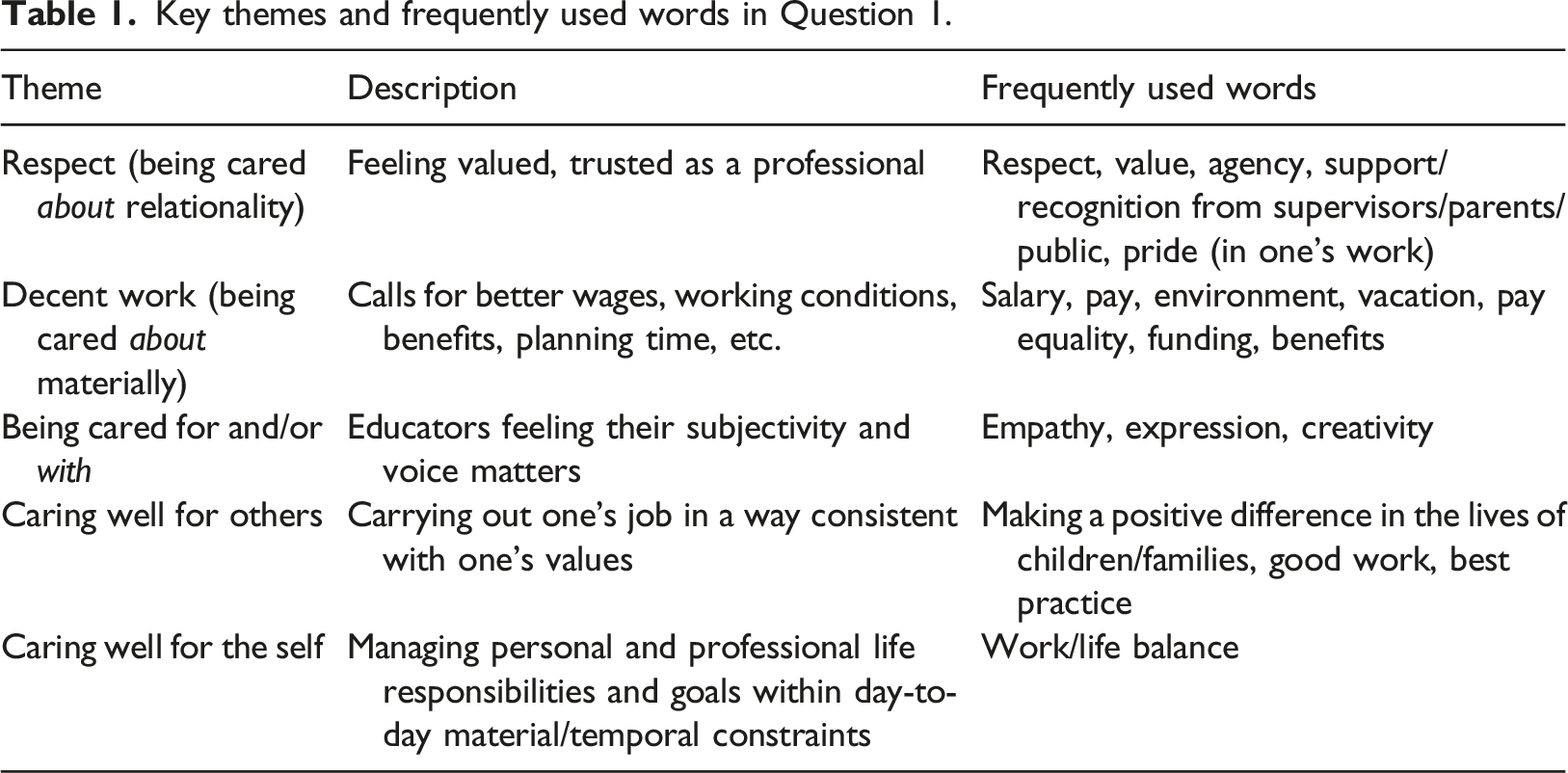
Key themes and frequently used words in Question 1.
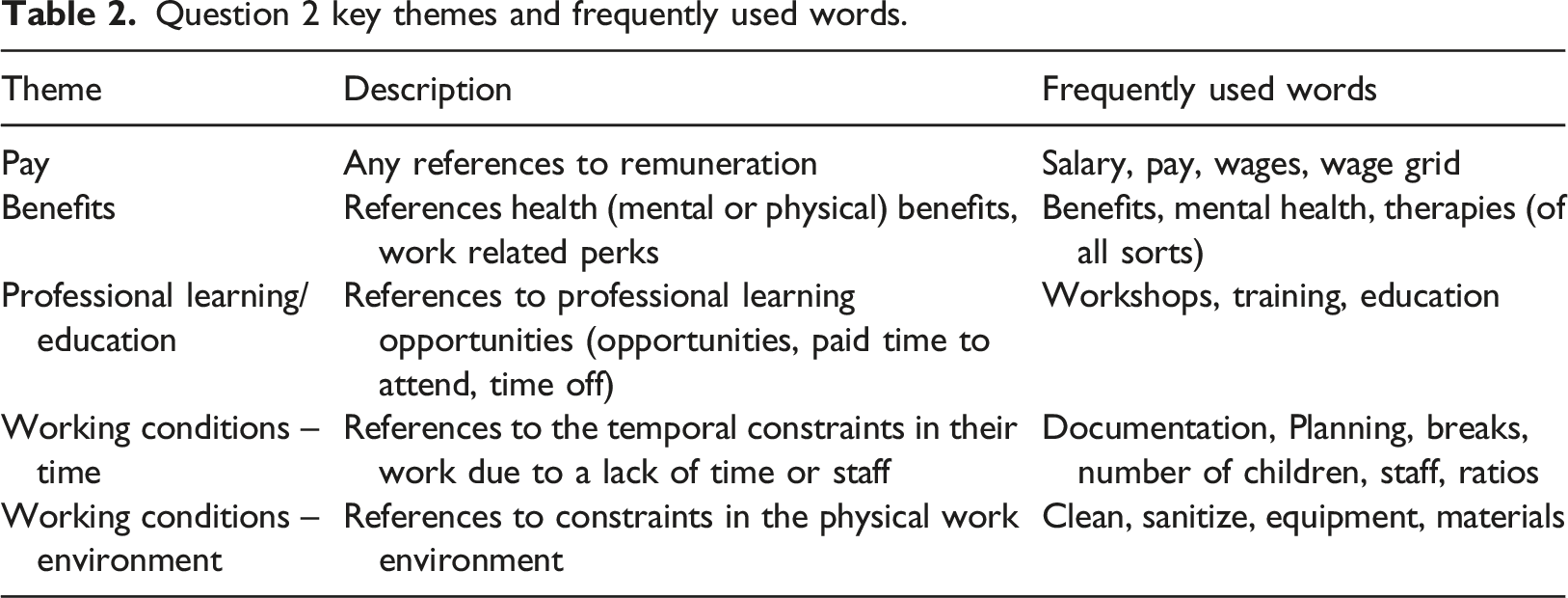
Question 2 key themes and frequently used words.
Findings
Question 1: What does well-being mean to you?
Caring about and for
Outside of consistently identifying decent work as foundational to their well-being (the material aspect of caring about that is the focus of question two), a feminist care ethics lens yielded some interesting insights into ECEs’ conceptualisation of their own well-being: particularly the importance of feeling cared about, cared for, and cared with. When ECEs were to conceptualise their well-being, feeling relationally cared about and for by/from sector outsiders (policy-makers, the public, society-at-large) and insiders (families, supervisors, co-workers) at the program, community and social policy level was emphasized more than decent work itself. References to being cared for and/or with occurred in 75 of the 200 responses to this question while specific references to pay was named in only 32 responses. Stated succinctly by one participant, ECEs need to “feel worthy” or like “our profession matters”. Of course, it is unlikely (if not impossible) that any ECE would feel “worthy” or like they “matter” in exploitative material conditions.
Caring with
ECEs went on to articulate the place of caring with in defining their well-being. Framed in the positive, respondents noted a need “to express feelings and creativity” in a context where leaders “actually take opinions from staff”. One respondent communicated that “policy-makers must understand what it’s like day to day”. Framed in the negative, respondents felt there was no space for their experiences and/or voices to influence decision-making at any level. For example, one ECE suggested she needed to “have more opportunity to express my opinions and ideas”. A seasoned ECE moved from the negative to the positive when she said: As someone who has been in this field for 45 years now there never seems to be any representation or consultation with front line staffers who are actually the ones dealing with everyone. Insisting that front line staff be a part of any committees would be an awesome and meaningful step.
Reflecting more despondency, another respondent put it this way: “I always feel that the government forgets we even exist in childcare centres”.
ECEs’ understanding of why their well-being matters
One interesting and illuminating finding is related to how ECEs justified the attention to their well-being. ECEs were overwhelmingly likely to rationalise attention to their unmet needs through focusing on the “acceptable” needs of children and families. This became evident when ECEs defined their own well-being in terms of how well they could care for the children. Caring well for children was understood to be performing at work in a way that was consistent with their personal and professional values. For example, one respondent suggested that being well meant “feeling physically and emotionally ready to care for the children of the community” while another defined her own well-being as “being mentally happy and healthy to be able to create positive impact in the lives of children”. More simply, ECEs defined their own well-being as being “able to do good work”, “having a well-rounded, even keeled attitude” and “being there for the children”. ECEs clearly struggled with asserting their needs as important in their own right – likely an unintended consequence of a focus on developmental, outcomes-focused child centered curriculums. They felt they were important only in terms of what they could (or couldn’t) do with the children rather than as inextricably interdependent human beings in relationship with children, families and each other.
Finally, it was striking how often the theme of “work/life balance” emerged in ECEs’ explanations of well-being. The phrase “work/life balance” emerged in 40 of 200 responses, while the sentiment was present in over half of responses. Not surprisingly, many respondents communicated that they felt depleted and exhausted in both their personal/home and professional/work lives and needed help “balancing” the two.
It was interesting to observe how the neoliberal positioning of “work/life balance” at the individual level was often internalised by ECEs who felt they were not doing a good enough job at “balancing” their lives. Having said that, it was heartening that other ECEs problematised this way of thinking, positioning their struggles with work/life balance at a structural level. For example, respondents recognised they needed “to be given time to accomplish expectations”, have “rest periods” or the “ability to take an occasional day off without feeling guilty”. Specifically having the time to be able to care well for oneself was only mentioned by one participant and again it was justified in a way that emphasised her performance at work: “taking care of me so I can be present and authentic for the children in my care”. In this way, that ECEs deserve the time and resources to care for themselves appears to feel distant. And even when this idea did emerge (once), the main path of getting there was again to downplay their own needs and focus on the children.
Question 2: What ideas or strategies might you suggest to sector leaders (employers, policy-makers, advocates) to increase your overall level of well-being as an early childhood educator?
While the question was worded in the positive, it elicited many answers related to unmet needs. The message was clear: educators will not and cannot experience wellness until the inadequate material realities of her/their work are rectified. The relational aspects of the work explained above did emerge here as well, but respondents were transparent in that they felt addressing the scarce material conditions of their work environments was necessary to make possible consistently caring relationships. To gain a more nuanced understanding of how ECEs’ feel decent work could or should be achieved, the research team delineated responses related to pay, benefits, professional learning opportunities and working conditions.
Pay
The most intuitive strategy to address the material inadequacies in which ECEs exist, and one that came up in the majority of answers to this question, was better wages for ECEs. Responses included “doubling the pay”, “implementing a wage grid”, “payment for overtime” and “providing a good living wage”. Along with this, respondents consistently identified a need for extended health benefits – particularly for part-time staff 11 . Beyond traditional, extended health benefits, ECEs noted the importance of “mental health supports”, “mental health days”, “childcare assistance for our own children” and even “free parking” to help them manage overwhelm and stress in their daily lives. Also important to several respondents was having “a pension and retirement plan”.
Professional learning
Another key piece of decent work that came up was access to systemically supported professional learning. ECEs welcomed professional learning and generally understood it as a key component of their professional well-being. However, they kept coming back to practical resource challenges to fulfilling (and adequately documenting) their legally mandated Continuous Professional Learning (CPL) requirements. Common strategies suggested by ECEs to rectify this gap were “paid time off to attend workshops and conferences” and “government paid professional development courses”. A few respondents noted that the government should also “lessen the demands of CPL requirements”.
It is important to take a moment to specifically note two ECEs that identified as Black in their written responses felt there was an urgent need to provide professional learning around “anti-racist training for staff”. One ECE aptly identified her experiences of overt racism in her childcare program as gravely undermining her well-being: “as a Black woman I have had to stand alone defending children from teacher bias and quit one position when my supervisor didn’t defend me against a parent’s racist request to remove her son from my class”. That such overt racism is still being experienced by ECEs today is both alarming and troubling. It speaks to the urgent need for systemically supported, easily accessible, anti-racist, anti-colonial education/resources for all people who encounter childcare programs.
Time
Another thing ECEs constantly came back to was time. Inextricably linked to the concept of work/life balance, “time” was the most frequently mentioned word in the responses to this question (111 of 200). ECEs expressed a need for more time with the children, time to plan, time set up a classroom, time to reflect, time to connect with parents/families and each other and time do the myriad of other daily tasks that are required to fulfill their ethical and practical standards of practice. The time struggle is perhaps best summed up in one respondent’s assertion: “the job must be possible”.
Respondents expressed overwhelm with the sheer number of children for whom they are responsible. They expressed a need for “more staff”, “better qualified staff”, “consistent staff” and “more staff collaboration time”. Particularly exasperating for ECEs working in an understaffed context was the “unnecessary” and “relentless” paperwork they felt interrupted good care at every phase. Stated succinctly by one respondent: “cut down on unnecessary tasks and paperwork so we can focus more on the children”. Several ECEs referred to the government’s increasing documentation expectations as “micro-managing”, reflecting a lack of “trust” and “undermining” them as a professional group. With some frustration coming through, respondents called for governments to “stop micromanaging…trust that each interaction we have with children is intentional”. These temporal constraints were augmented by environmental barriers that also overlooked ECEs’ needs: “good equipment”, “well maintained buildings”, “industrial dishwashers” and “outdoor plumbing” were identified as practical resources that would significantly reduce stress.
Voice/agency in the decision-making process
Outside addressing the material shortcomings of their work environments, ECEs had suggestions for policy-makers to rectify the lack of relational respect (i.e., voice) identified in question one: “give us power and responsibility within our community and careers”, “ask and value in put for changes related to policy that affect us on the front line” and “listen instead of dismiss our suggestions”. Perhaps most importantly, one respondent expressed her frustration with being consulted and then ignored. She advised policy-makers to “see it through – don’t let it fall by the “wasteside”. Intentionally or not, this respondent used the term “wasteside” (rather than “wayside”) reflecting how unimportant (“wasted”) any of her efforts had felt when she had been consulted on policy decisions in the past.
At a program level, one respondent suggested her employer “stop switching partners 12 when we have formed a great relationship with our partner” while another indicated she felt ECEs should be “introduced as professionals to families and the community”. At a public level, ECEs encouraged policy-makers to create a public awareness campaign that would “raise the profile of educators” (a strategy employed by the AECEO in years past), invite politicians to their programs to see first-hand what their work entailed and simply just listening and acting on feedback provided.
Discussion
The findings clearly illustrate that ECEs have much to say about their own well-being. Our analysis reveals that the rapid professionalisation of ECEs has not brought either relational respect (at the interpersonal and community or public policy level) or the material resources necessary to establish conditions where good care is the rule rather than the exception. Instead, it appears to be expected that ECEs will sacrifice their own well-being (physically, psychologically, and emotionally) to ensure children are well cared for. And by and large they do.
But this is not a sustainable way of approaching, let alone expanding, ECEs’ work. Interestingly, the findings indicate that ECEs’ well-being could be improved by simply acknowledging ECEs have needs and that their needs matter. Decent work (including better remuneration) is a necessary starting point. But it is not enough. ECEs also need to feel seen, heard and valued as human beings. Policy solutions must truly embrace a “both/and” rather than “either/or” in relation to the discursive/material value of ECEs and their work (an insight also gestured towards by Cumming et al., 2020). Each is insufficient without the other.
Building on existing qualitative methodological approaches to studying ECE well-being (e.g., Corr et al., 2014; Cumming et al., 2021; Jovanovic, 2012), the findings indicate that ECEs value being included in the process of defining well-being as well as what is needed to achieve it. This was particularly pronounced in relation to decision-making at the program and policy level. ECEs didn’t want decisions to keep happening to them. They wanted decisions to happen with them. Unfortunately, several educators felt they had been symbolically used in relation to past attempts to participate in decision-making. That a respondent (intentionally or not) used the term “wasteside” (when using the expression “falling by the wayside”) in relation to feedback previously provided to decision-makers is a clear indication of how unimportant they feel. The implications of this are grave as ECEs may understandably feel reluctant to engage in research, advocacy and/or policy development in the future.
Another key take-away from this study is the importance of honouring ECEs’ time. While some researchers acknowledge the importance of things such as educator planning time for children’s well-being (e.g., King et al., 2016), there is little research that teases apart the relationship between an ECE’s time and her/their well-being (one key exception is Johnston, 2021). Twenty years ago, feminist care ethics scholar Joan Toronto (2003) asserted her concerns around the compression of time in capitalist, neoliberal societies. While she notes that time itself is “stubbornly resistant to human control” (no institution or policy can create more time), resources can be enhanced and/and allocated in a way that pays heed to work that does not does not adhere to neoliberalism’s obsession with “efficiency”. Caring well cannot be made more efficient. That the word “time” came up more often than any other word in these open-ended questions about well-being is an indication that we cannot think about, let alone address, ECE well-being without addressing the major temporal constraints in which ECEs exist. Further work disentangling time and well-being may yield important insights into policy solutions that discursively and materially address the temporal needs of ECEs.
Limitations
As with any piece of research, there are some clear limitations to our findings. First and foremost, we regret not placing the qualitative questions in relation to ECE well-being earlier in the survey. We recognise now that we acted on our own implicit assumptions about the superiority of “objective” rather than “subjective” data in examining ECE well-being. We feel confident our response rate would have been much higher, and we would have likely received more rich, nuanced answers, had the survey been structured to prioritised open-ended questions. Similarly, it would be helpful to take a deeper dive into the ECEs’ conceptualisations of well-being and their potential as decision-makers through interviews and/or focus groups.
Conclusion
Addressing the chronic workforce issues in ECE is possible: listen to them, see them, value their work, invite them to be a part of the decision-making process at the program, community and public policies levels and then act with them. It is well past time that their needs, their subjectivity, their experiences and voices are prioritised. The implications of doing this is drastic in a market-model of care that has conveniently been able to ignore them. We remain hopeful that our society, economy and politic can be organised in a way that prioritises care - particularly in a sociopolitical context that has put more than $30 billion (CAD) (over the next decade) to expand access to childcare in Canada (Child Care Now, 2021). Our hope for more careful childcare spaces, where ECEs can be well, exists because of the fierce, dedication, commitment and care ECEs continue to enact in relation to children, families and each other. ECEs have the experience and knowledge needed to build a much better childcare system. Their well-being is foundational to this. The answers are there. It is time we (all citizens) make space for their voices and act with them.
Footnotes
Declaration of conflicting interests
The author(s) declared no potential conflicts of interest with respect to the research, authorship, and/or publication of this article.
Funding
The author(s) received no financial support for the research, authorship, and/or publication of this article.
