







Abstract
In this article, we develop a programmatic notion of innovation ecosystems, which emphasizes the analysis of different forms of distributed innovation without reducing the perspective to the role of a focal organization. It highlights relationships between communities and corporate firms as nexus for distributed innovation and elaborates how different facets of openness shape the dynamic of the ecosystem. Thus, our model allows for the analysis and comparison of a broad scope of constellations, their particular coordinating mechanisms as well as related advantages and disadvantages. We apply this framework to two specific cases of distributed innovation, the RepRap 3D printer and the ARA modular smartphone, in order to delineate how differences in the forms of openness affect the prevalent relationships between communities and firms as well as the constituting functions of their particular innovation ecosystem.
Keywords
Introduction
With the broad diffusion of digital technologies and associated effects of ubiquitous networking, novel modes of innovation have become a topic for innovation studies. 1 –4 Moreover, researchers have come to associate various notions of openness, distributedness, and decentralization with these modes. 5 These three properties, it is generally held, are catalysts for creativity as they link heterogeneous actors and establish multifaceted means for their interactions while also exceeding the boundaries of single firms. Most approaches have nevertheless focused on individual companies and their enactment of distributed innovation processes and related notions of openness. In this article, we try to develop a symmetrical approach that permits a more comprehensive analysis of innovation ecosystems and their innovative properties.
Against the backdrop of ecosystems, which generally consist of highly diverse actors interacting in different ways across organizational boundaries, we highlight communities as one of the distinct modes of coordination within such ecosystems. We describe the unique forms of interaction that occur when communities, firms, and rather diffuse groups of actors like crowds come together to engage in open innovation activities. We draw on comparative insights from two innovation ecosystems—one for 3-D printers and one for a modular smartphone—to answer our guiding question, namely: How are distributed innovation processes coordinated between communities and firms? By emphasizing these entities as distinct subpopulations within ecosystems, we can elaborate on their particular modes of innovation and describe how their interplay affects the constitution of ecosystems on a more general level.
Although openness plays a pivotal role in the constitution of the ecosystems in both of our empirical cases, we observe differences in the way it affects the community–firm relations within the particular ecosystem. Our first case, the community surrounding RepRap 3D printers represents a bottom-up innovation approach based on widely dispersed decision-making and strong affinities to open source movements. Our second case, the community which developed in the course of the ARA project was initiated by the for-profit company Google to initiate a decentralized and heterogeneous innovation ecosystem consisting in part of an external developer community.
In the course of this article, we first discuss existing perspectives on open and distributed innovation and focus on community–firm relations as one key challenge for coordination. We then suggest a general framework that permits the analysis and evaluation of different forms of innovation ecosystems and apply it to our two cases of distributed innovation. Our analysis centers on the relationships between communities and firms, as well as the distinct means by which they contribute to the constituting functions of their particular innovation ecosystem. We draw on the classic functions of variation, selection, and retention 6 –8 to argue that ecosystems have to fulfill these functions both in order to become “innovative” and in order to mitigate general tensions between different populations engaging in joint processes of distributed innovation. With this theoretical foundation, we also intend to elaborate on the current reception of the ecosystem perspective on innovation. 9,10 Our model provides an alternative to the rather normative perspectives which emphasize the lead role of focal firms. 11 –13
General perspectives on open and distributed innovation
At least three strands of literature center around different aspects of open and distributed innovation. The first, which can be summarized as the “open innovation” perspective, focuses on firms which endeavor to enhance their internal R&D approaches by looking outside their own boundaries to acquire potentially innovative ideas, patents, products, and so on, which generate additional value
1,14
–16
: Open innovation is the use of purposive inflows and outflows of knowledge to accelerate internal innovation, and expand the markets for external use of innovation, respectively.
17
A second strand of literature fills this void with research on user innovation. Its central insight is that innovative processes can also be carried out without the supervision of a guiding firm.
19
–21
Facets of user innovation have been observed in the fields of sports equipment,
22
household appliances,
23
or electronics.
24
Von Hippel goes one step further to argue that user innovation usually reflects a widely distributed process between different actors who are interconnected in communities providing sociability, support, information, a sense of belonging, and collective identity.
25
These community-based constellations of user innovation thus reveal unique and noticeably different properties from the market- and firm-based settings usually underlying the open innovation perspective sketched out above: [W]hat is most exciting is that innovation communities composed of users and for users, communities that according to traditional economic views shouldn’t exist, work well enough to create and sustain complex innovations without any manufacturer involvement.
26
An innovation is “open” in our terminology when all information related to the innovation is a public good—nonrivalrous and nonexcludable. […] It differs fundamentally from the recent use of the term to refer to organizational permeability—an organization’s “openness” to the acquisition of new ideas, patents, products, etc. from outside its boundaries, often via licensing protected intellectual property.
23
A third strand of relevant literature embraces studies on open source software (OSS) and its developer communities.
29,30
These communities reflect hybrid modes of innovation that capture aspects from both open innovation and user innovation.
2,31
Accordingly, also the notions of openness in this case are entangled to a certain degree, since open boundaries as well as freely available knowledge constitute the building blocks for distributed processes of OSS development: OSS communities represent the most radical edge of openness and sharing observed to date in complex technology development. OSS communities are open in the sense that their outputs can be used by anyone (within the limits of the license), and anyone can join by subscribing to the development e-mail list. Openness in joining, in turn, leads to transparency in the development process, since the bulk of communication about projects and their direction generally occurs in public.
5
To lay the groundwork for our further elaboration, we will first consider the principal differences between communities and firms in greater detail. In addition, we identify the need for a versatile concept of openness to address different kinds of openness and analyze the forms of openness that exist in a specific case and how they may change over time.
Community as a governance mode
In this article, we emphasize communities and firms as two distinct types of mesolevel coordination within ecosystems that are especially relevant for distributed and heterogeneous innovation processes. We have already pointed out that commercial firms are the focus of most related research endeavors. While the distinct traits of communities as sources of and environments for innovation have been singled out as a promising topic among innovation scholars, the community concept still lacks analytical strength and definition. 35,36 We want to draw on existing approaches that distinguish communities from other modes of governance to derive a general understanding of communities as social contexts for innovation as well as the idiosyncrasies that community–firm relations need to leverage in order to spur innovation.
Starting from a similar point of view, Adler’s 33 work on the knowledge economy and the future of capitalism offers findings on the key properties that distinguish these different modes of governance. 33 Markets, for example, at least in their ideal form, rely on the price mechanism to coordinate exchange between competing suppliers and anonymous buyers. Hierarchies employ authority to create and coordinate a horizontal and vertical division of labor (ibid. 216). Communities, though, rely on the key coordinating mechanism of mutual trust “derived from grounding in open dialogue among peers” (ibid. 227).
While the above characterization of community-, market-, and firm-based modes of coordination relies on rather sharp analytical contrasts, the conceptual distinction between communities and networks themselves is tricky. Both modes draw on interaction based on “reciprocal, preferential and mutually supportive actions,” 33 for example. Nevertheless, network governance is the perspective most prominently applied to contexts of economic value creation and it clearly emphasizes relationships between organizations seeking to gain either direct monetary profit (see, e.g. Hagedoorn’s analysis of patent pools 37,38 ) or indirect benefits from their participation. 39 Communities, on the other hand exhibit different mechanisms of coordination and motivation. Adler, for example, stress the absence of formal or legal contracts in community environments. 33 In contrast to hierarchies, markets or networks, which rely on employment relationships, market or alliance contracts, community interactions are based on common goals, open sharing, and a mutually acknowledged philosophy.
Applied to empirical contexts of open source and user innovation, this assumption gains further evidence. For instance, Franke and Shah 19,40 find that economic exchange and monetary profit are only minor motivations for both innovators and those who assist them. Instead, they rather cite “having fun and viewing the giving of innovation-related assistance to community members as a social norm as the strongest factors influencing their decision to assist innovators” (ibid. 158).
To further ground our sociological understanding of communities, we add Gläser’s
41
rather theoretical insights on production communities to Franke and Shah’s practical findings. According to Gläser, his own take on communities aptly captures unique coordinating modes found in the fields of science and OSS, as actions and interactions in specific actor constellations are guided by a certain research endeavor or field of scientific interest. Such endeavors, fields, or, in the case of OSS, software projects can be characterized as a common, collective pursuit uniting all community members (ibid. 6). What makes Gläser’s approach unique is not his particular analysis of productive communities but rather his broader discussion of conceptual implications for collective identities that follow from theorizing communities based on “common properties” such as shared practices, interests, or subject matters of work (ibid. 7). Merging more traditional definitions that refer to “collectivities of people (a) who share values or beliefs, and (b) whose social relations are relations of affect, characterized by mutuality and emotional bonds, and (c) who frequently interact” (ibid. 1
42,43
), Gläser proposes his own definition of communities as follows: A community is an actor constellation that consists of individuals who perceive to have something in common with others, and whose actions and interactions are at least partially influenced by this perception. (ibid. 6)
These general conceptual traits, as well as the practical insights sketched out above, ground our understanding of communities as a distinct governance mode in the broader context of innovation ecosystems. We define innovation communities as actor constellations that collectively engage in the development, improvement, or application of novel entities such as certain products or a particular body of knowledge. The communal mode of interaction is thus enabled and recursively stabilized by the imperative of openness and the accessibility of knowledge, which is normatively acknowledged and performatively enacted by the involved actors.
We believe that, whereas the community’s defining purpose serves as the core aspect that motivates community members, the constitutive principles of openness and sharing reproduce the community form as a distinct mode of governance that differs considerably from hierarchy-, market-, and network-based forms of coordination. 44
In the next section, we narrow down the scope of governance alternatives in order to delineate communities and firms as distinct populations within the comprehensive perspective of innovation ecosystems. We particularly focus on interactions between communities and firms and their effects on the creation of distributed innovations.
Integrating communities and firms in contexts of distributed and open innovation: The ecosystems perspective
We use the term innovation ecosystem to delineate the broader contexts in which complex innovations are put forth. Originally coined to describe the core functional unit of a set of different species and their environment, the concept of ecosystems highlights the relational aspects of the elements observed: “Ecosystems are thus networks of interrelations between organisms and their environment in a defined space.” 45
We transfer these aspects of the biological and evolutionary term into the social context of innovation production. This “defined space” of an innovation ecosystem is determined by the specific activities and processes that facilitate and produce specific innovations and thus recursively constitute this space. These reciprocal bonds between the means and ends of innovative action and its surrounding structures indeed resemble the original biological application of the term: “The ecosystem is the basic functional unit in ecology, since it includes both organisms (biotic communities) and abiotic environment, each influencing the properties of the other and both necessary for maintenance of life as we have it on earth” (Odum, 1971, p. 8, as cited in Keller and Golley 46 ). Adopting this perspective for the study of innovation, we consider ecosystems as the mutually intertwined social, economic, and material contexts which are necessary for the occurrence of innovation.
Innovation ecosystems consist of all relevant actors, their activities, and relations, which together coordinate actions and the flow of information resources and which reciprocally constitute the collective endeavor of distributed innovation. However, in the context of this study, we focus on communities and firms as well as their interrelations and their particular effects on innovation processes.
We are well aware that we are not the first to have applied the ecosystems concept to the topic of innovation. Indeed, a survey reveals multiple uses of the term. It has become an “attractive metaphor” 47 mainly in practitioner literature but also in management research. 48 (Moreover, in both our empirical cases, the actors used evolutionary vocabulary. This is another reason why it is important to explain how we use evolutionary terms like ecosystem, population, variation, selection, retention, and so forth.) In this contexts, innovation ecosystems have been defined “as a network of interconnected organizations, connected to a focal firm or platform, that incorporates both production and use side participants, and creates and appropriates new value through innovation” (ibid. 205). Adner and Kapoor define an innovation ecosystem as a “focal firm and all other firms relevant for the innovation process: upstream suppliers, and its downstream buyers and complementors.” 12
In many respects, these uses are not too far from our own perspective. For example, Adner and Kapoor want to “distinguish among the different roles played by various actors” (ibid. 309) within an ecosystem, an objective that we also share. There is nevertheless one crucial difference: Our considerations do not start with a focal firm. In our approach, we go beyond the classical management (theory) perspective, which conceives of all phenomena in relation to a single firm. Instead, we apply a broader lens, one that captures the relational properties and dynamics of an ecosystem as such. In this regard, we differ from perspectives that portray innovation ecosystems as organizational fields. 47,49
Both perspectives, that is, the existence of one dominant focal firm, which could perhaps serve as a suitable starting point to explain an entire ecosystem, and the existence of an ecosystem that exhibits the properties of one organizational field, are ultimately empirical questions. While both perspectives show different variants of ecosystems, they do not exhaust all conceivable or existing possibilities. Ecosystems can consist, for example, of more than one organizational field—or none at all. They can have very different forms of power distribution. Perhaps a community, not a firm, is the most relevant actor, and so on. In this regard, we consider ecosystems generally as having the qualities of nested mesolevel orders, meaning that they consist of elements that are themselves composed of mesolevel orders. 50 (Fligstein and McAdam also use the term “field” to describe mesolevel orders. But their concept of field is very different from the concept of “organizational field” and much broader. 51 It encompasses all kinds and forms of mesolevel orders. To avoid needless confusion regarding the different field concepts, we refer to the crucial concept elaborated by Fligstein and McAdams exclusively as “mesolevel orders.”) Our notion of innovation ecosystem thus constructs a comprehensive mesolevel order for distributed innovation that potentially includes firms, organizations in general, communities, and other entities, which may maintain distinct modes of coordination. Our aim with this construct is to enable the analysis of the structure and dynamics of distributed innovation in different contexts.
To elaborate on our analysis of ecosystems, reduce the immanent complexity of their entities, and capture their particular impacts on distributed innovation, we apply the analytical unit of population. We speak of populations when describing subsets within an ecosystem that shares similar structural properties. This use of the concept closely approximates that of Hoffman 52 and Barley 53 for institutional theory and Hannan and Freeman 54 for their population ecology of organizations: Populations within innovation ecosystems circumscribe subsets of actors that share similarities in their properties and their relations with other populations of the particular ecosystem. Actors within a population also show a similar perspective on innovations, apply similar rationalities, and use similar primary modes of coordination. The entire set of suppliers for a focal firm could constitute a population, for example. All communities that exchange open source knowledge or work on a collective endeavor may also constitute distinct populations. Within one population, but also between populations, actors struggle to achieve their own interests. Power can be distributed very unevenly in such ecosystems. More powerful actors or populations may be able to set the general rules under which the ecosystem functions, while less powerful players have to abide by these rules as a prerequisite for participation in the ecosystem.
To delineate the interplay of different populations in joint contexts of distributed innovation, we apply a rather functional perspective. However, this approach should not be mistaken for a functionalist perspective that attributes a function to every social phenomenon to explain its existence. We assume, in contrast, that social phenomena exist for a variety of different reasons—having a function within society may be one of them, while tradition, interest, and power (and many more 55 ) are also effective explanations. Instead of relying on such a “Panglossian paradigm” (ibid.), we use function as an analytical concept which assists us in defining our research topic, namely the successful production of innovations. To create successful innovative outcomes, ecosystems need to perform certain functions that generate novel solutions, pick the most promising for further development, and finally stabilize these outcomes to enable their broad diffusion.
To stick to our evolutionary terminology, we term these three basic innovation-related functions variation, selection, and retention. Variation describes the creation of new and different forms of potential innovations. Selection describes mechanisms which reduce the number of variations for a potential innovation. This can happen in a Darwinian manner by negatively selecting unsuccessful options or in a more Lamarckian fashion by selecting and promoting promising developments. Retention, finally, describes processes that allow for the diffusion and restabilization of innovations in a wider social context.
Since this evolutionary vocabulary has been used by many different authors to describe very different aspects of the innovation process, 6 –8 some clarification of how we use these concepts is necessary. We generally describe these three mechanisms as functions of innovation ecosystems aiming at the development and possible diffusion of novel technological artifacts as prospective innovations. We assume neither that these functions occur in a consecutive linear manner nor that they are necessarily supervised or controlled by a focal organization. Instead, they are dispersed across the various populations that together constitute a functional innovation ecosystem. Additionally, even if all three functions have to be present in every innovation ecosystem for it to be successful, their specific content, that is, actual processes and activities, can differ and may also lead to significantly different outcomes depending on the particular constellation of populations that shapes the ecosystem’s inherent structure.
Regarding the notion of populations as subsets of actors sharing similar properties, a correlation between their coordinating principles and the particular ways they contribute to the ecosystem’s functions is very likely. With regard to our empirical cases, we show how these functions are to different degrees covered by the communities and/or organizations that lie at the heart of the innovation ecosystems we observe. Consequently, our analysis emphasizes the actual realization of these functions within distributed ecosystems as well as the different means and ends employed by distinct populations.
Normative and structural openness
To grasp the dynamics of distributed innovation, we add one more element to our analysis: openness. We think this is crucial, because the specific interrelations of the above functions are affected by the distinct forms of openness prevalent within and across the populations of an innovation ecosystem.
Drawing on the particular distinctions between market-, firm-, or community-based modes of coordinating innovative action, we consider openness as a crucial variable to answer our guiding questions. Openness has become a “master category” in many different areas: in the realms of technology and innovation but also in political thought. 56 Yet, perceptions of its content and definition differ significantly. In our case, openness is crucial, as it generally forms the basis for distributed innovation in heterogeneous ecosystems. If no openness and, as a result, no exchange between different parts of the ecosystem were to occur, the ecosystem would cease to exist. Openness may take on very different forms and meanings in different contexts. And it is crucial to understand these differences and their relevance. In order to strengthen our analytical model, we distinguish between two general dimensions of openness in an innovation ecosystem: normative and structural openness.
Normative openness refers to the justifications and legitimations given for demanding or applying deliberate modes of free and inclusive knowledge exchange within an innovation ecosystem. In its normative dimension, openness can entail different meanings. Some actors consider openness essential for a free, just, and democratic exchange of knowledge. Others see it as an imperative to gain a competitive advantage: Openness, in this perspective, is a component in a business model. While the former notion can be found, for instance, in open source communities where openness is the ideological glue that enables internal cohesion (along with the related ideas of participation, access, and collaboration), 57 the latter perspective describes companies like Google that incorporate openness as a normative component in their business strategy, for instance by furnishing open innovation platforms to promote competitiveness in the market. 58
Structural openness, in contrast, refers to more tangible facets of openness. It describes how certain things can circulate and/or be exchanged within a certain context. When that context is innovation, this dimension primarily stresses different forms and occurrences of knowledge. Some examples include how technological knowledge is made available or how intellectual property (IP) is managed within the boundaries of an innovation ecosystem or its particular populations. Moreover, structural openness is also reflected in practices of knowledge exchange the construction of secrecy, or the general power relations that govern the flow of relevant information.
These two-dimensions of openness often exist in tandem, for example, normative ideas of free knowledge exchange and structural forms of knowledge transfer and accessibility (e.g. open access, copy left, etc.). The properties and relations of these two-dimensions heavily influence the dynamics of innovation ecosystems.
Cases: RepRap 3D printer and the ARA modular smartphone
In order to develop and apply our analytical concept of innovation ecosystems, we describe two empirical cases—RepRap 3D printers and Project ARA—which share some common properties and differ in others. Both are characterized by a complex interaction between a community—or communities—and one or more firms involved in the innovation process. In both cases, openness is crucial for the facilitation of distributed innovation, but the specific notions of openness as well as specific relations among the populations and the application of functions like variation, selection, and retention differ considerably between the two ecosystems.
To gain insights into the specific properties of these two cases, we conducted case studies for each of the ecosystems that draw on their chronology, emphasize the emerging technologies, and trace the evolution of communities and firms as well as their constitutive and formative relations. 59 To flesh out our understanding of the coordination of distributed innovation, we will draw on process-generated data supplemented by qualitative interviews.
Since interactions and associated modes of coordination in both ecosystems mainly take place in the digital realm, mailing lists, online forums, or other digitally published documents, all provide suitable data sources. 60,61 Furthermore, we approach data analysis from a qualitative standpoint that aims to infer insights inductively from unstructured materials rather than derive them deductively from quantitative statistics. We believe that this approach aligns with our objectives of qualifying the distinct properties of community-based modes of interaction, along with associated dimensions of openness and their significance in the context of distributed innovation.
Against the background of the theoretical and conceptual foundations of innovation ecosystems, we structure the discussion of our empirical cases as follows: First, we describe the main technological issues and innovations at stake as well as the origins of the particular ecosystem. Second, we pin down the populations that together shape the ecosystem as well as the relationships between them. Third, we take a closer look at the specific processes of variation, selection, and retention in each ecosystem that constitute its capacities for distributed innovation. Here, we emphasize openness as a key enabling factor as well as related differences and resulting frictions between community- and firm-based populations. Finally, we discuss the general aspects of mesolevel coordination within each of the observed cases and assess its recursive transformation as a result of the overall endeavor.
RepRap 3D printers
Origin and issue of the ecosystem
RepRap is the abbreviation for replicating rapid prototyper and refers to a category of 3-D printers, which was initially motivated by the aim of creating a self-replicating machine capable of “printing” most of its own components. The beginnings of the RepRap ecosystem can be traced back to 2004/2005, when Adrian Bowyer, then working as an academic in the fields of mathematics and engineering at the University of Bath (UK), initially launched RepRap as a publicly funded project (http://reprap.org/wiki/About, last accessed 27 March 2017). Due to his academic origins, Bowyer expressed and pursued the technological issue of self-replicating 3-D printing as a noncommercial endeavor. Throughout the project, Bowyer was eager to share the project’s progress as well as any sources of related knowledge on a dedicated Internet blog, where he also elaborated on the political motives behind his idea as well as associated accounts of the open source movement. Bowyer intended to mobilize OS activists to contribute to the RepRap project and thus foster its further development in an inclusive and evolutionary way: Consequently I have decided to give the entire machine and all its design files away free under the GNU General Public Licence, like Linux. This ensures that no one (especially not me) has control over, and restrictions on, the technology. It is a happy coincidence that this—the morally correct thing to do—is also the only stable strategy. […] So the self-copying and evolving RepRap machine may allow the revolutionary ownership, by the proletariat, of the means of production.
62

RepRap 3D printer “Darwin” (source: http://reprap.org/wiki/RepRap_Darwin).
Populations and their mutual relationships
Although the original community of researchers and tech savvy “geeks” played a pivotal role for the RepRap ecosystem (see Figure 2), the recent rise of the so-called “maker movement” and the renaissance of “do-it-yourself” (DIY) as a personalized mode of production
64
significantly expanded the project’s scope. The increased popularity of 3-D printing in general and RepRap’s low-cost and DIY-friendly approach in particular led to a significant growth of people involved and thus to an increased differentiation of motives and interests for participation. With these developments came new and increasing attempts to bring RepRap derivatives to consumer markets and exploit their commercial potential. Today, the initial idea of self-replication has generated a variety of technological applications, which together with diverse actors constitutes a heterogeneous ecosystem: Some guys care about the open [source] hardware but there are also users who don’t care about it at all. They just like to use the printers and they like the tinkering process. There are also people who just build it and don’t care about anything. There are guys who rip stuff and use it without crediting. It’s pretty much a bit of everything. (i-RR-3)
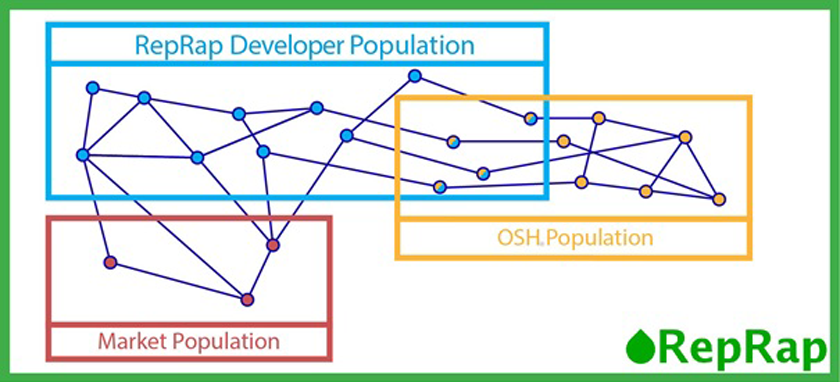
The RepRap ecosystem, own representation.
From an analytical perspective, we can identify three overlapping populations which contribute to the innovation ecosystem: The first consists of actors who are primarily interested in the technological aspects of RepRap 3D printers. This population most closely resembles an ideal typical innovation community. It unites actors who share a common interest in tinkering and base their actions on the open exchange of nonproprietary knowledge. To reinforce and maintain their network-constituting modes of interaction, members of this population embrace strong accounts of structural openness, captured for instance by the open source licenses they attach to their newly developed 3-D printers. The second population is mainly engaged in the ideological and legal aspects of open source hardware (OSH). Actors in this population are either individuals who consider themselves “OSH evangelists” or corporate actors like the “Open Source Hardware Association,” which issues OSH definitions as well as best practices for licensing and documentation. Although these actors do not associate exclusively based on the topic of 3-D printing but in relation to OSH applications in general, their common interest lies in the political and normative motifs the RepRap printer represents. These political themes also foster a strong sense of community. In contrast, a third population consists of actors with entrepreneurial ambitions to commercialize developments stemming from the ecosystem. These actors are either user–entrepreneurs with RepRap-based start-up ambitions or established firms like industrial companies or venture capitalists seeking to appropriate value from the ecosystem. They primarily utilize market-based mechanisms and interact with the community in order to exploit the outcomes of RepRap commercially.
Regarding the mutual relations between the ecosystem’s populations, the technological advancement and success of the innovation community of RepRap developers eventually created the foundation for start-up companies that began to appropriate its ideas. Together with other firms that became commercial stakeholders in the 3-D printing field, these companies represent the ecosystem’s emerging market subpopulation. In general, both the market and the RepRap developer population can coexist with RepRap’s open source community in rather symbiotic ways, at least as long as the commercial firms respect the community’s constitutive open source values. Here, the OSH population gains relevance for the overarching ecosystem as its core interest is the diffusion and elaboration of the open source principle as an alternative mode of hardware development. Quite similar to the OSS realm, related initiatives shape interactions between community and market populations as they repeatedly try to protect the open source principles from inappropriate economic exploitation. Compared to OSS, however, the OSH field is largely void of formal and legal institutions. Therefore, the effective means to prevent commercial firms from draining the community are rather limited.
Dynamics of distributed innovation: Variation, selection, retention
Since interaction within the RepRap ecosystem widely lacks central guidance, the provision and maintenance of its functions also appear rather uncoordinated at first glance. The building blocks that shaped RepRap in its early stages, namely the application of an evolutionary approach to technology alongside the commitments to normative and structural openness, essentially yielded a bottom-up mode of structuration that recursively shaped its basic functions.
In terms of this ecosystem’s structural characteristics, the innovation community of RepRap developers provides the function of variation. Fueled by their curiosity in technological topics and their common acknowledgement of open source principles, this population developed strong exploration and search dynamics, generating numerous tweaks and variations of the Darwin, RepRap’s model printer. Indeed, the so-called “RepRap family tree” lists more than 400 derivatives of the initial Darwin, each of them representing an outcome enabled by the very means of distributed innovation (see Figure A1 for a tree diagram of the “evolution” of RepRap 3-D printers). However, with the increasing differentiation of the ecosystem, the growing number of start-ups in particular added a significant quantity of other 3-D printer models alongside the Darwin, which subsequently expanded the scope of variation.
RepRap’s references to evolutionary theory play out heavily when it comes to selection processes and the related coordination of technological progress. Focusing first on the developers’ community, instead of restricting the scope of possible options for the further development of printers to the most promising approaches, this population explicitly welcomes any kind of variation—as long as it conforms to the dominant norms surrounding openness. Additionally, the RepRap developer population does not actively push the selection process. Instead, selection of the most promising technological approaches and 3-D printer designs is mainly a self-reinforcing outcome of decentralized community appreciation—the more members follow a certain path, the bigger it gets. In contrast to the occurrence of selection as a nondirected “happening,” the market population of start-up companies introduced a rather purposive selection approach to the ecosystem as its members began to strategically decide which of the available 3-D printer designs was best suited to their entrepreneurial ambitions.
Although both populations apply contrary selection processes, these opposing modes are generally conducive to the proliferation of RepRaps, since the trajectories selected in particular by the market-oriented actors support the diffusion the ecosystem’s innovative outcomes. As a consequence of this twofold selection, the broad scope of variations is narrowed down to the dominant RepRap derivatives that may then enter retention. On the one hand, community retention is likely to consolidate RepRap printers that technically outperform previous models while incorporating open source principles. On the other hand, while the market population values technological advancements as well, certain aspects of structural openness start to matter less—potential profits and market access increasingly figure as pressing issues.
Although market-based retention may help to streamline the rather diffuse selection outcomes occurring in this decentralized community and it does contribute significantly to the usability and reliability of 3-D printers, market-based efforts also spur the dissemination of RepRap-related devices into contexts not directly linked to the original community.
It is at the intersection of community- and market-based retention that the core paradox of the RepRap ecosystem unfolds: At first glance, the commercial applications help increase the diffusion of the innovations at stake as they link the ideas of the community population to the “outside” world. However, start-ups that erase the 3-D printers’ open source heritage also harm the reproduction of the overarching ecosystem as they create so-called “dead-end derivatives” instead of maintaining openness and accessibility: As their designs will not enable people to create new iterations of existing models, they eventually interrupt the evolutionary process that enabled the ecosystem to emerge in the first place. 65
Coordination, openness, and transformation
In the first years of RepRap’s proliferation within the broader contexts of the DIY and maker culture, the core community and the quite complementary firm-based population provided functions that together created a viable ecosystem. Numbers attest to this viability: Various RepRap-aligned 3D printers came to represent the most common desktop 3-D printing applications. 66 However, with growing markets, increasing community spin-offs, and the emergence of a new population consisting of corporate commercial vendors for 3-D printers, the decline of the community populations, along their emphasis on self-replication and open source values, can be clearly traced within the overall ecosystem.
In connection with the changing dynamics and ongoing transformation of the ecosystem, the particular implementation of openness shifted as well. In the beginning of RepRap, openness was a taken-for-granted principle that shaped the structural properties of the entire community, both in normative and structural terms. Indeed, since all early contributors to RepRap came from a scientific background or the open source movement, openness represented the widely accepted constitutive bottom line for community interaction and knowledge dissemination. As sketched out before, the impact of openness also affected the functions of the ecosystem—a playing field without formal structures, centralized guidance, or regulative constraints—and thus spurred a serendipitous chain of RepRap-related outcomes that demonstrated the community’s explorative capacity. Generally speaking, open source principles do not necessarily contradict entrepreneurial efforts to found commercial ventures. Start-ups like Ultimaker or Aleph Objects have already shown that community–firm relations can be maintained based on shared values and practices. However, there have been cases of notably successful start-ups, such as Makerbot or Bits from Bytes, which revealed devastating patterns of interaction and caused serious friction in the coordination of the ecosystem. In these two cases, the community spin-offs started to acquire venture capital or even merged with corporate vendors, which subsequently decreased their compliance with the community’s practices of sustaining normative and structural openness as its essential means for reproduction. In these cases, the companies’ strategic decisions to stop publishing open source design files for its printers caused some serious controversy in the RepRap community, which voiced disappointment and even a sense of betrayal in various statements and forum discussions. While the community did consider unlimited sharing of new product ideas and related blueprints, a legitimate and facilitating practice for development efforts, it certainly harms business competitiveness by spurring imitations and hollowing out a company’s IP. Consequently, the start-ups that emerged from the RepRap community took their own creative liberty with the original implications of open source in an attempt to identify some middle ground that would relieve tensions between opposing goals and purposes.
Regarding this broader mesolevel scope, the populations of original RepRap developers and OSH enthusiasts base their activities on a normative and structural interpretation of openness. In contrast, the market population consisting of start-ups and a growing number of corporate companies breaks with both dimensions as the involved actors follow a rather pragmatic approach, at most implementing openness in a way that also complies with their dominant profit-making motive. Their creation of dead-end derivatives introduces coordination problems for the ecosystem as a whole. As more and more RepRap developers either fear being “drained” by market actors or envy their economic gain, the ecosystem’s enabling function for distributed innovation gradually dissolves.
Project ARA
Origin and issue of the ecosystem
As our second case, we discuss Project ARA (named after Ara Knaian, a co-founder of NK Labs), which refers to Google’s explicit ambition to create “a modular hardware ecosystem” (See http://www.projectara.com/faq/, last accessed 7 March 2016. Please note that since Google recently shelved Project ARA, most of the online resources have now changed or quit the WWW.). The technological issue that constitutes the ARA innovation ecosystem is the idea to create a modular smartphone that is highly customizable both in its functions and appearance. The ARA Smartphone was supposed to consist of a so-called “endoskeleton,” which would serve as a structural frame for various functional modules (e.g. displays, cameras, keyboards, extra batteries, processors, blood sugar monitors, etc.). These modules are attached to the endoskeleton via electropermanent magnets and can be swapped to customize the phone’s features (see Figure 3 for illustration).

Project ARA’s modular phone (http://sites.sju.edu/oit/index.php/2013/11/04/motorolasprojectara, last accessed 31 March 2017).
Although Project ARA was initially launched by Google’s Advanced Technology and Projects group (ATAP, a subunit of the formerly Google-owned company Motorola) in 2013, the project’s articulated approach to research and development embraced more open and distributed modes of innovation among different groups of actors. In a first blog post, project lead Paul Eremenko announced the guiding visions of ARA as follows: Project ARA is developing a free, open hardware platform for creating highly modular smartphones. We want to do for hardware what the Android platform has done for software: create a vibrant third-party developer ecosystem, lower the barriers to entry, increase the pace of innovation, and substantially compress development timelines. (http://motorola-blog.blogspot.jp/2013/10/goodbye-sticky-hello-ara.html, last accessed 7 March 2016)
Populations and their mutual relationships
In addition to ATAP as the key actor, the ARA ecosystem included three other populations. The first consisted of independent developers, who initially represented a loosely coupled group with a common interest in the project. ATAP’s objective from the beginning was to turn this group into a “vibrant third-party developer ecosystem” (ibid.). That ambition required a certain joint momentum as well as considerable professionalization in transforming initial ideas for ARA modules into actual prototypes and products.
Another population consisted of a group of international companies highly skilled in advanced technological R&D and manufacturing. Google contracted these companies to deliver the endoskeleton components as well as functional modules that would supply the proof of concept for ARA’s overall vision.
Besides these two groups, the Phonebloks community represents another important population in the ecosystem. Phonebloks was initially launched by the Dutch designer Dave Hakkens, who intended to reduce waste and increase sustainability in mobile technology by developing a modular phone. Phonebloks clearly advocated an open coordinating approach, drawing heavily on community members to generate ideas and content, which would in turn accelerate interactions among the community. These participants were very eager to share their thoughts and ideas on how to advance the Phonebloks concept and together resembled a large but rather loosely coupled group of individuals, whose interactions mainly took place in forum discussions.
Already one month before ATAP revealed its version of a modular smartphone, Hakkens launched his initiative which captured almost the same technical approach. Although both initiatives differed in their means and ends, Emerenko’s announcement of Project ARA also highlighted the collaboration with Phonebloks in terms of complementary efforts: “We [ATAP] have done deep technical work. Dave created a community. The power of open requires both” (ibid.).
The emergence of all ARA-related populations (see Figure 4) was a consequence of ATAP’s support for individual development efforts (on the part of third-party developers and corporate contractors) and Dave Hakkens’s advocacy in the case of Phonebloks. Because Emerenko and his colleagues at ATAP successfully got in touch with Hakkens in order to increase the project’s public reception, the emerging populations of Phonebloks contributors and the third-party ARA developers also began to foster closer ties. While this at first led to growing momentum on both sides, a number of developers, especially within the Phonebloks population, eventually raised concerns that Google’s promotion of Project ARA may dilute their original ecological ambitions.
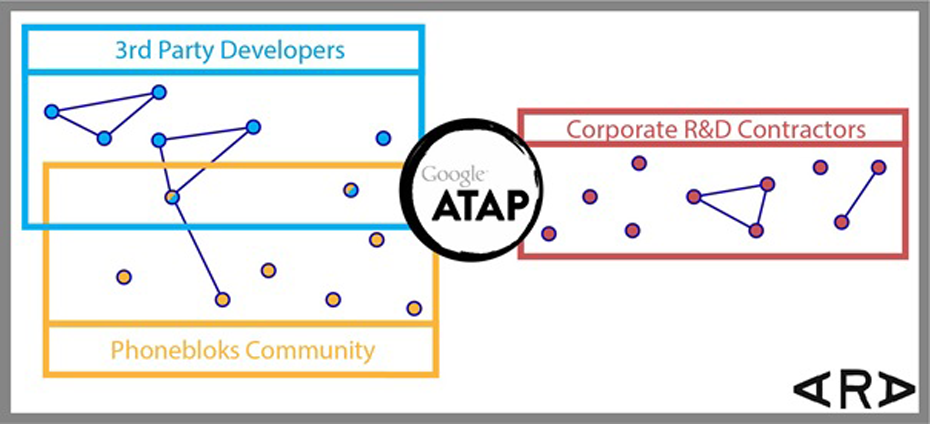
Project ARA ecosystem, own representation.
Regarding the general level of the ecosystem, ATAP was the leading entity that shaped the means and ends for mutual interactions. In this position, the unit also represented Google’s broader strategy and related aims of expanding the relevance of Android by producing modular hardware devices. While this ambition might seem appropriate from Google’s point of view, it hardly resembled the impetus behind Phonebloks, for quite different reasons. Moreover, the developers who would presumably create the third-party ecosystem received no direct gains, so ATAP’s attempt to foster goal-driven interaction and exchange had no real backing from these populations. Since relationships with external R&D contractors were far more formalized, ATAP was able to exercise greater control over their efforts.
Dynamics of distributed innovation: Variation, selection, retention
Due to its pivotal position at the intersection of the different populations, ATAP is the central actor in this case that provides the catalyzing functions for distributed innovation.
According to Google’s general approach with ARA, variation is supposed to take place within the array of available smartphone modules. Google (or ATAP) provides the endoskeleton for the ARA smartphone, as well as a module developer kit (MDK) consisting of all the information and specs external developers need to create and develop modules independently. However, such ambitions still need guidance and support from ATAP, whether in terms of R&D resources or a standardized implementation framework, which guarantees a correct fit between decentrally developed modules and ARA’s technological infrastructure.
Regarding functions of selection, ATAP extensively shapes the immediate development processes for the modules by selecting what it perceives as worthwhile ideas and subsequent trajectories for the technological development of the ARA smartphone. To create a module for the ARA platform, individual developers are required to test its compatibility with the ARA endoskeleton interface. This necessitates the completion of a form (including information on the intended ideas) and the request for access to such a prototyping device. Google planned to provide the modules following the market launch via a hardware-based extension of its “Play Store” which the company had already established to provide apps for their Android operating system. Selection would thus be shaped by the terms and conditions of the “Play Store” as well as the appreciation of ARA customers.
Retention depends on ATAP’s assessment of potential contributions to Project ARA. During the early phases of the ecosystem, ATAP established two ways to signal a positive assessment: The first refers to monetary prizes for unique module applications submitted by the developer population. According to ATAP, “modules will be evaluated by a team of judges, who will choose the winner(s) in accordance with official rules and evaluation criteria” (http://www.projectara.com/prize/, last accessed 30 November 2016). Similar to the prize mechanism, the development board’s approval of requests also reflects the value that ATAP assigns to a prospective idea. Potential customers and their Play Store purchases would have been the final means of retention; however, this market-based channel to perpetuate ARA modules has yet to be realized, which is why Google (or ATAP) still remains the central bottleneck of retention.
Coordination, openness, and transformation
When ATAP revealed its plans with Project ARA, its ambition to build a “free, open hardware platform” as well as a “third-party developer ecosystem,” and highlighted its partnership with Phonebloks, the project attracted a great deal of public interest, as well as potential contributors, right from the start. However, since the Phonebloks community had no direct access to ATAP’s technological research and development, ATAP started its own community-building activities. The unit launched an ARA Scouts program where people could propose solutions for predefined “challenges.” A dedicated developer forum gave potential third-party developers the chance to team up and exchange ideas for ARA functional modules.
The fact that ATAP implemented the developer forum as a part of its own domain instead of joining one of the Phonebloks forums showed that ATAP had a certain interest in retaining control over distributed development efforts. Indeed, because the Phonebloks community represented a large but rather loosely coupled group of individuals with a shared vision of a modular phone, visible in forum discussions, ATAP’s move intended to increase the project’s chance of success.
Thus, the emerging third-party developer population was dependent on ATAP and the information it disclosed. In order to increase mutual interaction with and between independent developers, ATAP organized developer’s conferences, for example. However, to enable decentralized innovation within the independent developer population, ATAP had to create and supply the MDK as well as endoskeleton prototypes. As ATAP fell short of expected progress in solving ARA’s key technological challenges, the unit could not provide enough testing devices to the external developers, which subsequently weakened the dynamics within their population. At this later stage, ATAP focused on relationships with R&D contractors in an attempt to make basic progress.
Openness reflects an important aspect of the ARA ecosystem, but in a form which represents a sharp contrast to the case of RepRap. While the RepRap ecosystem reflected various facets of normative and structural openness, ATAP is the main orchestrator in terms of shaping the exchange of potentially innovative knowledge within the ARA ecosystem. Similar to related efforts in the realm of software-based Android applications, Google’s selective interfaces also have a restrictive effect on the innovative dynamics of ARA’s hardware ecosystem. During the evolution of the ecosystem, ATAP was at the center of power relations: It provided the mandatory resources for any potential ecosystem member to participate in the joint endeavors of distributed innovation: Our intent is to stay in control of the platform and specify the platform and then protect the platform. Not coincidently, there is a strong analogy here in our approach with the way that Google approaches Android. […] We’re putting out a free and open platform specification but we do plan to remain formally in control of that platform specification. But it is free and everybody can use it and everybody can build on it. And we don’t charge royalties or anything like that. (i-ARA-1)
Discussion: Openness and community
We chose RepRap and Project ARA as two examples of distributed modes of innovation: Both ecosystems reveal strong accounts of openness and consist of various community–firm relations with distinct approaches to coordinating collective action. While in the case of RepRap, community is the main driver for almost all facets of the ecosystem, Project ARA is heavily impacted by the community-building attempts of a focal firm endeavoring to nurture a hardware ecosystem for its technological platform. A comparison of these two cases also presents very different notions of openness, contrasting population dynamics and relationships, as well as diverse enactments of variation, selection, and retention.
Based on the portraits of our two cases, we also find distinct differences between the community-based interactions in both contexts. Since communities generally reflect collective, small-scale, decentralized processes, their coordination usually reveals bottom-up dynamics with an intrinsic reluctance toward centralized control. The RepRap creators explicitly embraced these properties in order to revolutionize production and the meaning of ownership. In keeping with this grassroots model and ethos, members of the community also founded quite a few younger companies like, for example, “bits from bytes,” “Ultimaker,” or “Makerbot.” These start-ups are generally accepted in such communities as long as they reproduce the community’s constitutive values, foster reciprocity, and keep investing in openness. Interestingly, this seems to be a tough challenge for most community spin-offs—at least when they become successful in economic terms.
While openness is crucial in both cases, its importance takes very different forms. In our theoretical discussion and our analysis, we distinguished between a normative and a structural dimension of openness. In the case of the RepRap ecosystem, structural openness is very far reaching and multifaceted. Since the 3-D printer blueprints are typically licensed to secure open access, no single person or entity has control over this IP. Community development is in general a very integrative process that invites all kinds of participation. In terms of the technology and its features, not only does their development resemble an open, emergent, evolutionary process, but the devices themselves also provide additional means for increased openness. Due to their self-replicating nature, they inherently do away with all forms of control over the diffusion of this specific kind of technology and, in the process, open up the activity of production itself by making a wide variety of goods more accessible to the broader public. This structural dimension is backed by strong normative belief in openness derived from the open source movement.
If a normative concept were the sole yardstick for openness, on the other hand, Project ARA would fail such an assessment miserably: Google (or more specifically its ATAP unit) authored the roadmaps for technology development in this case. Google also provided the specifications, standards, and tools that would serve as the basis for community development. For the modular smartphone that the company intended to produce as a result of its Project ARA, Google planned to control the features of the endoskeleton, while external developers from the community would design the modules.
Given the above contrasts, it is hardly surprising that this innovation ecosystem operates based on a different form of openness as well. On a normative level, Google perceives openness as the cornerstone of a business model: Hardware development should be opened up to actors who have so far not been able to participate in large-scale projects. In terms of openness on a structural level, everyone is invited to contribute to the project—participation which in this context essentially means developing and producing smartphone modules. ATAP’s rules and specifications are of course a far cry from the openness that can be observed in the RepRap case. But, like all structures, rules, and specifications are also enabling. So in this case, the focal organization defines and implements openness with the intention of orchestrating a decentralized, distributed, and thriving ecosystem of hardware production and expanding the scope of development to obtain a greater variety of ideas and applications for smartphone modules.
The position and influence of the community-based populations in the ARA case differs from those of the RepRap communities, too. With regard to the Phonebloks community, which already existed before ATAP announced its ambitions to create a modular smartphone, divergent interests, and guiding visions for the device’s development made for an increasingly tepid relationship between Phonebloks and ATAP. The second community in this case, initiated to merge independent developers, represents yet another population. ATAP initially created this facet of the ecosystem to spur a “vibrant” developer community and make one specific product, the ARA phone, a success.
Comparing both ecosystems and their primary mechanisms of variation, selection, and retention on a rather abstract level, coordination within the RepRap community exhibits strong bottom-up dynamics and multilateral decision-making, while the ARA ecosystem is primarily shaped by Google’s ATAP group, which applies a rather top-down approach to coordination. This general distinction also affects the provision of catalyzing functions in the two ecosystems.
For the case of RepRap, the enabling structures for innovation result from complementary efforts like knowledge exchange, component trading, or collaborative developments that are self-organized within and among the particular populations. In the current state of the ARA ecosystem, Google (or ATAP) is in charge of any stimulus that fosters the innovative performance of its various populations. Since the whole endeavor is guided by roadmaps and strategic goals that shape the development of the technological issue, centralized orchestration would also seem like an appropriate approach to increase the project’s momentum. Nevertheless, it also restricts the scope of visions and opportunities for the prospective evolution of the ecosystem.
Conclusion: Functions of innovation ecosystems
Regarding the general dynamics that shape contemporary modes of innovation, it becomes obvious from the preceding discussion that innovation is increasingly pursued through hybrid and multifaceted endeavors based on widely dispersed sets of knowledge incorporated among heterogeneous groups of actors. Although current discussions on open, distributed, and user innovation do imply these properties to certain degrees, their particular concepts appear too narrow to capture the whole scope of possible constellations. Especially their emphasis on single organizations is unnecessarily limiting. Networks and fields are two perspectives on organizations and innovation which permit a departure from the single organization perspective that is still so dominant in many contexts. We have proposed a third: The concept of innovation ecosystems as a framework to analyze distinct modes of distributed innovation by emphasizing the coordination of collective innovative action across different populations as well as the corresponding functions shaping the social, economic, and material contexts in which innovation takes place.
On a theoretical level, we have developed a concept of innovation ecosystems which allows for the analysis of different forms of innovation activities and settings. This concept takes into consideration the normative and structural aspects of openness and the various relations, not only between actors but also between different modes of coordination. Suitable for local, regional or (inter)national constellations, varying concepts of openness, and multiple roles of organizations and communities, our model encourages and assists with complexity in analysis. It permits an understanding of these different forms, their properties, and the advantages and disadvantages which they entail. It thus facilitates a more nuanced understanding of innovation modes without limiting analysis to the role of a focal organization, or communities or to any one specific notion of openness.
Footnotes
Declaration of Conflicting Interests
The author(s) declared no potential conflicts of interest with respect to the research, authorship, and/or publication of this article.
Funding
The author(s) received no financial support for the research, authorship, and/or publication of this article.