







Abstract
It is expected that presidents would rely on their own parties to advance their policy agenda. But parties are not unitary actors; they contain policy differences that can set back presidents’ plans. What needs to happen inside a party to make it an effective presidential tool? I propose that internal rules that concentrate decision-making power can help overcome preference heterogeneity and support a president-led policy agenda. Focusing on Rafael Correa's time in power (2007–2017), I use a mixed-method strategy to trace a process of organisational changes. This process shaped how the party dealt with policy differences and helped the president accelerate the approval of his agenda and preserve his preferred policy content. These findings show how a party can go through a process of personalisation and the conditions under which a ruling party can become an effective presidential tool.
Introduction
When politicians belong to the same party, they are expected to share views about how society works and how it should be improved. This is not always the case. Ideological and policy preferences often diverge among party members. In lawmaking, shared party membership does not ensure agreement between presidents and legislators on whether new legislation is needed or what it should contain. Parties are not unitary actors, and intra-party differences can shape executive–legislative relations and presidents’ legislative success. Presidents have various tools to build legislative support, and reliance on their own party is among the most valuable. Yet when the ruling party contains diverse preferences, partisan support is uncertain. Furthermore, if the ruling party is also the largest, negotiation shifts inward. How can a president advance an agenda under these conditions? I argue that party organisation can secure votes when preferences diverge. Presidents’ ability to use their party as an effective policymaking tool depends on intra-party decision-making rules
The organisation of the ruling party can shape executive–legislative relations and policymaking. The literature on presidential regimes argues that presidents use several tools to build legislative support, including partisan strength (Chaisty et al., 2012, 2018). However, this approach assumes these tools exist and are readily available. This holds for prerogatives such as agenda-setting or budgetary powers, which are institutionally defined and stable (e.g. constitutions). Partisan support, by contrast, cannot be taken for granted (Corrales, 2002; Levitsky, 2003). To understand when and how presidents use their parties to advance their agendas, we must problematise the relationship between presidents and ruling parties, including internal organisation. System-level institutions, like electoral rules, can shape party behaviour, but less is known about how intra-party organisation affects legislative behaviour. This is especially relevant in broad or weakly programmatic parties, where diverse groups coexist. Internal decision-making rules matter because they allocate rights, shape agreement, and structure members’ influence over party behaviour.
This article examines the “black box” of parties to understand how intra-party procedures affect national politics. It focuses on Ecuador's former president, Rafael Correa, and his party, Alianza País (AP), using a mixed-methods approach. This case links intra-party decision rules to policymaking outcomes. I combine process tracing and event history analysis (EHA) to examine organisational changes within the ruling party and their influence on lawmaking. I identify stylised rules for how AP decided on contested bills and trace a process of organisational changes in the decision-making processes. These changes reduced approval times for president-sponsored bills while preserving his preferred policy content. The party underwent a personalisation process (Richter et al., 2025) that enabled the president to use it as an effective policymaking tool.
Correa led extensive policy change across three consecutive terms, in a country characterised by deadlock and instability. His success relied on multiple tools, including party support. Yet AP did not simply rubber-stamp his initiatives. The relationship between Correa and AP was complex, including disagreements across policy areas such as labour rights, reproductive rights, civil rights, environmental policy, water management, mining, and land tenure, to name some policy domains. These conflicts produced threats, public confrontations, absences in voting sessions, sanctions, and defections. Correa advanced his agenda not because members shared his views, but despite internal differences. This case highlights how intra-party decision rules shape party behaviour in policymaking when preferences diverge.
The article connects party organisation and behaviour in a region characterised by weakly institutionalised party systems. Its findings contribute to three strands of Latin American politics. First, it extends the Presidential Toolbox framework by identifying intra-party conditions under which presidents can use parties as policymaking tools. Second, it documents a process of party personalisation that shapes policymaking. Third, it shows how an institutionally strong president also relied on his party to advance his agenda. The next section reviews the literature on presidents, party organisation, and lawmaking, followed by the main hypothesis and research design. Next, the article presents the results, and the final section concludes.
Parties and Lawmaking
Executive–Legislative Relations and Ruling Parties
Research on executive–legislative relations in Latin America has developed into a theoretically rich and empirically grounded field. Early work emphasised institutional design and partisan strength as determinants of legislative support (Cox and Morgenstern, 2001; Haggard and McCubbins, 2001; Mainwaring and Shugart, 1997). More recent studies show that these relations depend on factors beyond institutional prerogatives (Albala, 2016; Cheibub and Limongi, 2010; Chaisty et al., 2012; Morgenstern et al., 2013; Raile et al., 2011). Chaisty et al. (2018) advance a more comprehensive framework – the presidential toolbox – arguing that presidents deploy multiple instruments to build and manage legislative support: agenda-setting powers, budgetary authority, partisan strength, cabinet allocation, and informal institutions. Like cabinet posts or budgetary resources, parties help distribute rewards and sanctions to align legislators with the president.
Theories of executive–legislative relations, including the presidential toolbox, recognise partisan power but often overlook the collective nature of parties. Parties are not unitary actors, and internal tensions can weaken their role as policymaking tools. A key source of tension is divergence between presidents’ and legislators’ preferences, especially in broad or weakly programmatic parties where factions coexist (Anria, 2019; Ellner, 2013). Policy disagreement and competing principals (e.g. party leaders versus the president) can erode cohesion and legislative success (Panebianco, 1989; Hazan, 2003; Carey, 2007; Close and Gherghina, 2019). The literature suggests that maintaining unity requires institutional or organisational mechanisms to manage preference heterogeneity and misaligned incentives (Little and Farrell, 2017).
Another assumption concerns president–party relations. Parties may adopt structures that foster deliberation, compromise, or discipline (Anria and Cyr, 2017; Little and Farrell, 2017; Van Dyck, 2018; Anria, 2019), yet it remains unclear how presidents interact with co-partisans under preference heterogeneity. The literature needs to address explicitly the conditions under which ruling parties are more likely to support presidents. These conditions depend on internal rules and procedures because they shape the roles and influence of presidents, legislators, and other party actors.
Parties are organisations that coordinate legislators toward shared goals. 1 Existing explanations emphasise their role in facilitating exchanges across policy domains and organising scarce legislative resources (Weingast and Marshall, 1988; Cox and McCubbins, 1993; Aldrich, 1995; Pachón and Johnson, 2016). Parties can also enforce discipline because they control valued goods (Kam, 2014; Saalfeld and Strøm, 2014). 2
Parties operate through formal and informal rules, procedures, and resources that structure behaviour (Borz and Janda, 2020; White, 2006). They vary in structure, complexity, formality, and institutionalisation – especially in Latin America (Borz and Janda, 2020; Dávila Gordillo and Wylie, 2021; Janda, 1983). They also change for different reasons such as containing internal heterogeneity, maintaining unity, or avoiding governing obstacles (Harmel and Janda, 1994; Andeweg and Thomassen, 2011; Gauja, 2016; Anria, 2019). While much attention has focused on why parties adopt specific structures and why they change, it is equally important to assess whether organisational change shapes behaviour in specific arenas. 3
Party organisation can shape the lawmaking process. In weakly institutionalised systems – common in Latin America – parties are often catch-all or weakly programmatic (Mainwaring, 2018), making preference divergence likely (Anria, 2019; Ellner, 2013). When heterogeneous actors coexist within a party, it is unclear how this affects legislative behaviour, internal bargaining over policy, or the conditions under which differences hinder the president's agenda. Party organisation likely determines how parties cope with coordination problems, and the extent to which the party can accomplish its goals.
Dominant Parties, Personalisation, and Lawmaking
Dominant parties can play different roles vis-à-vis the executive. Presidents may use ruling parties to shape agenda-setting and legislative output (Cox and McCubbins, 1993; Alemán and Calvo, 2010). For instance, Casar (1995, 1999) and Chasquetti (2011) show that Mexican and Uruguayan presidents used their parties to contain factions and align congressional votes. By contrast, Anria and Cyr (2017) and Anria (2019) show that in Bolivia the president could not advance preferred policies because his party, the MAS, constrained him; party–society linkages shaped the executive's agenda despite strong presidential powers. Parties, then, are not automatically available tools for advancing legislative interests. They become effective presidential tools only under specific conditions. Some operate at the party system-level (e.g. Mexico or Uruguay), but party organisation can also shape decisions and behaviour (e.g. Bolivia). This article focuses on intra-party mechanisms.
Parties can also concentrate power in a single figure, with significant effects on policymaking. Richter et al. (2025) argue that personalisation involves the concentration of executive power in policymaking. They identify multiple pathways through which executive personalisation shapes policy. This article extends the concept by examining how it unfolds within a presidential party. When party rules and procedures centralise decision-making in the president – effectively fusing executive and party leadership – presidential influence over policy content increases. 4 In sum, the article broadens the concept's scope and explains the political and organisational processes behind the personalisation of the ruling party.
Policymaking in Ecuador
For decades (1979–2006), Ecuadorian presidents struggled to advance their policy agendas. This stemmed partly from unstable institutions, fragmented congresses, and small presidential parties (Mejía Acosta, 2009; Mejía Acosta and Polga-Hecimovich, 2011). Lawmaking was often sustained through clandestine coalitions based on pork, cabinet allocations, and judicial appointments (Mejía Acosta, 2009; Basabe-Serrano and Polga-Hecimovich, 2013). The process changed markedly between 2008 and 2017, when Rafael Correa led an unprecedented wave of policy changes (Polga-Hecimovich, 2020; Aldaz Peña, 2021). 5
Correa's legislative success may have had multiple causes, including the presence of a dominant party. Yet in a region where parties often function as a “black box” (Levitsky, 2001), this explanation is incomplete. A dominant party alters policy bargaining in at least two ways: it shifts exchanges from a multiparty arena into the ruling party and makes internal rules and procedures central to negotiation. Party membership, however, does not ensure shared preferences or disciplined behaviour. In Correa's case, both anecdotal and systematic evidence (see below) show difficulties securing votes on issues such as environmental policy, civil rights, or economic policy. Moreover, he also used line vetoes selectively to manage intra-coalition preferences (Valdivieso and Huertas-Hernández, 2024). Correa was a successful lawmaker not because of the size of AP, but from managing internal conflict.
Existing research on Correa and AP does not explain how he used his party to advance an ambitious agenda. We know that executive–legislative relations reflected the president's institutional and fiscal strength, and legislative weakening (Aldaz Peña, 2021; Polga-Hecimovich, 2020; Sánchez, 2022; Valdivieso and Huertas-Hernández, 2024). Voting patterns and party-discipline measures also suggest that AP became increasingly important for securing legislative majorities (Ramírez, 2013; Quang, 2016). 6 Still, AP's political effects remain understudied despite its broad base, electoral success, and national reach. Existing work traces the origins and evolution of a heterogeneous party that became more disciplined, focusing on its formal structure, organisational changes, political context, and potential effects on Ecuadorian politics (Benavides, 2012; Román, 2014; Cordero, 2016; Sánchez, 2022). However, it does not assess AP's impact in specific arenas. This article addresses that gap by testing the role of party organisation on the lawmaking process.
Research Design: Tracing Organisational Changes
Party Organisation and Lawmaking Outcomes
The theoretical focus of this article is the organisation of the ruling party in the legislative arena. Party organisation consists of rules, procedures (formal or informal), and resources that parties use and own (White, 2006; Borz and Janda, 2020). 7 This article focuses on the rules and procedures parties use to decide policy content (Lancaster, 2014). 8 They shape decision-making by allocating rights to party members over specific domains, determining how, when, and by whom decisions are made, and thus influence party behaviour (Borz and Janda, 2020).
Party rules and procedures define at least two key dimensions of decision-making. First, they determine inclusiveness (Lancaster, 2014), that is, which members participate in decisions over policy content. The number of decision-makers constrains or expands the range of preferences entering the process. As participation increases, so does the likelihood of divergent preferences; for example, a small advisory committee is likely to generate a narrower set of policy options than a group including all legislators. The position of decision-makers also matters. Processes may involve rank-and-file members, leaders, senior figures, advisors, or elected officials. If decisions are restricted to leaders or legislators, rank-and-file preferences may be excluded. I therefore focus on inclusiveness by examining the number and roles of decision-makers.
Second, rules and procedures determine how parties aggregate preferences. Decision rules establish the degree of internal decentralisation (Lancaster, 2014), that is, whether the party requires unanimity, a simple majority, or if only one person decides, to name three options. At the extreme, if one person is entitled to decide, then she has the power to introduce or block content. Similarly, if decision-making entails more than one stage, then each stage would shape policy. Hence, how a party aggregates preferences shapes policy content. I focus on the extent of decentralisation looking into the decision-making rules that the party used.
Taken together, these dimensions generate expectations about how intra-party rules affect policy formation. Applied to this case, if rules and procedures grant greater influence to the executive relative to other party members, policy outcomes should align more closely with Correa's preferences. If these rules change to increase his decision-making power, presidential influence over lawmaking should also rise. If these expectations hold, we should observe greater presidential influence on policy content and bill approval.
I propose a causal pathway linking party organisation to policy approval. The following section presents a comparative statics account of how specific organisational features affect the lawmaking process. The goal is to clarify the expectations tested in the remainder of the article. Figure 1 presents the hypothesised causal graph, outlining how party organisation shapes bill approval.
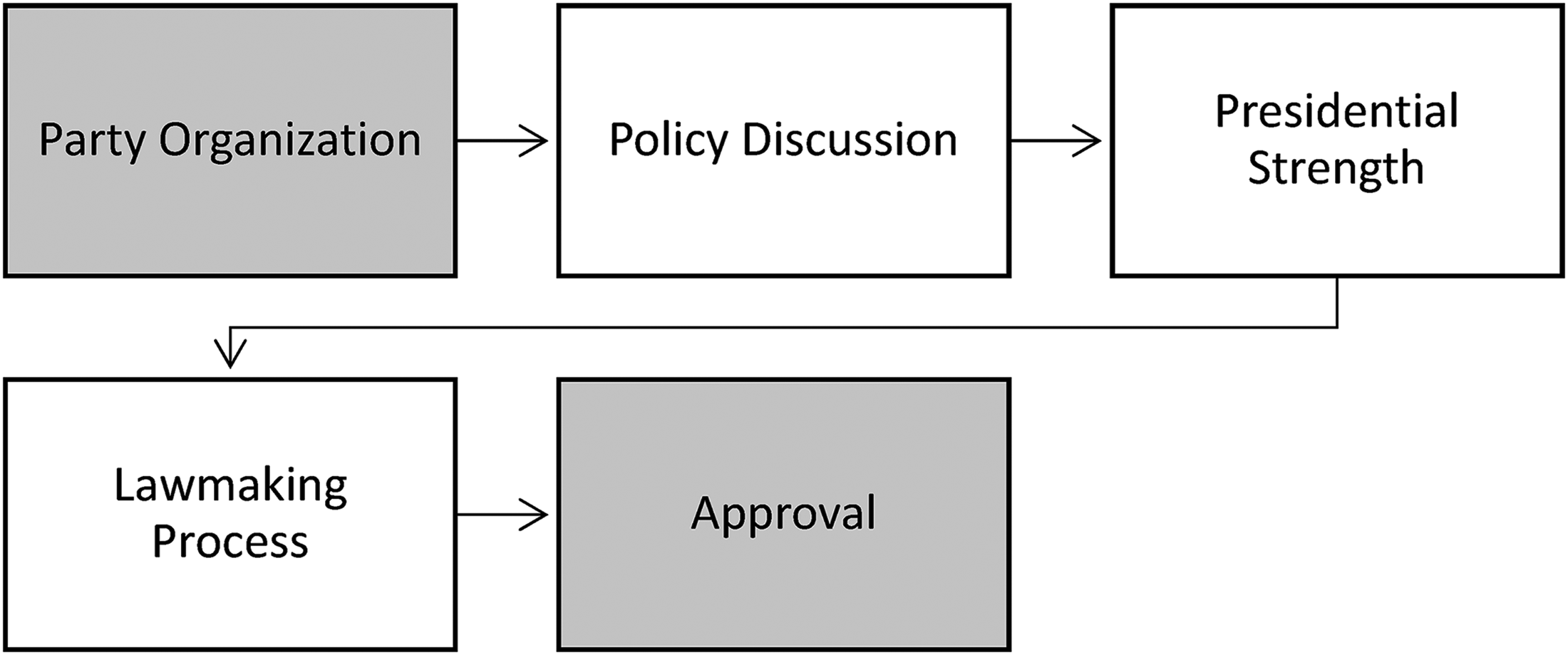
The Causal Path from Party Organisation to Policy Approval.
The theoretical focus of this article – the link between party organisation and bill approval – requires further qualification. This approach treats party organisation as the independent variable relative to the outcome of interest. However, party organisation and its changes are not random; political and institutional forces at multiple levels can shape it. It is therefore possible that other factors influence party organisation and, through it, bill approval. At the same time, a party's internal structure constitutes a political arena in its own right. I focus on this level to maintain theoretical tractability in what could otherwise become a more complex phenomenon. Thus, while treating party organisation as exogenous, I acknowledge that it may itself be shaped by other factors. Future research can examine the forces underlying the organisation of AP.
Methodology
This article examines a process and therefore employs Process Tracing, an appropriate method for testing mechanisms (Beach and Brun Pedersen, 2016; Bennet and Checkel, 2016). I present and evaluate evidence on the empirical implications of each stage in the proposed path. The units of analysis are bill proposals on which party members held divergent positions, drawn from four legislative periods. Appendix A details the data sources. Below, I outline the empirical implications for each stage of the causal path depicted in Figure 1. Each implication has a corresponding subsection in the Results section, where I present the findings.
Actors and Procedures (Party Organisation). The article describes the characteristics of intra-party decision-making, including the nature of these procedures, who the key players were (origin), their available actions, decision-making rules, and the timing of decision-making.
Policy Discussion. The article describes changes in intra-party policy discussion; particularly on the origin and number of decision-makers.
Presidential Strength. The article describes the (relative) influence of the president on intra-party decision-making. Focusing on the centralisation and coordination of decision-making.
Lawmaking Process. The article evaluates if more presidential strength reduces the time of approval of president-led bills (compared to bills sponsored by other players). Moreover, the time for approval of president-led bills should decline as the president acquires more control over intra-party decision-making. Another empirical implication of the mechanism that I propose is that bills presented by AP legislators should also be approved faster and for the same reason. If AP legislators present a bill in an area in which the party has different positions, then the organisation of the party would deal with these policy differences; as this organisation centralises decision-making power, policy discussions and agreements should come about faster.
Approval. The article evaluates if more presidential strength leads to the approval of the president's preferred content.
While Process Tracing is the core method, the research design includes a quantitative component, making it a mixed-method strategy. The empirical approach uses EHA to evaluate the relationship between party organisation and the speed of bill approval (the “Lawmaking Process” stage of the proposed mechanism). EHA is well suited to analyse the timing of events, focusing on when they occur (Box-Steffensmeier and Jones, 2004). Given this design, most of the inferential leverage comes from evidence supporting (or not) the proposed mechanism. The quantitative component constitutes only part of the overall evidence. It is therefore important to clarify the inferential scope and limits of EHA. Like other correlational methods, EHA is subject to endogeneity concerns. While reverse causality can be ruled out – the timing of events cannot alter prior conditions, other sources of endogeneity may remain. 9 The Results section addresses this limitation in light of the estimates and theory.
Consistent with mixed-method guidelines, this approach integrates rather than triangulates methods (Seawright, 2016; Goertz, 2017): quantitative and qualitative tools address different components of a single research question. Here, each method evaluates distinct stages of the proposed mechanism. However, this design departs from canonical mixed-method approaches, which typically follow nested designs where a quantitative component embeds qualitative analysis. For instance, Lieberman (2005) and Seawright (2016) propose designs in which quantitative analysis identifies general relationships, while qualitative evidence tests mechanisms or refine measurement. 10 By contrast, this study nests the quantitative component – EHA – within an overarching qualitative strategy. The quantitative analysis evaluates the empirical implications of one stage within a broader mechanism. 11
Data
I use three data sources to test the proposed hypothesis. First, I rely on interviews with former members of congress from the 2008–2017 period. Second, I compiled data on bill proposals submitted to congress during the same period. Third, I use media sources and the electronic archives of AP. The following paragraphs describe data collection in more detail.
Data on AP's internal procedures for policy discussion draw on in-depth interviews with former legislators and members of Ecuador's 2008 Constituent Assembly (CA). The interviews had two objectives: (1) to understand how ruling party members decided on legislative proposals, and (2) to assess how the party managed divergent preferences across bills between 2008 and 2017. Interviewees were legislators from the committees where proposals were debated. I conducted semi-structured interviews. 12 The quantitative component covers legislative activity. It includes data on the legislative process for bills introduced between 2007 and December 2016, as well as legislative activity through April 2017 (the end of the 2013–2017 legislature). These data come from the online archives of the National Assembly. The dataset contains 725 observations, including bill proposals and reform initiatives.
Ecuador, Correa and Alianza País
Before turning to the results, it is useful to situate executive–legislative relations and the evolution of AP within Ecuador's political context. Correa came to power in 2006 with support from a broad electoral coalition, largely from the left-to-centre spectrum, including parties, unions, environmental groups, and independent politicians. Together, they formed Movimiento País, a new political movement in a system marked by conflict among traditional parties. Strained executive–legislative relations had already contributed to the ousting of three democratically elected presidents between 1996 and 2005.
Correa's power expanded steadily. A pivotal decision was to convene a CA shortly after taking office. The resulting constitutional design strengthened the executive – particularly in fiscal and legislative powers – and the central government relative to sub-national units. This reform coincided with a commodity boom, increasing fiscal resources. Correa's influence extended beyond formal executive authority: he shaped his party, the electoral authority, local governments, regulatory agencies, and the judiciary. Through formal and informal means, he advanced his political goals while weakening vertical and horizontal accountability and electoral competition (Basabe-Serrano et al., 2010; Verdesoto, 2014). Over time, his rule became more authoritarian (Melendez and Moncagatta, 2017). The centralisation of decision-making within the ruling party should be understood within this broader trend.
Correa interacted with five legislatures during his tenure. In 2006, he faced a congress in which his party had no representation. In 2007, the CA assumed legislative powers, with AP holding a majority. The Assembly later created a temporary legislature (2008–2009), the Legislative and Auditing Committee (congresillo), again with an AP majority, to bridge the transition to the new constitutional order. The 2009–2013 legislature followed, where AP held the largest plurality. Finally, in the 2013–2017 legislature, Correa commanded a qualified majority. These bodies differed in composition, party strength, and the legislative prerogatives of the executive and congress (Aldaz Peña, 2018).
Results: A Process of Organisational Change and its Effects
Actors and Procedures
The analysis begins by identifying the main decision-makers and the rules governing their choices. I asked legislators to reconstruct how AP addressed policy content in specific bills. 13 Based on their responses, I present stylised procedures of policy discussion. While some procedures remained stable over time, others changed. A key feature is their informality: they were not codified in party statutes. They operated as accepted routines, did not necessarily align with the formal lawmaking process, lacked fixed sequences, and were used as needed.
AP members described three stages of policy discussion. The first involved only legislators; the second included legislators and executive officials; and the third involved the president and a smaller group of legislators. This article focuses on the latter two stages, where internal policy differences emerged. I label them stages of indirect and direct presidential participation, depending on the president's role.
Policy Discussion
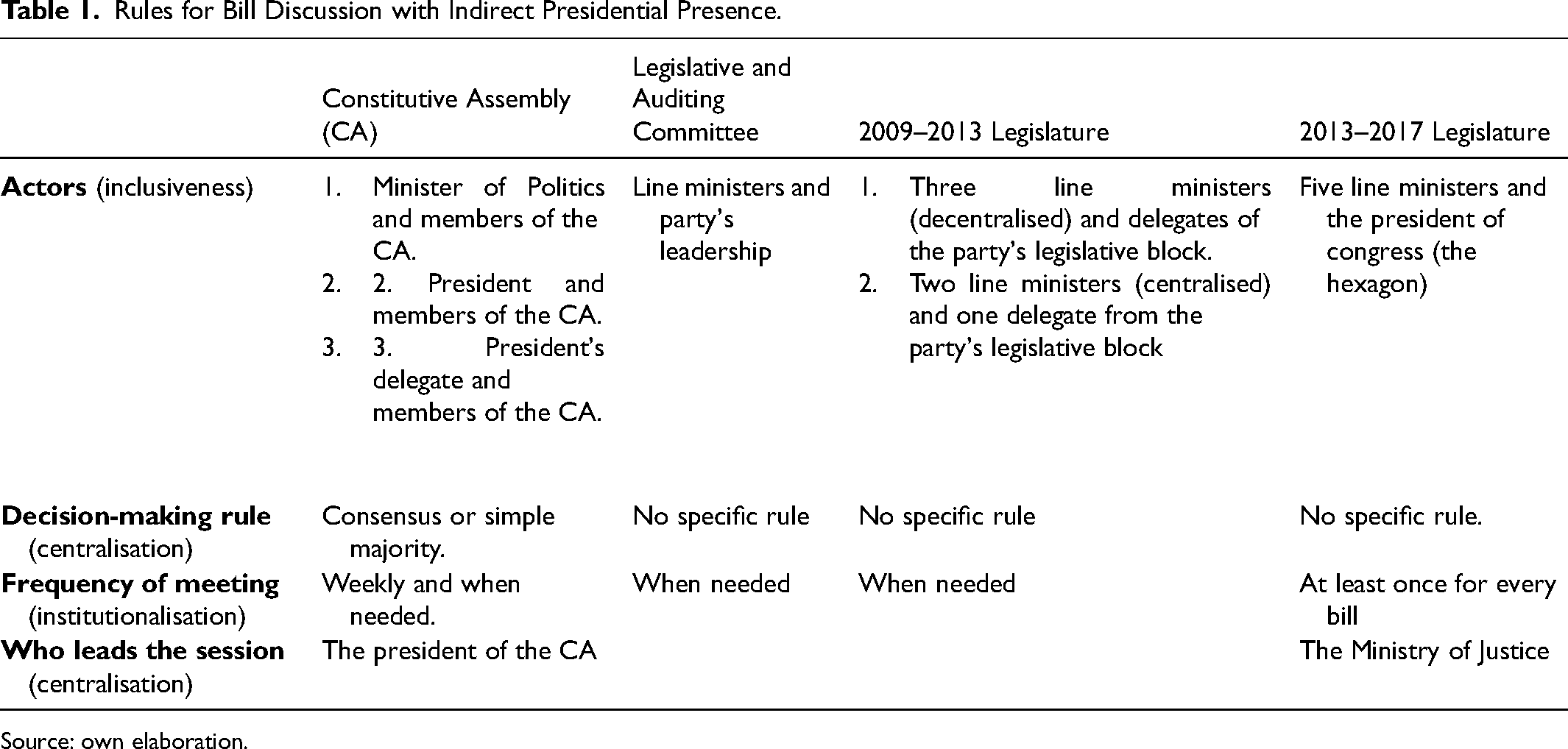
A second key feature of AP is that its organisation evolved over time. The findings identify at least four dimensions that varied: actors (and their roles), decision rules, frequency, and leadership. The following section describes how AP addressed policy proposals in chronological order. Table 1 summarises the main features of the party's structure for bill discussion and decision-making under indirect presidential involvement across legislative periods.
Rules for Bill Discussion with Indirect Presidential Presence.
Source: own elaboration.
The CA was a period of experimentation for AP. Different actors represented the executive in policy discussions. Initially, the Ministry of Politics served as the main link between the president and the CA. 14 As the work of the CA evolved, Correa participated directly in meetings on constitutional and policy content. Eventually, the executive and the CA's president designated a single coordinator to facilitate communication. Before this designation, many members of the CA claimed to know the president's position, when in fact they did not. Lack of complete information prevented agreements, created the need to have a more direct and permanent dialogue, and motivated the existence of a coordinator.
The first half of the 2009–2013 legislature marked the first organisational change within AP. Policy discussions were structured through three channels. A political channel, led by the Minister of Politics, managed internal and external negotiations (with legislative allies). A legal channel, through the Ministry of Justice, aimed to ensure coherence and avoid contradictory legislation. A technical channel connected line ministries with legislative committees to address substantive policy content.
Subsequent changes took place during the second half of the 2009–2013 and the 2013–2017 periods. Both changes centralised policy discussion inside the executive. First, the executive established a triangular setup that brought to the discussion table three parts: the executive's legal adviser, the line minister closest to the area under discussion, and a representative of the party's legislative block. The second change introduced more line ministers to the discussion and changed the identity of the person that represented AP's legislative block; this setup was labelled “the hexagon.” Six people were part of this arrangement; five of them were line ministers: the Ministry of Justice (who presided the ‘hexagon’), the Planning Secretariat, Ministry of Politics, Public Administration Secretariat, and the President's legal adviser (who participated on behalf of the president); the last member was the head of congress (also an AP member). But depending on the topic and the bill, other people were invited to participate. However, as with previous arrangements, the rule of who were the members that met was not always followed. For example, one interviewee said that she discussed a bill in a hexagon that she devised: “sometimes the hexagon had three, seven or eight sides (…) depending on the topic, there were different people with whom we had to coordinate.” This statement conveys the idea that not all the procedures were well established.
Aside from the identity of the participants, internal discussions barely followed other procedural rules. One example is the frequency of meetings; this was a feature of policy discussion that was inconsistent across time. For instance, the hexagon was supposed to meet at least two times for each bill, before the first formal debate and before voting; the answers from interviewees suggest that in practice the frequency of meetings reflected more the practical need to craft agreements than the adherence to a set of rules. Similarly, decision-making lacked an established set of rules. For instance, in the case of the CA, the answer of one of the interviewees shows how rules were shaped according to conveniences: “many times we did vote, but not always, the leader of the block (Alberto Acosta) aimed to reach consensus (…) but when he (Rafael Correa) knew that he had the majority to impose his thesis, he asked to take a vote.” 15
Indirect presidential presence did “solve” internal differences, but it was not always successful. The approval of some bills required an additional – and final – stage of discussion. The most relevant feature of the final stage was the physical presence of Correa during policy discussion. Appendix C shows the participants of this stage of decision-making, across legislatures. Bill discussion did not follow an established sequence of stages. There is not a specific set of criteria for when or why this stage was reached. When asked about when Correa participated, the answers received were related to the feasibility of reaching agreements. For instance, one interviewee boasted of her political skills by saying that since members of the hexagon were reluctant to accept parts of her suggestions, she successfully pushed for a meeting with the President, so that she could personally explain her points to him. 16 A meeting among members of AP's legislative block and Correa was the final stage of decision-making over policy content.
Organisational changes were informal and fluid. The rules that AP followed were not codified in internal statutes. The timing of changes is not crisp for most cases. For example, during the CA and the 2009–2013 legislatures, AP adopted different organisation forms but without specific dates of rule establishment. Some interviewees mentioned that the triangular setup of policy decision-making during the 2009–2013 legislature emerged after a period of tense relations between Correa and AP legislators. 17 The Hexagon, on the contrary, is more clearly associated with the 2013–2017 legislature. Hence, while crisp changes are difficult to identify, I use legislative periods to show how features of intra-party organisation varied across time.
Presidential Strength
The intra-party decision-making process became more centralised, and the role of Correa became more influential. These are two immediate results of AP's organisational changes. The first result is the relative composition of the actors that discussed bills. From the executive side, it starts with one member interacting with assembly-members during the CA, just a few months after Correa took power. But the number of members from the executive consistently increases. Ultimately, by the end of Correa's tenure, five line ministers represented the executive during policy decision-making (2013–2017). From the side of legislators, policy discussion started with the presence of all of them (2008), but the number of legislators declined until only one became part of intra-party discussions. The party's organisation not only changed the total number of relevant actors, but their relative presence as well.
Another result of AP's organisational changes is its extent of coordination. The organisational changes introduced from the 2009–2013 legislature suggest that the president wanted to consider different views on the discussion of bills (political, legal, and technical). Moreover, the organisation of AP changed in a way that it simultaneously considered political, legal and technical aspects of lawmaking. Thus, AP devised organisational changes that allowed the president to have influence on three aspects of the lawmaking process, in an increasingly centralised structure.
Interviewees point out that Correa's influence on internal decision-making increased over time. During the CA, the content pushed by the president was constrained by members of AP. For example, one interviewee said: “when the President knew that he had the majority to impose his thesis, he asked Alberto Acosta to proceed to a vote; but many times he said no (…), he was convinced that a consensus could emerge, and many times a consensus was reached.” 18 Another former legislator also remarks the limits that Correa faced: “they wanted the text to be approved the way Correa sent, without changes, (but) there was still a force inside the block (…) who said that this is not right (…). Sometimes we (did) stop Correa.” 19 Interviewees agree on saying that 2013–2017 was the period of more presidential influence over intra-party decision-making. One legislator explained that the agreements reached inside the hexagon were mandatory; she referred to the hexagon as “the pentagon”, as the U.S. Defense Department, to highlight the adherence that these decisions produced. 20 But Correa's increasingly central role did not eradicate conflict with other party members. 21
Lawmaking Process
I use EHA to assess if the president's influence is associated with a reduction in the time for bill approval. In this case, it is of interest to understand which factors explain the timing of approval rather than the determinants of approval. 22 Given that there are no a priori reasons to assume a specific hazard rate, I consider a Cox Hazard Rate model for the data that I use, as suggested by the literature (Box-Steffensmeier and Jones, 2004; Golub, 2007; Hiroi and Rennó, 2014, 2018).
The dependent variable is the time elapsed between the presentation of the bill and its approval. This approach is standard in the literature (Golub, 2007; Hiroi and Rennó, 2014, 2018). 23 The independent variable is a proxy of decision-making rules within AP. I operationalise AP's internal rules in three ways. The first approach is to include dummy variables for each legislative period since AP's internal procedures varied across them. I should expect that bills voted during the 2013–2017 legislature should be approved faster. However, this is an imperfect strategy because other features of the lawmaking process, potentially relevant, could also vary across legislative periods (e.g. legislative prerogatives, or partisan composition of each legislature). Thus, the dummies for legislative periods would absorb all these sources of variation and will not exclusively capture the variation in the organisation of the party. I avoid this problem by defining variables for smaller time periods (2-year dummies instead of legislature-specific ones); doing so would still capture the variation of AP's organisation without being perfectly co-linear with other legislative-specific, time-varying factors. A third approach is to include a time-counting variable, i.e. a variable that increases linearly with time; in this case, it will be the number of days in government at the time of the approval of a bill. As with the second approach, this strategy would capture the variation of AP's organisation without absorbing other sources of variation.
The initial expectation is that bills sponsored by members of AP (president and legislators) should be approved faster. Indeed, a first look at the data shows that bills presented by AP members (president and legislators) take fewer days for approval. Columns 1 and 5 in Table A6 show the estimations (Appendix F). However, when I include the different specifications of the independent variable, the results change; the absolute value of the coefficients for sponsorship decreases and their statistical significance declines. These results show that the bills presented by members of AP are indeed approved faster, but via a specific channel of transmission, and not by partisan membership alone. The following lines elaborate more on this and other findings.
The first set of regressions shows that bills voted during the 2013–2017 Legislature were approved faster (column 2, Table A6). This result does not change even after the inclusion of several controls that consider legislature-specific factors, 24 the policy area, 25 the type of proposal, 26 the sponsor, the legislature in which the proposal was introduced, and the presence of different ministers of politics. 27 The results show that the coefficients for the variable of interest have the expected sign and are statistically significant in all the estimations (Table A4). However, as mentioned before, it could be argued that bills voted during the 2013–2017 legislature were approved faster due to other factors specific to that period. Thus, I take two alternative paths to avoid this problem.
Bills Voted During the Second Half of the 2013–2017 Legislature were Approved Faster.
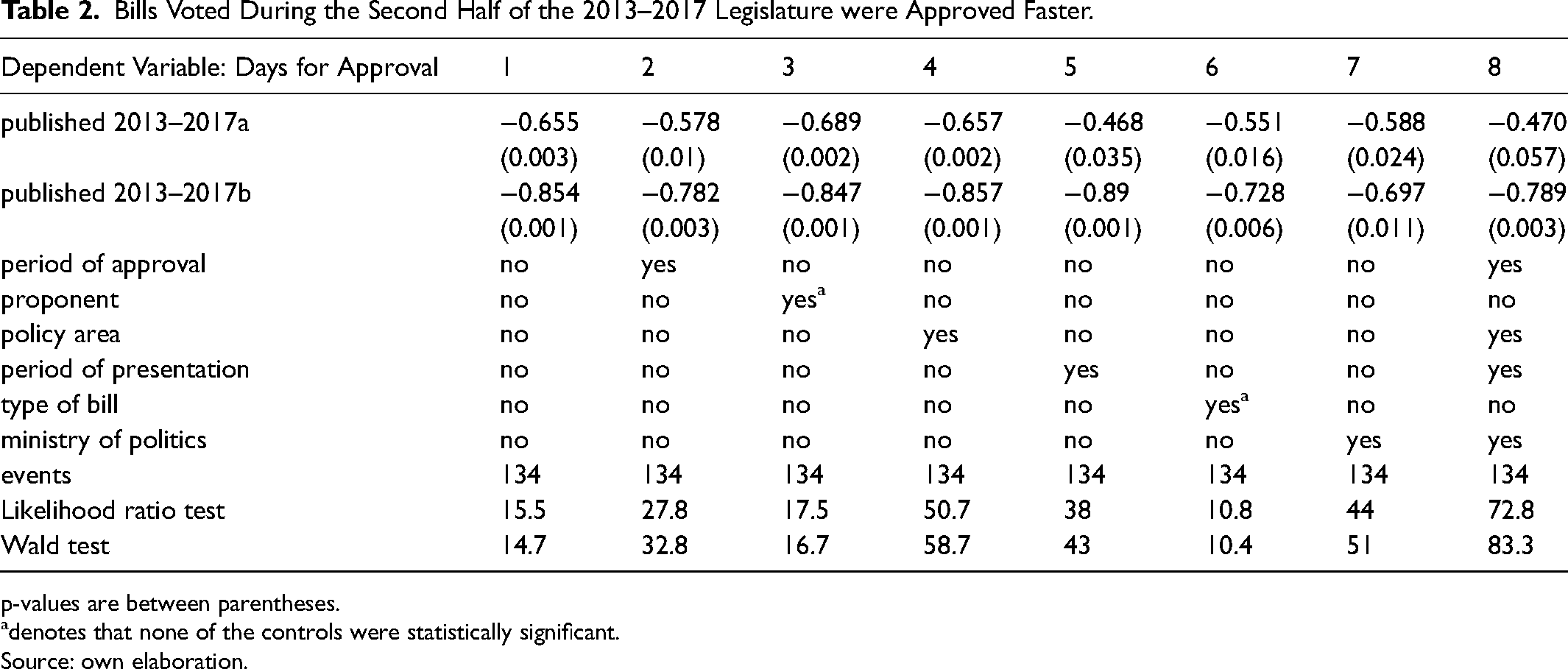
p-values are between parentheses.
denotes that none of the controls were statistically significant.
Source: own elaboration.
For the second set of estimations, I split the independent variable into two. That is, I include one variable to represent bills voted in the first half of the 2013–2017 legislature and another one for the second half (published 2013–2017a and published 2013–2017b, respectively). The absolute value of the coefficients slightly declines as the regressions include different sets of controls, but in all cases the coefficients have the expected sign. The statistical significance of the coefficient declines as well, with the inclusion of more controls, but they remain significant at different levels. Importantly, the results show that bills voted in the second half of the 2013–2017 legislature were approved faster than bills from all other periods. Table 2 presents the regression results.
I use days in government as another independent variable to avoid the potential co-linearity problem explained before. The estimations yield similar results. The coefficients for this variable have the expected sign and are statistically significant (99 percent level) across specifications, even after the inclusion of all the controls. Importantly, the results are not driven by other factors specific to each legislature. Appendix F shows the results of the estimations (Table A8). 28
The results presented in this subsection support one stage of the mechanism that this article presents. At first, bills introduced by the president and AP legislators appear to be approved faster than other bills. But when the estimations include the variables that proxy AP's organisational changes, the results change. First, AP-sponsored bills stop being significant, which shows that AP sponsorship is not correlated with approval time. Second, the variables that proxy organisational changes are significant across specifications and after the inclusion of various controls that the literature identifies as determinants of time for approval. The preferred set of estimations distinguished bills approved in the first and second half of the 2013–2017 legislature. I make this choice because it captures better the nature and timing of AP's changes while avoiding potential co-linearity problems. The organisation of AP made discrete changes, instead of continuous; thus, the variables that represent specific time periods (e.g. published in 2013–2015) capture better organisational changes compared with days in government, which is a monotonic and continuous variable.
Approval
Changes in the organisation of AP influenced how the party decided on the content of bills. Appendix G provides two case studies that show how AP's organisation operated in practice and how it influenced the approved content of bills. The case studies describe how AP managed internal disputes over the content of two bills: Decentralisation Bill (Código Orgánico Territorial, Autonomía y Descentralización, Cootad) and Penal Code Bill (Código Orgánico Integral Penal, Coip). These cases show how the party reacted to policy differences, the role that Correa had during AP's decision-making process, and the outcomes on contested parts of the bills. The next two paragraphs synthesise both cases.
On 10 July 2009, President Correa sent to congress the Decentralisation Bill. The bill had an ample scope and aimed to make considerable changes to fiscal, administrative, and political domains of sub-national governance. The main domains that created internal disputes in AP were the creation and attributions of indigenous districts (CTIs), the criteria and weights for revenue distribution to sub-national governments, the selection of the National Competences Council president (CNC), and the possibility that municipalities could organise lotteries. Throughout the policymaking process, AP considered alternatives to address preference heterogeneity, like splitting the bill into two, or eliminating blocks of articles altogether (e.g. the section on CTIs). But the party also reacted internally by adopting specific decision-making rules, like the three-way instance of internal decision-making presented in section Policy Discussion (Table 1). With this organisational innovation in place, the party was able to move forward. The party held meetings, that included Correa, at key points during the process of policy formation; the party met before the committee presented its report to the floor, before Congress voted, before Correa vetoed the bill, and before Congress addressed Correa's line vetoes. The bill was approved on 22 September 2010. The bill preserved Correa's preferred policy content on CTIs, CNC, and municipal lotteries.
On 13 October 2011, Correa sent to congress a bill that aimed to make a comprehensive reform to existing penal rules and procedures. The new bill would reform three existing pieces of legislation, define new types of crimes, and change processes and sanctions. There were three salient topics that generated different positions inside the party, the possibility to process teenagers as adults, the decriminalisation of abortion in case of rape, and the definition of medical malpractice as a penal issue. The process of policy formation led to one of AP's most difficult moments, derived from internal policy differences. On 10 October 2013, AP Legislators managed to craft support, in the floor, for a rule that would have allowed abortion in the case of rape, a policy that Correa hardly opposed. The treatment of this topic took place outside the party's rules, which led to differences going public, Correa threatening to resign, and AP sanctioning the female legislators that tried to make the change. As in the previous case, the hexagon met before Congress voted, before Correa signed the bill (line vetoed), and before Congress decided on the vetoed bill. The bill was approved in February 2014 preserving Correa's policy on abortion and a negotiated content on the two other domains.
Analysis and Discussion
This section presents the empirical implications of the stages in the proposed mechanism. First, it offered a stylised account of informal intra-party rules and procedures for policy decision-making. Second, it characterised these rules in terms of inclusiveness and centralisation (i.e. the number and origin of decision-makers) and their evolution. Third, it traced a process of informal organisational change that increased party personalisation, making decision-making less inclusive and more centralised. Fourth, it studied the relationship between AP's organisation and the rate of bill approval. Finally, it presented two case studies illustrating how the party managed policy differences and how the president shaped policy content. 29
Two analyses further scrutinise these results. First, the Lawmaking Process section evaluates alternative specifications of the EHA, including different operationalisations and control variables. Although some specifications affect the magnitude or significance of key coefficients, they remain statistically significant. I therefore reject the null hypothesis that these coefficients equal zero under standard criteria.
The quantitative component uses approved bills as units of analysis. It could be argued that this focus brings a selection bias. However, recall that the focus of this set of estimations is to understand time for approval, i.e. it considers bills that were approved and estimates covariates for the time that took the process of approval. A proposal that was not approved brings limited information if we want to know the covariates of when it was approved. 30 There is another potential limitation. Let's assume that the ruling party can kill a bill even before it reaches a committee. If this is a systematic behaviour, it will show that the ruling coalition also used formal legislative prerogatives to address preference heterogeneity, in addition to party rules. The use of intra-party rules is only one strategy, but there could be other mechanisms that the ruling coalition used to address preference heterogeneity.
Appendix H considers alternative interpretations of the evidence. The article aims to develop a theory of how party organisation affects policy approval rather than test existing frameworks. Accordingly, alternative explanations are assessed at each stage of the mechanism rather than against competing full mechanisms. Appendix H presents criteria and evidence that support the proposed stages, contradict alternatives, and, in some cases, do both. Overall, the evidence supports the plausibility of the proposed mechanism. Future research should refine or challenge it with fresh evidence from AP or other cases, ideally through explicit comparison with alternative mechanisms.
The case shows how personalisation within the ruling party shapes whether a president can use it as a policymaking tool. The analysis highlights two organisational dimensions – inclusiveness and centralisation – that structure decision-making over policy content. Three features of AP stand out: its informal and fluid organisation, its process of organisational change, and the increasing personalisation that made the party more decisive despite preference heterogeneity. 31
The case also points to tensions between party-level and system-level forces. In other contexts, organisational features such as party–society linkages may shape president–party relations and policymaking, as shown by Anria and Cyr (2017). More broadly, variation in party organisation warrants further study. The relationship between the executive and the ruling party likely depends on both system-level factors (e.g. electoral rules, as in Frente Amplio or Institutional Revolutionary Party) and party-level characteristics. Future research should identify when each set of factors is more influential and under what conditions parties enable (e.g. AP, PRI) or constrain (e.g. MAS) presidential power.
Conclusions
This article opens the “black box” of a political party to understand when it becomes an effective policymaking tool. The article links specific organisational features of the ruling party to policymaking outcomes through the case of Rafael Correa and AP. I argue that AP underwent a sequence of informal organisational changes that reallocated decision-making power over policy content, placing Correa at the centre. These findings illustrate how the ruling party went through a personalisation process. But also, they highlight that intra-party conditions can transform a majoritarian and heterogeneous party into an effective policymaking tool. 32
I propose a mechanism connecting the organisation of the party and policy approval and use a mixed-method approach to evaluate it. Specifically, I use a Process Tracing design that nests quantitative and qualitative methods. The evidence shows that AP adopted specific informal rules and procedures; this process of organisational changes concentrated decision-making power in the executive; which, in turn, contributed to a faster approval of president-led bills and helped him advance his preferred policy content. 33
This article contributes to and connects the literature on the presidential toolbox framework and on the personalisation of politics. Chaisty et al. (2018) show that presidents can use an array of tools to advance their policy agenda, including the ruling party. But there is a need to problematise the relationship between the president and her party to understand under which conditions and contexts the ruling party can become an effective presidential tool. In turn, Richter et al. (2025) propose that the personalisation of politics entails the concentration of power in the policymaking process, via institutional changes, among other processes. This article presents a case where the ruling party adopted changes in internal rules and procedures that concentrated decision-making power in the hands of the head of the executive. When preference heterogeneity exists, especially in the ruling party, a coordination problem arises, which could delay or halt president-led policy changes. A personalisation process that concentrates power can overcome this coordination problem. The organisation of the president's party can be highly relevant in cases of broad-based or weakly programmatic parties, where preference heterogeneity is likely to arise.
In comparative perspective, these findings show that parties can play different roles with respect to the president's policy agenda. Two sets of conditions appear to be relevant. Characteristics of the party system can make presidents more likely to secure partisan support, like the PRI and Frente Amplio cases show (Casar, 1995, 1999; Chasquetti, 2011). But intra-party organisation can also affect the relation between the president and the ruling party, halting the president's agenda when strong party–society links exist (Anria and Cyr, 2017; Anria, 2019) or advancing it when internal rules concentrate decision-making power, as this article shows. Further research should integrate these findings to elaborate if and how system-level and intra-party characteristics are interconnected, and the conditions under which these characteristics are more influential.
This article helps us understand Correa's ambitious wave of policy changes. He led the approval of a policy agenda not seen before. While part of his success was due to the ample use of fiscal and institutional prerogatives (Aldaz Peña, 2021; Polga-Hecimovich, 2020; Sánchez, 2022), his party was another element that helped him secure congressional support for his agenda despite its heterogenous nature. These findings suggest that a majoritarian party might not be enough to obtain legislative support because preference heterogeneity could halt a policy agenda. In a country characterised by an inchoate party system and weakly programmatic parties (Mainwaring, 2018), the personalisation of the party could be a necessity to overcome preference differences.
The findings presented here do not advance clear normative implications, in my opinion. While a specific organisational form could facilitate the approval of the president's policy agenda and reduce legislative obstruction, it also concentrates decision-making power, which could have detrimental effects. Further research can explore the degree of structure and agency over party organisation; for example, studying who pushes for organisational changes in a party, which organisational options are feasible, or the links between parties’ genetic features and organisational choices.
Supplemental Material
sj-docx-1-pla-10.1177_1866802X261462168 - Supplemental material for How to Craft a Presidential Tool: Personalisation, Party Organisation and Lawmaking
Supplemental material, sj-docx-1-pla-10.1177_1866802X261462168 for How to Craft a Presidential Tool: Personalisation, Party Organisation and Lawmaking by Raúl Aldaz Peña in Journal of Politics in Latin America
Footnotes
Acknowledgements
I want to thank Diana Dávila Gordillo, Kathryn Hochstetler, Peter Kingstone, Andrés Mejía Acosta, John Polga Hecimovic, Timothy Power, two anonymous referees, journal editors, and participants of the Party Congress Research Group and ECPR Joint Sessions for their comments and suggestions. All remaining mistakes are my own.
Data Availability
I can provide all the data used for this project upon request.
Ethical Approval
This project was conducted under the rules and approval of the Ethics Committee at King's College London.
Funding
The author(s) disclosed receipt of the following financial support for the research, authorship, and/or publication of this article: I received funding from the Secretaria Nacional de Ciencia, Tecnología y Educación Superior.

Supplemental material
Supplemental material for this article is available online.
Notes
Author biography
References
Supplementary Material
Please find the following supplemental material available below.
For Open Access articles published under a Creative Commons License, all supplemental material carries the same license as the article it is associated with.
For non-Open Access articles published, all supplemental material carries a non-exclusive license, and permission requests for re-use of supplemental material or any part of supplemental material shall be sent directly to the copyright owner as specified in the copyright notice associated with the article.
