






Abstract
Chinese population policy has long been shown to be a highly productive site for generating new social categories to enable governance. The article employs the sociology of knowledge approach to discourse and focuses on two recently much-debated categories: “families who lost their only child” (shidu jiating) and “empty-nest elderly” (kongchao laoren). Here, population policies intersect with larger social trends and new family situations. I investigate how these groups are delineated in the academic discourse thus creating the objects for social policy interventions. This process is by no means free of contention since the definition of the underlying problem entails certain policy prescriptions to tackle the issue. I demonstrate how problematising these specific groups normalises an idealised form of intergenerational care that is aligned with the interests of the state but clashes with social realities in contemporary China.
Keywords
Introduction
Building on Foucault, many scholars have found that discourse plays a powerful role in governance (Lemke, 2011). The Chinese state with its large propaganda machinery and strong sway over the social sciences has been exceptionally adept at wielding this instrument – even though this is by no means a conflict-free process and contentions over meaning-making and policy can always be found, even if sometimes indirect or hidden from plain sight. Population policy – a policy area in which China's party-state has been extremely ambitious – is a case in point. As Greenhalgh and Winckler (2005) demonstrate, over the decades in which the state implemented the one-child policy (OCP) it has shifted from direct hierarchical interventions and coercion to stronger reliance on indirect means and a “neoliberal biopolitics,” akin to what Schubert and Alpermann (2019) call “soft steering via discourses under the shadow of hierarchy.” Such an approach allows the state to guide social actors in its preferred direction by influencing the discursive environment in which they make their choices. But the state is not alone in determining the discursive field. As envisaged by Foucault, scientists play a crucial role (Bowker and Star, 2000: 137). They not only deliver the state's message and propose ways to shape policies to achieve state-set goals. In their work, scientists create the objects of intervention and shape the understanding of the issues themselves (Wong, 2016). Thus, the role of scientists in both instituting and abolishing the OCP has been analysed in detail in several major works (Greenhalgh, 2008, 2010; Scharping, 2003, 2019).
Over the past four decades, profound demographic and social transformations have reshaped the structure and functions of Chinese families. Rapid fertility decline and massive rural–urban migration have made families smaller and more spatially dispersed, thereby significantly reducing their practical capacity to provide care for both older adults and children (Yan, 2023). With the OCP replaced by a “two-child policy” since 2016 and a “three-child policy” since 2021, China's population discourses have gradually shifted their focus from discussing birth to debating old age and especially the thorny problem of eldercare provision (Van Gerven, 2019). The issue of aging has crept higher and higher on the government's agenda starting in the mid-1990s but gaining more traction under Xi Jinping since 2012 (Alpermann and Zhan, 2019). China transitioned from what is defined as an “aging” to an “aged” society in just twenty-two years: its population share aged sixty-five years and older doubled from 7 per cent to 14 per cent between 2002 and 2024 (Glinskaya and Feng, 2018: 6, for definition; World Bank, 2026, for data). China's speed of aging is much faster than that of developed countries in Europe or North America which took between forty and fifty-nine years for such a doubling of elderly population shares. But it is in line with neighbouring countries in East Asia (Japan: twenty-four years; South Korea: eighteen years), though these experienced aging at higher levels of economic development per capita (Feng et al., 2020: 4). In response to such an “aging tsunami” (Tu et al., 2022) the central government has tasked localities to increase their eldercare facilities but left the concrete ways to achieve the targets to localities (Alpermann and Maags, 2024). Despite these efforts, meeting eldercare needs presents considerable challenges, especially in rural areas and for specific age cohorts (Yan, 2026; Zhang, 2018).
At the same time, state policies have consistently promoted family responsibility for welfare provision since the 1990s, and the revival of filial piety discourse under Xi Jinping has further moralised intergenerational obligations (Barbalet, 2025). This reframing of structural issues as matters of family responsibility has rendered certain families that lack children's support particularly vulnerable in eldercare. These “key groups” are being identified in the academic and policy discourses, thus creating the targets for social policy intervention. In this article I examine the emergence, delineation and debates surrounding two particular groups in order to analyse how social categorisations are created to be employed for government interventions in contemporary Chinese population. The first group of interest is “families who lost their only-child” (失独家庭, shidu jiating) (aka “old people who lost their only-child” 失独老人, shidu laoren). The second group are “empty-nest elderly” (空巢老人, kongchao laoren; and to some extent “left-behind elderly” 留守老人, liushou laoren). This structured comparison of similar cases allows us to draw more general conclusions with regard to prevailing patterns of emerging social categorisations in the field of population policy. I argue that these discourses bring into view certain disadvantaged groups, while at the same time normalising an idealised family-based form of eldercare that is very much in line with governance objectives pursued by the party-state.
The article proceeds as follows. I first review the literature on the interactions between academic discourses and governance in China and locate the current study in this context. Second, I introduce the sociology of knowledge approach as the conceptual framework (Bowker and Star, 2000; Keller, 2011, 2013). Next, I discuss the data, academic studies selected from a database, and methods. The main part of the article presents the findings of the discourse analysis, discussing three questions for each of the two groups (shidu and kongchao): (i) how to delineate these groups (membership); what makes them particular (group characteristics); what or who is blamed for their predicament (responsibilitisation). It highlights the controversies, inconsistencies and oversights in the discourse. In the discussion, I focus on the knowledge/power effects of the discourses presented (Keller, 2018: 29). Here, I develop the argument that the mainstream of the discourse normalises a particular vision of “good” aging by presenting certain family constellations as inherently problematic. This vision comes very close to that propagated by the party-state in its official policy documents and state media but clashes with Chinese realities. Thus, I intervene into current debates on the sociology of family in China (cf. Barbalet, 2025; Yan, 2025) in a similar way as Gu (2022) by showing how “a dominant ideology of ‘the normal family’” is being produced through discourses focusing on “weak groups” within society (in her case “left-behind children” or 留守儿童, liushou ertong).
Academic Discourses and Governance in China
Conventionally, the political role of academics in Chinese politics was often framed in terms of “intellectuals” and “party-state.” This is most prominently the case in the work of Goldman (1981) who sees them acting as government “advisers” as well as occasionally “dissenters.” If in “the Goldman school” (Cheek, 2016: 21) the focus was on dissident intellectuals, others later highlighted the crucial roles of “establishment intellectuals” (Hamrin and Cheek, 1986). But what these approaches shared in common was their emphasis on the direct involvement of intellectuals in the public sphere or politics. However, after scientists had repeatedly failed to push for liberalisation in the political realm (Miller, 1996), a shift towards professionalisation occurred in the twenty-first century. More Chinese scholars withdrew from the heavily state-controlled “official world” and instead focused on the “academic world” (Cheek, 2016: 280–281). As Cheek observes, “even those who still speak up increasingly do so as experts in their field rather than as public intellectuals or social critics” (Cheek, 2016: 281). “Broader intellectual debates,” as far as they still take place in Xi Jinping's China, can provide a window into the “practice of governance” (Veg, 2019: 23). However, in most cases, it will be impossible to draw direct causal links between these spheres. Rather, I propose to see academic discourses and policymaking as two spheres which are only loosely coupled with one another: there definitely is a connection between them – He (2013: 198) even speaks of a “bureaucratisation” of political or social science due to strong state guidance regarding topics and framing. In individual cases, it may be possible to establish exactly how certain ideas came to influence policymaking (Leisering et al., 2017). Yet, more often this connection will remain opaque due to the untransparent policymaking process and the disparate nature of knowledge production in the social sciences. But even so, it does pay off to study academic discourses, as Veg (2019: 23) argues: “Public intellectual debates can serve as a proxy for political discussions that take place behind closed doors.” While the analysis below highlights the alignment between academic discourses and state norms of family-based aging, I do not assume a direct equivalence between the two. Rather, following He (2013) and Veg (2019), I argue that the relationship between the state and academia in contemporary China is loosely coupled, meaning that scholars retain professional autonomy while working within institutional environments shaped by state priorities, funding policies and discursive expectations. In such a context, expert knowledge often tends to unintentionally reinforce the state's preferred rhetorics, as Gu (2022) shows in the case of left-behind children. In the field of aging, this means that academic categorisations of shidu and kongchao frequently emphasise the absence or inadequacy of children's support, thus reproducing a normative model of “normal family” that mirrors the state's long-term promotion of intergenerational responsibility.
Moreover, I follow Bowker and Star (2000) in their call for social sciences to unearth how systems of classification and categorisation have come into existence to “more deeply explore the terrain of the politics of science in action” (Bowker and Star, 2000: 48). With respect to Chinese population policy, Greenhalgh (2008) has compellingly demonstrated how a Foucauldian lens can be a powerful tool to analyse the nexus between “science” and “politics” in the People's Republic, if appropriately attuned to the Chinese context. Greenhalgh zooms in more narrowly on the specific part played by “scientists” in population governance: “The governmentality perspective emphasises the importance of mentalities or rationalities of governance, especially knowledge- or science-based ones. Science is the core logic in modern systems of governance and power” (Greenhalgh, 2008: 8). With that she draws attention to questions of policy problematisations and knowledge-production, i.e. the natural purview of academics and scholars. Very often, they are the actors who bring issues to political attention, frame them as objects for (social) policy intervention, and provide convincing solutions based on “scientific” evidence and analysis (Wang, 2008). They may influence policymaking and/or change the understanding of the issue in question within society through the discourse they create.
In a similar Foucauldian vein, Wong (2016) analysed how modern sexology was introduced in China, how this science informed everyday understandings of “sexual happiness” and how this is connected to governmentality through the creation of “the desiring subject.” In her case, the connection between classifications social scientists create and the process of governing is more exclusively indirect compared to the population control measures discussed by Greenhalgh, since governance is primarily in the form of “soft steering through discourses” rather than direct interventions by state actors in citizens’ private lives. Nevertheless, “sexual happiness” is deemed necessary not just for individual fulfilment but for the larger purpose of “marital harmony and social stability” (Wong, 2016: 79). Knowledge produced by social scientists provides the linkage between these objectives through classifications of what counts as “healthy sexual behaviour.”
More recently, Heger-Laube (2025) thoughtfully dissected the emergence and usage of the social category of “landless peasants” (失地农民, shidi nongmin) in Chinese social science literature. While her primary interest is in reconstructing the narrated self-perceptions and emergent identities of those who are thus labelled, what we can learn from her work here is that this social categorisation is overly homogenising and treats a huge – but mostly not interlinked – segment of society as an actual “social group” with common characteristics and purportedly even a collective identity (Heger-Laube, 2025: 44–48). Moreover, this group – like the ones I am interested in – is by definition seen as “weak” by those who delve into studying it. Like other categorical and negative classifications this brings in a dimension of “inferiority” – not just “inequality” – and “otherness” – instead of mere “difference” – as Holbig and Neckel (2016: 403–406) show. As they elaborate, “[f]or weaker groups, the rule is that ‘weakness’ is a particularly threatening classification when it justifies not only gradual inequality, but categorical inferiority” (Holbig and Neckel, 2016: 418). Thus, they point at the general paradox underlying social categorisations and social policies that in order to protect the weak, one must identify them, yet this label can in itself become a force to reproduce their subordinate position in social hierarchies if it is reified. This is demonstrated clearly in a study on yet another “weak (social) group” (弱势群体, ruoshi qunti), namely recipients of minimum livelihood guarantee payments (低保户, dibaohu). Here, Alpermann (2016) demonstrates how respondents both strive to be included in this classification for the sake of receiving benefits, while they simultaneously contend with the negative stereotypes inherent in the label (cf. Chen et al., 2022).
The classification of one of two population groups that are in focus here has also been studied previously. Alpermann and Yang (2020) analysed shidu families through the lens of academic discourse, policy responses and shidu petitioners’ own conceptions, while Yang (2023) focused on the interactions between state support and popular contention by members of this group. Both studies highlight the intricate problems of social classification and how it is being utilised by different actors. However, they do not systematically explain the categorisation process itself, nor do they compare this case with similar ones to examine commonalities and differences. Thus, I build on these earlier works to demonstrate how social categorisations of elderly people in China are conceived and contested, comparing shidu with kongchao elderly to allow for a most-similar case design to bring out the variations and nuances.
Sociology of Knowledge as Framework
Building on the above, I use a sociology of knowledge approach to study social categorisations, as outlined by Bowker and Star (2000) in their seminal work Sorting Things Out: Classification and Its Consequences. While these authors also aim at contributing to other fields, such as “technology, history and information science” (Bowker and Star, 2000: 6), the goal here is to enrich the understanding of how academic discourses generate social categories which subsequently inform governance. Methodologically, this article follows Keller's sociology of knowledge approach to discourse (SKAD) (Keller, 2011, 2013; cf. Alpermann and Fröhlich, 2020). SKAD integrates concepts and theoretical elements developed in the tradition of Foucauldian discourse analysis and the discourse theories that built on it into the sociology of knowledge approach which flowed from Berger and Luckmann's (1966) The Social Construction of Reality. SKAD thereby opens up a comprehensive research framework for the analysis of institutional forms of knowledge production both as public and specialised discourses. Within SKAD, doing discourse analysis is understood as a hermeneutic process of interpreting texts. It is therefore situated in the qualitative-interpretive paradigm of social science and, as such, it is based on its epistemological premises: human understanding of and communication about the world is premised on social knowledge. Reality is “constructed” in so far as it only becomes meaningful for humans once they understand it through the prism of socially constructed, typified schemes for interpretation and action.
In the mediatised and scientised societies of our information age, knowledge is not primarily produced, circulated, institutionalised and transformed in the private realm of small life-worlds; instead, this process mostly happens on a collective level in the form of discourses. SKAD therefore analyses processes of knowledge production and its (semi-) public circulation in institutional fields like politics, academia or the mass media. It understands a discourse as an institutionally regulated practice of sign usage (cf. Keller, 2011: 12) which forms around a specific subject matter. While a discourse is realised in concrete material utterances, these utterances can be condensed into a limited set of statements about a subject matter which are characterised by common patterns, practices, rules and resources of meaning-making (cf. Keller, 2011: 234), in short, the discourse.
The production of knowledge in discourse is a process, and it is the goal of SKAD research to understand this process. Causal explanations, e.g. how “the discourse” influences policymaking, are beyond the scope of this approach (Hornidge et al., 2018: 4, emphasis in original). Instead, SKAD asks for the ways in which knowledge is socially constructed, communicated, externalised, institutionalised, legitimised and transformed on the institutional level, and explores the effects and implications thereof. Discourse production is conceived of as a conflictual interaction between actors who have (or do not have) different resources at their command and use varying strategies to pursue their (discursively framed) interests. What they contest for is the power to define which interpretation of reality and actions towards it are accepted as legitimate.
Data and Methods
The data for this study comes from the China National Knowledge Infrastructure (more precisely the China Academic Journals database). First, all articles with the term shidu or kongchao in their title were identified, initially for the timeframe until 2019, later expanded and updated (see Figure 1). The articles analysed for this study were selected out of this corpus based on the ideas of theoretical sampling, as proposed by Keller (cf. Corbin and Strauss, 2008). That is, I first chose to analyse items that create maximum contrast of positions in the discourse arena – based on author's positionality (institutional and disciplinary background, academic prestige, etc.), topic, approach, etc. Additional criteria for selection were the popularity of the article (measured in download figures) and the year of publication (to gauge trends over time). These criteria were not used in a rigid way to mechanically select specific articles but considered alongside other factors mentioned above. Based on this preliminary analysis, I then further selected articles that provided a maximum contrast to what I already found to allow us to gauge the range of discursive positions. Alternatively, I selected similar content in a strategy of minimal contrasting to bring out finer nuances within a given position (Keller, 2018: 39). This process continued to the point of saturation (Nelson, 2017). In total, I analysed some 90 Chinese-language texts (and perused many more) as well as reviewing the English-language literature on the subject. Below, I only provide “anchor examples” to illustrate my observations, since the full documentation of all materials would take up too much space. Interested readers can receive it upon request.
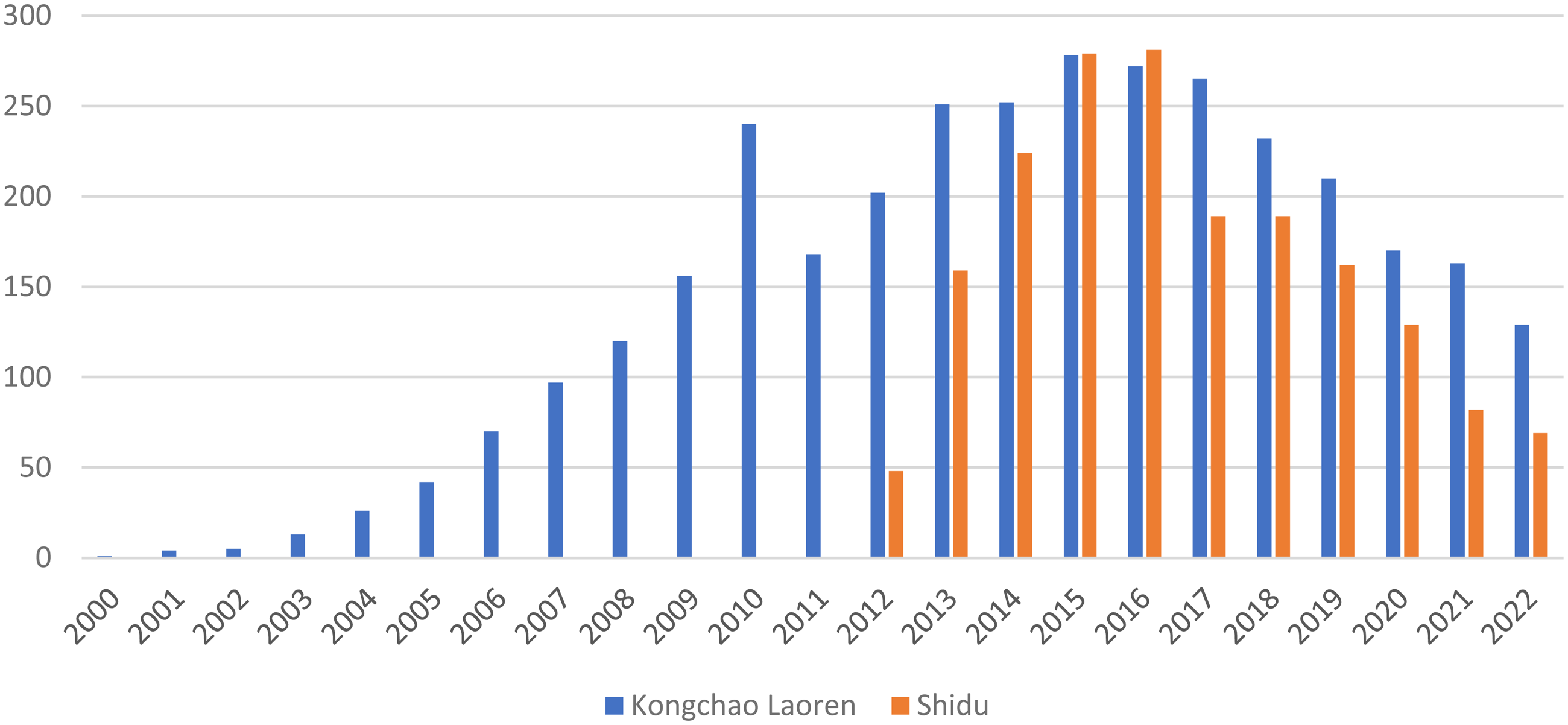
Number of Publications with “Shidu” and “Kongchao” in Title.
It turned out that the strategy of minimal contrasting is much easier to apply than its opposite since Chinese academic discourses tend to be “bloated” due to what Alpermann and Fröhlich (2020) call a “bandwagon effect.” Chinese academics are materially incentivised to publish as much as possible, irrespective of topic and their own specialisation. Thus, Miao and Gong (2026: 1172) cite a mid-aged academic: “I write whatever is popular, whatever articles are more likely to get published.” While I do not claim that this strategy is followed by all within Chinese academia (or, indeed, that it is unique for China), it is pervasive enough to create a lot of repetition. This, in turn, renders any attempt at quantifying particular positions moot. My purpose, instead, is to outline the way knowledge about the social categories shidu and kongchao is being produced and what the “power/knowledge effect” (Keller, 2018: 29) of this discourse is. To do so, I focus on three questions in the following sections that present the findings: group membership, group characteristics and responsibilisation.
Group Membership
“Categories and their boundaries are centrally important in science, and scientists are especially good at documenting and publicly arguing about the boundaries of categories” (Bowker and Star, 2000: 296). This observation holds true in my cases. Starting with work by demographer and long-term OCP critic Mu (2004) shidu families were coming into view over the 2000s, even though the term itself only came into academic use from 2012. In these early works, shidu were defined as those “single-child families” who had lost their child due to death. Hence, the common English translation as “bereaved single-child families.” Furthermore, only those couples are commonly treated as shidu that did not have another child (through birth or adoption) after the loss of the first (Chen, 2017; Guo, 2018). This additional criterion shows that the categorisation is not meant to bring out the direct consequences of losing a child but the absence of a child in old age. Otherwise, one would have to include families who lost a child even if a sibling remained or parents who adopted after losing their only child. Furthermore, legal documents regulating subsidies set the age limit for the shidu mother at 49 years (Ministry of Finance and NHFPC, 2010), further demonstrating this focus on the elderly without supporting children. However, it soon became clear that from a social welfare perspective, this was not the only situation deserving attention, since children might also be incapacitated (either by birth or later, for instance, through illness or an accident) and therefore also be unable to provide old-age care to their aging parents. Mu (2015) therefore proposed to distinguish between “absolute shidu” and “relative shidu” to reflect these differences but this extension of the group was not generally accepted.
A parallel issue regarding group membership arises with respect to kongchao families but with an important twist: the concept of “empty-nesters” is not indigenous but a notion imported from advanced capitalist societies. The original idea that children leaving their parents upon reaching adulthood causes an “empty-nest syndrome” of grief and loneliness among parents (in particular mothers) is by now considered too simplistic. Instead, in the international literature it is recognised that feelings of relief and freedom may have countervailing effects (Raup and Myers, 1989; Zhang, 2020: 2). Many Chinese scholars develop the concept of “empty-nest elders” based on the family life cycle model, according to which “empty-nest” describes the late phase of family life where elderly parents live on their own after their children grew up and left the family (Jiang and Chen, 2010; Yue and Tian, 2020). Similar to the shidu debate – and in contrast to the original notion of an “empty-nest syndrome” developed in the United States – the focus in kongchao studies is exclusively on old age, not on the immediate emotional impact of children moving out. An age limit is usually attached that only people aged 60 and over can be counted as an empty-nest elder in relevant discussion (Chen, 2009; Zhang and Li, 2020). This definition of the social category ostensibly revolves around the eldercare situation which could be justified in a society where eldercare facilities are underdeveloped. However, upon closer inspection, this does not hold up to scrutiny.
First, both elderly people living alone and as a couple are lumped together in the category empty-nest elders – an important variation to most international studies that do differentiate here (Zhang, 2020: 2). Arguably, if the care situation was the major concern, then whether elderly parents live as single or with their spouse should be a main factor to be considered (cf. Yan, 2023: 5). Yet, what I find is that most studies on kongchao foreground only the vertical, or intergenerational, care situation and completely disregard the horizontal or intragenerational one. Second, people who have no child, either because of voluntary childlessness or the child's death, are obviously excluded by the former definition of kongchao. Thus, this makes the categorisation less about the care situation and more about the reason for not having an adult child around the house. Given this, some authors contest that a broader definition should be used to also include other childless people, like shidu and voluntary or involuntary childless (Li, 2009; Zhao and Xu, 2003). To reconcile these differences, the categorisation offered by Wang and An (2005) brings in the childbearing history of elders. They call those who remain childless in their whole life “primary empty-nesters,” and those whose child no longer lives with them “secondary empty-nesters.”
In parallel to Mu Guangzong's attempt to distinguish “relative” and “absolute shidu” discussed above, Zhang and Wang (2010) propose to distinguish between “relative empty-nest elders” (children live separately but in the same city), “absolute empty-nest elders” (children live in another city or abroad), and empty-nest elders without children (i.e. (in)voluntary childless couples as well as shidu). While this proposed usage would extend group membership and at the same time introducing gradations, other authors studying the situation in the countryside tend to restrict it further. They do not consider elderly parents living alone as kongchao if one of their children is living at least within the same village (Nie, 2017; Zhang and Yu, 2007). Yet, the physical distance, and hence practical availability for support and care, may be much larger within an urban area compared to between one village and the next. Thus, standards for operationalising the concept of elderly empty-nesters may vary considerably between city and countryside. Notably, the category of “left-behind elderly” (留守老人, liushou laoren) may actually include any elderly person who has one child who left their village for migration, even if those parents live with another sibling (Tang and Xu, 2019). On the other hand, the term liushou laoren is exclusively used for the rural population, while kongchao is being applied in urban and rural contexts.
More generally, this focus on living arrangements has come in for criticism, because it is only an imperfect proxy for care arrangements. Thus, Zhou et al. (2014) as well as Yan (2015) argue that elders become empty-nested essentially because they lack children's care. For this reason, relevant discussions should also include those who live with their children yet receive no support from them due to strained relationship and poor communication between each other. From this perspective, there are various degrees of being empty-nested – depending on the practical availability of children and their willingness to provide old-age support rather than the mere fact of living arrangements. Yet, such a gradational view challenges the whole classification, since it turns categorical distinctions into gradual ones, or a nominal into an ordinal variable (Holbig and Neckel, 2016: 405). Arguably, the ease with which living arrangements can be assessed in a survey in contrast with the intricate difficulties to adequately measure care flows between generations also makes the former a much more commonly used indicator. In other words, easier operationalisation trumps a more appropriate measurement. This has notable repercussions for the knowledge/power effects of this categorisation as will be argued below.
Group Characteristics
Given the lack of definitional consensus estimates of respective group sizes vary significantly in both cases. Instead of delving into statistical issues, suffice it to say that a lower bound estimate for shidu couples nationwide would be somewhere around 1.5 million, whereas higher bound estimates reach up to 10 million (Chen, 2017: 48; Mu, 2015: 117). The empty-nest group is estimated to be considerably larger: a recent study using the 2020 population census puts the number of kongchao above the age of 65 living as a couple at 28 million, those living alone at 26 million (Ding et al., 2025: 17).
At any rate, the emphasis of scholars studying both groups is on future trends not the present, and some paint outright horror scenarios. The scale of empty-nesters is predicted to grow with accelerating speed over the following decades. Zeng and Wang (2004) argue that around 65 per cent of urban and 30 per cent of rural elders will live in empty-nest families in the 2030s. However, the estimation from Li et al. (2003) is much more radical: they suggest 90 per cent of Chinese elders will become empty-nesters by 2030. This has to be viewed against the backdrop of rapidly growing absolute numbers of elderly: according to the report of National Committee on Aging (2006), the number of people aged 60 and over is going to reach 400 million in 2050. In comparison, Mu (2019) warns that this figure could rise to 480 million elders. For shidu the most commonly cited growth rate is much lower but still concerning: most studies rely on an official report based on age-specific mortality rates, indicating that each year an additional 87,000 cases of shidu families are to be expected (NBS, UNFPA and UNICEF, 2015: 3–5). Thus, a first shared characteristic is that both groups are made out to be rapidly increasing – though at very different levels.
However, it is important to keep in mind that these disconcerting projections are derived from merely looking at living arrangements, instead of the availability of care. Studying the latter, two rounds of a nationally representative sample survey find that the share of urban elderly depending exclusively on “self-care” rose from 2 per cent in 2000 to 9.2 per cent in 2010, the equivalent values for rural elderly increased from 0.8 per cent to 19.5 per cent (Sun and Du, 2016: 105). Without doubt, these are rapid increases and especially in the countryside present serious social challenges. Yet conversely, these figures mean that nationwide in 2010 some 85 per cent of elderly persons could rely on some form of care arrangement. It is therefore evident that the way kongchao are defined and their group size is presented has a significant impact on the urgency created to address their needs.
This urgency is further strengthened by the way the bulk of studies approach their subject: they clearly present kongchao and shidu as weak groups in society that are disadvantaged in a number of dimensions like finances, health or everyday support. Economically, shidu have to cope completely without the support of a grown-up child, but many studies also find kongchao to be financially worse off, especially in rural areas (Han and Zheng, 2011; Xing et al., 2019). There are, however, exceptions in some local studies where non-empty-nesters turn out to be worse off (Liu et al., 2014). Psychological challenges and mental issues constitute another angle from which shidu and kongchao both are presented as particularly problematic groups in a wide range of publications. For the latter loneliness leading to depression is the main challenge (Cui et al., 2011; Su et al., 2022), while for the former grief about the loss of their child and social stigmatisation are added factors (Zhang and Jia, 2018). Virtually all contributions to the discourse, therefore, see shidu as extremely vulnerable and many reference high rates of depression and suicidal ideation among them as evidence. It is, however, worth paying attention to how this knowledge is produced: studies on shidu are particularly hard to conduct since their status is not readily visible from administrative records or census data. In fact, many shidu even hide this identity due to the associated social stigma of not being able to continue their family lines (Mu, 2015). Thus, most studies rely on non-representative local samples and often lack a control group. For qualitative studies that use in-depth interviews and within-case comparison, not including a control group can be considered the norm (Munck, 2003: 114). But this practice extends to cases where statistics are being generated that are then treated as generalisable: thus, the oft-cited finding, that suicidal ideation among shidu reaches as high as 44 per cent, for instance, stems from a sample of just 50 respondents (Fang, 2013). While such a finding is quite plausible, it cannot be called robust in a methodological sense.
Things look different with respect to kongchao studies. Larger-scale (even nationally representative) surveys are more commonly used in these works and they usually include statistical comparisons between empty-nested and non-empty-nested respondents. I posit that this has to do with the fact that kongchao are more readily identifiable in such surveys provided these employ an easy-to-use operationalisation. As seen above, however, living arrangements are only imperfect proxies for actual care arrangements. Moreover, in these studies more often than not authors do not distinguish between kongchao living as couples or all by themselves. These studies therefore risk obscuring an important factor in their explanatory models. In other words, vertical (intergenerational) care flows are treated as far more important than horizontal ones.
In sum, both kongchao and shidu are being primarily studied under the perspective of what they lack or how they are disadvantaged. Against this mainstream, only a select few studies could be found that highlight the agency of shidu, e.g. in organising self-help groups (Chen, 2017; Xie and Wang, 2015). In the main, shidu as well as kongchao come across as passive sufferers of disadvantage constructing them as ready objects for state intervention. Interestingly, this tendency of depiction has been critically remarked upon in some studies, but only with respect to media images of shidu, not regarding the academic discourse itself (Ci and Zhou, 2015). If both groups are presented primarily as passive victims, this begs the question who or what is blamed for their predicament. This is what I turn to next.
Responsibilisation
In the case of shidu the major fault line of debate is between those who blame the OCP as the leading cause and those who reject this idea. The mainstream understanding of the issue is that the OCP provided only the historical background or an auxiliary cause in the emergence of the shidu phenomenon. This position holds that many (urban) families would have voluntarily opted for having only one child anyway. At any rate, the OCP did not cause the single child to die and, hence, can only be seen as a background factor (Ci and Zhou, 2015). In contrast to this, Mu (2015, 2016a, 2016b) argues vociferously that the OCP was the main cause, since all single-child families had to be regarded as “risk families” to begin with – namely at risk of becoming shidu. In one of his publications, however, he also distinguishes “policy shidu” from “voluntary shidu,” admitting that not in all cases was having an only-child a decision forced on the families (Mu, 2016a). Against this view, another group of authors recently proposed that the OCP had no role whatsoever. The logic underlying this assumed connection between OCP and becoming shidu, for them is “if only the policy had allowed more than one child, the shidu situation had been avoided.” But they point out that it is possible to formulate many more such “if only X, then Y” propositions. For instance, in cases of suicide by the child: “if only the parents had taught their child well the value of life, then the suicide could have been avoided” (Ci and Zhou, 2015: 37). With this drastic example, they attempt to change the perspective and, arguably, reapportion responsibility in what could be seen as a “blame the victim” move: shidu by suicide constitute only a small fraction of the overall numbers, but their example creates the impression that somehow the parents themselves bear a part of the responsibility for their predicament. In sum, the key issue at stake here is the role played by state policy. The implication is clear: the larger and more direct the role of the OCP, the more legitimate the claims for help voiced by shidu and their academic supporters.
In contrast to this, I find that regarding the kongchao group the consensus holds that mostly impersonal factors are to blame. The emergence of the “empty-nest” phenomenon is presented as an inevitable result of China's modernisation and industrialisation process (Chen and Yang, 2004; Nie and Wen, 2012). Socioeconomic development along with this process has been the major shaping factor in reducing Chinese people's fertility and eventually led to the prevalence of nuclear family in the society. Moreover, this family downsising trend has been further enhanced by the country's decades-long family planning programme (Li, 2009) – an auxiliary, not primary cause. Along with the rise of divorce rate, current Chinese parents generally have fewer children and are more likely to live on their own. I contend that it is relevant to highlight the impersonal character of these attributed causes. In these authors’ view, neither the children nor their aging parents are to blame, much less so the government or state policies. According to them, kongchao are a deplorable but unavoidable side-effect of mega-trends that are generally seen as progress towards modernity.
In the specific discussion about rural empty-nest families, Yao (2006) also underlined the impacts from household responsibility system and household registration (户口, hukou) system. The household responsibility system, on the one hand, has significantly improved the work efficiency in agriculture and resulted in an overall manpower surplus in rural areas. On the other hand, the loosened hukou system allows the workforce to be set free to move to cities for better job opportunities. Thus, an increased number of elders have to live alone in the countryside. Again, it is large-scale social transformations – generally understood to be improvements! – such as modernisation of agriculture, industrialisation and urbanisation which give rise to the phenomenon.
At the micro level, the increase in empty-nest families is usually explained by individual preferences of both child and parents. For example, it becomes increasingly common in Chinese society that children move to another place because of study, career, or marriage (Chen, 2009). Meanwhile, some family reasons such as limited living space, children's high work pressure, and more generally the tension between generations because of conflicted life concepts are frequently found to hold parents back from living with their children (Zhou, 2009). Their willingness to live alone is sometimes further enhanced by the neighbouring environment to which they have adjusted for decades (Zhao and Xu, 2003), let alone there are many parents who now voluntarily embrace an “empty-nest” for an independent life with more freedoms (China Research Centre on Aging, 2010). Therefore, the stress regarding factors at work on the micro-level is on individual choice and self-realisation – positively connoted concepts. In most studies, no mention is made of lacking ethical standards, particularly with respect to the core Confucian value of “filial piety” (孝, xiao). This is surprising, given how pervasive this value still is in contemporary Chinese society and how strongly it is being promoted by the government (Meinhof and Zhang, 2022). So, I specifically searched for studies that do address this notion only to find that most rather sympathise with the dilemmas of trans-local caregiving. This manifests itself in the expression 孝而难养 (xiao er nan yang, “filial but facing care problems”): these authors argue that migrant children who leave their parents behind may be filial in their hearts (孝心, xiaoxin) if not in practice (孝行, xiaoxing) (Zheng and Wu, 2022). That said, with enough searching I also managed to find the opposite position that explicitly blames a decline in moral standards as the root of the kongchao problem, though this view clearly is expressed by a minority (Hong, 2012). This distribution between different opinions seems to be in line with popular sentiments. When sociologist Lü Dewen recently claimed that “the elderly care crisis is essentially an ethical crisis” and that increasing pension payouts to rural residents would only “weaken the children's responsibility for care,” these remarks triggered a public backlash (Zhihu, 2026).
Discussion
As Bowker and Star (2000: 5) remind us “each category valorises some point of view and silences another.” With that in mind, I follow up the above comparison of the two discourses with a discussion that asks what their knowledge/power effects might be. First, the primary objective for most authors seems to be the earnest desire to shed light on a suffering group on the margins of contemporary Chinese society. Earning academic credentials or other rewards for publications may motivate some, especially those whose studies seem repetitive to policy pronouncements or offer neither fresh empirical data nor conceptual contributions. But in the main, the studies I analysed are written with empathy and compassion. In that they have a critical potential to challenge the current marginalisation and achieve some beneficial policy changes for the researched group. This is true in particular for those studies on shidu which to some extent hold the OCP responsible for the predicament of bereaved elderly. However, with the OCP repealed and replaced with a pro-natal policy, these critics have lost their most direct target.
Second, the way the two groups are constructed in the discourse – namely as quintessential “weak groups” – risks undermining any gains: “Weakness” can compel others to help the weak and defend their interests – implications that are subject to political, legal and economic analysis. However, if the weak are to be protected and empowered, they must be identified as “weak” in the first place, and this act of identification has quite paradoxical consequences. The reason is that it can serve to reify the vulnerability that it actually intends to eliminate. (Holbig and Neckel, 2016: 401)
Moreover, by problematising these groups – no matter how real their problems may be – these discourses inadvertently normalise an idealised form of aging in which elderly parents live in one household with their adult children. Thus, they reinforce a notion that is both culturally deeply embedded and currently politically strongly reinforced (Alpermann and Zhan, 2019). Yet, further differentiation may be needed. A recent study, based on nationally representative sample data collected in 2017, demonstrated that compared to elderly living with adult children nearby (network families), those living with both children and grandchildren (stem family) were happier. But those living only with their adult children (truncated stem family) were significantly unhappier than their counterparts in network families. Living isolated (kongchao) or in a skipped-generation family (only grandparents and grandchildren) had negative effects too, but these were not statistically significant (Pan and Bian, 2025: 908–909). Thus, the propagated ideal may not even be in the best interest of all elderly.
Academics contributing to these discourses may not share (in fact, may even oppose) the Party-state's agenda of deflecting eldercare problems by placing the care burden on families themselves. Yet unwittingly the knowledge they produce strengthens the notion that ordinarily elders should live with their child – no matter how unrealistic this has become in China's modernised society (Cao, 2019; Keimig, 2021; Yan, 2023). This current social condition has been theorised as “neo-familism” by Yan (2025: 754) who argued: “the relationship between parents and adult children has replaced the conjugal tie as the axis of domestic organization.” Thus, it fits the bill that, as observed above, the bulk of studies is so focused on the (lack of) intergenerational care as to overlook the importance of intragenerational (spousal) support. Despite this lack of attention, studies published internationally indicate that while empty-nest status does not predict self-reported wellbeing of elderly Chinese, those without a spouse were, in fact, significantly more unhappy (Zhang, 2020). The almost singular focus on vertical eldercare flows in the examined academic discourse stands in contrast to how the situation of “empty-nesters” is discussed internationally. Thus, given the way Chinese academics construct the two groups in their scholarly articles, they stabilise a conservative knowledge/power structure more than they challenge it. This finding concurs with Gu's (2022) analysis of media and policy discourses on “left-behind children” which also points out how “a dominant ideology of ‘the normal family’” (519) is being created through “pathologising rural migrant families” (523).
Conclusion
The actual policies adopted with respect to these two groups of elderly are beyond the scope of this article. Instead, my focus here was on dissecting the academic discourses surrounding these two groups that form the basis for later policy interventions. In summary, I find many similarities but also striking differences in the way these two groups have been conceptualised, addressed, and thus socially constructed through scholarly treatments. While I recognise some critical potential in the discourses I analysed, they also have strong conservative knowledge/power effects, in that they normalise the ideal that children care selflessly for their parents in old age which is currently also propagated by the state. In this way, social categorisations play a crucial though indirect role in population governance.
Zooming out from my own cases, I contend that similar effects may also to be found in other comparable cases of “weak” social groups” like “left-behind elderly” (Ao et al., 2016; Connelly and Maurer-Fazio, 2016; He et al., 2016), “left-behind children” (Gu, 2022) or “landless peasants” (Heger-Laube, 2025). In each of these cases and probably many more, Chinese social scientists recognise the existence of a “weak” social group in need of supportive government or social intervention, discuss the empirical problems associated with the group, engage in contention about the best definition (or operationalisation) of the group, until at some point serious doubts arise whether the whole action of labelling it is justified given that upon closer inspection its members are rather heterogeneous. I hope that with this comparative case-study of parallel discourses (a “most-similar case” design) this study provides a basis for fruitful comparisons of “most different cases” as well to shed further light on the important nexus between academic knowledge production and power in Chinese governance.
Footnotes
Declaration of Conflicting Interests
The authors declared no potential conflicts of interest with respect to the research, authorship, and/or publication of this article.
Funding
The author disclosed receipt of the following financial support for the research, authorship, and/or publication of this article: This work was supported by the Bundesministerium für Bildung und Forschung (Grant No. 01UC2000D).
