






Abstract
Existing scholarship predominantly examines how elite patronage influences the behaviour of political elites, while the ways in which businesses perceive and respond to patronage dynamics remain understudied. This study addresses this gap by investigating the impact of local leaders’ patronage status, defined as their position relative to the supreme leader within patronage networks, on firms’ research and development (R&D) activities in China. The central argument is that patronage dynamics can function as informative signals about the local policy environment, and that firm innovation behaviour varies systematically with these signals. Specifically, firms are more likely to increase R&D investment when local leaders are part of the supreme leader's network, perceiving these connections as indicative of stable and favourable conditions for innovation. In addition, changes in local leaders’ patronage status drive firms to stabilise their R&D investment levels to mitigate risks associated with potential political uncertainty. This argument is tested using firm-level panel data of Chinese listed companies, with findings strongly supporting the hypotheses. The extensional analysis shows that non-state-owned enterprises are more responsive to patronage dynamics than state-owned enterprises, that firms in highly regulated sectors exhibit greater sensitivity to these dynamics than their counterparts in less regulated sectors, and that the impact of patronage dynamics is moderated by national leadership's explicit innovation agenda. This study enhances our understanding of the political economy of firm innovation as well as the impact of elite patronage on business activities.
Introduction
Characterised by informal and hierarchical interactions between political elites, elite patronage is a key factor in creating political dynamics and building a policy environment, which then influences economic activities. Most of existing scholarship examines how elite patronage directly impacts policy formulation and implementation (Bardhan and Mookherjee, 2012; Choi, 2012; Dewan and Squintani, 2016; Gallo and Lewis, 2012; Jiang and Zhang, 2015; Wang, 2015). For example, Jiang (2018) argues that city leaders connected to their superiors have stronger incentives to promote economic growth. Liang (2024) claims that local priority in China is determined by local leaders’ calculation regarding whether or not to gain the supreme leader's patronage. However, another dimension of elite patronage remains understudied, that is, how businesses perceive and respond to the dynamics of elite patronage. By focusing exclusively on the direct impact on elite behaviour, extant literature overlooks the proactive role of businesses. As the influence of elite patronage on political behaviour gains recognition in both academia and industry, it is widely understood that elite patronage provides critical information about policy preferences, resource allocation, and the protection available to clients, all of which are key components of the business environment. From this perspective, it is natural for rational business actors to pay close attention to these dynamics, treating them as signals or proxies of the broader political and policy environment. Among the many strategic decisions firms must make in response to political cues, their innovation efforts, especially long-term R&D investment, are particularly sensitive to the perceived stability and direction of the policy environment.
This study intends to fill this gap by focusing on one critical dimension of firm response: how firms react to elite patronage dynamics when making decisions about innovation, particularly long-term investment in R&D. In particular, this study focuses on the Chinese context and examines the impact of city leaders’ patronage status, defined as an official's position relative to the supreme leader in patronage networks, on firms’ research and development (R&D) activities. China offers a solid context to understand how elite patronage influences business decisions, because: one, with relatively weak formal institutions, individual politicians weigh heavily in determining the business environment, and two, political patronage, or factionalism, exists extensively in China's political ecosystem and sets a fundamental tone for the political dynamics there.
The central argument is that firms tend to see elite patronage and its change as signals of the policy environment, on which they depend to adjust their innovation efforts. More specifically, firms are more likely to increase investment in R&D when local leaders are in the supreme leader's network, with the belief that such connections indicate favourable and stable policy conditions for innovation. Meanwhile, with a change in the local leader's patronage status, firms tend to stabilise the level of R&D investment to offset potential risks accompanying such political shifts.
The argument is tested using firm-level panel data of Chinese listed firms. The findings indicate that, first, firms tend to raise their R&D investment when city leaders are in the supreme leader's network, meaning that these leaders are connected with provincial leaders who are clients of the supreme leader. Second, year-to-year variation in R&D investment tends to decline following changes in city leaders’ patronage status. The results offer strong support for the argument and remain robust across various model specifications. In addition, extensional studies are conducted to examine heterogeneity by firm ownership and regulatory exposure and national leadership. The results indicate that non-state-owned enterprises (non-SOEs) are more sensitive to patronage dynamics than state-owned enterprises (SOEs), that firms in highly regulated sectors respond more strongly than those in other sectors, and that the influence of local patronage dynamics is moderated by the national leadership's explicit innovation agenda.
This study contributes to several branches of literature. First, it adds to the literature on the economic impact of patronage by highlighting the proactive role of the business sector. Unlike extant research that focuses on elite behaviour, this study emphasises how businesses perceive and strategically react to elite patronage dynamics, shedding light on an understudied dimension of political patronage.
Furthermore, this study contributes to the political-economic study of firm innovation by identifying a new determinant of R&D investment. Shifting the focus from traditional economic metrics (Acs and Audretsch, 1987; Barasa et al., 2017; Knight, 1967; Luong et al., 2017; Molina-Morales and Martínez-Fernández, 2010; Wan et al., 2005; You et al., 2020), a burgeoning scholarship looks into politics for explanation of firm innovation behaviours (Chadee and Roxas, 2013; De Waldemar, 2012; Dong and Torgler, 2013; Dunning and Lundan, 2008). This study contributes to this scholarship by identifying a new political factor.
Lastly, this study enhances our understanding of political uncertainty. Current scholarship often measures political uncertainty through leadership turnover (Chen, 2021; Chen et al., 2005), relying on the unsolid assumption that changes in personnel naturally result in changes in the political environment. This study challenges this assumption and proposes changes in a leader's patronage status as a more precise indicator of shifts in the policy environment. By offering a more reliable measure, the study enhances the understanding of political uncertainty and its implications for economic behaviour.
Literature Review
Innovation at the firm level is widely regarded as a driving force behind productivity, employment, and economic growth (Nelson, 1987). Extensive research has explored what drives firms to innovate. Much of this research focuses on economic factors. For example, some scholars are particularly interested in the effects of firm attributes, such as size, ownership type, financial structure, and managerial capabilities (Acs and Audretsch, 1987; Knight, 1967; Wan et al., 2005; You et al., 2020). Firm size, for instance, is often positively correlated with R&D investment level, as bigger firms typically enjoy more resources and capacity for innovation (Cohen and Klepper, 1996; Lee and Sung, 2005). Studies also document the role of ownership type, which suggests that privately owned firms have a stronger incentive to innovate compared to SOE, with the latter more constrained by bureaucratic inefficiencies (Hu, 2001; Ruiqi Wang et al., 2017). Financial structure, including access to external funding, has been highlighted as a crucial determinant, as restricted access to financing can inhibit a firm's ability to invest in risky R&D projects (Carpenter and Petersen, 2002).
Other studies examine the economic environment in which firms operate, including agglomeration economies and knowledge spillovers (Barasa et al., 2017; Luong et al., 2017; Molina-Morales and Martínez-Fernández, 2010). Agglomeration economies, defined as the advantages firms gain from geographic proximity to one another, have been shown to promote innovation by facilitating shared infrastructure and lowering transaction costs (Buzard et al., 2017; Carlino and Kerr, 2015; Glaeser et al., 1992). In addition, knowledge spillovers occur when firms benefit from the R&D conducted by other firms, particularly in clusters or regions with a high concentration of innovative activity (Audretsch and Belitski, 2020; Audretsch and Feldman, 1996; Cassiman and Veugelers, 2002). Such spillovers can be instrumental in boosting a firm's innovation capacity, especially for smaller firms that lack sufficient resources to conduct R&D activities of their own (Cabrer-Borrás and Serrano-Domingo, 2007; Xu and Wang, 1999).
Recent research has increasingly focused on how political factors, such as institutional environment and individual politicians, influence corporate incentives to innovate. To begin with, the quality of local institutions, particularly in emerging countries with aggressive government intervention, plays a key role in firm decision-making (Dunning and Lundan, 2008). For example, many studies in this branch have examined the impact of corruption and anti-corruption efforts (De Waldemar, 2012). More recent research also highlights government effectiveness as a determinant of the commitment to producing new products and introducing novel processes in firms (Rodríguez-Pose and Cataldo, 2015; Tebaldi and Elmslie, 2008; Varsakelis, 2006).
Public financing, including direct subsidies and investment by public venture capitals, has also received increasing attention from political economists (Colombo et al., 2016; Fang et al., 2018; Huang et al., 2019; Kenney, 2011). Theoretically, public support for business R&D investments is originated from concerns over market failures, which are associated with the incomplete appropriation of R&D return (Arrow, 1972; Hu, 2001). However, empirical research remains divided on the effectiveness of public financing in firm innovation. Some studies find that public financing mitigates negative externalities and encourages firms to increase R&D investment, supporting a “crowding-in” or additionality effect (Aerts and Schmidt, 2008; Görg and Strobl, 2007). In contrast, other studies suggest that firms may simply substitute planned R&D investments with public financial resources, resulting in a “crowding-out” effect (Czarnitzki and Fier, 2002; González et al., 2005).
Political leaders as makers of public policies are documented as a significant determinant of the political environment and thus influence firm innovation. This is particularly true in emerging economies, where weaker institutions increase the prominence of individual politicians. An expanding literature takes two approaches to examine how politicians impact firm innovation. One line of inquiry investigates the impact of political connections, that is, how unique resources acquired through informal relationships with politicians influence firm-level decision-making. In developing economies, political resources play a crucial role in enabling businesses to lower financing costs and accelerate growth (Boubakri et al., 2012; Cull et al., 2015). However, political connections can also impose costs, such as rent-seeking that strains R&D budgets (Li et al., 2008). Firms with political ties may also be subject to excessive political manipulation in exchange for resources, which can distort investment decisions (Wu et al., 2012).
Another line of inquiry examines politicians as decision-makers who shape institutions and policies. Most research in this area concentrates on how politicians’ policy preferences and their changes influence firm behaviour, including innovation. Studies have shown that politicians’ characteristics, such as education, career background, ideological bias, age, and career prospects, affect their policy preferences, which in turn impact firm innovation (Howell and Higgins, 1990; Kurzhals et al., 2020; Ovtchinnikov et al., 2020). There is also growing interest in leader turnover as an indicator of policy shifts and potential inconsistencies (Chen, 2021; Chen et al., 2005).
Although substantial research has explored the effects of patronage relationships and the determinants of firm innovation, the proactive role of businesses in interpreting elite patronage dynamics remains underexamined. This study also aims to fill this gap by examining how firms interpret local leaders’ patronage status and changes, and adjust their innovation efforts accordingly. With that, it adds a new dimension to understanding the interaction between politics and firm innovation, especially in the authoritarian context.
Theory and Hypotheses
Logics of Political Patronage
Patronage relationships are often viewed as detrimental to public welfare and economic growth. Conventional wisdom holds that these relationships are features of corrupt and patrimonial systems (Bratton and Van de Walle, 1994; Singer, 2009; Van de Walle, 2001). However, anthropologists have noted that, in certain contexts, government patronage can foster long-term trust, which may benefit economic development (Johnson, 2021). In organisational theory, patronage relationships based on expectations of future interactions are seen as potential solutions to organisational challenges (Baker et al., 2002). The impact of patronage relationships is inconclusive because patronage is fundamentally an interpersonal relationship without inherent implications. Anthropologists define patronage as relationships of reciprocity and kinship, where both parties exchange services that benefit each other (Landé, 1973). In these relationships, cooperation is maintained not by external mediators, but by common interest in preserving long-term benefits.
As informal, hierarchical networks of mutual benefit (Jiang, 2018), patronage relationships depend on the survival and prosperity of patronage networks (Arriola, 2009; Weingrod, 1968). This makes survival-oriented coordination the defining feature of patron–client interaction. The success and survival of the leading patron, which is essential for the network's endurance, thus becomes the primary goal of patron–client cooperation. The mutual obligations within these relationships are crucial to achieving this goal. Patrons play a crucial role in providing clients with rewards that are both highly sought-after and uniquely accessible through their relationship, such as material gains or political advantages, including opportunities for career advancement. These rewards often go beyond what formal selection processes can offer, including appointments to strategic positions or accelerated promotions. In addition, patrons are responsible for protecting their clients, whether by overlooking minor mistakes or shielding them from disciplinary actions. On the other hand, clients carry significant obligations within the patron–client dynamic. Their primary duty is to strengthen the patron's influence by upholding their authority and enthusiastically fulfilling their tasks. For example, when a patron implements a new policy with uncertain prospects, she would expect clients to take the initiative to adopt it and to deliver outcomes that validate the patron's decisions, setting a precedent for others to follow.
China's Political Ecosystem and Patronage Status
China's governance hierarchy has five levels, that is, the centre, province, prefecture, county, and township. To maintain a balance between theoretical depth and simplicity, this study focuses on the prefectural level and above, excluding counties and townships, which are considered grassroots extensions of prefectures. The three-tier framework – central, provincial, and prefectural – functions as both a hierarchy for policy operation and a system for political selection. It captures the complete policy cycle, with the central government formulating policies, prefectural governments taking charge of implementation, and provincial governments serving as intermediaries (Chung, 2016). Incorporating the role of patronage, this political system is structured as a hierarchical bureaucracy where leaders at each level have authority over the promotion results of their subordinates, and vertical patronage ties link leaders with certain subordinates, though not all are included in these connections (Liang, 2024). The central concept, patronage status, is defined as a leader's position relative to the supreme leader's network (Liang, 2024). This study operates on the assumption that the supreme leader's interests diverge from those of other national leaders, a reasonable premise given the persistent political competition within the ruling coalition. As the supreme leader is both the primary beneficiary of policy successes and the primary bearer of responsibility for failures, she is likely to possess policy preferences distinct from other national leaders. When linking patronage status to policy implementation, it is therefore justified to adopt an analytical approach centred on the supreme leader.
Figure 1 presents a simplified model of this system. At the apex of both the patronage pyramid and the political hierarchy is the national supreme leader, the central party secretary. Officials below are categorised as either clients or non-clients of their immediate superiors, according to whether or not there exists a patronage relationship. This study focuses on city leaders’ patronage status due to the critical role that city leadership plays in shaping local economic activities. City leaders in China often have significant authority over local economic policies, resource allocation, and the regulatory environment, which are crucial factors influencing the business environment. Following Liang (2024), at the prefectural level, four distinct patronage statuses emerge:
Client of Client: Prefectural leaders who have a connection with their provincial leaders, and whose provincial leaders also remain connected to the supreme leader. Non-client of Client: Prefectural leaders who lack a connection with their provincial leaders, but whose provincial leaders are connected to the supreme leader. Client of Non-client: Prefectural leaders who have a connection with their provincial leaders, although these provincial leaders lack a connection with the supreme leader. Non-client of Non-client: Prefectural leaders who lack a connection with their provincial leaders, and whose provincial leaders are also not connected to the supreme leader.
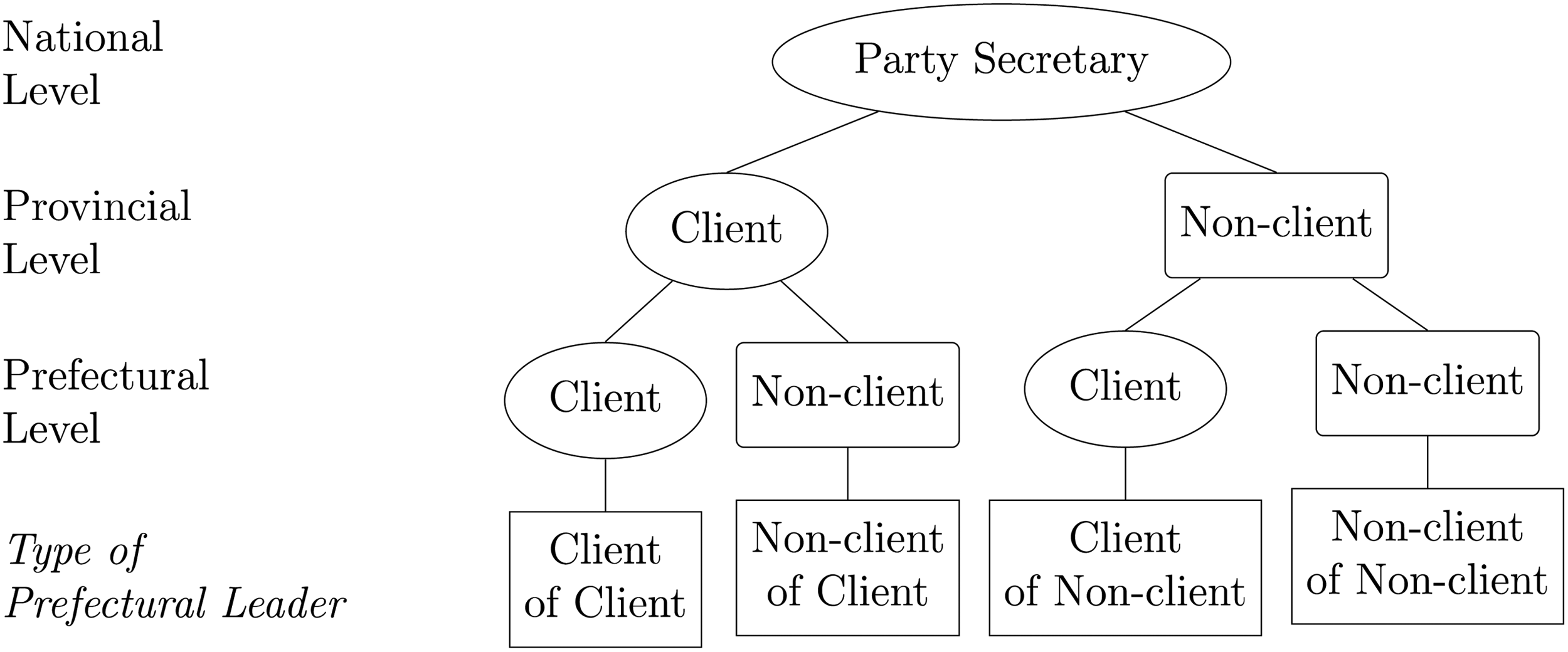
Political ecosystem of China.
Patronage Status as Indicator of Policy Favour
In China, the legitimacy of the Chinese Communist Party (CCP) is grounded in public support, which is largely derived from policy achievements. Therefore, policy prioritisation and the effectiveness of implementation lie at the heart of Chinese politics, influencing not only cadre performance evaluations but also the survival and competitiveness of patronage networks. As previously discussed, these networks operate like teams, with members working collectively to advance the network's goals, an important aspect of which, in the Chinese context, is maximising the effectiveness of their preferred policies. Specifically, within each network, the patron identifies policies that promise the greatest benefit to the network and should therefore be prioritised, as well as those that may harm the network's interests and should be avoided. Once policy preferences are established, patrons offer guidance, resources, and political support, while clients are responsible for implementing these policies within their respective jurisdictions.
Local leaders’ policy preferences and access to political and economic resources – both of which are crucial to firms’ capacity and willingness to innovate – are profoundly shaped by patronage relationships (Heilmann, 2008; Wank, 1995). Compared to other leaders, those connected with the supreme leader enjoy advantages in both areas, thereby being perceived as better positioned to create an environment conducive to innovation. First, these local leaders are more likely to prioritise innovation, as it aligns with the supreme leader's agenda. Innovation is regarded as a crucial strategy for overcoming the “middle-income trap,” a pressing challenge for China that threatens the stability of the regime, particularly for the supreme leader (Ernst, 2011). Despite its strategic importance, however, innovation is inherently costly, risky, and slow to yield tangible results (Yizhong Wang et al., 2017), which may deter many officials from prioritising it (Gao, 2015). As a result, only those leaders with strong ties to the supreme leader are inclined to emphasise innovation. In contrast, leaders without such connections are more likely to focus on policies geared towards short-term economic growth, which are more immediately beneficial for cadre evaluations.
Second, because their policy priorities align with those of the supreme leader, these local leaders gain greater access to resources and wield stronger political influence that favours innovation. Specifically, this alignment enhances their capacity to allocate funding, provide subsidies, and offer preferential treatment to local firms. Such leaders are also more likely to secure support from higher levels of government, resulting in a more favourable policy environment for businesses under their jurisdiction. The perception of increased resource availability and political support encourages firms to view the local business environment as stable and supportive, thereby reducing uncertainties that typically hinder long-term investments like R&D. Moreover, strong connections to the supreme leader can help streamline administrative processes and reduce bureaucratic barriers. By leveraging their political capital, these leaders can expedite regulatory approvals and facilitate interactions between firms and government agencies. This reduction in administrative obstacles instils greater confidence in firms to pursue innovation, as they perceive fewer risks and delays associated with government procedures.
Additionally, targeted incentives for innovation represent another benefit of having well-connected local leaders. These incentives may include grants, tax deductions, or other kinds of financial support aimed at fostering technological advancement. Such measures provide direct encouragement for firm innovation, as they anticipate a favourable political climate facilitated by the local leader's ability to effectively mobilise resources. The combination of sustainable focus, enhanced resource allocation, and reduced bureaucratic friction creates an environment perceived by firms as conducive to innovation. Hence, firms are more willing to allocate resources to R&D projects, viewing such investments as less risky and more likely to generate positive returns. Therefore,
Patronage Status Change and Volatility of R&D Investment
Local leaders’ patronage status, as a signal of policy preference and resource accessibility, is perceived as a crucial aspect of the political environment, and its change naturally indicates political uncertainty. The relationship between political uncertainty and firm innovation has been extensively studied, with scholars presenting mixed findings. Some argue that political uncertainty is negatively associated with firms’ incentives to invest in innovation (Bernanke, 1983; Khan et al., 2020; Yizhong Wang et al., 2017), while others suggest that, under certain circumstances, firms may increase investment with the expectation of a shifting political environment (Atanassov et al., 2024).
Despite the inconsistency, extant studies share two key features. First, most agree that political uncertainty affects innovation primarily through expected changes in factors crucial to business operations, such as politician-firm connections (Díaz-Díaz et al., 2022), policy environments (Bhattacharya et al., 2017; Marcus, 1981), and the resources provided by governments (Becker, 2015; Guellec and De La Potterie, 2003). Second, empirical research typically measures political uncertainty by tracking leadership turnover (Cao et al., 2022; Feng and Johansson, 2017; Yizhong Wang et al., 2017), implicitly assuming that a change in leadership automatically signals changes in the political environment.
This study departs from existing scholarship in two key ways. First, rather than increasing or decreasing R&D investment, I argue that firms under political uncertainty might be motivated to stabilise investment. Second, this study proxies political uncertainty with changes in local leaders’ patronage status instead of leadership turnover. R&D activities are inherently long-term, costly, and risky. Upon change of local leaders’ patronage status, there is an increasing risk of policy shifts, changes in resource allocation, or adjustments in administrative support. Under this heightened political uncertainty, firms are more inclined to avoid making substantial changes to their innovation investment, opting to “wait and see” how the new political dynamics unfold before making informed adjustments. Specifically, firms are less likely to make aggressive R&D investments. Bernanke (1983) and Mcdonald and Siegel (1986) highlight how capital irreversibility and uncertainty create a positive option value for deferring investments. This impact is especially significant in the context of innovation, which requires significant and often irreversible investments in intangible assets (Khan et al., 2020; Yizhong Wang et al., 2017).
Meanwhile, they are also unlikely to drastically cut R&D budgets, fearing that the situation might stabilise, and cutting R&D might undermine their competitive position. R&D investment often involves significant upfront costs that are irreversible (such as human capital and technology infrastructure investments) (Bloom, 2007). Firms are aware that reducing R&D investment too drastically could hurt their long-term innovation capabilities. Therefore, they may choose to smooth their investment patterns to avoid the high cost of restarting R&D projects once the political environment becomes stable again. By maintaining a more consistent level of R&D spending, they hedge against the risks of policy shifts that could make restarting innovation projects more costly. Therefore, the volatility of R&D investment tends to decrease following a change in patronage status, as firms adopt a risk-averse stance in response to perceived political uncertainty.
A change in patronage status inherently introduces uncertainty into the policy environment. Such a change can occur in two main scenarios. In the first scenario, while the patronage status of the city leader appears to change, the shift is actually driven by a change at the provincial level, where the provincial leader's patronage status changes between being a Client of the supreme leader and a Non-Client. This shift signifies a significant realignment between patronage networks, likely altering the overall goals and priorities that the provincial leader sets for cities within the province. Although the change occurs at the city level, it is primarily driven by the shift in the provincial leader's patronage status. Such changes create considerable uncertainty for firms, as they anticipate potential shifts in the provincial policy environment that could influence their access to crucial resources and support for innovation.
The second scenario involves a change at the prefectural level, without a corresponding shift at the provincial level. This may involve a transition between Client of Client and Non-Client of Client, or between Client of Non-Client and Non-Client of Non-Client. In this case, while the relationship between the prefectural leader and the provincial leader changes, the overarching policy goals set by the provincial leader remain stable. This means that, despite changes in the level of trust, resources, and political support that the prefectural leader receives (where clients enjoy more advantages compared to non-clients), the general direction and policy preferences established by the province do not change. As a result, prefectural-level changes do not generate the same degree of uncertainty for firms, with the broader provincial policy environment remaining relatively stable. Therefore,
Research Design
The hypotheses are evaluated through a series of quantitative analyses using data from Chinese listed firms spanning the years 2006 to 2020. This section outlines the variables, measurement methods, data sources, and estimation strategy.
Data and Measurement
Dependent Variable
Following the mainstream approach of extant research (Fang et al., 2014; Hitt et al., 1996; Wan et al., 2005), I evaluate firm-level innovation efforts, the dependent variable, with the ratio of R&D input to firm revenue.
While innovation encompasses a variety of strategic behaviours, such as R&D, patenting, licensing, acquisitions, and collaborations, not all of these efforts equally reflect a firm's intrinsic commitment to innovation. This study focuses on internal R&D investment because it captures a long-term, uncertain, and irreversible form of innovation activity. Compared to external strategies, internal R&D is more likely to be influenced by firms’ perceptions of policy stability and support, and thus serves as a fitting proxy for studying political sensitivity in innovation behaviour.
Innovation output measures, such as patent applications, are not adopted as the primary dependent variable for several reasons. First, there is often a substantial and heterogeneous time lag between R&D investment and observable innovation outputs, which weakens the link between real-time political conditions and measured outcomes. Second, patenting behaviour varies systematically across industries and technologies, and is influenced by strategic and regulatory incentives, including differences in intellectual property protection and disclosure requirements, among others. These factors introduce additional sources of variation that are not directly related to firms’ innovation effort or the theoretical mechanism examined in this study.
Moreover, many alternative innovation instruments, such as mergers, joint ventures, or technology purchases, are often confounded by strategic motives unrelated to innovation, such as regulatory arbitrage, market expansion, or tax optimisation. Therefore, they do not reliably indicate firms’ willingness to engage in innovation as a long-term strategy. Finally, R&D input is also among the most consistently reported indicators in firm-level data, ensuring comparability and reducing the likelihood of measurement error.
Independent Variable
For Hypothesis 1, the primary independent variable is city leaders’ patronage status, which is a categorical variable that could be one of the four types: Client of Client, Non-client of Client, Client of Non-client, and Non-client of Non-client. To decide what category each city leader falls into, it requires identifying the patronage status for each leader. The identification process follows the approach outlined by Liang (2024) as detailed in Appendix C.
For Hypothesis 2a, the primary independent variable is a binary indicator that takes the value 1 if there is any change in the city leader's patronage status, and 0 if no change occurs. For Hypothesis 2b, the two key independent variables are binary indicators that distinguish between provincial-level and prefectural-level patronage status changes. The first variable takes the value 1 if the change involves a shift at the provincial level – specifically, between the supreme leader's Client and Non-Client – and 0 if no such change occurs. The second variable takes the value 1 if the change occurs only at the prefectural level, such as shifts between Client of Client and Non-Client of Client, or between Client of Non-Client and Non-Client of Non-Client, and 0 if no such change occurs.
Control Variables
As discussed in the literature, firm attributes and local socioeconomic conditions can also influence firm innovation. I include both types of indicators as controls in the analysis.
Following the literature on economic determinants for corporate innovation, I control for the following firm-level variables: return on total assets (total profits/total assets), leverage ratio (total debt/total assets), firm size (logarithm of total assets), Tobin's Q (market capitalisation/total assets), firm age, sales growth and fixed asset ratio (fixed assets/total assets).
For city-level variables, I control for both a standard set of socioeconomic variables including logged GDP, logged per capita GDP, logged fixed asset investment, and logged population. In addition, leader turnovers are found to impact firm innovation (Chen, 2021; Chen et al., 2005). Given the potential correlation between leader turnover and change in leaders’ patronage status, I add city leader turnover as a control variable to ensure that my findings are not derived from leader turnover.
Sample and Data Accessibility
The sample consists of A-share listed firms on the Shanghai and Shenzhen Stock Exchanges from 2006 to 2020. To ensure that all observations reflect industrial companies under normal operation, I exclude financial firms as well as firms with “special treatment” (ST) or “particular transfer” (PT) status. All firm-level and city-level data are sourced from China Stock Market and Accounting Research Dataset (CSMAR). The definitions of all variables and a descriptive summary of the data are provided in Appendices A and B.
In the empirical analysis, each firm-year observation is assigned to a single locality using the firm's reported headquarters or registration location in CSMAR and matched to the prefectural-level city party secretary governing that locality. This approach reflects that listed firms’ R&D expenditures are typically budgeted and approved at headquarters and that many firm–government interactions shaping innovation incentives are embedded in the headquarters or registration locality. For firms operating across multiple locations, this assignment is an approximation because the data does not identify the geographic location of specific R&D activities.
The information required to identify a bureaucrat's patronage status is sourced from the China Political Elite Database, which is a detailed biographical repository of Chinese political leaders across various levels. This database provides structured career information for all civilian leaders at the prefectural level and above for the period between 2000 and 2015. The data between 2016 and 2020 is acquired from Liang (2024).
Estimation Strategy
H1: All else being equal, firms are more likely to increase R&D investment when city leaders are members of the supreme leader's network, that is, in the patronage status of Client of Client.

For all models, i indexes the firm, k the city, and t the year. In Equation 1, the dependent variable Innovationi,t stands for firm i's innovation intensity in year t, which is measured respectively in the ratio of R&D investment to total revenue. The independent variable CoCk,t is a binary variable that takes the value 1 when the leader in city k and year t has the patronage status of Client of Client, which means this leader is a member of the supreme leader's network, and 0 if otherwise. X represents a vector of firm-specific covariates that vary over time, and Y denotes a vector of city-level covariates that also change over time. The industry fixed effects ηind account for time-invariant differences across industries (the industry classification conforms to the “Industry Classification Guidelines for Listed Companies”), while the year fixed effects γt are included to control for year-specific economic or political trends affecting all firms uniformly. As presented below, all other model specifications include these control variables and fixed effects.
H2a: All else being equal, year-to-year volatility of firms’ R&D investment is likely to decline upon a change in city leaders’ patronage status.

The independent variable changebik,t is a binary variable that takes on the value 1 when there is any change in the leader's patronage status in city k between year t−1 and year t, and 0 if there is no change. The dependent variable is measured with the absolute value of year-to-year change of firm i's innovation intensity, that is, the difference in R&D ratio between years t and t−1.
H2b: All else being equal, a change involving provincial leaders’ patronage status has a stronger effect in stabilising firms’ R&D investment than a change that only involves city leaders’ patronage status.

In Equation 3, the two independent variables of interest, provchangek,t and citychangek,t, are binary indicators that differentiate between provincial-level and prefectural-level patronage status changes. provchangek,t takes the value 1 when the patronage status change in city k's leader in year t involves a shift at the provincial level – that is, between the supreme leader's Client and Non-Client – and 0 if no such change occurs. citychangek,t takes the value 1 when the change only involves the prefectural level, such as shifts between Client of Client and Non-Client of Client, or between Client of Non-Client and Non-Client of Non-Client, and 0 if no such change occurs.
Empirical Analysis and Findings
In this section, I present the results of the empirical tests conducted to evaluate the previously introduced hypotheses. Visual representations of key findings are provided for clarity. Each coefficient plot includes the coefficient values of the primary independent variables and firm controls, allowing for a direct comparison between the effects of the primary explanatory variables and those of firm attributes, which are widely regarded as key predictors of firm behaviour. Full regression results and robustness checks are available in the Appendix.
Baseline Results
As predicted in Hypothesis 1, firms are likely to increase investment in R&D when their city leaders hold a “Client of Client” (CoC) status, which aligns with the supreme leader's direct network. We should therefore expect the coefficient of the binary variable “CoC” to be significantly positive. Figure 2(a) illustrates the finding, with Table 3 in Appendix D.1 presenting the complete regression results. These results support the hypothesis. In a robustness check, I substitute CoC with a categorical variable distinguishing the four patronage status types for city leaders (Sectyperm2, Sectyperm3, and Sectyperm4 represent Non-client of client, Client of non-client, and Non-client of non-client, respectively). Figure 2(b) illustrates the finding, with the full regression result presented in Table 4 in Appendix D.1.
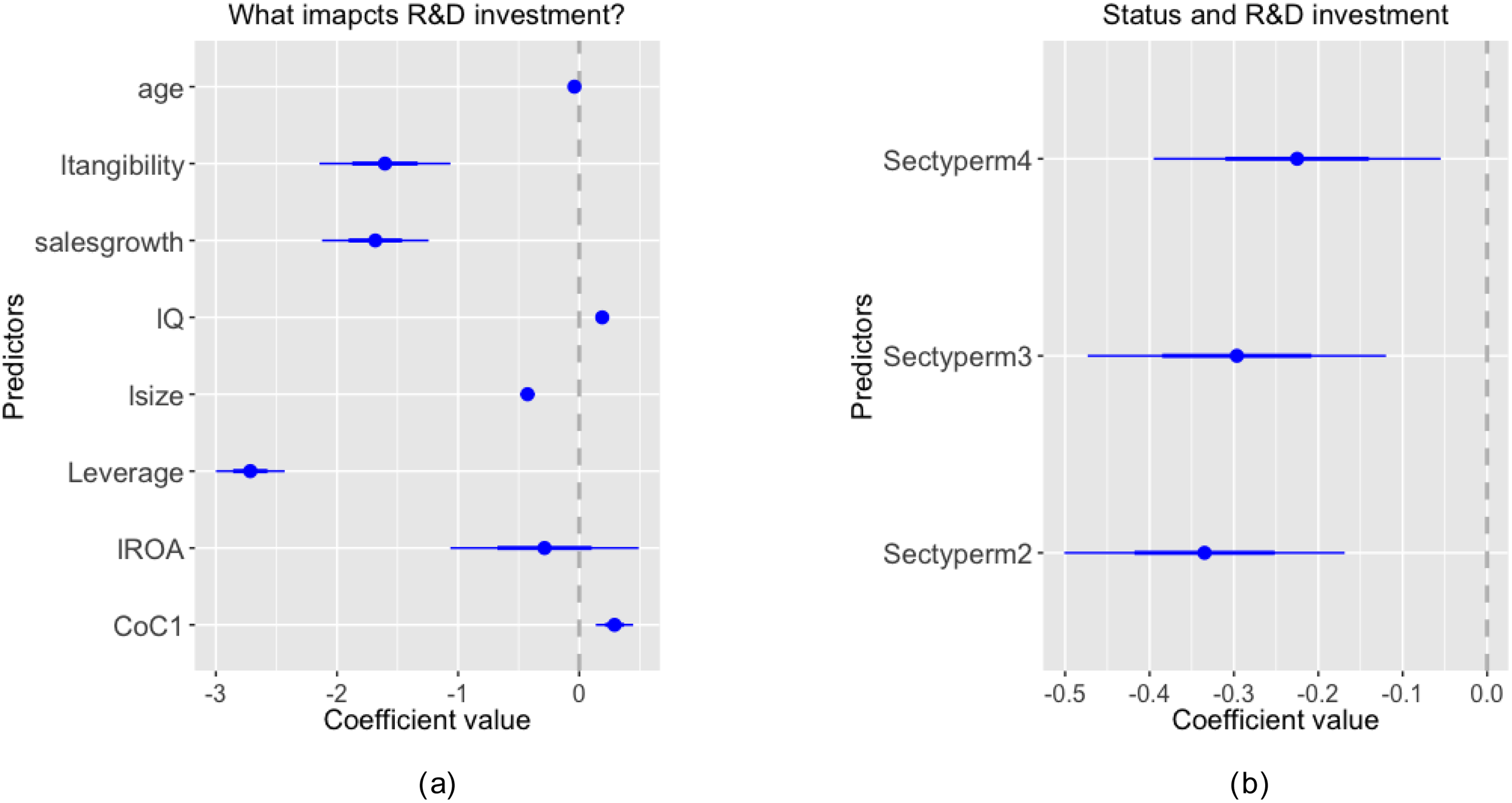
Effect of patronage status. (a) Client of Client versus Others and (b) Comparison among each status.
As displayed in Figure 2(b), compared with the reference category COC, the coefficients of the other three patronage statuses are all significantly negative, which indicates that firms’ R&D investment is significantly higher when city leaders are “Clients of Clients,” compared to the other three patronage statuses.
Hypothesis 2a predicts that a change in the patronage status of city leaders will decrease the volatility of firms’ innovation intensity, as measured by year-to-year difference in the ratio of R&D input. As depicted in Figure 3(a) (please refer to Appendix D.2 Tables 5 for complete regression results), the coefficient value of “changebi,” a binary variable representing whether leaders’ patronage status changes or not, is significantly negative as predicted. Hypothesis 2b predicts that a change involving provincial leaders’ patronage status has a stronger effect in stabilising firms’ R&D investment than a change that only involves city leaders’ patronage status. Figure 3(b) (please refer to Appendix D.2 Tables 6 for complete regression results) shows that both coefficients are significantly negative, and the magnitude of citychange is smaller than that of provchange.
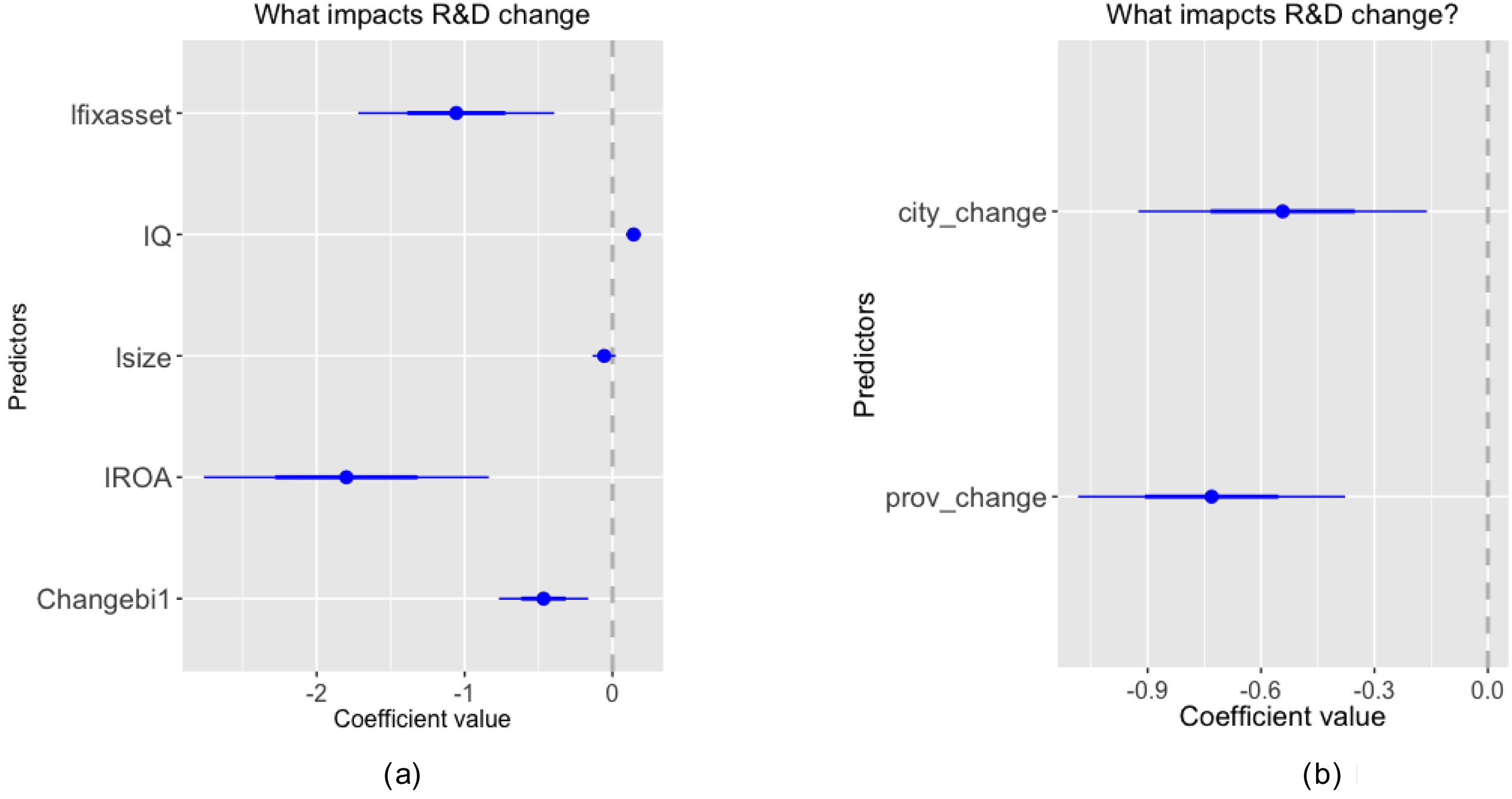
Effect of patronage status change. (a) Effect of patronage status change (changebi) and (b) effect of change at different levels.
Event Study Analysis: Over-Time Dynamics
To further examine the dynamic impact of elite patronage on firm innovation, I conduct an event study. While the baseline models estimate the average effect of patronage status and its change, they do not capture how firms’ innovation behaviours evolve in response to political shifts. An event study approach allows us to trace firm behaviour in the periods before and after a key political event – in this study, the entry of a CoC leader and a change in local leaders’ patronage status. The time window spans from three years prior to the event (year −3) to three years after (year 3). This range is chosen to balance analytical depth with sample size constraints. A narrower window may miss important lead-up and lagged effects, while a broader window is likely to produce excessive noise and reduce statistical power due to fewer observations.
Figure 4 presents the dynamic effect of entry of CoC leaders. To begin with, an event study analysis should meet the identification assumption, which, in the context of this study, requires the absence of systematic divergence in R&D intensity prior to the leader's arrival. As illustrated in Figure 4, the coefficients for the pre-entry years are close to zero, with wide confidence intervals that straddle zero, indicating that they are not statistically different from zero. This means that, prior to the arrival of a CoC leader, firms in cities that would later receive a CoC leader are not trending differently in R&D investment compared to the firms in cities that would not receive a CoC leader, which supports the identification assumption.
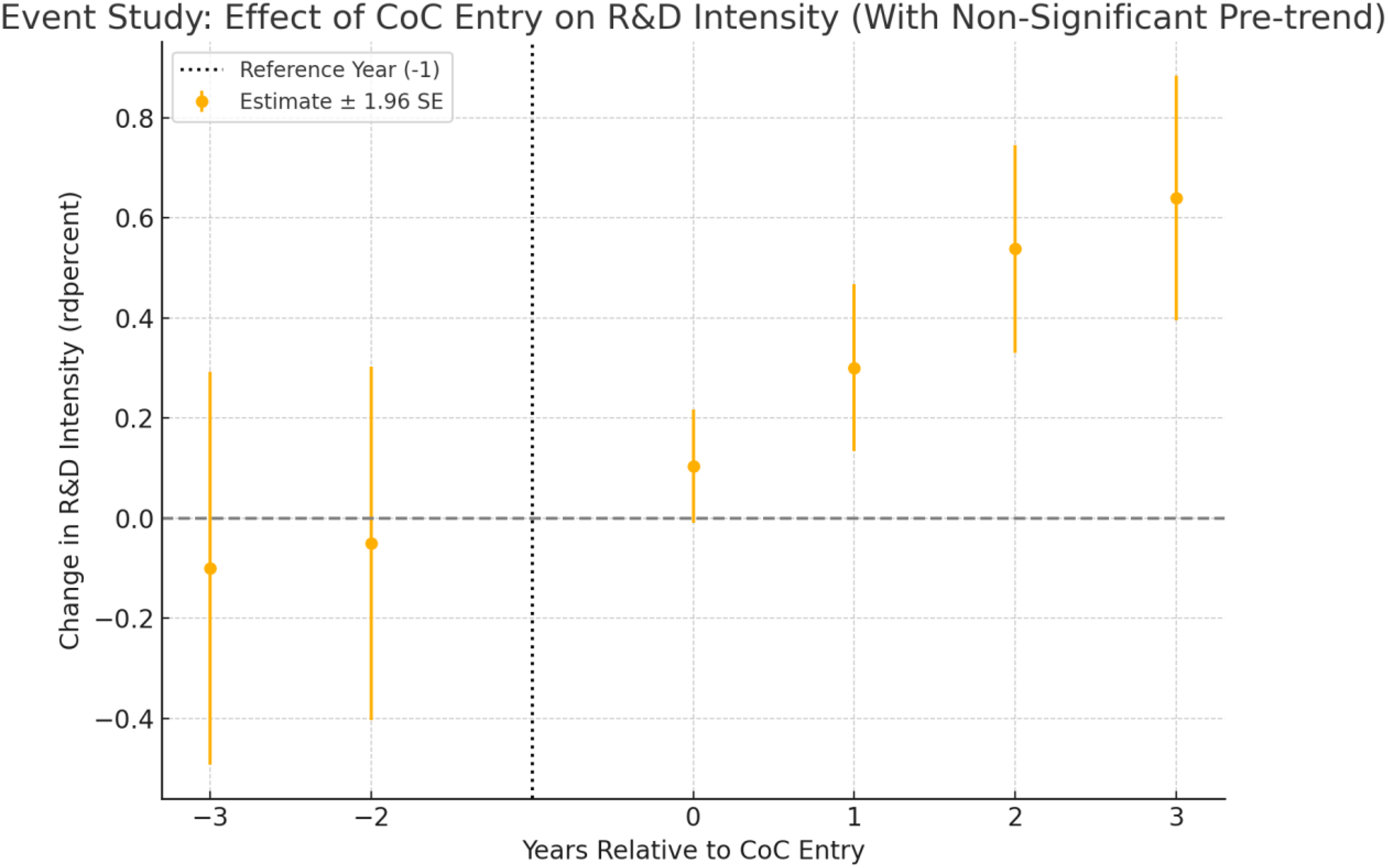
Dynamic effect of entry of CoC leaders.
Following the entry of the CoC leader (year 0), the trajectory of R&D intensity goes upward. The post-entry coefficients exhibit a steady rise from year 0 through year 3, indicating a growing treatment effect over time. By one year after the leader's entry (year 1), the coefficient on R&D intensity becomes statistically positive with increased magnitude. This effect strengthens in years 2 and 3. Such a pattern suggests that the influence of the arrival of a CoC leader on firm behaviour intensifies over time. This dynamic post-entry increase in R&D investment, combined with the flat pre-trend, provides strong support for Hypothesis 1. It implies that when a city leader connected to the supreme leader's patronage network (CoC) comes to power, firms respond by intensifying their innovation efforts. The fact that the treatment effect grows over several years is consistent with the notion that political alignment with the top leadership creates a more favourable environment for firm innovation.
Figure 5 presents the results of the event study analysis examining how changes in local leaders’ patronage status affect the volatility of firms’ R&D investment. As with Figure 4, the identification assumption underlying the event study design is met, as indicated by the statistically insignificant coefficients for years −3 and −2. This suggests that, prior to the change, firms in cities where a shift in patronage status would later occur were not following a systematically different trajectory in R&D volatility compared to firms in cities without such changes.
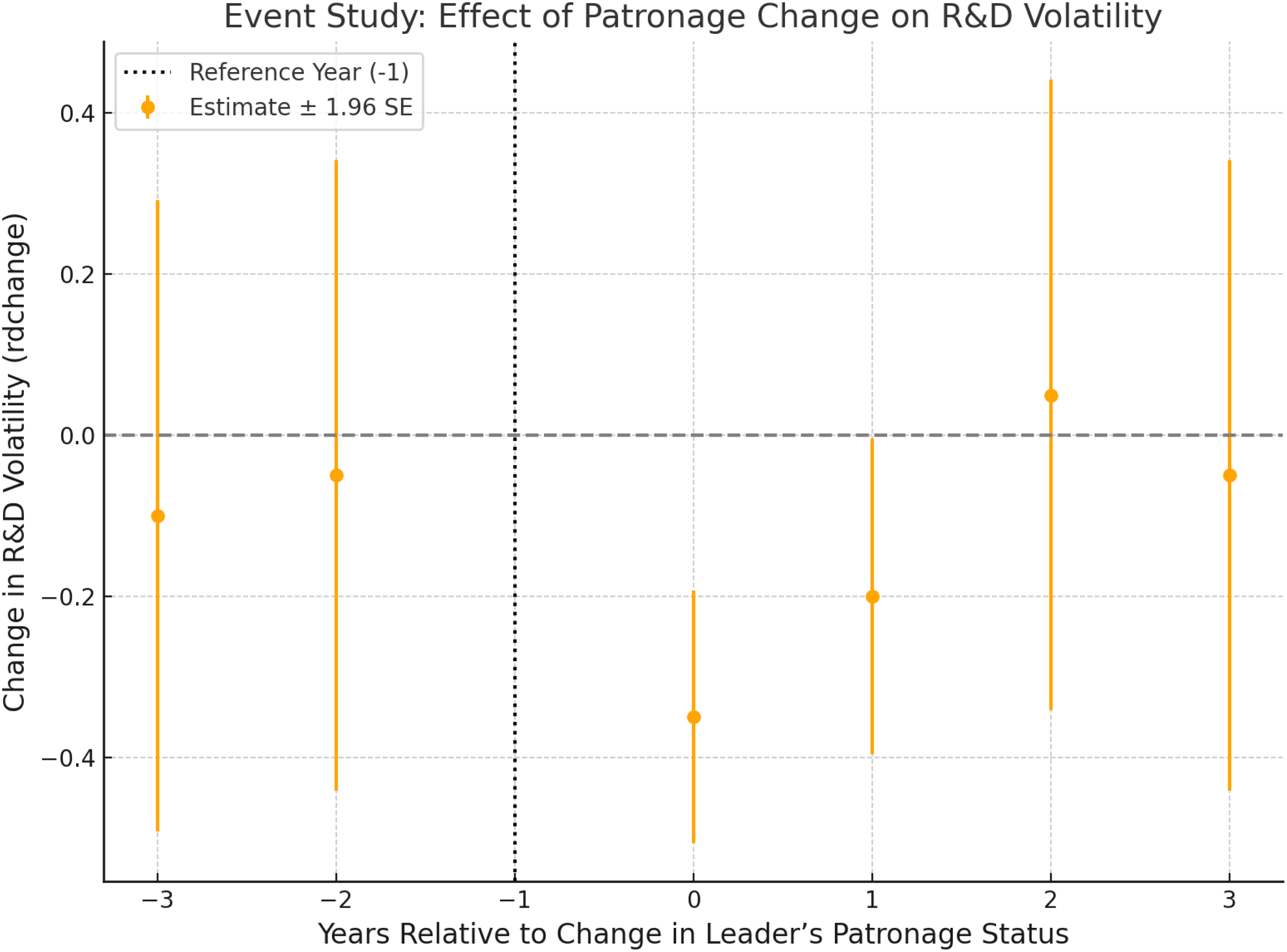
Dynamic effect of patronage status change.
Following the leadership change, a notable pattern emerges: in both the year of the change (year 0) and the year immediately after (year 1), R&D volatility declines, with both coefficients negative and statistically significant. This pattern supports the view that firms tend to stabilise their innovation behaviour in response to political uncertainty. The effect is strongest in year 0, with a smaller yet still significant decline in year 1, suggesting that the stabilising response begins to fade after the year of the change. By years 2 and 3, the coefficients are no longer statistically significant, indicating that the effect of the patronage status shift does not persist beyond the short term.
Robustness Check
I conduct a series of additional analyses to ensure the robustness of the main findings. First, as discussed earlier, in Formula 1, I replace the binary independent variable CoC with a categorical variable patronage status. The result remains consistent with the baseline one. Second, instead of industry fixed effects, I include firm fixed effects to control for the effect of unobservable firm characteristics. The regression results (please see Appendix E) are similar to the baseline results.
In addition, some firm controls, particularly Tobin's Q, may be jointly determined with R&D because market valuation can respond to innovation investment and expectations. To address this concern, I conduct robustness checks to re-estimate the main models excluding Tobin's Q. The key results (please see Appendix F) are substantively unchanged in both magnitude and statistical significance, suggesting that the findings are not driven by conditioning on potentially endogenous controls.
Lastly, I add leader tenure length (measured as the number of years the city party secretary has been in office) to the baseline models. Tenure length provides a partial proxy for political continuity and firms’ expectations about near-term personnel stability. The results (please see Appendix G) show that the coefficients of the key independent variables remain similar in magnitude and statistical significance. Tenure length does not show a systematic effect on the level of R&D investment but is negatively associated with R&D volatility, which indicates that longer tenure length is linked to smoother firm innovation adjustment without changing baseline innovation incentives.
Assessing Alternative Mechanisms
This subsection clarifies how the empirical findings speak to major alternative explanations. Because the analysis does not directly observe firms’ internal deliberations, the goal here is not to prove a micro-level decision process, but to show what kinds of competing accounts are difficult to reconcile with the observable patterns in the data.
A first alternative is a direct resource-support mechanism, in which patronage dynamics matter mainly because politically advantaged leaders can deliver subsidies, preferential credit, procurement opportunities, or administrative facilitation for innovation. This mechanism is difficult to evaluate definitively, as it could in principle coexist with the signal-based mechanism proposed in this study. Empirically, the resource-support mechanism can align with the findings related to R&D investment levels. However, if this mechanism were dominant, one would generally expect changes in patronage status to produce relatively persistent shifts in firms’ innovation environment. More specifically, expanded access to financing or administrative support would allow firms to commit to multi-year projects and smooth R&D budgeting over time, which predicts a durable reduction in volatility. By contrast, the event-study evidence (Figure 5) shows that R&D volatility declines only in the year of the patronage-status change and the year immediately after. This temporal pattern is difficult to reconcile with an explanation in which patronage operates primarily through resource expansion, and is more consistent with firms temporarily stabilising investment in response to heightened political uncertainty, which operates through changes in expectations rather than persistent changes in resource support.
A second alternative is coercion or political pressure, in which leaders compel firms to adjust innovation investment through monitoring, target setting, or enforcement. If coercion were the dominant mechanism, one would generally expect more persistent adjustment, as firms would be incentivised to comply with political expectations as long as enforcement and monitoring continue. Similar to the prediction of the resource-support mechanism, this mechanism typically involves more sustained changes in investment behaviour rather than temporary smoothing. By contrast, the volatility event-study pattern suggests that firms initially stabilise investment but soon return to baseline behaviour. This temporal pattern is more consistent with firms temporarily adopting a “wait-and-see” posture under heightened political uncertainty than with sustained compliance induced by political pressure.
Although this study does not directly observe the decision process inside firms, the empirical findings, especially the short-lived volatility response, place meaningful constraints on competing accounts. Given the scope and nature of the available panel data, assessing alternative mechanisms through their empirical implications represents a feasible way to address this limitation. However, qualitative evidence such as interviews or case studies could provide valuable process-tracing and help further consolidate the causal relationship. Developing such evidence is an important direction for future research.
Extensional Analysis
Does Firm Ownership Matter?
The empirical findings suggest that changes in the patronage status of local leaders reduce volatility of firm-level innovation. However, not all businesses are as sensitive to policy inconsistency as others. Specifically, scholars of Chinese political economy have discovered that SOE not only enjoy long-term relationships with local banks and government agencies (Lin et al., 2020; Wang et al., 2004), but also take advantage of connections with higher-level bureaucrats built through the government-SOE involving door (Hay et al., 1994), which enables them to press local leaders for desired resource and expedient procedures (Szamosszegi and Kyle, 2011), receive stable inflows of public funds and cheap bank credits (Hay et al. 1994). Therefore, I anticipate weaker stabilising effects of patronage status change on SOEs.
To test the hypothesis, I examined the correlation between patronage status change and R&D investment volatility using the same models, but separately for SOEs and non-SOEs. The results are presented in Table 1 (for complete regression tables, see Appendix H.1). The findings show that non-SOEs exhibit sensitivity to both general patronage status changes and the two differentiated scenarios – provincial-level and city-level changes. In contrast, SOEs do not adjust their volatility in response to changes in local leaders’ patronage status, which supports the hypothesised mediating effect of firm ownership.
Mediating Effect of Firm Ownership.
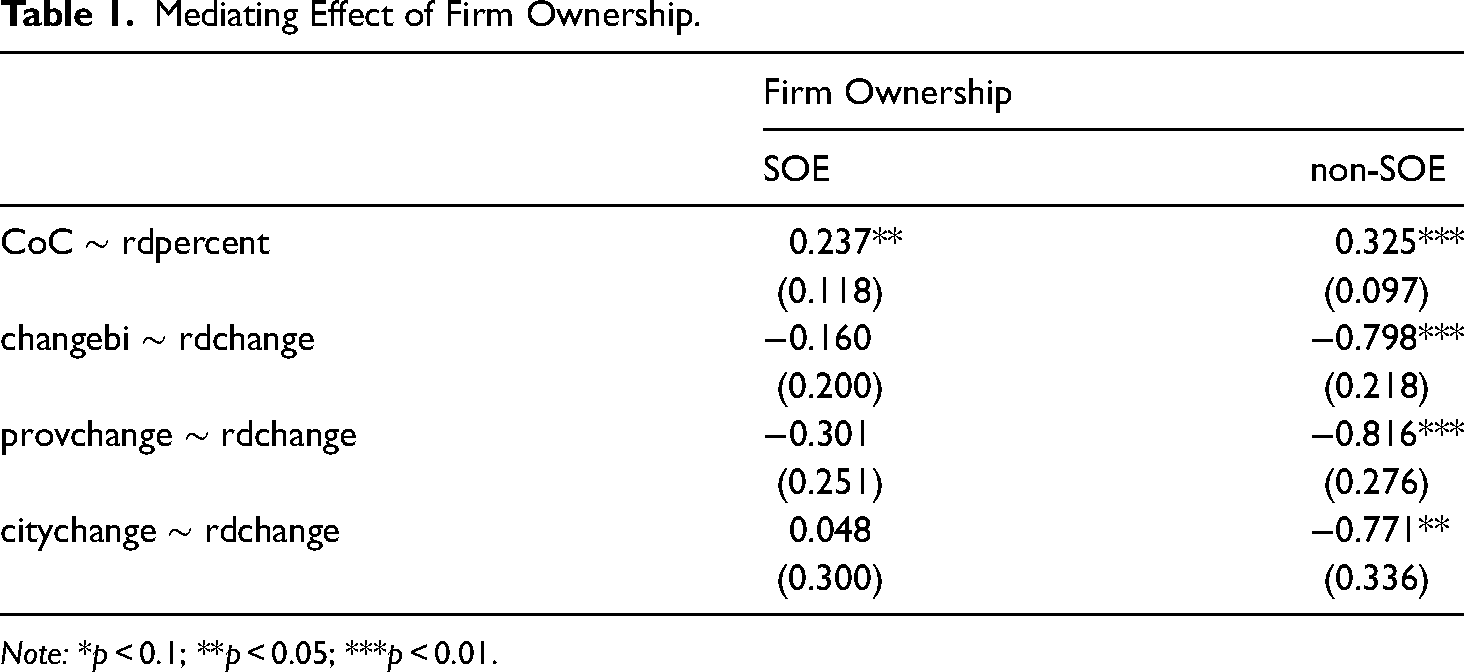
Note: *p < 0.1; **p < 0.05; ***p < 0.01.
However, SOEs are heterogeneous, and an important extension is to distinguish central SOEs from provincially or municipally controlled SOEs. Because central SOEs are typically embedded in national bureaucratic and financing networks and are less reliant on a particular city's policy environment, they are likely to be less sensitive to city-level patronage dynamics. By contrast, locally controlled SOEs may be more exposed to local implementation priorities and administrative discretion. Evaluating this heterogeneity would be a promising direction for future work.
Does Regulatory Exposure Matter?
In addition to ownership, firms’ innovation behaviours in response to patronage dynamics may also vary by sector, particularly depending on their level of regulatory exposure. Regulation not only shapes the operational landscape of firms, but also defines the intensity of their interaction with the state. Therefore, regulatory exposure serves as an important lens to investigate heterogeneity in how firms perceive and respond to patronage dynamics. In highly regulated industries – such as energy, healthcare, and telecommunications – firms are more deeply embedded in the political system and more dependent on government policies and resource allocations. This dependence makes them especially attentive to political signals, including elite patronage dynamics.
To examine potential sectoral heterogeneity derived from the variation in regulatory exposure, I ran the baseline regressions separately for firms in high-regulation sectors and other sectors, with high-regulation industries identified according to the CSMAR classification. In addition, I estimated a model on the full sample that includes interaction terms between the primary independent variables and a binary indicator for whether a firm belongs to a high-regulation sector.
The results are presented in Table 2 (for complete regression tables, see Appendix H2). As shown in the first row, firms in both high-regulation and other sectors tend to increase R&D investment upon the entry of a CoC leader. However, the positive and significant interaction term indicates that firms in highly regulated sectors experience a larger increase, consistent with the expectation that these firms are more sensitive to political dynamics.
Heterogeneity Derived from Variation in Regulatory Exposure.
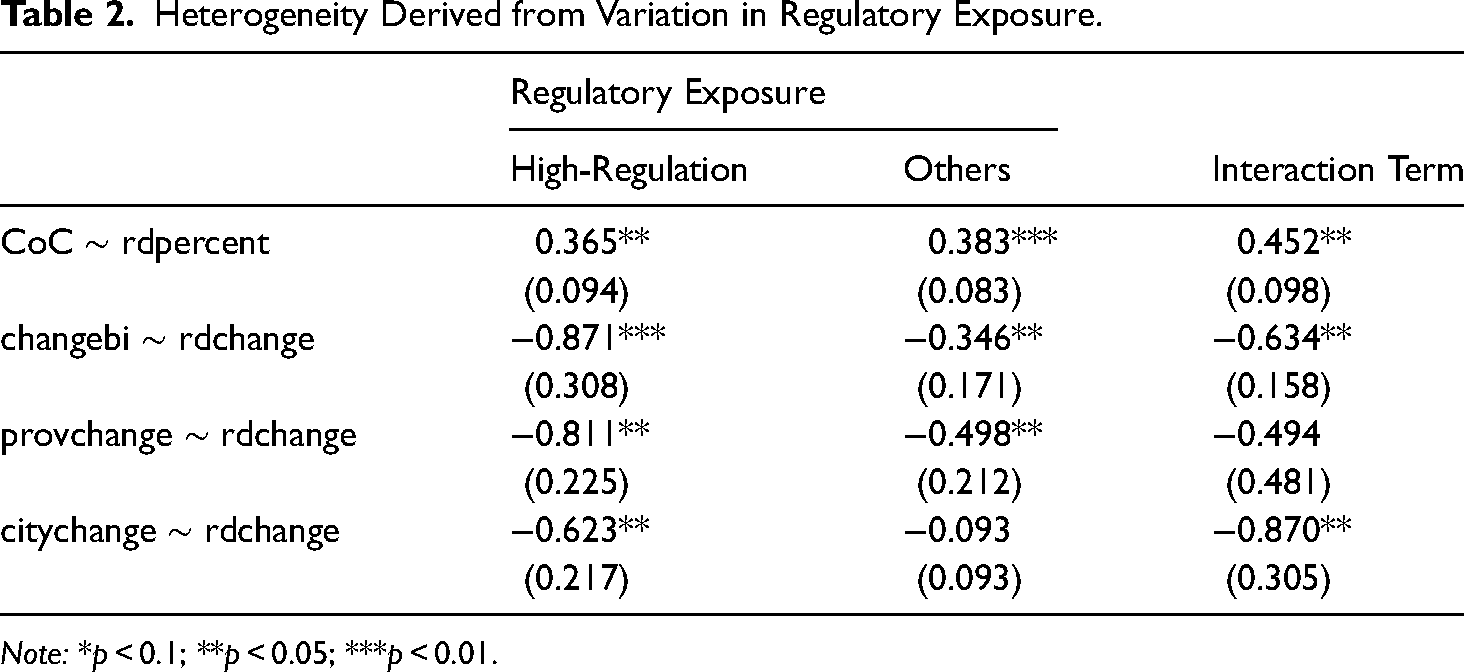
Note: *p < 0.1; **p < 0.05; ***p < 0.01.
The second row of the table shows that firms in both groups stabilise their R&D investment when local leaders’ patronage status changes. The significantly negative interaction term suggests that high-regulation firms engage in an even stronger stabilising response, reflected in smaller year-to-year volatility of R&D investment.
The third and fourth rows present the results for differentiated patronage status changes. When the change occurs at the provincial level, all firms respond by stabilising their R&D investment, and the interaction term indicates no systematic difference in this effect across sectors. However, when the change occurs only at the city level – which is of relatively lower political consequence – only highly regulated firms have a stabilising response, whereas other firms remain largely unaffected.
In a nutshell, these results show that firms in high-regulation sectors are systematically more responsive to political dynamics. They exhibit stronger responses to favourable signals and react more defensively to uncertainty, while firms in less-regulated sectors display weaker responses in general.
Does Central Leader's Preference Matter?
I also examine whether the impact of patronage dynamics changes during Xi Jinping's second term, which began in 2018 and displays a stronger central emphasis on high-tech development. In a policy environment where the top leadership provides clearer and stronger signals about innovation priorities, firms may rely less on local patronage cues. To investigate this possibility, I estimate the baseline models on two subsamples (pre- and during-Xi's second term) and also run regressions on the full sample that include interaction terms between the primary independent variables and a binary indicator for whether the time is during Xi's second term (xisecond).
The results are presented in Table 3 (please see Appendix H.3 for complete regression tables). As the first row indicates, across both periods, firms increase their R&D investment upon the arrival of a CoC leader, consistent with the expectation that strong patronage ties signal a favourable and stable environment for innovation. However, the interaction term between CoC entry and xisecond is negative and statistically significant, suggesting that the positive effect diminishes during Xi's second term. This finding supports the anticipation that as the central leadership's innovation drive becomes more explicit and credible, the marginal importance of local patronage signals declines, even though firms continued to respond positively to favourable political cues.
Heterogeneity Derived from National Leadership's Preference.
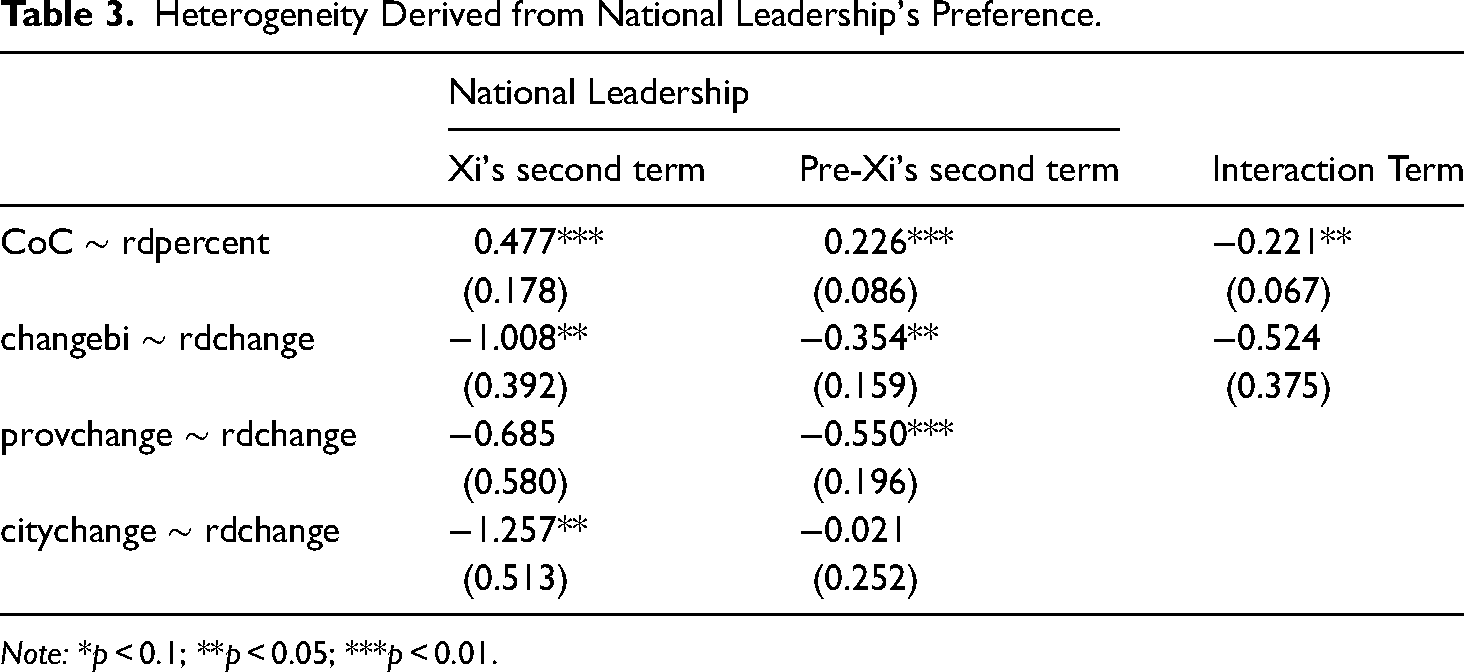
Note: *p < 0.1; **p < 0.05; ***p < 0.01.
The second row shows that patronage status change continues to exert a stabilising effect in both periods, as indicated by significantly negative coefficients in the subsample regressions. Meanwhile, the interaction term between changebi and xisecond is statistically insignificant in the full-sample model, which suggests no systematic difference across the two periods. Substantively, this implies that firms continue to hedge against political uncertainty by stabilising R&D investment even when the national innovation agenda provides a more explicit and favourable policy background. The mechanism of risk management through stabilisation appears robust over time.
The third and fourth rows present the results of differentiated patronage status changes, distinguishing between provincial- and city-level events. Before Xi's second term, firms respond primarily to provincial-level changes, which trigger a significant stabilising effect, whereas city-level changes elicit no systematic response. This pattern aligns with the analysis that provincial-level change is of higher political stakes. However, during Xi's second term, the pattern reverses: provincial-level changes lose their effect, while city-level changes become significantly associated with stabilisation. This counterintuitive shift may reflect the centralisation of policy signals under Xi's second term. Provincial changes may no longer signal meaningful uncertainty because the top-down innovation agenda dominates. But city-level changes represent the most immediate source of political uncertainty, which drives firms to stabilise their R&D investment.
Conclusion
This study explores how firms interpret and respond to dynamics of elite patronage, specifically the patronage status of local leaders, within China's unique hierarchical and political system. It argues that firms view the patronage status of local leaders as a signal of the broader policy environment, affecting their strategic decisions on R&D investment. To begin with, firms interpret strong connections between local leaders and the supreme leader as an indicator of a favourable and stable policy environment conducive to innovation. In addition, changes in a leader's patronage status introduce political uncertainty, prompting firms to adopt a cautious approach toward their innovation expenditures to maintain stability.
The empirical analysis confirms that firms significantly increase R&D investment when city leaders are in a Client of Client status, which indicates their strong connection with the supreme leader. Additionally, changes in patronage status reduce the volatility of R&D investment, with firms opting for a steady investment pattern in response to political uncertainty. The effect becomes more significant when the change in patronage status takes place at the provincial level compared to the city level, as provincial leaders have a greater influence over policy direction.
The study also examines heterogeneity by firm ownership, regulatory exposure, and national leadership. The results indicate that non-SOEs are more sensitive to patronage dynamics than SOEs, that firms in highly regulated sectors respond more strongly than those in other sectors, and that the influence of local patronage dynamics is moderated by the national leadership's explicit innovation agenda.
The findings are particularly relevant to contexts where political networks and patronage play a significant role in shaping the business environment. While this framework is tailored to China's political structure, similar dynamics may exist in other authoritarian or hybrid regimes where political ties are crucial for business operations.
This research makes several important contributions to the academic scholarship on political uncertainty, corporate behaviour, and patronage networks. First, it deepens the understanding of how patronage networks affect economic behaviour. While the existing literature has extensively documented how connections between firms and political actors influence firm decisions, this research expands the focus to include changes within political elites’ patronage networks. This shift in perspective provides a nuanced understanding of how political dynamics between government officials at different levels impact firm innovation, offering new insights into the economic consequences of elite political relationships.
Second, it enhances the existing literature on political uncertainty by introducing patronage status changes as a more refined and accurate measure than leadership turnover. Traditional measures often assume that leadership changes inherently lead to policy shifts, but this study shows that political patronage networks offer a more precise indicator of when such shifts occur, particularly in authoritarian regimes like China's.
Finally, this study contributes to the literature on firm innovation by identifying patronage status changes as a significant variable influencing innovation intensity. Compared to other proxies of political uncertainty, this measure aligns more closely with how modern business sectors interpret and react to political developments, particularly in environments where political connections are key to business success.
Future research could explore the lasting effects of cumulative patronage status changes on firms’ innovation trajectories. While this study focuses on the immediate impact of such changes, firms that experience repeated political uncertainty may develop strategies to adapt, or their innovation capabilities may be permanently altered. Additionally, further exploration of how patronage networks evolve over time and how firms in different sectors respond to these changes could provide deeper insights into the complex interaction between politics and business in emerging markets. Also, this study does not attempt to differentiate the directional effects of every specific patronage category or each possible “from–to” transition, because doing so would require additional theoretical framing to generate clear expectations. That said, developing such a framework is a promising direction for future research.
Supplemental Material
sj-docx-1-cca-10.1177_18681026261457559 - Supplemental material for Elite Patronage and Firm Innovation in China
Supplemental material, sj-docx-1-cca-10.1177_18681026261457559 for Elite Patronage and Firm Innovation in China by Yuxing Liang in Journal of Current Chinese Affairs
Footnotes
Data Availability
The data that support the findings of this study are available from the author upon reasonable request.
Declaration of Conflicting Interests
The author declared no potential conflicts of interest with respect to the research, authorship, and/or publication of this article.
Funding
The author received no financial support for the research, authorship, and/or publication of this article.
Supplemental Material
Supplemental material for this article is available online.

Author Biography
References
Supplementary Material
Please find the following supplemental material available below.
For Open Access articles published under a Creative Commons License, all supplemental material carries the same license as the article it is associated with.
For non-Open Access articles published, all supplemental material carries a non-exclusive license, and permission requests for re-use of supplemental material or any part of supplemental material shall be sent directly to the copyright owner as specified in the copyright notice associated with the article.
