







Abstract
Intrusion Detection Systems (IDS) play a significant role in cybersecurity as they detect potential threats and protect network infrastructure. With the existing cybersecurity environment, the selection of the most suitable IDS software tool is very crucial to provide strong cybersecurity practices in organizations. The availability of various IDS software tools with varying features and capabilities makes the selection of the optimal one a complex decision-making problem. Conventional multi-criteria Decision making (MCDM) approaches cannot deal with the uncertainty and ambiguity associated with these criteria, which can result in making wrong decisions. The current study introduces a novel framework for the selection of an optimal IDS software tool that integrates Neutrosophic sets and COCOSO (Combined Compromise Solution) to effectively deal with the uncertainty involved in IDS selection. The Best-Worst Method considers the best and worst criteria for consistent and accurate weight assignment to improve decision accuracy. The Neutrosophic approach deals with ambiguity by considering truth, falsity, and indeterminacy together, and improves the flexibility of the COCOSO approach to assess these IDS software tools. A case study illustrates the usability and efficiency of the introduced framework to select an IDS software tool in secure dynamic environments over conventional approaches.
Introduction
Intrusion Detection Systems (IDS) have become a crucial part of any cybersecurity infrastructure to serve as a proactive tool for detecting, preventing, and monitoring security risks in networks. With the rise in cyber-attacks, organizations all over the world are investing in intrusion detection systems as a vital part of their digital infrastructure. IDS software acts as a line of Défense against malicious activity, unauthorized access, and data breaches by monitoring, detecting, and responding to security breaches within networks. However, the selection of an IDS software tool is a challenging process as it considers multiple criteria simultaneously, such as detection accuracy, system compatibility, resource consumption, cost, ease of integration, and scalability. Each of these criteria has a varying level of significance as per organizational security requirements.1–3 Therefore, choosing IDS software requires a robust decision-making approach that can take into consideration multiple frequently conflicting criteria.
Traditional MCDM approaches, such as TOPSIS (Technique for Order Preference by Similarity to Ideal Solution) and AHP (Analytic Hierarchy Process), have widely used for IDS software tool selection and assessment.4–6 However, these techniques often lack in the consideration of allied ambiguities and uncertainties in the decision-making process. Thus, in such real-time decision-making environments where exact information is unavailable or where decisions include subjective, confusing information, or criteria may overlap, these traditional approaches might not yield reliable results. 7
To address these gaps, recent studies have widely incorporated fuzzy and Neutrosophic sets, which are more flexible - allowing decision makers to manage indeterminate, uncertain, and inconsistent information specially for IDS tool selection. 8 Neutrosophic logic considers truth, falsity, and indeterminacy to represent data, thus providing a better and flexible structure to manage indeterminate, uncertain, and inconsistent information. 9 This paper introduces an integrated Neutrosophic-based COCOSO MCDM approach which combines Best Worst Method (BWM) to determine the weights for selecting the IDS software tool. BWM, a new and growingly popular MCDM weighing technique, improves consistency by limiting decision-makers to comparing only the best and worst criteria, making the weighting process dependable and efficient. 10 The COCOSO approach is intended to synthesize compromise solutions and ideally suited to manage the intricate trade-offs in multi-criteria evaluation.11,12
1.1 Novelty and contributions
Traditional MCDM approaches such as COPRAS, VIKOR, and TOPSIS etc. works either with crisp or fuzzy data, which may not effectively reflect the indeterminateness and vagueness intrinsic in such cyber-security related decision-making scenarios. By utilizing Neutrosophic sets, our proposed framework clearly models indeterminateness along with truth and falsity which allows a more realistic way of handling uncertainty in IDS evaluation.
These traditional approaches often used either subjective or inconsistent pairwise comparison for weight allotment which reduces reliability.
The proposed framework uses the BWM approach to generate more reliable, and less redundant weights which helps to reduce judgment errors and to ensure reliability and robustness in muti-criteria weighting for IDS evaluation. BWM delivers dependable weights, which strengthen the COCOSO ranking mechanism.
These traditional approaches often used a single compromise measure like VIKOR uses regret minimization and TOPSIS uses distance to ideal. However, our framework NB-COCOSO integrates the COCOSO compromise strategy. It combines weighted sum, exponential, and relative significance-based aggregation to provide robust ranking. This hybrid compromise results in consistent and stable ranking mechanism in IDS evaluation.
The state-of-the-art works for IDS tool selection are confined and commonly unreliable in handling uncertainty and expert inconsistency. The proposed NB-COCOSO framework is one of the first which formally integrating the Neutrosophic theory, BWM, and COCOSO in IDS tool selection, thereby bridging the methodological gap.
To illustrate the utility of this approach, the current work applies the Neutrosophic-BWM-COCOSO (NB-COCOSO) framework to a case study of IDS software tools selection. The results demonstrate its effectiveness in providing clear, uncertainty-resilient decision outcomes and highlight its superiority over traditional approaches. This research contributes a structured, adaptable framework to cybersecurity decision-making, enabling organizations to make informed and reliable IDS tool choices in complex, dynamic environments. The main objectives of this study are as follows: Develop an integrated framework for decision-making that combines the BWM method with Neutrosophic-based COCOSO to improve the objectivity and robustness of choosing the optimal IDS software tool. Address the intrinsic vagueness, uncertainty and indeterminacy allied with the decision-making method by using Neutrosophic logic which allows a more realistic and adaptable assessment of IDS software alternatives. Assign weights using BWM approach which ensures reliable and efficient weighting to evaluation criteria by concentrating on best and worst criteria while maintaining consistency. Determine and prioritize essential criteria for assessing IDS software tools. Validate the proposed NB-COCOSO framework by comparing the outcomes with other conventional MCDM methods (COPRAS, DBA, VIKOR, and TOPSIS) to ensure consistency, reliability, and effectiveness. Employ the introduced NB-COCOSO framework in a real-life scenario, demonstrating the model's efficacy, usefulness, and adaptability to dynamic cybersecurity requirements.
The rest of the paper is organized as mentioned: Section 2 discusses the state-of-the-art available in open literature. Section 3 introduces the proposed NB-COCOSO framework which describes the integrated framework using approaches Neutrosophic, BWM and COCOSO method. Section 4 presents the step-by-step discussion on the simulation of proposed approach. Section 5 discusses the detailed results and findings followed by conclusion in section 6.
2 State-of-the-art
In the evolving environment of cyber security, the choice of an efficient IDS becomes a crucial task for organizations. The significance of IDS software assessment has extensively acknowledged, as it permits organizations to make comparisons and deploy the best IDS system in their organization environment, which can further reduce the risk of security breaches. 13 Schrötter et al. 14 compared well-known IDS tools such as Snort, Zeek, and Suricata. The authors used the IPv6 plugin Suite to detect stateful attacks for improving Snort. Hu et al. 15 assessed Snort and Suricata, for the identification of efficiency on networks. They considered parameters like system resource utilization, identification accuracy, packet drop frequency, and packet processing power for performance evaluation. Moreover, they also described the complications while using open-source IDSs in large networks and suggested solutions for network managers that can help in establishing new IDSs.
Waleed et al. 16 considered three Open-Source IDS, namely Snort, Zeek, and Suricata, to analyse the performance over parameters like packet size, ruleset size, detection engine algorithms, and packet capturing modules. Wahyu et al. 17 attempted to analyse the performance of these IDS tools, Snort, Suricata, Zeek, along with two more tools, OSSEC and honeypot Cowrie. The authors used parameters like throughput, delay, packet loss, and jitter for evaluation. They also evaluated the tools for handling DDoS attacks. Snort performed better over other IDS tools. Boukebous et al. 18 compared two network-based IDS tools, Snort-3 and Suricata, based on multithreading, cross-platform support, and expanded bindings. The authors analysed the performance in terms of packet processing rate, accuracy, number of packets, memory, and processor usage. Snort-3 performed better over Suricata; however, Suricata performed comparably with Snort-3.
In the next year, Ghazi et al. 19 analysed both the tools based on their detection abilities, frameworks, and performance metrics such as processing speeds, traffic volumes, and threat types. This study also explored the possibilities of integration of IDS tools with AI and machine learning. Chinnasamy et al. 20 discussed the rule-based detection engine, security information, signature-based threat detection, and event management of the Suricata IDS tool. This study also pointed out the efficiency of Suricata as compared to Snort and Zeek in terms of scalability and performance. Over the course of that year, Yang 21 used four evaluation criteria, scalability, detection accuracy, false positive rate, and resource efficiency to evaluate the performance of four IDS tools. Being an open source and with strong community support, the traditional tools: Snort and Zeek still considered as valuable. However, Darktrace and QRadar performed better with respect to scalability and accuracy over Snort and Zeek. In that year itself, Almuseelem 22 analysed the four IDS tools Snort, Zeek, Suricata, and OSSEC but in cloud environments and for analysing an Amazon VPC's traffic. Performance of OSSEC proved to be better over Snort and Suricata in a period of 3 h.
Few studies23,24 examined the performance of machine learning algorithms to select the best IDS tool. AbdulRaheem et al. 25 introduced an ML-based Snort and Zeek to make the classification between the benign traffic and DDoS attack traffic. The ML-based Snort and Zeek consumed less processing time as compared to the existing methods. Limited research studies explored MCDM approaches for the evaluation of IDS tools based on multiple evaluation criteria. Seelammal & Vimala 26 determined the optimal feature selection using an MCDM approach in dynamic environments. The authors also discussed how the large datasets can manage in an optimized way. Belal and Sundaram 27 introduced a hybrid framework, MEREC-VIKOR, for evaluating attack detection based on multiple conflicting criteria. They used the CICIDS dataset for the simulation of the proposed framework.
In state-of-the-art, few studies stated that the integration of fuzzy with the conventional MCDM approaches may improve the results. Almotiri 28 used the fuzzy AHP approach for the selection of the most efficient traffic detection approach. In addition, they implemented the TOPSIS approach to evaluate and classify alternatives based on their overall performance. During that year, AlHarbi et al. 5 used the same AHP-TOPSIS approach for the assessment of ML-based IDS software tools in hesitant fuzzy conditions. In the subsequent year, Alyami et al. 29 applied the same approach to evaluate the efficiency and effectiveness of five well-known IDS tools, such as Suricata, Zeek, Security Onion, Snort, and OSSEC, in a security environment. The study shown the more benefits of Suricata over Snort. Abushark et al. 30 applied the same approach to assess the ML-based IDS software tools based on optimization. The authors identified the cybersecurity attributes that can help developers to make an effective and efficient IDS tool. Another study applied the same hybrid approach for optimal decision making for detecting malevolent attacks but in Vehicular Ad-hoc Network (VANET).
Within that year, Abdel-Basset et al. 31 applied the q-rung orthopair fuzzy sets for dealing with uncertainty and vagueness. They used the q-rung orthopair fuzzy weighted geometric for combining the experts and specialists’ opinions. They used the COCOSO method to assess the 6 IDS tools (Suricata, Zeek, Security Onion, Snort, Wazuh, and OSSEC) for their reliability and effectiveness. The authors declared that Suricata is the best among six IDS based on multithreading performance. AbdelMouty & Abdel-Monem 32 used the Neutrosophic EDAS method to rank and assess the security risks in the power system. Alhakami 6 used the Fuzzy-AHP TOPSIS approach for the assessment of effective Défense against Gen V Multi-Vector attacks. Due to limited research available on the evaluation of IDS tools, the state-of-the-art included the research studies which can used while implementing IDS tools. It is tough to implement these tools as they built for specific systems and conditions. Therefore, there is a substantial requirement for assessing the effectiveness of the IDS tools based on different criteria. Table 1 summarizes only those research studies which presented the evaluation of IDS tools.
Summary of state-of-the-art for evaluating IDS software tools.
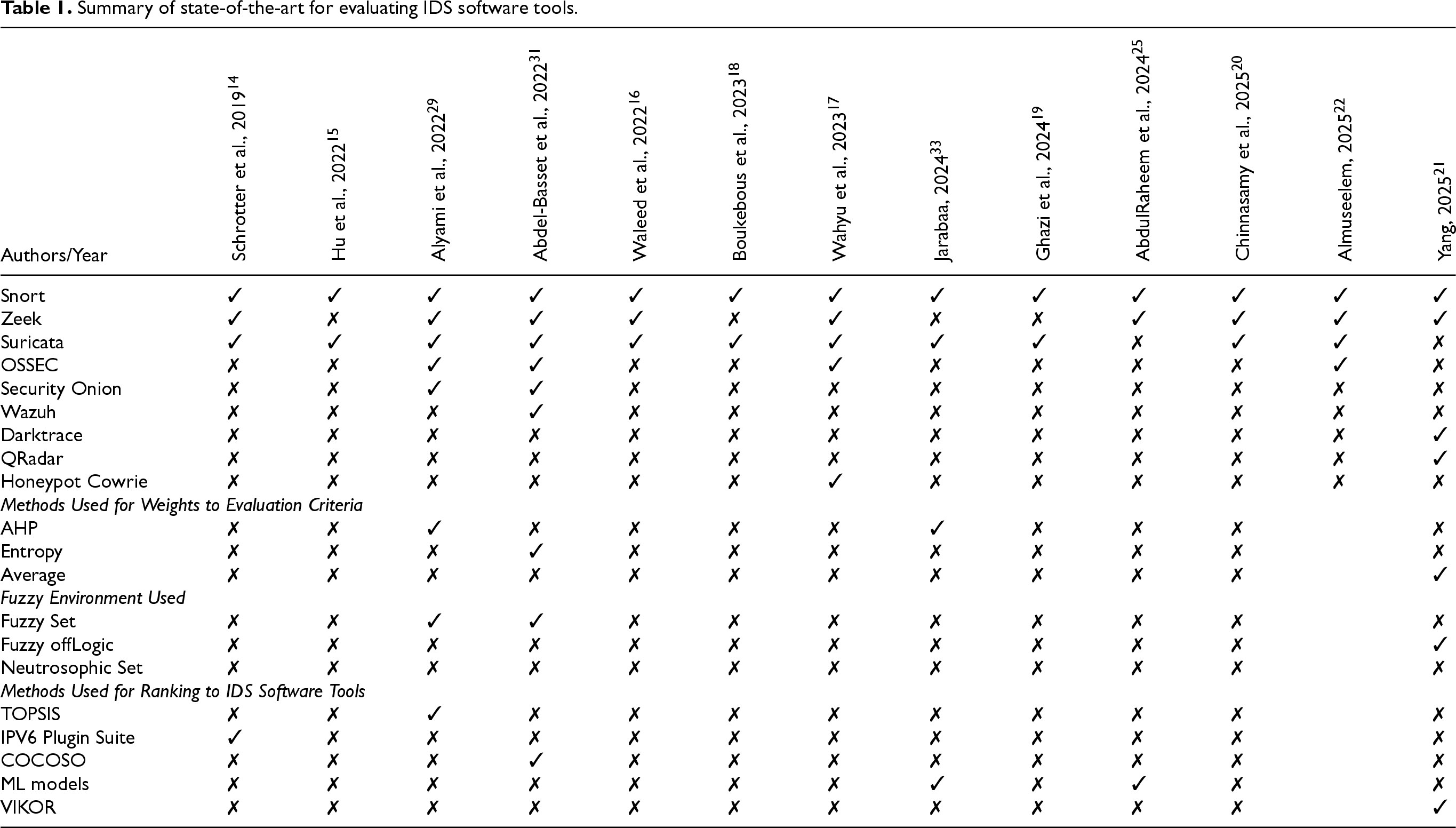
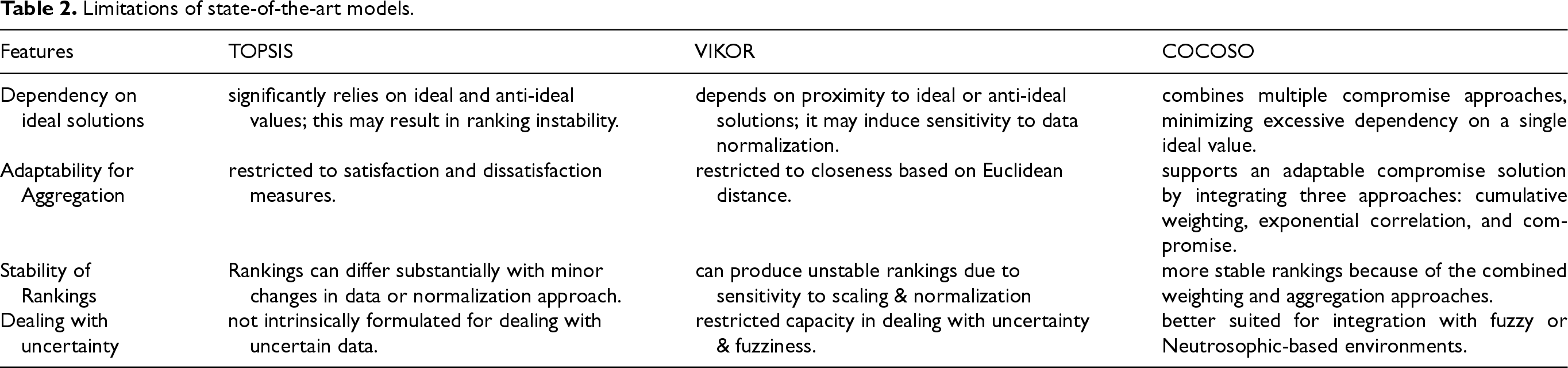
Table 2 discusses the limitations of state-of-the-art models as compared to COCOSO approach. However, as per state-of-the-art, no single model is ideal for all conditions. As per our knowledge and after analysing Tables 1 and 2, it can be concluded that this research work is the first one that examines twelve available IDS software tools using an integrated Neutrosophic MCDM-based technique. These are Zeek, Splunk, OSSEC, Sagan, Snort, Suricata, Tripwire, Security Onion, Manage Engine, Gatewatcher, CrowdSec, and AIDE. The rapid usage of COCOSO on different applications is visible in state-of-the-art due to its understandable and less complex nature.34–36 So, this study uses the COCOSO MCDM approach for assessing the effectiveness.
Limitations of state-of-the-art models.
3 Proposed NB-COCOSO Framework
A novel NB-COCOSO MCDM-based framework is introduced to select the optimum IDS tool based on predefined evaluation criteria as illustrated in Figure 1. This integration enhances decision-making since it combines consistency (BWM), addressing uncertainty (Neutrosophic), and reliable aggregation (COCOSO), providing an improved stable, flexible, and reliable evaluation framework compared to previous MCDM models.
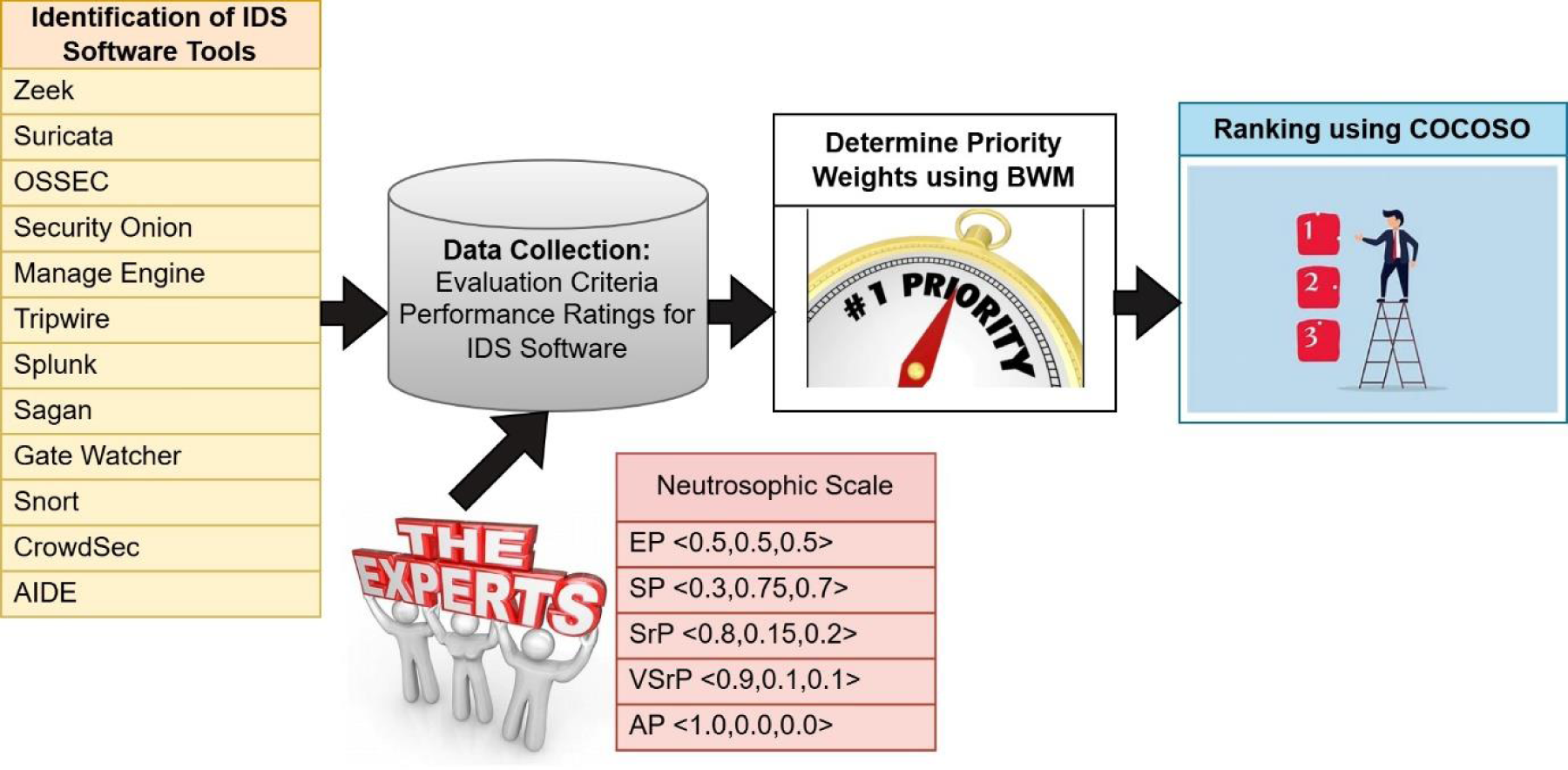
Proposed NB-COCOSO framework.
The first phase of the framework identifies the IDS tools and the evaluation criteria based on experts’ opinion and the state-of-the art. The framework takes these identified IDS tools as input for the evaluation. Second phase uses the BWM approach to assign the weights to these evaluation criteria. In the third phase, the data collection is done by the model. The experts use the Neutrosophic Fuzzy Set (NFS) to give judgments for each IDS tool with respect to the performance evaluation criterion. These inputs considered as the data for the proposed framework. In the final phase of the framework, the COCOSO approach is used to prioritize the IDS tools. The COCOSO approach needs crisp values to work on. So, during phase 3, the Neutrosophic data is converted into crisp values before being used by the COCOSO. The proposed framework integrates the three most viable approaches, NFS, BWM, and COCOSO. This section discusses all these approaches in detail, and the next section will discuss the simulation of the proposed framework.
3.1 Neutrosophic Fuzzy Set
The Neutrosophic Fuzzy Set is a computational model that synthesizes the traditional fuzzy and intuitionistic fuzzy theory by introducing a three-dimensional view of uncertainty. Florentin Smarandache
37
introduced this concept, which is effective when imprecision, vagueness, and indeterminacy coexist in real-world applications. It defines 3 independent membership components, namely true membership 
Here 
Consider an element ‘x’ in a set X of "IDS software tools":
The membership value for element (x) can be expressed as triplets <
3.1.1 Assessment aggregation and conversion into crisp values
An individual expert assigns a Neutrosophic value to their decision for each evaluation criterion, EC. The expert's perspectives are further aggregated for computing the overall assessment. The aggregation process simply combines these individual assessments given by multiple experts. Let's consider N cyber-experts who are offering their assessment for an element ‘x’. Each cyber-expert is assessing in terms of Neutrosophic value 
These aggregated values will again be a Neutrosophic value. Equation (3) is used to transform these Neutrosophic values into crisp values 
These crisp values will be further used by the COCOSO model to prioritize the IDS software tools. These crisp values will be used in the formation of dataset.
3.2 Best-Worst Method (BWM)
BWM is an MCDM approach that is utilized to determine the priority weights of evaluation criteria by only making comparisons among the most significant and least significant criteria alongside other criteria.38,39 However, AHP requires many pairwise comparisons while deriving weights to the evaluation criteria. This reduces redundancy and the mental efforts of experts which further reduces the chances of inconsistency. BWM expresses the problem as a mathematical optimization problem that helps to minimize the extreme deviation between the expert's pairwise comparisons. This ensures that the derived weights are also mathematically consistent. It comprises a consistency ratio which measure the integrity of expert judgments. It provides dependable weights, that strengthen ranking mechanism of COCOSO. Algorithm-1 gives a step-by-step description for computing priority weights using BWM.

3.3 COCOSO MCDM approach
COCOSO is introduced to provide a solution for the complex multi-variable evaluation problems. This MCDM approach combines different viewpoints of compromise programming and the Weighted Sum and Product models.40,41 The decision-making community has significantly acknowledged this approach. Algorithm-2 discusses the step-by-step procedure for COCOSO, which uses the crisp values ‘

4 The simulation of proposed NB-COCOSO framework
This study simulates the proposed decision support system to assess the IDS tools based on different criteria. The proposed decision support system was executed using multiple libraries of Python, such as Pandas, Statistics, NumPy, etc. Pandas’ library is utilized for data preprocessing, normalizing the decision matrix, and applying different MCDM methods. The NumPy library is utilized for data representation, vector normalization, applying weights to criteria, and other statistical operations. This study uses Spearman's correlation ranking for validation of the proposed work, which is implemented using NumPy arrays and statistics. The proposed NB-COCOSO works in 4 phases as illustrated in Figure 2. This section discusses the detailed simulation of each phase by considering a case study.
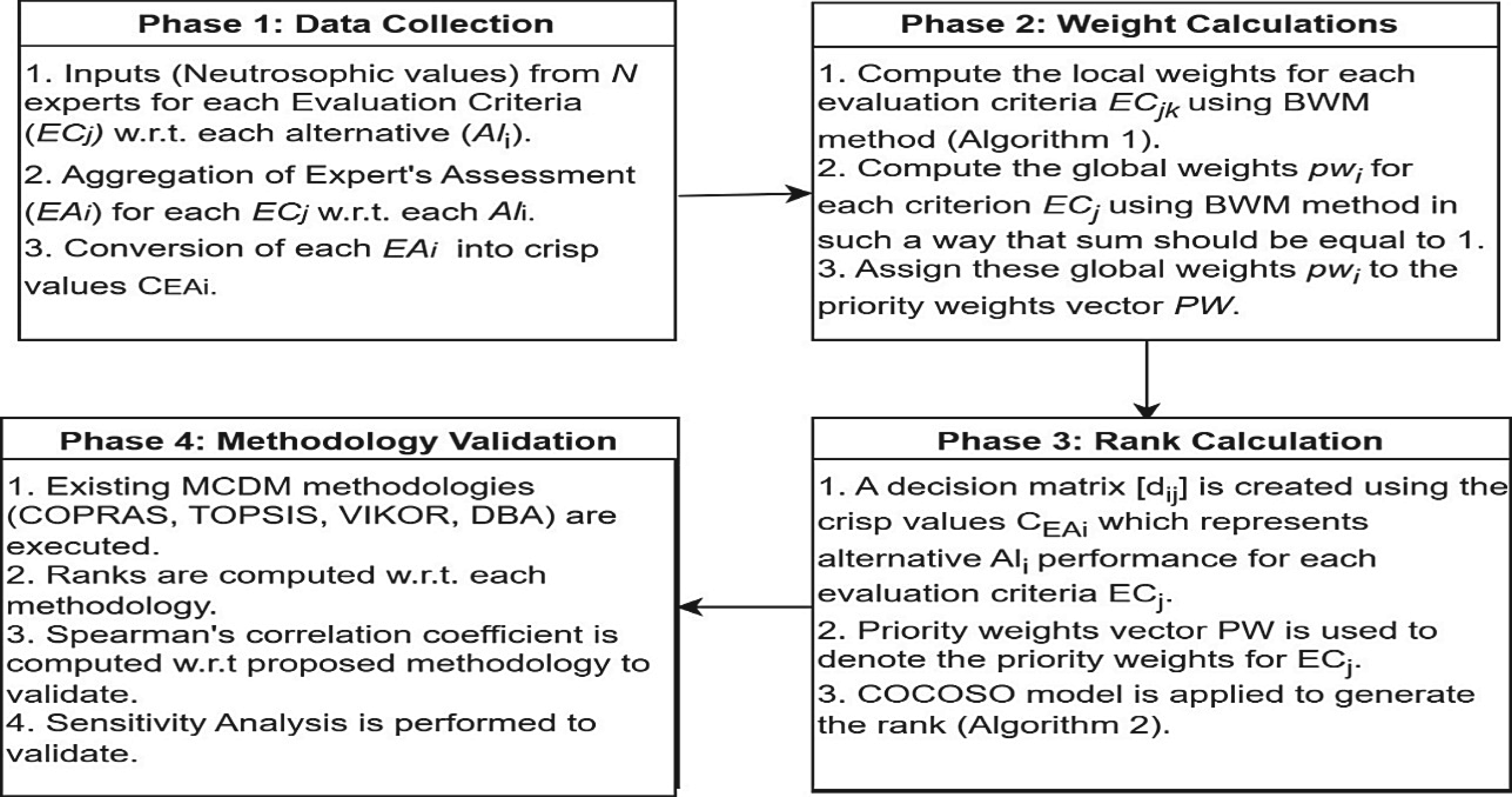
Simulation phases of the proposed NB-COCOSO.
4.1 Phase 1: Data collection
Phase 1 is simulated in four steps as shown in Figure 2.
Step 1: This study identified the evaluation criteria to ensure a comprehensive evaluation of these IDS tools across various functional domains. The four criteria (EC1, EC2, EC3 and EC4) - Categories (open source/closed source/freeware), Log source locations (host log files, application log files, network packets, sensor alerts), Targets (network, application, host), Monitored system(NIDS, HIDS, hybrid)-are aligned with classifications used in state-of-the-art,29,42,43 strategies from NIST,44,45 insights from cyber experts. These criteria consider not only the technical abilities but also the real-time deployment deliberations industries face while selecting an IDS.
A total of N= 40 experts were selected as per their professional backgrounds and domain knowledge, with expertise in security, MCDM techniques, or IDS tool deployment. The process of expert selection considered both academic qualifications and practical knowledge, ensuring that the committee included individuals with at least 15 years of research/industry experience, related publications, or involvement in IDS software development projects. Think Tank meetings were conducted to finalize the evaluation criteria so that the optimal selection of the IDS software tool can be conducted. Figure 3 illustrates the hierarchical structure of the evaluation of IDS tools used in this study. This section discusses the significance and meaning of each criterion and sub criteria in detail.
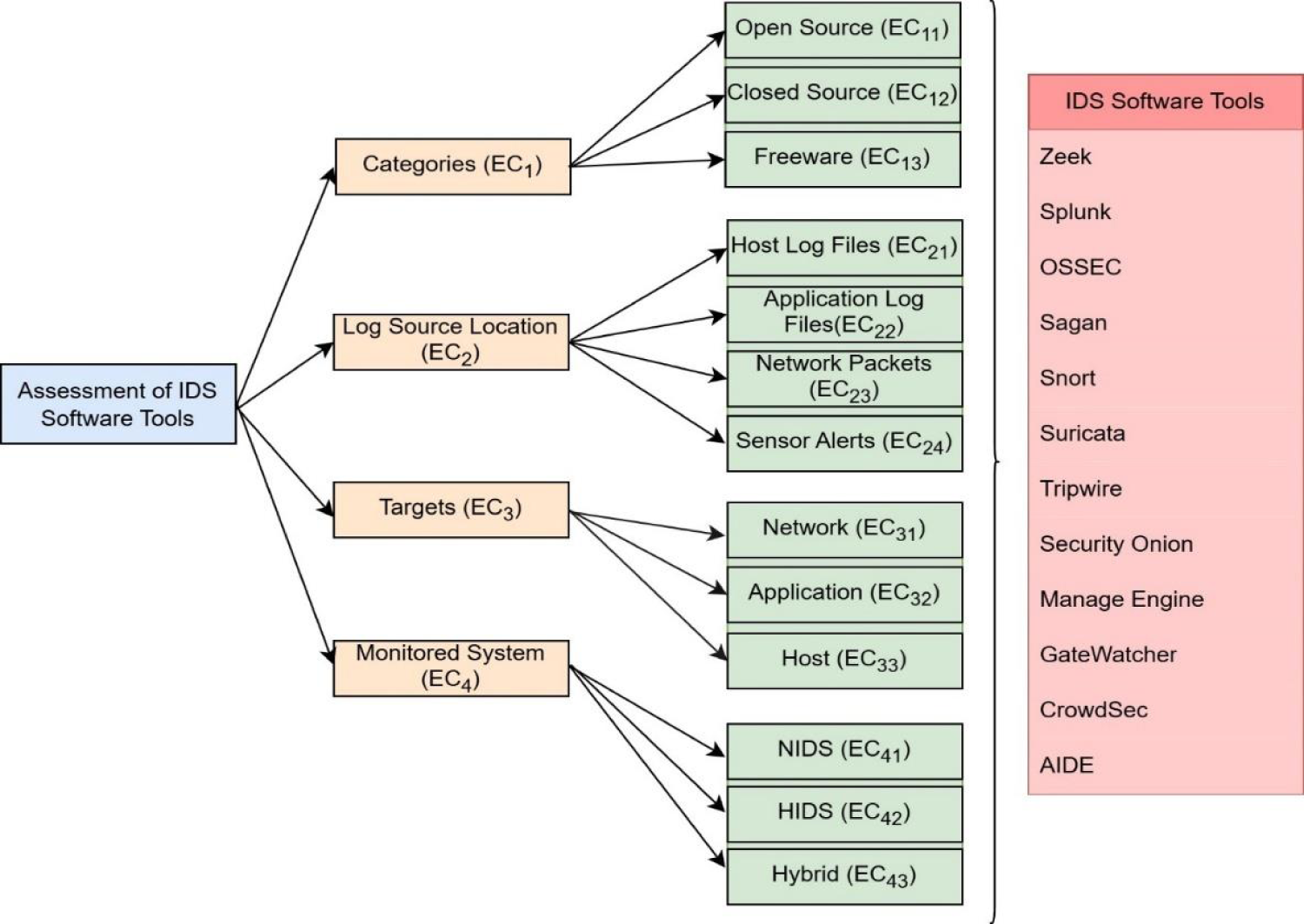
Alternatives and evaluation criteria used in simulation.
Categories (EC1): IDS software tools can be differentiated in terms of categories. They are either open source, closed source, or freeware. Open Source (EC11)- The tools for which the source code is publicly and freely available. The source code can be modified and distributed. Closed Source (EC12)-The tools for which the source code is not publicly and freely available. The code can be implemented and distributed by only specific vendors. Freeware (EC13)-The tools for which the software is freely available and can be distributed without any cost. However, the source code is not publicly available for modifications.
Log Source Location (EC2): It defines the points in a network from where data is gathered to detect intrusions. It plays a crucial role in monitoring and analysing traffic and other system activities. Host Log Files (EC21)- These files capture information about the activities and security events happening on a particular host. Application Log Files (EC22)- These files capture events, user activities, transactions, and errors. Network Packets (EC23)- These are the raw data transferred across a network, which operate as a primary source for causing network traffic logs. Sensor Alerts (EC24)- These are the records generated by sensors or monitoring devices installed across a network. These sensors continuously monitor traffic for detecting suspicious and malicious activity and generating alerts.
Targets (EC3): They signify those entities that IDS monitors for anomalies and malicious activities. It can be categorized into 3 categories: Network (EC31): It includes the traffic and devices that are on the network. Application (EC32): It focus on observing applications for their transactions, and data flows. Host (EC33): It refers to the individual devices or servers that are being monitored for malicious activities.
Monitored Systems (EC4): It specifies the infrastructure, entity, or environment that IDS monitors to detect malicious activities or threats. These systems can be classified according to the kind of IDS deployed. NIDS (EC41): It monitors traffic throughout the network or a segment of the network to identify threats that try to exploit vulnerabilities during communication over the network. HIDS (EC42): It monitors an individual host for malicious activities. These activities can be in system logs, files, applications, etc., which can change the behaviour of the host. Hybrid (EC43): It combines host and network-based monitoring to link data from several sources. It can improve the detection accuracy.
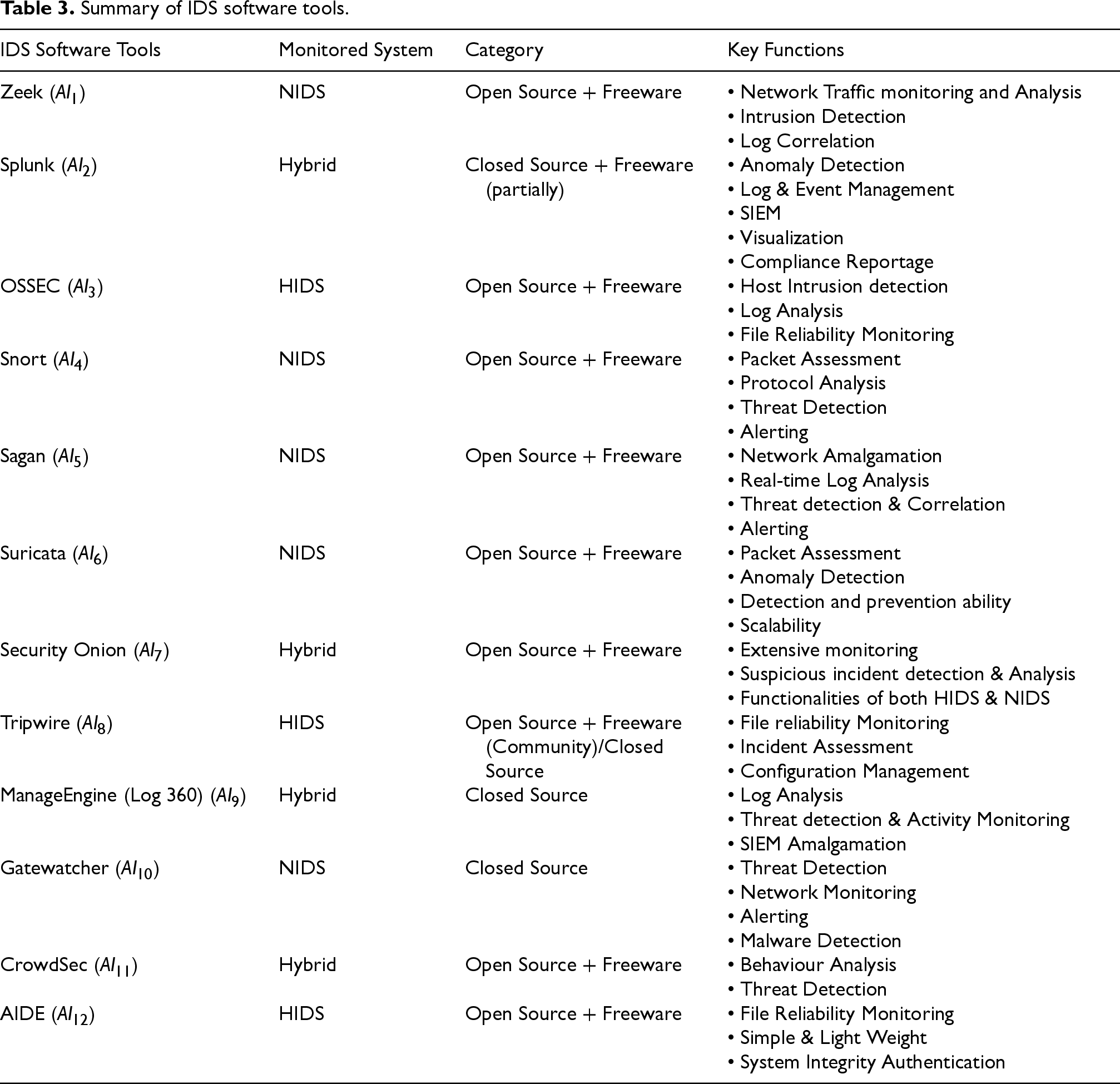
The 12 IDS software tools (Zeek, Splunk, OSSEC, Snort, Sagan, Suricata, Security Onion, Tripwire, ManageEngine Log360, Gatewatcher, CrowdSec, and AIDE)/ alternatives (Al1, Al2…Al12) were selected to signify an extensive scope of IDS technologies that are aligned with both academia and industry. Thereafter, consistency checks are applied to the data obtained from the experts by conducting the pairwise comparison to identify contradictions or biases in the responses of the experts. Statistical measures, such as Spearman's rank correlation, are used to determine the degree of concordance among the experts, wherever required. Table 3 summarizes the key functionalities of each of these software tools suggested by the experts for this study.29,46
Summary of IDS software tools.
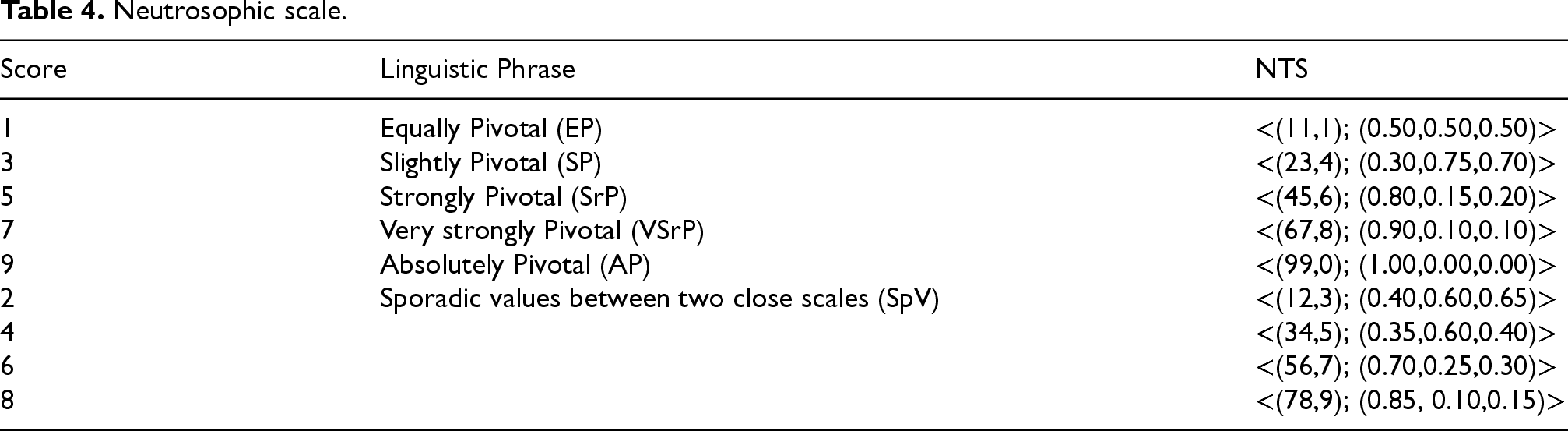
Step 2: Experts are advised to give judgments using linguistic scale such as equally pivotal, slightly pivotal etc., which were represented using the Neutrosophic scale 47 (refer to section 3.1) as mentioned in Table 4.
Neutrosophic scale.
The integration of NFS in the framework provides an intrinsic mechanism to capture uncertainty, indeterminacy, and hesitation in expert ratings, which increases overall reliability. Use of NFS itself minimizes the impact of individual subjectivity.
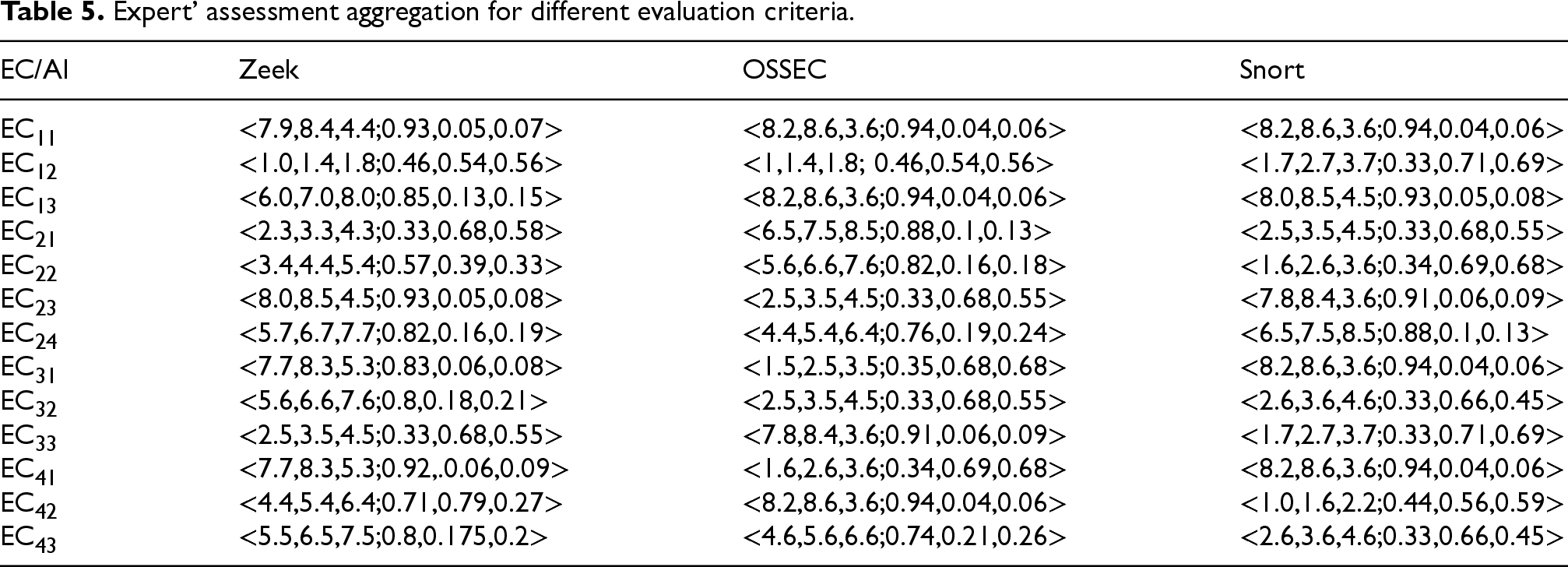
Step 3: Thereafter, the framework performed the Expert's assessment aggregation (EA) using a weighted arithmetic mean as given in equation (2) on the assessments provided by the experts. These aggregated values were corroborated by making comparisons across distinct subsets of experts. Higher correlation indicates robustness; however, deviations were further analysed. Due to the space limitation, EA values for only 3 IDS tools are mentioned in Table 5.
Expert’ assessment aggregation for different evaluation criteria.
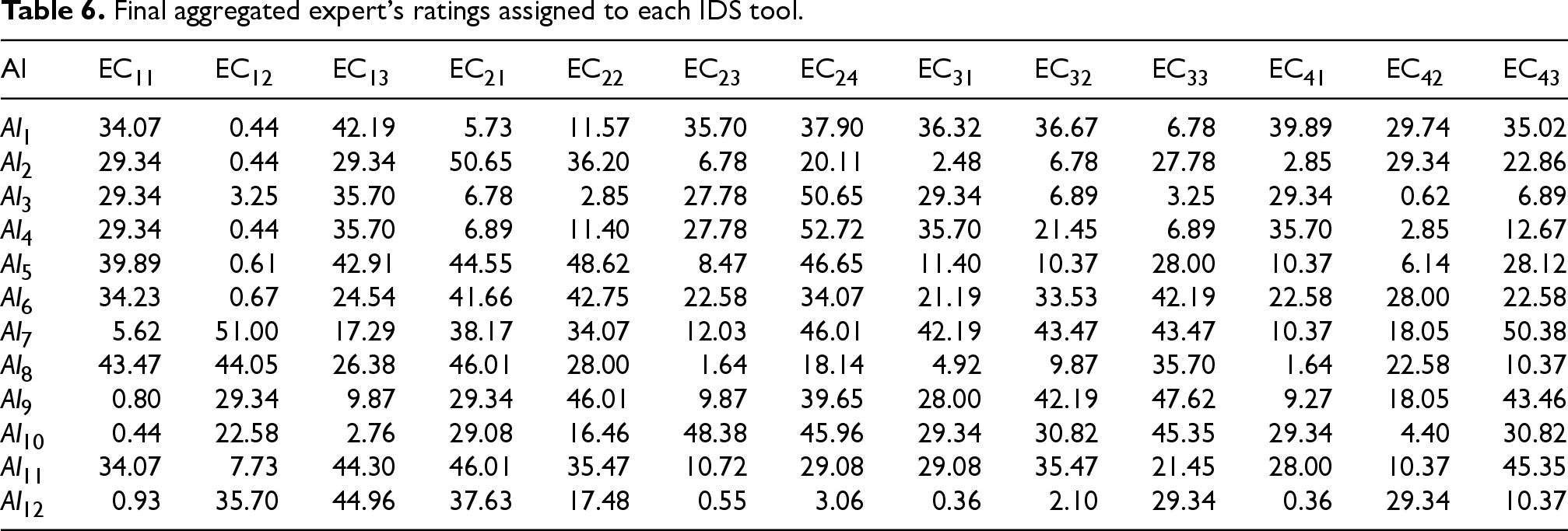
Step 4: These aggregated Neutrosophic values EA were subsequently converted into crisp values (CEA) using equation (3). These are the final values that are used to make the decisions to assess the IDS software tools and used as final decision matrix for the COCOSO approach. These final experts’ ratings are mentioned in Table 6. Finally, the dataset includes 12 IDS tools evaluated against 13 predefined criteria as mentioned in Figure 3.
Final aggregated expert's ratings assigned to each IDS tool.
4.2 Phase 2: Weight calculation
For each evaluation criterion, both local and global weights are calculated using the BWM method discussed under Algorithm 1. This study first discusses the steps for computing weights at the main criteria level, i.e., for EC1 to EC4. Best and worst criteria were selected as 

Afterwards, the problem was formulated as an optimization problem to generate weights for each evaluation criterion, and the vector PW was initialized as below:

Consistency conditions were checked for the generated weights. The pair-wise comparison consistency level is acceptable with a value of 0.1667 and an associated threshold value of 0.2681. Likewise, the local weights were computed for all sub-categories as mentioned under phase 2.




Global weights are computed for each evaluation criterion, and the optimal weight vector PW is updated accordingly. The weights of vector PW satisfied the criteria 
4.3 Phase 3: Rank calculation
In phase 3, ranks were calculated for each IDS tool 
Here, n is the number of IDS software tools 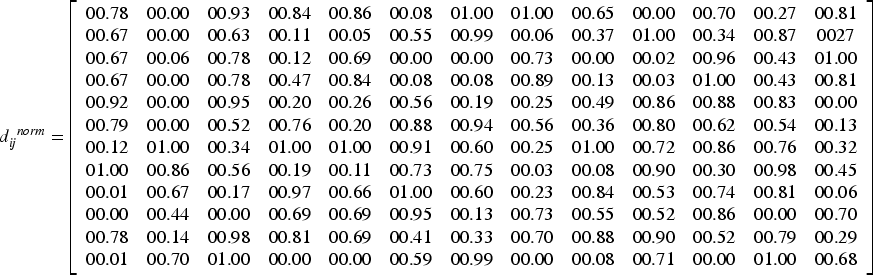
In the next step, the weighted normalized matrix 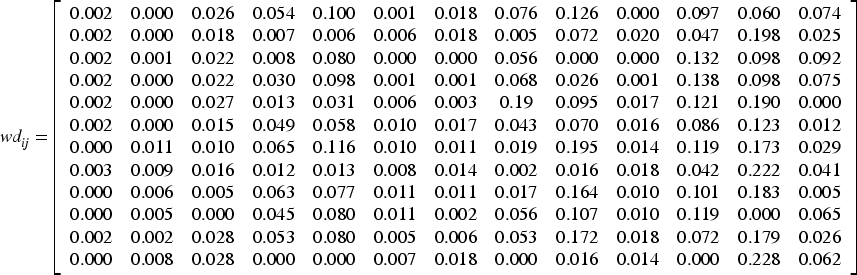
After that 
Aggregated scores.
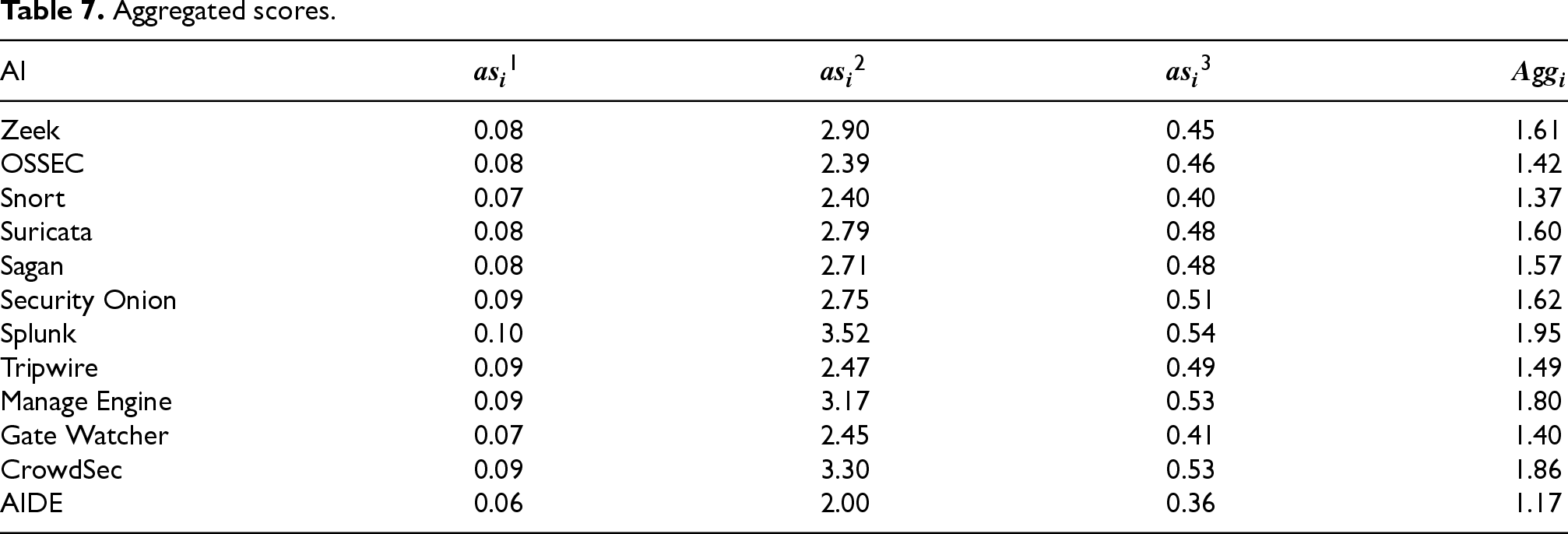
The alternative/Al with the highest
4.4 Phase 4: Methodology validation
Ensure a more comprehensive validation, the proposed framework has been benchmarked in comparison with multiple widely recognised MCDM techniques that are employed in state-of-the-art for IDS evaluation, including TOPSIS, DBA, VIKOR, and COPRAS. These models were selected because they signify diverse decision-making strategies and have well recognized and validated in existing IDS assessment literature. For quantitative validation, this study conducted a comparative performance analysis among all considered methods using the same dataset and evaluation criteria. The results prove that the proposed NB-COCOSO framework ensures more consistent rankings and lower susceptibility to data normalization when compared with traditional methods. Table 8 presents the ranking details of each of the MCDM approaches.
Rank comparison among state-of-the-art methodologies.
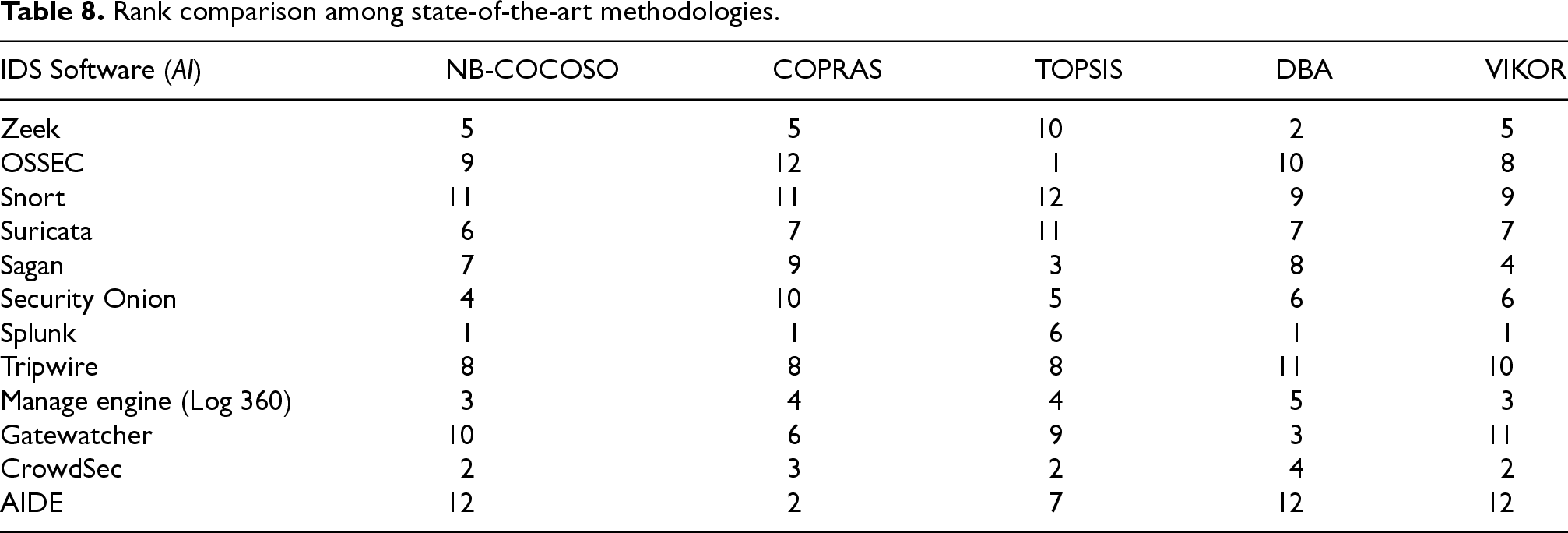
To further validate consistency and reliability, this study conducted a Spearman's rank correlation test among the rankings generated by NB-COCOSO and those obtained from other MCDM techniques. This is an important test to validate results and to ensure the strength of the decision-making process. The Spearman's rank correlation coefficient is computed as given in equation (7).

Here,
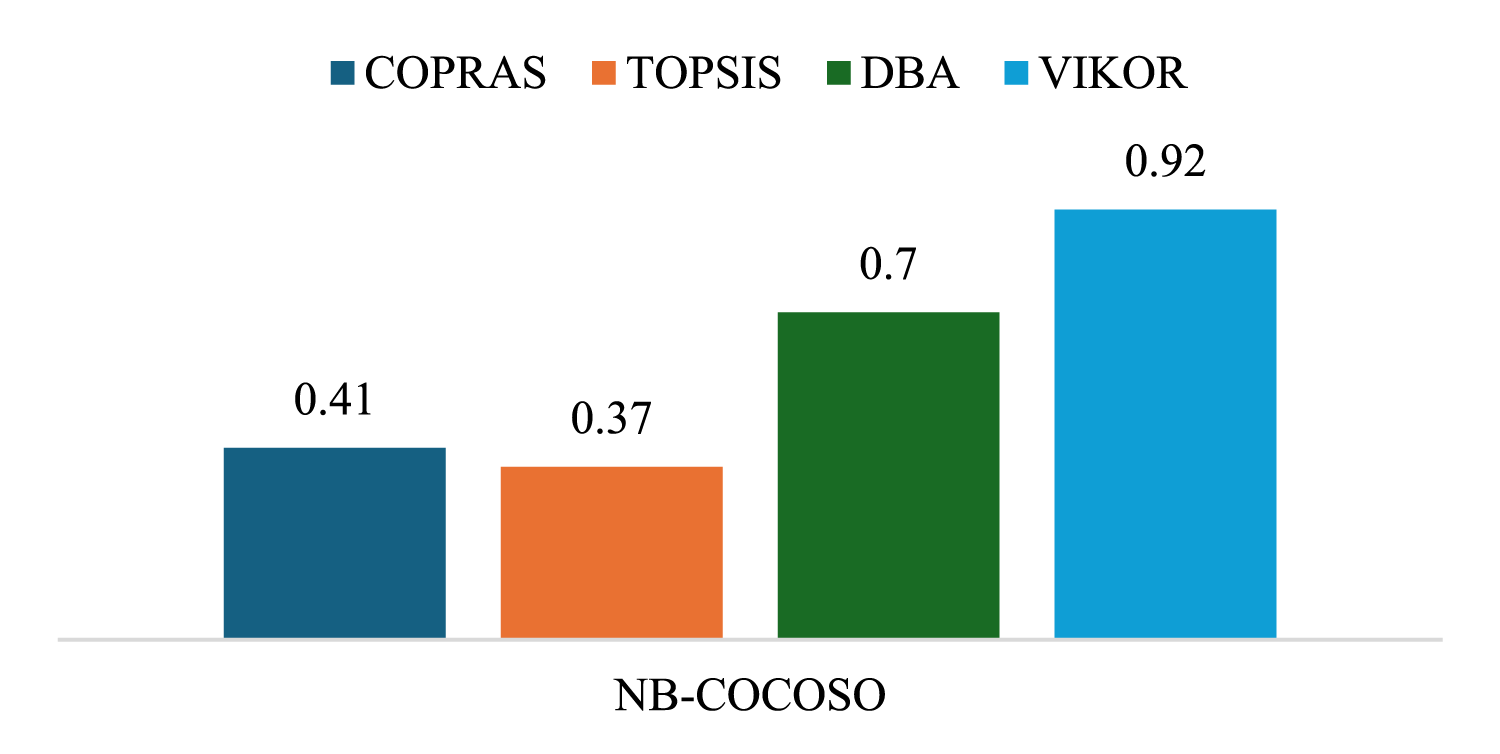
Spearman's rank correlation coefficient values.
Further, to strengthen the research findings, this study also performed a sensitivity analysis to check the impact of weights and evaluation criteria on the ranking.
4.4.1 Sensitivity analysis for weight parameters
Sensitivity analysis was performed for the proposed NB-COCOSO framework by excluding the weights derived using BWM, instead assigning equal importance to all evaluation criteria, i.e., considering each weight as 1. This analysis facilitates observing the robustness of the framework by identifying whether the final ranking of IDS tools is impacted by the expert-assigned weight or remains consistent even with identical weights across criteria. Such a comparison provides a more comprehensive insight into the stability of the decision-making process and validates that the proposed framework does not excessively depend on weight variations, thus improving its reliability and real-world applicability. The comparison results are shown in Figure 5. To further strengthen the results, Spearman's correlation coefficient test was conducted between the ranking of BWM-based weights and equal weights.
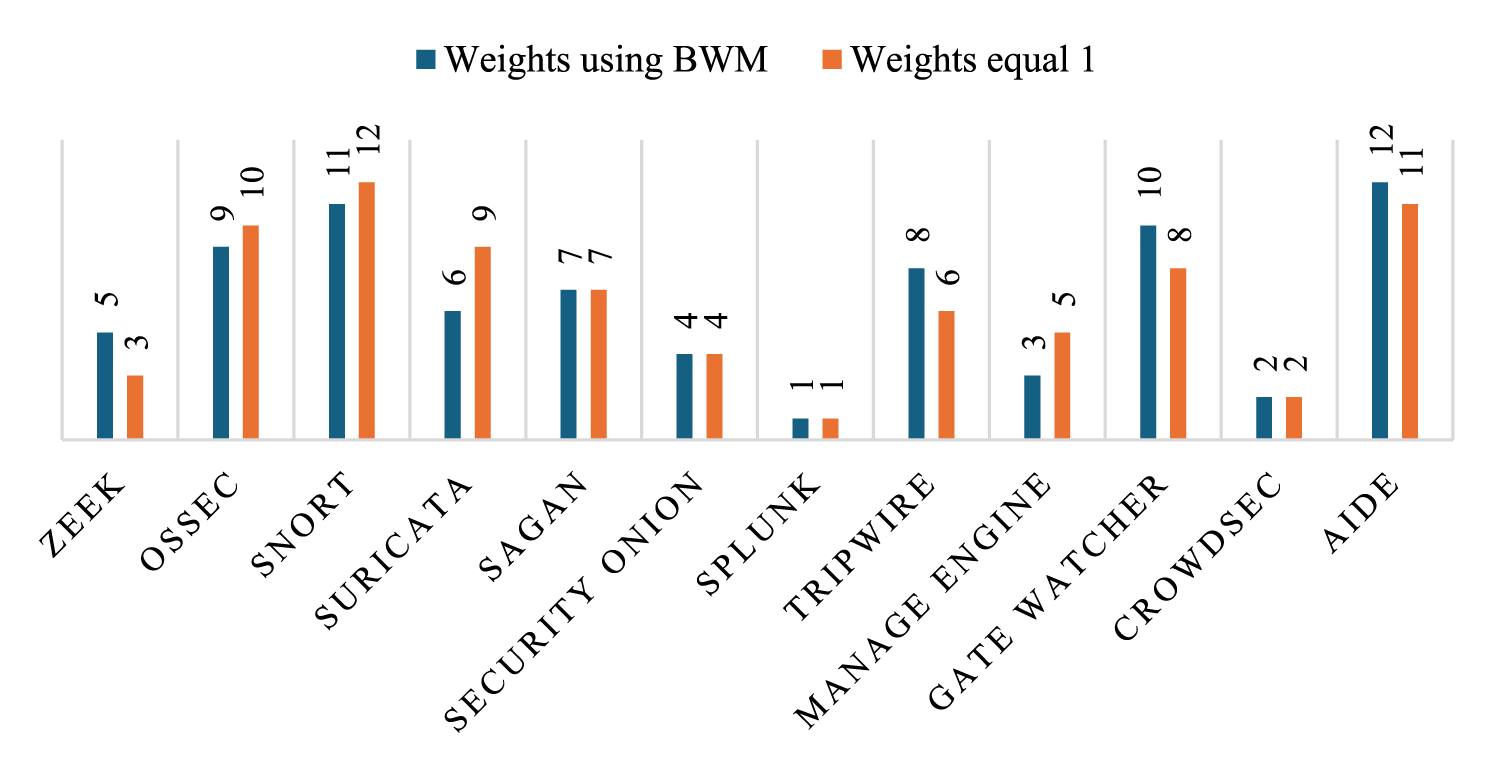
Sensitivity analysis for parameter ‘weight’.
4.4.2 Sensitivity analysis for evaluation criteria
The sensitivity analysis was augmented to examine the impact of each evaluation criterion (EC1, EC2, EC3, EC4) on the ranking of IDS software tools by systematically removing them one at a time. Starting with the elimination of EC1, the rankings were recalculated, followed by the exclusion of EC2, and so on until all evaluation criteria had assessed independently. The comparison results of ranking for each case are illustrated in Figure 6.
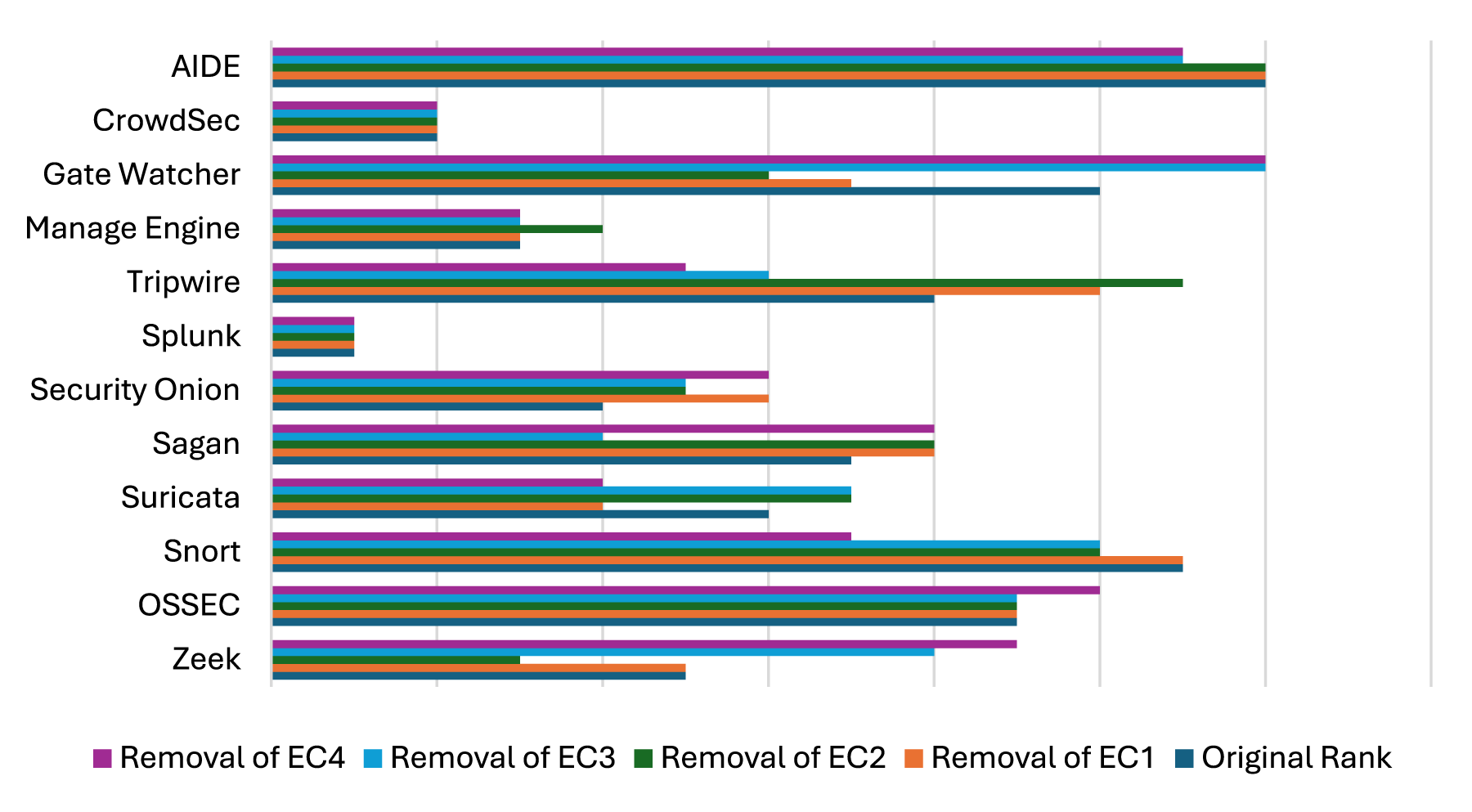
Sensitivity analysis for evaluation criteria.
The Spearman's rank correlation coefficient test was conducted across all cases with the original ranking, considering all evaluation criteria. Coefficient values are mentioned in Table 9.
Results of Spearman's correlation test.

5 Results and discussions
Hybrid MCDM was used for the evaluation of IDS software tools based on an integration of Neutrosophic BWM and COCOSO to effectively manage uncertainty as well as the subjectivity arising from weighting and ranking. The proposed NB-COCOSO framework efficiently deals with the uncertainty and subjective judgments of experts during the ranking process. The BWM approach was implemented to derive the weights for the evaluation criteria to improve the consistency, accuracy, and reliability. Subsequently, the COCOSO approach aggregated the scores for evaluation criteria and generated the final ranking of IDS software tools.
5.1 Selection of IDS software tools
The present research considered the 12 different well-known IDS Software tools used by organizations. In state-of-the-art research, no research study considered all these well-known IDS Tools collectively. Many of these tools are not even considered in the state-of-the-art (refer to Table 1).
5.2 Analysis of evaluation criteria weights determination using BWM
The initial phase of the analysis included expert opinions to prioritize evaluation criteria. Section 4.2 presents the computed local and optimal weights for each evaluation criterion. The evaluation criterion 'Hybrid' has the highest weight as 0.195, and 'open source' has the lowest weight as 0.0026 among 13 evaluation criteria. The pairwise comparison consistency ratio (0.1667) for all evaluation criteria is acceptable, which is below the threshold value of 0.2681. Consistency ratio for all sub-categorized evaluation criteria is also acceptable (EC1–0.12, EC2–0.16, EC3–0.07, EC4–0.125), which signifies the reliable weight calculation.
5.3 Analysis of the ranking of IDS software tools using COCOSO
After the determination of evaluation criteria weights, these 12 IDS tools were evaluated and ranked through the COCOSO method. Table 7 depicts the different scores over the evaluation criteria and the final aggregated compromise scores, which provide the final ranking. The ranks illustrated in Table 8 depict that the IDS software tool ‘Splunk’ is at the top rank with the maximum aggregated score as 1.95, and ‘AIDE’ at the last with the minimum score as 1.17. The IDS tool ‘Crowdsec’ got the second position, followed by ‘Manage Engine’ at the third position. The tools ‘Snort’, ‘Suricata’, and ‘Security Onion’ got the 11th, 6th, and 4th rank with the aggregated score values 1.37, 1.60, and 1.62, respectively.
5.4 Analysis of Spearman's correlation test
This study implemented Spearman's correlation test to validate the proposed methodology with the other state-of-the-art methodologies. As discussed in section 4.4, this value must satisfy
5.4 Analysis of sensitivity analysis
To comprehensively evaluate the consistency of the proposed NB-COCOSO framework, a two-fold sensitivity analysis was conducted by varying the weight of evaluation criteria and systematically removing evaluation criteria.
5.1.1 Sensitivity for parameter weight
From Figure 5, it can be analysed that the rankings attained with equal weights (initialising PW vector with 1) are majorly consistent with those obtained from the BWM. IDS tools ‘Splunk’ and ‘CrowdSec’ attained the same first and second rank in both scenarios. However, minor deviations are observed in specific positions, such as a swap between the rankings of ‘Manage Engine’ and ‘Zeek.’ This analysis demonstrates that the proposed framework is relatively stable, as the overall ranking of tools remains largely unaffected by changes in the weighting approach. The minor differences depict the influence of expert-assigned weights in fine-tuning the ranking.
The Spearman's rank correlation coefficient between the BWM-based ranking and the equal-weight ranking was observed as ρ = 0.9, which confirms the robustness and reliability of the overall ranking of IDS tools.
5.5.2 Sensitivity for evaluation criteria
Sensitivity analysis is extended to verify the impact of sequential removal of evaluation criteria on the ranking results of NB-COCOSO. The results in Figure 6 demonstrates that the overall ranking is majorly stable with the proposed framework in most cases. However, few positional changes are observed for IDS tools when the evaluation criteria are removed. Like, ‘Tripwire’ was originally at the 8th position by NB-COCOSO. However, after removing the EC1, the tool is at the 10th rank. The tool has 11th, 6th, and 5th rank after removing criteria EC2, EC3, and EC4, respectively. The results depict that the NB-COCOSO framework is majorly stable and not excessively dependent on any single evaluation criterion. However, in some cases, the greater variations are observed in the absence of certain evaluation criteria, indicating their stronger distinguishing influence in fine-tuning the ranking of IDS software tools.
This consistency, further validated by high Spearman's rank correlation values mentioned in Table 9 for all cases, emphasizes that the NB-COCOSO framework is stable and not excessively dependent on any single criterion.
5.5 Discussion
The results emphasize the superiority of the IDS software tool Splunk over other IDS software tools in terms of overall performance. The BWM efficiently acquired weights for evaluation criteria, generating more realistic weight distributions. The Neutrosophic approach captured expert hesitation and uncertainty while rating the IDS software tools concerning evaluation criteria, yielding more genuine ratings among IDS tools. Meanwhile, the COCOSO method assisted a comprehensive aggregation of evaluation criteria, balancing conflicting goals.
Spearman's correlation ranking test depicts the positive relationship between the NB-COCOSO and other state-of-the-art techniques, which proves the strength of the proposed framework.
The sensitivity analysis further emphasized the reliability of the proposed integrated framework NB-COCOSO, by demonstrating the ranking results concerning the dependency on the weight parameter and the dependency on the evaluation criteria. This validates the feasibility of the proposed framework for selecting optimal IDS software tools in uncertain environments.
In conclusion, the integrated NB-COCOSO model proves to be a robust decision-support system for evaluating IDS software tools. It helps organizations in selecting the optimal solution for enhanced cybersecurity.
6 Conclusion and future work
This study aimed to identify the optimal IDS software tool among twelve different IDS tools using an integrated decision-making framework called NB-COCOSO. It combines Neutrosophic, Best Worst Method, and COCOSO MCDM approach. The BWM was utilized to determine the comparative importance of evaluation criteria, while Neutrosophic was used to manage the uncertainty among the experts’ opinions, and the COCOSO method was employed to provide a rank to the IDS software tools as per their performance. Validate the robustness and strength of the proposed integrated methodology, Spearman's correlation ranking test was applied to different state-of-the-art methods. The positive correlation coefficient value confirmed a strong correlation between the proposed methodology and the state-of-the-art methods, which demonstrates the consistency and reliability of the proposed approach. Furthermore, two types of sensitivity analysis were conducted to inspect the impact of evaluation criterion weights and to examine the impact of types of evaluation criteria on the final ranking results, which proved the stability of the proposed decision-making framework.
The results of this study give valuable insights for cybersecurity professionals in selecting the most effective and efficient IDS software tool based on multiple evaluation criteria. Future work can extend this integrated approach by incorporating other evaluation criteria and by exploring other MCDM approaches. It can be extended by validating the framework using benchmark IDS datasets (e.g., NSL-KDD, CICIDS2017, UNSW-NB15) to access the model's effectiveness.
Footnotes

Ethical approval and informed consent statements
Ethical approval was not required for this study, as it did not involve human participants, animal subjects, or sensitive data.
Consent to participate
not applicable
Consent for publication
not applicable
Funding
The author received no financial support for the research, authorship, and/or publication of this article.
Declaration of conflicting interests
The author declared no potential conflicts of interest with respect to the research, authorship, and/or publication of this article.
Data availability statement
The data that support the findings of this study are available from the corresponding author upon reasonable request.